+


    by Jose Luis
         Cristian
+
                  Introduction

    Social networks are social structures composed of
    people, which are connected by one or more types of
    relationships such as friendship, kinship, common
    interests or shared knowledge.
+
    History

    Early social networking on the World Wide Web began in the
    form of generalized online communities.


    In 2003 social networks became popular with the invention of
    sites like Friendster, MySpace, Xing and LinkedIn.
+
                                          History

    Attesting to the rapid increase in social networking
    sites popularity, by 2005, it was reported that
    MySpace was getting more page views than Google.


    Facebook launched in 2004, became the largest
    social networking site in the world in early 2009, and
    remains largest of all social networks.
+
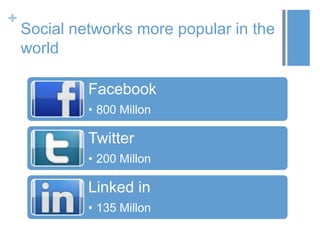
    Social networks more popular in the
    world

             Facebook
             • 800 Millon

             Twitter
             • 200 Millon

             Linked in
             • 135 Millon
+
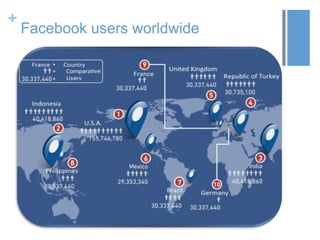
    Facebook users worldwide
+
    Advantages
    The best advantage of social networking sites is that these sites
    allow you to keep in touch with your friends, classmates, and
    relatives.

    These sites allow you to send and receive messages, upload
    photos, and videos.

    With social networking sites, you are not bound by any geographical
    and cultural differences. You get to meet and know a variety of
    people whose interests are similar to your own.

    You can build a network of contacts and interact with a lot of people
    at the same time. As such, you can spread your thoughts and
    interests to a large number of people.
+
                                         Disadvantages

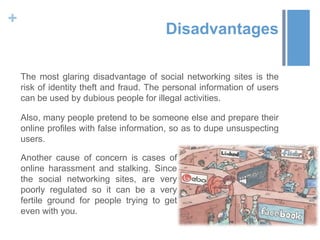
    The most glaring disadvantage of social networking sites is the
    risk of identity theft and fraud. The personal information of users
    can be used by dubious people for illegal activities.

    Also, many people pretend to be someone else and prepare their
    online profiles with false information, so as to dupe unsuspecting
    users.

    Another cause of concern is cases of
    online harassment and stalking. Since
    the social networking sites, are very
    poorly regulated so it can be a very
    fertile ground for people trying to get
    even with you.
+
    Addiction to social networks

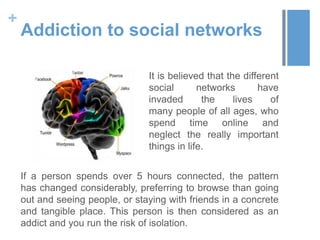
                                 It is believed that the different
                                 social       networks       have
                                 invaded       the     lives    of
                                 many people of all ages, who
                                 spend time online and
                                 neglect the really important
                                 things in life.


    If a person spends over 5 hours connected, the pattern
    has changed considerably, preferring to browse than going
    out and seeing people, or staying with friends in a concrete
    and tangible place. This person is then considered as an
    addict and you run the risk of isolation.
+
       Are you a Facebook addict?

Psychologists are now probing a new kind of addiction called
Facebook Addiction Disorder (FAD).

According to a clinical psychologist at the University of California, Los
Angeles here are some signs that you are addicted to Facebook:

1. You lose sleep over Facebook

2. You spend more than an hour a day on Facebook.

3. You become obsessed with old loves or exes you reconnect
with on Facebook.

4. You ignore work in favor of Facebook.

5. The thought of getting off Facebook leaves you in cold sweat.
+
                 Conclusions


    Social    networks    are    here     to    facilitate
    communication between the company, enrich
    our communication cultures around the world and
    likewise eliminate the long distances between
    family or acquaintances. Making good use of social
    networks, we won’t reach the great problem
    of dependence on social networks which exists today.

Social networks

  • 1.
    + by Jose Luis Cristian
  • 2.
    + Introduction Social networks are social structures composed of people, which are connected by one or more types of relationships such as friendship, kinship, common interests or shared knowledge.
  • 3.
    + History Early social networking on the World Wide Web began in the form of generalized online communities. In 2003 social networks became popular with the invention of sites like Friendster, MySpace, Xing and LinkedIn.
  • 4.
    + History Attesting to the rapid increase in social networking sites popularity, by 2005, it was reported that MySpace was getting more page views than Google. Facebook launched in 2004, became the largest social networking site in the world in early 2009, and remains largest of all social networks.
  • 5.
    + Social networks more popular in the world Facebook • 800 Millon Twitter • 200 Millon Linked in • 135 Millon
  • 6.
    + Facebook users worldwide
  • 7.
    + Advantages The best advantage of social networking sites is that these sites allow you to keep in touch with your friends, classmates, and relatives. These sites allow you to send and receive messages, upload photos, and videos. With social networking sites, you are not bound by any geographical and cultural differences. You get to meet and know a variety of people whose interests are similar to your own. You can build a network of contacts and interact with a lot of people at the same time. As such, you can spread your thoughts and interests to a large number of people.
  • 8.
    + Disadvantages The most glaring disadvantage of social networking sites is the risk of identity theft and fraud. The personal information of users can be used by dubious people for illegal activities. Also, many people pretend to be someone else and prepare their online profiles with false information, so as to dupe unsuspecting users. Another cause of concern is cases of online harassment and stalking. Since the social networking sites, are very poorly regulated so it can be a very fertile ground for people trying to get even with you.
  • 9.
    + Addiction to social networks It is believed that the different social networks have invaded the lives of many people of all ages, who spend time online and neglect the really important things in life. If a person spends over 5 hours connected, the pattern has changed considerably, preferring to browse than going out and seeing people, or staying with friends in a concrete and tangible place. This person is then considered as an addict and you run the risk of isolation.
  • 10.
    + Are you a Facebook addict? Psychologists are now probing a new kind of addiction called Facebook Addiction Disorder (FAD). According to a clinical psychologist at the University of California, Los Angeles here are some signs that you are addicted to Facebook: 1. You lose sleep over Facebook 2. You spend more than an hour a day on Facebook. 3. You become obsessed with old loves or exes you reconnect with on Facebook. 4. You ignore work in favor of Facebook. 5. The thought of getting off Facebook leaves you in cold sweat.
  • 11.
    + Conclusions Social networks are here to facilitate communication between the company, enrich our communication cultures around the world and likewise eliminate the long distances between family or acquaintances. Making good use of social networks, we won’t reach the great problem of dependence on social networks which exists today.