Questioning Skills
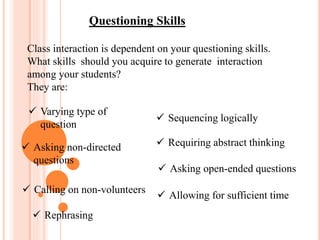
Class interaction is dependent on your questioning skills.
What skills should you acquire to generate interaction
among your students?
They are:
 Varying type of
question
 Asking non-directed
questions
 Calling on non-volunteers
 Rephrasing
 Sequencing logically
 Requiring abstract thinking
 Asking open-ended questions
 Allowing for sufficient time
Varying type of question- Ask
convergent, divergent and evaluate
questions. Convergent question have only
one acceptable correct answer.
Asking non directed question-
pose the question first, then call on
a student to answer. Don’t direct
your question to just one student.
Direct question to all.
Calling on non-volunteers- Don’t
just call on those who raise their
hands.
Rephrasing- if you sense a question was not
understood, simplify it, or ask it in another way.
Sequencing logically- it is asking
related questions one from simple
to complex one after another.
Requiring abstract thinking- This
means going beyond simple recall
questions.
Asking open-ended questions-
this means asking divergent
questions to develop to their higher
order thinking skills.
Allowing for sufficient time- wait time refers to
the pause needed by the teacher after asking a
question. This is the time when she waits for an
answer. A number of things to consider are:
A. The level of difficulty of the questions
B. The background knowledge of the respondents
C. The intellectual ability of the respondents
Provided sufficient time can achieve
the follwing:
Motivate slow thinking students to respond.
Improves the quality of the responses made.
Decreases the amount of guessing or wrong inferences.
Increase the number of the correct responses.
Leads the teacher to vary her teachers to evaluate the
answers given.
Encourage the students to ask their own questions.
Give students enough time to think about the answer.
Assessing comprehension- ask the
question to test comprehension. Now
and then find out if your students are
with you.
Involving as many as possible- Distribute
your questions to as many students. Widen
participation. Don’t just call on students who
raise their hands. By their facial expression,
you can sense who among your students
would like to recite.
How to Improve Questioning Technique:
The following are some points to consider
improving one’s questioning technique.
1. Know your own style of questioning
2. Request a colleague to critique your own style as to:
a. kind of questions often asked,
b. amount of wait time provided and
c. the type of responses required.
d. Knowing your errors in questioning would make it easy to
effect the necessary changes
Too many “what” questions will be avoided.
3. Increase your own repertoire of type of questions. Training
in employing divergent, high level and open-ended questions
improves your questioning technique. Fully aware of the
instructional objectives set for a particular lesson, you would
be able to frame more interesting and thought would-
provoking questions rather than the memory type.
4. Consider the individual abilities and interests of
the students. Experiencing success in giving correct
answers promotes a feeling of confidence among
them. Select the brighter ones to respond to high
level questions. An approving nod, a smile or a
praise for an answer given will encourage them to
volunteer own ideas.
5. Spend time reflecting on the type of questions you
ask. Improve on them.
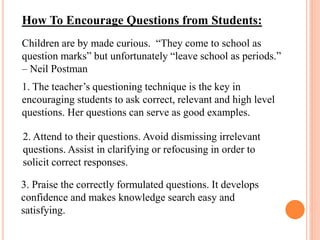
How To Encourage Questions from Students:
Children are by made curious. “They come to school as
question marks” but unfortunately “leave school as periods.”
– Neil Postman
1. The teacher’s questioning technique is the key in
encouraging students to ask correct, relevant and high level
questions. Her questions can serve as good examples.
2. Attend to their questions. Avoid dismissing irrelevant
questions. Assist in clarifying or refocusing in order to
solicit correct responses.
3. Praise the correctly formulated questions. It develops
confidence and makes knowledge search easy and
satisfying.
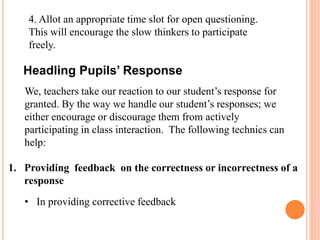
4. Allot an appropriate time slot for open questioning.
This will encourage the slow thinkers to participate
freely.
We, teachers take our reaction to our student’s response for
granted. By the way we handle our student’s responses; we
either encourage or discourage them from actively
participating in class interaction. The following technics can
help:
1. Providing feedback on the correctness or incorrectness of a
response
• In providing corrective feedback
Headling Pupils’ Response
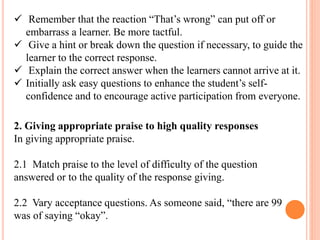
 Remember that the reaction “That’s wrong” can put off or
embarrass a learner. Be more tactful.
 Give a hint or break down the question if necessary, to guide the
learner to the correct response.
 Explain the correct answer when the learners cannot arrive at it.
 Initially ask easy questions to enhance the student’s self-
confidence and to encourage active participation from everyone.
2. Giving appropriate praise to high quality responses
In giving appropriate praise.
2.1 Match praise to the level of difficulty of the question
answered or to the quality of the response giving.
2.2 Vary acceptance questions. As someone said, “there are 99
was of saying “okay”.
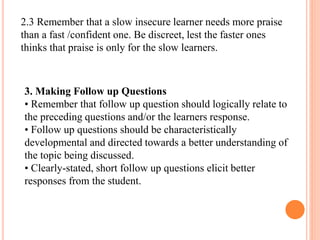
2.3 Remember that a slow insecure learner needs more praise
than a fast /confident one. Be discreet, lest the faster ones
thinks that praise is only for the slow learners.
3. Making Follow up Questions
• Remember that follow up question should logically relate to
the preceding questions and/or the learners response.
• Follow up questions should be characteristically
developmental and directed towards a better understanding of
the topic being discussed.
• Clearly-stated, short follow up questions elicit better
responses from the student.
4. Redirecting Questions
• Certain questions deserve to be answered by more than
one learner.
• Some students need a re-formulation of the question for
better understanding.
5. Following up a Student's response with related Questions
• Slowly repeating or replacing certain words in a question
may be the way to enable a student to give the correct
answer.
• On the order hand, other students may need to understand
better an accepted response to the question.
6. Rephrasing the seemingly unclear Question
• Rephrase unclear questions by using terms or
idioms familiar to the student.
• Avoid long and complicated sentence structures
in asking questions.
7. Showing Non-Verbal Encouragement
• Cultivate the habit of conveying positive meanings through
your body language. Body language, particularly a teacher’s
facial expression during recitation.
• Eye to eye contact, a smiling face and an encouraging hand
gesture remove fear of embarrassment from the students.
8. Encouraging Learners to ask Question
• Watch out for students who seem to have problems about certain
responses. Encourage them to bring out their questions.'
• Create a communication climate which encourages pupils to
provide additional information or give comments that can add to
understanding.
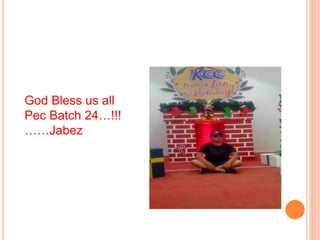
God Bless us all
Pec Batch 24…!!!
……Jabez

Presentation report

  • 1.
    Questioning Skills Class interactionis dependent on your questioning skills. What skills should you acquire to generate interaction among your students? They are:  Varying type of question  Asking non-directed questions  Calling on non-volunteers  Rephrasing  Sequencing logically  Requiring abstract thinking  Asking open-ended questions  Allowing for sufficient time
  • 2.
    Varying type ofquestion- Ask convergent, divergent and evaluate questions. Convergent question have only one acceptable correct answer. Asking non directed question- pose the question first, then call on a student to answer. Don’t direct your question to just one student. Direct question to all. Calling on non-volunteers- Don’t just call on those who raise their hands.
  • 3.
    Rephrasing- if yousense a question was not understood, simplify it, or ask it in another way. Sequencing logically- it is asking related questions one from simple to complex one after another. Requiring abstract thinking- This means going beyond simple recall questions. Asking open-ended questions- this means asking divergent questions to develop to their higher order thinking skills.
  • 4.
    Allowing for sufficienttime- wait time refers to the pause needed by the teacher after asking a question. This is the time when she waits for an answer. A number of things to consider are: A. The level of difficulty of the questions B. The background knowledge of the respondents C. The intellectual ability of the respondents
  • 5.
    Provided sufficient timecan achieve the follwing: Motivate slow thinking students to respond. Improves the quality of the responses made. Decreases the amount of guessing or wrong inferences. Increase the number of the correct responses. Leads the teacher to vary her teachers to evaluate the answers given. Encourage the students to ask their own questions. Give students enough time to think about the answer.
  • 6.
    Assessing comprehension- askthe question to test comprehension. Now and then find out if your students are with you. Involving as many as possible- Distribute your questions to as many students. Widen participation. Don’t just call on students who raise their hands. By their facial expression, you can sense who among your students would like to recite.
  • 7.
    How to ImproveQuestioning Technique: The following are some points to consider improving one’s questioning technique. 1. Know your own style of questioning 2. Request a colleague to critique your own style as to: a. kind of questions often asked, b. amount of wait time provided and c. the type of responses required. d. Knowing your errors in questioning would make it easy to effect the necessary changes Too many “what” questions will be avoided.
  • 8.
    3. Increase yourown repertoire of type of questions. Training in employing divergent, high level and open-ended questions improves your questioning technique. Fully aware of the instructional objectives set for a particular lesson, you would be able to frame more interesting and thought would- provoking questions rather than the memory type. 4. Consider the individual abilities and interests of the students. Experiencing success in giving correct answers promotes a feeling of confidence among them. Select the brighter ones to respond to high level questions. An approving nod, a smile or a praise for an answer given will encourage them to volunteer own ideas. 5. Spend time reflecting on the type of questions you ask. Improve on them.
  • 9.
    How To EncourageQuestions from Students: Children are by made curious. “They come to school as question marks” but unfortunately “leave school as periods.” – Neil Postman 1. The teacher’s questioning technique is the key in encouraging students to ask correct, relevant and high level questions. Her questions can serve as good examples. 2. Attend to their questions. Avoid dismissing irrelevant questions. Assist in clarifying or refocusing in order to solicit correct responses. 3. Praise the correctly formulated questions. It develops confidence and makes knowledge search easy and satisfying.
  • 10.
    4. Allot anappropriate time slot for open questioning. This will encourage the slow thinkers to participate freely. We, teachers take our reaction to our student’s response for granted. By the way we handle our student’s responses; we either encourage or discourage them from actively participating in class interaction. The following technics can help: 1. Providing feedback on the correctness or incorrectness of a response • In providing corrective feedback Headling Pupils’ Response
  • 11.
     Remember thatthe reaction “That’s wrong” can put off or embarrass a learner. Be more tactful.  Give a hint or break down the question if necessary, to guide the learner to the correct response.  Explain the correct answer when the learners cannot arrive at it.  Initially ask easy questions to enhance the student’s self- confidence and to encourage active participation from everyone. 2. Giving appropriate praise to high quality responses In giving appropriate praise. 2.1 Match praise to the level of difficulty of the question answered or to the quality of the response giving. 2.2 Vary acceptance questions. As someone said, “there are 99 was of saying “okay”.
  • 12.
    2.3 Remember thata slow insecure learner needs more praise than a fast /confident one. Be discreet, lest the faster ones thinks that praise is only for the slow learners. 3. Making Follow up Questions • Remember that follow up question should logically relate to the preceding questions and/or the learners response. • Follow up questions should be characteristically developmental and directed towards a better understanding of the topic being discussed. • Clearly-stated, short follow up questions elicit better responses from the student.
  • 13.
    4. Redirecting Questions •Certain questions deserve to be answered by more than one learner. • Some students need a re-formulation of the question for better understanding. 5. Following up a Student's response with related Questions • Slowly repeating or replacing certain words in a question may be the way to enable a student to give the correct answer. • On the order hand, other students may need to understand better an accepted response to the question.
  • 14.
    6. Rephrasing theseemingly unclear Question • Rephrase unclear questions by using terms or idioms familiar to the student. • Avoid long and complicated sentence structures in asking questions. 7. Showing Non-Verbal Encouragement • Cultivate the habit of conveying positive meanings through your body language. Body language, particularly a teacher’s facial expression during recitation. • Eye to eye contact, a smiling face and an encouraging hand gesture remove fear of embarrassment from the students.
  • 15.
    8. Encouraging Learnersto ask Question • Watch out for students who seem to have problems about certain responses. Encourage them to bring out their questions.' • Create a communication climate which encourages pupils to provide additional information or give comments that can add to understanding.
  • 16.
    God Bless usall Pec Batch 24…!!! ……Jabez