 
William J. Peters
Know Want to know Learn
Editing
Graphic
Organizers
Note -
taking
Partnering
Reflection
Word Wall
Summ
arize
Rubrics
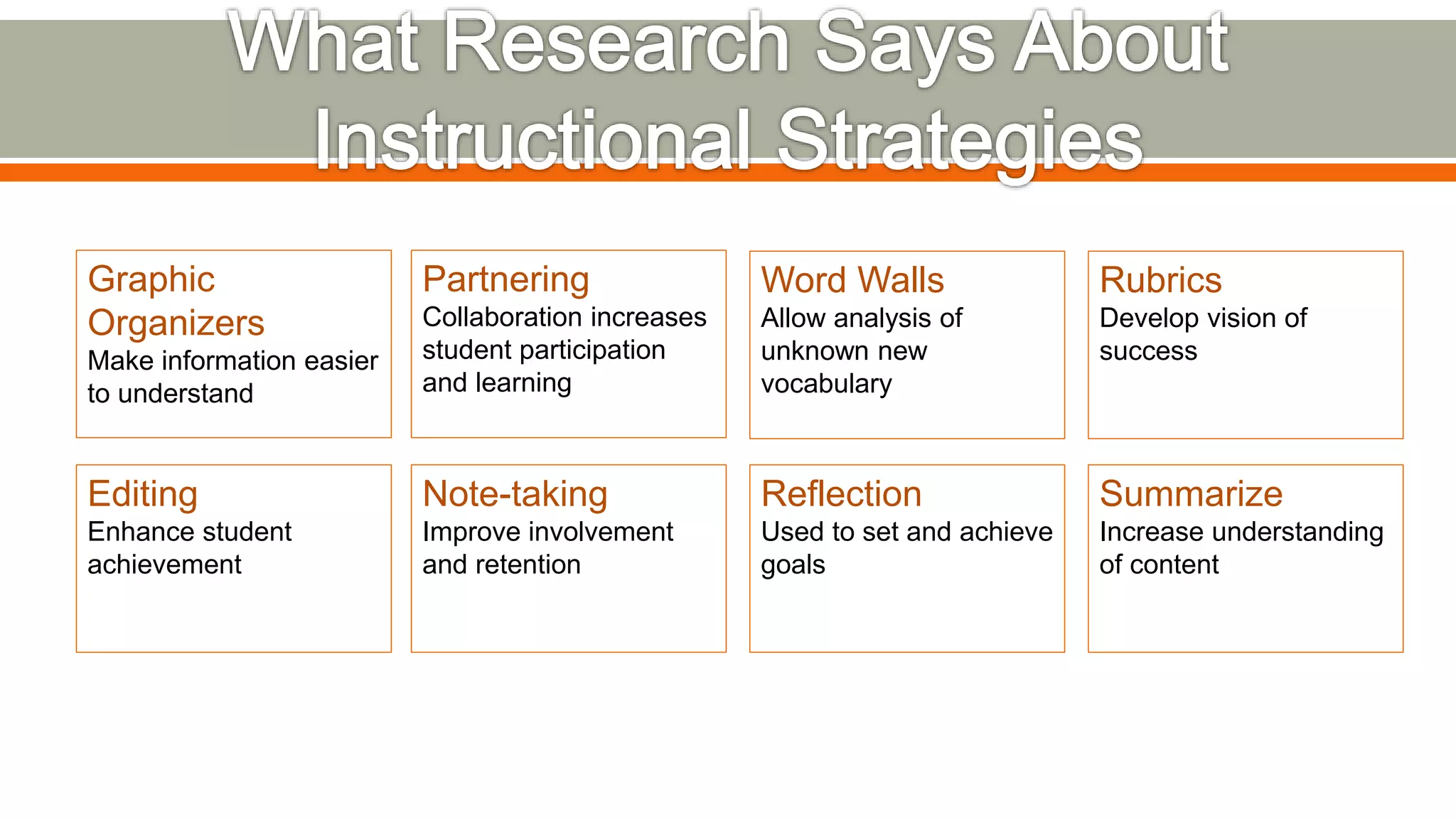
Editing
Enhance student
achievement
Graphic
Organizers
Make information easier
to understand
Note-taking
Improve involvement
and retention
Partnering
Collaboration increases
student participation
and learning
Reflection
Used to set and achieve
goals
Word Walls
Allow analysis of
unknown new
vocabulary
Summarize
Increase understanding
of content
Rubrics
Develop vision of
success
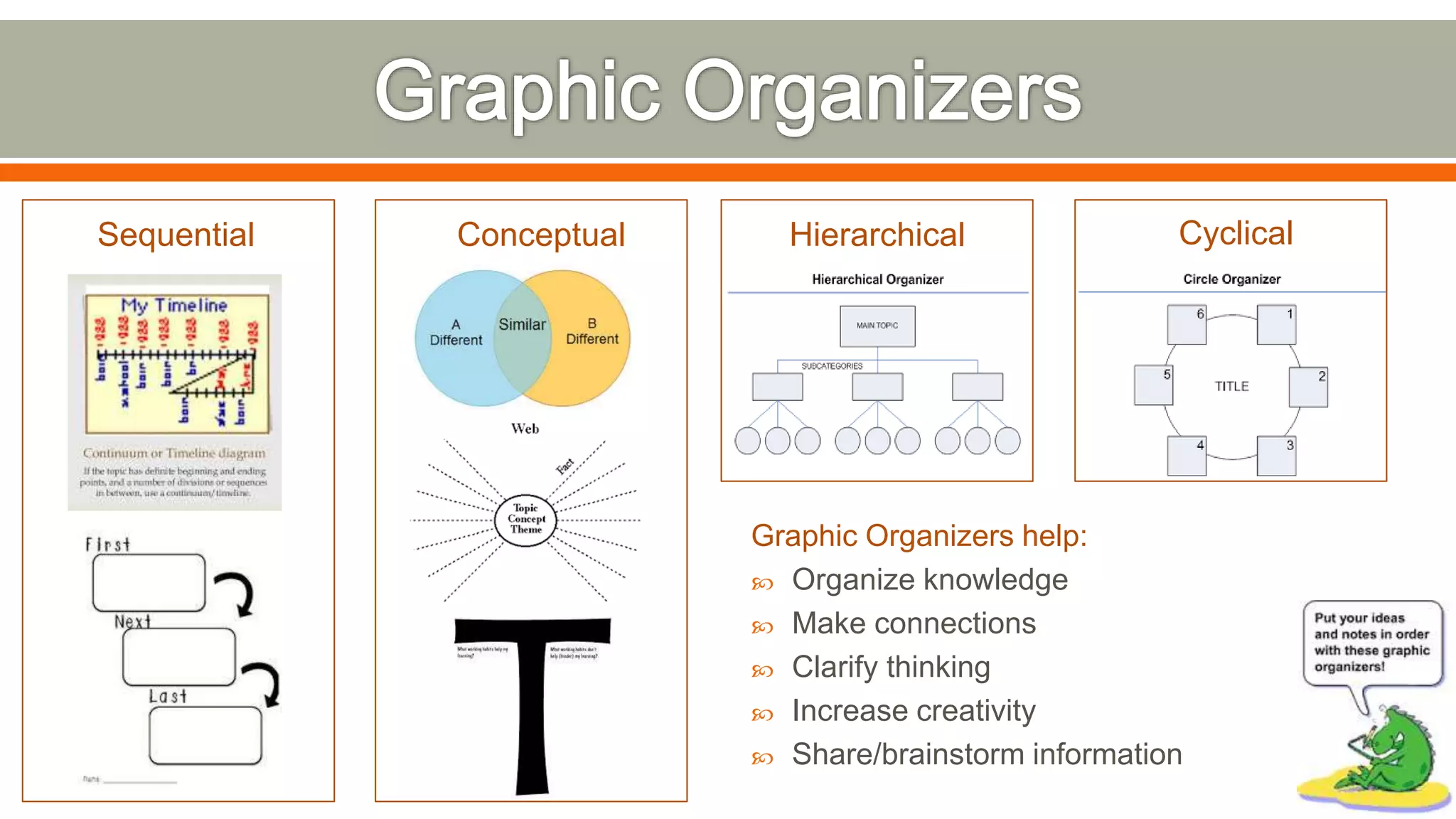
Sequential Conceptual Hierarchical Cyclical
Graphic Organizers help:
 Organize knowledge
 Make connections
 Clarify thinking
 Increase creativity
 Share/brainstorm information
Partnering helps:
 Foster development of community
 Elicit ideas, increase content
volume
 Practice language
Partnering can be used for:
Question and predict
Compare and
analyze
Classifying,
metaphors, analogies
Brainstorming
Share and discuss
Types of Word Walls:Word Walls are:
 Organized collection of words on
display
 Help in learning to read
Content
Content Specific
Language
Types of Rubrics:Rubrics help:
 Describe clear expectations
 Define quality
 Frame feedback
Content
Written Product Performance
ProcessesVisual Product
Types of Editing:Editing helps:
 Ensure standards and quality
 Examines writing , content,
organization
Teacher/
supervisor editing
Peer Editing
Self-editing
Types of Note-taking:
Outlining
Cornell Method Think in Threes
Charts
SQ3R
Note-taking helps:
 Retention
 Concept understanding,
relationships
 Revision
Sentence Method
Types of Reflection:Reflection helps:
 Form connections
 Fosters meaning
 Action + Reflection = Learning
Product – (Result)
Process – (How)
Progress – (Why)
Content – (What)
Types of Summaries:
Information
Provocative Report
Analysis
Executive Abstracts
Summarizing helps:
 Consolidate important information
 Improve memory
 Practice concision
 With your partner prepare a strategy plan for one lesson using any two or
more instructional strategies.
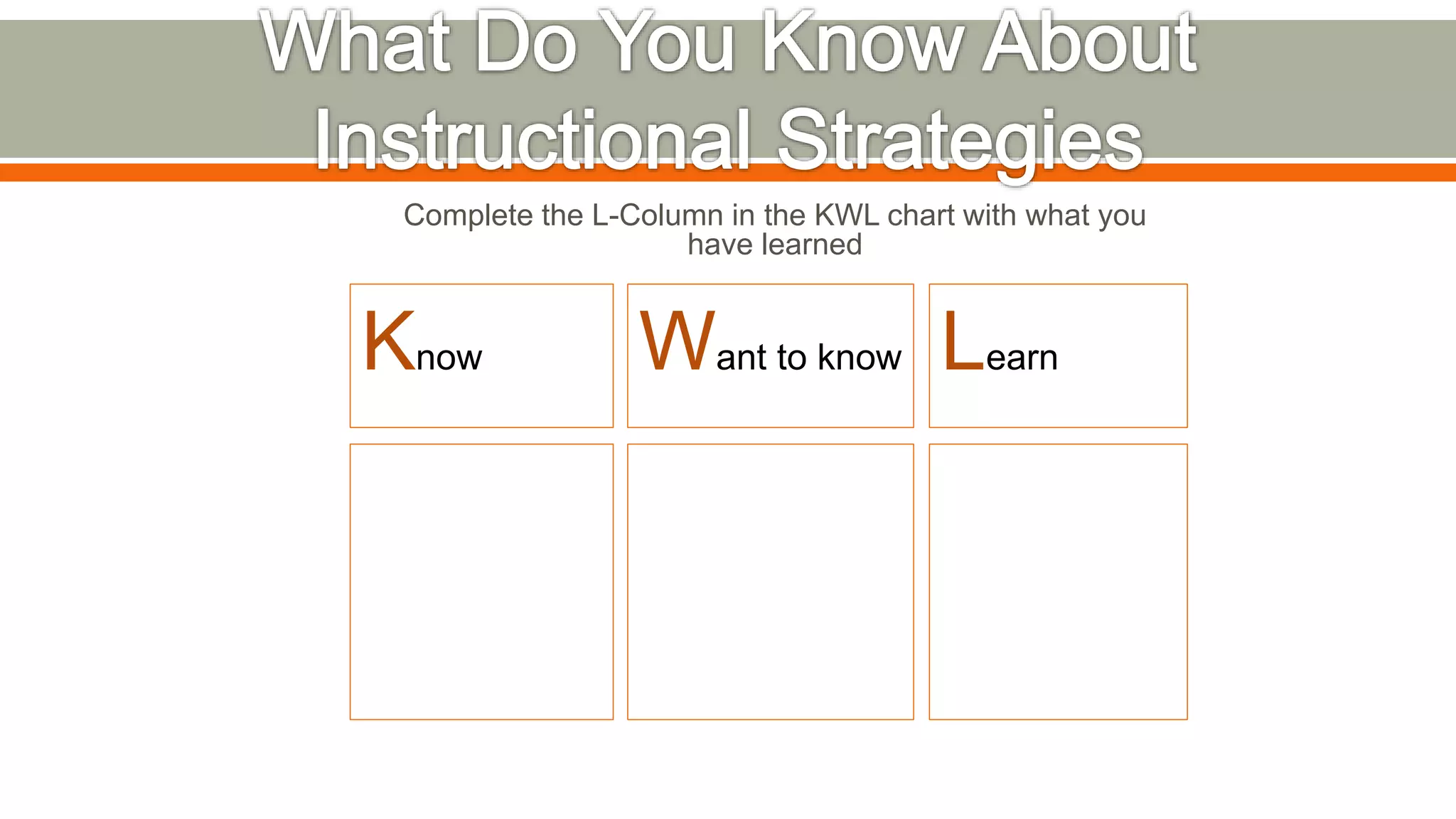
Complete the L-Column in the KWL chart with what you
have learned
Know Want to know Learn
 Research on Graphic Organizers. (n.d.). Retrieved December 4, 2015, from
https://www.mentoringminds.com/pdf/pdfGraphicOrganizersResearch.pdf
 Summarizing. (2015). Retrieved December 4, 2015, from
http://www.readingrockets.org/strategies/summarizing
 Word Walls. (n.d.). Retrieved December 4, 2015, from
http://mavoigt.weebly.com/word-wall.html

Effective Instructional Strategies

  • 1.
  • 2.
    Know Want toknow Learn
  • 3.
  • 4.
    Editing Enhance student achievement Graphic Organizers Make informationeasier to understand Note-taking Improve involvement and retention Partnering Collaboration increases student participation and learning Reflection Used to set and achieve goals Word Walls Allow analysis of unknown new vocabulary Summarize Increase understanding of content Rubrics Develop vision of success
  • 5.
    Sequential Conceptual HierarchicalCyclical Graphic Organizers help:  Organize knowledge  Make connections  Clarify thinking  Increase creativity  Share/brainstorm information
  • 6.
    Partnering helps:  Fosterdevelopment of community  Elicit ideas, increase content volume  Practice language Partnering can be used for: Question and predict Compare and analyze Classifying, metaphors, analogies Brainstorming Share and discuss
  • 7.
    Types of WordWalls:Word Walls are:  Organized collection of words on display  Help in learning to read Content Content Specific Language
  • 8.
    Types of Rubrics:Rubricshelp:  Describe clear expectations  Define quality  Frame feedback Content Written Product Performance ProcessesVisual Product
  • 9.
    Types of Editing:Editinghelps:  Ensure standards and quality  Examines writing , content, organization Teacher/ supervisor editing Peer Editing Self-editing
  • 10.
    Types of Note-taking: Outlining CornellMethod Think in Threes Charts SQ3R Note-taking helps:  Retention  Concept understanding, relationships  Revision Sentence Method
  • 11.
    Types of Reflection:Reflectionhelps:  Form connections  Fosters meaning  Action + Reflection = Learning Product – (Result) Process – (How) Progress – (Why) Content – (What)
  • 12.
    Types of Summaries: Information ProvocativeReport Analysis Executive Abstracts Summarizing helps:  Consolidate important information  Improve memory  Practice concision
  • 13.
     With yourpartner prepare a strategy plan for one lesson using any two or more instructional strategies.
  • 14.
    Complete the L-Columnin the KWL chart with what you have learned Know Want to know Learn
  • 15.
     Research onGraphic Organizers. (n.d.). Retrieved December 4, 2015, from https://www.mentoringminds.com/pdf/pdfGraphicOrganizersResearch.pdf  Summarizing. (2015). Retrieved December 4, 2015, from http://www.readingrockets.org/strategies/summarizing  Word Walls. (n.d.). Retrieved December 4, 2015, from http://mavoigt.weebly.com/word-wall.html

Editor's Notes

  • #3 Teachers will be given KWL chart to fill before the presentation. Each teacher will write what she/he know about the instructional strategies in the “K” column. Then fill the “W” column with what she/he wants to know. The “L” column will be completed at the end of the presentation.
  • #5 Ellis (2001) noted that information is more easily learned and understood with visual organizers. Meyen, Vergason, and Whelan (1996) share that graphic organizers depict a visual, organized display that makes “information easier to understand and learn”. Coleman Report, 1973) Collaborative activities are an effective way to increase student participation. Encourages persistence in learning (Johnson & Johnson, 1999). Demonstrate heightened responsibility for one’s learning (McAllister, 1990; Pierce and Van Houten, 1984). Student writing increases as students gain awareness that they have an audience they’re writing for (Wootten, 1981), Peer interactions can guide and support high- quality thinking and discussion (Cohen, 1994).   “They serve as an excellent source of information for students attempting to analyze unknown words, spell unfamiliar words, or define new vocabulary" (Yates, Cuthrell, & Rose, 2011). "Using three-dimensional picture models to represent words gives students a lasting correlation between pictures and the words they illustrate" (Zivkovich, 1997).  When used as part of a formative, student-centered approach to assessment, rubrics have the potential to help students develop a “vision of success” as well as “make dependable judgments about the quality of their own work” (Stiggins, 2001, p. 11). Asking students to continue working on a task until it is completed and accurate (until the standard is met) enhances student achievement (Marzano, Pickering, & Pollock, 2001). Note-taking in classes has been shown to increase academic achievement (Boyle, 2007; Boyle, 2010; Kiewra, 1985; Kiewra & Benton, 1988) Teachers can use reflection to set goals and determine what skills need to be revisited and how well students are understanding new information. (Jackson, 2009). Asking declarative and procedural questions encourages students to set goals and use higher levels of thinking. (Ullman, 2011) Summarizing strategies, on average, increased students' understanding of content by 19 percentile points (Haystead & Marzano, 2009).  
  • #6 Conceptual organizers Venn diagram, a web (or web map), a T-chart, or a cause/effect diagram. A conceptual organizer is a representation or diagram that helps explain concepts and relationships in all subjects, and in all age levels, Sequential organizers A timeline, A flow chart , A plot diagram , timeline matrix ,   strongest in presenting the order of events or actions. It is especially useful in strengthening higher levels of thinking through applying logical thinking.  Cyclical organizers describe events or processes that occur in a specific order. And do not have a beginning and an ending, but goes in a cycle. Hierarchical Organizers often used in explaining the classification system. It rates topics, or puts them in order according to the value of a specific criterion.   
  • #7 Partnering fosters the development of an effective learning community Partnering elicits many more ideas and increases the volume of content that can be understood. Partnering is an effective strategy to increase opportunities to practice using language Partnering increase vocabulary and fluency. Partnering can be used for Share and Discuss: Think-Pair-Share strategy Brainstorming Compare and Analyze Classifying, Metaphors, and Analogies Question and Predict
  • #8 A word wall is a literacy tool composed of an organized collection of words which are displayed in large visible letters on a wall, bulletin board, or other display areas in a classroom. If used consistently, can make a difference in learning to read in areas such as: Phonemic awareness Phonics Comprehension Vocabulary Fluency Types of word walls are Content Word Walls Content specific word walls Language Word Walls  
  • #9 A rubric is a tool that clearly represents the performance expectations for an assignment or piece of work. A rubric provides clear descriptions of the characteristics of the work associated with each component, at varying levels of mastery. Rubrics make the expectations of the task transparent. It defines quality and sets the focus so that everyone involved can recognize a quality product or performance. Rubrics provide a framework for feedback that is essential to student academic growth and achievement Examples of the different types of rubrics: Written products Performances Visual Products Processes Content
  • #10 Editing with effective feedback reminds the writer to go back and ensure that the standards and high quality are evident in their product.  Editing is not only related with correcting the mechanics of writing, but  includes examining the content to determine if it is accurate, relevant, and interesting, reviewing the organization of the paper to determine if it is arranged in a logical and pleasing manner. It also includes a focus on analysis based on the rubric so that the writer receives effective feedback. Types of editing Teacher/supervisor editing Self-editing Peer editing
  • #11 Note taking helps students' retention of most important ideas and builds concept understanding. Note taking is an active tool that captures and keeps important ideas that transmit quickly in students' minds allowing them to revise, understand relationships and organize for study. An effective tool that suits all learners' levels and types from kindergarten through high school till university helping them to learn from each other through discussing their opinions and understanding. Has different form that starts with simple outline, concept maps or complex GOs and electronic tools using technology. Memory reinforcement and mind stimulation is done through the coordination of manual recording and mental processing. Note taking is a process that includes revisiting notes, revising the notes and organizing the notes into a format that will assist the student to remember the information more readily. Notes should be organized so the student can use them to study for exams and/or use the notes for essays or research projects. Copious notes made by students will indicate more critical thinking on the part of the students to connect with the information. The process of taking notes is known as encoding which shown to be statistically more effective than not taking notes.  Note taking types Outlining Charts (Four column charts, Three column charts, KWL, KWS, The Note/Page/Comments chart) The Cornell Method Think in Threes SQ3R The Sentence Method
  • #12  Reflections are also a form of summary. They allow students to think about their thinking and give a short summary of it. Reflection allows students to relive experiences in their minds and connect them to other learning or feelings. Teachers often worry that reflection takes time away from learning activities. Real learning, however, requires reflection on top of action to create meaning. Teachers must get in the habit of “thinking about their thinking” to encourage students to do the same. Types of reflection Content - The What (Declarative knowledge (facts students learn), Procedural knowledge (skills students use)) Process - The How Product - The Result Progress - The Why
  • #13 Summarizing teaches students how to discern the most important ideas in a text, how to ignore irrelevant information, and how to integrate the central ideas in a meaningful way. Teaching students to summarize improves their memory for what is read. Summarization strategies can be used in almost every content area. It helps students learn to determine essential ideas and consolidate important details that support them. It enables students to focus on key words and phrases of an assigned text that are worth noting and remembering. It teaches students how to take a large selection of text and reduce it to the main points for more concise understanding. Summarize types Information summaries Analysis summaries Provocative summary Report Summaries Executive summary Abstracts
  • #14 Students will take notes while reading. Students will write a summary using their notes. Students exchange their summaries with a partner. Partners will peer-edit the writing using a rubric and provide feedback.