 Connect the introduction and body of the
essay
 Give the reader a sense of completion
 Give the reader something to think about
 Leave the reader with a lasting impression
 A Call to Action: the writer encourages the
audience to do something to effect a change
 Offer a Solution: the writer suggests some
possibilities to bring about this change
 Make a Prediction: the write either warns
the reader about what might happen if no
action is taken or encourages the reader not
to just sit back and accept the status quo
I have given you three truthful explanations
of why daily homework is an abomination to
the high school. This is due to problems with
participants in after school events, the time
we spend with our families, and our jobs.
Thank You for allowing me to express my
feelings.
What does the author want the reader to do?
 Include a final appeal to reinforce your
argument.
 Clearly and forcefully state your desired
action.
 Give information needed to take that
recommended action.
Daily mandatory homework for high school students
would serve no real worthwhile purpose but to
unnecessarily stress out students and teachers
alike. Teachers and students are busy, stressed,
preoccupied, and quite frankly, strung-out enough
as it is without this. Please, I urge you not to put
this in effect. Not simply because I don’t want
homework for all seven classes every day, but
because it would truly be detrimental to everyone
actively participating in the public school now and in
the future.
 Restate the problem
 Define the solution
 Focus on the strengths of the solution
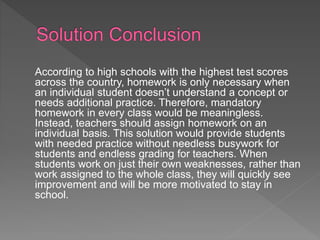
According to high schools with the highest test scores
across the country, homework is only necessary when
an individual student doesn’t understand a concept or
needs additional practice. Therefore, mandatory
homework in every class would be meaningless.
Instead, teachers should assign homework on an
individual basis. This solution would provide students
with needed practice without needless busywork for
students and endless grading for teachers. When
students work on just their own weaknesses, rather than
work assigned to the whole class, they will quickly see
improvement and will be more motivated to stay in
school.
 Takes the argument a step further than a
summary
 Keeps the reader thinking
 Draws the reader’s attention to what might
happen if no action is taken
 Offers encouragement for effecting a change
Imagine an empty classroom. As students
trickle in, without a word, they immediately take
out a piece of paper and a pencil to start writing
down today’s homework assignment. The
teacher walks to the front of the class to admire
her focused students as they work silently. Ring!
Class is in session. We can make this longed-
for dream a reality. Our high school’s motto has
always been “Be the Best You Can Be” and if
the required homework proposal is
implemented, we really would be.

Effective conclusions for persuasion

  • 2.
     Connect theintroduction and body of the essay  Give the reader a sense of completion  Give the reader something to think about  Leave the reader with a lasting impression
  • 3.
     A Callto Action: the writer encourages the audience to do something to effect a change  Offer a Solution: the writer suggests some possibilities to bring about this change  Make a Prediction: the write either warns the reader about what might happen if no action is taken or encourages the reader not to just sit back and accept the status quo
  • 4.
    I have givenyou three truthful explanations of why daily homework is an abomination to the high school. This is due to problems with participants in after school events, the time we spend with our families, and our jobs. Thank You for allowing me to express my feelings. What does the author want the reader to do?
  • 5.
     Include afinal appeal to reinforce your argument.  Clearly and forcefully state your desired action.  Give information needed to take that recommended action.
  • 6.
    Daily mandatory homeworkfor high school students would serve no real worthwhile purpose but to unnecessarily stress out students and teachers alike. Teachers and students are busy, stressed, preoccupied, and quite frankly, strung-out enough as it is without this. Please, I urge you not to put this in effect. Not simply because I don’t want homework for all seven classes every day, but because it would truly be detrimental to everyone actively participating in the public school now and in the future.
  • 7.
     Restate theproblem  Define the solution  Focus on the strengths of the solution
  • 8.
    According to highschools with the highest test scores across the country, homework is only necessary when an individual student doesn’t understand a concept or needs additional practice. Therefore, mandatory homework in every class would be meaningless. Instead, teachers should assign homework on an individual basis. This solution would provide students with needed practice without needless busywork for students and endless grading for teachers. When students work on just their own weaknesses, rather than work assigned to the whole class, they will quickly see improvement and will be more motivated to stay in school.
  • 9.
     Takes theargument a step further than a summary  Keeps the reader thinking  Draws the reader’s attention to what might happen if no action is taken  Offers encouragement for effecting a change
  • 10.
    Imagine an emptyclassroom. As students trickle in, without a word, they immediately take out a piece of paper and a pencil to start writing down today’s homework assignment. The teacher walks to the front of the class to admire her focused students as they work silently. Ring! Class is in session. We can make this longed- for dream a reality. Our high school’s motto has always been “Be the Best You Can Be” and if the required homework proposal is implemented, we really would be.