What is Communication?
Whatdoes it mean to you?
The process of communication is what allows us to
interact with other people; without it, we would be
unable to share knowledge or experiences with
anything outside of ourselves. Common forms of
communication include speaking, writing, gestures,
touch and broadcasting.
Wikipedia definition
3.
Verbal vs NonVerbal
Can we communicate without words?
Voice attributes
What are they and how do they affect communication?
Physical attributes
What could be considered here and how do they affect
communication?
The power of touch
What and when is OK?
Which is better, verbal or non verbal?
4.
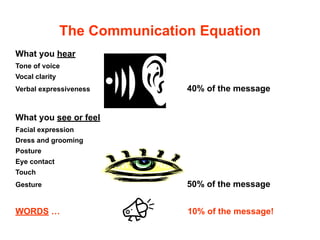
The Communication Equation
Whatyou hear
Tone of voice
Vocal clarity
Verbal expressiveness 40% of the message
What you see or feel
Facial expression
Dress and grooming
Posture
Eye contact
Touch
Gesture 50% of the message
WORDS … 10% of the message!
5.
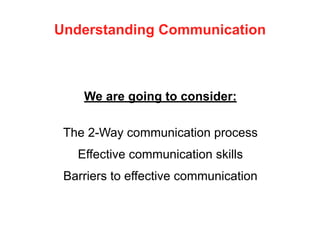
Understanding Communication
We aregoing to consider:
The 2-Way communication process
Effective communication skills
Barriers to effective communication
6.
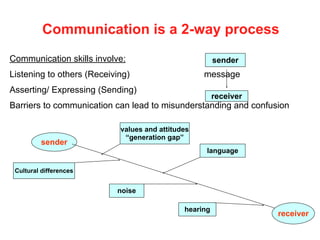
Communication is a2-way process
Communication skills involve:
Listening to others (Receiving) message
Asserting/ Expressing (Sending)
Barriers to communication can lead to misunderstanding and confusion
sender
receiver
sender
receiver
values and attitudes
“generation gap”
Cultural differences
language
noise
hearing
7.
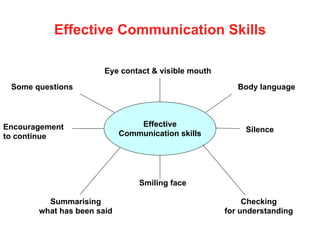
Effective Communication Skills
Effective
Communicationskills
Eye contact & visible mouth
Body language
Silence
Checking
for understanding
Smiling face
Summarising
what has been said
Encouragement
to continue
Some questions
8.
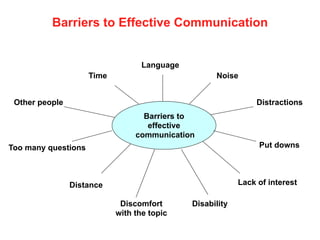
Barriers to EffectiveCommunication
Barriers to
effective
communication
Language
Noise
Time
Distractions
Other people
Put downs
Too many questions
Distance
Discomfort
with the topic
Disability
Lack of interest
9.
The Art ofListening
“If we were supposed to talk more than
listen, we would have been given two
mouths and one ear.”
Mark Twain
Responding
Responses to checkthat your perceptions are
correct
Responses to encourage further communication
See handout for further ideas
12.
Questioning Techniques
Open endedand Closed questions
Diverse Questioning techniques
Participants to practise
Then try the Questioning Quiz.
13.
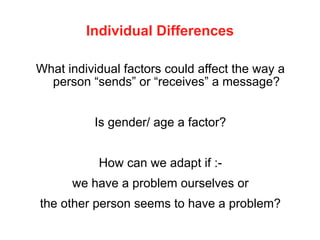
Individual Differences
What individualfactors could affect the way a
person “sends” or “receives” a message?
Is gender/ age a factor?
How can we adapt if :-
we have a problem ourselves or
the other person seems to have a problem?
14.
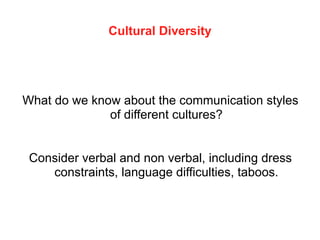
Cultural Diversity
What dowe know about the communication styles
of different cultures?
Consider verbal and non verbal, including dress
constraints, language difficulties, taboos.
15.
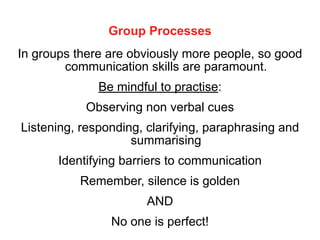
Group Processes
In groupsthere are obviously more people, so good
communication skills are paramount.
Be mindful to practise:
Observing non verbal cues
Listening, responding, clarifying, paraphrasing and
summarising
Identifying barriers to communication
Remember, silence is golden
AND
No one is perfect!
16.
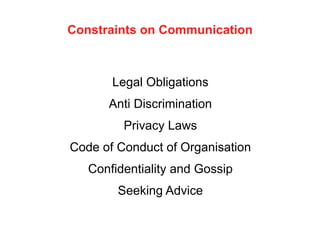
Constraints on Communication
LegalObligations
Anti Discrimination
Privacy Laws
Code of Conduct of Organisation
Confidentiality and Gossip
Seeking Advice
17.
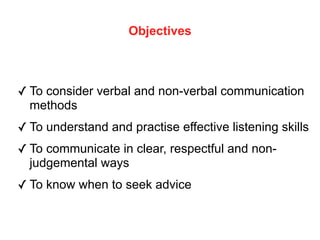
Objectives
✓ To considerverbal and non-verbal communication
methods
✓ To understand and practise effective listening skills
✓ To communicate in clear, respectful and non-
judgemental ways
✓ To know when to seek advice