Using
Developmental
Evaluation
to Learn about
System Change in the
Postsecondary Field
EERS: 35th Annual Conference
OMG Center for Collaborative Learning
May 1, 2012
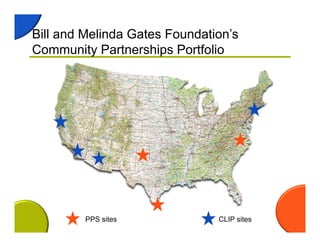
Bill and Melinda Gates Foundation’s
Community Partnerships Portfolio
CLIP sitesPPS sites
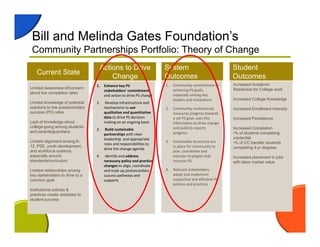
Bill and Melinda Gates Foundation’s
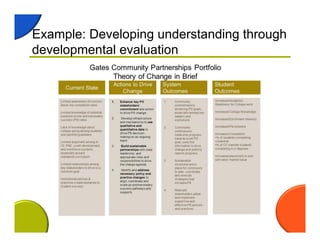
Community Partnerships Portfolio: Theory of Change
Current State
Actions to Drive
Change
System
Outcomes
Student
Outcomes
Limited awareness of/concern
about low completion rates
Limited knowledge of potential
solutions to low postsecondary
success (PS) rates
Lack of knowledge about
college-going among students
and parents/guardians
Limited alignment among K-
12, PSE, youth development,
and workforce systems,
especially around
standards/curriculum
Limited relationships among
key stakeholders to drive to a
common goal
Institutional policies &
practices create obstacles to
student success
Increased Academic
Readiness for College work
Increased College Knowledge
Increased Enrollment Intensity
Increased Persistence
Increased Completion
•% of students completing
credential
•% of CC transfer students
completing 4-yr degrees
Increased placement in jobs
with labor market value
1. Community commitment to 
achieving PS goals, 
especially among key 
leaders and institutions
2. Community continuously 
measures progress towards 
a set PS goal, uses this 
information to drive change 
and publicly reports 
progress.
3. Sustainable structures are 
in place for community to 
plan, coordinate and 
execute strategies that 
increase PS
4. Relevant stakeholders 
adopt and implement 
supportive and effective PS 
policies and practices 
1. Enhance key PS 
stakeholders’ commitment
and action to drive PS change
2. Develop infrastructure and 
mechanisms to use 
qualitative and quantitative 
data to drive PS decision‐
making on an ongoing basis 
3. Build sustainable 
partnerships with clear 
leadership  and appropriate 
roles and responsibilities to 
drive the change agenda
4. Identify and address 
necessary policy and practice 
changes to align, coordinate 
and scale up postsecondary 
success pathways and 
supports
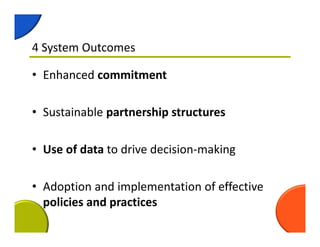
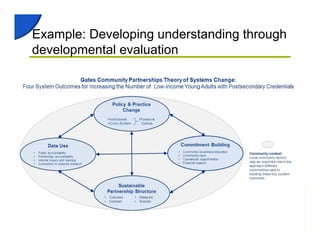
4 System Outcomes
• Enhanced commitment
• Sustainable partnership structures
• Use of data to drive decision‐making
• Adoption and implementation of effective 
policies and practices
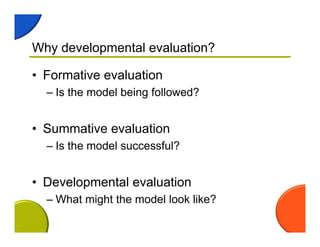
Why developmental evaluation?
• Formative evaluation
– Is the model being followed?
• Summative evaluation
– Is the model successful?
• Developmental evaluation
– What might the model look like?
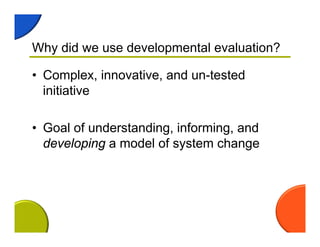
Why did we use developmental evaluation?
• Complex, innovative, and un-tested
initiative
• Goal of understanding, informing, and
developing a model of system change
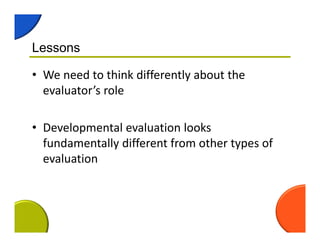
Lessons
• We need to think differently about the 
evaluator’s role
• Developmental evaluation looks 
fundamentally different from other types of 
evaluation
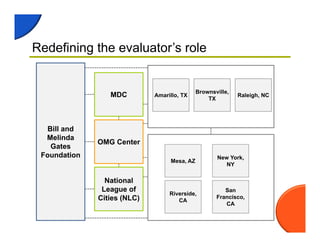
Redefining the evaluator’s role
Bill and
Melinda
Gates
Foundation
MDC
National
League of
Cities (NLC)
OMG Center
Raleigh, NC
Brownsville,
TX
Amarillo, TX
Mesa, AZ
New York,
NY
Riverside,
CA
San
Francisco,
CA
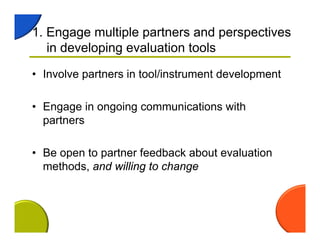
1. Engage multiple partners and perspectives
in developing evaluation tools
• Involve partners in tool/instrument development
• Engage in ongoing communications with
partners
• Be open to partner feedback about evaluation
methods, and willing to change
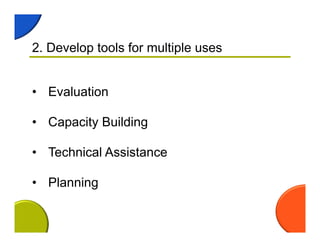
2. Develop tools for multiple uses
• Evaluation
• Capacity Building
• Technical Assistance
• Planning
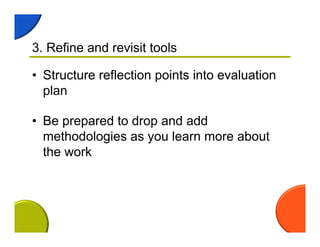
3. Refine and revisit tools
• Structure reflection points into evaluation
plan
• Be prepared to drop and add
methodologies as you learn more about
the work
Example: Developing understanding through
developmental evaluation
Example: Developing understanding through
developmental evaluation
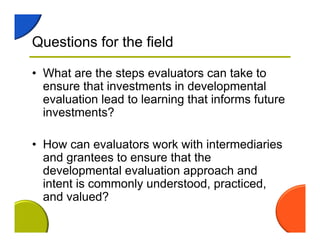
Questions for the field
• What are the steps evaluators can take to
ensure that investments in developmental
evaluation lead to learning that informs future
investments?
• How can evaluators work with intermediaries
and grantees to ensure that the
developmental evaluation approach and
intent is commonly understood, practiced,
and valued?
Contact
• Justin Piff: justin@omgcenter.org
• Sarah Singer Quast: sarah@omgcenter.org

EERS Presentation (Justin and Sarah)

  • 1.
    Using Developmental Evaluation to Learn about SystemChange in the Postsecondary Field EERS: 35th Annual Conference OMG Center for Collaborative Learning May 1, 2012
  • 2.
    Bill and MelindaGates Foundation’s Community Partnerships Portfolio CLIP sitesPPS sites
  • 3.
    Bill and MelindaGates Foundation’s Community Partnerships Portfolio: Theory of Change Current State Actions to Drive Change System Outcomes Student Outcomes Limited awareness of/concern about low completion rates Limited knowledge of potential solutions to low postsecondary success (PS) rates Lack of knowledge about college-going among students and parents/guardians Limited alignment among K- 12, PSE, youth development, and workforce systems, especially around standards/curriculum Limited relationships among key stakeholders to drive to a common goal Institutional policies & practices create obstacles to student success Increased Academic Readiness for College work Increased College Knowledge Increased Enrollment Intensity Increased Persistence Increased Completion •% of students completing credential •% of CC transfer students completing 4-yr degrees Increased placement in jobs with labor market value 1. Community commitment to  achieving PS goals,  especially among key  leaders and institutions 2. Community continuously  measures progress towards  a set PS goal, uses this  information to drive change  and publicly reports  progress. 3. Sustainable structures are  in place for community to  plan, coordinate and  execute strategies that  increase PS 4. Relevant stakeholders  adopt and implement  supportive and effective PS  policies and practices  1. Enhance key PS  stakeholders’ commitment and action to drive PS change 2. Develop infrastructure and  mechanisms to use  qualitative and quantitative  data to drive PS decision‐ making on an ongoing basis  3. Build sustainable  partnerships with clear  leadership  and appropriate  roles and responsibilities to  drive the change agenda 4. Identify and address  necessary policy and practice  changes to align, coordinate  and scale up postsecondary  success pathways and  supports
  • 4.
    4 System Outcomes • Enhanced commitment • Sustainable partnership structures •Use of data to drive decision‐making • Adoption and implementation of effective  policies and practices
  • 5.
    Why developmental evaluation? •Formative evaluation – Is the model being followed? • Summative evaluation – Is the model successful? • Developmental evaluation – What might the model look like?
  • 6.
    Why did weuse developmental evaluation? • Complex, innovative, and un-tested initiative • Goal of understanding, informing, and developing a model of system change
  • 7.
  • 8.
    Redefining the evaluator’srole Bill and Melinda Gates Foundation MDC National League of Cities (NLC) OMG Center Raleigh, NC Brownsville, TX Amarillo, TX Mesa, AZ New York, NY Riverside, CA San Francisco, CA
  • 9.
    1. Engage multiplepartners and perspectives in developing evaluation tools • Involve partners in tool/instrument development • Engage in ongoing communications with partners • Be open to partner feedback about evaluation methods, and willing to change
  • 10.
    2. Develop toolsfor multiple uses • Evaluation • Capacity Building • Technical Assistance • Planning
  • 11.
    3. Refine andrevisit tools • Structure reflection points into evaluation plan • Be prepared to drop and add methodologies as you learn more about the work
  • 12.
    Example: Developing understandingthrough developmental evaluation
  • 13.
    Example: Developing understandingthrough developmental evaluation
  • 14.
    Questions for thefield • What are the steps evaluators can take to ensure that investments in developmental evaluation lead to learning that informs future investments? • How can evaluators work with intermediaries and grantees to ensure that the developmental evaluation approach and intent is commonly understood, practiced, and valued?
  • 15.
    Contact • Justin Piff:justin@omgcenter.org • Sarah Singer Quast: sarah@omgcenter.org