Program Evaluation: Alternative Approaches and
Practical Guidelines – Ebook PDF Version download
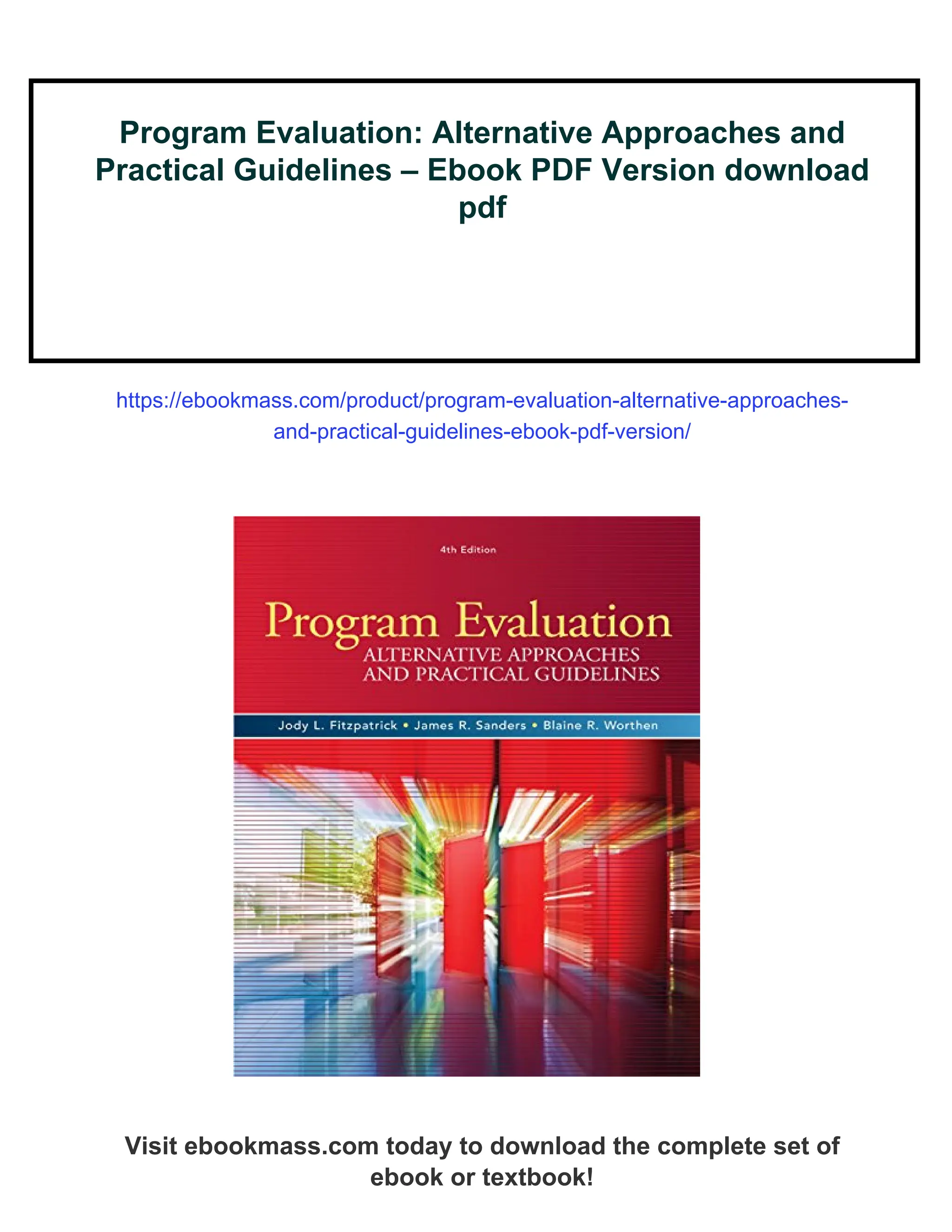
pdf
https://ebookmass.com/product/program-evaluation-alternative-approaches-
and-practical-guidelines-ebook-pdf-version/
Visit ebookmass.com today to download the complete set of
ebook or textbook!
We have selected some products that you may be interested in
Click the link to download now or visit ebookmass.com
for more options!.
Practical Approaches to Applied Research and Program
Evaluation for Helping Professionals 1st Edition, (Ebook
PDF)
https://ebookmass.com/product/practical-approaches-to-applied-
research-and-program-evaluation-for-helping-professionals-1st-edition-
ebook-pdf/
Comparative Approaches to Program Planning – Ebook PDF
Version
https://ebookmass.com/product/comparative-approaches-to-program-
planning-ebook-pdf-version/
Health Program Planning and Evaluation 3rd Edition, (Ebook
PDF)
https://ebookmass.com/product/health-program-planning-and-
evaluation-3rd-edition-ebook-pdf/
Program Evaluation: Methods and Case Studies 9th Edition,
(Ebook PDF)
https://ebookmass.com/product/program-evaluation-methods-and-case-
studies-9th-edition-ebook-pdf/
Introduction to 80×86 Assembly Language and Computer
Architecture – Ebook PDF Version
https://ebookmass.com/product/introduction-to-8086-assembly-language-
and-computer-architecture-ebook-pdf-version/
Program Evaluation for Social Workers: Foundations of
Evidence Based Programs 7th Edition, (Ebook PDF)
https://ebookmass.com/product/program-evaluation-for-social-workers-
foundations-of-evidence-based-programs-7th-edition-ebook-pdf/
Counseling and Educational Research: Evaluation and
Application Fourth Edition – Ebook PDF Version
https://ebookmass.com/product/counseling-and-educational-research-
evaluation-and-application-fourth-edition-ebook-pdf-version/
The Maudsley Prescribing Guidelines in Psychiatry 13th
Edition – Ebook PDF Version
https://ebookmass.com/product/the-maudsley-prescribing-guidelines-in-
psychiatry-13th-edition-ebook-pdf-version/
Psychological Approaches to Pain Management, Third Edition
– Ebook PDF Version: A Practitioner’s – Ebook PDF Version
https://ebookmass.com/product/psychological-approaches-to-pain-
management-third-edition-ebook-pdf-version-a-practitioners-ebook-pdf-
version/
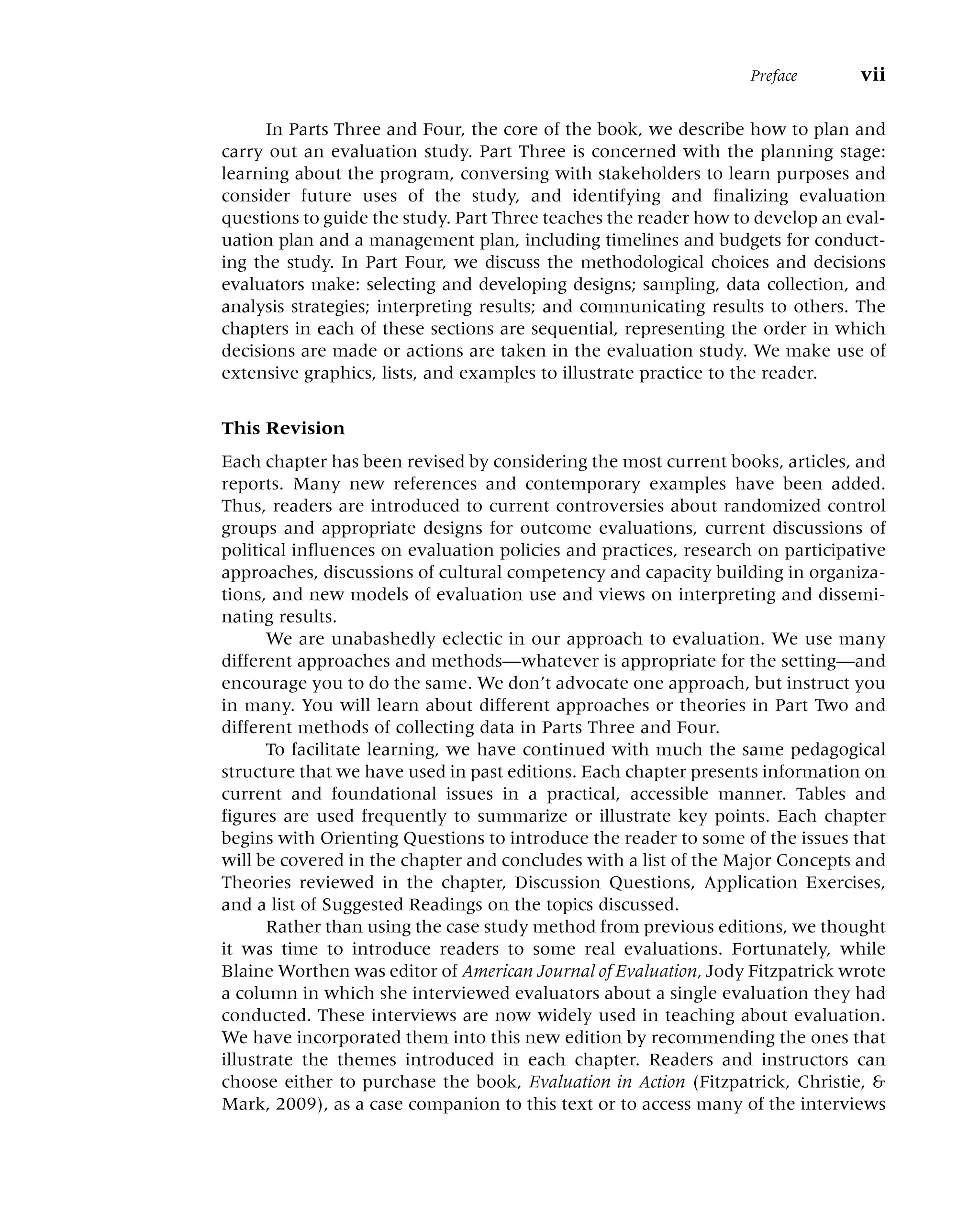
In Parts Three and Four, the core of the book, we describe how to plan and
carry out an evaluation study. Part Three is concerned with the planning stage:
learning about the program, conversing with stakeholders to learn purposes and
consider future uses of the study, and identifying and finalizing evaluation
questions to guide the study. Part Three teaches the reader how to develop an eval-
uation plan and a management plan, including timelines and budgets for conduct-
ing the study. In Part Four, we discuss the methodological choices and decisions
evaluators make: selecting and developing designs; sampling, data collection, and
analysis strategies; interpreting results; and communicating results to others. The
chapters in each of these sections are sequential, representing the order in which
decisions are made or actions are taken in the evaluation study. We make use of
extensive graphics, lists, and examples to illustrate practice to the reader.
This Revision
Each chapter has been revised by considering the most current books, articles, and
reports. Many new references and contemporary examples have been added.
Thus, readers are introduced to current controversies about randomized control
groups and appropriate designs for outcome evaluations, current discussions of
political influences on evaluation policies and practices, research on participative
approaches, discussions of cultural competency and capacity building in organiza-
tions, and new models of evaluation use and views on interpreting and dissemi-
nating results.
We are unabashedly eclectic in our approach to evaluation. We use many
different approaches and methods––whatever is appropriate for the setting––and
encourage you to do the same. We don’t advocate one approach, but instruct you
in many. You will learn about different approaches or theories in Part Two and
different methods of collecting data in Parts Three and Four.
To facilitate learning, we have continued with much the same pedagogical
structure that we have used in past editions. Each chapter presents information on
current and foundational issues in a practical, accessible manner. Tables and
figures are used frequently to summarize or illustrate key points. Each chapter
begins with Orienting Questions to introduce the reader to some of the issues that
will be covered in the chapter and concludes with a list of the Major Concepts and
Theories reviewed in the chapter, Discussion Questions, Application Exercises,
and a list of Suggested Readings on the topics discussed.
Rather than using the case study method from previous editions, we thought
it was time to introduce readers to some real evaluations. Fortunately, while
Blaine Worthen was editor of American Journal of Evaluation, Jody Fitzpatrick wrote
a column in which she interviewed evaluators about a single evaluation they had
conducted. These interviews are now widely used in teaching about evaluation.
We have incorporated them into this new edition by recommending the ones that
illustrate the themes introduced in each chapter. Readers and instructors can
choose either to purchase the book, Evaluation in Action (Fitzpatrick, Christie, &
Mark, 2009), as a case companion to this text or to access many of the interviews
Preface vii
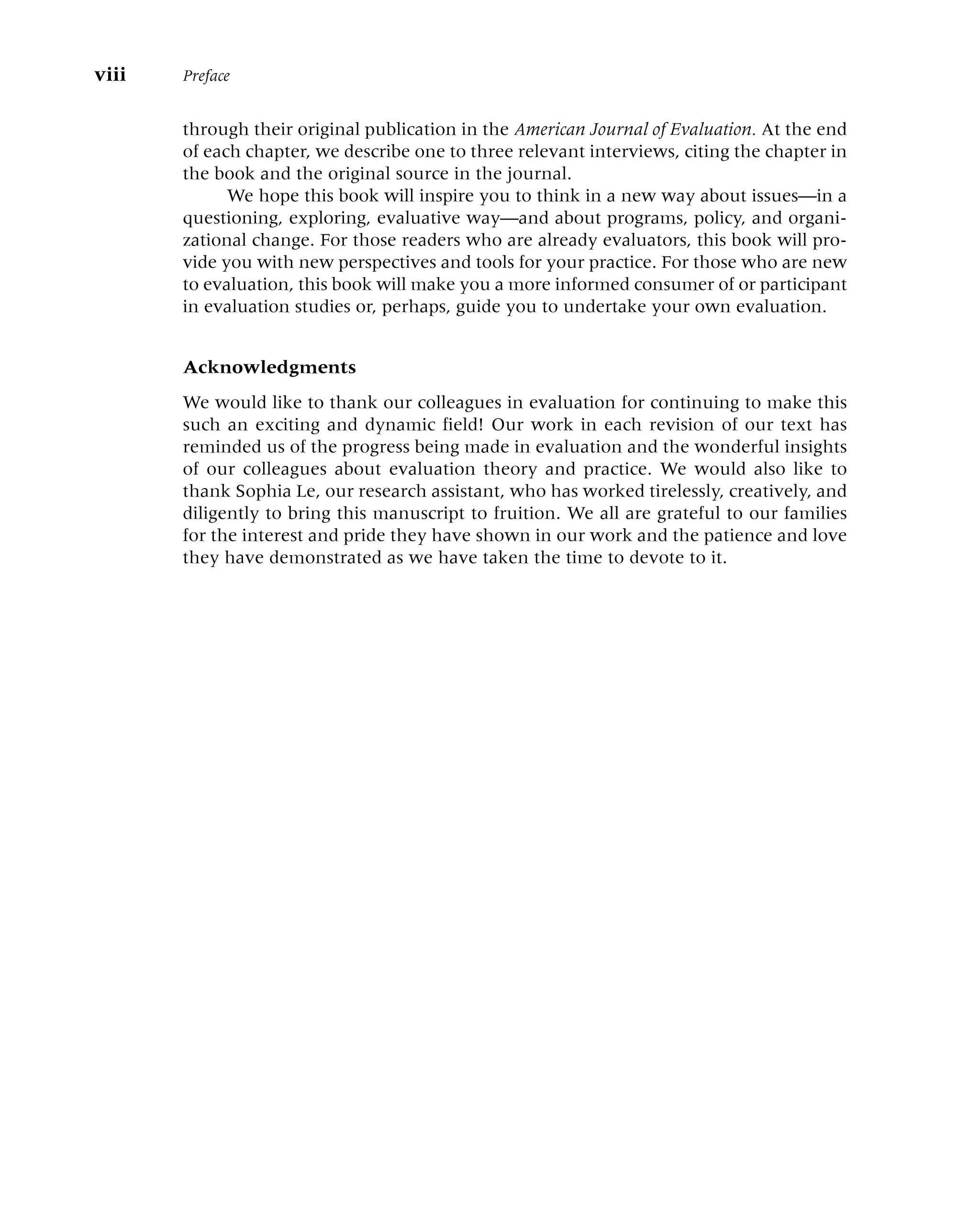
through their original publication in the American Journal of Evaluation. At the end
of each chapter, we describe one to three relevant interviews, citing the chapter in
the book and the original source in the journal.
We hope this book will inspire you to think in a new way about issues—in a
questioning, exploring, evaluative way—and about programs, policy, and organi-
zational change. For those readers who are already evaluators, this book will pro-
vide you with new perspectives and tools for your practice. For those who are new
to evaluation, this book will make you a more informed consumer of or participant
in evaluation studies or, perhaps, guide you to undertake your own evaluation.
Acknowledgments
We would like to thank our colleagues in evaluation for continuing to make this
such an exciting and dynamic field! Our work in each revision of our text has
reminded us of the progress being made in evaluation and the wonderful insights
of our colleagues about evaluation theory and practice. We would also like to
thank Sophia Le, our research assistant, who has worked tirelessly, creatively, and
diligently to bring this manuscript to fruition. We all are grateful to our families
for the interest and pride they have shown in our work and the patience and love
they have demonstrated as we have taken the time to devote to it.
viii Preface
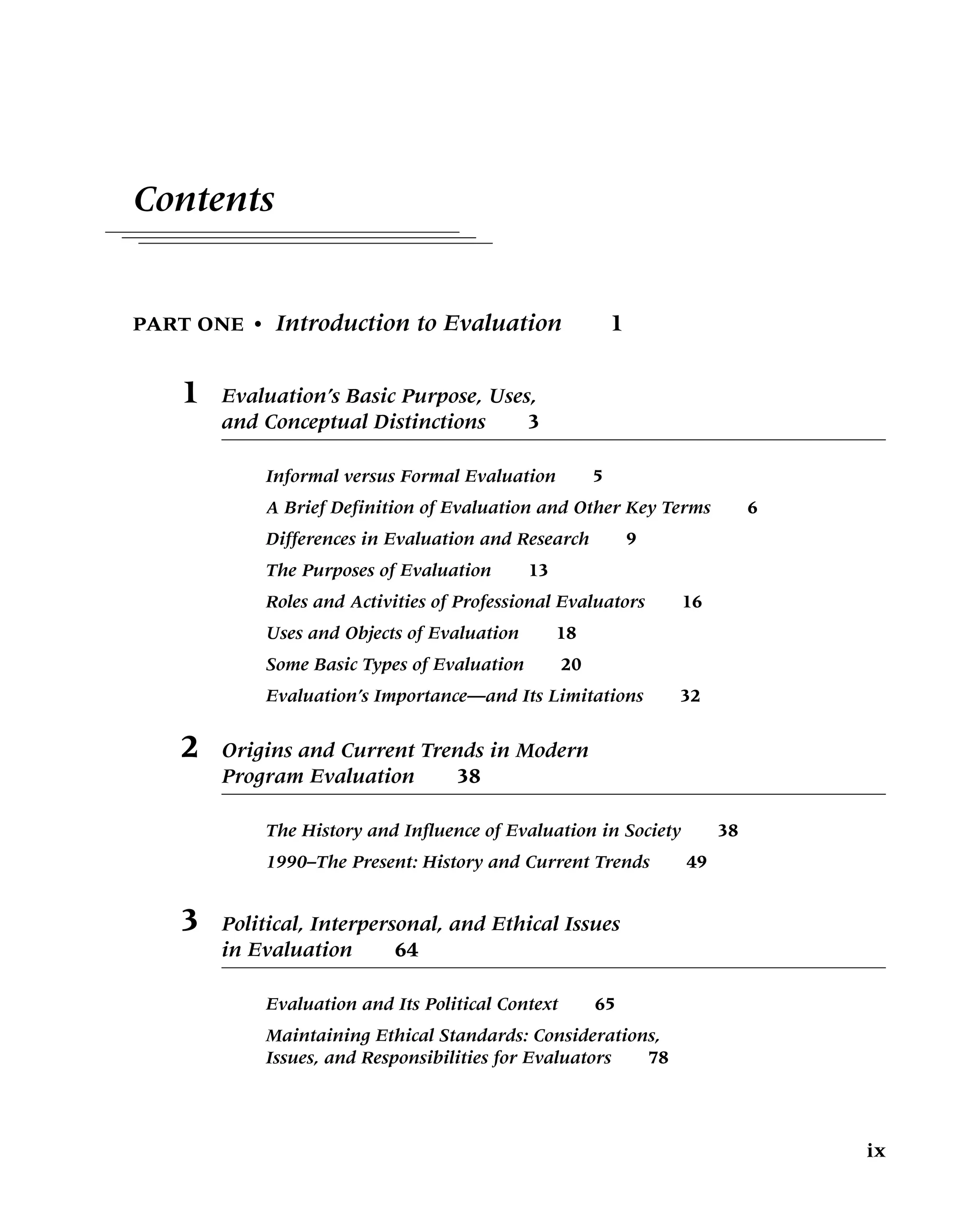
Contents
PART ONE • Introduction to Evaluation 1
1 Evaluation’s Basic Purpose, Uses,
and Conceptual Distinctions 3
Informal versus Formal Evaluation 5
A Brief Definition of Evaluation and Other Key Terms 6
Differences in Evaluation and Research 9
The Purposes of Evaluation 13
Roles and Activities of Professional Evaluators 16
Uses and Objects of Evaluation 18
Some Basic Types of Evaluation 20
Evaluation’s Importance—and Its Limitations 32
2 Origins and Current Trends in Modern
Program Evaluation 38
The History and Influence of Evaluation in Society 38
1990–The Present: History and Current Trends 49
3 Political, Interpersonal, and Ethical Issues
in Evaluation 64
Evaluation and Its Political Context 65
Maintaining Ethical Standards: Considerations,
Issues, and Responsibilities for Evaluators 78
ix
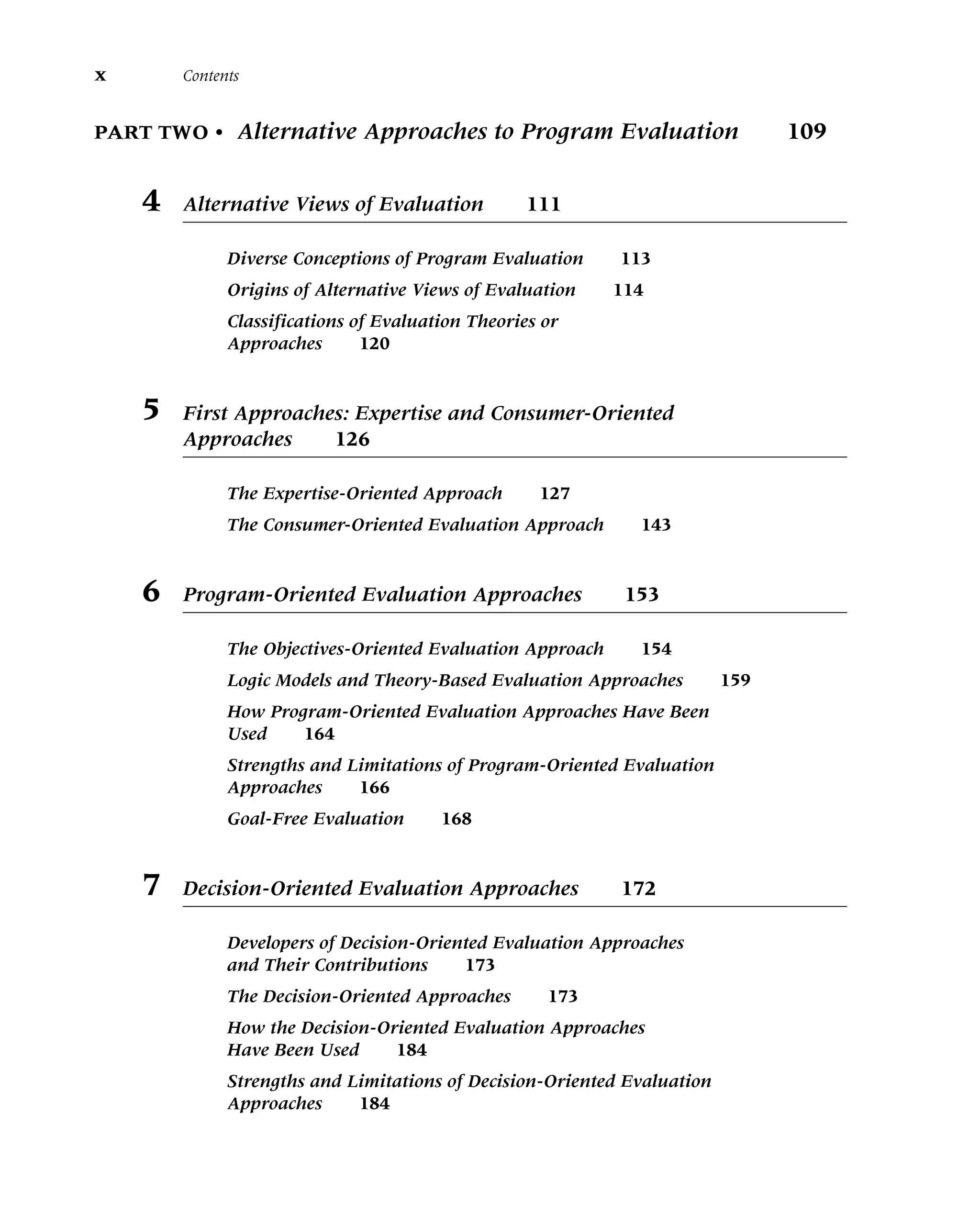
PART TWO • Alternative Approaches to Program Evaluation 109
4 Alternative Views of Evaluation 111
Diverse Conceptions of Program Evaluation 113
Origins of Alternative Views of Evaluation 114
Classifications of Evaluation Theories or
Approaches 120
5 First Approaches: Expertise and Consumer-Oriented
Approaches 126
The Expertise-Oriented Approach 127
The Consumer-Oriented Evaluation Approach 143
6 Program-Oriented Evaluation Approaches 153
The Objectives-Oriented Evaluation Approach 154
Logic Models and Theory-Based Evaluation Approaches 159
How Program-Oriented Evaluation Approaches Have Been
Used 164
Strengths and Limitations of Program-Oriented Evaluation
Approaches 166
Goal-Free Evaluation 168
7 Decision-Oriented Evaluation Approaches 172
Developers of Decision-Oriented Evaluation Approaches
and Their Contributions 173
The Decision-Oriented Approaches 173
How the Decision-Oriented Evaluation Approaches
Have Been Used 184
Strengths and Limitations of Decision-Oriented Evaluation
Approaches 184
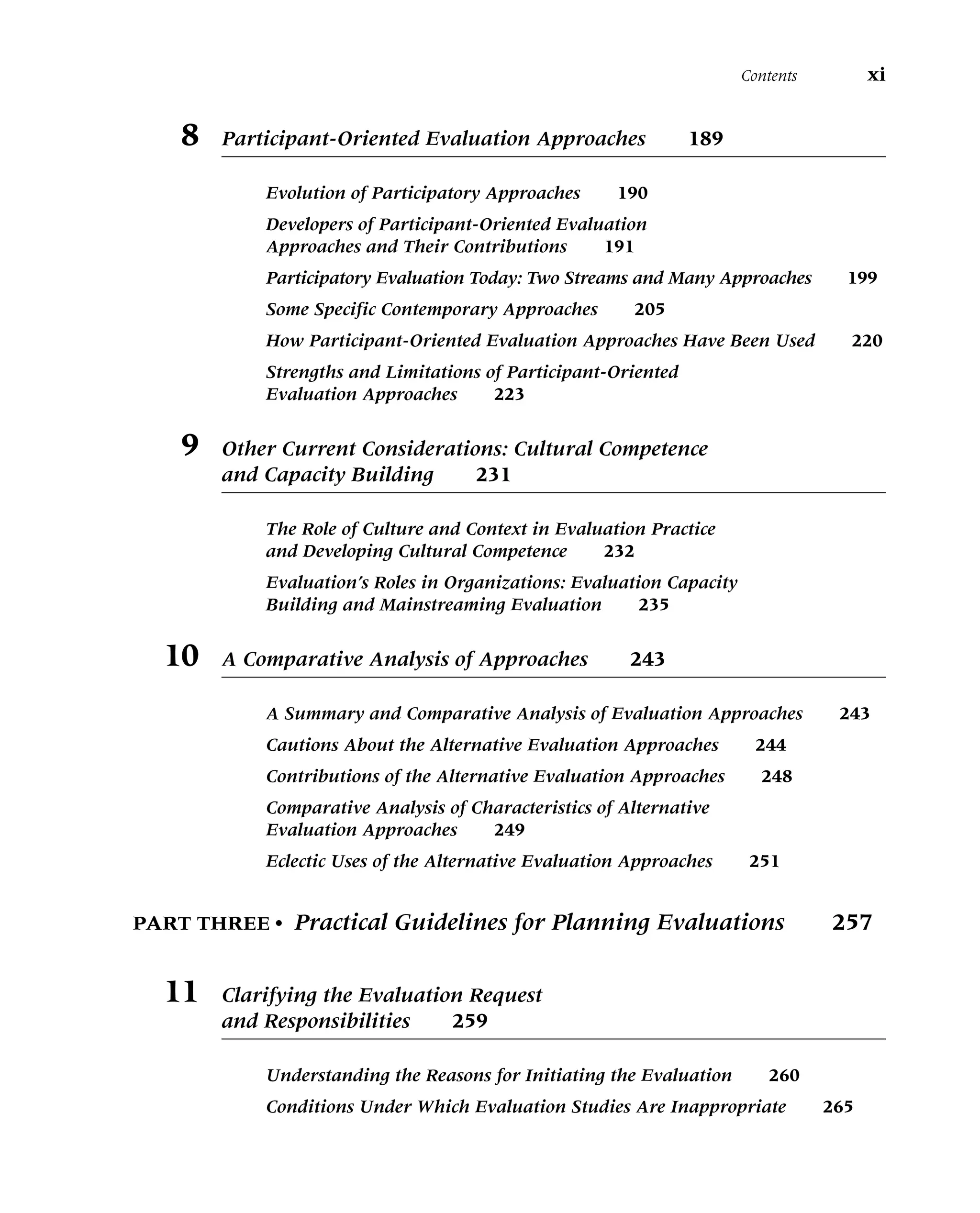
x Contents
8 Participant-Oriented Evaluation Approaches 189
Evolution of Participatory Approaches 190
Developers of Participant-Oriented Evaluation
Approaches and Their Contributions 191
Participatory Evaluation Today: Two Streams and Many Approaches 199
Some Specific Contemporary Approaches 205
How Participant-Oriented Evaluation Approaches Have Been Used 220
Strengths and Limitations of Participant-Oriented
Evaluation Approaches 223
9 Other Current Considerations: Cultural Competence
and Capacity Building 231
The Role of Culture and Context in Evaluation Practice
and Developing Cultural Competence 232
Evaluation’s Roles in Organizations: Evaluation Capacity
Building and Mainstreaming Evaluation 235
10 A Comparative Analysis of Approaches 243
A Summary and Comparative Analysis of Evaluation Approaches 243
Cautions About the Alternative Evaluation Approaches 244
Contributions of the Alternative Evaluation Approaches 248
Comparative Analysis of Characteristics of Alternative
Evaluation Approaches 249
Eclectic Uses of the Alternative Evaluation Approaches 251
PART THREE • Practical Guidelines for Planning Evaluations 257
11 Clarifying the Evaluation Request
and Responsibilities 259
Understanding the Reasons for Initiating the Evaluation 260
Conditions Under Which Evaluation Studies Are Inappropriate 265
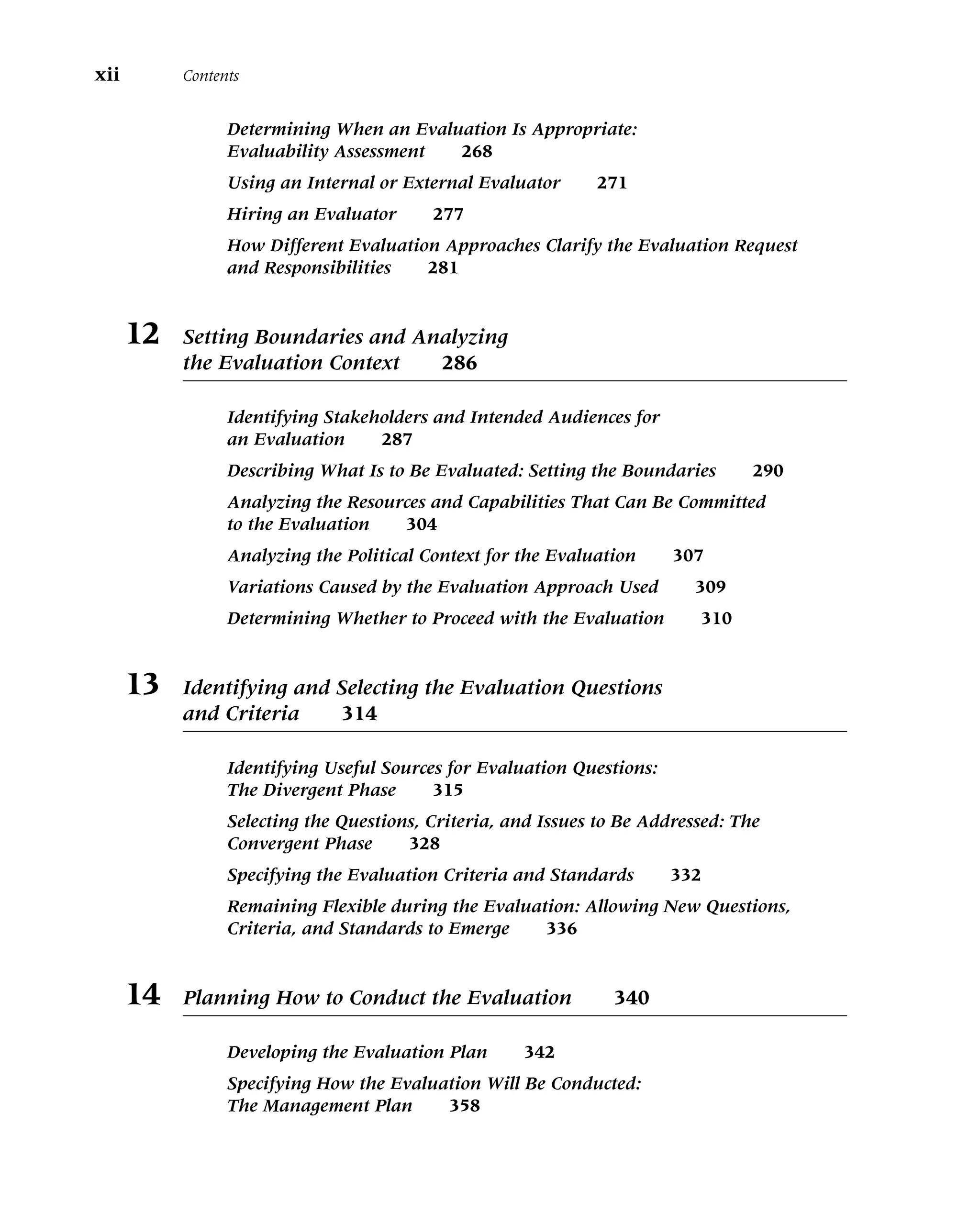
Contents xi
Determining When an Evaluation Is Appropriate:
Evaluability Assessment 268
Using an Internal or External Evaluator 271
Hiring an Evaluator 277
How Different Evaluation Approaches Clarify the Evaluation Request
and Responsibilities 281
12 Setting Boundaries and Analyzing
the Evaluation Context 286
Identifying Stakeholders and Intended Audiences for
an Evaluation 287
Describing What Is to Be Evaluated: Setting the Boundaries 290
Analyzing the Resources and Capabilities That Can Be Committed
to the Evaluation 304
Analyzing the Political Context for the Evaluation 307
Variations Caused by the Evaluation Approach Used 309
Determining Whether to Proceed with the Evaluation 310
13 Identifying and Selecting the Evaluation Questions
and Criteria 314
Identifying Useful Sources for Evaluation Questions:
The Divergent Phase 315
Selecting the Questions, Criteria, and Issues to Be Addressed: The
Convergent Phase 328
Specifying the Evaluation Criteria and Standards 332
Remaining Flexible during the Evaluation: Allowing New Questions,
Criteria, and Standards to Emerge 336
14 Planning How to Conduct the Evaluation 340
Developing the Evaluation Plan 342
Specifying How the Evaluation Will Be Conducted:
The Management Plan 358
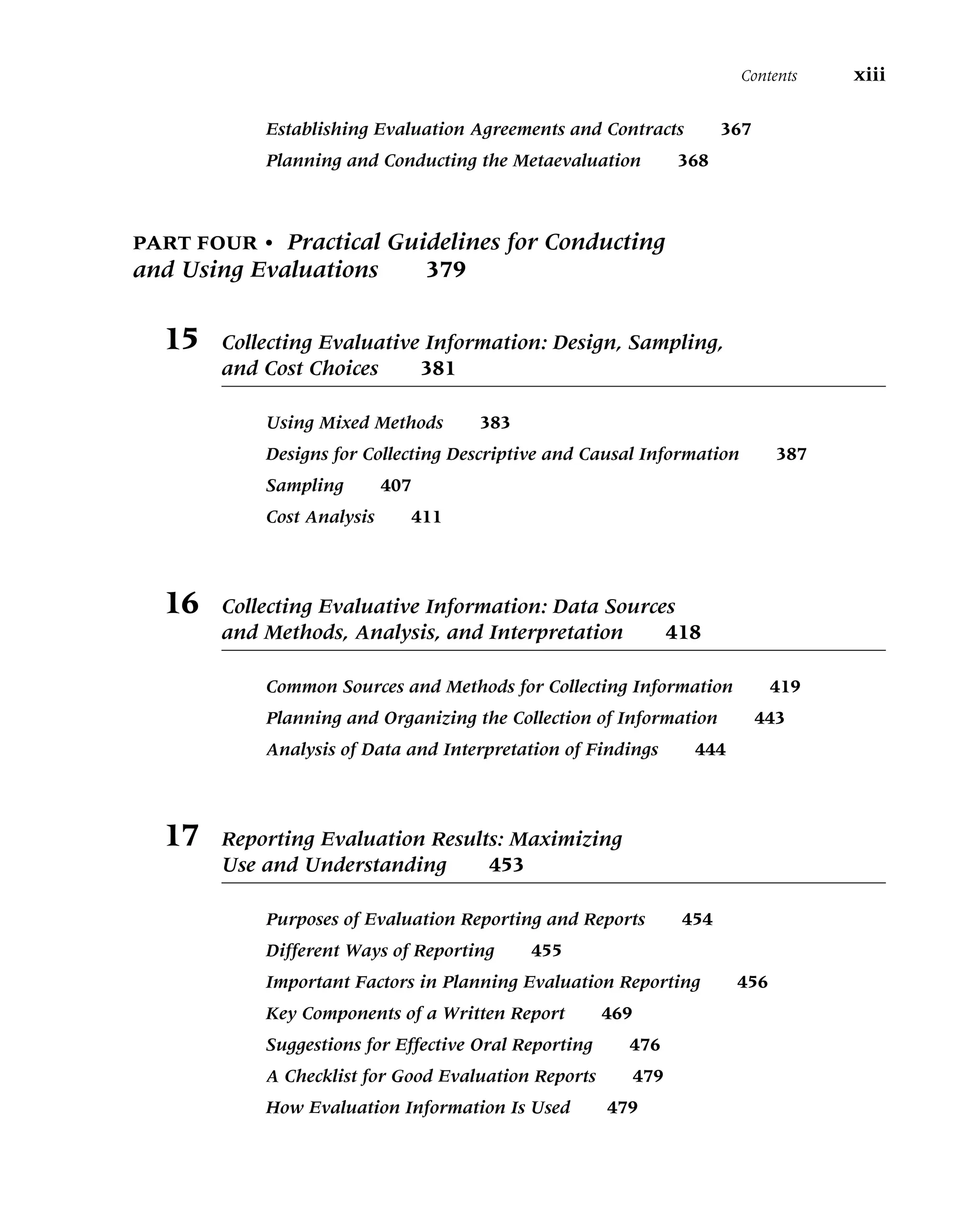
xii Contents
Establishing Evaluation Agreements and Contracts 367
Planning and Conducting the Metaevaluation 368
PART FOUR • Practical Guidelines for Conducting
and Using Evaluations 379
15 Collecting Evaluative Information: Design, Sampling,
and Cost Choices 381
Using Mixed Methods 383
Designs for Collecting Descriptive and Causal Information 387
Sampling 407
Cost Analysis 411
16 Collecting Evaluative Information: Data Sources
and Methods, Analysis, and Interpretation 418
Common Sources and Methods for Collecting Information 419
Planning and Organizing the Collection of Information 443
Analysis of Data and Interpretation of Findings 444
17 Reporting Evaluation Results: Maximizing
Use and Understanding 453
Purposes of Evaluation Reporting and Reports 454
Different Ways of Reporting 455
Important Factors in Planning Evaluation Reporting 456
Key Components of a Written Report 469
Suggestions for Effective Oral Reporting 476
A Checklist for Good Evaluation Reports 479
How Evaluation Information Is Used 479
Contents xiii
18 The Future of Evaluation 490
The Future of Evaluation 490
Predictions Concerning the Profession of Evaluation 491
Predictions Concerning the Practice of Evaluation 493
A Vision for Evaluation 496
Conclusion 497
Appendix A The Program Evaluation Standards
and Guiding Principles for Evaluators 499
References 505
Author Index 526
Subject Index 530
xiv Contents
I
Introduction
to Evaluation
Part
1
This initial section of our text provides the background necessary for the begin-
ning student to understand the chapters that follow. In it, we attempt to accom-
plish three things: to explore the concept of evaluation and its various meanings,
to review the history of program evaluation and its development as a discipline,
and to introduce the reader to some of the factors that influence the practice of
evaluation. We also acquaint the reader with some of the current controversies
and trends in the field.
In Chapter 1, we discuss the basic purposes of evaluation and the varying
roles evaluators play. We define evaluation specifically, and we introduce the
reader to several different concepts and distinctions that are important to evalua-
tion. In Chapter 2, we summarize the origins of today’s evaluation tenets and prac-
tices and the historical evolution of evaluation as a growing force in improving our
society’s public, nonprofit, and corporate programs. In Chapter 3, we discuss the
political, ethical, and interpersonal factors that underlie any evaluation and em-
phasize its distinction from research.
Our intent in Part One is to provide the reader with information essential to
understanding not only the content of the sections that follow but also the wealth
of material that exists in the literature on program evaluation. Although the con-
tent in the remainder of this book is intended to apply primarily to the evaluation
of programs, most of it also applies to the evaluation of policies, products, and
processes used in those areas and, indeed, to any object of an evaluation. In Part
Two we will introduce you to different approaches to evaluation to enlarge your
understanding of the diversity of choices that evaluators and stakeholders make
in undertaking evaluation.
Visit https://ebookmass.com today to explore
a vast collection of ebooks across various
genres, available in popular formats like
PDF, EPUB, and MOBI, fully compatible with
all devices. Enjoy a seamless reading
experience and effortlessly download high-
quality materials in just a few simple steps.
Plus, don’t miss out on exciting offers that
let you access a wealth of knowledge at the
best prices!
This page intentionally left blank
Evaluation’s Basic Purpose,
Uses, and Conceptual
Distinctions
Orienting Questions
1. What is evaluation? Why is it important?
2. What is the difference between formal and informal evaluation?
3. What are some purposes of evaluation? What roles can the evaluator play?
4. What are the major differences between formative and summative evaluations?
5. What questions might an evaluator address in a needs assessment, a process
evaluation, and an outcome evaluation?
6. What are the advantages and disadvantages of an internal evaluator? An external
evaluator?
3
1
The challenges confronting our society in the twenty-first century are enormous.
Few of them are really new. In the United States and many other countries, the
public and nonprofit sectors are grappling with complex issues: educating children
for the new century; reducing functional illiteracy; strengthening families; train-
ing people to enter or return to the workforce; training employees who currently
work in an organization; combating disease and mental illness; fighting discrimi-
nation; and reducing crime, drug abuse, and child and spouse abuse. More
recently, pursuing and balancing environmental and economic goals and working
to ensure peace and economic growth in developing countries have become prominent
concerns. As this book is written, the United States and many countries around
4 Part I • Introduction to Evaluation
the world are facing challenging economic problems that touch every aspect of so-
ciety. The policies and programs created to address these problems will require
evaluation to determine which solutions to pursue and which programs and poli-
cies are working and which are not. Each new decade seems to add to the list of
challenges, as society and the problems it confronts become increasingly complex.
As society’s concern over these pervasive and perplexing problems has
intensified, so have its efforts to resolve them. Collectively, local, regional, national,
and international agencies have initiated many programs aimed at eliminating
these problems or their underlying causes. In some cases, specific programs judged
to have been ineffective have been “mothballed” or sunk outright, often to be
replaced by a new program designed to attack the problem in a different—and,
hopefully, more effective—manner.
In more recent years, scarce resources and budget deficits have posed still
more challenges as administrators and program managers have had to struggle to
keep their most promising programs afloat. Increasingly, policymakers and man-
agers have been faced with tough choices, being forced to cancel some programs
or program components to provide sufficient funds to start new programs, to con-
tinue others, or simply to keep within current budgetary limits.
To make such choices intelligently, policy makers need good information
about the relative effectiveness of programs. Which programs are working well?
Which are failing? What are the programs’ relative costs and benefits? Similarly,
each program manager needs to know how well different parts of programs are
working. What can be done to improve those parts of the program that are not
working as well as they should? Have all aspects of the program been thought
through carefully at the planning stage, or is more planning needed? What is the
theory or logic model for the program’s effectiveness? What adaptations would
make the program more effective?
Answering such questions is the major task of program evaluation. The ma-
jor task of this book is to introduce you to evaluation and the vital role it plays in
virtually every sector of modern society. However, before we can hope to convince
you that good evaluation is an essential part of good programs, we must help you
understand at least the basic concepts in each of the following areas:
• How we—and others—define evaluation
• How formal and informal evaluation differ
• The basic purposes—and various uses—of formal evaluation
• The distinction between basic types of evaluation
• The distinction between internal and external evaluators
• Evaluation’s importance and its limitations
Covering all of those areas thoroughly could fill a whole book, not just one
chapter of an introductory text. In this chapter, we provide only brief coverage of
each of these topics to orient you to concepts and distinctions necessary to under-
stand the content of later chapters.
Chapter 1 • Evaluation’s Basic Purpose, Uses, and Conceptual Distinctions 5
Informal versus Formal Evaluation
Evaluation is not a new concept. In fact, people have been evaluating, or examin-
ing and judging things, since the beginning of human history. Neanderthals prac-
ticed it when determining which types of saplings made the best spears, as did Persian
patriarchs in selecting the most suitable suitors for their daughters, and English
yeomen who abandoned their own crossbows in favor of the Welsh longbow. They
had observed that the longbow could send an arrow through the stoutest armor
and was capable of launching three arrows while the crossbow sent only one. Al-
though no formal evaluation reports on bow comparisons have been unearthed in
English archives, it is clear that the English evaluated the longbow’s value for their
purposes, deciding that its use would strengthen them in their struggles with the
French. So the English armies relinquished their crossbows, perfected and improved
on the Welsh longbow, and proved invincible during most of the Hundred Years’ War.
By contrast, French archers experimented briefly with the longbow, then went
back to the crossbow—and continued to lose battles. Such are the perils of poor
evaluation! Unfortunately, the faulty judgment that led the French to persist in us-
ing an inferior weapon represents an informal evaluation pattern that has been re-
peated too often throughout history.
As human beings, we evaluate every day. Practitioners, managers, and
policymakers make judgments about students, clients, personnel, programs, and
policies. These judgments lead to choices and decisions. They are a natural part of
life. A school principal observes a teacher working in the classroom and forms
some judgments about that teacher’s effectiveness. A program officer of a founda-
tion visits a substance abuse program and forms a judgment about the program’s
quality and effectiveness. A policymaker hears a speech about a new method for de-
livering health care to uninsured children and draws some conclusions about whether
that method would work in his state. Such judgments are made every day in our work.
These judgments, however, are based on informal, or unsystematic, evaluations.
Informal evaluations can result in faulty or wise judgments. But, they are
characterized by an absence of breadth and depth because they lack systematic
procedures and formally collected evidence. As humans, we are limited in making
judgments both by the lack of opportunity to observe many different settings,
clients, or students and by our own past experience, which both informs and bi-
ases our judgments. Informal evaluation does not occur in a vacuum. Experience,
instinct, generalization, and reasoning can all influence the outcome of informal
evaluations, and any or all of these may be the basis for sound, or faulty, judg-
ments. Did we see the teacher on a good day or a bad one? How did our past ex-
perience with similar students, course content, and methods influence our
judgment? When we conduct informal evaluations, we are less cognizant of these
limitations. However, when formal evaluations are not possible, informal evalua-
tion carried out by knowledgeable, experienced, and fair people can be very use-
ful indeed. It would be unrealistic to think any individual, group, or organization
could formally evaluate everything it does. Often informal evaluation is the only
6 Part I • Introduction to Evaluation
practical approach. (In choosing an entrée from a dinner menu, only the most
compulsive individual would conduct exit interviews with restaurant patrons to
gather data to guide that choice.)
Informal and formal evaluation, however, form a continuum. Schwandt
(2001a) acknowledges the importance and value of everyday judgments and argues
that evaluation is not simply about methods and rules. He sees the evaluator as
helping practitioners to “cultivate critical intelligence.” Evaluation, he notes, forms
a middle ground “between overreliance on and over-application of method, general
principles, and rules to making sense of ordinary life on one hand, and advocating
trust in personal inspiration and sheer intuition on the other” (p. 86). Mark,
Henry, and Julnes (2000) echo this concept when they describe evaluation as a
form of assisted sense-making. Evaluation, they observe, “has been developed to
assist and extend natural human abilities to observe, understand, and make judgments
about policies, programs, and other objects in evaluation” (p. 179).
Evaluation, then, is a basic form of human behavior. Sometimes it is thorough,
structured, and formal. More often it is impressionistic and private. Our focus is on
the more formal, structured, and public evaluation. We want to inform readers of
various approaches and methods for developing criteria and collecting information
about alternatives. For those readers who aspire to become professional evaluators,
we will be introducing you to the approaches and methods used in these formal
studies. For all readers, practitioners and evaluators, we hope to cultivate that
critical intelligence, to make you cognizant of the factors influencing your more
informal judgments and decisions.
A Brief Definition of Evaluation
and Other Key Terms
In the previous section, the perceptive reader will have noticed that the term
“evaluation” has been used rather broadly without definition beyond what was
implicit in context. But the rest of this chapter could be rather confusing if we did
not stop briefly to define the term more precisely. Intuitively, it may not seem dif-
ficult to define evaluation. For example, one typical dictionary definition of eval-
uation is “to determine or fix the value of: to examine and judge.” Seems quite
straightforward, doesn’t it? Yet among professional evaluators, there is no uni-
formly agreed-upon definition of precisely what the term “evaluation” means. In
fact, in considering the role of language in evaluation, Michael Scriven, one of the
founders of evaluation, for an essay on the use of language in evaluation recently
noted there are nearly 60 different terms for evaluation that apply to one context
or another. These include adjudge, appraise, analyze, assess, critique, examine,
grade, inspect, judge, rate, rank, review, score, study, test, and so on (cited in
Patton, 2000, p. 7). While all these terms may appear confusing, Scriven notes
that the variety of uses of the term evaluation “reflects not only the immense im-
portance of the process of evaluation in practical life, but the explosion of a new
area of study” (cited in Patton, 2000, p. 7). This chapter will introduce the reader
Chapter 1 • Evaluation’s Basic Purpose, Uses, and Conceptual Distinctions 7
to the array of variations in application, but, at this point, we will focus on one
definition that encompasses many others.
Early in the development of the field, Scriven (1967) defined evaluation as
judging the worth or merit of something. Many recent definitions encompass this
original definition of the term (Mark, Henry, & Julnes, 2000; Schwandt, 2008;
Scriven, 1991a; Stake, 2000a; Stufflebeam, 2001b). We concur that evaluation is de-
termining the worth or merit of an evaluation object (whatever is evaluated). More
broadly, we define evaluation as the identification, clarification, and application of
defensible criteria to determine an evaluation object’s value (worth or merit) in rela-
tion to those criteria. Note that this definition requires identifying and clarifying de-
fensible criteria. Often, in practice, our judgments of evaluation objects differ because
we have failed to identify and clarify the means that we, as individuals, use to judge
an object. One educator may value a reading curriculum because of the love it instills
for reading; another may disparage the program because it does not move the child
along as rapidly as other curricula in helping the student to recognize and interpret
letters, words, or meaning. These educators differ in the value they assign to the cur-
ricula because their criteria differ. One important role of an evaluator is to help stake-
holders articulate their criteria and to stimulate dialogue about them. Our definition,
then, emphasizes using those criteria to judge the merit or worth of the product.
Evaluation uses inquiry and judgment methods, including: (1) determining
the criteria and standards for judging quality and deciding whether those stan-
dards should be relative or absolute, (2) collecting relevant information, and
(3) applying the standards to determine value, quality, utility, effectiveness, or sig-
nificance. It leads to recommendations intended to optimize the evaluation object
in relation to its intended purpose(s) or to help stakeholders determine whether
the evaluation object is worthy of adoption, continuation, or expansion.
Programs, Policies, and Products
In the United States, we often use the term “program evaluation.” In Europe and
some other countries, however, evaluators often use the term “policy evaluation.”
This book is concerned with the evaluation of programs, policies, and products. We
are not, however, concerned with evaluating personnel or the performance of indi-
vidual people or employees. That is a different area, one more concerned with man-
agement and personnel.1 (See Joint Committee. [1988]) But, at this point, it would
be useful to briefly discuss what we mean by programs, policies, and products.
“Program” is a term that can be defined in many ways. In its simplest sense, a pro-
gram is a “standing arrangement that provides for a . . . service” (Cronbach et al., 1980,
p. 14). The Joint Committee on Standards for Educational Evaluation (1994) defined
program simply as “activities that are provided on a continuing basis” (p. 3). In their
1
The Joint Committee on Standards for Educational Evaluation has developed some standards for
personnel evaluation that may be of interest to readers involved in evaluating the performance of teach-
ers or other employees working in educational settings. These can be found at http://www.eval.org/
evaluationdocuments/perseval.html.
8 Part I • Introduction to Evaluation
new edition of the Standards (2010) the Joint Committee noted that a program is
much more than a set of activities. They write:
Defined completely, a program is
• A set of planned systematic activities
• Using managed resources
• To achieve specified goals
• Related to specific needs
• Of specific, identified, participating human individuals or groups
• In specific contexts
• Resulting in documentable outputs, outcomes and impacts
• Following assumed (explicit or implicit) systems of beliefs (diagnostic, causal, in-
tervention, and implementation theories about how the program works)
• With specific, investigable costs and benefits. (Joint Committee, 2010, in press)
Note that their newer definition emphasizes programs achieving goals related
to particular needs and the fact that programs are based on certain theories or as-
sumptions. We will talk more about this later when we discuss program theory. We
will simply summarize by saying that a program is an ongoing, planned intervention
that seeks to achieve some particular outcome(s), in response to some perceived ed-
ucational, social, or commercial problem. It typically includes a complex of people,
organization, management, and resources to deliver the intervention or services.
In contrast, the word “policy” generally refers to a broader act of a public orga-
nization or a branch of government. Organizations have policies—policies about re-
cruiting and hiring employees, policies about compensation, policies concerning
interactions with media and the clients or customers served by the organization. But,
government bodies—legislatures, departments, executives, and others—also pass or
develop policies. It might be a law or a regulation. Evaluators often conduct studies to
judge the effectiveness of those policies just as they conduct studies to evaluate pro-
grams. Sometimes, the line between a program and a policy is quite blurred. Like a
program, a policy is designed to achieve some outcome or change, but, unlike a pro-
gram, a policy does not provide a service or activity. Instead, it provides guidelines,
regulations, or the like to achieve a change. Those who study public policy define policy
even more broadly: “public policy is the sum of government activities, whether acting
directly or through agents, as it has an influence on the life of citizens” (Peters, 1999,
p. 4). Policy analysts study the effectiveness of public policies just as evaluators study
the effectiveness of government programs. Sometimes, their work overlaps. What one
person calls a policy, another might call a program. In practice, in the United States,
policy analysts tend to be trained in political science and economics, and evaluators
tend to be trained in psychology, sociology, education, and public administration. As
the field of evaluation expands and clients want more information on government
programs, evaluators study the effectiveness of programs and policies.
Finally, a “product” is a more concrete entity than either a policy or a pro-
gram. It may be a textbook such as the one you are reading. It may be a piece of
software. Scriven defines a product very broadly to refer to the output of some-
thing. Thus, a product could be a student or a person who received training, the
Chapter 1 • Evaluation’s Basic Purpose, Uses, and Conceptual Distinctions 9
work of a student, or a curricula which is “the product of a research and development
effort” (1991a, p. 280).
Stakeholders
Another term used frequently in evaluation is “stakeholders.” Stakeholders are
various individuals and groups who have a direct interest in and may be affected
by the program being evaluated or the evaluation’s results. In the Encyclopedia of
Evaluation, Greene (2005) identifies four types of stakeholders:
(a) People who have authority over the program including funders, policy makers,
advisory boards;
(b) People who have direct responsibility for the program including program devel-
opers, administrators, managers, and staff delivering the program;
(c) People who are the intended beneficiaries of the program, their families, and their
communities; and
(d) People who are damaged or disadvantaged by the program (those who lose fund-
ing or are not served because of the program). (pp. 397–398)
Scriven (2007) has grouped stakeholders into groups based on how they are impacted
by the program, and he includes more groups, often political groups, than does
Greene. Thus, “upstream impactees” refer to taxpayers, political supporters, funders,
and those who make policies that affect the program. “Midstream impactees,” also
called primary stakeholders by Alkin (1991), are program managers and staff. “Down-
stream impactees” are those who receive the services or products of the program.
All of these groups hold a stake in the future direction of that program even
though they are sometimes unaware of their stake. Evaluators typically involve at
least some stakeholders in the planning and conduct of the evaluation. Their par-
ticipation can help the evaluator to better understand the program and the infor-
mation needs of those who will use it.
Differences in Evaluation and Research
It is important to distinguish between evaluation and research, because these dif-
ferences help us to understand the distinctive nature of evaluation. While some
methods of evaluation emerged from social science research traditions, there are
important distinctions between evaluation and research. One of those distinctions
is purpose. Research and evaluation seek different ends. The primary purpose of
research is to add to knowledge in a field, to contribute to the growth of theory.
A good research study is intended to advance knowledge. While the results of an
evaluation study may contribute to knowledge development (Mark, Henry, &
Julnes, 2000), that is a secondary concern in evaluation. Evaluation’s primary pur-
pose is to provide useful information to those who hold a stake in whatever is be-
ing evaluated (stakeholders), often helping them to make a judgment or decision.
10 Part I • Introduction to Evaluation
Research seeks conclusions; evaluation leads to judgments. Valuing is the sine
qua non of evaluation. A touchstone for discriminating between an evaluator and
a researcher is to ask whether the inquiry being conducted would be regarded as
a failure if it produced no data on the value of the thing being studied. A researcher
answering strictly as a researcher will probably say no.
These differing purposes have implications for the approaches one takes.
Research is the quest for laws and the development of theory—statements of re-
lationships among two or more variables. Thus, the purpose of research is typically
to explore and establish causal relationships. Evaluation, instead, seeks to exam-
ine and describe a particular thing and, ultimately, to consider its value. Some-
times, describing that thing involves examining causal relationships; often, it does
not. Whether the evaluation focuses on a causal issue depends on the information
needs of the stakeholders.
This highlights another difference in evaluation and research—who sets the
agenda. In research, the hypotheses to be investigated are chosen by the researcher
based on the researcher’s assessment of the appropriate next steps in developing
theory in the discipline or field of knowledge. In evaluation, the questions to be
answered are not those of the evaluator, but rather come from many sources,
including those of significant stakeholders. An evaluator might suggest questions,
but would never determine the focus of the study without consultation with
stakeholders. Such actions, in fact, would be unethical in evaluation. Unlike re-
search, good evaluation always involves the inclusion of stakeholders—often a
wide variety of stakeholders—in the planning and conduct of the evaluation for
many reasons: to ensure that the evaluation addresses the needs of stakeholders,
to improve the validity of results, and to enhance use.
Another difference between evaluation and research concerns generalizabil-
ity of results. Given evaluation’s purpose of making judgments about a particular
thing, good evaluation is quite specific to the context in which the evaluation
object rests. Stakeholders are making judgments about a particular evaluation object,
a program or a policy, and are not as concerned with generalizing to other settings
as researchers would be. In fact, the evaluator should be concerned with the par-
ticulars of that setting, with noting them and attending to the factors that are rel-
evant to program success or failure in that setting. (Note that the setting or context
may be a large, national program with many sites, or a small program in one school.)
In contrast, because the purpose of research is to add to general knowledge, the
methods are often designed to maximize generalizability to many different settings.
As suggested previously, another difference between research and evaluation
concerns the intended use of their results. Later in the book, we will discuss the
many different types of use that may occur in evaluation, but, ultimately, evalua-
tion is intended to have some relatively immediate impact. That impact may be on
immediate decisions, on decisions in the not-too-distant future, or on perspectives
that one or more stakeholder groups or stakeholders have about the object of the
evaluation or evaluation itself. Whatever the impact, the evaluation is designed to
be used. Good research may or may not be used right away. In fact, research that
adds in important ways to some theory may not be immediately noticed, and
Chapter 1 • Evaluation’s Basic Purpose, Uses, and Conceptual Distinctions 11
connections to a theory may not be made until some years after the research is
conducted.2 Nevertheless, the research stands alone as good research if it meets the
standards for research in that discipline or field. If one’s findings are to add to knowl-
edge in a field, ideally, the results should transcend the particulars of time and setting.
Thus, research and evaluation differ in the standards used to judge their
adequacy (Mathison, 2007). Two important criteria for judging the adequacy of
research are internal validity, the study’s success at establishing causality, and external
validity, the study’s generalizability to other settings and other times. These crite-
ria, however, are not sufficient, or appropriate, for judging the quality of an eval-
uation. As noted previously, generalizability, or external validity, is less important
for an evaluation because the focus is on the specific characteristics of the program
or policy being evaluated. Instead, evaluations are typically judged by their accuracy
(the extent to which the information obtained is an accurate reflection—a one-to-
one correspondence—with reality), utility (the extent to which the results serve
the practical information needs of intended users), feasibility (the extent to which
the evaluation is realistic, prudent, diplomatic, and frugal), and propriety (the extent
to which the evaluation is done legally and ethically, protecting the rights of those
involved). These standards and a new standard concerning evaluation accountabil-
ity were developed by the Joint Committee on Standards for Evaluation to help
both users of evaluation and evaluators themselves to understand what evalua-
tions should do (Joint Committee, 2010). (See Chapter 3 for more on the Standards.)
Researchers and evaluators also differ in the knowledge and skills required to
perform their work. Researchers are trained in depth in a single discipline—their
field of inquiry. This approach is appropriate because a researcher’s work, in almost
all cases, will remain within a single discipline or field. The methods he or she uses
will remain relatively constant, as compared with the methods that evaluators use,
because a researcher’s focus remains on similar problems that lend themselves to
certain methods of study. Evaluators, by contrast, are evaluating many different
types of programs or policies and are responding to the needs of clients and stakehold-
ers with many different information needs. Therefore, evaluators’ methodological
training must be broad and their focus may transcend several disciplines. Their edu-
cation must help them to become sensitive to the wide range of phenomena to which
they must attend if they are to properly assess the worth of a program or policy.
Evaluators must be broadly familiar with a wide variety of methods and techniques
so they can choose those most appropriate for the particular program and the needs
of its stakeholders. In addition, evaluation has developed some of its own specific
methods, such as using logic models to understand program theory and metaevalua-
tion. Mathison writes that “evaluation as a practice shamelessly borrows from all
disciplines and ways of thinking to get at both facts and values” (2007, p. 20). Her
statement illustrates both the methodological breadth required of an evaluator and
2
A notable example concerns Darwin’s work on evolution. Elements of his book, The Origin of the Species,
were rejected by scientists some years ago and are only recently being reconsidered as new research sug-
gests that some of these elements were correct. Thus, research conducted more than 100 years ago
emerges as useful because new techniques and discoveries prompt scientists to reconsider the findings.
Visit https://ebookmass.com today to explore
a vast collection of ebooks across various
genres, available in popular formats like
PDF, EPUB, and MOBI, fully compatible with
all devices. Enjoy a seamless reading
experience and effortlessly download high-
quality materials in just a few simple steps.
Plus, don’t miss out on exciting offers that
let you access a wealth of knowledge at the
best prices!
Exploring the Variety of Random
Documents with Different Content
CHAPTER XIV—HARBOR LIGHTS
CHAPTER XIV—IN WHICH BEVERIDGE SURPRISES
HIMSELF
HENRY IS TWENTY
A Further Episodic History of Henry Calverly,
3rd
By Samuel Merwin
1921
CONTENTS
OF PATTERNS AND PERSONS
I—THE IRRATIONAL ANIMAL
II—IN SAND-FLY TIME
III—THE STIMULANT
IV—THE WHITE STAR
V—TIGER, TIGER!
VI—ALADDIN ON SIMPSON STREET
VII—THE BUBBLE, REPUTATION
VIII—THIS BUD OF LOVE
IX—WHAT'S MONEY!
X—LOVE LAUGHS
THE TRUFFLERS
A Story
By Samuel Merwin
Illustrated by Frank Snapp
Indianapolis Bobbs-Merrill Company Publishers
1916
CONTENTS
CHAPTER I—THE GIRL IN THE PLAID COAT
CHAPTER II—THE SEVENTH-STORY MEN
CHAPTER III—JACOB ZANIN
CHAPTER IV—A LITTLE JOURNEY IN PARANOIA
CHAPTER V—PETER TREADS THE HEIGHTS
CHAPTER VI—THE WORM POURS OIL ON A FIRE
CHAPTER VII—PETER THINKS ABOUT THE PICTURES
CHAPTER VIII—SUE WALKS OVER A HILL
CHAPTER IX—THE NATURE FILM PRODUCING CO. INC.
CHAPTER X—PETER THE MAGNIFICENT
CHAPTER XI—PROPINQUITY-PLUS
CHAPTER XII—THE MOMENT AFTER
CHAPTER XIII—TWO GIRLS OF THE VILLAGE
CHAPTER XIV—THE WORM TURNS FROM BOOKS TO LIFE
CHAPTER XV—ZANIN MAKES HIMSELF FELT
CHAPTER XVI—THE WORM PROPOSES MARRIAGE IN
GENERAL
CHAPTER XVII—ENTER GRACE DERRING
CHAPTER XVIII—THE WORM CONSIDERS LOVE
CHAPTER XIX—BUSINESS INTERVENES
CHAPTER XX—PETER GETS A NOTE
CHAPTER XXI—OYSTERS AT JIM'S
CHAPTER XXII—A BACHELOR AT LARGE
CHAPTER XXIII—THE BUZZER
CHAPTER XXIV—THE WILD FAGAN PERSON
CHAPTER XXV—HE WHO HESITATED
CHAPTER XXVI—ENTER MARIA TONIFETTI
CHAPTER XXVII—PETER IS DRIVEN TO ACT
CHAPTER XXVIII—SUE DOES NOT SEND FOR PETER
CHAPTER XXIX—AT THE CORNER OF TENTH
CHAPTER XXX—FIFTY MINUTES FROM BROADWAY
CHAPTER XXXI—A PAIR OF RED BOOTS
CHAPTER XXXII—CHAPTER ONE
CHAPTER XXXIII—EARTHY BROWNS AND GREENS
CHAPTER XXXIV—ONE DOES FORGET ABOUT HAPPINESS
CHAPTER XXXV—THE NATURE FILM
CHAPTER XXXVI—APRIL! APRIL!
CHAPTER XXXVII—REENTER MARIA TONIFETTI
CHAPTER XXXVIII—PETER STEALS A PLAY
CHAPTER XXXIX—A MOMENT OF MELODRAMA
CHAPTER XL—HIS UNCONQUERABLE SOUL
IN RED AND GOLD
By Samuel Merwin
Frontispiece by Cyrus Leroy Baldridge
1921
CONTENTS
CHAPTER I—FELLOW VOYAGERS
CHAPTER II—BETWEEN THE WORLDS
CHAPTER III—MISS HUI FEI
CHAPTER IV—INTRIGUE
CHAPTER V—RESURGENCE
CHAPTER VI—CONFLAGRATION
CHAPTER VII—THE INSCRUTABLE WEST
CHAPTER VIII—ABOARD THE YELLOW JUNK
CHAPTER IX—IN A GARDEN
CHAPTER X—YOUTH
CHAPTER XI—THE LANDSCAPE SCROLL OF CHAO MENG-FU
CHAPTER XII—AT THE HOUR OF THE TIGER
CHAPTER XIII—HIS EXCELLENCY SPEAKS
CHAPTER XIV—THE WORLD OF FACT
CHAPTER XV—IN A COURTYARD
ANTHONY THE ABSOLUTE
By Samuel Merwin
Illustrated By R. M. Crosby
1914
CONTENTS
ANTHONY THE ABSOLUTE
At Sea—March 28th.
Yokohama, Grand Hotel, March 20th.
Grand Hotel, Yokohama, March 30th, Early Afternoon.
Midnight—Still the 30th.
On the Railway, Coasting the Island Sea—March 31st.
Peking, April 5th, Midday.
April 5th—night.
Hôtel de Chine, Peking, April 5th—or 6th.
April 6th. Night.
April 7th.
April 8th. Noon.
Night.
April 10th.
April 11th.
April 12th.
April 12th—very late.
April 14th.
April 14, (continued).
April 15th, 11 A. M.
April 15th. Night.
April 16th. Morning,
April 17th.
Grand Hôtel des Wagon-lits. April 17th. Later.
April 18th. Morning. (At the Wagon-lits).
Late Afternoon. (still the 18th.)
April 19th. Noon.
Same date.
Same date.
Still the 19th. Very late.
April 20th.
April 21st. Early.
Same date. Night.
On the Steamer, "Hsing Mien,", Yangtze River. May 1st.
HILLS OF HAN
A Romantic Incident
By Samuel Merwin
Illustrated by Walt Louderback
1919
CONTENTS
NOTE
HILLS OF HAN
CHAPTER I—THE SOLITARY
CHAPTER II—ROMANCE
CHAPTER III—THE SHEPHERD
CHAPTER IV—THE RIDDLE OF LIFE, AND OF DEATH
CHAPTER V—IN T'AINAN
CHAPTER VI—CATASTROPHE
CHAPTER VII—LOVE IS A TROUBLE
CHAPTER VIII—THE WAYFARER
CHAPTER IX—KNOTTED LIVES
CHAPTER X—GRANITE
CHAPTER XI—EMOTION
CHAPTER XII—STORM CENTER
CHAPTER XIII—THE PLEDGE
CHAPTER XIV—DILEMMA
CHAPTER XV—THE HILLS
CHAPTER XVI—DESTINY
CHAPTER XVII—APPARITION
CHAPTER XVIII—THE DARK
CHAPTER XIX—LIVING THROUGH
CHAPTER XX—LIGHT
CHAPTER XXI—THE SOULS OF MEN
CHAPTER XXII—BEGINNINGS
HIS LITTLE WORLD
The Story of Hunch Badeau
By Samuel Merwin
Illustrated by Alonzo Kimball
1903
CONTENTS
HIS LITTLE WORLD
CHAPTER I—THE MEETING
CHAPTER II—ON THE BEACH
CHAPTER III—THE CALL
CHAPTER IV—HUNCH'S WEDDING
CHAPTER V—MAMIE'S DEVICE
CHAPTER VI—BRUCE CELEBRATES
CHAPTER VII—A LIGHT GOES OUT
CHAPTER VIII—SETTING A DAY
CHAPTER IX—THE STORM
CHAPTER X—JIM BARTLETT CALLS
CHAPTER XI—STARTING FRESH
CHAPTER XII—HUNCH AND MAMIE
CHAPTER XIII—A DARK DAY AT LIDDINGTON
CHAPTER XIV—CONSIDINE'S WORK IS ENDED
CHAPTER XV—THE LETTER
CHAPTER XVI—POP-CORN BALLS
CHAPTER XVII—OLD TIES
CHAPTER XVIII—THE HOUSE WITH THE SHINGLED FRONT
THE WHIP HAND
A Tale Of The Pine Country
By Samuel Merwin
1903
CONTENTS
BOOK I—BEGINNINGS
PROLOGUE—The Young Man at the Stern
CHAPTER I—Mr. G. Hyde Bigelow
CHAPTER II—Low Life
CHAPTER III—George and His Troubles
CHAPTER IV—The End of the Beginning
BOOK — PINE
CHAPTER I—A Decision to Fight
CHAPTER II—Under Way
CHAPTER III—Tightening the Blockade
CHAPTER IV—Mr. Babcock Breakfasts Late
CHAPTER V—A Venture in Matrimony
CHAPTER VI—A Shut-down
CHAPTER VII—Halloran Goes to Chicago
CHAPTER VIII—The Question
CHAPTER X—A Letter
CHAPTER XI—High Life at the Le Ducs
CHAPTER XII—The Pine Comes In
BOOK III — THROUGH FIRE
CHAPTER I—A Little Talk with Captain Craig
CHAPTER II—Going to Headquarters
CHAPTER III—Mr. Babcock's Last Card
CHAPTER IV—Twelve, Midnight
CHAPTER V—The Meeting
CHAPTER VII—Three Announcements
CHAPTER VIII—Leveling Down
*** END OF THE PROJECT GUTENBERG EBOOK INDEX OF THE
PROJECT GUTENBERG WORKS OF SAMUEL MERWIN ***
Updated editions will replace the previous one—the old editions will
be renamed.
Creating the works from print editions not protected by U.S.
copyright law means that no one owns a United States copyright in
these works, so the Foundation (and you!) can copy and distribute it
in the United States without permission and without paying
copyright royalties. Special rules, set forth in the General Terms of
Use part of this license, apply to copying and distributing Project
Gutenberg™ electronic works to protect the PROJECT GUTENBERG™
concept and trademark. Project Gutenberg is a registered trademark,
and may not be used if you charge for an eBook, except by following
the terms of the trademark license, including paying royalties for use
of the Project Gutenberg trademark. If you do not charge anything
for copies of this eBook, complying with the trademark license is
very easy. You may use this eBook for nearly any purpose such as
creation of derivative works, reports, performances and research.
Project Gutenberg eBooks may be modified and printed and given
away—you may do practically ANYTHING in the United States with
eBooks not protected by U.S. copyright law. Redistribution is subject
to the trademark license, especially commercial redistribution.
START: FULL LICENSE
THE FULL PROJECT GUTENBERG LICENSE
PLEASE READ THIS BEFORE YOU DISTRIBUTE OR USE THIS WORK
To protect the Project Gutenberg™ mission of promoting the free
distribution of electronic works, by using or distributing this work (or
any other work associated in any way with the phrase “Project
Gutenberg”), you agree to comply with all the terms of the Full
Project Gutenberg™ License available with this file or online at
www.gutenberg.org/license.
Section 1. General Terms of Use and
Redistributing Project Gutenberg™
electronic works
1.A. By reading or using any part of this Project Gutenberg™
electronic work, you indicate that you have read, understand, agree
to and accept all the terms of this license and intellectual property
(trademark/copyright) agreement. If you do not agree to abide by all
the terms of this agreement, you must cease using and return or
destroy all copies of Project Gutenberg™ electronic works in your
possession. If you paid a fee for obtaining a copy of or access to a
Project Gutenberg™ electronic work and you do not agree to be
bound by the terms of this agreement, you may obtain a refund
from the person or entity to whom you paid the fee as set forth in
paragraph 1.E.8.
1.B. “Project Gutenberg” is a registered trademark. It may only be
used on or associated in any way with an electronic work by people
who agree to be bound by the terms of this agreement. There are a
few things that you can do with most Project Gutenberg™ electronic
works even without complying with the full terms of this agreement.
See paragraph 1.C below. There are a lot of things you can do with
Project Gutenberg™ electronic works if you follow the terms of this
agreement and help preserve free future access to Project
Gutenberg™ electronic works. See paragraph 1.E below.
1.C. The Project Gutenberg Literary Archive Foundation (“the
Foundation” or PGLAF), owns a compilation copyright in the
collection of Project Gutenberg™ electronic works. Nearly all the
individual works in the collection are in the public domain in the
United States. If an individual work is unprotected by copyright law
in the United States and you are located in the United States, we do
not claim a right to prevent you from copying, distributing,
performing, displaying or creating derivative works based on the
work as long as all references to Project Gutenberg are removed. Of
course, we hope that you will support the Project Gutenberg™
mission of promoting free access to electronic works by freely
sharing Project Gutenberg™ works in compliance with the terms of
this agreement for keeping the Project Gutenberg™ name associated
with the work. You can easily comply with the terms of this
agreement by keeping this work in the same format with its attached
full Project Gutenberg™ License when you share it without charge
with others.
1.D. The copyright laws of the place where you are located also
govern what you can do with this work. Copyright laws in most
countries are in a constant state of change. If you are outside the
United States, check the laws of your country in addition to the
terms of this agreement before downloading, copying, displaying,
performing, distributing or creating derivative works based on this
work or any other Project Gutenberg™ work. The Foundation makes
no representations concerning the copyright status of any work in
any country other than the United States.
1.E. Unless you have removed all references to Project Gutenberg:
1.E.1. The following sentence, with active links to, or other
immediate access to, the full Project Gutenberg™ License must
appear prominently whenever any copy of a Project Gutenberg™
work (any work on which the phrase “Project Gutenberg” appears,
or with which the phrase “Project Gutenberg” is associated) is
accessed, displayed, performed, viewed, copied or distributed:
This eBook is for the use of anyone anywhere in the
United States and most other parts of the world at no
cost and with almost no restrictions whatsoever. You
may copy it, give it away or re-use it under the terms
of the Project Gutenberg License included with this
eBook or online at www.gutenberg.org. If you are not
located in the United States, you will have to check the
laws of the country where you are located before using
this eBook.
1.E.2. If an individual Project Gutenberg™ electronic work is derived
from texts not protected by U.S. copyright law (does not contain a
notice indicating that it is posted with permission of the copyright
holder), the work can be copied and distributed to anyone in the
United States without paying any fees or charges. If you are
redistributing or providing access to a work with the phrase “Project
Gutenberg” associated with or appearing on the work, you must
comply either with the requirements of paragraphs 1.E.1 through
1.E.7 or obtain permission for the use of the work and the Project
Gutenberg™ trademark as set forth in paragraphs 1.E.8 or 1.E.9.
1.E.3. If an individual Project Gutenberg™ electronic work is posted
with the permission of the copyright holder, your use and distribution
must comply with both paragraphs 1.E.1 through 1.E.7 and any
additional terms imposed by the copyright holder. Additional terms
will be linked to the Project Gutenberg™ License for all works posted
with the permission of the copyright holder found at the beginning
of this work.
1.E.4. Do not unlink or detach or remove the full Project
Gutenberg™ License terms from this work, or any files containing a
part of this work or any other work associated with Project
Gutenberg™.
1.E.5. Do not copy, display, perform, distribute or redistribute this
electronic work, or any part of this electronic work, without
prominently displaying the sentence set forth in paragraph 1.E.1
with active links or immediate access to the full terms of the Project
Gutenberg™ License.
1.E.6. You may convert to and distribute this work in any binary,
compressed, marked up, nonproprietary or proprietary form,
including any word processing or hypertext form. However, if you
provide access to or distribute copies of a Project Gutenberg™ work
in a format other than “Plain Vanilla ASCII” or other format used in
the official version posted on the official Project Gutenberg™ website
(www.gutenberg.org), you must, at no additional cost, fee or
expense to the user, provide a copy, a means of exporting a copy, or
a means of obtaining a copy upon request, of the work in its original
“Plain Vanilla ASCII” or other form. Any alternate format must
include the full Project Gutenberg™ License as specified in
paragraph 1.E.1.
1.E.7. Do not charge a fee for access to, viewing, displaying,
performing, copying or distributing any Project Gutenberg™ works
unless you comply with paragraph 1.E.8 or 1.E.9.
1.E.8. You may charge a reasonable fee for copies of or providing
access to or distributing Project Gutenberg™ electronic works
provided that:
• You pay a royalty fee of 20% of the gross profits you derive
from the use of Project Gutenberg™ works calculated using the
method you already use to calculate your applicable taxes. The
fee is owed to the owner of the Project Gutenberg™ trademark,
but he has agreed to donate royalties under this paragraph to
the Project Gutenberg Literary Archive Foundation. Royalty
payments must be paid within 60 days following each date on
which you prepare (or are legally required to prepare) your
periodic tax returns. Royalty payments should be clearly marked
as such and sent to the Project Gutenberg Literary Archive
Foundation at the address specified in Section 4, “Information
about donations to the Project Gutenberg Literary Archive
Foundation.”
• You provide a full refund of any money paid by a user who
notifies you in writing (or by e-mail) within 30 days of receipt
that s/he does not agree to the terms of the full Project
Gutenberg™ License. You must require such a user to return or
destroy all copies of the works possessed in a physical medium
and discontinue all use of and all access to other copies of
Project Gutenberg™ works.
• You provide, in accordance with paragraph 1.F.3, a full refund of
any money paid for a work or a replacement copy, if a defect in
the electronic work is discovered and reported to you within 90
days of receipt of the work.
• You comply with all other terms of this agreement for free
distribution of Project Gutenberg™ works.
1.E.9. If you wish to charge a fee or distribute a Project Gutenberg™
electronic work or group of works on different terms than are set
forth in this agreement, you must obtain permission in writing from
the Project Gutenberg Literary Archive Foundation, the manager of
the Project Gutenberg™ trademark. Contact the Foundation as set
forth in Section 3 below.
1.F.
1.F.1. Project Gutenberg volunteers and employees expend
considerable effort to identify, do copyright research on, transcribe
and proofread works not protected by U.S. copyright law in creating
the Project Gutenberg™ collection. Despite these efforts, Project
Gutenberg™ electronic works, and the medium on which they may
be stored, may contain “Defects,” such as, but not limited to,
incomplete, inaccurate or corrupt data, transcription errors, a
copyright or other intellectual property infringement, a defective or
damaged disk or other medium, a computer virus, or computer
codes that damage or cannot be read by your equipment.
1.F.2. LIMITED WARRANTY, DISCLAIMER OF DAMAGES - Except for
the “Right of Replacement or Refund” described in paragraph 1.F.3,
the Project Gutenberg Literary Archive Foundation, the owner of the
Project Gutenberg™ trademark, and any other party distributing a
Project Gutenberg™ electronic work under this agreement, disclaim
all liability to you for damages, costs and expenses, including legal
fees. YOU AGREE THAT YOU HAVE NO REMEDIES FOR
NEGLIGENCE, STRICT LIABILITY, BREACH OF WARRANTY OR
BREACH OF CONTRACT EXCEPT THOSE PROVIDED IN PARAGRAPH
1.F.3. YOU AGREE THAT THE FOUNDATION, THE TRADEMARK
OWNER, AND ANY DISTRIBUTOR UNDER THIS AGREEMENT WILL
NOT BE LIABLE TO YOU FOR ACTUAL, DIRECT, INDIRECT,
CONSEQUENTIAL, PUNITIVE OR INCIDENTAL DAMAGES EVEN IF
YOU GIVE NOTICE OF THE POSSIBILITY OF SUCH DAMAGE.
1.F.3. LIMITED RIGHT OF REPLACEMENT OR REFUND - If you
discover a defect in this electronic work within 90 days of receiving
it, you can receive a refund of the money (if any) you paid for it by
sending a written explanation to the person you received the work
from. If you received the work on a physical medium, you must
return the medium with your written explanation. The person or
entity that provided you with the defective work may elect to provide
a replacement copy in lieu of a refund. If you received the work
electronically, the person or entity providing it to you may choose to
give you a second opportunity to receive the work electronically in
lieu of a refund. If the second copy is also defective, you may
demand a refund in writing without further opportunities to fix the
problem.
1.F.4. Except for the limited right of replacement or refund set forth
in paragraph 1.F.3, this work is provided to you ‘AS-IS’, WITH NO
OTHER WARRANTIES OF ANY KIND, EXPRESS OR IMPLIED,
INCLUDING BUT NOT LIMITED TO WARRANTIES OF
MERCHANTABILITY OR FITNESS FOR ANY PURPOSE.
1.F.5. Some states do not allow disclaimers of certain implied
warranties or the exclusion or limitation of certain types of damages.
If any disclaimer or limitation set forth in this agreement violates the
law of the state applicable to this agreement, the agreement shall be
interpreted to make the maximum disclaimer or limitation permitted
by the applicable state law. The invalidity or unenforceability of any
provision of this agreement shall not void the remaining provisions.
1.F.6. INDEMNITY - You agree to indemnify and hold the Foundation,
the trademark owner, any agent or employee of the Foundation,
anyone providing copies of Project Gutenberg™ electronic works in
accordance with this agreement, and any volunteers associated with
the production, promotion and distribution of Project Gutenberg™
electronic works, harmless from all liability, costs and expenses,
including legal fees, that arise directly or indirectly from any of the
following which you do or cause to occur: (a) distribution of this or
any Project Gutenberg™ work, (b) alteration, modification, or
additions or deletions to any Project Gutenberg™ work, and (c) any
Defect you cause.
Section 2. Information about the Mission
of Project Gutenberg™
Project Gutenberg™ is synonymous with the free distribution of
electronic works in formats readable by the widest variety of
computers including obsolete, old, middle-aged and new computers.
It exists because of the efforts of hundreds of volunteers and
donations from people in all walks of life.
Volunteers and financial support to provide volunteers with the
assistance they need are critical to reaching Project Gutenberg™’s
goals and ensuring that the Project Gutenberg™ collection will
Welcome to our website – the perfect destination for book lovers and
knowledge seekers. We believe that every book holds a new world,
offering opportunities for learning, discovery, and personal growth.
That’s why we are dedicated to bringing you a diverse collection of
books, ranging from classic literature and specialized publications to
self-development guides and children's books.
More than just a book-buying platform, we strive to be a bridge
connecting you with timeless cultural and intellectual values. With an
elegant, user-friendly interface and a smart search system, you can
quickly find the books that best suit your interests. Additionally,
our special promotions and home delivery services help you save time
and fully enjoy the joy of reading.
Join us on a journey of knowledge exploration, passion nurturing, and
personal growth every day!
ebookmasss.com

Program Evaluation: Alternative Approaches and Practical Guidelines – Ebook PDF Version
  • 1.
    Program Evaluation: AlternativeApproaches and Practical Guidelines – Ebook PDF Version download pdf https://ebookmass.com/product/program-evaluation-alternative-approaches- and-practical-guidelines-ebook-pdf-version/ Visit ebookmass.com today to download the complete set of ebook or textbook!
  • 2.
    We have selectedsome products that you may be interested in Click the link to download now or visit ebookmass.com for more options!. Practical Approaches to Applied Research and Program Evaluation for Helping Professionals 1st Edition, (Ebook PDF) https://ebookmass.com/product/practical-approaches-to-applied- research-and-program-evaluation-for-helping-professionals-1st-edition- ebook-pdf/ Comparative Approaches to Program Planning – Ebook PDF Version https://ebookmass.com/product/comparative-approaches-to-program- planning-ebook-pdf-version/ Health Program Planning and Evaluation 3rd Edition, (Ebook PDF) https://ebookmass.com/product/health-program-planning-and- evaluation-3rd-edition-ebook-pdf/ Program Evaluation: Methods and Case Studies 9th Edition, (Ebook PDF) https://ebookmass.com/product/program-evaluation-methods-and-case- studies-9th-edition-ebook-pdf/
  • 3.
    Introduction to 80×86Assembly Language and Computer Architecture – Ebook PDF Version https://ebookmass.com/product/introduction-to-8086-assembly-language- and-computer-architecture-ebook-pdf-version/ Program Evaluation for Social Workers: Foundations of Evidence Based Programs 7th Edition, (Ebook PDF) https://ebookmass.com/product/program-evaluation-for-social-workers- foundations-of-evidence-based-programs-7th-edition-ebook-pdf/ Counseling and Educational Research: Evaluation and Application Fourth Edition – Ebook PDF Version https://ebookmass.com/product/counseling-and-educational-research- evaluation-and-application-fourth-edition-ebook-pdf-version/ The Maudsley Prescribing Guidelines in Psychiatry 13th Edition – Ebook PDF Version https://ebookmass.com/product/the-maudsley-prescribing-guidelines-in- psychiatry-13th-edition-ebook-pdf-version/ Psychological Approaches to Pain Management, Third Edition – Ebook PDF Version: A Practitioner’s – Ebook PDF Version https://ebookmass.com/product/psychological-approaches-to-pain- management-third-edition-ebook-pdf-version-a-practitioners-ebook-pdf- version/
  • 6.
    In Parts Threeand Four, the core of the book, we describe how to plan and carry out an evaluation study. Part Three is concerned with the planning stage: learning about the program, conversing with stakeholders to learn purposes and consider future uses of the study, and identifying and finalizing evaluation questions to guide the study. Part Three teaches the reader how to develop an eval- uation plan and a management plan, including timelines and budgets for conduct- ing the study. In Part Four, we discuss the methodological choices and decisions evaluators make: selecting and developing designs; sampling, data collection, and analysis strategies; interpreting results; and communicating results to others. The chapters in each of these sections are sequential, representing the order in which decisions are made or actions are taken in the evaluation study. We make use of extensive graphics, lists, and examples to illustrate practice to the reader. This Revision Each chapter has been revised by considering the most current books, articles, and reports. Many new references and contemporary examples have been added. Thus, readers are introduced to current controversies about randomized control groups and appropriate designs for outcome evaluations, current discussions of political influences on evaluation policies and practices, research on participative approaches, discussions of cultural competency and capacity building in organiza- tions, and new models of evaluation use and views on interpreting and dissemi- nating results. We are unabashedly eclectic in our approach to evaluation. We use many different approaches and methods––whatever is appropriate for the setting––and encourage you to do the same. We don’t advocate one approach, but instruct you in many. You will learn about different approaches or theories in Part Two and different methods of collecting data in Parts Three and Four. To facilitate learning, we have continued with much the same pedagogical structure that we have used in past editions. Each chapter presents information on current and foundational issues in a practical, accessible manner. Tables and figures are used frequently to summarize or illustrate key points. Each chapter begins with Orienting Questions to introduce the reader to some of the issues that will be covered in the chapter and concludes with a list of the Major Concepts and Theories reviewed in the chapter, Discussion Questions, Application Exercises, and a list of Suggested Readings on the topics discussed. Rather than using the case study method from previous editions, we thought it was time to introduce readers to some real evaluations. Fortunately, while Blaine Worthen was editor of American Journal of Evaluation, Jody Fitzpatrick wrote a column in which she interviewed evaluators about a single evaluation they had conducted. These interviews are now widely used in teaching about evaluation. We have incorporated them into this new edition by recommending the ones that illustrate the themes introduced in each chapter. Readers and instructors can choose either to purchase the book, Evaluation in Action (Fitzpatrick, Christie, & Mark, 2009), as a case companion to this text or to access many of the interviews Preface vii
  • 7.
    through their originalpublication in the American Journal of Evaluation. At the end of each chapter, we describe one to three relevant interviews, citing the chapter in the book and the original source in the journal. We hope this book will inspire you to think in a new way about issues—in a questioning, exploring, evaluative way—and about programs, policy, and organi- zational change. For those readers who are already evaluators, this book will pro- vide you with new perspectives and tools for your practice. For those who are new to evaluation, this book will make you a more informed consumer of or participant in evaluation studies or, perhaps, guide you to undertake your own evaluation. Acknowledgments We would like to thank our colleagues in evaluation for continuing to make this such an exciting and dynamic field! Our work in each revision of our text has reminded us of the progress being made in evaluation and the wonderful insights of our colleagues about evaluation theory and practice. We would also like to thank Sophia Le, our research assistant, who has worked tirelessly, creatively, and diligently to bring this manuscript to fruition. We all are grateful to our families for the interest and pride they have shown in our work and the patience and love they have demonstrated as we have taken the time to devote to it. viii Preface
  • 8.
    Contents PART ONE •Introduction to Evaluation 1 1 Evaluation’s Basic Purpose, Uses, and Conceptual Distinctions 3 Informal versus Formal Evaluation 5 A Brief Definition of Evaluation and Other Key Terms 6 Differences in Evaluation and Research 9 The Purposes of Evaluation 13 Roles and Activities of Professional Evaluators 16 Uses and Objects of Evaluation 18 Some Basic Types of Evaluation 20 Evaluation’s Importance—and Its Limitations 32 2 Origins and Current Trends in Modern Program Evaluation 38 The History and Influence of Evaluation in Society 38 1990–The Present: History and Current Trends 49 3 Political, Interpersonal, and Ethical Issues in Evaluation 64 Evaluation and Its Political Context 65 Maintaining Ethical Standards: Considerations, Issues, and Responsibilities for Evaluators 78 ix
  • 9.
    PART TWO •Alternative Approaches to Program Evaluation 109 4 Alternative Views of Evaluation 111 Diverse Conceptions of Program Evaluation 113 Origins of Alternative Views of Evaluation 114 Classifications of Evaluation Theories or Approaches 120 5 First Approaches: Expertise and Consumer-Oriented Approaches 126 The Expertise-Oriented Approach 127 The Consumer-Oriented Evaluation Approach 143 6 Program-Oriented Evaluation Approaches 153 The Objectives-Oriented Evaluation Approach 154 Logic Models and Theory-Based Evaluation Approaches 159 How Program-Oriented Evaluation Approaches Have Been Used 164 Strengths and Limitations of Program-Oriented Evaluation Approaches 166 Goal-Free Evaluation 168 7 Decision-Oriented Evaluation Approaches 172 Developers of Decision-Oriented Evaluation Approaches and Their Contributions 173 The Decision-Oriented Approaches 173 How the Decision-Oriented Evaluation Approaches Have Been Used 184 Strengths and Limitations of Decision-Oriented Evaluation Approaches 184 x Contents
  • 10.
    8 Participant-Oriented EvaluationApproaches 189 Evolution of Participatory Approaches 190 Developers of Participant-Oriented Evaluation Approaches and Their Contributions 191 Participatory Evaluation Today: Two Streams and Many Approaches 199 Some Specific Contemporary Approaches 205 How Participant-Oriented Evaluation Approaches Have Been Used 220 Strengths and Limitations of Participant-Oriented Evaluation Approaches 223 9 Other Current Considerations: Cultural Competence and Capacity Building 231 The Role of Culture and Context in Evaluation Practice and Developing Cultural Competence 232 Evaluation’s Roles in Organizations: Evaluation Capacity Building and Mainstreaming Evaluation 235 10 A Comparative Analysis of Approaches 243 A Summary and Comparative Analysis of Evaluation Approaches 243 Cautions About the Alternative Evaluation Approaches 244 Contributions of the Alternative Evaluation Approaches 248 Comparative Analysis of Characteristics of Alternative Evaluation Approaches 249 Eclectic Uses of the Alternative Evaluation Approaches 251 PART THREE • Practical Guidelines for Planning Evaluations 257 11 Clarifying the Evaluation Request and Responsibilities 259 Understanding the Reasons for Initiating the Evaluation 260 Conditions Under Which Evaluation Studies Are Inappropriate 265 Contents xi
  • 11.
    Determining When anEvaluation Is Appropriate: Evaluability Assessment 268 Using an Internal or External Evaluator 271 Hiring an Evaluator 277 How Different Evaluation Approaches Clarify the Evaluation Request and Responsibilities 281 12 Setting Boundaries and Analyzing the Evaluation Context 286 Identifying Stakeholders and Intended Audiences for an Evaluation 287 Describing What Is to Be Evaluated: Setting the Boundaries 290 Analyzing the Resources and Capabilities That Can Be Committed to the Evaluation 304 Analyzing the Political Context for the Evaluation 307 Variations Caused by the Evaluation Approach Used 309 Determining Whether to Proceed with the Evaluation 310 13 Identifying and Selecting the Evaluation Questions and Criteria 314 Identifying Useful Sources for Evaluation Questions: The Divergent Phase 315 Selecting the Questions, Criteria, and Issues to Be Addressed: The Convergent Phase 328 Specifying the Evaluation Criteria and Standards 332 Remaining Flexible during the Evaluation: Allowing New Questions, Criteria, and Standards to Emerge 336 14 Planning How to Conduct the Evaluation 340 Developing the Evaluation Plan 342 Specifying How the Evaluation Will Be Conducted: The Management Plan 358 xii Contents
  • 12.
    Establishing Evaluation Agreementsand Contracts 367 Planning and Conducting the Metaevaluation 368 PART FOUR • Practical Guidelines for Conducting and Using Evaluations 379 15 Collecting Evaluative Information: Design, Sampling, and Cost Choices 381 Using Mixed Methods 383 Designs for Collecting Descriptive and Causal Information 387 Sampling 407 Cost Analysis 411 16 Collecting Evaluative Information: Data Sources and Methods, Analysis, and Interpretation 418 Common Sources and Methods for Collecting Information 419 Planning and Organizing the Collection of Information 443 Analysis of Data and Interpretation of Findings 444 17 Reporting Evaluation Results: Maximizing Use and Understanding 453 Purposes of Evaluation Reporting and Reports 454 Different Ways of Reporting 455 Important Factors in Planning Evaluation Reporting 456 Key Components of a Written Report 469 Suggestions for Effective Oral Reporting 476 A Checklist for Good Evaluation Reports 479 How Evaluation Information Is Used 479 Contents xiii
  • 13.
    18 The Futureof Evaluation 490 The Future of Evaluation 490 Predictions Concerning the Profession of Evaluation 491 Predictions Concerning the Practice of Evaluation 493 A Vision for Evaluation 496 Conclusion 497 Appendix A The Program Evaluation Standards and Guiding Principles for Evaluators 499 References 505 Author Index 526 Subject Index 530 xiv Contents
  • 14.
    I Introduction to Evaluation Part 1 This initialsection of our text provides the background necessary for the begin- ning student to understand the chapters that follow. In it, we attempt to accom- plish three things: to explore the concept of evaluation and its various meanings, to review the history of program evaluation and its development as a discipline, and to introduce the reader to some of the factors that influence the practice of evaluation. We also acquaint the reader with some of the current controversies and trends in the field. In Chapter 1, we discuss the basic purposes of evaluation and the varying roles evaluators play. We define evaluation specifically, and we introduce the reader to several different concepts and distinctions that are important to evalua- tion. In Chapter 2, we summarize the origins of today’s evaluation tenets and prac- tices and the historical evolution of evaluation as a growing force in improving our society’s public, nonprofit, and corporate programs. In Chapter 3, we discuss the political, ethical, and interpersonal factors that underlie any evaluation and em- phasize its distinction from research. Our intent in Part One is to provide the reader with information essential to understanding not only the content of the sections that follow but also the wealth of material that exists in the literature on program evaluation. Although the con- tent in the remainder of this book is intended to apply primarily to the evaluation of programs, most of it also applies to the evaluation of policies, products, and processes used in those areas and, indeed, to any object of an evaluation. In Part Two we will introduce you to different approaches to evaluation to enlarge your understanding of the diversity of choices that evaluators and stakeholders make in undertaking evaluation.
  • 15.
    Visit https://ebookmass.com todayto explore a vast collection of ebooks across various genres, available in popular formats like PDF, EPUB, and MOBI, fully compatible with all devices. Enjoy a seamless reading experience and effortlessly download high- quality materials in just a few simple steps. Plus, don’t miss out on exciting offers that let you access a wealth of knowledge at the best prices!
  • 16.
  • 17.
    Evaluation’s Basic Purpose, Uses,and Conceptual Distinctions Orienting Questions 1. What is evaluation? Why is it important? 2. What is the difference between formal and informal evaluation? 3. What are some purposes of evaluation? What roles can the evaluator play? 4. What are the major differences between formative and summative evaluations? 5. What questions might an evaluator address in a needs assessment, a process evaluation, and an outcome evaluation? 6. What are the advantages and disadvantages of an internal evaluator? An external evaluator? 3 1 The challenges confronting our society in the twenty-first century are enormous. Few of them are really new. In the United States and many other countries, the public and nonprofit sectors are grappling with complex issues: educating children for the new century; reducing functional illiteracy; strengthening families; train- ing people to enter or return to the workforce; training employees who currently work in an organization; combating disease and mental illness; fighting discrimi- nation; and reducing crime, drug abuse, and child and spouse abuse. More recently, pursuing and balancing environmental and economic goals and working to ensure peace and economic growth in developing countries have become prominent concerns. As this book is written, the United States and many countries around
  • 18.
    4 Part I• Introduction to Evaluation the world are facing challenging economic problems that touch every aspect of so- ciety. The policies and programs created to address these problems will require evaluation to determine which solutions to pursue and which programs and poli- cies are working and which are not. Each new decade seems to add to the list of challenges, as society and the problems it confronts become increasingly complex. As society’s concern over these pervasive and perplexing problems has intensified, so have its efforts to resolve them. Collectively, local, regional, national, and international agencies have initiated many programs aimed at eliminating these problems or their underlying causes. In some cases, specific programs judged to have been ineffective have been “mothballed” or sunk outright, often to be replaced by a new program designed to attack the problem in a different—and, hopefully, more effective—manner. In more recent years, scarce resources and budget deficits have posed still more challenges as administrators and program managers have had to struggle to keep their most promising programs afloat. Increasingly, policymakers and man- agers have been faced with tough choices, being forced to cancel some programs or program components to provide sufficient funds to start new programs, to con- tinue others, or simply to keep within current budgetary limits. To make such choices intelligently, policy makers need good information about the relative effectiveness of programs. Which programs are working well? Which are failing? What are the programs’ relative costs and benefits? Similarly, each program manager needs to know how well different parts of programs are working. What can be done to improve those parts of the program that are not working as well as they should? Have all aspects of the program been thought through carefully at the planning stage, or is more planning needed? What is the theory or logic model for the program’s effectiveness? What adaptations would make the program more effective? Answering such questions is the major task of program evaluation. The ma- jor task of this book is to introduce you to evaluation and the vital role it plays in virtually every sector of modern society. However, before we can hope to convince you that good evaluation is an essential part of good programs, we must help you understand at least the basic concepts in each of the following areas: • How we—and others—define evaluation • How formal and informal evaluation differ • The basic purposes—and various uses—of formal evaluation • The distinction between basic types of evaluation • The distinction between internal and external evaluators • Evaluation’s importance and its limitations Covering all of those areas thoroughly could fill a whole book, not just one chapter of an introductory text. In this chapter, we provide only brief coverage of each of these topics to orient you to concepts and distinctions necessary to under- stand the content of later chapters.
  • 19.
    Chapter 1 •Evaluation’s Basic Purpose, Uses, and Conceptual Distinctions 5 Informal versus Formal Evaluation Evaluation is not a new concept. In fact, people have been evaluating, or examin- ing and judging things, since the beginning of human history. Neanderthals prac- ticed it when determining which types of saplings made the best spears, as did Persian patriarchs in selecting the most suitable suitors for their daughters, and English yeomen who abandoned their own crossbows in favor of the Welsh longbow. They had observed that the longbow could send an arrow through the stoutest armor and was capable of launching three arrows while the crossbow sent only one. Al- though no formal evaluation reports on bow comparisons have been unearthed in English archives, it is clear that the English evaluated the longbow’s value for their purposes, deciding that its use would strengthen them in their struggles with the French. So the English armies relinquished their crossbows, perfected and improved on the Welsh longbow, and proved invincible during most of the Hundred Years’ War. By contrast, French archers experimented briefly with the longbow, then went back to the crossbow—and continued to lose battles. Such are the perils of poor evaluation! Unfortunately, the faulty judgment that led the French to persist in us- ing an inferior weapon represents an informal evaluation pattern that has been re- peated too often throughout history. As human beings, we evaluate every day. Practitioners, managers, and policymakers make judgments about students, clients, personnel, programs, and policies. These judgments lead to choices and decisions. They are a natural part of life. A school principal observes a teacher working in the classroom and forms some judgments about that teacher’s effectiveness. A program officer of a founda- tion visits a substance abuse program and forms a judgment about the program’s quality and effectiveness. A policymaker hears a speech about a new method for de- livering health care to uninsured children and draws some conclusions about whether that method would work in his state. Such judgments are made every day in our work. These judgments, however, are based on informal, or unsystematic, evaluations. Informal evaluations can result in faulty or wise judgments. But, they are characterized by an absence of breadth and depth because they lack systematic procedures and formally collected evidence. As humans, we are limited in making judgments both by the lack of opportunity to observe many different settings, clients, or students and by our own past experience, which both informs and bi- ases our judgments. Informal evaluation does not occur in a vacuum. Experience, instinct, generalization, and reasoning can all influence the outcome of informal evaluations, and any or all of these may be the basis for sound, or faulty, judg- ments. Did we see the teacher on a good day or a bad one? How did our past ex- perience with similar students, course content, and methods influence our judgment? When we conduct informal evaluations, we are less cognizant of these limitations. However, when formal evaluations are not possible, informal evalua- tion carried out by knowledgeable, experienced, and fair people can be very use- ful indeed. It would be unrealistic to think any individual, group, or organization could formally evaluate everything it does. Often informal evaluation is the only
  • 20.
    6 Part I• Introduction to Evaluation practical approach. (In choosing an entrée from a dinner menu, only the most compulsive individual would conduct exit interviews with restaurant patrons to gather data to guide that choice.) Informal and formal evaluation, however, form a continuum. Schwandt (2001a) acknowledges the importance and value of everyday judgments and argues that evaluation is not simply about methods and rules. He sees the evaluator as helping practitioners to “cultivate critical intelligence.” Evaluation, he notes, forms a middle ground “between overreliance on and over-application of method, general principles, and rules to making sense of ordinary life on one hand, and advocating trust in personal inspiration and sheer intuition on the other” (p. 86). Mark, Henry, and Julnes (2000) echo this concept when they describe evaluation as a form of assisted sense-making. Evaluation, they observe, “has been developed to assist and extend natural human abilities to observe, understand, and make judgments about policies, programs, and other objects in evaluation” (p. 179). Evaluation, then, is a basic form of human behavior. Sometimes it is thorough, structured, and formal. More often it is impressionistic and private. Our focus is on the more formal, structured, and public evaluation. We want to inform readers of various approaches and methods for developing criteria and collecting information about alternatives. For those readers who aspire to become professional evaluators, we will be introducing you to the approaches and methods used in these formal studies. For all readers, practitioners and evaluators, we hope to cultivate that critical intelligence, to make you cognizant of the factors influencing your more informal judgments and decisions. A Brief Definition of Evaluation and Other Key Terms In the previous section, the perceptive reader will have noticed that the term “evaluation” has been used rather broadly without definition beyond what was implicit in context. But the rest of this chapter could be rather confusing if we did not stop briefly to define the term more precisely. Intuitively, it may not seem dif- ficult to define evaluation. For example, one typical dictionary definition of eval- uation is “to determine or fix the value of: to examine and judge.” Seems quite straightforward, doesn’t it? Yet among professional evaluators, there is no uni- formly agreed-upon definition of precisely what the term “evaluation” means. In fact, in considering the role of language in evaluation, Michael Scriven, one of the founders of evaluation, for an essay on the use of language in evaluation recently noted there are nearly 60 different terms for evaluation that apply to one context or another. These include adjudge, appraise, analyze, assess, critique, examine, grade, inspect, judge, rate, rank, review, score, study, test, and so on (cited in Patton, 2000, p. 7). While all these terms may appear confusing, Scriven notes that the variety of uses of the term evaluation “reflects not only the immense im- portance of the process of evaluation in practical life, but the explosion of a new area of study” (cited in Patton, 2000, p. 7). This chapter will introduce the reader
  • 21.
    Chapter 1 •Evaluation’s Basic Purpose, Uses, and Conceptual Distinctions 7 to the array of variations in application, but, at this point, we will focus on one definition that encompasses many others. Early in the development of the field, Scriven (1967) defined evaluation as judging the worth or merit of something. Many recent definitions encompass this original definition of the term (Mark, Henry, & Julnes, 2000; Schwandt, 2008; Scriven, 1991a; Stake, 2000a; Stufflebeam, 2001b). We concur that evaluation is de- termining the worth or merit of an evaluation object (whatever is evaluated). More broadly, we define evaluation as the identification, clarification, and application of defensible criteria to determine an evaluation object’s value (worth or merit) in rela- tion to those criteria. Note that this definition requires identifying and clarifying de- fensible criteria. Often, in practice, our judgments of evaluation objects differ because we have failed to identify and clarify the means that we, as individuals, use to judge an object. One educator may value a reading curriculum because of the love it instills for reading; another may disparage the program because it does not move the child along as rapidly as other curricula in helping the student to recognize and interpret letters, words, or meaning. These educators differ in the value they assign to the cur- ricula because their criteria differ. One important role of an evaluator is to help stake- holders articulate their criteria and to stimulate dialogue about them. Our definition, then, emphasizes using those criteria to judge the merit or worth of the product. Evaluation uses inquiry and judgment methods, including: (1) determining the criteria and standards for judging quality and deciding whether those stan- dards should be relative or absolute, (2) collecting relevant information, and (3) applying the standards to determine value, quality, utility, effectiveness, or sig- nificance. It leads to recommendations intended to optimize the evaluation object in relation to its intended purpose(s) or to help stakeholders determine whether the evaluation object is worthy of adoption, continuation, or expansion. Programs, Policies, and Products In the United States, we often use the term “program evaluation.” In Europe and some other countries, however, evaluators often use the term “policy evaluation.” This book is concerned with the evaluation of programs, policies, and products. We are not, however, concerned with evaluating personnel or the performance of indi- vidual people or employees. That is a different area, one more concerned with man- agement and personnel.1 (See Joint Committee. [1988]) But, at this point, it would be useful to briefly discuss what we mean by programs, policies, and products. “Program” is a term that can be defined in many ways. In its simplest sense, a pro- gram is a “standing arrangement that provides for a . . . service” (Cronbach et al., 1980, p. 14). The Joint Committee on Standards for Educational Evaluation (1994) defined program simply as “activities that are provided on a continuing basis” (p. 3). In their 1 The Joint Committee on Standards for Educational Evaluation has developed some standards for personnel evaluation that may be of interest to readers involved in evaluating the performance of teach- ers or other employees working in educational settings. These can be found at http://www.eval.org/ evaluationdocuments/perseval.html.
  • 22.
    8 Part I• Introduction to Evaluation new edition of the Standards (2010) the Joint Committee noted that a program is much more than a set of activities. They write: Defined completely, a program is • A set of planned systematic activities • Using managed resources • To achieve specified goals • Related to specific needs • Of specific, identified, participating human individuals or groups • In specific contexts • Resulting in documentable outputs, outcomes and impacts • Following assumed (explicit or implicit) systems of beliefs (diagnostic, causal, in- tervention, and implementation theories about how the program works) • With specific, investigable costs and benefits. (Joint Committee, 2010, in press) Note that their newer definition emphasizes programs achieving goals related to particular needs and the fact that programs are based on certain theories or as- sumptions. We will talk more about this later when we discuss program theory. We will simply summarize by saying that a program is an ongoing, planned intervention that seeks to achieve some particular outcome(s), in response to some perceived ed- ucational, social, or commercial problem. It typically includes a complex of people, organization, management, and resources to deliver the intervention or services. In contrast, the word “policy” generally refers to a broader act of a public orga- nization or a branch of government. Organizations have policies—policies about re- cruiting and hiring employees, policies about compensation, policies concerning interactions with media and the clients or customers served by the organization. But, government bodies—legislatures, departments, executives, and others—also pass or develop policies. It might be a law or a regulation. Evaluators often conduct studies to judge the effectiveness of those policies just as they conduct studies to evaluate pro- grams. Sometimes, the line between a program and a policy is quite blurred. Like a program, a policy is designed to achieve some outcome or change, but, unlike a pro- gram, a policy does not provide a service or activity. Instead, it provides guidelines, regulations, or the like to achieve a change. Those who study public policy define policy even more broadly: “public policy is the sum of government activities, whether acting directly or through agents, as it has an influence on the life of citizens” (Peters, 1999, p. 4). Policy analysts study the effectiveness of public policies just as evaluators study the effectiveness of government programs. Sometimes, their work overlaps. What one person calls a policy, another might call a program. In practice, in the United States, policy analysts tend to be trained in political science and economics, and evaluators tend to be trained in psychology, sociology, education, and public administration. As the field of evaluation expands and clients want more information on government programs, evaluators study the effectiveness of programs and policies. Finally, a “product” is a more concrete entity than either a policy or a pro- gram. It may be a textbook such as the one you are reading. It may be a piece of software. Scriven defines a product very broadly to refer to the output of some- thing. Thus, a product could be a student or a person who received training, the
  • 23.
    Chapter 1 •Evaluation’s Basic Purpose, Uses, and Conceptual Distinctions 9 work of a student, or a curricula which is “the product of a research and development effort” (1991a, p. 280). Stakeholders Another term used frequently in evaluation is “stakeholders.” Stakeholders are various individuals and groups who have a direct interest in and may be affected by the program being evaluated or the evaluation’s results. In the Encyclopedia of Evaluation, Greene (2005) identifies four types of stakeholders: (a) People who have authority over the program including funders, policy makers, advisory boards; (b) People who have direct responsibility for the program including program devel- opers, administrators, managers, and staff delivering the program; (c) People who are the intended beneficiaries of the program, their families, and their communities; and (d) People who are damaged or disadvantaged by the program (those who lose fund- ing or are not served because of the program). (pp. 397–398) Scriven (2007) has grouped stakeholders into groups based on how they are impacted by the program, and he includes more groups, often political groups, than does Greene. Thus, “upstream impactees” refer to taxpayers, political supporters, funders, and those who make policies that affect the program. “Midstream impactees,” also called primary stakeholders by Alkin (1991), are program managers and staff. “Down- stream impactees” are those who receive the services or products of the program. All of these groups hold a stake in the future direction of that program even though they are sometimes unaware of their stake. Evaluators typically involve at least some stakeholders in the planning and conduct of the evaluation. Their par- ticipation can help the evaluator to better understand the program and the infor- mation needs of those who will use it. Differences in Evaluation and Research It is important to distinguish between evaluation and research, because these dif- ferences help us to understand the distinctive nature of evaluation. While some methods of evaluation emerged from social science research traditions, there are important distinctions between evaluation and research. One of those distinctions is purpose. Research and evaluation seek different ends. The primary purpose of research is to add to knowledge in a field, to contribute to the growth of theory. A good research study is intended to advance knowledge. While the results of an evaluation study may contribute to knowledge development (Mark, Henry, & Julnes, 2000), that is a secondary concern in evaluation. Evaluation’s primary pur- pose is to provide useful information to those who hold a stake in whatever is be- ing evaluated (stakeholders), often helping them to make a judgment or decision.
  • 24.
    10 Part I• Introduction to Evaluation Research seeks conclusions; evaluation leads to judgments. Valuing is the sine qua non of evaluation. A touchstone for discriminating between an evaluator and a researcher is to ask whether the inquiry being conducted would be regarded as a failure if it produced no data on the value of the thing being studied. A researcher answering strictly as a researcher will probably say no. These differing purposes have implications for the approaches one takes. Research is the quest for laws and the development of theory—statements of re- lationships among two or more variables. Thus, the purpose of research is typically to explore and establish causal relationships. Evaluation, instead, seeks to exam- ine and describe a particular thing and, ultimately, to consider its value. Some- times, describing that thing involves examining causal relationships; often, it does not. Whether the evaluation focuses on a causal issue depends on the information needs of the stakeholders. This highlights another difference in evaluation and research—who sets the agenda. In research, the hypotheses to be investigated are chosen by the researcher based on the researcher’s assessment of the appropriate next steps in developing theory in the discipline or field of knowledge. In evaluation, the questions to be answered are not those of the evaluator, but rather come from many sources, including those of significant stakeholders. An evaluator might suggest questions, but would never determine the focus of the study without consultation with stakeholders. Such actions, in fact, would be unethical in evaluation. Unlike re- search, good evaluation always involves the inclusion of stakeholders—often a wide variety of stakeholders—in the planning and conduct of the evaluation for many reasons: to ensure that the evaluation addresses the needs of stakeholders, to improve the validity of results, and to enhance use. Another difference between evaluation and research concerns generalizabil- ity of results. Given evaluation’s purpose of making judgments about a particular thing, good evaluation is quite specific to the context in which the evaluation object rests. Stakeholders are making judgments about a particular evaluation object, a program or a policy, and are not as concerned with generalizing to other settings as researchers would be. In fact, the evaluator should be concerned with the par- ticulars of that setting, with noting them and attending to the factors that are rel- evant to program success or failure in that setting. (Note that the setting or context may be a large, national program with many sites, or a small program in one school.) In contrast, because the purpose of research is to add to general knowledge, the methods are often designed to maximize generalizability to many different settings. As suggested previously, another difference between research and evaluation concerns the intended use of their results. Later in the book, we will discuss the many different types of use that may occur in evaluation, but, ultimately, evalua- tion is intended to have some relatively immediate impact. That impact may be on immediate decisions, on decisions in the not-too-distant future, or on perspectives that one or more stakeholder groups or stakeholders have about the object of the evaluation or evaluation itself. Whatever the impact, the evaluation is designed to be used. Good research may or may not be used right away. In fact, research that adds in important ways to some theory may not be immediately noticed, and
  • 25.
    Chapter 1 •Evaluation’s Basic Purpose, Uses, and Conceptual Distinctions 11 connections to a theory may not be made until some years after the research is conducted.2 Nevertheless, the research stands alone as good research if it meets the standards for research in that discipline or field. If one’s findings are to add to knowl- edge in a field, ideally, the results should transcend the particulars of time and setting. Thus, research and evaluation differ in the standards used to judge their adequacy (Mathison, 2007). Two important criteria for judging the adequacy of research are internal validity, the study’s success at establishing causality, and external validity, the study’s generalizability to other settings and other times. These crite- ria, however, are not sufficient, or appropriate, for judging the quality of an eval- uation. As noted previously, generalizability, or external validity, is less important for an evaluation because the focus is on the specific characteristics of the program or policy being evaluated. Instead, evaluations are typically judged by their accuracy (the extent to which the information obtained is an accurate reflection—a one-to- one correspondence—with reality), utility (the extent to which the results serve the practical information needs of intended users), feasibility (the extent to which the evaluation is realistic, prudent, diplomatic, and frugal), and propriety (the extent to which the evaluation is done legally and ethically, protecting the rights of those involved). These standards and a new standard concerning evaluation accountabil- ity were developed by the Joint Committee on Standards for Evaluation to help both users of evaluation and evaluators themselves to understand what evalua- tions should do (Joint Committee, 2010). (See Chapter 3 for more on the Standards.) Researchers and evaluators also differ in the knowledge and skills required to perform their work. Researchers are trained in depth in a single discipline—their field of inquiry. This approach is appropriate because a researcher’s work, in almost all cases, will remain within a single discipline or field. The methods he or she uses will remain relatively constant, as compared with the methods that evaluators use, because a researcher’s focus remains on similar problems that lend themselves to certain methods of study. Evaluators, by contrast, are evaluating many different types of programs or policies and are responding to the needs of clients and stakehold- ers with many different information needs. Therefore, evaluators’ methodological training must be broad and their focus may transcend several disciplines. Their edu- cation must help them to become sensitive to the wide range of phenomena to which they must attend if they are to properly assess the worth of a program or policy. Evaluators must be broadly familiar with a wide variety of methods and techniques so they can choose those most appropriate for the particular program and the needs of its stakeholders. In addition, evaluation has developed some of its own specific methods, such as using logic models to understand program theory and metaevalua- tion. Mathison writes that “evaluation as a practice shamelessly borrows from all disciplines and ways of thinking to get at both facts and values” (2007, p. 20). Her statement illustrates both the methodological breadth required of an evaluator and 2 A notable example concerns Darwin’s work on evolution. Elements of his book, The Origin of the Species, were rejected by scientists some years ago and are only recently being reconsidered as new research sug- gests that some of these elements were correct. Thus, research conducted more than 100 years ago emerges as useful because new techniques and discoveries prompt scientists to reconsider the findings.
  • 26.
    Visit https://ebookmass.com todayto explore a vast collection of ebooks across various genres, available in popular formats like PDF, EPUB, and MOBI, fully compatible with all devices. Enjoy a seamless reading experience and effortlessly download high- quality materials in just a few simple steps. Plus, don’t miss out on exciting offers that let you access a wealth of knowledge at the best prices!
  • 27.
    Exploring the Varietyof Random Documents with Different Content
  • 28.
    CHAPTER XIV—HARBOR LIGHTS CHAPTERXIV—IN WHICH BEVERIDGE SURPRISES HIMSELF HENRY IS TWENTY A Further Episodic History of Henry Calverly, 3rd
  • 29.
    By Samuel Merwin 1921 CONTENTS OFPATTERNS AND PERSONS I—THE IRRATIONAL ANIMAL II—IN SAND-FLY TIME III—THE STIMULANT IV—THE WHITE STAR V—TIGER, TIGER! VI—ALADDIN ON SIMPSON STREET VII—THE BUBBLE, REPUTATION VIII—THIS BUD OF LOVE IX—WHAT'S MONEY! X—LOVE LAUGHS
  • 30.
  • 31.
    By Samuel Merwin Illustratedby Frank Snapp Indianapolis Bobbs-Merrill Company Publishers 1916 CONTENTS CHAPTER I—THE GIRL IN THE PLAID COAT CHAPTER II—THE SEVENTH-STORY MEN CHAPTER III—JACOB ZANIN CHAPTER IV—A LITTLE JOURNEY IN PARANOIA CHAPTER V—PETER TREADS THE HEIGHTS CHAPTER VI—THE WORM POURS OIL ON A FIRE CHAPTER VII—PETER THINKS ABOUT THE PICTURES CHAPTER VIII—SUE WALKS OVER A HILL CHAPTER IX—THE NATURE FILM PRODUCING CO. INC. CHAPTER X—PETER THE MAGNIFICENT CHAPTER XI—PROPINQUITY-PLUS CHAPTER XII—THE MOMENT AFTER
  • 32.
    CHAPTER XIII—TWO GIRLSOF THE VILLAGE CHAPTER XIV—THE WORM TURNS FROM BOOKS TO LIFE CHAPTER XV—ZANIN MAKES HIMSELF FELT CHAPTER XVI—THE WORM PROPOSES MARRIAGE IN GENERAL CHAPTER XVII—ENTER GRACE DERRING CHAPTER XVIII—THE WORM CONSIDERS LOVE CHAPTER XIX—BUSINESS INTERVENES CHAPTER XX—PETER GETS A NOTE CHAPTER XXI—OYSTERS AT JIM'S CHAPTER XXII—A BACHELOR AT LARGE CHAPTER XXIII—THE BUZZER CHAPTER XXIV—THE WILD FAGAN PERSON CHAPTER XXV—HE WHO HESITATED CHAPTER XXVI—ENTER MARIA TONIFETTI CHAPTER XXVII—PETER IS DRIVEN TO ACT CHAPTER XXVIII—SUE DOES NOT SEND FOR PETER CHAPTER XXIX—AT THE CORNER OF TENTH CHAPTER XXX—FIFTY MINUTES FROM BROADWAY CHAPTER XXXI—A PAIR OF RED BOOTS CHAPTER XXXII—CHAPTER ONE CHAPTER XXXIII—EARTHY BROWNS AND GREENS
  • 33.
    CHAPTER XXXIV—ONE DOESFORGET ABOUT HAPPINESS CHAPTER XXXV—THE NATURE FILM CHAPTER XXXVI—APRIL! APRIL! CHAPTER XXXVII—REENTER MARIA TONIFETTI CHAPTER XXXVIII—PETER STEALS A PLAY CHAPTER XXXIX—A MOMENT OF MELODRAMA CHAPTER XL—HIS UNCONQUERABLE SOUL IN RED AND GOLD
  • 34.
    By Samuel Merwin Frontispieceby Cyrus Leroy Baldridge 1921 CONTENTS CHAPTER I—FELLOW VOYAGERS CHAPTER II—BETWEEN THE WORLDS CHAPTER III—MISS HUI FEI CHAPTER IV—INTRIGUE CHAPTER V—RESURGENCE CHAPTER VI—CONFLAGRATION CHAPTER VII—THE INSCRUTABLE WEST CHAPTER VIII—ABOARD THE YELLOW JUNK CHAPTER IX—IN A GARDEN CHAPTER X—YOUTH CHAPTER XI—THE LANDSCAPE SCROLL OF CHAO MENG-FU CHAPTER XII—AT THE HOUR OF THE TIGER
  • 35.
    CHAPTER XIII—HIS EXCELLENCYSPEAKS CHAPTER XIV—THE WORLD OF FACT CHAPTER XV—IN A COURTYARD ANTHONY THE ABSOLUTE
  • 36.
    By Samuel Merwin IllustratedBy R. M. Crosby 1914 CONTENTS ANTHONY THE ABSOLUTE At Sea—March 28th. Yokohama, Grand Hotel, March 20th. Grand Hotel, Yokohama, March 30th, Early Afternoon. Midnight—Still the 30th. On the Railway, Coasting the Island Sea—March 31st. Peking, April 5th, Midday. April 5th—night. Hôtel de Chine, Peking, April 5th—or 6th. April 6th. Night. April 7th. April 8th. Noon. Night. April 10th.
  • 37.
    April 11th. April 12th. April12th—very late. April 14th. April 14, (continued). April 15th, 11 A. M. April 15th. Night. April 16th. Morning, April 17th. Grand Hôtel des Wagon-lits. April 17th. Later. April 18th. Morning. (At the Wagon-lits). Late Afternoon. (still the 18th.) April 19th. Noon. Same date. Same date. Still the 19th. Very late. April 20th. April 21st. Early. Same date. Night. On the Steamer, "Hsing Mien,", Yangtze River. May 1st.
  • 38.
    HILLS OF HAN ARomantic Incident
  • 39.
    By Samuel Merwin Illustratedby Walt Louderback 1919 CONTENTS NOTE HILLS OF HAN CHAPTER I—THE SOLITARY CHAPTER II—ROMANCE CHAPTER III—THE SHEPHERD CHAPTER IV—THE RIDDLE OF LIFE, AND OF DEATH CHAPTER V—IN T'AINAN CHAPTER VI—CATASTROPHE CHAPTER VII—LOVE IS A TROUBLE CHAPTER VIII—THE WAYFARER CHAPTER IX—KNOTTED LIVES CHAPTER X—GRANITE CHAPTER XI—EMOTION CHAPTER XII—STORM CENTER
  • 40.
    CHAPTER XIII—THE PLEDGE CHAPTERXIV—DILEMMA CHAPTER XV—THE HILLS CHAPTER XVI—DESTINY CHAPTER XVII—APPARITION CHAPTER XVIII—THE DARK CHAPTER XIX—LIVING THROUGH CHAPTER XX—LIGHT CHAPTER XXI—THE SOULS OF MEN CHAPTER XXII—BEGINNINGS HIS LITTLE WORLD The Story of Hunch Badeau
  • 41.
    By Samuel Merwin Illustratedby Alonzo Kimball 1903 CONTENTS HIS LITTLE WORLD CHAPTER I—THE MEETING CHAPTER II—ON THE BEACH CHAPTER III—THE CALL CHAPTER IV—HUNCH'S WEDDING CHAPTER V—MAMIE'S DEVICE CHAPTER VI—BRUCE CELEBRATES CHAPTER VII—A LIGHT GOES OUT CHAPTER VIII—SETTING A DAY CHAPTER IX—THE STORM CHAPTER X—JIM BARTLETT CALLS CHAPTER XI—STARTING FRESH CHAPTER XII—HUNCH AND MAMIE CHAPTER XIII—A DARK DAY AT LIDDINGTON
  • 42.
    CHAPTER XIV—CONSIDINE'S WORKIS ENDED CHAPTER XV—THE LETTER CHAPTER XVI—POP-CORN BALLS CHAPTER XVII—OLD TIES CHAPTER XVIII—THE HOUSE WITH THE SHINGLED FRONT THE WHIP HAND A Tale Of The Pine Country
  • 43.
    By Samuel Merwin 1903 CONTENTS BOOKI—BEGINNINGS PROLOGUE—The Young Man at the Stern CHAPTER I—Mr. G. Hyde Bigelow CHAPTER II—Low Life CHAPTER III—George and His Troubles CHAPTER IV—The End of the Beginning BOOK — PINE CHAPTER I—A Decision to Fight CHAPTER II—Under Way CHAPTER III—Tightening the Blockade CHAPTER IV—Mr. Babcock Breakfasts Late CHAPTER V—A Venture in Matrimony CHAPTER VI—A Shut-down CHAPTER VII—Halloran Goes to Chicago
  • 44.
    CHAPTER VIII—The Question CHAPTERX—A Letter CHAPTER XI—High Life at the Le Ducs CHAPTER XII—The Pine Comes In BOOK III — THROUGH FIRE CHAPTER I—A Little Talk with Captain Craig CHAPTER II—Going to Headquarters CHAPTER III—Mr. Babcock's Last Card CHAPTER IV—Twelve, Midnight CHAPTER V—The Meeting CHAPTER VII—Three Announcements CHAPTER VIII—Leveling Down
  • 45.
    *** END OFTHE PROJECT GUTENBERG EBOOK INDEX OF THE PROJECT GUTENBERG WORKS OF SAMUEL MERWIN *** Updated editions will replace the previous one—the old editions will be renamed. Creating the works from print editions not protected by U.S. copyright law means that no one owns a United States copyright in these works, so the Foundation (and you!) can copy and distribute it in the United States without permission and without paying copyright royalties. Special rules, set forth in the General Terms of Use part of this license, apply to copying and distributing Project Gutenberg™ electronic works to protect the PROJECT GUTENBERG™ concept and trademark. Project Gutenberg is a registered trademark, and may not be used if you charge for an eBook, except by following the terms of the trademark license, including paying royalties for use of the Project Gutenberg trademark. If you do not charge anything for copies of this eBook, complying with the trademark license is very easy. You may use this eBook for nearly any purpose such as creation of derivative works, reports, performances and research. Project Gutenberg eBooks may be modified and printed and given away—you may do practically ANYTHING in the United States with eBooks not protected by U.S. copyright law. Redistribution is subject to the trademark license, especially commercial redistribution. START: FULL LICENSE
  • 46.
    THE FULL PROJECTGUTENBERG LICENSE
  • 47.
    PLEASE READ THISBEFORE YOU DISTRIBUTE OR USE THIS WORK To protect the Project Gutenberg™ mission of promoting the free distribution of electronic works, by using or distributing this work (or any other work associated in any way with the phrase “Project Gutenberg”), you agree to comply with all the terms of the Full Project Gutenberg™ License available with this file or online at www.gutenberg.org/license. Section 1. General Terms of Use and Redistributing Project Gutenberg™ electronic works 1.A. By reading or using any part of this Project Gutenberg™ electronic work, you indicate that you have read, understand, agree to and accept all the terms of this license and intellectual property (trademark/copyright) agreement. If you do not agree to abide by all the terms of this agreement, you must cease using and return or destroy all copies of Project Gutenberg™ electronic works in your possession. If you paid a fee for obtaining a copy of or access to a Project Gutenberg™ electronic work and you do not agree to be bound by the terms of this agreement, you may obtain a refund from the person or entity to whom you paid the fee as set forth in paragraph 1.E.8. 1.B. “Project Gutenberg” is a registered trademark. It may only be used on or associated in any way with an electronic work by people who agree to be bound by the terms of this agreement. There are a few things that you can do with most Project Gutenberg™ electronic works even without complying with the full terms of this agreement. See paragraph 1.C below. There are a lot of things you can do with Project Gutenberg™ electronic works if you follow the terms of this agreement and help preserve free future access to Project Gutenberg™ electronic works. See paragraph 1.E below.
  • 48.
    1.C. The ProjectGutenberg Literary Archive Foundation (“the Foundation” or PGLAF), owns a compilation copyright in the collection of Project Gutenberg™ electronic works. Nearly all the individual works in the collection are in the public domain in the United States. If an individual work is unprotected by copyright law in the United States and you are located in the United States, we do not claim a right to prevent you from copying, distributing, performing, displaying or creating derivative works based on the work as long as all references to Project Gutenberg are removed. Of course, we hope that you will support the Project Gutenberg™ mission of promoting free access to electronic works by freely sharing Project Gutenberg™ works in compliance with the terms of this agreement for keeping the Project Gutenberg™ name associated with the work. You can easily comply with the terms of this agreement by keeping this work in the same format with its attached full Project Gutenberg™ License when you share it without charge with others. 1.D. The copyright laws of the place where you are located also govern what you can do with this work. Copyright laws in most countries are in a constant state of change. If you are outside the United States, check the laws of your country in addition to the terms of this agreement before downloading, copying, displaying, performing, distributing or creating derivative works based on this work or any other Project Gutenberg™ work. The Foundation makes no representations concerning the copyright status of any work in any country other than the United States. 1.E. Unless you have removed all references to Project Gutenberg: 1.E.1. The following sentence, with active links to, or other immediate access to, the full Project Gutenberg™ License must appear prominently whenever any copy of a Project Gutenberg™ work (any work on which the phrase “Project Gutenberg” appears, or with which the phrase “Project Gutenberg” is associated) is accessed, displayed, performed, viewed, copied or distributed:
  • 49.
    This eBook isfor the use of anyone anywhere in the United States and most other parts of the world at no cost and with almost no restrictions whatsoever. You may copy it, give it away or re-use it under the terms of the Project Gutenberg License included with this eBook or online at www.gutenberg.org. If you are not located in the United States, you will have to check the laws of the country where you are located before using this eBook. 1.E.2. If an individual Project Gutenberg™ electronic work is derived from texts not protected by U.S. copyright law (does not contain a notice indicating that it is posted with permission of the copyright holder), the work can be copied and distributed to anyone in the United States without paying any fees or charges. If you are redistributing or providing access to a work with the phrase “Project Gutenberg” associated with or appearing on the work, you must comply either with the requirements of paragraphs 1.E.1 through 1.E.7 or obtain permission for the use of the work and the Project Gutenberg™ trademark as set forth in paragraphs 1.E.8 or 1.E.9. 1.E.3. If an individual Project Gutenberg™ electronic work is posted with the permission of the copyright holder, your use and distribution must comply with both paragraphs 1.E.1 through 1.E.7 and any additional terms imposed by the copyright holder. Additional terms will be linked to the Project Gutenberg™ License for all works posted with the permission of the copyright holder found at the beginning of this work. 1.E.4. Do not unlink or detach or remove the full Project Gutenberg™ License terms from this work, or any files containing a part of this work or any other work associated with Project Gutenberg™. 1.E.5. Do not copy, display, perform, distribute or redistribute this electronic work, or any part of this electronic work, without
  • 50.
    prominently displaying thesentence set forth in paragraph 1.E.1 with active links or immediate access to the full terms of the Project Gutenberg™ License. 1.E.6. You may convert to and distribute this work in any binary, compressed, marked up, nonproprietary or proprietary form, including any word processing or hypertext form. However, if you provide access to or distribute copies of a Project Gutenberg™ work in a format other than “Plain Vanilla ASCII” or other format used in the official version posted on the official Project Gutenberg™ website (www.gutenberg.org), you must, at no additional cost, fee or expense to the user, provide a copy, a means of exporting a copy, or a means of obtaining a copy upon request, of the work in its original “Plain Vanilla ASCII” or other form. Any alternate format must include the full Project Gutenberg™ License as specified in paragraph 1.E.1. 1.E.7. Do not charge a fee for access to, viewing, displaying, performing, copying or distributing any Project Gutenberg™ works unless you comply with paragraph 1.E.8 or 1.E.9. 1.E.8. You may charge a reasonable fee for copies of or providing access to or distributing Project Gutenberg™ electronic works provided that: • You pay a royalty fee of 20% of the gross profits you derive from the use of Project Gutenberg™ works calculated using the method you already use to calculate your applicable taxes. The fee is owed to the owner of the Project Gutenberg™ trademark, but he has agreed to donate royalties under this paragraph to the Project Gutenberg Literary Archive Foundation. Royalty payments must be paid within 60 days following each date on which you prepare (or are legally required to prepare) your periodic tax returns. Royalty payments should be clearly marked as such and sent to the Project Gutenberg Literary Archive Foundation at the address specified in Section 4, “Information
  • 51.
    about donations tothe Project Gutenberg Literary Archive Foundation.” • You provide a full refund of any money paid by a user who notifies you in writing (or by e-mail) within 30 days of receipt that s/he does not agree to the terms of the full Project Gutenberg™ License. You must require such a user to return or destroy all copies of the works possessed in a physical medium and discontinue all use of and all access to other copies of Project Gutenberg™ works. • You provide, in accordance with paragraph 1.F.3, a full refund of any money paid for a work or a replacement copy, if a defect in the electronic work is discovered and reported to you within 90 days of receipt of the work. • You comply with all other terms of this agreement for free distribution of Project Gutenberg™ works. 1.E.9. If you wish to charge a fee or distribute a Project Gutenberg™ electronic work or group of works on different terms than are set forth in this agreement, you must obtain permission in writing from the Project Gutenberg Literary Archive Foundation, the manager of the Project Gutenberg™ trademark. Contact the Foundation as set forth in Section 3 below. 1.F. 1.F.1. Project Gutenberg volunteers and employees expend considerable effort to identify, do copyright research on, transcribe and proofread works not protected by U.S. copyright law in creating the Project Gutenberg™ collection. Despite these efforts, Project Gutenberg™ electronic works, and the medium on which they may be stored, may contain “Defects,” such as, but not limited to, incomplete, inaccurate or corrupt data, transcription errors, a copyright or other intellectual property infringement, a defective or
  • 52.
    damaged disk orother medium, a computer virus, or computer codes that damage or cannot be read by your equipment. 1.F.2. LIMITED WARRANTY, DISCLAIMER OF DAMAGES - Except for the “Right of Replacement or Refund” described in paragraph 1.F.3, the Project Gutenberg Literary Archive Foundation, the owner of the Project Gutenberg™ trademark, and any other party distributing a Project Gutenberg™ electronic work under this agreement, disclaim all liability to you for damages, costs and expenses, including legal fees. YOU AGREE THAT YOU HAVE NO REMEDIES FOR NEGLIGENCE, STRICT LIABILITY, BREACH OF WARRANTY OR BREACH OF CONTRACT EXCEPT THOSE PROVIDED IN PARAGRAPH 1.F.3. YOU AGREE THAT THE FOUNDATION, THE TRADEMARK OWNER, AND ANY DISTRIBUTOR UNDER THIS AGREEMENT WILL NOT BE LIABLE TO YOU FOR ACTUAL, DIRECT, INDIRECT, CONSEQUENTIAL, PUNITIVE OR INCIDENTAL DAMAGES EVEN IF YOU GIVE NOTICE OF THE POSSIBILITY OF SUCH DAMAGE. 1.F.3. LIMITED RIGHT OF REPLACEMENT OR REFUND - If you discover a defect in this electronic work within 90 days of receiving it, you can receive a refund of the money (if any) you paid for it by sending a written explanation to the person you received the work from. If you received the work on a physical medium, you must return the medium with your written explanation. The person or entity that provided you with the defective work may elect to provide a replacement copy in lieu of a refund. If you received the work electronically, the person or entity providing it to you may choose to give you a second opportunity to receive the work electronically in lieu of a refund. If the second copy is also defective, you may demand a refund in writing without further opportunities to fix the problem. 1.F.4. Except for the limited right of replacement or refund set forth in paragraph 1.F.3, this work is provided to you ‘AS-IS’, WITH NO OTHER WARRANTIES OF ANY KIND, EXPRESS OR IMPLIED,
  • 53.
    INCLUDING BUT NOTLIMITED TO WARRANTIES OF MERCHANTABILITY OR FITNESS FOR ANY PURPOSE. 1.F.5. Some states do not allow disclaimers of certain implied warranties or the exclusion or limitation of certain types of damages. If any disclaimer or limitation set forth in this agreement violates the law of the state applicable to this agreement, the agreement shall be interpreted to make the maximum disclaimer or limitation permitted by the applicable state law. The invalidity or unenforceability of any provision of this agreement shall not void the remaining provisions. 1.F.6. INDEMNITY - You agree to indemnify and hold the Foundation, the trademark owner, any agent or employee of the Foundation, anyone providing copies of Project Gutenberg™ electronic works in accordance with this agreement, and any volunteers associated with the production, promotion and distribution of Project Gutenberg™ electronic works, harmless from all liability, costs and expenses, including legal fees, that arise directly or indirectly from any of the following which you do or cause to occur: (a) distribution of this or any Project Gutenberg™ work, (b) alteration, modification, or additions or deletions to any Project Gutenberg™ work, and (c) any Defect you cause. Section 2. Information about the Mission of Project Gutenberg™ Project Gutenberg™ is synonymous with the free distribution of electronic works in formats readable by the widest variety of computers including obsolete, old, middle-aged and new computers. It exists because of the efforts of hundreds of volunteers and donations from people in all walks of life. Volunteers and financial support to provide volunteers with the assistance they need are critical to reaching Project Gutenberg™’s goals and ensuring that the Project Gutenberg™ collection will
  • 54.
    Welcome to ourwebsite – the perfect destination for book lovers and knowledge seekers. We believe that every book holds a new world, offering opportunities for learning, discovery, and personal growth. That’s why we are dedicated to bringing you a diverse collection of books, ranging from classic literature and specialized publications to self-development guides and children's books. More than just a book-buying platform, we strive to be a bridge connecting you with timeless cultural and intellectual values. With an elegant, user-friendly interface and a smart search system, you can quickly find the books that best suit your interests. Additionally, our special promotions and home delivery services help you save time and fully enjoy the joy of reading. Join us on a journey of knowledge exploration, passion nurturing, and personal growth every day! ebookmasss.com