Dr. Asad Zaman
Presentation at PIDE, 21st April 2014
Based on “Empirical Evidence Against Utility
Theory: A Survey of the Literature”
See Video Lecture at: http://bit.do/AZeeau
 Methodenstreit: Historical, Local, Empirical
Method Lost to Universal Invariant Laws.
 Weber: Reality is too complex. Focus on a
few simple factors.
 Polanyi: Great Transformation from
Traditional Society to Market Society
 Market Society requires greed, pursuit of
profits, lack of compassion to function.
 Dramatic Conflict between Humane Social
Values & Market Values.
 Conflict between Market & Social Norms.
 Developing Market Society requires
CRUSHING social norms.
 No compassion for the poor.
 No sense of brotherhood.
 Competition instead of Cooperation.
 As Market Norms Take Over, Society Breaks
Down.
 Enter to Learn, Leave to Earn (instead of
Serve)
 Doctors make Profits from Poor/Sick/Needy.
 Built in Social Norms: Compassion, Kindness,
Empathy.
 Market Norms: Selfishness, Greed,
Competition.
 Leads to Dual Personality
 Experiments show human behavior depends
on FRAMING.
 Library Volunteers
 Blood Donations
 Work Bonus & Monitoring.
 Humans are COLD, CALCULATING & CALLOUS:
 COLD: Not affected by emotions: purely
rational calculation of self-interest.
 CALCULATING: They MAXIMIZE to the last
penny.
 CALLOUS: Indifferent to the feelings of
others.
 TRUTH: This is not so, EVEN in the
marketplace. Impulse Buying – Ads appeal to
many kinds of emotions.
 Proposer Offers A Share of Total
 Responder accepts: both get as proposed.
 Responder Rejects: No one gets anything.
 ANALYZE RESULTS AFTER PLAYING GAME
ECONOMIC THEORY gives UNIQUE MAXIMIZING
SOLUTION
 Proposer takes ALL except for one UNIT.
Responder Accepts, because ONE is more
than ZERO.
 Above is unique dominant strategy, JUST LIKE
utility maximization.
 FAILS COMPLETELY to describe human
behavior.
 BEHAVIORAL ECONOMICS: goal to describe
human behavior (instead of axiomatizing it).
 Behavioral Economics is a threatened
minority group.
 They seek to conform, at least outwardly.
 They seek acceptance within mainstream.
 They try to make MINIMAL changes to
existing economic theories to bring them into
conformity with observed behavior.
 Prospect Theory is a good example.
 Good Short Term Strategy, but not
revolutionary.
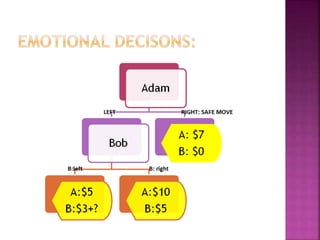
Adam
Bob
A:$5
B:$3+?
A:$10
B:$5
A: $7
B: $0
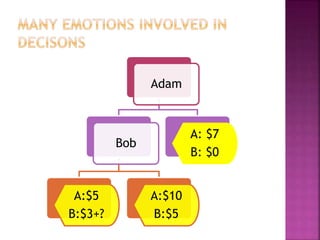
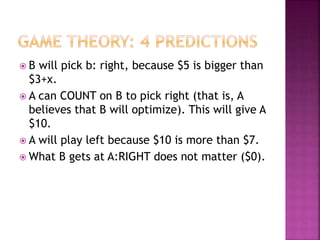
 B will pick b: right, because $5 is bigger than
$3+x.
 A can COUNT on B to pick right (that is, A
believes that B will optimize). This will give A
$10.
 A will play left because $10 is more than $7.
 What B gets at A:RIGHT does not matter ($0).
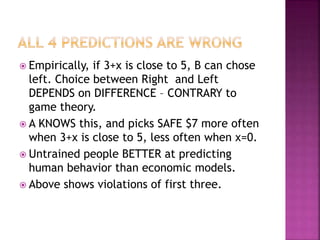
 Empirically, if 3+x is close to 5, B can chose
left. Choice between Right and Left
DEPENDS on DIFFERENCE – CONTRARY to
game theory.
 A KNOWS this, and picks SAFE $7 more often
when 3+x is close to 5, less often when x=0.
 Untrained people BETTER at predicting
human behavior than economic models.
 Above shows violations of first three.
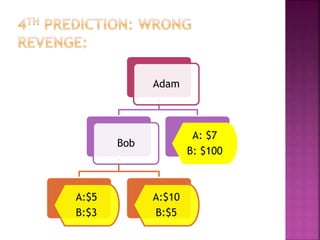
Adam
Bob
A:$5
B:$3
A:$10
B:$5
A: $7
B: $100
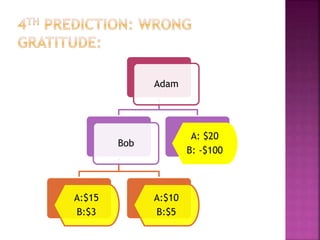
Adam
Bob
A:$15
B:$3
A:$10
B:$5
A: $20
B: -$100
 Carelessness, Indifference
 RECIPROCITY
 Caring for Others
 Theory: Cooperation is long run selfishness.
 Practice: People dont make long run
calculations.
 Theory: Selfish Behavior Maximizes LR
Welfare.
 Practice: Generous & Cooperative Behavior
maximizes LR welfare.
 Scarcity Thinking Versus Abundance –
mindsets: Amir Wahbelbari
 “Scarcity: Why Having Too Little Means So
Much” Sendhil Mullainathan, Eldar Shafir
 Generosity is a UNIVERSAL behavior, contrary
to Economic Theory
 Preference, Outcomes, Enjoyment all depend
on social norms, and cultural conditioning.
 Process is often more important than
outcomes.
 Institutional & Socio-Cultural Details matter
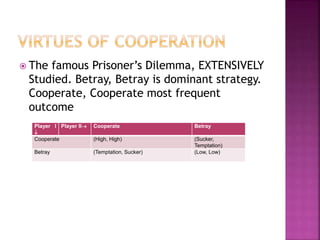
 The famous Prisoner’s Dilemma, EXTENSIVELY
Studied. Betray, Betray is dominant strategy.
Cooperate, Cooperate most frequent
outcome
Player I

Player II Cooperate Betray
Cooperate (High, High) (Sucker,
Temptation)
Betray (Temptation, Sucker) (Low, Low)
 “Cheap Talk” has strong effect on outcomes
 Size of Temptation & Sucker payoff matters
systematically.
 Cooperation is strong in repeated games.
According to game theory, no cooperation in
finite repeated games.

Behavioral Economics Versus Neoclassical Utility Theory

  • 1.
    Dr. Asad Zaman Presentationat PIDE, 21st April 2014 Based on “Empirical Evidence Against Utility Theory: A Survey of the Literature” See Video Lecture at: http://bit.do/AZeeau
  • 2.
     Methodenstreit: Historical,Local, Empirical Method Lost to Universal Invariant Laws.  Weber: Reality is too complex. Focus on a few simple factors.  Polanyi: Great Transformation from Traditional Society to Market Society  Market Society requires greed, pursuit of profits, lack of compassion to function.  Dramatic Conflict between Humane Social Values & Market Values.
  • 3.
     Conflict betweenMarket & Social Norms.  Developing Market Society requires CRUSHING social norms.  No compassion for the poor.  No sense of brotherhood.  Competition instead of Cooperation.  As Market Norms Take Over, Society Breaks Down.  Enter to Learn, Leave to Earn (instead of Serve)  Doctors make Profits from Poor/Sick/Needy.
  • 4.
     Built inSocial Norms: Compassion, Kindness, Empathy.  Market Norms: Selfishness, Greed, Competition.  Leads to Dual Personality  Experiments show human behavior depends on FRAMING.  Library Volunteers  Blood Donations  Work Bonus & Monitoring.
  • 5.
     Humans areCOLD, CALCULATING & CALLOUS:  COLD: Not affected by emotions: purely rational calculation of self-interest.  CALCULATING: They MAXIMIZE to the last penny.  CALLOUS: Indifferent to the feelings of others.  TRUTH: This is not so, EVEN in the marketplace. Impulse Buying – Ads appeal to many kinds of emotions.
  • 6.
     Proposer OffersA Share of Total  Responder accepts: both get as proposed.  Responder Rejects: No one gets anything.  ANALYZE RESULTS AFTER PLAYING GAME
  • 7.
    ECONOMIC THEORY givesUNIQUE MAXIMIZING SOLUTION  Proposer takes ALL except for one UNIT. Responder Accepts, because ONE is more than ZERO.  Above is unique dominant strategy, JUST LIKE utility maximization.  FAILS COMPLETELY to describe human behavior.  BEHAVIORAL ECONOMICS: goal to describe human behavior (instead of axiomatizing it).
  • 8.
     Behavioral Economicsis a threatened minority group.  They seek to conform, at least outwardly.  They seek acceptance within mainstream.  They try to make MINIMAL changes to existing economic theories to bring them into conformity with observed behavior.  Prospect Theory is a good example.  Good Short Term Strategy, but not revolutionary.
  • 10.
  • 11.
     B willpick b: right, because $5 is bigger than $3+x.  A can COUNT on B to pick right (that is, A believes that B will optimize). This will give A $10.  A will play left because $10 is more than $7.  What B gets at A:RIGHT does not matter ($0).
  • 12.
     Empirically, if3+x is close to 5, B can chose left. Choice between Right and Left DEPENDS on DIFFERENCE – CONTRARY to game theory.  A KNOWS this, and picks SAFE $7 more often when 3+x is close to 5, less often when x=0.  Untrained people BETTER at predicting human behavior than economic models.  Above shows violations of first three.
  • 13.
  • 14.
  • 15.
     Carelessness, Indifference RECIPROCITY  Caring for Others
  • 16.
     Theory: Cooperationis long run selfishness.  Practice: People dont make long run calculations.  Theory: Selfish Behavior Maximizes LR Welfare.  Practice: Generous & Cooperative Behavior maximizes LR welfare.  Scarcity Thinking Versus Abundance – mindsets: Amir Wahbelbari  “Scarcity: Why Having Too Little Means So Much” Sendhil Mullainathan, Eldar Shafir
  • 17.
     Generosity isa UNIVERSAL behavior, contrary to Economic Theory  Preference, Outcomes, Enjoyment all depend on social norms, and cultural conditioning.  Process is often more important than outcomes.  Institutional & Socio-Cultural Details matter
  • 18.
     The famousPrisoner’s Dilemma, EXTENSIVELY Studied. Betray, Betray is dominant strategy. Cooperate, Cooperate most frequent outcome Player I  Player II Cooperate Betray Cooperate (High, High) (Sucker, Temptation) Betray (Temptation, Sucker) (Low, Low)
  • 19.
     “Cheap Talk”has strong effect on outcomes  Size of Temptation & Sucker payoff matters systematically.  Cooperation is strong in repeated games. According to game theory, no cooperation in finite repeated games.