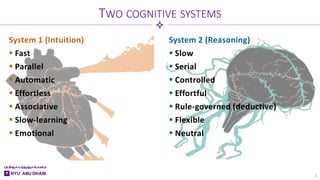
System 1 (Intuition)
Fast
Parallel
Automatic
Effortless
Associative
Slow-learning
Emotional
System 2 (Reasoning)
Slow
Serial
Controlled
Effortful
Rule-governed (deductive)
Flexible
Neutral
TWO COGNITIVE SYSTEMS
2
3.
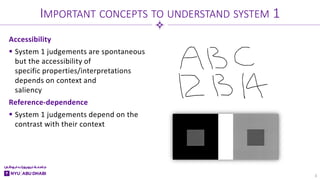
Accessibility
System 1judgements are spontaneous
but the accessibility of
specific properties/interpretations
depends on context and
saliency
Reference-dependence
System 1 judgements depend on the
contrast with their context
IMPORTANT CONCEPTS TO UNDERSTAND SYSTEM 1
3
4.
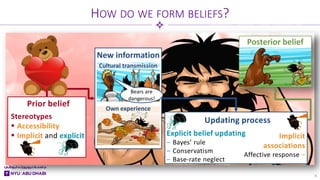
HOW DO WEFORM BELIEFS?
4
New information
Cultural transmission
Own experience
Bears are
dangerous!
Prior belief
Prior belief
Stereotypes
Accessibility
Implicit and explicit
Updating process
Implicit
associations
Affective response ‒
Posterior belief
Explicit belief updating
‒ Bayes’ rule
‒ Conservatism
‒ Base-rate neglect
5.
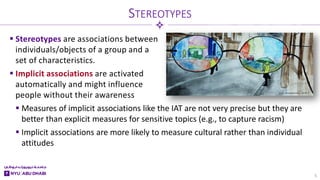
Stereotypes areassociations between
individuals/objects of a group and a
set of characteristics.
Implicit associations are activated
automatically and might influence
people without their awareness
Measures of implicit associations like the IAT are not very precise but they are
better than explicit measures for sensitive topics (e.g., to capture racism)
Implicit associations are more likely to measure cultural rather than individual
attitudes
STEREOTYPES
5
6.
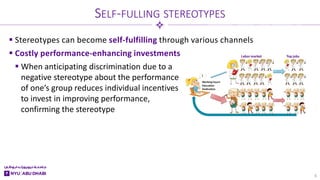
Stereotypes canbecome self-fulfilling through various channels
Costly performance-enhancing investments
When anticipating discrimination due to a
negative stereotype about the performance
of one’s group reduces individual incentives
to invest in improving performance,
confirming the stereotype
SELF-FULLING STEREOTYPES
6
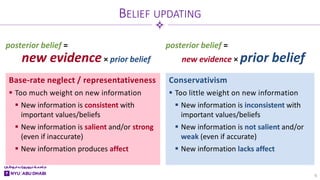
Base-rate neglect /representativeness
Too much weight on new information
New information is consistent with
important values/beliefs
New information is salient and/or strong
(even if inaccurate)
New information produces affect
Conservativism
Too little weight on new information
New information is inconsistent with
important values/beliefs
New information is not salient and/or
weak (even if accurate)
New information lacks affect
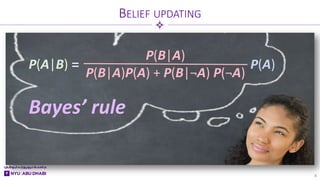
BELIEF UPDATING
9
posterior belief =
new evidence× prior belief
posterior belief =
new evidence × prior belief
COMPETITIVENESS
11
[adjective] a desireand/or ability to perform in competitions
Time difference when competing faster
–0.050
+0.058
+0.201
+0.135
vs.
vs.
vs.
vs.
vs.
vs.
+0.016
+0.016
40%
66%
60%
34%
0%
10%
20%
30%
40%
50%
60%
70%
Men Women
Percent
Piece-rate Tournament
12.
DECISIONS UNDER RISKAND UNCERTAINTY
12
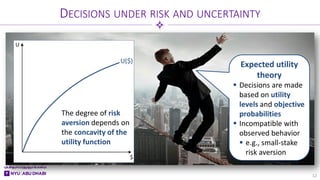
Expected utility
theory
Decisions are made
based on utility
levels and objective
probabilities
Incompatible with
observed behavior
e.g., small-stake
risk aversion
U
$
U($)
The degree of risk
aversion depends on
the concavity of the
utility function
13.
DECISIONS UNDER RISKAND UNCERTAINTY
13
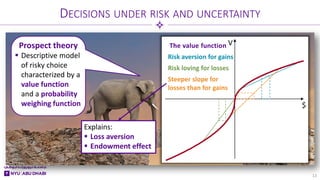
Prospect theory
Descriptive model
of risky choice
characterized by a
value function
and a probability
weighing function
V
$
The value function
Risk aversion for gains
Risk loving for losses
Steeper slope for
losses than for gains
Explains:
Loss aversion
Endowment effect
14.
DECISIONS UNDER RISKAND UNCERTAINTY
14
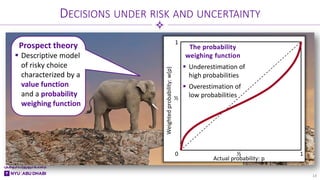
Prospect theory
Descriptive model
of risky choice
characterized by a
value function
and a probability
weighing function
1
1
0
½
½
Actual probability: p
Weighted
probability:
w(p)
The probability
weighing function
Underestimation of
high probabilities
Overestimation of
low probabilities
15.
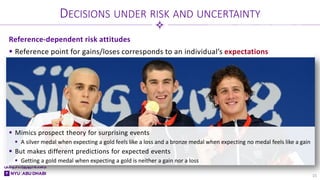
Reference-dependent risk attitudes
Reference point for gains/loses corresponds to an individual’s expectations
DECISIONS UNDER RISK AND UNCERTAINTY
15
Mimics prospect theory for surprising events
A silver medal when expecting a gold feels like a loss and a bronze medal when expecting no medal feels like a gain
But makes different predictions for expected events
Getting a gold medal when expecting a gold is neither a gain nor a loss
16.
t
D
1
0
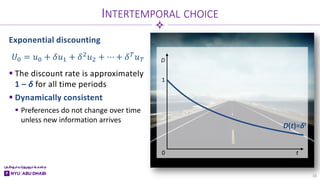
Exponential discounting
Thediscount rate is approximately
1 – δ for all time periods
Dynamically consistent
Preferences do not change over time
unless new information arrives
INTERTEMPORAL CHOICE
16
𝑈𝑈0 = 𝑢𝑢0 + 𝛿𝛿𝑢𝑢1 + 𝛿𝛿2𝑢𝑢2 + ⋯ + 𝛿𝛿𝑇𝑇𝑢𝑢𝑇𝑇
D(t)=δt
17.
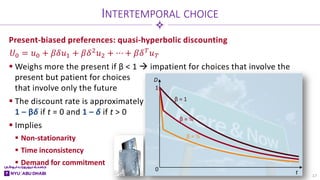
Present-biased preferences: quasi-hyperbolicdiscounting
Weighs more the present if β < 1 impatient for choices that involve the
present but patient for choices
that involve only the future
The discount rate is approximately
1 – βδ if t = 0 and 1 – δ if t > 0
Implies
Non-stationarity
Time inconsistency
Demand for commitment
t
D
0
1
INTERTEMPORAL CHOICE
17
𝑈𝑈0 = 𝑢𝑢0 + 𝛽𝛽𝛽𝛽𝑢𝑢1 + 𝛽𝛽𝛿𝛿2𝑢𝑢2 + ⋯ + 𝛽𝛽𝛿𝛿𝑇𝑇𝑢𝑢𝑇𝑇
β = ½
β = 1
β = ¾
18.
If benefitsare in the future but costs are in the present, present-biased
individuals want to postpone paying the costs
Naïve individuals
Are present-biased β < 1 and incorrectly believe that
they will not be present-biased in the future βe = 1
Tend to always procrastinate
Sophisticated individuals
Are present-biased β < 1 and correctly anticipate that they will be present-
biased in the future βe = β
Might not procrastinate as much depending on the distribution of costs and
benefits over time
PROCRASTINATION AND PRESENT-BIASED PREFERENCES
18
19.
Reduce immediate costs
Buy a gym membership (reduce daily cost of going)
Transportation subsidies
Increase immediate rewards
Exercise with a friend
Pay people to exercise
Commitment reduce your future choices
Remove ice-cream from your house
Impose yourself binding deadlines
WHAT CAN YOU DO TO SELF-REGULATE?
20.
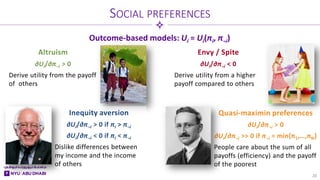
Altruism
∂Ui/∂π¬i > 0
Deriveutility from the payoff
of others
Envy / Spite
∂Ui/∂π¬i < 0
Derive utility from a higher
payoff compared to others
SOCIAL PREFERENCES
20
Outcome-based models: Ui = Ui(πi, π¬i)
Inequity aversion
∂Ui/∂π¬i > 0 if πi > π¬i
∂Ui/∂π¬i < 0 if πi < π¬i
Dislike differences between
my income and the income
of others
Quasi-maximin preferences
∂Ui/∂π¬i > 0
∂Ui/∂π¬i >> 0 if π¬i = min{π1,…,πN}
People care about the sum of all
payoffs (efficiency) and the payoff
of the poorest
21.
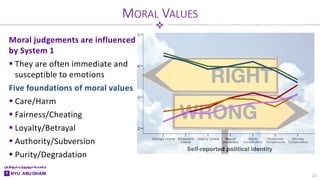
Moral judgements areinfluenced
by System 1
They are often immediate and
susceptible to emotions
Five foundations of moral values
Care/Harm
Fairness/Cheating
Loyalty/Betrayal
Authority/Subversion
Purity/Degradation
MORAL VALUES
21
22.
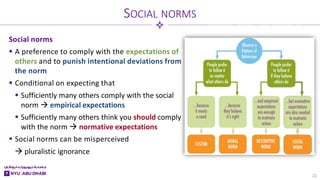
Social norms
Apreference to comply with the expectations of
others and to punish intentional deviations from
the norm
Conditional on expecting that
Sufficiently many others comply with the social
norm empirical expectations
Sufficiently many others think you should comply
with the norm normative expectations
Social norms can be misperceived
pluralistic ignorance
SOCIAL NORMS
22
23.
Nudging [to pushsomeone gently]
Policies that help you improve your behavior without
(greatly) limiting your choices libertarian paternalism
Good tool to address problems of internalities (conflict
between systems 1 and 2)
Decisions with delayed consequences, that are complex or
overwhelming, and for which there is little scope to learn
Common tools for nudging include:
Changing the choice and salience of alternatives, deciding
the timing of choices and deadlines, decision aids, default
options, and using information about social norms
NUDGES
23
24.
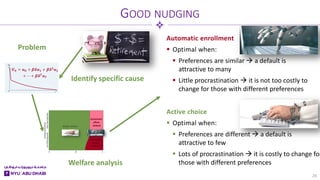
Automatic enrollment
Optimalwhen:
Preferences are similar a default is
attractive to many
Little procrastination it is not too costly to
change for those with different preferences
Active choice
Optimal when:
Preferences are different a default is
attractive to few
Lots of procrastination it is costly to change for
those with different preferences
GOOD NUDGING
24
Problem
Identify specific cause
Welfare analysis
25.
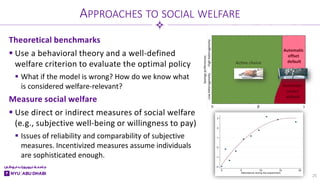
Theoretical benchmarks
Usea behavioral theory and a well-defined
welfare criterion to evaluate the optimal policy
What if the model is wrong? How do we know what
is considered welfare-relevant?
Measure social welfare
Use direct or indirect measures of social welfare
(e.g., subjective well-being or willingness to pay)
Issues of reliability and comparability of subjective
measures. Incentivized measures assume individuals
are sophisticated enough.
APPROACHES TO SOCIAL WELFARE
25


![COMPETITIVENESS
11
[adjective] a desire and/or ability to perform in competitions
Time difference when competing faster
–0.050
+0.058
+0.201
+0.135
vs.
vs.
vs.
vs.
vs.
vs.
+0.016
+0.016
40%
66%
60%
34%
0%
10%
20%
30%
40%
50%
60%
70%
Men Women
Percent
Piece-rate Tournament](https://image.slidesharecdn.com/beslides-260125132104-ba26172c/85/Behavioral-Economics-Slides-explanation-pdf-11-320.jpg)
![Nudging [to push someone gently]
Policies that help you improve your behavior without
(greatly) limiting your choices libertarian paternalism
Good tool to address problems of internalities (conflict
between systems 1 and 2)
Decisions with delayed consequences, that are complex or
overwhelming, and for which there is little scope to learn
Common tools for nudging include:
Changing the choice and salience of alternatives, deciding
the timing of choices and deadlines, decision aids, default
options, and using information about social norms
NUDGES
23](https://image.slidesharecdn.com/beslides-260125132104-ba26172c/85/Behavioral-Economics-Slides-explanation-pdf-23-320.jpg)