Motivate Europe
Live
April 22
Enterprise Engagement:
Aligning Performance Across
The Organization
•An alliance of corporate
practitioners, academics,
solution providers.
•Mission: Create a formal
framework, implementation
process and field.
•Activities: Information,
learning, consulting, a stock
index.
Who We Are
2EEA Certification Series – Collaboration &
Innovation
9/10/2014 EEA Certification Series – Framework &
Implementation
4/14/2014 2
3EEA Certification Series – Collaboration &
Innovation
9/10/2014
EEA University Online
EEA Certification Series – Framework &
Implementation
4/14/2014 3
Agenda
1. Intro: Enterprise Engagement
2. The Foundations of Engagement
3. The Implementation Framework
4. The Tactics
5. Summary
6. Q&A
Agenda
4EEA Certification Series – Collaboration &
Innovation
9/10/2014 EEA Certification Series – Framework &
Implementation
4/14/2014 4
Poll #1
For which stakeholders do you
currently measure engagement?
• Employees
• Customers
• Partners/Channel Partners
• Suppliers
• Investors
• The Community
5EEA Certification Series – Collaboration &
Innovation
9/10/2014 EEA Certification Series – Framework &
Implementation
4/14/2014 5
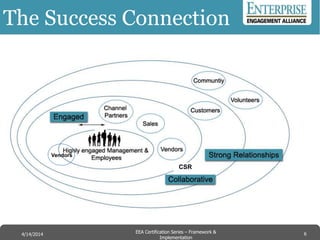
The Success Connection
To Success
Your Success
Vendors
CSR
6EEA Certification Series – Collaboration &
Innovation
9/10/2014 EEA Certification Series – Framework &
Implementation
4/14/2014 6
The Engagement Plan
7EEA Certification Series – Collaboration &
Innovation
9/10/2014 EEA Certification Series – Framework &
Implementation
4/14/2014 7
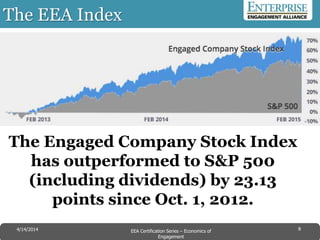
The EEA Index
84/14/2014 EEA Certification Series – Economics of
Engagement
The Engaged Company Stock Index
has outperformed to S&P 500
(including dividends) by 23.13
points since Oct. 1, 2012.
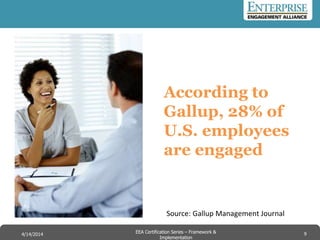
According to
Gallup, 28% of
U.S. employees
are engaged
Source: Gallup Management Journal
9EEA Certification Series – Collaboration &
Innovation
9/10/2014 EEA Certification Series – Framework &
Implementation
4/14/2014 9
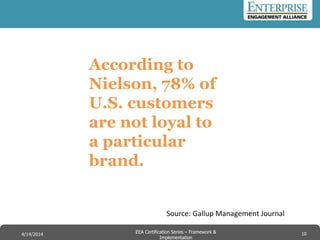
According to
Nielson, 78% of
U.S. customers
are not loyal to
a particular
brand.
Source: Gallup Management Journal
10EEA Certification Series – Collaboration &
Innovation
9/10/2014 EEA Certification Series – Framework &
Implementation
4/14/2014 10
Definition of Engagement
• Fostering the proactive involvement of
those people critical to achieving goals.
• The question is: Engaged for what?
• It’s not enough to have engaged
people…the goal is to link engagement
to actions that result in success. ose.
• Feedback—meaningful suggestions on
how to improve.
114/14/2014 EEA Certification Series – Tradeshow
Engagement
What Makes This Unique
• The focus is on creating a brand that
means the same thing to everyone.
• It aligns all stakeholders:
–Customers
–Distribution Partners
–Employees (sales and non-sales)
–Vendors/suppliers
–Communities and shareholders
124/14/2014 EEA Certification Series – Tradeshow
Engagement
EEA White Paper
134/14/2014 EEA Certification Series – Travel &
Engagement
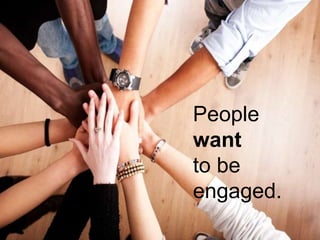
People
want
to be
engaged.
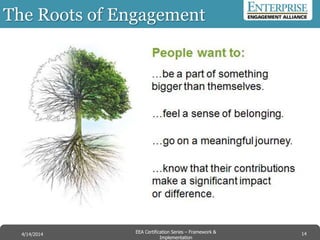
The Roots of Engagement
14EEA Certification Series – Collaboration &
Innovation
9/10/2014 EEA Certification Series – Framework &
Implementation
4/14/2014 14
Collaboration
Myths about work & workers
Fear is good.
Some jobs have to be boring.
People with too much to do are
unhappier than those with too
little to do.
Companies loyal to employees
are less success as businesses.
15EEA Certification Series – Collaboration &
Innovation
9/10/2014 EEA Certification Series – Framework &
Implementation
4/14/2014 15
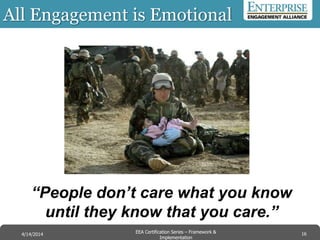
All Engagement is Emotional
“People don’t care what you know
until they know that you care.”
16EEA Certification Series – Collaboration &
Innovation
9/10/2014 EEA Certification Series – Framework &
Implementation
4/14/2014 16
Connecting Your Organization
Enterprise Engagement is
about connections
between Employees,
Customers, Partners and
Suppliers – All Key
Stakeholders
17EEA Certification Series – Collaboration &
Innovation
9/10/2014 EEA Certification Series – Framework &
Implementation
4/14/2014 17
Connecting Your Organization
18EEA Certification Series – Collaboration &
Innovation
9/10/2014 EEA Certification Series – Framework &
Implementation
4/14/2014 18
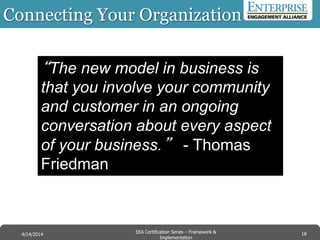
“The new model in business is
that you involve your community
and customer in an ongoing
conversation about every aspect
of your business.” - Thomas
Friedman
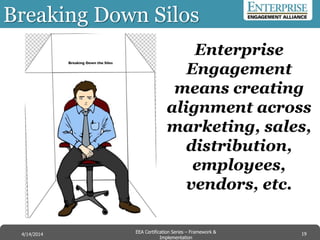
Breaking Down Silos
Enterprise
Engagement
means creating
alignment across
marketing, sales,
distribution,
employees,
vendors, etc.
19EEA Certification Series – Collaboration &
Innovation
9/10/2014 EEA Certification Series – Framework &
Implementation
4/14/2014 19
The Foundations of
Engagement
• A clear sense of mission and goals.
• Emotional bonding.
• Capability.
• Fun.
• Support.
• Task value.
• Feedback.
20EEA Certification Series – Collaboration &
Innovation
9/10/2014 EEA Certification Series – Framework &
Implementation
4/14/2014 20
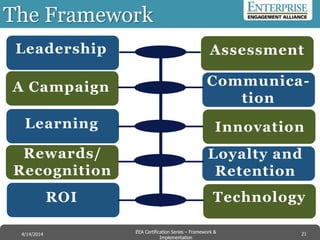
The Framework
Leadership
A Campaign
Learning
Rewards/
Recognition
ROI
Assessment
Communica-
tion
Innovation
Loyalty and
Retention
Technology
21EEA Certification Series – Collaboration &
Innovation
9/10/2014 EEA Certification Series – Framework &
Implementation
4/14/2014 21
Poll #2
Show of Hands. Do you have a ‘C’
level officer responsible for
engagement in your
organization?
 Yes
 No
 Not Sure
22EEA Certification Series – Collaboration &
Innovation
9/10/2014 EEA Certification Series – Framework &
Implementation
4/14/2014 22
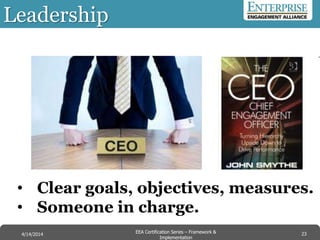
Leadership
• Clear goals, objectives, measures.
• Someone in charge.
23EEA Certification Series – Collaboration &
Innovation
9/10/2014 EEA Certification Series – Framework &
Implementation
4/14/2014 23
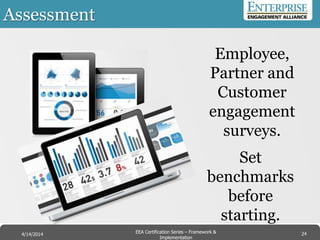
Assessment
Employee,
Partner and
Customer
engagement
surveys.
Set
benchmarks
before
starting.
24EEA Certification Series – Collaboration &
Innovation
9/10/2014 EEA Certification Series – Framework &
Implementation
4/14/2014 24
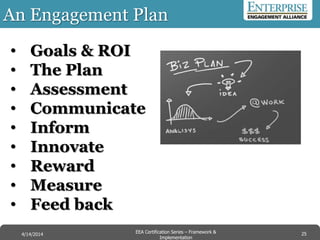
An Engagement Plan
• Goals & ROI
• The Plan
• Assessment
• Communicate
• Inform
• Innovate
• Reward
• Measure
• Feed back
25EEA Certification Series – Collaboration &
Innovation
9/10/2014 EEA Certification Series – Framework &
Implementation
4/14/2014 25
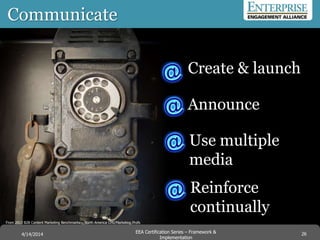
Communicate
From 2013 B2B Content Marketing Benchmarks – North America CMI/Marketing Profs
Create & launch
Announce
Reinforce
continually
Use multiple
media
26EEA Certification Series – Collaboration &
Innovation
9/10/2014 EEA Certification Series – Framework &
Implementation
4/14/2014 26
Inform and Uplift
People need to be capable to do what is
asked of them.
27EEA Certification Series – Collaboration &
Innovation
9/10/2014 EEA Certification Series – Framework &
Implementation
4/14/2014 27
Innovation
The process of
generating
creative ideas
that improve
experiences,
products or
services also
fosters task
value.
https://www.flickr.com/photos/17258892@N05/2588347668/
28EEA Certification Series – Collaboration &
Innovation
9/10/2014 EEA Certification Series – Framework &
Implementation
4/14/2014 28
Recognition
• Recognition is one of many Engagement
tools, not the other way around.
• Important to recognize people for
submitting ideas and for collaborating to
develop solutions.
• Recognition should be part of formal
design and administrative processes, in
accordance with best practices, company
culture and personal preferences.
29EEA Certification Series – Collaboration &
Innovation
9/10/2014 EEA Certification Series – Framework &
Implementation
4/14/2014 29
Rewards
• Rewards should address
intrinsic touch points.
• Rewards should address
“emotion” and “support”.
• Make rewards intrinsic, tap
emotions engagement by
personalizing.
• Use rewards to
communicate.
30EEA Certification Series – Collaboration &
Innovation
9/10/2014 EEA Certification Series – Framework &
Implementation
4/14/2014 30
Return on Investment
4.88
0.25
2.03
-4.05
-0.85 -1.04
-5
-4
-3
-2
-1
0
1
2
3
4
5
6
Increase in % of Effective Employees / Decrease in %
of Ineffective Employees
No change in % of Effective or Ineffective Employees
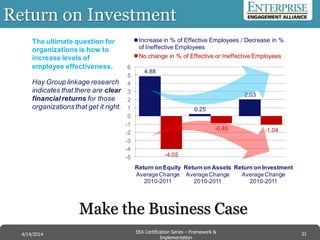
The ultimate question for
organizations is how to
increase levels of
employee effectiveness.
Hay Group linkage research
indicates that there are clear
financial returns for those
organizations that get it right.
Return on Equity
AverageChange
2010-2011
Return on Assets
AverageChange
2010-2011
Return on Investment
AverageChange
2010-2011
Make the Business Case
31EEA Certification Series – Collaboration &
Innovation
9/10/2014 EEA Certification Series – Framework &
Implementation
4/14/2014 31
Master Measurement
Model
A process for identifying the actions that
lead to success.
A statistical process control for
transforming behaviors into a monetary
value.
A means of creating a currency of
performance points to sustain interest.
32EEA Certification Series – Collaboration &
Innovation
9/10/2014 EEA Certification Series – Framework &
Implementation
4/14/2014 32
Technology
33
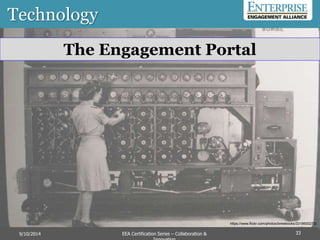
The Engagement Portal
https://www.flickr.com/photos/brewbooks/3318600273/
EEA Certification Series – Collaboration &9/10/2014
Summary
Engagement is low across the board.
Organizations that create a “culture of
engagement” outperform others.
A culture of engagement must be
carefully built, measured, maintained.
An understanding of all audiences and
drivers of engagement is critical.
The tactics of engagement are the
roadmap to ROI.
34EEA Certification Series – Collaboration &
Innovation
9/10/2014 EEA Certification Series – Framework &
Implementation
4/14/2014 34
A Virtuous Circle
35EEA Certification Series – Collaboration &
Innovation
9/10/2014 EEA Certification Series – Framework &
Implementation
4/14/2014 35
• Customers and distribution get better
products and services.
• Employees derive greater satisfaction
from work.
• Vendors get greater satisfaction from
doing business.
• Shareholders see higher profits.
Questions
36EEA Certification Series – Collaboration &
Innovation
9/10/2014 EEA Certification Series – Framework &
Implementation
4/14/2014 36
Bruce Bolger
Managing Director
• Enterprise Engagement Alliance at
Theeea.org.
• Publisher of Engagement Strategies at
• Enterpriseengagement.org.
• Co-author of Enterprise Engagement:
The Textbook.
Get Your Copy
37EEA Certification Series – Collaboration &
Innovation
9/10/2014 EEA Certification Series – Framework &
Implementation
4/14/2014 37

Eea framework and implementation uk

  • 1.
    Motivate Europe Live April 22 EnterpriseEngagement: Aligning Performance Across The Organization
  • 2.
    •An alliance ofcorporate practitioners, academics, solution providers. •Mission: Create a formal framework, implementation process and field. •Activities: Information, learning, consulting, a stock index. Who We Are 2EEA Certification Series – Collaboration & Innovation 9/10/2014 EEA Certification Series – Framework & Implementation 4/14/2014 2
  • 3.
    3EEA Certification Series– Collaboration & Innovation 9/10/2014 EEA University Online EEA Certification Series – Framework & Implementation 4/14/2014 3
  • 4.
    Agenda 1. Intro: EnterpriseEngagement 2. The Foundations of Engagement 3. The Implementation Framework 4. The Tactics 5. Summary 6. Q&A Agenda 4EEA Certification Series – Collaboration & Innovation 9/10/2014 EEA Certification Series – Framework & Implementation 4/14/2014 4
  • 5.
    Poll #1 For whichstakeholders do you currently measure engagement? • Employees • Customers • Partners/Channel Partners • Suppliers • Investors • The Community 5EEA Certification Series – Collaboration & Innovation 9/10/2014 EEA Certification Series – Framework & Implementation 4/14/2014 5
  • 6.
    The Success Connection ToSuccess Your Success Vendors CSR 6EEA Certification Series – Collaboration & Innovation 9/10/2014 EEA Certification Series – Framework & Implementation 4/14/2014 6
  • 7.
    The Engagement Plan 7EEACertification Series – Collaboration & Innovation 9/10/2014 EEA Certification Series – Framework & Implementation 4/14/2014 7
  • 8.
    The EEA Index 84/14/2014EEA Certification Series – Economics of Engagement The Engaged Company Stock Index has outperformed to S&P 500 (including dividends) by 23.13 points since Oct. 1, 2012.
  • 9.
    According to Gallup, 28%of U.S. employees are engaged Source: Gallup Management Journal 9EEA Certification Series – Collaboration & Innovation 9/10/2014 EEA Certification Series – Framework & Implementation 4/14/2014 9
  • 10.
    According to Nielson, 78%of U.S. customers are not loyal to a particular brand. Source: Gallup Management Journal 10EEA Certification Series – Collaboration & Innovation 9/10/2014 EEA Certification Series – Framework & Implementation 4/14/2014 10
  • 11.
    Definition of Engagement •Fostering the proactive involvement of those people critical to achieving goals. • The question is: Engaged for what? • It’s not enough to have engaged people…the goal is to link engagement to actions that result in success. ose. • Feedback—meaningful suggestions on how to improve. 114/14/2014 EEA Certification Series – Tradeshow Engagement
  • 12.
    What Makes ThisUnique • The focus is on creating a brand that means the same thing to everyone. • It aligns all stakeholders: –Customers –Distribution Partners –Employees (sales and non-sales) –Vendors/suppliers –Communities and shareholders 124/14/2014 EEA Certification Series – Tradeshow Engagement
  • 13.
    EEA White Paper 134/14/2014EEA Certification Series – Travel & Engagement People want to be engaged.
  • 14.
    The Roots ofEngagement 14EEA Certification Series – Collaboration & Innovation 9/10/2014 EEA Certification Series – Framework & Implementation 4/14/2014 14
  • 15.
    Collaboration Myths about work& workers Fear is good. Some jobs have to be boring. People with too much to do are unhappier than those with too little to do. Companies loyal to employees are less success as businesses. 15EEA Certification Series – Collaboration & Innovation 9/10/2014 EEA Certification Series – Framework & Implementation 4/14/2014 15
  • 16.
    All Engagement isEmotional “People don’t care what you know until they know that you care.” 16EEA Certification Series – Collaboration & Innovation 9/10/2014 EEA Certification Series – Framework & Implementation 4/14/2014 16
  • 17.
    Connecting Your Organization EnterpriseEngagement is about connections between Employees, Customers, Partners and Suppliers – All Key Stakeholders 17EEA Certification Series – Collaboration & Innovation 9/10/2014 EEA Certification Series – Framework & Implementation 4/14/2014 17
  • 18.
    Connecting Your Organization 18EEACertification Series – Collaboration & Innovation 9/10/2014 EEA Certification Series – Framework & Implementation 4/14/2014 18 “The new model in business is that you involve your community and customer in an ongoing conversation about every aspect of your business.” - Thomas Friedman
  • 19.
    Breaking Down Silos Enterprise Engagement meanscreating alignment across marketing, sales, distribution, employees, vendors, etc. 19EEA Certification Series – Collaboration & Innovation 9/10/2014 EEA Certification Series – Framework & Implementation 4/14/2014 19
  • 20.
    The Foundations of Engagement •A clear sense of mission and goals. • Emotional bonding. • Capability. • Fun. • Support. • Task value. • Feedback. 20EEA Certification Series – Collaboration & Innovation 9/10/2014 EEA Certification Series – Framework & Implementation 4/14/2014 20
  • 21.
    The Framework Leadership A Campaign Learning Rewards/ Recognition ROI Assessment Communica- tion Innovation Loyaltyand Retention Technology 21EEA Certification Series – Collaboration & Innovation 9/10/2014 EEA Certification Series – Framework & Implementation 4/14/2014 21
  • 22.
    Poll #2 Show ofHands. Do you have a ‘C’ level officer responsible for engagement in your organization?  Yes  No  Not Sure 22EEA Certification Series – Collaboration & Innovation 9/10/2014 EEA Certification Series – Framework & Implementation 4/14/2014 22
  • 23.
    Leadership • Clear goals,objectives, measures. • Someone in charge. 23EEA Certification Series – Collaboration & Innovation 9/10/2014 EEA Certification Series – Framework & Implementation 4/14/2014 23
  • 24.
    Assessment Employee, Partner and Customer engagement surveys. Set benchmarks before starting. 24EEA CertificationSeries – Collaboration & Innovation 9/10/2014 EEA Certification Series – Framework & Implementation 4/14/2014 24
  • 25.
    An Engagement Plan •Goals & ROI • The Plan • Assessment • Communicate • Inform • Innovate • Reward • Measure • Feed back 25EEA Certification Series – Collaboration & Innovation 9/10/2014 EEA Certification Series – Framework & Implementation 4/14/2014 25
  • 26.
    Communicate From 2013 B2BContent Marketing Benchmarks – North America CMI/Marketing Profs Create & launch Announce Reinforce continually Use multiple media 26EEA Certification Series – Collaboration & Innovation 9/10/2014 EEA Certification Series – Framework & Implementation 4/14/2014 26
  • 27.
    Inform and Uplift Peopleneed to be capable to do what is asked of them. 27EEA Certification Series – Collaboration & Innovation 9/10/2014 EEA Certification Series – Framework & Implementation 4/14/2014 27
  • 28.
    Innovation The process of generating creativeideas that improve experiences, products or services also fosters task value. https://www.flickr.com/photos/17258892@N05/2588347668/ 28EEA Certification Series – Collaboration & Innovation 9/10/2014 EEA Certification Series – Framework & Implementation 4/14/2014 28
  • 29.
    Recognition • Recognition isone of many Engagement tools, not the other way around. • Important to recognize people for submitting ideas and for collaborating to develop solutions. • Recognition should be part of formal design and administrative processes, in accordance with best practices, company culture and personal preferences. 29EEA Certification Series – Collaboration & Innovation 9/10/2014 EEA Certification Series – Framework & Implementation 4/14/2014 29
  • 30.
    Rewards • Rewards shouldaddress intrinsic touch points. • Rewards should address “emotion” and “support”. • Make rewards intrinsic, tap emotions engagement by personalizing. • Use rewards to communicate. 30EEA Certification Series – Collaboration & Innovation 9/10/2014 EEA Certification Series – Framework & Implementation 4/14/2014 30
  • 31.
    Return on Investment 4.88 0.25 2.03 -4.05 -0.85-1.04 -5 -4 -3 -2 -1 0 1 2 3 4 5 6 Increase in % of Effective Employees / Decrease in % of Ineffective Employees No change in % of Effective or Ineffective Employees The ultimate question for organizations is how to increase levels of employee effectiveness. Hay Group linkage research indicates that there are clear financial returns for those organizations that get it right. Return on Equity AverageChange 2010-2011 Return on Assets AverageChange 2010-2011 Return on Investment AverageChange 2010-2011 Make the Business Case 31EEA Certification Series – Collaboration & Innovation 9/10/2014 EEA Certification Series – Framework & Implementation 4/14/2014 31
  • 32.
    Master Measurement Model A processfor identifying the actions that lead to success. A statistical process control for transforming behaviors into a monetary value. A means of creating a currency of performance points to sustain interest. 32EEA Certification Series – Collaboration & Innovation 9/10/2014 EEA Certification Series – Framework & Implementation 4/14/2014 32
  • 33.
  • 34.
    Summary Engagement is lowacross the board. Organizations that create a “culture of engagement” outperform others. A culture of engagement must be carefully built, measured, maintained. An understanding of all audiences and drivers of engagement is critical. The tactics of engagement are the roadmap to ROI. 34EEA Certification Series – Collaboration & Innovation 9/10/2014 EEA Certification Series – Framework & Implementation 4/14/2014 34
  • 35.
    A Virtuous Circle 35EEACertification Series – Collaboration & Innovation 9/10/2014 EEA Certification Series – Framework & Implementation 4/14/2014 35 • Customers and distribution get better products and services. • Employees derive greater satisfaction from work. • Vendors get greater satisfaction from doing business. • Shareholders see higher profits.
  • 36.
    Questions 36EEA Certification Series– Collaboration & Innovation 9/10/2014 EEA Certification Series – Framework & Implementation 4/14/2014 36 Bruce Bolger Managing Director • Enterprise Engagement Alliance at Theeea.org. • Publisher of Engagement Strategies at • Enterpriseengagement.org. • Co-author of Enterprise Engagement: The Textbook.
  • 37.
    Get Your Copy 37EEACertification Series – Collaboration & Innovation 9/10/2014 EEA Certification Series – Framework & Implementation 4/14/2014 37

Editor's Notes

  • #2  .
  • #9  The Engaged Company portfolio has outperformed the S&P 500 (including dividends) by 23.13 percentage points since October 1, 2012. The Good Company portfolio includes 45 companies with combined high scores as employers, sellers, and stewards of the community and environment. Tracking of the portfolio began on October 1, 2012. The composition of the portfolio is periodically updated (most recently on Sept. 12, 2014), based on new data from the Good Company Index™.
  • #11 NEED PHOTO OF SHOPPER
  • #12 Enterprise Engagement is about connecting engagement across the organization, not about siloing engagement by marketing, sales, HR, as has usually been done. Our concept of engagement carefully links employees with customers—we are not about employee engagement comes first, as some would argue.  Here is a summary of the key drivers of engagement and the corresponding business tactics that need to be integrated in order to create a formal Engagement Business Plan with a clear ROI. They are based on dozens of research studies, here are the fundamental drivers of Engagement that the framework is designed to address At tradeshows, exhibitors and organizers have the opportunity to engage participants emotionally, face to face and to infuse that sense of community, include fun and bring a much more human element to the value proposition than can virtual events.
  • #13 Enterprise Engagement is about connecting engagement across the organization, not about siloing engagement by marketing, sales, HR, as has usually been done. Our concept of engagement carefully links employees with customers—we are not about employee engagement comes first, as some would argue.  Here is a summary of the key drivers of engagement and the corresponding business tactics that need to be integrated in order to create a formal Engagement Business Plan with a clear ROI. They are based on dozens of research studies, here are the fundamental drivers of Engagement that the framework is designed to address At tradeshows, exhibitors and organizers have the opportunity to engage participants emotionally, face to face and to infuse that sense of community, include fun and bring a much more human element to the value proposition than can virtual events.
  • #16 If the benefits and critical need to have a culture of engagement are so easily understood, why don’t all companies have one? The simple answer is that they’re not led and managed with methods and behaviors that can support such a culture. Unethical behavior, a leading employee engagement research company, recently published a report citing 33 myths about work and workers that are basically the opposite of how employees should be treated to maximize engagement and collaboration. These myths include: People who feel secure in their jobs become complacent It is useless – even counterproductive – for employees doing routine, highly standardized work to be involved in decisions 
about the work. People who have too much to do are more unhappy than 
people who have too little to do Companies that are loyal to their employees are less successful as businesses Whether a company is ethical and a good corporate citizen is of little concern to most of its employees Professionals are much more concerned about doing a quality job than are nonprofessionals 
Another major challenge to launching an effective system that will support and sustain a culture of engagement is that the majority of companies are managed based on hierarchical structures with ingrained bureaucracies and policies. Conversely, openness, creativity and recognizing the accomplishments of others are the cornerstones of collaboration and innovation, rather than covering your back, keeping your head down and taking the conventional route, so that risk-taking and mistakes are minimized.
  • #21 Enterprise Engagement is about connecting engagement across the organization, not about siloing engagement by marketing, sales, HR, as has usually been done. Our concept of engagement carefully links employees with customers—we are not about employee engagement comes first, as some would argue.  Here is a summary of the key drivers of engagement and the corresponding business tactics that need to be integrated in order to create a formal Engagement Business Plan with a clear ROI. They are based on dozens of research studies, here are the fundamental drivers of Engagement that the framework is designed to address:
  • #22 The engagement framework and implementation process can be used to address any tactical issue by identifying the necessary levers to engage and make people capable of achieving a specific goal. This framework addresses the levers of Engagement outlined on the previous slide to create a business plan with a measurable return on investment.
  • #25  The current environment should be assessed by conducting employee, partner and customer engagement surveys to determine the current level of engagement in each and to gauge the level of readiness to embark on a campaign to create a culture of engagement It can be valuable to benchmark other companies that have cultures of engagement in order to set reasonable goals and have an understanding of the communications campaign and other support that will be necessary .
  • #26 Strategic Plan. The first step is to develop a strategic plan for the company’s culture of engagement, based on the mission, vision and values of the CEO and leadership team, company history, competitive environment and other factors. As part of this planning process, it’s important to determine which stakeholders should be involved and to what extent. Participation can range from specific groups like technical engineers or product development teams all the way up to a company- wide approach that even adds channel partners, dealers, distributors and even customers and suppliers. There are hundreds if not thousands of innovation consulting companies, as well as internal experts who can help create a strategic plan and ensure participation, engagement and results.
  • #27  Once the commitment has been made to implement a culture of engagement, it’s important to create and launch a communications campaign, just like any other marketing or advertising endeavor, although with a focus on internal audiences. This campaign starts with an initial announcement and should then be used to continuously communicate the collaborative culture and reasons for the initiative throughout the launch period and, ideally, on an ongoing basis. As noted previously, having a culture of engagement isn’t a “program,” it must be reinforced to become a way of life ingrained in the company DNA. The communications campaign should include an impactful, multi-media approach – an interactive engagement website/portal, collaborative tools, in-person engagement meetings, etc.
  • #28  Training is necessary on many levels, starting with cultural awareness, then moving into creativity, behavioral styles, work competencies, team dynamics, collaboration, innovation methods and processes, coaching, authentic recognition and more. Managers should receive training on the importance of engagement and their role in driving it. Employees should be trainined on personal engagement and their role in building a culture of engagement.
  • #29 Innovation is the process of generating creative ideas that when acted upon can improve experiences, products or services. In a business sense, innovation improves revenues and profits and/or reduces costs. The investment necessary to support a culture of engagement and innovation should provide a return-on-investment because, if properly designed and implemented, innovation is a trainable, repeatable process. Having a culture of engagement and innovation has always been important for companies, but with today’s fast-paced technological changes – data processing power, speed, storage and search capabilities, Big Data, expanding knowledge, service levels, social media, etc. – it’s even more critical. We have seen many examples of companies that were leaders in their fields for many years, such as Sears, J.C. Penny and many others in retailing, leapfrogged by more recently established firms like Amazon and Overstock. This trend is most pronounced in the world of technology, where companies like Blackberry, which was recognized as one of the most progressive and profitable a few years ago, are now on the verge of bankruptcy. Companies must collaborate and innovate or, literally, die. The primary reasons for building a culture of engagement and innovation are to improve products, processes and to reduce costs. Related secondary benefits to employee productivity, engagement, retention and advocacy are also important. Companies that are ranked as having high employee engagement scores are also usually leaders in engagement and innovation. Increases in revenues and profits are much higher for companies that have formalized cultures of engagement and innovation – Apple, Google, Zappos, JetBlue and others. People are using collaborative shared services to reduce costs, eliminate waste, improve convenience and in some cases earn income. Start-up businesses such as AirBnB, which allows people to rent an extra bedroom in their house to travelers, has grown so fast that within five years it became one of the biggest booking site for rooms, even greater than many of the big hotel chains. Sarah DaVano, Chief Strategy and Cultural Officer of Sparks & Honey, an agency that syncs brands with culture, calls this the “Collaborative Economy” and sites many examples of collaborative shared services, not just from start-ups, but from major corporations as well, such as Citibank’s sponsorship and payment system for the Citi Bike bike-sharing program recently launched in New York City.
  • #30  Rewards & Recognition. It’s essential to have a recognition system integrated with your engagement strategy, or it is doomed to fail. In general, most innovation experts believe that the “intrinsic motivation” of allowing people to participate in and be recognized by their company’s engagement program is important. Motivation professionals will tell you that offering cash isn’t as effective (and can sometimes be counterproductive or even harmful) as tangible awards such as innovative merchandise, gift cards, travel and/or experiences to thank people for their contributions and going “above and beyond” their normal work. 

  • #31 Measurement. The entire ensystem should be measured, from front-end idea submissions and challenge participation, to collaboration to solve the challenges, straight through to the back-end of implementation. It’s important to track the leading indicators of success (such as participation rates) rather than just the final results, because these are lagging indicators that won’t occur for some time into the future. And keep n mind that there are many ideas that can’t be effectively measured, even though they have an impact on the quality of the workplace, customer service and other key areas
  • #32 Measurement. The entire engagement system should be measured, from front-end assessments to impact and ROI of specific programs and measurements of improvement across the organization’s stakeholder groups, all correlated to key measures of business success such as sales, revenues, profits, customer retention, etc., It’s important to track the leading indicators of success (such engagement survey results – if done frequently) rather than just the final results, because these are lagging indicators that won’t occur for some time into the future. And keep n mind that there are some elelments that can’t be effectively measured, even though they have an impact on the quality of the workplace, customer service and other key areas
  • #34  Once the commitment has been made to launch and support a culture of engagement through a sustainable innovation system, the message has been communicated to all of the stakeholders about the types of ideas needed, and some training has been initiated to power creativity and collaboration, a platform must be selected and implemented to support the system. For the last 30 years or so, software has been used to manage “suggestion systems,” which were basically database programs to manage the input of ideas for improvement and cost reduction. With the advent of more powerful software, the internet and many years of innovation knowledge and experience, innovation platforms have been introduced with many enhanced functions beyond being the central repository for information related to engagement re, including: Challenges...problems or situations that can be improved or solved through engagement, collaboration and innovation and are put forth because they’re in alignment with the company’s objectives. Collaboration...where teams are often comprised of people from different disciplines, geographies and business units to help break down the “silos” of corporate divisions that generally don’t work together and sometimes compete for resources. Evaluation...of solutions using ranking algorithms and “gamification” techniques (such as points, badges and leaderboards) to vote on which ideas have the most application and merit for the company. 
161 Social Recognition...as a means to recognize participants directly and/or through their ranking score in “points,” which can have tangible value or just serve as a social currency. Idea Submissions...for new products, services and processes; generally not free-form. Project Management...using integrated tools to shepherd the best ideas from development through implementation. Archiving...ideas so they can be referenced in the database for later use, if not appropriate to implement immediately. Rewards...so participants can redeem their points for tangible rewards such as innovative merchandise and gift cards, or experiences such as lunch with the CEO. 
Coaching. Like anything else, there’s an art as well as a science to creating a culture of collaboration and innovation. It starts with the CEO, but it should be supported by immediate supervisors and local managers. To be effective, these leaders have to be trained to be coaches, and there should be tracking systems in place to assure this happens on an ongoing basis. According to Keith Rosen, President of ProfitBuilders a leading coaching training company, most managers aren’t properly trained to be coaches; they need to develop skills such as empathy and listening and focus on leading the innovation initiative. 
Implementation. Once the best ideas have been selected and vetted and management has approved and budgeted for them, they must be implemented or the whole system becomes just a meaningless exercise.