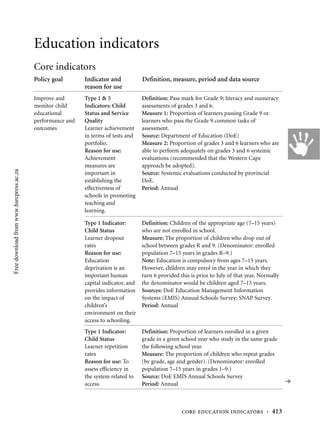
Education indicators
                                         Core indicators
                                         Policy goal       Indicator and            Definition, measure, period and data source
                                                           reason for use
                                         Improve and       Type 1 & 5               Definition: Pass mark for Grade 9; literacy and numeracy
                                         monitor child     Indicators: Child        assessments of grades 3 and 6.
                                         educational       Status and Service       Measure 1: Proportion of learners passing Grade 9 or
                                         performance and   Quality                  learners who pass the Grade 9 common tasks of
                                         outcomes          Learner achievement      assessment.
                                                           in terms of tests and    Source: Department of Education (DoE)
                                                           portfolio.               Measure 2: Proportion of grades 3 and 6 learners who are
                                                           Reason for use:          able to perform adequately on grades 3 and 6 systemic
                                                           Achievement              evaluations (recommended that the Western Cape
                                                           measures are             approach be adopted).
Free download from www.hsrcpress.ac.za


                                                           important in             Source: Systemic evaluations conducted by provincial
                                                           establishing the         DoE.
                                                           effectiveness of         Period: Annual
                                                           schools in promoting
                                                           teaching and
                                                           learning.

                                                           Type 1 Indicator:        Definition: Children of the appropriate age (7–15 years)
                                                           Child Status             who are not enrolled in school.
                                                           Learner dropout          Measure: The proportion of children who drop out of
                                                           rates                    school between grades R and 9. (Denominator: enrolled
                                                           Reason for use:          population 7–15 years in grades R–9.)
                                                           Education                Note: Education is compulsory from ages 7–15 years.
                                                           deprivation is an        However, children may enrol in the year in which they
                                                           important human          turn 6 provided this is prior to July of that year. Normally
                                                           capital indicator, and   the denominator would be children aged 7–15 years.
                                                           provides information     Sources: DoE Education Management Information
                                                           on the impact of         Systems (EMIS) Annual Schools Survey; SNAP Survey.
                                                           children’s               Period: Annual
                                                           environment on their
                                                           access to schooling.
                                                           Type 1 Indicator:        Definition: Proportion of learners enrolled in a given
                                                           Child Status             grade in a given school year who study in the same grade
                                                           Learner repetition       the following school year.
                                                           rates                    Measure: The proportion of children who repeat grades
                                                           Reason for use: To       (by grade, age and gender). (Denominator: enrolled
                                                           assess efficiency in     population 7–15 years in grades 1–9.)
                                                           the system related to    Source: DoE EMIS Annual Schools Survey
                                                           access.                  Period: Annual                                                 ➔


                                                                                                     core education indicators • 413
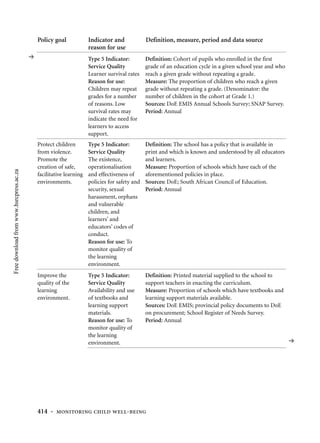
Policy goal             Indicator and             Definition, measure, period and data source
                                                                     reason for use
                                         ➔                           Type 5 Indicator:         Definition: Cohort of pupils who enrolled in the first
                                                                     Service Quality           grade of an education cycle in a given school year and who
                                                                     Learner survival rates    reach a given grade without repeating a grade.
                                                                     Reason for use:           Measure: The proportion of children who reach a given
                                                                     Children may repeat       grade without repeating a grade. (Denominator: the
                                                                     grades for a number       number of children in the cohort at Grade 1.)
                                                                     of reasons. Low           Sources: DoE EMIS Annual Schools Survey; SNAP Survey.
                                                                     survival rates may        Period: Annual
                                                                     indicate the need for
                                                                     learners to access
                                                                     support.
                                             Protect children        Type 5 Indicator:         Definition: The school has a policy that is available in
                                             from violence.          Service Quality           print and which is known and understood by all educators
                                             Promote the             The existence,            and learners.
                                             creation of safe,       operationalisation        Measure: Proportion of schools which have each of the
Free download from www.hsrcpress.ac.za


                                             facilitative learning   and effectiveness of      aforementioned policies in place.
                                             environments.           policies for safety and   Sources: DoE; South African Council of Education.
                                                                     security, sexual          Period: Annual
                                                                     harassment, orphans
                                                                     and vulnerable
                                                                     children, and
                                                                     learners’ and
                                                                     educators’ codes of
                                                                     conduct.
                                                                     Reason for use: To
                                                                     monitor quality of
                                                                     the learning
                                                                     environment.
                                             Improve the             Type 5 Indicator:         Definition: Printed material supplied to the school to
                                             quality of the          Service Quality           support teachers in enacting the curriculum.
                                             learning                Availability and use      Measure: Proportion of schools which have textbooks and
                                             environment.            of textbooks and          learning support materials available.
                                                                     learning support          Sources: DoE EMIS; provincial policy documents to DoE
                                                                     materials.                on procurement; School Register of Needs Survey.
                                                                     Reason for use: To        Period: Annual
                                                                     monitor quality of
                                                                     the learning
                                                                     environment.                                                                           ➔


                                             414 • monitoring child well-being
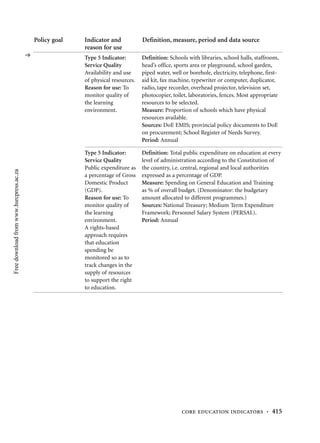
Policy goal   Indicator and            Definition, measure, period and data source
                                                           reason for use
                                         ➔                 Type 5 Indicator:        Definition: Schools with libraries, school halls, staffroom,
                                                           Service Quality          head’s office, sports area or playground, school garden,
                                                           Availability and use     piped water, well or borehole, electricity, telephone, first-
                                                           of physical resources.   aid kit, fax machine, typewriter or computer, duplicator,
                                                           Reason for use: To       radio, tape recorder, overhead projector, television set,
                                                           monitor quality of       photocopier, toilet, laboratories, fences. Most appropriate
                                                           the learning             resources to be selected.
                                                           environment.             Measure: Proportion of schools which have physical
                                                                                    resources available.
                                                                                    Sources: DoE EMIS; provincial policy documents to DoE
                                                                                    on procurement; School Register of Needs Survey.
                                                                                    Period: Annual

                                                           Type 5 Indicator:        Definition: Total public expenditure on education at every
                                                           Service Quality          level of administration according to the Constitution of
                                                           Public expenditure as    the country, i.e. central, regional and local authorities
Free download from www.hsrcpress.ac.za


                                                           a percentage of Gross    expressed as a percentage of GDP.
                                                           Domestic Product         Measure: Spending on General Education and Training
                                                           (GDP).                   as % of overall budget. (Denominator: the budgetary
                                                           Reason for use: To       amount allocated to different programmes.)
                                                           monitor quality of       Sources: National Treasury; Medium Term Expenditure
                                                           the learning             Framework; Personnel Salary System (PERSAL).
                                                           environment.             Period: Annual
                                                           A rights-based
                                                           approach requires
                                                           that education
                                                           spending be
                                                           monitored so as to
                                                           track changes in the
                                                           supply of resources
                                                           to support the right
                                                           to education.


                                                                                                     core education indicators • 415
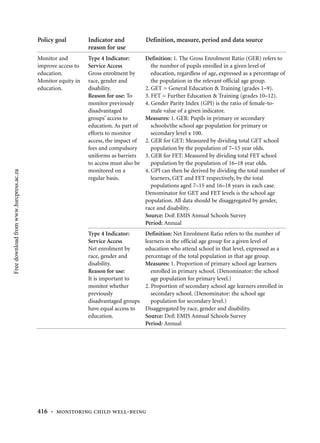
Policy goal         Indicator and            Definition, measure, period and data source
                                                             reason for use
                                         Monitor and         Type 4 Indicator:        Definition: 1. The Gross Enrolment Ratio (GER) refers to
                                         improve access to   Service Access              the number of pupils enrolled in a given level of
                                         education.          Gross enrolment by          education, regardless of age, expressed as a percentage of
                                         Monitor equity in   race, gender and            the population in the relevant official age group.
                                         education.          disability.              2. GET = General Education & Training (grades 1–9).
                                                             Reason for use: To       3. FET = Further Education & Training (grades 10–12).
                                                             monitor previously       4. Gender Parity Index (GPI) is the ratio of female-to-
                                                             disadvantaged               male value of a given indicator.
                                                             groups’ access to        Measures: 1. GER: Pupils in primary or secondary
                                                             education. As part of       schools/the school age population for primary or
                                                             efforts to monitor          secondary level x 100.
                                                             access, the impact of    2. GER for GET: Measured by dividing total GET school
                                                             fees and compulsory         population by the population of 7–15 year olds.
                                                             uniforms as barriers     3. GER for FET: Measured by dividing total FET school
                                                             to access must also be      population by the population of 16–18 year olds.
                                                             monitored on a           4. GPI can then be derived by dividing the total number of
Free download from www.hsrcpress.ac.za


                                                             regular basis.              learners, GET and FET respectively, by the total
                                                                                         populations aged 7–15 and 16–18 years in each case.
                                                                                      Denominator for GET and FET levels is the school age
                                                                                      population. All data should be disaggregated by gender,
                                                                                      race and disability.
                                                                                      Source: DoE EMIS Annual Schools Survey
                                                                                      Period: Annual
                                                             Type 4 Indicator:        Definition: Net Enrolment Ratio refers to the number of
                                                             Service Access           learners in the official age group for a given level of
                                                             Net enrolment by         education who attend school in that level, expressed as a
                                                             race, gender and         percentage of the total population in that age group.
                                                             disability.              Measures: 1. Proportion of primary school age learners
                                                             Reason for use:             enrolled in primary school. (Denominator: the school
                                                             It is important to          age population for primary level.)
                                                             monitor whether          2. Proportion of secondary school age learners enrolled in
                                                             previously                  secondary school. (Denominator: the school age
                                                             disadvantaged groups        population for secondary level.)
                                                             have equal access to     Disaggregated by race, gender and disability.
                                                             education.               Source: DoE EMIS Annual Schools Survey
                                                                                      Period: Annual


                                         416 • monitoring child well-being
Policy goal   Indicator and           Definition, measure, period and data source
                                                       reason for use
                                         Improve the   Type 5 Indicator:       Definition: The child is taught in the first language in the
                                         quality of    Service Quality         Foundation Phase (grades R–3).
                                         education.    Language of             Measure: The proportion of children in the designated
                                                       instruction and         grades who are instructed in their home language.
                                                       home language.          Sources: DoE EMIS Annual Schools Survey; SNAP Survey.
                                                       Reason for use:         Period: Annual
                                                       Instruction in the
                                                       child’s home
                                                       language determines
                                                       whether learners are
                                                       able to understand
                                                       and engage with
                                                       educational material.
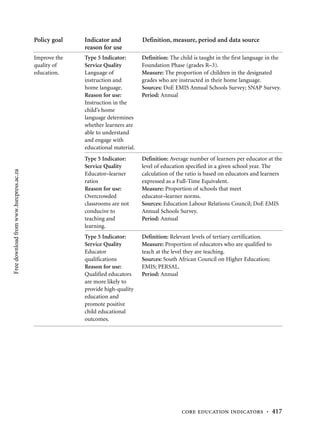
                                                       Type 5 Indicator:       Definition: Average number of learners per educator at the
                                                       Service Quality         level of education specified in a given school year. The
Free download from www.hsrcpress.ac.za


                                                       Educator–learner        calculation of the ratio is based on educators and learners
                                                       ratios                  expressed as a Full-Time Equivalent.
                                                       Reason for use:         Measure: Proportion of schools that meet
                                                       Overcrowded             educator–learner norms.
                                                       classrooms are not      Sources: Education Labour Relations Council; DoE EMIS
                                                       conducive to            Annual Schools Survey.
                                                       teaching and            Period: Annual
                                                       learning.
                                                       Type 5 Indicator:       Definition: Relevant levels of tertiary certification.
                                                       Service Quality         Measure: Proportion of educators who are qualified to
                                                       Educator                teach at the level they are teaching.
                                                       qualifications          Sources: South African Council on Higher Education;
                                                       Reason for use:         EMIS; PERSAL.
                                                       Qualified educators     Period: Annual
                                                       are more likely to
                                                       provide high-quality
                                                       education and
                                                       promote positive
                                                       child educational
                                                       outcomes.


                                                                                                core education indicators • 417
Policy goal           Indicator and          Definition, measure, period and data source
                                                               reason for use
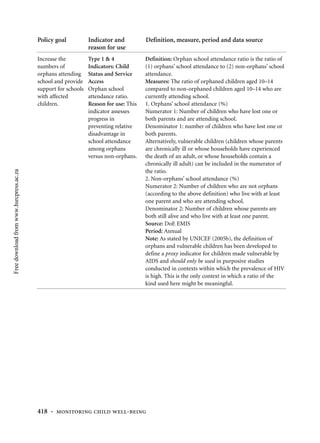
                                         Increase the          Type 1 & 4             Definition: Orphan school attendance ratio is the ratio of
                                         numbers of            Indicators: Child      (1) orphans’ school attendance to (2) non-orphans’ school
                                         orphans attending     Status and Service     attendance.
                                         school and provide    Access                 Measures: The ratio of orphaned children aged 10–14
                                         support for schools   Orphan school          compared to non-orphaned children aged 10–14 who are
                                         with affected         attendance ratio.      currently attending school.
                                         children.             Reason for use: This   1. Orphans’ school attendance (%)
                                                               indicator assesses     Numerator 1: Number of children who have lost one or
                                                               progress in            both parents and are attending school.
                                                               preventing relative    Denominator 1: number of children who have lost one or
                                                               disadvantage in        both parents.
                                                               school attendance      Alternatively, vulnerable children (children whose parents
                                                               among orphans          are chronically ill or whose households have experienced
                                                               versus non-orphans.    the death of an adult, or whose households contain a
                                                                                      chronically ill adult) can be included in the numerator of
                                                                                      the ratio.
Free download from www.hsrcpress.ac.za


                                                                                      2. Non-orphans’ school attendance (%)
                                                                                      Numerator 2: Number of children who are not orphans
                                                                                      (according to the above definition) who live with at least
                                                                                      one parent and who are attending school.
                                                                                      Denominator 2: Number of children whose parents are
                                                                                      both still alive and who live with at least one parent.
                                                                                      Source: DoE EMIS
                                                                                      Period: Annual
                                                                                      Note: As stated by UNICEF (2005b), the definition of
                                                                                      orphans and vulnerable children has been developed to
                                                                                      define a proxy indicator for children made vulnerable by
                                                                                      AIDS and should only be used in purposive studies
                                                                                      conducted in contexts within which the prevalence of HIV
                                                                                      is high. This is the only context in which a ratio of the
                                                                                      kind used here might be meaningful.


                                         418 • monitoring child well-being

Education Indicators

  • 1.
    Education indicators Core indicators Policy goal Indicator and Definition, measure, period and data source reason for use Improve and Type 1 & 5 Definition: Pass mark for Grade 9; literacy and numeracy monitor child Indicators: Child assessments of grades 3 and 6. educational Status and Service Measure 1: Proportion of learners passing Grade 9 or performance and Quality learners who pass the Grade 9 common tasks of outcomes Learner achievement assessment. in terms of tests and Source: Department of Education (DoE) portfolio. Measure 2: Proportion of grades 3 and 6 learners who are Reason for use: able to perform adequately on grades 3 and 6 systemic Achievement evaluations (recommended that the Western Cape measures are approach be adopted). Free download from www.hsrcpress.ac.za important in Source: Systemic evaluations conducted by provincial establishing the DoE. effectiveness of Period: Annual schools in promoting teaching and learning. Type 1 Indicator: Definition: Children of the appropriate age (7–15 years) Child Status who are not enrolled in school. Learner dropout Measure: The proportion of children who drop out of rates school between grades R and 9. (Denominator: enrolled Reason for use: population 7–15 years in grades R–9.) Education Note: Education is compulsory from ages 7–15 years. deprivation is an However, children may enrol in the year in which they important human turn 6 provided this is prior to July of that year. Normally capital indicator, and the denominator would be children aged 7–15 years. provides information Sources: DoE Education Management Information on the impact of Systems (EMIS) Annual Schools Survey; SNAP Survey. children’s Period: Annual environment on their access to schooling. Type 1 Indicator: Definition: Proportion of learners enrolled in a given Child Status grade in a given school year who study in the same grade Learner repetition the following school year. rates Measure: The proportion of children who repeat grades Reason for use: To (by grade, age and gender). (Denominator: enrolled assess efficiency in population 7–15 years in grades 1–9.) the system related to Source: DoE EMIS Annual Schools Survey access. Period: Annual ➔ core education indicators • 413
  • 2.
    Policy goal Indicator and Definition, measure, period and data source reason for use ➔ Type 5 Indicator: Definition: Cohort of pupils who enrolled in the first Service Quality grade of an education cycle in a given school year and who Learner survival rates reach a given grade without repeating a grade. Reason for use: Measure: The proportion of children who reach a given Children may repeat grade without repeating a grade. (Denominator: the grades for a number number of children in the cohort at Grade 1.) of reasons. Low Sources: DoE EMIS Annual Schools Survey; SNAP Survey. survival rates may Period: Annual indicate the need for learners to access support. Protect children Type 5 Indicator: Definition: The school has a policy that is available in from violence. Service Quality print and which is known and understood by all educators Promote the The existence, and learners. creation of safe, operationalisation Measure: Proportion of schools which have each of the Free download from www.hsrcpress.ac.za facilitative learning and effectiveness of aforementioned policies in place. environments. policies for safety and Sources: DoE; South African Council of Education. security, sexual Period: Annual harassment, orphans and vulnerable children, and learners’ and educators’ codes of conduct. Reason for use: To monitor quality of the learning environment. Improve the Type 5 Indicator: Definition: Printed material supplied to the school to quality of the Service Quality support teachers in enacting the curriculum. learning Availability and use Measure: Proportion of schools which have textbooks and environment. of textbooks and learning support materials available. learning support Sources: DoE EMIS; provincial policy documents to DoE materials. on procurement; School Register of Needs Survey. Reason for use: To Period: Annual monitor quality of the learning environment. ➔ 414 • monitoring child well-being
  • 3.
    Policy goal Indicator and Definition, measure, period and data source reason for use ➔ Type 5 Indicator: Definition: Schools with libraries, school halls, staffroom, Service Quality head’s office, sports area or playground, school garden, Availability and use piped water, well or borehole, electricity, telephone, first- of physical resources. aid kit, fax machine, typewriter or computer, duplicator, Reason for use: To radio, tape recorder, overhead projector, television set, monitor quality of photocopier, toilet, laboratories, fences. Most appropriate the learning resources to be selected. environment. Measure: Proportion of schools which have physical resources available. Sources: DoE EMIS; provincial policy documents to DoE on procurement; School Register of Needs Survey. Period: Annual Type 5 Indicator: Definition: Total public expenditure on education at every Service Quality level of administration according to the Constitution of Public expenditure as the country, i.e. central, regional and local authorities Free download from www.hsrcpress.ac.za a percentage of Gross expressed as a percentage of GDP. Domestic Product Measure: Spending on General Education and Training (GDP). as % of overall budget. (Denominator: the budgetary Reason for use: To amount allocated to different programmes.) monitor quality of Sources: National Treasury; Medium Term Expenditure the learning Framework; Personnel Salary System (PERSAL). environment. Period: Annual A rights-based approach requires that education spending be monitored so as to track changes in the supply of resources to support the right to education. core education indicators • 415
  • 4.
    Policy goal Indicator and Definition, measure, period and data source reason for use Monitor and Type 4 Indicator: Definition: 1. The Gross Enrolment Ratio (GER) refers to improve access to Service Access the number of pupils enrolled in a given level of education. Gross enrolment by education, regardless of age, expressed as a percentage of Monitor equity in race, gender and the population in the relevant official age group. education. disability. 2. GET = General Education & Training (grades 1–9). Reason for use: To 3. FET = Further Education & Training (grades 10–12). monitor previously 4. Gender Parity Index (GPI) is the ratio of female-to- disadvantaged male value of a given indicator. groups’ access to Measures: 1. GER: Pupils in primary or secondary education. As part of schools/the school age population for primary or efforts to monitor secondary level x 100. access, the impact of 2. GER for GET: Measured by dividing total GET school fees and compulsory population by the population of 7–15 year olds. uniforms as barriers 3. GER for FET: Measured by dividing total FET school to access must also be population by the population of 16–18 year olds. monitored on a 4. GPI can then be derived by dividing the total number of Free download from www.hsrcpress.ac.za regular basis. learners, GET and FET respectively, by the total populations aged 7–15 and 16–18 years in each case. Denominator for GET and FET levels is the school age population. All data should be disaggregated by gender, race and disability. Source: DoE EMIS Annual Schools Survey Period: Annual Type 4 Indicator: Definition: Net Enrolment Ratio refers to the number of Service Access learners in the official age group for a given level of Net enrolment by education who attend school in that level, expressed as a race, gender and percentage of the total population in that age group. disability. Measures: 1. Proportion of primary school age learners Reason for use: enrolled in primary school. (Denominator: the school It is important to age population for primary level.) monitor whether 2. Proportion of secondary school age learners enrolled in previously secondary school. (Denominator: the school age disadvantaged groups population for secondary level.) have equal access to Disaggregated by race, gender and disability. education. Source: DoE EMIS Annual Schools Survey Period: Annual 416 • monitoring child well-being
  • 5.
    Policy goal Indicator and Definition, measure, period and data source reason for use Improve the Type 5 Indicator: Definition: The child is taught in the first language in the quality of Service Quality Foundation Phase (grades R–3). education. Language of Measure: The proportion of children in the designated instruction and grades who are instructed in their home language. home language. Sources: DoE EMIS Annual Schools Survey; SNAP Survey. Reason for use: Period: Annual Instruction in the child’s home language determines whether learners are able to understand and engage with educational material. Type 5 Indicator: Definition: Average number of learners per educator at the Service Quality level of education specified in a given school year. The Free download from www.hsrcpress.ac.za Educator–learner calculation of the ratio is based on educators and learners ratios expressed as a Full-Time Equivalent. Reason for use: Measure: Proportion of schools that meet Overcrowded educator–learner norms. classrooms are not Sources: Education Labour Relations Council; DoE EMIS conducive to Annual Schools Survey. teaching and Period: Annual learning. Type 5 Indicator: Definition: Relevant levels of tertiary certification. Service Quality Measure: Proportion of educators who are qualified to Educator teach at the level they are teaching. qualifications Sources: South African Council on Higher Education; Reason for use: EMIS; PERSAL. Qualified educators Period: Annual are more likely to provide high-quality education and promote positive child educational outcomes. core education indicators • 417
  • 6.
    Policy goal Indicator and Definition, measure, period and data source reason for use Increase the Type 1 & 4 Definition: Orphan school attendance ratio is the ratio of numbers of Indicators: Child (1) orphans’ school attendance to (2) non-orphans’ school orphans attending Status and Service attendance. school and provide Access Measures: The ratio of orphaned children aged 10–14 support for schools Orphan school compared to non-orphaned children aged 10–14 who are with affected attendance ratio. currently attending school. children. Reason for use: This 1. Orphans’ school attendance (%) indicator assesses Numerator 1: Number of children who have lost one or progress in both parents and are attending school. preventing relative Denominator 1: number of children who have lost one or disadvantage in both parents. school attendance Alternatively, vulnerable children (children whose parents among orphans are chronically ill or whose households have experienced versus non-orphans. the death of an adult, or whose households contain a chronically ill adult) can be included in the numerator of the ratio. Free download from www.hsrcpress.ac.za 2. Non-orphans’ school attendance (%) Numerator 2: Number of children who are not orphans (according to the above definition) who live with at least one parent and who are attending school. Denominator 2: Number of children whose parents are both still alive and who live with at least one parent. Source: DoE EMIS Period: Annual Note: As stated by UNICEF (2005b), the definition of orphans and vulnerable children has been developed to define a proxy indicator for children made vulnerable by AIDS and should only be used in purposive studies conducted in contexts within which the prevalence of HIV is high. This is the only context in which a ratio of the kind used here might be meaningful. 418 • monitoring child well-being