Education and Learning in Museums 2.0PhD Thesis "Art Museums in Web 2.0" by Bianca BocatiusInstitute of Information Science, Heinrich-Heine-University Duesseldorf
OutlineLifelong Learning in MuseumsDigital Educational Museum ServiceOverviewOutlook
1. Lifelong Learning in MuseumsReasonsforincreasingimportanceoflifelonglearning (LINDE & STOCK, 2009: 205f):ModificationofknowledgeKnowledge as most important economic resourceLifelong learning is essential for success and development of a knowledge-based society.
1. Lifelong Learning in MuseumsMuseum as informal learning place:
"Museums provide unique educational opportunities; their displays of objects and their informal atmosphere not only invite learning, but also make possible the enjoyment of learning, often for the first time […]"(AAM, 1969).
Museum as place of lifelong learning:
"Museums all over Europe have been reviewing their rôle, adding a new facet to their mission in terms of their relationship with society and the local community and have undertaken significant actions to become agents of social change and social integration, bringing more people back into the learning cycle. Nowadays it is largely recognized that most of what we learn is acquired in informal contexts and that museums are ideal places for learning throughout life, as they offer free choice learning and can address all age ranges" (EUROPEAN MUSEUM FORUM (ed.), 2005: 1).1. Lifelong Learning in MuseumsRamifications for museums:Nowadayseducation and learning are the biggest challenges for museums (DMB & BVMP (ed.), 2008: 6).Museums as informative and communicative systemsInformation and Communication Technologies enlarge the educational supportICT in museums: e.g. smartphones, computer-based terminals and the Internet.
2. Digital Educational Museum ServiceASTLEITNER (2004) points out four basic developments for learning online:Self-directed learningLocal distanceCooperative knowledge acquisitionDiversity for pluralistic thinking (ASTLEITNER 2004: 13f)
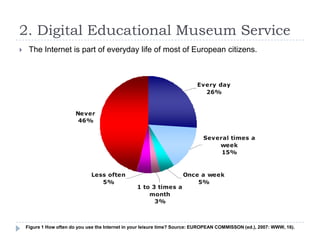
2. Digital Educational Museum ServiceThe Internet is part of everyday life of most of European citizens.Figure 1 Howoften do youusethe Internet in yourleisure time? Source: EUROPEAN COMMISSON (ed.), 2007: WWW, 16).
2. Digital Educational Museum ServiceThe World Wide Web developed from a static and one-way platform to an interactive and two-way communicative service (O'REILLY 30.09.2005: WWW).  The Internet can now be used to grasp information but also as a platform for self-expression (O'REILLY 30.09.2005: WWW). Now in the time of Web 2.0 the Internet user is a consumer and producer of content as well (prosumer) (WEIBEL, 2007: 23).
2. Digital Educational Museum ServiceThe digital educational museum service in Germany can be separated into three categories: General information, such as address, contact person and other contact details;Specialized information about the educational service as well as an on-line registration form, download center, information about projects or educational programs;Educational service and learning opportunities such as mentioned in the second category plus information about the collection or exhibitions, online games, databases, online exhibitions, detailed explanations (PREHN, 2002: WWW, 5).
2. Digital Educational Museum ServiceFigure 2 Digital Educational Museum Service of the Jewish Museum Berlin (Jewish Museum Berlin, WWW. Last access: 02.09.10.)
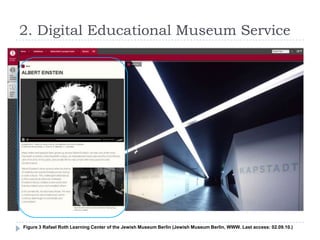
2. Digital Educational Museum ServiceFigure 3 Rafael Roth Learning Center of the Jewish Museum Berlin (Jewish Museum Berlin, WWW. Last access: 02.09.10.)
2. Digital Educational Museum ServiceA fourth category of the Digital Educational Museum Service:Brooklyn Museum, New York = unit of building and virtual counterpart with the Project "Click! A Crowd-Curated Exhibition"Web 2.0 functions and focus on communication, interaction and participation
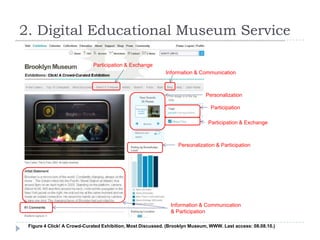
2. Digital Educational Museum ServiceParticipation & ExchangeInformation & CommunicationPersonalizationParticipationParticipation & ExchangePersonalization & ParticipationInformation & Communication & ParticipationFigure 4 Click! A Crowd-Curated Exhibition, Most Discussed. (Brooklyn Museum, WWW. Last access: 08.08.10.)
2. Digital Educational Museum ServiceSo what did the Brooklyn Museum provide that can be defined as a Web 2.0 tool?Participation: open to any photographer who had produced work with a Brooklyn theme, participation via rating, selection, comparison & taggingCommunication: blog or comment function on the photosPersonalization: MySite concept, embedding the blog in personal sites, e.g. igoogle, social bookmarkingInformation: RSS function on the blogCombination of on-line and on-site activities
Web 2.0 in museums can be divided into four functional areas which represent different purposes of Web 2.0: Personalization: MySite concepts, download center, databases, social bookmarksInformation and Communication: RSS newsfeeds, podcast, weblogs, microbloggingParticipation: wikis, social tagging, comment functions, participatory projectsNetwork and Exchange: Flickr, YouTube, MySpace, Facebook, social bookmarks, mashups (LILL & SCHWEIBENZ, 2009: WWW, 22)
2. Digital Educational Museum ServiceFigure 5 Click! A Crowd-Curated Exhibition, Real Exhibition in Online-Archive. (Brooklyn Museum, WWW. Last access: 08.08.10.)
3. OverviewBenefits of the Digital Educational Museum Service on the Internet:To guarantee public access to cultural heritageTo enable visitors to prepare and review their visits individually (connection of museum and virtual counterpart)To offer participatory opportunitiesTo communicate and activate dialoguesTo connect and expand educational work by combining on-site and on-line activities Toguarantee a communicativeandparticipatoryrelationship between the museum and its visitors on-siteand on-line

Education and learning in museum

  • 1.
    Education and Learningin Museums 2.0PhD Thesis "Art Museums in Web 2.0" by Bianca BocatiusInstitute of Information Science, Heinrich-Heine-University Duesseldorf
  • 2.
    OutlineLifelong Learning inMuseumsDigital Educational Museum ServiceOverviewOutlook
  • 3.
    1. Lifelong Learningin MuseumsReasonsforincreasingimportanceoflifelonglearning (LINDE & STOCK, 2009: 205f):ModificationofknowledgeKnowledge as most important economic resourceLifelong learning is essential for success and development of a knowledge-based society.
  • 4.
    1. Lifelong Learningin MuseumsMuseum as informal learning place:
  • 5.
    "Museums provide uniqueeducational opportunities; their displays of objects and their informal atmosphere not only invite learning, but also make possible the enjoyment of learning, often for the first time […]"(AAM, 1969).
  • 6.
    Museum as placeof lifelong learning:
  • 7.
    "Museums all overEurope have been reviewing their rôle, adding a new facet to their mission in terms of their relationship with society and the local community and have undertaken significant actions to become agents of social change and social integration, bringing more people back into the learning cycle. Nowadays it is largely recognized that most of what we learn is acquired in informal contexts and that museums are ideal places for learning throughout life, as they offer free choice learning and can address all age ranges" (EUROPEAN MUSEUM FORUM (ed.), 2005: 1).1. Lifelong Learning in MuseumsRamifications for museums:Nowadayseducation and learning are the biggest challenges for museums (DMB & BVMP (ed.), 2008: 6).Museums as informative and communicative systemsInformation and Communication Technologies enlarge the educational supportICT in museums: e.g. smartphones, computer-based terminals and the Internet.
  • 8.
    2. Digital EducationalMuseum ServiceASTLEITNER (2004) points out four basic developments for learning online:Self-directed learningLocal distanceCooperative knowledge acquisitionDiversity for pluralistic thinking (ASTLEITNER 2004: 13f)
  • 9.
    2. Digital EducationalMuseum ServiceThe Internet is part of everyday life of most of European citizens.Figure 1 Howoften do youusethe Internet in yourleisure time? Source: EUROPEAN COMMISSON (ed.), 2007: WWW, 16).
  • 10.
    2. Digital EducationalMuseum ServiceThe World Wide Web developed from a static and one-way platform to an interactive and two-way communicative service (O'REILLY 30.09.2005: WWW). The Internet can now be used to grasp information but also as a platform for self-expression (O'REILLY 30.09.2005: WWW). Now in the time of Web 2.0 the Internet user is a consumer and producer of content as well (prosumer) (WEIBEL, 2007: 23).
  • 11.
    2. Digital EducationalMuseum ServiceThe digital educational museum service in Germany can be separated into three categories: General information, such as address, contact person and other contact details;Specialized information about the educational service as well as an on-line registration form, download center, information about projects or educational programs;Educational service and learning opportunities such as mentioned in the second category plus information about the collection or exhibitions, online games, databases, online exhibitions, detailed explanations (PREHN, 2002: WWW, 5).
  • 12.
    2. Digital EducationalMuseum ServiceFigure 2 Digital Educational Museum Service of the Jewish Museum Berlin (Jewish Museum Berlin, WWW. Last access: 02.09.10.)
  • 13.
    2. Digital EducationalMuseum ServiceFigure 3 Rafael Roth Learning Center of the Jewish Museum Berlin (Jewish Museum Berlin, WWW. Last access: 02.09.10.)
  • 14.
    2. Digital EducationalMuseum ServiceA fourth category of the Digital Educational Museum Service:Brooklyn Museum, New York = unit of building and virtual counterpart with the Project "Click! A Crowd-Curated Exhibition"Web 2.0 functions and focus on communication, interaction and participation
  • 15.
    2. Digital EducationalMuseum ServiceParticipation & ExchangeInformation & CommunicationPersonalizationParticipationParticipation & ExchangePersonalization & ParticipationInformation & Communication & ParticipationFigure 4 Click! A Crowd-Curated Exhibition, Most Discussed. (Brooklyn Museum, WWW. Last access: 08.08.10.)
  • 16.
    2. Digital EducationalMuseum ServiceSo what did the Brooklyn Museum provide that can be defined as a Web 2.0 tool?Participation: open to any photographer who had produced work with a Brooklyn theme, participation via rating, selection, comparison & taggingCommunication: blog or comment function on the photosPersonalization: MySite concept, embedding the blog in personal sites, e.g. igoogle, social bookmarkingInformation: RSS function on the blogCombination of on-line and on-site activities
  • 17.
    Web 2.0 inmuseums can be divided into four functional areas which represent different purposes of Web 2.0: Personalization: MySite concepts, download center, databases, social bookmarksInformation and Communication: RSS newsfeeds, podcast, weblogs, microbloggingParticipation: wikis, social tagging, comment functions, participatory projectsNetwork and Exchange: Flickr, YouTube, MySpace, Facebook, social bookmarks, mashups (LILL & SCHWEIBENZ, 2009: WWW, 22)
  • 18.
    2. Digital EducationalMuseum ServiceFigure 5 Click! A Crowd-Curated Exhibition, Real Exhibition in Online-Archive. (Brooklyn Museum, WWW. Last access: 08.08.10.)
  • 19.
    3. OverviewBenefits ofthe Digital Educational Museum Service on the Internet:To guarantee public access to cultural heritageTo enable visitors to prepare and review their visits individually (connection of museum and virtual counterpart)To offer participatory opportunitiesTo communicate and activate dialoguesTo connect and expand educational work by combining on-site and on-line activities Toguarantee a communicativeandparticipatoryrelationship between the museum and its visitors on-siteand on-line