EDUCATION
SUBMITTED TO
DEPT. OF AGRICULTURAL
EXTENSION
SUBMITTED
BY
Bhashkar
kumar
DKAC/033/2016-
MEANING OF EDUCATION
• Education is the process of desirable change into the
behaviour of human beings.
• It can also be defined as the ‘’process of imparting or
acquiring knowledge or habits through instruction or
study’’.
• They should be acceptable socially, culturally and
comically and result in a change in knowledge, skill,
attitude and understanding.
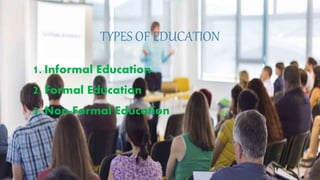
TYPES OF EDUCATION
1. Informal Education
2. Formal Education
3. Non-Formal Education
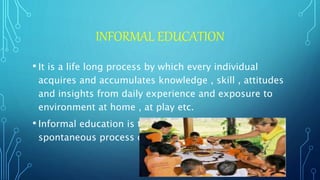
INFORMAL EDUCATION
• It is a life long process by which every individual
acquires and accumulates knowledge , skill , attitudes
and insights from daily experience and exposure to
environment at home , at play etc.
• Informal education is the wise , respectful and
spontaneous process of cultivating learning.
FORMAL EDUCATION
• It is highly institutionalized , uniform , full time ,
chronologically graded and hierarchically structured
‘education system’ , spanning lower primary school
and the upper reaches of the university.
• Formal education only prepares man to earn a living
more specifically for the jobs.
• In this education teacher is considered superior to the
taught.
NON-FORMAL EDUCATION
• It is an organised , systematic , educational activity
carried on outside the framework of the formal system
to provide selected types of learning to particular sub
groups in population , adults as well as children
according to their needs.
E.g.-Training of farmers , online free courses.
• It is open ended educational system.
EXTENSION EDUCATION
• It is also a types of education deals with the creation ,
transmission and application of knowledge designed
to bring about planned changes in the behaviour-
complex of people; with a view to help them live
better by learning the ways of improving their
vocations, enterprises and institutions.
• In extension education the leaners are heterogeneous
and have diverse goals.
Education

Education

  • 1.
    EDUCATION SUBMITTED TO DEPT. OFAGRICULTURAL EXTENSION SUBMITTED BY Bhashkar kumar DKAC/033/2016-
  • 2.
    MEANING OF EDUCATION •Education is the process of desirable change into the behaviour of human beings. • It can also be defined as the ‘’process of imparting or acquiring knowledge or habits through instruction or study’’. • They should be acceptable socially, culturally and comically and result in a change in knowledge, skill, attitude and understanding.
  • 3.
    TYPES OF EDUCATION 1.Informal Education 2. Formal Education 3. Non-Formal Education
  • 4.
    INFORMAL EDUCATION • Itis a life long process by which every individual acquires and accumulates knowledge , skill , attitudes and insights from daily experience and exposure to environment at home , at play etc. • Informal education is the wise , respectful and spontaneous process of cultivating learning.
  • 5.
    FORMAL EDUCATION • Itis highly institutionalized , uniform , full time , chronologically graded and hierarchically structured ‘education system’ , spanning lower primary school and the upper reaches of the university. • Formal education only prepares man to earn a living more specifically for the jobs. • In this education teacher is considered superior to the taught.
  • 6.
    NON-FORMAL EDUCATION • Itis an organised , systematic , educational activity carried on outside the framework of the formal system to provide selected types of learning to particular sub groups in population , adults as well as children according to their needs. E.g.-Training of farmers , online free courses. • It is open ended educational system.
  • 7.
    EXTENSION EDUCATION • Itis also a types of education deals with the creation , transmission and application of knowledge designed to bring about planned changes in the behaviour- complex of people; with a view to help them live better by learning the ways of improving their vocations, enterprises and institutions. • In extension education the leaners are heterogeneous and have diverse goals.