OBTL Plan EDUC 1A/EDUC 101 – The Child and Adolescent Learners and Learning Principles
Republic of the Philippines
TARLAC STATE UNIVERSITY
College of Teacher Education
VISION Tarlac State University is envisioned to be a premier university in Asia and the Pacific Region.
Tarlac State University commits to promote and sustain the offering of quality and programs in higher and advanced education ensuring equitable
access to education for people empowerment, professional development, and global competitiveness.
Towards this end, TSU shall:
MISSION
1. Provide high quality instruction trough qualified, competent and adequately trained faculty members and support staff.
2. Be a premier research institution by enhancing research undertakings in the fields of technology and sciences and strengthening
collaboration with local and international institutions.
3. Be a champion in community development by strengthening partnership with public and private organizations and individuals.
E - xcellence
Q - uality
CORE VALUES
U - nity
I - ntegrity
T - rust in God, Transparency & True Commitment
Y - earning for Global Competitiveness
Course Name The Child and Adolescent Learner and Learning Principles
Form No.: TSU-VPA-__-__ Revision No.: 00__ Effectivity Date: ________________ Page 1 of 13
OBTL Plan EDUC 1A/EDUC 101 – The Child and Adolescent Learners and Learning Principles
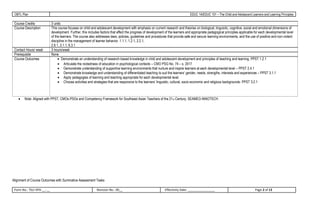
Course Credits 3 units
Course Description This course focuses on child and adolescent development with emphasis on current research and theories on biological, linguistic, cognitive, social and emotional dimensions of
development. Further, this includes factors that affect the progress of development of the learners and appropriate pedagogical principles applicable for each developmental level
of the learners. The course also addresses laws, policies, guidelines and procedures that provide safe and secure learning environments, and the use of positive and non-violent
discipline in the management of learner behavior. 1.1.1; 1.2.1, 2.2.1,
2.6.1, 3.1.1, 6.3.1
Contact Hours/ week 3 hours/week
Prerequisite None
Course Outcomes • Demonstrate an understanding of research-based knowledge in child and adolescent development and principles of teaching and learning. PPST 1.2.1
• Articulate the rootedness of education in psychological contexts – CMO PSG No. 74 – s. 2017
• Demonstrate understanding of supportive learning environments that nurture and inspire learners at each developmental level – PPST 2.4.1
• Demonstrate knowledge and understanding of differentiated teaching to suit the learners’ gender, needs, strengths, interests and experiences – PPST 3.1.1
• Apply pedagogies of learning and teaching appropriate for each developmental level.
• Choose activities and strategies that are responsive to the learners’ linguistic, cultural, socio-economic and religious backgrounds- PPST 3.2.1
• Note: Aligned with PPST, CMOs-PSGs and Competency Framework for Southeast Asian Teachers of the 21st Century, SEAMEO-INNOTECH.
Alignment of Course Outcomes with Summative Assessment Tasks
Form No.: TSU-VPA-__-__ Revision No.: 00__ Effectivity Date: ________________ Page 2 of 13
OBTL Plan EDUC 1A/EDUC 101 – The Child and Adolescent Learners and Learning Principles
Course Outcomes Summative Assessment Task Details
At the end of the course, the pre-service teachers can , BTIs
covered) Unit test Construct a unit test that will evaluate knowledge and understanding of the different
[1] demonstrate content knowledge and its application within and principles of learning as they relate to child and adolescent development.
/or across curriculum teaching areas; 1.1.1
Present research findings on recent Presentation of research findings.
[2] demonstrate an understanding of the different research-based studies on child and adolescent growth
theories related to the broad dimensions of child and adolescent and development and their implication to
development the teaching-learning process, teacher-
and their application to each particular developmental level of the learner relationship and child care.
learners; 1.2.1
Present different models and designs of Synthesis projects
pedagogies of learning and teaching.
[3] demonstrate understanding of pedagogical principles suited to That are supportive of learners at each
diverse learners’ needs and experiences at different developmental level.
developmental levels; 3.1.1
Illustrate how teaching can be Synthesis projects
[4] demonstrate knowledge of laws, policies, guidelines and differentiated for diverse learners.
procedures that provide safe and secure learning environments;
and 6.3.1, 2.1.1
Describe the developmental Synthesis projects
characteristics of learners
[5] demonstrate knowledge of positive and non-violent discipline in
the management of learner behavior. 2.6.1 Present different models and designs of
pedagogies of learning and teaching for
each developmental level.
Present different models and designs of
pedagogies of learning and teaching
responsive to diverse linguistic, cultural, Synthesis projects
socio-economic and religious
backgrounds.
Form No.: TSU-VPA-__-__ Revision No.: 00__ Effectivity Date: ________________ Page 3 of 13
OBTL Plan EDUC 1A/EDUC 101 – The Child and Adolescent Learners and Learning Principles
LEARNING PLAN
Reso
Desired Learning Outcomes
Course Content/Subject Matter Textbook/ References Teaching and Learning Activities (TLAs) Assessment of Tasks (ATs)
urce Time
(DLOs) Materi Table
als
At the end of the unit, Acero, Victorina • Conversation Journey on the words, Quiz; Reflection paper; research abstract
the pre-service O.,Javier Evelyn ‘’Learner-Centered,’’ and the word Summative quizzes1.1.1 [1] 1.2.1 [2]] 6 hrs
teacher (PST) can: S.,Castro ‘’Principles:’’ Class discussion; 1.1.1 [1] 1.2.1 [2] 24
• a. explain the basic
Unit 1 – Basic Concepts
, Herminia O.( 2000) research; reflection Unit learning log or reflective journal.
concepts related Principles and 1.1.1 [1] 1.2.1 [2]
(Natural)
to child and adolescent Strategies of Facilitated discussion using comparative Infographic. The PST, individually or in
A. Definitions of Child and
development; and Teaching.Manila: Rex study. A comparative discussion of the small groups, will explain the basic
Adolescent Learners
1.1.1 [1] Bookstore, Inc. definition and characteristics of child and concepts related to child and adolescent
1. Definitions from UNESCO,
• b. explain how current Corpuz., Brenda B., adolescent learners coming from various learners’ development and growth using
UNICEF and WHO
research and Salandan, GloriaG., sources or authorities. text and graphic presentation or
B. Growth and Development:
theories on child and (2013) Principles of Advanced reading/research. infographic. The output will be presented
Nature or Nurture?
adolescent Teaching 1. Quezon Topics on growth and development may be in class or exhibited in a gallery. 1.1.1 [1
C. Periods of Development
development City:Lorimar given in advance to PSTs in small groups to Debate. Debate may also be used to
D. Developmental Tasks and
contribute to Publishing ,Inc. 2013 prepare them for debate and further assess PSTs’ understanding of the
Education (Havighurst)
teaching and learning discussions. “nature or nurture” issue based on their
E. Domains of Development
within and Explicit Instruction. This shall involve research. Groupings will be pre-
1. Biological
across different areas. modelling, guided learner practice and determined to guide PSTs in their
2. Cognitive
1.2.1 [2 Swindoll,Charles R. independent learner practice. Current research research. Premium will be given on the
3. Socio-emotional
(1993). You and Your shall be used to highlight key concepts, with justifications and clarity of points.
F. Context and Development
Child. Anaheim, emphasis on the integration of theory into Library/Online research. This involves
G. Development and
California. Insight for practice. Online journal search strategies will the systematic gathering of information in
Pedagogy: Theory and
Living also be introduced to promote PSTs’ academic order to write a paper, create a
Research
Meece, J.L. (1997). literacy. presentation, or complete a project. As
1. Theories and hypotheses
Child and adolescent used in this context, pre-service teachers
2. Methodology
development for shall gather research information on
3. Integrating theory and
educators. New York: identified topics from journals. The
practice.
McGraw-Hill. preservice teachers shall focus on the
4.Spiritual Issues on Human
research Problem, Theories,
Development
Methodology, Findings and Discussion of
Results. Insights, reflections and
Form No.: TSU-VPA-__-__ Revision No.: 00__ Effectivity Date: ________________ Page 4 of 13
OBTL Plan EDUC 1A/EDUC 101 – The Child and Adolescent Learners and Learning Principles
discussions regarding integrating theory
into teaching and learning based on
research knowledge shall be given
emphasis.
Output: Matrix or poster of the
research material
At the end of the unit, the Unit 2 – Biological Development Interactive instruction and facilitated Concept Maps. PSTs, in small groups, 9 hrs.
pre-service teacher (PST) A. Biological Beginnings Owens, K. (2002). discussion. illustrate the mental connections they PPT
can: B. Physical and Motor Child and A historical overview on biological make between major concepts or other Comp
a. discuss the concepts Development adolescent development of children and adolescents may concepts they have learned about a uter/
and theories related to the C. Neuroscience and Brain development: An introduced. Timelines focusing on major topic. Other organizers may be used Lapto
biological/physical development integrated contributors/contributions to the field of whenever appropriate. Output: The p
development of children D. Factors Affecting approach. biological psychology will be useful in the concept map will be presented and used Relat
and adolescents; and 1.1.1 Biological/ Physical Belmont, CA: discussion of the concepts and theories. Video to discuss the research-based concepts ed
[1] Development Wadsworth/Thoms clips and multimedia presentations may be and theories related to the Literat
b. make connections, using E. Theories on Learning. used to supplement the discussion of concepts biological/physical development of ure
knowledge on current 1. Developmental Milestones on biological development. Library/Online children and adolescents. Assessment
research literature, (Gesell) Sroufe, L.., Cooper, research. This involves the systematic shall be based on detail of content,
between biological 2. Ecological Systems Theory R.., & DeHart, .B. gathering of information in order to write a relationship of concepts, discussion and
development theories and (Bronfenbrenner) (2000). Child paper, create a presentation, or complete a presentation.
developmentally F. Current Research and development: Its project. As used in this context, preservice Simulations.
appropriate teaching Pedagogical Applications nature and course. teachers shall gather research information on This presents cases, problems,
approaches suited to New York: McGraw- identified topics from journals. The preservice scenarios, etc. in which the students
learners’ gender, needs, Hill. teachers shall focus on the research Problem, must role play. A critical situation is
strengths, interests and Theories, Methodology, Findings and discussed and analyzed, and decisions
experiences. 1.2.1 [2] Discussion of Results, as well as, applications are made about how to resolve the
3.1.1 [3] and implications of biological development situation using knowledge derived from
theories to teaching child and adolescent library or online research. A problem
learners solving organizer (refer to Annex B) may
be used to aid in the decision making
Poster presentations. Poster
presentations may be an alternative to
simulations. Knowledge and information
derived from library/online research may
be presented explaining the connections
Form No.: TSU-VPA-__-__ Revision No.: 00__ Effectivity Date: ________________ Page 5 of 13
OBTL Plan EDUC 1A/EDUC 101 – The Child and Adolescent Learners and Learning Principles
of biological development theories to
teaching approaches suited to learners’
gender, needs, strengths, interests and
experiences. An alternative to poster
presentation is the Research Literature
Matrix (refer to Annex C).
Textbook/
Resourc
Time
Desired Learning Outcomes (DLOs) Course Content/Subject Matter Teaching and Learning Activities (TLAs) Assessment of Tasks (ATs) e
References Table
Materials
At the end of the unit, the pre- Unit 3 – Cognitive Development Meece, J.L. (1997). Interactive instruction and facilitated Concept Maps. PSTs, in small PPT 9 hrs
service teacher (PST) can: A. Cognitive Development Child and adolescent discussion. groups, illustrate the mental Compute
a. discuss the concepts and Theories development for A historical overview on cognitive connections they make between r/ Laptop
theories related to the cognitive 1. Piaget educators. New York: development of children and major concepts or other Related
development of children and 2. Vygotsky McGraw-Hill. adolescents may introduced. Timelines concepts they have learned or Literature
adolescents; and1.1.1 [1] B. Intelligence and Individual focusing on major researched on about a topic. Films
b. make connections, using Differences contributors/contributions to the field of Other organizers may be used
knowledge on current research 1. Concept of Intelligence (Binet) cognitive psychology will be useful in whenever appropriate. Output:
literature, between cognitive 2. General Intelligence (Spearman) the discussion of the concepts and The concept map will be
development theories and 3. Primary Mental Abilities (Thurstone theories. Video clips and multimedia presented and used to discuss
developmentally appropriate 4. Multiple Intelligences (Gardner) presentations may be used to the concepts and theories
teaching approaches suited to 5. Triarchic Theory of Intelligence supplement the discussion of concepts related to the cognitive
learners' gender, needs, strengths, (Sternberg) on cognitive development. development of children and
interests and experiences. 1.2.1 6. Cognitive Information Processing Library/Online research. This involves adolescents. Assessment shall
[2] 3.1.1 [3] Theory (Atkinson and Shiffrin) the systematic gathering of information be based on detail of content,
C. Factors Affecting Cognitive in order to write a paper, create a relationship of concepts,
Development presentation, or complete a project. As discussion and presentation.
D. Language Development used in this context, preservice Simulations. This presents
E. Factors Affecting Cognitive and teachers shall gather research cases, problems, scenarios, etc.
Language Development information on identified topics from in which the students must role
F. Current Research and journals. The preservice teachers shall play. A critical situation is
Pedagogical Applications focus on the research Problem, discussed and analyzed, and
Theories, Methodology, Findings and decisions are made about how to
Discussion of Results, as well as, resolve the situation using
applications and implications of knowledge derived from library
cognitive development theories to or online research. A problem
teaching child and adolescent learners. solving organizer (refer to Annex
Form No.: TSU-VPA-__-__ Revision No.: 00__ Effectivity Date: ________________ Page 6 of 13
OBTL Plan EDUC 1A/EDUC 101 – The Child and Adolescent Learners and Learning Principles
B) may be used to aid in the
decision making
Poster presentations. Poster
presentations may be an
alternative to simulations.
Knowledge and information
derived from library/online
research may be presented
explaining the connections of
cognitive development theories
to teaching approaches suited to
learners’ gender, needs,
strengths, interests and
experiences. An alternative to
poster presentation is the
Research Literature Matrix (refer
to Annex C) 1.1.1 [1] 3
At the end of the unit, the pre- Unit 4 – Social and Emotional Interactive instruction and facilitated Concept Maps. PSTs, in small PPT 9hrs
service teacher (PST) can: Development Sroufe, L.., Cooper, discussion. A historical overview on groups, illustrate the mental Compute
a. discuss the concepts and A.Socio-emotional Development R.., & DeHart, .B. socio-emotional development of connections they make between r/ Laptop
theories related to the socio- (2000). Child children and adolescents may major concepts or other Related
emotional development of B.Development of Self and Social development: Its introduced. Timelines focusing on major concepts they have learned Literature
children and adolescents Understandings nature and course. contributors/ contributions to the field of about a topic. Other organizers Films
b. ; make connections, using 1. Psychoanalytic Theory (Freud) New York: McGraw- social psychology will be useful in the may be used whenever Psycholo
knowledge on current research 2. Psychosocial Theory (Erikson) Hill. discussion of the concepts and appropriate. Output: The concept gical
literature, between socio 3. Social Learning Theory theories. Video clips and multimedia map will be presented and used tests
emotional development (Bandura) presentations may be used to to discuss the concepts and
theories and developmentally supplement the discussion of concepts theories related to the socio-
appropriate teaching C.Development of Motivation and on socio-emotional development. emotional development of
approaches suited to learners’ Self-Regulation children and adolescents.
gender, needs, strengths, 1. Content Theories Library/Online research. This involves Assessment shall be based on
interests and experience – Hierarchy of Needs (Maslow) the systematic gathering of information detail of content, relationship of
- ERG Theory (Alderfer) in order to write a paper, create a concepts, discussion and
- Theory of Needs (McClelland) presentation, or complete a project. As presentation
- Two Factors Theory (Herzberg) used in this context, preservice
2. Process Theories teachers shall gather research Simulations. This presents
- Reinforcement Theory (Skinner) information on identified topics from cases, problems, scenarios, etc.
- Expectancy Theory (Vroom) journals. The preservice teachers shall in which the students must role
Form No.: TSU-VPA-__-__ Revision No.: 00__ Effectivity Date: ________________ Page 7 of 13
OBTL Plan EDUC 1A/EDUC 101 – The Child and Adolescent Learners and Learning Principles
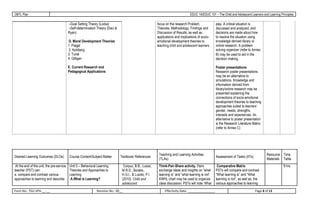
–Goal Setting Theory (Locke) focus on the research Problem,
–Self-determination Theory (Deci & Theories, Methodology, Findings and
Ryan) Discussion of Results, as well as,
applications and implications of socio-
D. Moral Development Theories emotional development theories to
1. Piaget teaching child and adolescent learners.
2. Kohlberg
3. Turiel
4. Gilligan
E. Current Research and
Pedagogical Applications
play. A critical situation is
discussed and analyzed, and
decisions are made about how
to resolve the situation using
knowledge derived library or
online research. A problem
solving organizer (refer to Annex
B) may be used to aid in the
decision making.
Poster presentations.
Research poster presentations
may be an alternative to
simulations. Knowledge and
information derived from
library/online research may be
presented explaining the
connections of socio-emotional
development theories to teaching
approaches suited to learners’
gender, needs, strengths,
interests and experiences. An
alternative to poster presentation
is the Research Literature Matrix
(refer to Annex C)
Desired Learning Outcomes (DLOs) Course Content/Subject Matter Textbook/ References
Teaching and Learning Activities
Assessment of Tasks (ATs)
Resource Time
(TLAs) Materials Table
At the end of the unit, the pre-service Unit 5 – Behavioral Learning Corpuz, B.B., Lucas, Think-Pair-Share activity. Pairs Comparative Matrix 9 hrs
teacher (PST) can: Theories and Approaches to M.R.D., Borabo, exchange ideas and insights on “what PSTs will compare and contrast
a. compare and contrast various Learning H.G.I., & Lucido, P.I. learning is” and “what learning is not”. “What learning is” and “What
approaches to learning and describe A.What is Learning? (2010). Child and KWHL chart may be used to organize learning is not”, as well as, the
adolescent class discussion. PSTs will note: What various approaches to learning
Form No.: TSU-VPA-__-__ Revision No.: 00__ Effectivity Date: ________________ Page 8 of 13
OBTL Plan EDUC 1A/EDUC 101 – The Child and Adolescent Learners and Learning Principles
how they are manifested in the B. Approaches to Learning
classroom; 1.1.1 [1] 1. Behavioral
b. apply behavior analysis in teaching 2. Social cognitive
child and adolescent learners across 3. Information processing
curriculum areas; 1.1.1 [1] 4. Cognitive constructivist
c. make connections, using 5. Social constructivist
knowledge on current research
literature, between behavioral C.Connectionism
learning theories and
developmentally appropriate1.2.1 [2] D. Conditioning
3.1.1 [3] 1. Classical
2. Contiguous
3. Operant
E. Behavior Analysis in
Education
F. Gestalt-Insight Learning
G. Experiential Learning Theory
H. Current Research and
Pedagogical Applications
development: Looking
at learners at different
life stages. Quezon
City: Lorimar
Publishing, Inc.
Owens, K. (2002).
Child and adolescent
development: An
integrated approach.
Belmont, CA:
Wadsworth/Thomson
Learning.
Gastardo-Conaco, M.
C., Jimenez, M., &
Billedo, C. J. (2003).
Filipino adolescents in
changing times. QC:
UP Center for
Women’s Studies and
the Philippine Center
for Population and
Development.
Ogena, N. B. (1999).
How are the Filipino
youth changing? The
shifting lifestyles of our
they Know, what they Want to know,
How will they know and what they
Learned. Interactive instruction and
facilitated discussion. Timelines
focusing on major contributors and their
contributions to the field of behavioral
psychology will be useful in the
discussion of the concepts and theories.
Video clips and multimedia
presentations will greatly supplement
the discussion of concepts on
behaviorism and other learning theories.
Library/Online research. This involves
the systematic gathering of information
in order to write a paper, create a
presentation, or complete a project. As
used in this context, preservice teachers
shall gather research information on
identified topics from journals. The
preservice teachers shall focus on the
research the Problem, Theories,
Methodology, Findings and Discussion
of Results, as well as, applications and
implications of behavioral learning
theories to teaching child and
adolescent learners.
using a Comparative Matrix. In
addition, PSTs will describe actual
classroom situations (based on
experience or observation)
manifesting the corresponding
approach to learning. Outputs
shall be presented in class and
will be rated using a rubric.
Interview on Field Experience
of Teachers
PSTs (individually or in small
groups) will interview at least 2
teachers of different grade levels.
PSTs will ask: (1) what are the
challenges, especially
behavioral, the teachers usually
encountered in teaching, and (2)
what course of action did the
teachers take to overcome these
challenges? The PSTs will then
summarize the results in a
matrix, apply behavior analysis
and determine the effectiveness
of the course of action of the
teacher using the learning
principles and related research
literature, and recommend a
better course of action, if any.
Form No.: TSU-VPA-__-__ Revision No.: 00__ Effectivity Date: ________________ Page 9 of 13
OBTL Plan EDUC 1A/EDUC 101 – The Child and Adolescent Learners and Learning Principles
At the end of the unit, the pre-service Unit 6 – Safety and Security in the Liwag, M. C. D. & Advanced reading/research. Panel discussion. 9 hrs
teacher (PST) can: Learning Environment Macapagal, M.E. J. Topics on laws, policies, and PSTs, in small groups, will
a. discuss the laws, policies, (1999). How we raise our procedures that protect children’s present a panel discussion to the
guidelines and procedures that A. UN Convention on the Rights daughters and sons: rights and assure their safety and class. Panel discussions will
protect children’s rights and assure of the Child and PD 603 Child rearing and gender security in school may be given ahead address laws, policies and issues
their safety and security in school; socialization in the to PSTs in small groups to prepare on the rights of child and
and 2.1.1 [4] 6.3.1 [4] B. Anti-Bullying Act of 2013 Philippines. United them for panel discussion. adolescent learners as well as on
b. explain and draw implications of (Republic Act 10627) Nations Children’s Fund their safety and security in school.
policies and procedures on child and the Ateneo Wellness Seminar/Colloquium with a
protection, and positive/non-violent C. Child Protection Policy Center. resource person from the field. Written narrative.
discipline in the management of D. Positive Discipline A basic education master teacher, a PSTs will be asked to write a
behavior. 2.6.1 [5] Corpuz, Brenda B., school head or a colleague may be narrative on their insights from the
Lucas, Ma. Rita D., invited to discuss on laws, policies, panel discussions and the
Borabo, Heidi Grace L. and procedures that protect children’s colloquium capped with insights
rights and assure their safety and on the different purposes of
security in school, as well as, policies professional reflection. Output: A
and procedures on child protection, written narrative with discussions
and positive/nonviolent discipline in on the implications of policies and
the management of behavior procedures on child protection,
and positive/non-violent discipline
in the management of behavior.
Suggested Readings and Iral, Florante S., et al. Teaching Profession. Plaridel Bulacan : St. Andrew Publishing House, 2012.
References Bilbao, Purita P., et al. Teaching Profession. Quezon City : Lorimar Publishing Co., Inc, 2006.
Other References:
Tejero, Erlinda G., et al. Multidisciplinary Teaching Strategies. Mandaluyong City: National Bookstore, 2012.
Zulueta, Francisco M. and Zenaida V. Sevilla. Principles of Teaching and Teaching Strategies. Navotas City : National Bookstore, 2012.
NCBTS-Based Table of Specification for LET
Corpuz, B.B., Lucas, M.R.D., Borabo, H.G.L., & Lucido, P.I. (2018) The Child and Adolescent Learners and Learning Principles. Lorimar Publishing, Inc, Quezon City,
Philippines. Corpuz, B.B., Lucas, M.R.D., Borabo, H.G.L., & Lucido, P.I. (2015) Child and Adolescent Development. Lorimar Publishing, Inc, Quezon City, Philippines. Lucas,
Ma. Rita D. & Corpuz, Brenda B. (2014) Facilitating Learning: A metacognitive process. Lorimar Publishing, Inc, Quezon City, Philippines. Cohen, L., Manion, L., Morrison, K. &
Wyse, D. (2010) A Guide to Teaching Practice, 5e. Routeledge, 270 Madison Ave., New York, NY. Santrock, J.W. (2011) Educational Psychology, 5e. McGraw-Hill
Companies, Inc. New York, NY. Schunk, Dale H. (2012) Learning Theories: An educational perspective, 6e. Pearson Education, Inc. Boston, MA Higher Education
Commission (2012) Child Development: Faculty Resource. Higher Education Commission, Pakistan. UN-OHCHR (n.d.) 1989 Convention on the Rights of the Child. UN Office
of the High Commissioner for Human Rights. Retrieved from https://www.ohchr.org/Documents/ProfessionalInterest/crc.pdf Presidential Decree No. 603 (1974) The Child and
Youth Welfare Code of the Philippines. Retrieved from https://www.pcw.gov.ph/law/presidential-decree-no-603
Form No.: TSU-VPA-__-__ Revision No.: 00__ Effectivity Date: ________________ Page 10 of 13
OBTL Plan EDUC 1A/EDUC 101 – The Child and Adolescent Learners and Learning Principles
Republic Act No. 7610 (1992) Special Protection of Children Against Abuse, Exploitation and Discrimination Act. Available online:
https://www.pcw.gov.ph/sites/default/files/documents/laws/republic_act_7610.pdf Department Order No. 40, series of 2012 – Child Protection Policy. Available online:
http://www.deped.gov.ph/wp-content/uploads/2012/05/ DO_s2012_40.pdf Department of Education (2015) – Positive discipline in everyday teaching: A primer for Filipino
teachers. Available online: https://bulacandeped.com/wp-content/uploads/2016/08/POSITIVEDISCIPLINE-IN-EVERYDAY-TEACHING-A-Primer-for-Filipino-Teachers.pdf
UNHCR (2001) Child and Adolescent Development. UNHCR – Action for the Rights of Children Programme. Retrieved from
https://www.unhcr.org/protection/children/3bb81bad4/actionrights-children-arc-foundations-child-adolescent-development.html David L (2019),
"Summaries of Learning Theories and Models," in Learning Theories. Retrieved from, https://www.learning-theories.com/ Verywell Mind (2019) Theories of
Psychology. Retrieved from https://www.verywellmind.com/theories-of-psychology-4157184
Course Requirements
• Major Exams • Summative quizzes • Per unit outputs as specified in the assessment • End of course learning log (reflective journal) and portfolio (compilation of outputs) on
the different learning theories and research with reflections on their applications and implications to teaching child and adolescent learners.
Grading System
Midterm Finals
40% -Written long exam (Midterm) 30% -Summative Exam (Finals)
30% - ePortfolio 20% - ePortfolio
30% -Class Participation 25% -Class Participation
25% -Lesson Plan Exemplar
Classroom Policies
1. Active participation in class discussion thru MS Team is graded.
2. Cheating, during examination, will be given a score of 5.0.
3. Attendance will be checked a very meeting.
4. Assignments are to be submitted on time. Failure to submit assignments is equivalent to a grade of 5.0.
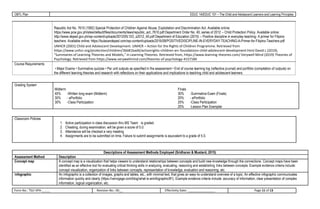
Descriptions of Assessment Methods Employed (Sridharan & Mustard, 2015)
Assessment Method Description
Concept map A concept map is a visualization that helps viewers to understand relationships between concepts and build new knowledge through the connections. Concept maps have been
identified as an effective tool for evaluating critical thinking skills in analyzing, evaluating, reasoning and establishing links between concepts. Example evidence criteria include:
concept visualization, organization of links between concepts, representation of knowledge, evaluation and reasoning, etc.
Infographic An infographic is a collection of images, graphs and tables, etc., with minimal text, that gives an easy-to-understand overview of a topic. An effective infographic communicates
information quickly and clearly (https://venngage.com/blog/what-is-aninfographic/#1). Example evidence criteria include: accuracy of information, clear presentation of complex
information, logical organization, etc.
Form No.: TSU-VPA-__-__ Revision No.: 00__ Effectivity Date: ________________ Page 11 of 13
OBTL Plan EDUC 1A/EDUC 101 – The Child and Adolescent Learners and Learning Principles
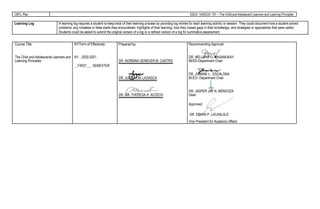
Learning Log A learning log requires a student to keep track of their learning process by providing log entries for each learning activity or session. They could document how a student solved
problems, any mistakes or false starts they encountered, highlights of their learning, how they closed gaps in their knowledge, and strategies or approaches that were useful.
Students could be asked to submit the original version of a log or a refined version of a log for summative assessment.
Course Title: AY/Term of Effectively: Prepared by: Recommending Approval:
The Child and Adolescents Learners and AY: _2020-2021 DR. MELLANY G. MASANGKAY
Learning Principles DR. NORBINA GENEVER M. CASTRO BEED-Department Chair
__FIRST___ SEMESTER
DR, JOANNE L. .ESCALONA
DR. JULIETA M. LAGASCA BCED- Department Chair
DR. JASPER JAY N. MENDOZA
DR. MA. THERESA A. ACOSTA Dean
Approved:
DR. ERWIN P. LACANLALE
Vice President for Academic Affairs
Form No.: TSU-VPA-__-__ Revision No.: 00__ Effectivity Date: ________________ Page 12 of 13
OBTL Plan EDUC 1A/EDUC 101 – The Child and Adolescent Learners and Learning Principles
Form No.: TSU-VPA-__-__ Revision No.: 00__ Effectivity Date: ________________ Page 13 of 13

Educ-101-1.pdf

  • 1.
    OBTL Plan EDUC1A/EDUC 101 – The Child and Adolescent Learners and Learning Principles Republic of the Philippines TARLAC STATE UNIVERSITY College of Teacher Education VISION Tarlac State University is envisioned to be a premier university in Asia and the Pacific Region. Tarlac State University commits to promote and sustain the offering of quality and programs in higher and advanced education ensuring equitable access to education for people empowerment, professional development, and global competitiveness. Towards this end, TSU shall: MISSION 1. Provide high quality instruction trough qualified, competent and adequately trained faculty members and support staff. 2. Be a premier research institution by enhancing research undertakings in the fields of technology and sciences and strengthening collaboration with local and international institutions. 3. Be a champion in community development by strengthening partnership with public and private organizations and individuals. E - xcellence Q - uality CORE VALUES U - nity I - ntegrity T - rust in God, Transparency & True Commitment Y - earning for Global Competitiveness Course Name The Child and Adolescent Learner and Learning Principles Form No.: TSU-VPA-__-__ Revision No.: 00__ Effectivity Date: ________________ Page 1 of 13
  • 2.
    OBTL Plan EDUC1A/EDUC 101 – The Child and Adolescent Learners and Learning Principles Course Credits 3 units Course Description This course focuses on child and adolescent development with emphasis on current research and theories on biological, linguistic, cognitive, social and emotional dimensions of development. Further, this includes factors that affect the progress of development of the learners and appropriate pedagogical principles applicable for each developmental level of the learners. The course also addresses laws, policies, guidelines and procedures that provide safe and secure learning environments, and the use of positive and non-violent discipline in the management of learner behavior. 1.1.1; 1.2.1, 2.2.1, 2.6.1, 3.1.1, 6.3.1 Contact Hours/ week 3 hours/week Prerequisite None Course Outcomes • Demonstrate an understanding of research-based knowledge in child and adolescent development and principles of teaching and learning. PPST 1.2.1 • Articulate the rootedness of education in psychological contexts – CMO PSG No. 74 – s. 2017 • Demonstrate understanding of supportive learning environments that nurture and inspire learners at each developmental level – PPST 2.4.1 • Demonstrate knowledge and understanding of differentiated teaching to suit the learners’ gender, needs, strengths, interests and experiences – PPST 3.1.1 • Apply pedagogies of learning and teaching appropriate for each developmental level. • Choose activities and strategies that are responsive to the learners’ linguistic, cultural, socio-economic and religious backgrounds- PPST 3.2.1 • Note: Aligned with PPST, CMOs-PSGs and Competency Framework for Southeast Asian Teachers of the 21st Century, SEAMEO-INNOTECH. Alignment of Course Outcomes with Summative Assessment Tasks Form No.: TSU-VPA-__-__ Revision No.: 00__ Effectivity Date: ________________ Page 2 of 13
  • 3.
    OBTL Plan EDUC1A/EDUC 101 – The Child and Adolescent Learners and Learning Principles Course Outcomes Summative Assessment Task Details At the end of the course, the pre-service teachers can , BTIs covered) Unit test Construct a unit test that will evaluate knowledge and understanding of the different [1] demonstrate content knowledge and its application within and principles of learning as they relate to child and adolescent development. /or across curriculum teaching areas; 1.1.1 Present research findings on recent Presentation of research findings. [2] demonstrate an understanding of the different research-based studies on child and adolescent growth theories related to the broad dimensions of child and adolescent and development and their implication to development the teaching-learning process, teacher- and their application to each particular developmental level of the learner relationship and child care. learners; 1.2.1 Present different models and designs of Synthesis projects pedagogies of learning and teaching. [3] demonstrate understanding of pedagogical principles suited to That are supportive of learners at each diverse learners’ needs and experiences at different developmental level. developmental levels; 3.1.1 Illustrate how teaching can be Synthesis projects [4] demonstrate knowledge of laws, policies, guidelines and differentiated for diverse learners. procedures that provide safe and secure learning environments; and 6.3.1, 2.1.1 Describe the developmental Synthesis projects characteristics of learners [5] demonstrate knowledge of positive and non-violent discipline in the management of learner behavior. 2.6.1 Present different models and designs of pedagogies of learning and teaching for each developmental level. Present different models and designs of pedagogies of learning and teaching responsive to diverse linguistic, cultural, Synthesis projects socio-economic and religious backgrounds. Form No.: TSU-VPA-__-__ Revision No.: 00__ Effectivity Date: ________________ Page 3 of 13
  • 4.
    OBTL Plan EDUC1A/EDUC 101 – The Child and Adolescent Learners and Learning Principles LEARNING PLAN Reso Desired Learning Outcomes Course Content/Subject Matter Textbook/ References Teaching and Learning Activities (TLAs) Assessment of Tasks (ATs) urce Time (DLOs) Materi Table als At the end of the unit, Acero, Victorina • Conversation Journey on the words, Quiz; Reflection paper; research abstract the pre-service O.,Javier Evelyn ‘’Learner-Centered,’’ and the word Summative quizzes1.1.1 [1] 1.2.1 [2]] 6 hrs teacher (PST) can: S.,Castro ‘’Principles:’’ Class discussion; 1.1.1 [1] 1.2.1 [2] 24 • a. explain the basic Unit 1 – Basic Concepts , Herminia O.( 2000) research; reflection Unit learning log or reflective journal. concepts related Principles and 1.1.1 [1] 1.2.1 [2] (Natural) to child and adolescent Strategies of Facilitated discussion using comparative Infographic. The PST, individually or in A. Definitions of Child and development; and Teaching.Manila: Rex study. A comparative discussion of the small groups, will explain the basic Adolescent Learners 1.1.1 [1] Bookstore, Inc. definition and characteristics of child and concepts related to child and adolescent 1. Definitions from UNESCO, • b. explain how current Corpuz., Brenda B., adolescent learners coming from various learners’ development and growth using UNICEF and WHO research and Salandan, GloriaG., sources or authorities. text and graphic presentation or B. Growth and Development: theories on child and (2013) Principles of Advanced reading/research. infographic. The output will be presented Nature or Nurture? adolescent Teaching 1. Quezon Topics on growth and development may be in class or exhibited in a gallery. 1.1.1 [1 C. Periods of Development development City:Lorimar given in advance to PSTs in small groups to Debate. Debate may also be used to D. Developmental Tasks and contribute to Publishing ,Inc. 2013 prepare them for debate and further assess PSTs’ understanding of the Education (Havighurst) teaching and learning discussions. “nature or nurture” issue based on their E. Domains of Development within and Explicit Instruction. This shall involve research. Groupings will be pre- 1. Biological across different areas. modelling, guided learner practice and determined to guide PSTs in their 2. Cognitive 1.2.1 [2 Swindoll,Charles R. independent learner practice. Current research research. Premium will be given on the 3. Socio-emotional (1993). You and Your shall be used to highlight key concepts, with justifications and clarity of points. F. Context and Development Child. Anaheim, emphasis on the integration of theory into Library/Online research. This involves G. Development and California. Insight for practice. Online journal search strategies will the systematic gathering of information in Pedagogy: Theory and Living also be introduced to promote PSTs’ academic order to write a paper, create a Research Meece, J.L. (1997). literacy. presentation, or complete a project. As 1. Theories and hypotheses Child and adolescent used in this context, pre-service teachers 2. Methodology development for shall gather research information on 3. Integrating theory and educators. New York: identified topics from journals. The practice. McGraw-Hill. preservice teachers shall focus on the 4.Spiritual Issues on Human research Problem, Theories, Development Methodology, Findings and Discussion of Results. Insights, reflections and Form No.: TSU-VPA-__-__ Revision No.: 00__ Effectivity Date: ________________ Page 4 of 13
  • 5.
    OBTL Plan EDUC1A/EDUC 101 – The Child and Adolescent Learners and Learning Principles discussions regarding integrating theory into teaching and learning based on research knowledge shall be given emphasis. Output: Matrix or poster of the research material At the end of the unit, the Unit 2 – Biological Development Interactive instruction and facilitated Concept Maps. PSTs, in small groups, 9 hrs. pre-service teacher (PST) A. Biological Beginnings Owens, K. (2002). discussion. illustrate the mental connections they PPT can: B. Physical and Motor Child and A historical overview on biological make between major concepts or other Comp a. discuss the concepts Development adolescent development of children and adolescents may concepts they have learned about a uter/ and theories related to the C. Neuroscience and Brain development: An introduced. Timelines focusing on major topic. Other organizers may be used Lapto biological/physical development integrated contributors/contributions to the field of whenever appropriate. Output: The p development of children D. Factors Affecting approach. biological psychology will be useful in the concept map will be presented and used Relat and adolescents; and 1.1.1 Biological/ Physical Belmont, CA: discussion of the concepts and theories. Video to discuss the research-based concepts ed [1] Development Wadsworth/Thoms clips and multimedia presentations may be and theories related to the Literat b. make connections, using E. Theories on Learning. used to supplement the discussion of concepts biological/physical development of ure knowledge on current 1. Developmental Milestones on biological development. Library/Online children and adolescents. Assessment research literature, (Gesell) Sroufe, L.., Cooper, research. This involves the systematic shall be based on detail of content, between biological 2. Ecological Systems Theory R.., & DeHart, .B. gathering of information in order to write a relationship of concepts, discussion and development theories and (Bronfenbrenner) (2000). Child paper, create a presentation, or complete a presentation. developmentally F. Current Research and development: Its project. As used in this context, preservice Simulations. appropriate teaching Pedagogical Applications nature and course. teachers shall gather research information on This presents cases, problems, approaches suited to New York: McGraw- identified topics from journals. The preservice scenarios, etc. in which the students learners’ gender, needs, Hill. teachers shall focus on the research Problem, must role play. A critical situation is strengths, interests and Theories, Methodology, Findings and discussed and analyzed, and decisions experiences. 1.2.1 [2] Discussion of Results, as well as, applications are made about how to resolve the 3.1.1 [3] and implications of biological development situation using knowledge derived from theories to teaching child and adolescent library or online research. A problem learners solving organizer (refer to Annex B) may be used to aid in the decision making Poster presentations. Poster presentations may be an alternative to simulations. Knowledge and information derived from library/online research may be presented explaining the connections Form No.: TSU-VPA-__-__ Revision No.: 00__ Effectivity Date: ________________ Page 5 of 13
  • 6.
    OBTL Plan EDUC1A/EDUC 101 – The Child and Adolescent Learners and Learning Principles of biological development theories to teaching approaches suited to learners’ gender, needs, strengths, interests and experiences. An alternative to poster presentation is the Research Literature Matrix (refer to Annex C). Textbook/ Resourc Time Desired Learning Outcomes (DLOs) Course Content/Subject Matter Teaching and Learning Activities (TLAs) Assessment of Tasks (ATs) e References Table Materials At the end of the unit, the pre- Unit 3 – Cognitive Development Meece, J.L. (1997). Interactive instruction and facilitated Concept Maps. PSTs, in small PPT 9 hrs service teacher (PST) can: A. Cognitive Development Child and adolescent discussion. groups, illustrate the mental Compute a. discuss the concepts and Theories development for A historical overview on cognitive connections they make between r/ Laptop theories related to the cognitive 1. Piaget educators. New York: development of children and major concepts or other Related development of children and 2. Vygotsky McGraw-Hill. adolescents may introduced. Timelines concepts they have learned or Literature adolescents; and1.1.1 [1] B. Intelligence and Individual focusing on major researched on about a topic. Films b. make connections, using Differences contributors/contributions to the field of Other organizers may be used knowledge on current research 1. Concept of Intelligence (Binet) cognitive psychology will be useful in whenever appropriate. Output: literature, between cognitive 2. General Intelligence (Spearman) the discussion of the concepts and The concept map will be development theories and 3. Primary Mental Abilities (Thurstone theories. Video clips and multimedia presented and used to discuss developmentally appropriate 4. Multiple Intelligences (Gardner) presentations may be used to the concepts and theories teaching approaches suited to 5. Triarchic Theory of Intelligence supplement the discussion of concepts related to the cognitive learners' gender, needs, strengths, (Sternberg) on cognitive development. development of children and interests and experiences. 1.2.1 6. Cognitive Information Processing Library/Online research. This involves adolescents. Assessment shall [2] 3.1.1 [3] Theory (Atkinson and Shiffrin) the systematic gathering of information be based on detail of content, C. Factors Affecting Cognitive in order to write a paper, create a relationship of concepts, Development presentation, or complete a project. As discussion and presentation. D. Language Development used in this context, preservice Simulations. This presents E. Factors Affecting Cognitive and teachers shall gather research cases, problems, scenarios, etc. Language Development information on identified topics from in which the students must role F. Current Research and journals. The preservice teachers shall play. A critical situation is Pedagogical Applications focus on the research Problem, discussed and analyzed, and Theories, Methodology, Findings and decisions are made about how to Discussion of Results, as well as, resolve the situation using applications and implications of knowledge derived from library cognitive development theories to or online research. A problem teaching child and adolescent learners. solving organizer (refer to Annex Form No.: TSU-VPA-__-__ Revision No.: 00__ Effectivity Date: ________________ Page 6 of 13
  • 7.
    OBTL Plan EDUC1A/EDUC 101 – The Child and Adolescent Learners and Learning Principles B) may be used to aid in the decision making Poster presentations. Poster presentations may be an alternative to simulations. Knowledge and information derived from library/online research may be presented explaining the connections of cognitive development theories to teaching approaches suited to learners’ gender, needs, strengths, interests and experiences. An alternative to poster presentation is the Research Literature Matrix (refer to Annex C) 1.1.1 [1] 3 At the end of the unit, the pre- Unit 4 – Social and Emotional Interactive instruction and facilitated Concept Maps. PSTs, in small PPT 9hrs service teacher (PST) can: Development Sroufe, L.., Cooper, discussion. A historical overview on groups, illustrate the mental Compute a. discuss the concepts and A.Socio-emotional Development R.., & DeHart, .B. socio-emotional development of connections they make between r/ Laptop theories related to the socio- (2000). Child children and adolescents may major concepts or other Related emotional development of B.Development of Self and Social development: Its introduced. Timelines focusing on major concepts they have learned Literature children and adolescents Understandings nature and course. contributors/ contributions to the field of about a topic. Other organizers Films b. ; make connections, using 1. Psychoanalytic Theory (Freud) New York: McGraw- social psychology will be useful in the may be used whenever Psycholo knowledge on current research 2. Psychosocial Theory (Erikson) Hill. discussion of the concepts and appropriate. Output: The concept gical literature, between socio 3. Social Learning Theory theories. Video clips and multimedia map will be presented and used tests emotional development (Bandura) presentations may be used to to discuss the concepts and theories and developmentally supplement the discussion of concepts theories related to the socio- appropriate teaching C.Development of Motivation and on socio-emotional development. emotional development of approaches suited to learners’ Self-Regulation children and adolescents. gender, needs, strengths, 1. Content Theories Library/Online research. This involves Assessment shall be based on interests and experience – Hierarchy of Needs (Maslow) the systematic gathering of information detail of content, relationship of - ERG Theory (Alderfer) in order to write a paper, create a concepts, discussion and - Theory of Needs (McClelland) presentation, or complete a project. As presentation - Two Factors Theory (Herzberg) used in this context, preservice 2. Process Theories teachers shall gather research Simulations. This presents - Reinforcement Theory (Skinner) information on identified topics from cases, problems, scenarios, etc. - Expectancy Theory (Vroom) journals. The preservice teachers shall in which the students must role Form No.: TSU-VPA-__-__ Revision No.: 00__ Effectivity Date: ________________ Page 7 of 13
  • 8.
    OBTL Plan EDUC1A/EDUC 101 – The Child and Adolescent Learners and Learning Principles –Goal Setting Theory (Locke) focus on the research Problem, –Self-determination Theory (Deci & Theories, Methodology, Findings and Ryan) Discussion of Results, as well as, applications and implications of socio- D. Moral Development Theories emotional development theories to 1. Piaget teaching child and adolescent learners. 2. Kohlberg 3. Turiel 4. Gilligan E. Current Research and Pedagogical Applications play. A critical situation is discussed and analyzed, and decisions are made about how to resolve the situation using knowledge derived library or online research. A problem solving organizer (refer to Annex B) may be used to aid in the decision making. Poster presentations. Research poster presentations may be an alternative to simulations. Knowledge and information derived from library/online research may be presented explaining the connections of socio-emotional development theories to teaching approaches suited to learners’ gender, needs, strengths, interests and experiences. An alternative to poster presentation is the Research Literature Matrix (refer to Annex C) Desired Learning Outcomes (DLOs) Course Content/Subject Matter Textbook/ References Teaching and Learning Activities Assessment of Tasks (ATs) Resource Time (TLAs) Materials Table At the end of the unit, the pre-service Unit 5 – Behavioral Learning Corpuz, B.B., Lucas, Think-Pair-Share activity. Pairs Comparative Matrix 9 hrs teacher (PST) can: Theories and Approaches to M.R.D., Borabo, exchange ideas and insights on “what PSTs will compare and contrast a. compare and contrast various Learning H.G.I., & Lucido, P.I. learning is” and “what learning is not”. “What learning is” and “What approaches to learning and describe A.What is Learning? (2010). Child and KWHL chart may be used to organize learning is not”, as well as, the adolescent class discussion. PSTs will note: What various approaches to learning Form No.: TSU-VPA-__-__ Revision No.: 00__ Effectivity Date: ________________ Page 8 of 13
  • 9.
    OBTL Plan EDUC1A/EDUC 101 – The Child and Adolescent Learners and Learning Principles how they are manifested in the B. Approaches to Learning classroom; 1.1.1 [1] 1. Behavioral b. apply behavior analysis in teaching 2. Social cognitive child and adolescent learners across 3. Information processing curriculum areas; 1.1.1 [1] 4. Cognitive constructivist c. make connections, using 5. Social constructivist knowledge on current research literature, between behavioral C.Connectionism learning theories and developmentally appropriate1.2.1 [2] D. Conditioning 3.1.1 [3] 1. Classical 2. Contiguous 3. Operant E. Behavior Analysis in Education F. Gestalt-Insight Learning G. Experiential Learning Theory H. Current Research and Pedagogical Applications development: Looking at learners at different life stages. Quezon City: Lorimar Publishing, Inc. Owens, K. (2002). Child and adolescent development: An integrated approach. Belmont, CA: Wadsworth/Thomson Learning. Gastardo-Conaco, M. C., Jimenez, M., & Billedo, C. J. (2003). Filipino adolescents in changing times. QC: UP Center for Women’s Studies and the Philippine Center for Population and Development. Ogena, N. B. (1999). How are the Filipino youth changing? The shifting lifestyles of our they Know, what they Want to know, How will they know and what they Learned. Interactive instruction and facilitated discussion. Timelines focusing on major contributors and their contributions to the field of behavioral psychology will be useful in the discussion of the concepts and theories. Video clips and multimedia presentations will greatly supplement the discussion of concepts on behaviorism and other learning theories. Library/Online research. This involves the systematic gathering of information in order to write a paper, create a presentation, or complete a project. As used in this context, preservice teachers shall gather research information on identified topics from journals. The preservice teachers shall focus on the research the Problem, Theories, Methodology, Findings and Discussion of Results, as well as, applications and implications of behavioral learning theories to teaching child and adolescent learners. using a Comparative Matrix. In addition, PSTs will describe actual classroom situations (based on experience or observation) manifesting the corresponding approach to learning. Outputs shall be presented in class and will be rated using a rubric. Interview on Field Experience of Teachers PSTs (individually or in small groups) will interview at least 2 teachers of different grade levels. PSTs will ask: (1) what are the challenges, especially behavioral, the teachers usually encountered in teaching, and (2) what course of action did the teachers take to overcome these challenges? The PSTs will then summarize the results in a matrix, apply behavior analysis and determine the effectiveness of the course of action of the teacher using the learning principles and related research literature, and recommend a better course of action, if any. Form No.: TSU-VPA-__-__ Revision No.: 00__ Effectivity Date: ________________ Page 9 of 13
  • 10.
    OBTL Plan EDUC1A/EDUC 101 – The Child and Adolescent Learners and Learning Principles At the end of the unit, the pre-service Unit 6 – Safety and Security in the Liwag, M. C. D. & Advanced reading/research. Panel discussion. 9 hrs teacher (PST) can: Learning Environment Macapagal, M.E. J. Topics on laws, policies, and PSTs, in small groups, will a. discuss the laws, policies, (1999). How we raise our procedures that protect children’s present a panel discussion to the guidelines and procedures that A. UN Convention on the Rights daughters and sons: rights and assure their safety and class. Panel discussions will protect children’s rights and assure of the Child and PD 603 Child rearing and gender security in school may be given ahead address laws, policies and issues their safety and security in school; socialization in the to PSTs in small groups to prepare on the rights of child and and 2.1.1 [4] 6.3.1 [4] B. Anti-Bullying Act of 2013 Philippines. United them for panel discussion. adolescent learners as well as on b. explain and draw implications of (Republic Act 10627) Nations Children’s Fund their safety and security in school. policies and procedures on child and the Ateneo Wellness Seminar/Colloquium with a protection, and positive/non-violent C. Child Protection Policy Center. resource person from the field. Written narrative. discipline in the management of D. Positive Discipline A basic education master teacher, a PSTs will be asked to write a behavior. 2.6.1 [5] Corpuz, Brenda B., school head or a colleague may be narrative on their insights from the Lucas, Ma. Rita D., invited to discuss on laws, policies, panel discussions and the Borabo, Heidi Grace L. and procedures that protect children’s colloquium capped with insights rights and assure their safety and on the different purposes of security in school, as well as, policies professional reflection. Output: A and procedures on child protection, written narrative with discussions and positive/nonviolent discipline in on the implications of policies and the management of behavior procedures on child protection, and positive/non-violent discipline in the management of behavior. Suggested Readings and Iral, Florante S., et al. Teaching Profession. Plaridel Bulacan : St. Andrew Publishing House, 2012. References Bilbao, Purita P., et al. Teaching Profession. Quezon City : Lorimar Publishing Co., Inc, 2006. Other References: Tejero, Erlinda G., et al. Multidisciplinary Teaching Strategies. Mandaluyong City: National Bookstore, 2012. Zulueta, Francisco M. and Zenaida V. Sevilla. Principles of Teaching and Teaching Strategies. Navotas City : National Bookstore, 2012. NCBTS-Based Table of Specification for LET Corpuz, B.B., Lucas, M.R.D., Borabo, H.G.L., & Lucido, P.I. (2018) The Child and Adolescent Learners and Learning Principles. Lorimar Publishing, Inc, Quezon City, Philippines. Corpuz, B.B., Lucas, M.R.D., Borabo, H.G.L., & Lucido, P.I. (2015) Child and Adolescent Development. Lorimar Publishing, Inc, Quezon City, Philippines. Lucas, Ma. Rita D. & Corpuz, Brenda B. (2014) Facilitating Learning: A metacognitive process. Lorimar Publishing, Inc, Quezon City, Philippines. Cohen, L., Manion, L., Morrison, K. & Wyse, D. (2010) A Guide to Teaching Practice, 5e. Routeledge, 270 Madison Ave., New York, NY. Santrock, J.W. (2011) Educational Psychology, 5e. McGraw-Hill Companies, Inc. New York, NY. Schunk, Dale H. (2012) Learning Theories: An educational perspective, 6e. Pearson Education, Inc. Boston, MA Higher Education Commission (2012) Child Development: Faculty Resource. Higher Education Commission, Pakistan. UN-OHCHR (n.d.) 1989 Convention on the Rights of the Child. UN Office of the High Commissioner for Human Rights. Retrieved from https://www.ohchr.org/Documents/ProfessionalInterest/crc.pdf Presidential Decree No. 603 (1974) The Child and Youth Welfare Code of the Philippines. Retrieved from https://www.pcw.gov.ph/law/presidential-decree-no-603 Form No.: TSU-VPA-__-__ Revision No.: 00__ Effectivity Date: ________________ Page 10 of 13
  • 11.
    OBTL Plan EDUC1A/EDUC 101 – The Child and Adolescent Learners and Learning Principles Republic Act No. 7610 (1992) Special Protection of Children Against Abuse, Exploitation and Discrimination Act. Available online: https://www.pcw.gov.ph/sites/default/files/documents/laws/republic_act_7610.pdf Department Order No. 40, series of 2012 – Child Protection Policy. Available online: http://www.deped.gov.ph/wp-content/uploads/2012/05/ DO_s2012_40.pdf Department of Education (2015) – Positive discipline in everyday teaching: A primer for Filipino teachers. Available online: https://bulacandeped.com/wp-content/uploads/2016/08/POSITIVEDISCIPLINE-IN-EVERYDAY-TEACHING-A-Primer-for-Filipino-Teachers.pdf UNHCR (2001) Child and Adolescent Development. UNHCR – Action for the Rights of Children Programme. Retrieved from https://www.unhcr.org/protection/children/3bb81bad4/actionrights-children-arc-foundations-child-adolescent-development.html David L (2019), "Summaries of Learning Theories and Models," in Learning Theories. Retrieved from, https://www.learning-theories.com/ Verywell Mind (2019) Theories of Psychology. Retrieved from https://www.verywellmind.com/theories-of-psychology-4157184 Course Requirements • Major Exams • Summative quizzes • Per unit outputs as specified in the assessment • End of course learning log (reflective journal) and portfolio (compilation of outputs) on the different learning theories and research with reflections on their applications and implications to teaching child and adolescent learners. Grading System Midterm Finals 40% -Written long exam (Midterm) 30% -Summative Exam (Finals) 30% - ePortfolio 20% - ePortfolio 30% -Class Participation 25% -Class Participation 25% -Lesson Plan Exemplar Classroom Policies 1. Active participation in class discussion thru MS Team is graded. 2. Cheating, during examination, will be given a score of 5.0. 3. Attendance will be checked a very meeting. 4. Assignments are to be submitted on time. Failure to submit assignments is equivalent to a grade of 5.0. Descriptions of Assessment Methods Employed (Sridharan & Mustard, 2015) Assessment Method Description Concept map A concept map is a visualization that helps viewers to understand relationships between concepts and build new knowledge through the connections. Concept maps have been identified as an effective tool for evaluating critical thinking skills in analyzing, evaluating, reasoning and establishing links between concepts. Example evidence criteria include: concept visualization, organization of links between concepts, representation of knowledge, evaluation and reasoning, etc. Infographic An infographic is a collection of images, graphs and tables, etc., with minimal text, that gives an easy-to-understand overview of a topic. An effective infographic communicates information quickly and clearly (https://venngage.com/blog/what-is-aninfographic/#1). Example evidence criteria include: accuracy of information, clear presentation of complex information, logical organization, etc. Form No.: TSU-VPA-__-__ Revision No.: 00__ Effectivity Date: ________________ Page 11 of 13
  • 12.
    OBTL Plan EDUC1A/EDUC 101 – The Child and Adolescent Learners and Learning Principles Learning Log A learning log requires a student to keep track of their learning process by providing log entries for each learning activity or session. They could document how a student solved problems, any mistakes or false starts they encountered, highlights of their learning, how they closed gaps in their knowledge, and strategies or approaches that were useful. Students could be asked to submit the original version of a log or a refined version of a log for summative assessment. Course Title: AY/Term of Effectively: Prepared by: Recommending Approval: The Child and Adolescents Learners and AY: _2020-2021 DR. MELLANY G. MASANGKAY Learning Principles DR. NORBINA GENEVER M. CASTRO BEED-Department Chair __FIRST___ SEMESTER DR, JOANNE L. .ESCALONA DR. JULIETA M. LAGASCA BCED- Department Chair DR. JASPER JAY N. MENDOZA DR. MA. THERESA A. ACOSTA Dean Approved: DR. ERWIN P. LACANLALE Vice President for Academic Affairs
  • 13.
    Form No.: TSU-VPA-__-__Revision No.: 00__ Effectivity Date: ________________ Page 12 of 13
  • 14.
    OBTL Plan EDUC1A/EDUC 101 – The Child and Adolescent Learners and Learning Principles Form No.: TSU-VPA-__-__ Revision No.: 00__ Effectivity Date: ________________ Page 13 of 13