1
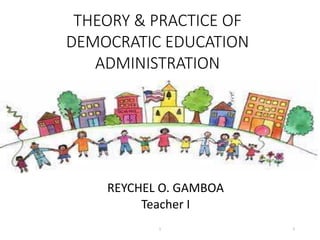
THEORY & PRACTICE OF
DEMOCRATIC EDUCATION
ADMINISTRATION
REYCHEL O. GAMBOA
Teacher I
2
1
Topics
• Definition of Physical Plan
Facilities
• School Community Relations
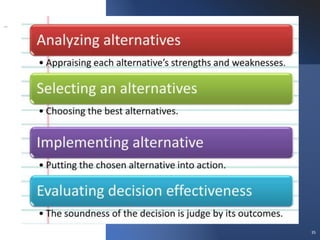
• Decision Making Process
3
1
Physical Plant and Facilities
Physical Plant - physical facilities
 lands,
 Buildings
 furniture
 other physical infrastructures
 equipment
 teaching spaces
 ancillary rooms.
4
1
Basic Principles on Physical Plant and Facilities
1. Provide the proper school
environment that is most conducive.
2. Functional and effective educational
facilities are developed, operated and
managed on the basis of a
comprehensive plan of action of the
school, prepared by all stakeholders in
education in the community.
5
1
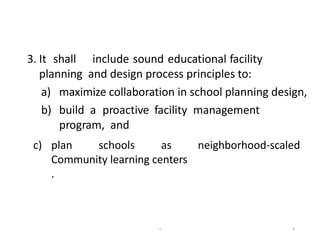
3. It shall include sound educational facility
planning and design process principles to:
a) maximize collaboration in school planning design,
b) build a proactive facility management
program, and
c) plan schools as neighborhood-scaled
Community learning centers
.
6
1
1 7
1 8
1 9
Physical Plant and Facilities
• The quality and adequacy of
the physical plant and facilities
of a learning institution
determine to a large measure
the successful implementation
of its curricular programs.
10
1
Location
 a wholesome environment
 safe from traffic and transportation hazards,
 sufficiently free from noise, dust, smoke, and
other undesirable elements.
 adequate facilities for drainage and sewage
disposal.
 meet the needs of the present school population
and its future expansion
 accessible to present and anticipated school
population by means of public transportation or
school bus
 satisfactory road network and sidewalks.
11
1
Campus
 the intellectual
 social
 physical
cultural interests of the
Institution
12
1
Buildings
 strong and durable materials
pleasing to the eye and in conformity
with the surroundings
meet the future expansion needs
insure safe and convenient mobility
13
1
Classrooms
The size and number of classrooms
equipped with the required
furniture,blackboards
should have a pleasant
atmosphere.
Lighting ventilation
 general appearance, and
acoustics should be satisfactory.
14
1
Offices, Staff and Function Rooms
administrative
offices
 faculty rooms
reception areas
15
1
Medical and Dental Clinic
 A medical and dental clinic should be
properly set up, strategically, well-
ventilated and lighted, screened and
provided with clean water supply.
 It should be provided with basic
equipment, medical supplies , beds,
cabinets and linens.
16
1
Student Center
A student Center is available
where students can make
wholesome interaction and listen
to good music, play table games,
watch TV programs, etc.
17
1
Food Services Unit or Canteen
Clean and sanitary food
services
affordable meals and
snacks
18
1
School
and Community
Community
Relations
19
1
“The problem of education is everybody's problem. As
everybody's problem. As building literacy is our
literacy is our collective responsibility, so too is
so too is improving of our schools, our collective
collective responsibility. We must build bridges
bridges between the school and the community.” –
community.” –
Former DepED Secretary Florencio
Florencio Abad
20
1
A. The Teacher, Parents and the
Community
DepEd Order 54, s. 2009
Revised Guidelines
Governing
Parents-Teachers
Associations (PTAs)at the
School Level
21
1
PTA (Parent-Teacher
Association) -formerly known as
Parents-Teacher and community
Association (PTCA)
22
1
Teachers continue to
enrich students'
experiences at
home.
23
1
Community members of the
community such as local
24
1
25
1
Remember:
It takes a whole village to
raise a child.
-African
proverb
26
1
27
1
28
1
29
1
30
1
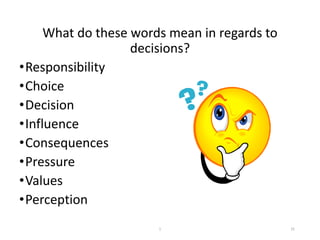
What do these words mean in regards to
decisions?
•Responsibility
•Choice
•Decision
•Influence
•Consequences
•Pressure
•Values
•Perception
31
1
•Responsibility – Think before you act! You are
accountable for your actions
•Choice – Every choice you make, effects your health
somehow
•Decision – Decisions you make reflect your state of health
•Influence – You have the potential to make others
healthier
•Consequences – Every decision you make has a
consequence
•Pressure – Don’t let pressure influence your decisions
•Values – Someone with good character, has good core
ethical values; responsibility, honesty, integrity, and respect
•Perception – Being aware of your surroundings and how
you view it
32
1
1
33
1
34
1
35
1 36
Further Readings and References
English, F. W. (2006). School Plant Management.
California: SAGE Publications, Inc.
Physical Plan and Facilities. (n.d.). Retrieved February 28,
2015, from USeP:
http://www.usep.edu.ph/Apps/UAC/images/downloadabl
e%20files/SSIR/Area%208%20Self-
Survey%20Instrument.pdf
37
1
38
1

EDUC 114-SAT 10-1-R.GAMBOA r1.pptx

  • 1.
  • 2.
    THEORY & PRACTICEOF DEMOCRATIC EDUCATION ADMINISTRATION REYCHEL O. GAMBOA Teacher I 2 1
  • 3.
    Topics • Definition ofPhysical Plan Facilities • School Community Relations • Decision Making Process 3 1
  • 4.
    Physical Plant andFacilities Physical Plant - physical facilities  lands,  Buildings  furniture  other physical infrastructures  equipment  teaching spaces  ancillary rooms. 4 1
  • 5.
    Basic Principles onPhysical Plant and Facilities 1. Provide the proper school environment that is most conducive. 2. Functional and effective educational facilities are developed, operated and managed on the basis of a comprehensive plan of action of the school, prepared by all stakeholders in education in the community. 5 1
  • 6.
    3. It shallinclude sound educational facility planning and design process principles to: a) maximize collaboration in school planning design, b) build a proactive facility management program, and c) plan schools as neighborhood-scaled Community learning centers . 6 1
  • 7.
  • 8.
  • 9.
  • 10.
    Physical Plant andFacilities • The quality and adequacy of the physical plant and facilities of a learning institution determine to a large measure the successful implementation of its curricular programs. 10 1
  • 11.
    Location  a wholesomeenvironment  safe from traffic and transportation hazards,  sufficiently free from noise, dust, smoke, and other undesirable elements.  adequate facilities for drainage and sewage disposal.  meet the needs of the present school population and its future expansion  accessible to present and anticipated school population by means of public transportation or school bus  satisfactory road network and sidewalks. 11 1
  • 12.
    Campus  the intellectual social  physical cultural interests of the Institution 12 1
  • 13.
    Buildings  strong anddurable materials pleasing to the eye and in conformity with the surroundings meet the future expansion needs insure safe and convenient mobility 13 1
  • 14.
    Classrooms The size andnumber of classrooms equipped with the required furniture,blackboards should have a pleasant atmosphere. Lighting ventilation  general appearance, and acoustics should be satisfactory. 14 1
  • 15.
    Offices, Staff andFunction Rooms administrative offices  faculty rooms reception areas 15 1
  • 16.
    Medical and DentalClinic  A medical and dental clinic should be properly set up, strategically, well- ventilated and lighted, screened and provided with clean water supply.  It should be provided with basic equipment, medical supplies , beds, cabinets and linens. 16 1
  • 17.
    Student Center A studentCenter is available where students can make wholesome interaction and listen to good music, play table games, watch TV programs, etc. 17 1
  • 18.
    Food Services Unitor Canteen Clean and sanitary food services affordable meals and snacks 18 1
  • 19.
  • 20.
    “The problem ofeducation is everybody's problem. As everybody's problem. As building literacy is our literacy is our collective responsibility, so too is so too is improving of our schools, our collective collective responsibility. We must build bridges bridges between the school and the community.” – community.” – Former DepED Secretary Florencio Florencio Abad 20 1
  • 21.
    A. The Teacher,Parents and the Community DepEd Order 54, s. 2009 Revised Guidelines Governing Parents-Teachers Associations (PTAs)at the School Level 21 1
  • 22.
    PTA (Parent-Teacher Association) -formerlyknown as Parents-Teacher and community Association (PTCA) 22 1
  • 23.
    Teachers continue to enrichstudents' experiences at home. 23 1
  • 24.
    Community members ofthe community such as local 24 1
  • 25.
  • 26.
    Remember: It takes awhole village to raise a child. -African proverb 26 1
  • 27.
  • 28.
  • 29.
  • 30.
  • 31.
    What do thesewords mean in regards to decisions? •Responsibility •Choice •Decision •Influence •Consequences •Pressure •Values •Perception 31 1
  • 32.
    •Responsibility – Thinkbefore you act! You are accountable for your actions •Choice – Every choice you make, effects your health somehow •Decision – Decisions you make reflect your state of health •Influence – You have the potential to make others healthier •Consequences – Every decision you make has a consequence •Pressure – Don’t let pressure influence your decisions •Values – Someone with good character, has good core ethical values; responsibility, honesty, integrity, and respect •Perception – Being aware of your surroundings and how you view it 32 1
  • 33.
  • 34.
  • 35.
  • 36.
  • 37.
    Further Readings andReferences English, F. W. (2006). School Plant Management. California: SAGE Publications, Inc. Physical Plan and Facilities. (n.d.). Retrieved February 28, 2015, from USeP: http://www.usep.edu.ph/Apps/UAC/images/downloadabl e%20files/SSIR/Area%208%20Self- Survey%20Instrument.pdf 37 1
  • 38.