 PREPARED BY:
 CHARINA H. BACHOCO
 MIRALYN A.TAPAO
 What comprises school physical environment?
 >Refers to the building s and all it’s contents,
grounds and equipment in and surrounding the
school.
 >Basic amenities such as sanitation facilities that
prevent transmission of disease; safe drinking
water availability; air cleanliness; etc.
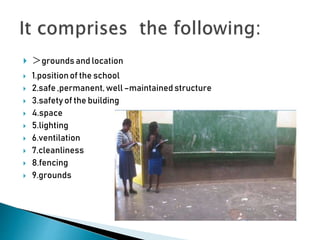
 >grounds and location
 1.positionof the school
 2.safe ,permanent,well–maintained structure
 3.safety of the building
 4.space
 5.lighting
 6.ventilation
 7.cleanliness
 8.fencing
 9.grounds
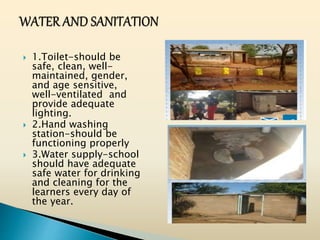
 1.Toilet-should be
safe, clean, well-
maintained, gender,
and age sensitive,
well-ventilated and
provide adequate
lighting.
 2.Hand washing
station-should be
functioning properly
 3.Water supply-school
should have adequate
safe water for drinking
and cleaning for the
learners every day of
the year.
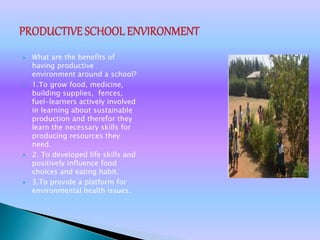
 What are the benefits of
having productive
environment around a school?
 1.To grow food, medicine,
building supplies, fences,
fuel-learners actively involved
in learning about sustainable
production and therefor they
learn the necessary skills for
producing resources they
need.
 2. To developed life skills and
positively influence food
choices and eating habit.
 3.To provide a platform for
environmental health issues.
1.Landscaping use for teaching and learning:
Implementing activities toward a productive school
environment is NOT used for punishment or child
labor
2.Local resource:
Philosophy of using local resources, knowledge,
skills, experiences. Requires a thorough
identification of all local resources.
3.Avoid donor
dependency:
Most garden programs
have stopped because
they relied on outside
inputs and incentives to
implement. This trend
dependency should be
discourage. The program
itself should be
motivating incentive for
integration and
implementation.
4.Targeting inputs:
Identification of what real inputs needed
thorough identification of local resources.
5.Who contributes which resources outline
clearly.
Clearly communicate the contributions from
the various partners, teachers, learners,
community, and the government
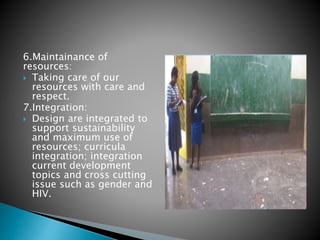
6.Maintainance of
resources:
 Taking care of our
resources with care and
respect.
7.Integration:
 Design are integrated to
support sustainability
and maximum use of
resources; curricula
integration; integration
current development
topics and cross cutting
issue such as gender and
HIV.
 Step 1:Analyse the current situation and map
it.
 This is done through a variety of methods
such as discussion, research, observation,
making transect walks, etc.
 Useful information
 >Climate
 >Environment
 >Buildings and structures
 >Resources
 >Productive resources – Examples: Local
seeds , land, water, time, space, labor, energy
 Step 2:
 Set the goals:
 Develop a clear
directions and vision
for the issues found
in the analysis.
 Example:
 S-SPECIFIC
 M-MEASURABLE
 A-ATTAINABLE
 R-RELEVANT
 T-TIME-BOUND
 Step 3:Design the school in an integrated way
 >Consider the structure that will be needed-
recreation areas, classrooms, teachers homes,
animal enclosures, dams, ponds, tanks, shelters,
nurseries, etc.
 >Design plants, trees and animals combinations
to suit the environmental zones around the
school
 >Use local resources to save energy and
minimize cost
 >Decide who will be involved [teachers, learners
and community]
 Step 4:Draw up action plan
 >Create a scheme of work for implementing and
monitoring the project.
 >Consider the resource analysis, the changing
seasons and the workload on the community
during those seasons, school breaks and other
factors that affect the timing of activities
 >Define roles and responsibilities, decide on the
possible timescale, and quantify the necessary
resources.
 >Quantify the expected outcomes/targets.
4.Healthy eating
 >School food services
should be integrated into a
schools effort to manage
its environment.
 >Coordinated with health
and nutrition education
and with other components
of the health-promoting
school to reinforce lessons
on healthy eating and
ensure nutrition support.
Projects phases out rather
community based feeding
program and household
based feeding should be
 >school food services should be integrated
into a school effort to manage its
environment.
 >Coordinated with health and nutrition
education and with other components of the
health-promoting school to reinforce lesson
on healthy eating and ensure nutrition
support. Project phases out rather
community based feeding program and
household based feeding should be.
 >If there is school based
feeding program, it
should be given before
school ,10:oo am or
lunch if classes goes
through.
 >General healthy eating
following 6 food group
model should be also
promoted.
 >Schools should not only
depend on external
sponsored feeding
programs which can
leave the schools in
suspense.
 THANK YOU!
 GOD BLESS US ALWAYS!

11 SCHOOL PHYSICAL ENVIRONMENT.pptx

  • 1.
     PREPARED BY: CHARINA H. BACHOCO  MIRALYN A.TAPAO
  • 2.
     What comprisesschool physical environment?  >Refers to the building s and all it’s contents, grounds and equipment in and surrounding the school.  >Basic amenities such as sanitation facilities that prevent transmission of disease; safe drinking water availability; air cleanliness; etc.
  • 3.
     >grounds andlocation  1.positionof the school  2.safe ,permanent,well–maintained structure  3.safety of the building  4.space  5.lighting  6.ventilation  7.cleanliness  8.fencing  9.grounds
  • 4.
     1.Toilet-should be safe,clean, well- maintained, gender, and age sensitive, well-ventilated and provide adequate lighting.  2.Hand washing station-should be functioning properly  3.Water supply-school should have adequate safe water for drinking and cleaning for the learners every day of the year.
  • 5.
     What arethe benefits of having productive environment around a school?  1.To grow food, medicine, building supplies, fences, fuel-learners actively involved in learning about sustainable production and therefor they learn the necessary skills for producing resources they need.  2. To developed life skills and positively influence food choices and eating habit.  3.To provide a platform for environmental health issues.
  • 6.
    1.Landscaping use forteaching and learning: Implementing activities toward a productive school environment is NOT used for punishment or child labor 2.Local resource: Philosophy of using local resources, knowledge, skills, experiences. Requires a thorough identification of all local resources.
  • 7.
    3.Avoid donor dependency: Most gardenprograms have stopped because they relied on outside inputs and incentives to implement. This trend dependency should be discourage. The program itself should be motivating incentive for integration and implementation.
  • 8.
    4.Targeting inputs: Identification ofwhat real inputs needed thorough identification of local resources. 5.Who contributes which resources outline clearly. Clearly communicate the contributions from the various partners, teachers, learners, community, and the government
  • 9.
    6.Maintainance of resources:  Takingcare of our resources with care and respect. 7.Integration:  Design are integrated to support sustainability and maximum use of resources; curricula integration; integration current development topics and cross cutting issue such as gender and HIV.
  • 10.
     Step 1:Analysethe current situation and map it.  This is done through a variety of methods such as discussion, research, observation, making transect walks, etc.
  • 11.
     Useful information >Climate  >Environment  >Buildings and structures  >Resources  >Productive resources – Examples: Local seeds , land, water, time, space, labor, energy
  • 12.
     Step 2: Set the goals:  Develop a clear directions and vision for the issues found in the analysis.  Example:  S-SPECIFIC  M-MEASURABLE  A-ATTAINABLE  R-RELEVANT  T-TIME-BOUND
  • 13.
     Step 3:Designthe school in an integrated way  >Consider the structure that will be needed- recreation areas, classrooms, teachers homes, animal enclosures, dams, ponds, tanks, shelters, nurseries, etc.  >Design plants, trees and animals combinations to suit the environmental zones around the school  >Use local resources to save energy and minimize cost  >Decide who will be involved [teachers, learners and community]
  • 14.
     Step 4:Drawup action plan  >Create a scheme of work for implementing and monitoring the project.  >Consider the resource analysis, the changing seasons and the workload on the community during those seasons, school breaks and other factors that affect the timing of activities  >Define roles and responsibilities, decide on the possible timescale, and quantify the necessary resources.  >Quantify the expected outcomes/targets.
  • 15.
    4.Healthy eating  >Schoolfood services should be integrated into a schools effort to manage its environment.  >Coordinated with health and nutrition education and with other components of the health-promoting school to reinforce lessons on healthy eating and ensure nutrition support. Projects phases out rather community based feeding program and household based feeding should be
  • 16.
     >school foodservices should be integrated into a school effort to manage its environment.  >Coordinated with health and nutrition education and with other components of the health-promoting school to reinforce lesson on healthy eating and ensure nutrition support. Project phases out rather community based feeding program and household based feeding should be.
  • 17.
     >If thereis school based feeding program, it should be given before school ,10:oo am or lunch if classes goes through.  >General healthy eating following 6 food group model should be also promoted.  >Schools should not only depend on external sponsored feeding programs which can leave the schools in suspense.
  • 18.
     THANK YOU! GOD BLESS US ALWAYS!