Pickleball:
Ground-
strokes
7TH GRADE
LAURYN JOHNSON
Content Standards and Objectives
1.4 Demonstrate body management and object-manipulation skills needed
for successful participation in individual and dual physical activities.
2.2 Analyze movement patterns and correct errors
5.3 Demonstrate an acceptance of differences in physical development and personal preferences as they
affect participation in physical activity
-Students will be able to perform forehand and backhand strokes using techniques taught in the lesson
-SWBAT change the position of their body or paddle slightly to improve their performance.
-SWBAT participate in partner work without judging others’ skills.
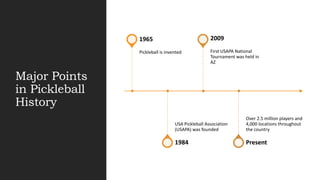
Major Points
in Pickleball
History
Pickleball is invented
1965
USA Pickleball Association
(USAPA) was founded
1984
First USAPA National
Tournament was held in
AZ
2009
Over 2.5 million players and
4,000 locations throughout
the country
Present
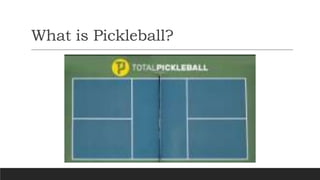
What is Pickleball?
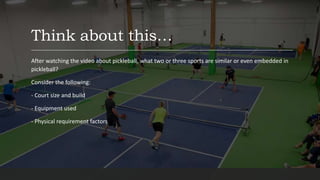
Think about this…
After watching the video about pickleball, what two or three sports are similar or even embedded in
pickleball?
Consider the following:
- Court size and build
- Equipment used
- Physical requirement factors
Warm up
Pickleball Wall (partner
activity)
- Students will pair up with someone who has a similar
hair color
- One will stand 3 feet away from a wall while the
other stands close by
- The first student will hit the ball against the wall
minimum 2 times, maximum 4
- They must warn their partner of their last hit and the
partner will try to hit the ball off the rebound
- Students will continue for as long as possible
- If the 2nd partner misses, they must start the new
round
Groundstrokes
FOREHAND AND
BACKHAND
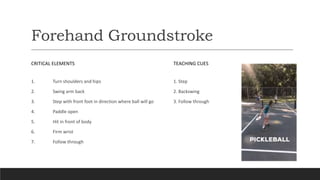
Forehand Groundstroke
CRITICAL ELEMENTS
1. Turn shoulders and hips
2. Swing arm back
3. Step with front foot in direction where ball will go
4. Paddle open
5. Hit in front of body
6. Firm wrist
7. Follow through
TEACHING CUES
1. Step
2. Backswing
3. Follow through
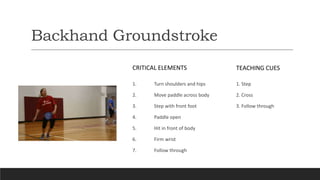
Backhand Groundstroke
TEACHING CUES
CRITICAL ELEMENTS
1. Turn shoulders and hips
2. Move paddle across body
3. Step with front foot
4. Paddle open
5. Hit in front of body
6. Firm wrist
7. Follow through
1. Step
2. Cross
3. Follow through
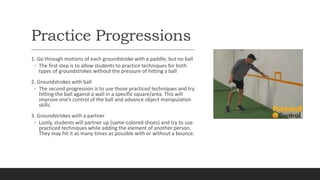
Practice Progressions
1. Go through motions of each groundstroke with a paddle, but no ball
◦ The first step is to allow students to practice techniques for both
types of groundstrokes without the pressure of hitting a ball
2. Groundstrokes with ball
◦ The second progression is to use those practiced techniques and try
hitting the ball against a wall in a specific square/area. This will
improve one’s control of the ball and advance object manipulation
skills
3. Groundstrokes with a partner
◦ Lastly, students will partner up (same-colored shoes) and try to use
practiced techniques while adding the element of another person.
They may hit it as many times as possible with or without a bounce.
Consider
this…
Looking at the progressions listed on the last
slide, name at least one advantage that each
progression allows you to work on before
playing a traditional game of pickleball.
Let’s Play
2 v 2
-Partners will run to the nearest court and face a different set of partners (4 people per court)
-They will attempt to keep the ball in play as long as possible
-No score will be kept as the point is to keep passing
Alternative:
- If you are looking for more of a challenge, play until the first team scores 5 points
Review
1. What are the steps to a forehand stroke? How about backhand?
2. If your ball keeps hitting the net, how can you change your paddle to get it higher? How can
you move your body to hit the ball further?
3. Will every hit be perfect? Will your partner always be on the same level as you?
Ask Yourself
- Can I effectively teach a
friend or family member
the groundstrokes?
- Now that we have
learned how to hit
groundstrokes, what other
pickleball skills could we
be learning in the next few
lessons?

EDSC 304- Pickleball Lecture

  • 1.
  • 2.
    Content Standards andObjectives 1.4 Demonstrate body management and object-manipulation skills needed for successful participation in individual and dual physical activities. 2.2 Analyze movement patterns and correct errors 5.3 Demonstrate an acceptance of differences in physical development and personal preferences as they affect participation in physical activity -Students will be able to perform forehand and backhand strokes using techniques taught in the lesson -SWBAT change the position of their body or paddle slightly to improve their performance. -SWBAT participate in partner work without judging others’ skills.
  • 3.
    Major Points in Pickleball History Pickleballis invented 1965 USA Pickleball Association (USAPA) was founded 1984 First USAPA National Tournament was held in AZ 2009 Over 2.5 million players and 4,000 locations throughout the country Present
  • 4.
  • 5.
    Think about this… Afterwatching the video about pickleball, what two or three sports are similar or even embedded in pickleball? Consider the following: - Court size and build - Equipment used - Physical requirement factors
  • 6.
    Warm up Pickleball Wall(partner activity) - Students will pair up with someone who has a similar hair color - One will stand 3 feet away from a wall while the other stands close by - The first student will hit the ball against the wall minimum 2 times, maximum 4 - They must warn their partner of their last hit and the partner will try to hit the ball off the rebound - Students will continue for as long as possible - If the 2nd partner misses, they must start the new round
  • 7.
  • 8.
    Forehand Groundstroke CRITICAL ELEMENTS 1.Turn shoulders and hips 2. Swing arm back 3. Step with front foot in direction where ball will go 4. Paddle open 5. Hit in front of body 6. Firm wrist 7. Follow through TEACHING CUES 1. Step 2. Backswing 3. Follow through
  • 9.
    Backhand Groundstroke TEACHING CUES CRITICALELEMENTS 1. Turn shoulders and hips 2. Move paddle across body 3. Step with front foot 4. Paddle open 5. Hit in front of body 6. Firm wrist 7. Follow through 1. Step 2. Cross 3. Follow through
  • 10.
    Practice Progressions 1. Gothrough motions of each groundstroke with a paddle, but no ball ◦ The first step is to allow students to practice techniques for both types of groundstrokes without the pressure of hitting a ball 2. Groundstrokes with ball ◦ The second progression is to use those practiced techniques and try hitting the ball against a wall in a specific square/area. This will improve one’s control of the ball and advance object manipulation skills 3. Groundstrokes with a partner ◦ Lastly, students will partner up (same-colored shoes) and try to use practiced techniques while adding the element of another person. They may hit it as many times as possible with or without a bounce.
  • 11.
    Consider this… Looking at theprogressions listed on the last slide, name at least one advantage that each progression allows you to work on before playing a traditional game of pickleball.
  • 12.
  • 13.
    2 v 2 -Partnerswill run to the nearest court and face a different set of partners (4 people per court) -They will attempt to keep the ball in play as long as possible -No score will be kept as the point is to keep passing Alternative: - If you are looking for more of a challenge, play until the first team scores 5 points
  • 14.
    Review 1. What arethe steps to a forehand stroke? How about backhand? 2. If your ball keeps hitting the net, how can you change your paddle to get it higher? How can you move your body to hit the ball further? 3. Will every hit be perfect? Will your partner always be on the same level as you?
  • 15.
    Ask Yourself - CanI effectively teach a friend or family member the groundstrokes? - Now that we have learned how to hit groundstrokes, what other pickleball skills could we be learning in the next few lessons?