



Smart Data.
Smarter Workflow.
Case Studies:
HREC-CREC-REC
Determinations
Moderated by: Anthony J. Buonicore, P.E., BCEE, QEP
Panelists:
Jeff Watson, National Lead—Environmental Due Diligence,
Enercon Services
Lynn Smith, Environmental Due Diligence Leader, V3
Companies
Nick Albergo, Senior Consultant, GHD Consulting Services, Inc.
1.
REC-HREC-CREC Definitions in
E1527-13
REC-HREC-CREC E1527-13 Definitions
▸ REC – presence or likely presence of
any hazardous substances or
petroleum products in, on, or at a
property: (1) due to any release to the
environment; (2) under conditions
indicative of a release to the environment;
or (3) under conditions that pose a
material threat of a future release to the
environment.
REC-HREC-CREC E1527-13 Definitions
HREC – a past release of any hazardous
substances or petroleum products that has
occurred in connection with the property and has
been addressed to the satisfaction of the
applicable regulatory authority or meeting
unrestricted use criteria established by a
regulatory authority, without subjecting the
property to any required controls.
REC-HREC-CREC E1527-13 Definitions
▸ CREC – a REC resulting from a past release of
hazardous substances or petroleum products that has
been addressed to the satisfaction of the applicable
regulatory authority (e.g., as evidenced by issuance of a
NFA letter or equivalent, or meeting risk-based criteria
established by the regulatory authority), with hazardous
substances or petroleum products allowed to remain
in place subject to the implementation of required
controls.
2.
Session Format
▸ Facts of Each Case
▸ Panelists’ Opinions
▸ Audience Participation
Case One
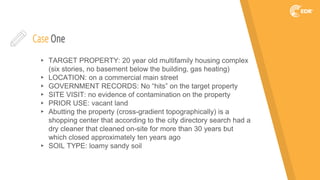
▸ TARGET PROPERTY: 20 year old multifamily housing complex
(six stories, no basement below the building, gas heating)
▸ LOCATION: on a commercial main street
▸ GOVERNMENT RECORDS: No “hits” on the target property
▸ SITE VISIT: no evidence of contamination on the property
▸ PRIOR USE: vacant land
▸ Abutting the property (cross-gradient topographically) is a
shopping center that according to the city directory search had a
dry cleaner that cleaned on-site for more than 30 years but
which closed approximately ten years ago
▸ SOIL TYPE: loamy sandy soil
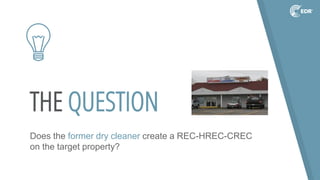
THE QUESTION
Does the former dry cleaner create a REC-HREC-CREC
on the target property?
Case Two
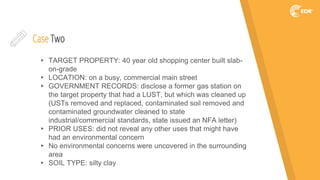
▸ TARGET PROPERTY: 40 year old shopping center built slab-
on-grade
▸ LOCATION: on a busy, commercial main street
▸ GOVERNMENT RECORDS: disclose a former gas station on
the target property that had a LUST, but which was cleaned up
(USTs removed and replaced, contaminated soil removed and
contaminated groundwater cleaned to state
industrial/commercial standards, state issued an NFA letter)
▸ PRIOR USES: did not reveal any other uses that might have
had an environmental concern
▸ No environmental concerns were uncovered in the surrounding
area
▸ SOIL TYPE: silty clay
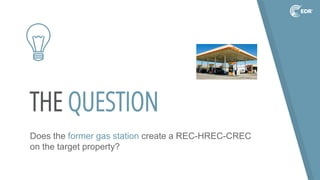
THE QUESTION
Does the former gas station create a REC-HREC-CREC
on the target property?
Case Three
▸ TARGET PROPERTY: an office building built on a brownfield
site (former industrial site that operated from 1930s to the
1960s)
▸ PRIOR USE: Former industrial site manufactured cosmetic
applicators, tubes and dispensers for the cosmetics industry and
used chlorinated solvents principally for cleaning
▸ The site was investigated in the late 1980 and early 1990s.
▸ Metals and VOCs were found in the soil and VOCs in the
groundwater, above state commercial/industrial cleanup
standards.
▸ The state allowed the use of RBCA to establish soil and
groundwater cleanup levels.
▸ State issued an NFA letter.
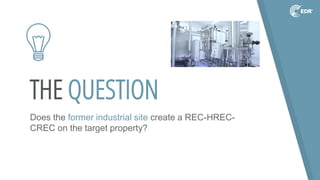
THE QUESTION
Does the former industrial site create a REC-HREC-
CREC on the target property?
Case Four
▸ TARGET PROPERTY: a shopping center with no tenants
having environmental issues
▸ PRIOR USE: A gas station that previously existed on the
property was in the LUST database
▹ Contaminated soil with BTEX was excavated and removed
from the site.
▹ Contaminated groundwater with BTEX was treated with an SVE
system until levels were demonstrated below the existing
residential cleanup level.
▹ The state issued an NFA letter.
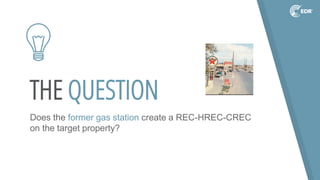
THE QUESTION
Does the former gas station create a REC-HREC-CREC
on the target property?
Case Five
▸ TARGET PROPERTY: has been a shopping center for
more than 50 years with no current tenants having
environmental issues.
▸ The property is being sold.
▸ PRIOR USE: vacant land
▸ The last Phase I (conducted in accordance with E1527-
05 in 2006 by a reputable Phase I firm) did not indicate
evidence of any RECs associated with the property or in
the surrounding area.
▸ You are asked to “update” the last Phase I.
THE QUESTIONS
Would you agree to update the previous Phase I?
Would there still be any potential REC issues or would
this likely be a case of no RECs?
Case Six
▸ TARGET PROPERTY: a newly constructed office
building in the CBD built on a property that included a
former gas station.
▸ The former gas station had USTs that were removed.
▸ Sampling indicated BTEX contaminated soil that was
excavated and taken off-site.
▸ Groundwater was not sampled.
▸ The property received an NFA letter from the state.
▸ The new office building included a multi-level (four
levels) underground parking garage.
▸ No other environmental issues were uncovered in the
site inspection, or the government and historical records
check.
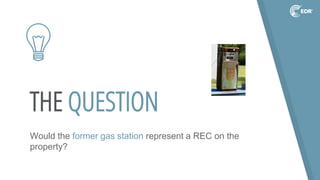
THE QUESTION
Would the former gas station represent a REC on the
property?
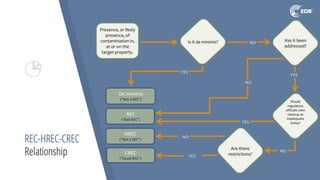
REC-HREC-CREC
Relationship
Presence, or likely
presence, of
contamination in,
at or on the
target property.
Is it de minimis? Has it been
addressed?
Would
regulatory
officials view
cleanup as
inadequate
today?
Are there
restrictions?
YES
NO
NO
YES
REC
(“Bad REC”)
De minimis
(“Not a REC”)
NO
CREC
(“Good REC”)
HREC
(“Not a REC”)
YES
YES
NO
Thanks to today’s panelists!
Jeff Watson, National Lead—Environmental Due Diligence, Enercon
Services
Lynn Smith, Environmental Due Diligence Leader, V3 Companies
Nick Albergo, Senior Consultant, GHD Consulting Services, Inc.

EDR Chicago DDD REC-CREC-HREC

  • 1.
    Smart Data. Smarter Workflow. CaseStudies: HREC-CREC-REC Determinations
  • 2.
    Moderated by: AnthonyJ. Buonicore, P.E., BCEE, QEP Panelists: Jeff Watson, National Lead—Environmental Due Diligence, Enercon Services Lynn Smith, Environmental Due Diligence Leader, V3 Companies Nick Albergo, Senior Consultant, GHD Consulting Services, Inc.
  • 3.
  • 4.
    REC-HREC-CREC E1527-13 Definitions ▸REC – presence or likely presence of any hazardous substances or petroleum products in, on, or at a property: (1) due to any release to the environment; (2) under conditions indicative of a release to the environment; or (3) under conditions that pose a material threat of a future release to the environment.
  • 5.
    REC-HREC-CREC E1527-13 Definitions HREC– a past release of any hazardous substances or petroleum products that has occurred in connection with the property and has been addressed to the satisfaction of the applicable regulatory authority or meeting unrestricted use criteria established by a regulatory authority, without subjecting the property to any required controls.
  • 6.
    REC-HREC-CREC E1527-13 Definitions ▸CREC – a REC resulting from a past release of hazardous substances or petroleum products that has been addressed to the satisfaction of the applicable regulatory authority (e.g., as evidenced by issuance of a NFA letter or equivalent, or meeting risk-based criteria established by the regulatory authority), with hazardous substances or petroleum products allowed to remain in place subject to the implementation of required controls.
  • 7.
    2. Session Format ▸ Factsof Each Case ▸ Panelists’ Opinions ▸ Audience Participation
  • 8.
    Case One ▸ TARGETPROPERTY: 20 year old multifamily housing complex (six stories, no basement below the building, gas heating) ▸ LOCATION: on a commercial main street ▸ GOVERNMENT RECORDS: No “hits” on the target property ▸ SITE VISIT: no evidence of contamination on the property ▸ PRIOR USE: vacant land ▸ Abutting the property (cross-gradient topographically) is a shopping center that according to the city directory search had a dry cleaner that cleaned on-site for more than 30 years but which closed approximately ten years ago ▸ SOIL TYPE: loamy sandy soil
  • 9.
    THE QUESTION Does theformer dry cleaner create a REC-HREC-CREC on the target property?
  • 10.
    Case Two ▸ TARGETPROPERTY: 40 year old shopping center built slab- on-grade ▸ LOCATION: on a busy, commercial main street ▸ GOVERNMENT RECORDS: disclose a former gas station on the target property that had a LUST, but which was cleaned up (USTs removed and replaced, contaminated soil removed and contaminated groundwater cleaned to state industrial/commercial standards, state issued an NFA letter) ▸ PRIOR USES: did not reveal any other uses that might have had an environmental concern ▸ No environmental concerns were uncovered in the surrounding area ▸ SOIL TYPE: silty clay
  • 11.
    THE QUESTION Does theformer gas station create a REC-HREC-CREC on the target property?
  • 12.
    Case Three ▸ TARGETPROPERTY: an office building built on a brownfield site (former industrial site that operated from 1930s to the 1960s) ▸ PRIOR USE: Former industrial site manufactured cosmetic applicators, tubes and dispensers for the cosmetics industry and used chlorinated solvents principally for cleaning ▸ The site was investigated in the late 1980 and early 1990s. ▸ Metals and VOCs were found in the soil and VOCs in the groundwater, above state commercial/industrial cleanup standards. ▸ The state allowed the use of RBCA to establish soil and groundwater cleanup levels. ▸ State issued an NFA letter.
  • 13.
    THE QUESTION Does theformer industrial site create a REC-HREC- CREC on the target property?
  • 14.
    Case Four ▸ TARGETPROPERTY: a shopping center with no tenants having environmental issues ▸ PRIOR USE: A gas station that previously existed on the property was in the LUST database ▹ Contaminated soil with BTEX was excavated and removed from the site. ▹ Contaminated groundwater with BTEX was treated with an SVE system until levels were demonstrated below the existing residential cleanup level. ▹ The state issued an NFA letter.
  • 15.
    THE QUESTION Does theformer gas station create a REC-HREC-CREC on the target property?
  • 16.
    Case Five ▸ TARGETPROPERTY: has been a shopping center for more than 50 years with no current tenants having environmental issues. ▸ The property is being sold. ▸ PRIOR USE: vacant land ▸ The last Phase I (conducted in accordance with E1527- 05 in 2006 by a reputable Phase I firm) did not indicate evidence of any RECs associated with the property or in the surrounding area. ▸ You are asked to “update” the last Phase I.
  • 17.
    THE QUESTIONS Would youagree to update the previous Phase I? Would there still be any potential REC issues or would this likely be a case of no RECs?
  • 18.
    Case Six ▸ TARGETPROPERTY: a newly constructed office building in the CBD built on a property that included a former gas station. ▸ The former gas station had USTs that were removed. ▸ Sampling indicated BTEX contaminated soil that was excavated and taken off-site. ▸ Groundwater was not sampled. ▸ The property received an NFA letter from the state. ▸ The new office building included a multi-level (four levels) underground parking garage. ▸ No other environmental issues were uncovered in the site inspection, or the government and historical records check.
  • 19.
    THE QUESTION Would theformer gas station represent a REC on the property?
  • 20.
    REC-HREC-CREC Relationship Presence, or likely presence,of contamination in, at or on the target property. Is it de minimis? Has it been addressed? Would regulatory officials view cleanup as inadequate today? Are there restrictions? YES NO NO YES REC (“Bad REC”) De minimis (“Not a REC”) NO CREC (“Good REC”) HREC (“Not a REC”) YES YES NO
  • 22.
    Thanks to today’spanelists! Jeff Watson, National Lead—Environmental Due Diligence, Enercon Services Lynn Smith, Environmental Due Diligence Leader, V3 Companies Nick Albergo, Senior Consultant, GHD Consulting Services, Inc.