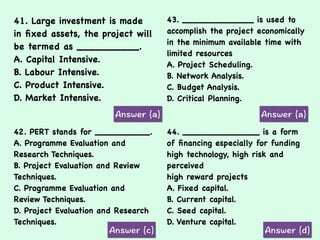

41. Large investment is made
in fixed assets, the project will
be termed as __________.
A. Capital Intensive.
B. Labour Intensive.
C. Product Intensive.
D. Market Intensive.
43. _____________ is used to
accomplish the project economically
in the minimum available time with
limited resources
A. Project Scheduling.
B. Network Analysis.
C. Budget Analysis.
D. Critical Planning.
42. PERT stands for __________.
A. Programme Evaluation and
Research Techniques.
B. Project Evaluation and Review
Techniques.
C. Programme Evaluation and
Review Techniques.
D. Project Evaluation and Research
Techniques.
44. ______________ is a form
of financing especially for funding
high technology, high risk and
perceived
high reward projects
A. Fixed capital.
B. Current capital.
C. Seed capital.
D. Venture capital.
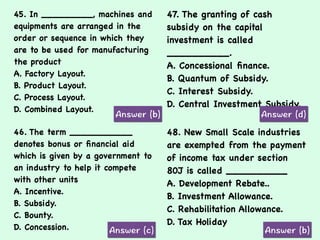
45. In _________, machines and
equipments are arranged in the
order or sequence in which they
are to be used for manufacturing
the product
A. Factory Layout.
B. Product Layout.
C. Process Layout.
D. Combined Layout.
47. The granting of cash
subsidy on the capital
investment is called
__________.
A. Concessional finance.
B. Quantum of Subsidy.
C. Interest Subsidy.
D. Central Investment Subsidy.
46. The term ___________
denotes bonus or financial aid
which is given by a government to
an industry to help it compete
with other units
A. Incentive.
B. Subsidy.
C. Bounty.
D. Concession.
48. New Small Scale industries
are exempted from the payment
of income tax under section
80J is called __________
A. Development Rebate..
B. Investment Allowance.
C. Rehabilitation Allowance.
D. Tax Holiday
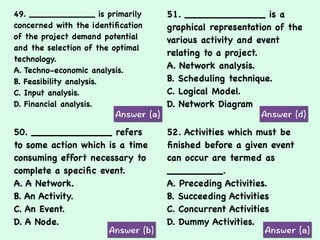
49. ____________ is primarily
concerned with the identification
of the project demand potential
and the selection of the optimal
technology.
A. Techno-economic analysis.
B. Feasibility analysis.
C. Input analysis.
D. Financial analysis.
51. _____________ is a
graphical representation of the
various activity and event
relating to a project.
A. Network analysis.
B. Scheduling technique.
C. Logical Model.
D. Network Diagram
50. _____________ refers
to some action which is a time
consuming effort necessary to
complete a specific event.
A. A Network.
B. An Activity.
C. An Event.
D. A Node.
52. Activities which must be
finished before a given event
can occur are termed as
_________.
A. Preceding Activities.
B. Succeeding Activities
C. Concurrent Activities
D. Dummy Activities.
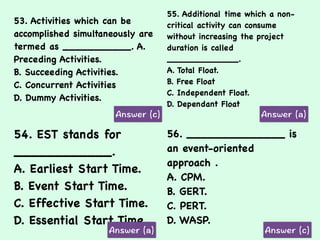
53. Activities which can be
accomplished simultaneously are
termed as ___________. A.
Preceding Activities.
B. Succeeding Activities.
C. Concurrent Activities
D. Dummy Activities.
55. Additional time which a non-
critical activity can consume
without increasing the project
duration is called
_____________.
A. Total Float.
B. Free Float
C. Independent Float.
D. Dependant Float
54. EST stands for
____________.
A. Earliest Start Time.
B. Event Start Time.
C. Effective Start Time.
D. Essential Start Time.
56. ______________ is
an event-oriented
approach .
A. CPM.
B. GERT.
C. PERT.
D. WASP.
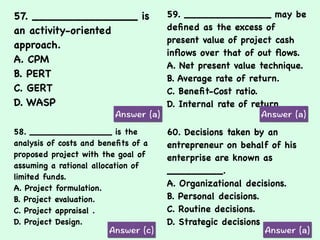
57. _______________ is
an activity-oriented
approach.
A. CPM
B. PERT
C. GERT
D. WASP
59. ______________ may be
defined as the excess of
present value of project cash
inflows over that of out flows.
A. Net present value technique.
B. Average rate of return.
C. Benefit-Cost ratio.
D. Internal rate of return
58. _______________ is the
analysis of costs and benefits of a
proposed project with the goal of
assuming a rational allocation of
limited funds.
A. Project formulation.
B. Project evaluation.
C. Project appraisal .
D. Project Design.
60. Decisions taken by an
entrepreneur on behalf of his
enterprise are known as
_________.
A. Organizational decisions.
B. Personal decisions.
C. Routine decisions.
D. Strategic decisions
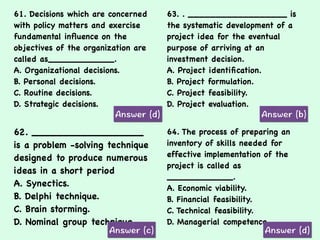
61. Decisions which are concerned
with policy matters and exercise
fundamental influence on the
objectives of the organization are
called as____________.
A. Organizational decisions.
B. Personal decisions.
C. Routine decisions.
D. Strategic decisions.
63. . __________________ is
the systematic development of a
project idea for the eventual
purpose of arriving at an
investment decision.
A. Project identification.
B. Project formulation.
C. Project feasibility.
D. Project evaluation.
62. __________________
is a problem -solving technique
designed to produce numerous
ideas in a short period
A. Synectics.
B. Delphi technique.
C. Brain storming.
D. Nominal group technique.
64. The process of preparing an
inventory of skills needed for
effective implementation of the
project is called as
____________.
A. Economic viability.
B. Financial feasibility.
C. Technical feasibility.
D. Managerial competence.
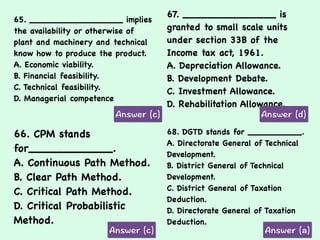
65. _________________ implies
the availability or otherwise of
plant and machinery and technical
know how to produce the product.
A. Economic viability.
B. Financial feasibility.
C. Technical feasibility.
D. Managerial competence
67. _______________ is
granted to small scale units
under section 33B of the
Income tax act, 1961.
A. Depreciation Allowance.
B. Development Debate.
C. Investment Allowance.
D. Rehabilitation Allowance.
66. CPM stands
for____________.
A. Continuous Path Method.
B. Clear Path Method.
C. Critical Path Method.
D. Critical Probabilistic
Method.
68. DGTD stands for __________.
A. Directorate General of Technical
Development.
B. District General of Technical
Development.
C. District General of Taxation
Deduction.
D. Directorate General of Taxation
Deduction.
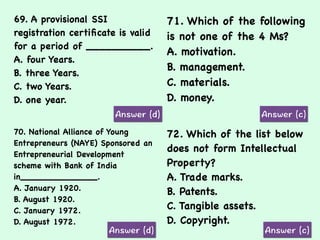
69. A provisional SSI
registration certificate is valid
for a period of __________.
A. four Years.
B. three Years.
C. two Years.
D. one year.
71. Which of the following
is not one of the 4 Ms?
A. motivation.
B. management.
C. materials.
D. money.
70. National Alliance of Young
Entrepreneurs (NAYE) Sponsored an
Entrepreneurial Development
scheme with Bank of India
in______________.
A. January 1920.
B. August 1920.
C. January 1972.
D. August 1972.
72. Which of the list below
does not form Intellectual
Property?
A. Trade marks.
B. Patents.
C. Tangible assets.
D. Copyright.
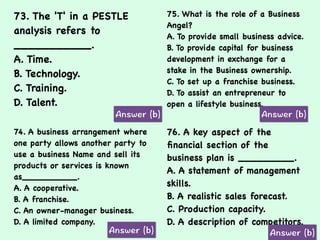
73. The 'T' in a PESTLE
analysis refers to
___________.
A. Time.
B. Technology.
C. Training.
D. Talent.
75. What is the role of a Business
Angel?
A. To provide small business advice.
B. To provide capital for business
development in exchange for a
stake in the Business ownership.
C. To set up a franchise business.
D. To assist an entrepreneur to
open a lifestyle business.
74. A business arrangement where
one party allows another party to
use a business Name and sell its
products or services is known
as__________.
A. A cooperative.
B. A franchise.
C. An owner-manager business.
D. A limited company.
76. A key aspect of the
financial section of the
business plan is _________.
A. A statement of management
skills.
B. A realistic sales forecast.
C. Production capacity.
D. A description of competitors.
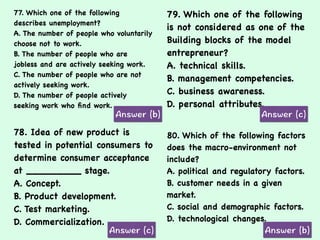
77. Which one of the following
describes unemployment?
A. The number of people who voluntarily
choose not to work.
B. The number of people who are
jobless and are actively seeking work.
C. The number of people who are not
actively seeking work.
D. The number of people actively
seeking work who find work.
79. Which one of the following
is not considered as one of the
Building blocks of the model
entrepreneur?
A. technical skills.
B. management competencies.
C. business awareness.
D. personal attributes.
78. Idea of new product is
tested in potential consumers to
determine consumer acceptance
at _________ stage.
A. Concept.
B. Product development.
C. Test marketing.
D. Commercialization.
80. Which of the following factors
does the macro-environment not
include?
A. political and regulatory factors.
B. customer needs in a given
market.
C. social and demographic factors.
D. technological changes.
Edp mcq 2, Entrepreneurship Development Programme MCQS, Objective Type Questions on EDP

Edp mcq 2, Entrepreneurship Development Programme MCQS, Objective Type Questions on EDP

  • 2.
    41. Large investmentis made in fixed assets, the project will be termed as __________. A. Capital Intensive. B. Labour Intensive. C. Product Intensive. D. Market Intensive. 43. _____________ is used to accomplish the project economically in the minimum available time with limited resources A. Project Scheduling. B. Network Analysis. C. Budget Analysis. D. Critical Planning. 42. PERT stands for __________. A. Programme Evaluation and Research Techniques. B. Project Evaluation and Review Techniques. C. Programme Evaluation and Review Techniques. D. Project Evaluation and Research Techniques. 44. ______________ is a form of financing especially for funding high technology, high risk and perceived high reward projects A. Fixed capital. B. Current capital. C. Seed capital. D. Venture capital.
  • 3.
    45. In _________,machines and equipments are arranged in the order or sequence in which they are to be used for manufacturing the product A. Factory Layout. B. Product Layout. C. Process Layout. D. Combined Layout. 47. The granting of cash subsidy on the capital investment is called __________. A. Concessional finance. B. Quantum of Subsidy. C. Interest Subsidy. D. Central Investment Subsidy. 46. The term ___________ denotes bonus or financial aid which is given by a government to an industry to help it compete with other units A. Incentive. B. Subsidy. C. Bounty. D. Concession. 48. New Small Scale industries are exempted from the payment of income tax under section 80J is called __________ A. Development Rebate.. B. Investment Allowance. C. Rehabilitation Allowance. D. Tax Holiday
  • 4.
    49. ____________ isprimarily concerned with the identification of the project demand potential and the selection of the optimal technology. A. Techno-economic analysis. B. Feasibility analysis. C. Input analysis. D. Financial analysis. 51. _____________ is a graphical representation of the various activity and event relating to a project. A. Network analysis. B. Scheduling technique. C. Logical Model. D. Network Diagram 50. _____________ refers to some action which is a time consuming effort necessary to complete a specific event. A. A Network. B. An Activity. C. An Event. D. A Node. 52. Activities which must be finished before a given event can occur are termed as _________. A. Preceding Activities. B. Succeeding Activities C. Concurrent Activities D. Dummy Activities.
  • 5.
    53. Activities whichcan be accomplished simultaneously are termed as ___________. A. Preceding Activities. B. Succeeding Activities. C. Concurrent Activities D. Dummy Activities. 55. Additional time which a non- critical activity can consume without increasing the project duration is called _____________. A. Total Float. B. Free Float C. Independent Float. D. Dependant Float 54. EST stands for ____________. A. Earliest Start Time. B. Event Start Time. C. Effective Start Time. D. Essential Start Time. 56. ______________ is an event-oriented approach . A. CPM. B. GERT. C. PERT. D. WASP.
  • 6.
    57. _______________ is anactivity-oriented approach. A. CPM B. PERT C. GERT D. WASP 59. ______________ may be defined as the excess of present value of project cash inflows over that of out flows. A. Net present value technique. B. Average rate of return. C. Benefit-Cost ratio. D. Internal rate of return 58. _______________ is the analysis of costs and benefits of a proposed project with the goal of assuming a rational allocation of limited funds. A. Project formulation. B. Project evaluation. C. Project appraisal . D. Project Design. 60. Decisions taken by an entrepreneur on behalf of his enterprise are known as _________. A. Organizational decisions. B. Personal decisions. C. Routine decisions. D. Strategic decisions
  • 7.
    61. Decisions whichare concerned with policy matters and exercise fundamental influence on the objectives of the organization are called as____________. A. Organizational decisions. B. Personal decisions. C. Routine decisions. D. Strategic decisions. 63. . __________________ is the systematic development of a project idea for the eventual purpose of arriving at an investment decision. A. Project identification. B. Project formulation. C. Project feasibility. D. Project evaluation. 62. __________________ is a problem -solving technique designed to produce numerous ideas in a short period A. Synectics. B. Delphi technique. C. Brain storming. D. Nominal group technique. 64. The process of preparing an inventory of skills needed for effective implementation of the project is called as ____________. A. Economic viability. B. Financial feasibility. C. Technical feasibility. D. Managerial competence.
  • 8.
    65. _________________ implies theavailability or otherwise of plant and machinery and technical know how to produce the product. A. Economic viability. B. Financial feasibility. C. Technical feasibility. D. Managerial competence 67. _______________ is granted to small scale units under section 33B of the Income tax act, 1961. A. Depreciation Allowance. B. Development Debate. C. Investment Allowance. D. Rehabilitation Allowance. 66. CPM stands for____________. A. Continuous Path Method. B. Clear Path Method. C. Critical Path Method. D. Critical Probabilistic Method. 68. DGTD stands for __________. A. Directorate General of Technical Development. B. District General of Technical Development. C. District General of Taxation Deduction. D. Directorate General of Taxation Deduction.
  • 9.
    69. A provisionalSSI registration certificate is valid for a period of __________. A. four Years. B. three Years. C. two Years. D. one year. 71. Which of the following is not one of the 4 Ms? A. motivation. B. management. C. materials. D. money. 70. National Alliance of Young Entrepreneurs (NAYE) Sponsored an Entrepreneurial Development scheme with Bank of India in______________. A. January 1920. B. August 1920. C. January 1972. D. August 1972. 72. Which of the list below does not form Intellectual Property? A. Trade marks. B. Patents. C. Tangible assets. D. Copyright.
  • 10.
    73. The 'T'in a PESTLE analysis refers to ___________. A. Time. B. Technology. C. Training. D. Talent. 75. What is the role of a Business Angel? A. To provide small business advice. B. To provide capital for business development in exchange for a stake in the Business ownership. C. To set up a franchise business. D. To assist an entrepreneur to open a lifestyle business. 74. A business arrangement where one party allows another party to use a business Name and sell its products or services is known as__________. A. A cooperative. B. A franchise. C. An owner-manager business. D. A limited company. 76. A key aspect of the financial section of the business plan is _________. A. A statement of management skills. B. A realistic sales forecast. C. Production capacity. D. A description of competitors.
  • 11.
    77. Which oneof the following describes unemployment? A. The number of people who voluntarily choose not to work. B. The number of people who are jobless and are actively seeking work. C. The number of people who are not actively seeking work. D. The number of people actively seeking work who find work. 79. Which one of the following is not considered as one of the Building blocks of the model entrepreneur? A. technical skills. B. management competencies. C. business awareness. D. personal attributes. 78. Idea of new product is tested in potential consumers to determine consumer acceptance at _________ stage. A. Concept. B. Product development. C. Test marketing. D. Commercialization. 80. Which of the following factors does the macro-environment not include? A. political and regulatory factors. B. customer needs in a given market. C. social and demographic factors. D. technological changes.