Lily O’Brien-Mead
Aspects of Editing

Over time editing in films has developed and changed into an important aspect
of creating a film, editing is crucial in a film, it can change the mood, the
storyline and even the audiences feeling towards the film. Film first came into
place in the late 19th century with the Lumiere brothers and Thomas Edision
creating short films. These films contained no editing, making no storyline
which to us may seem very boring, but for people in those days just to see the
moving image entertained the audiences greatly. The first experimentation
with editing soon followed after, in the very late 1800’s/early 1900’s with films
such as ‘The Great Train Robbery’ (1903) and George Mielles’ film ‘Journey to
the Moon’ (1902).
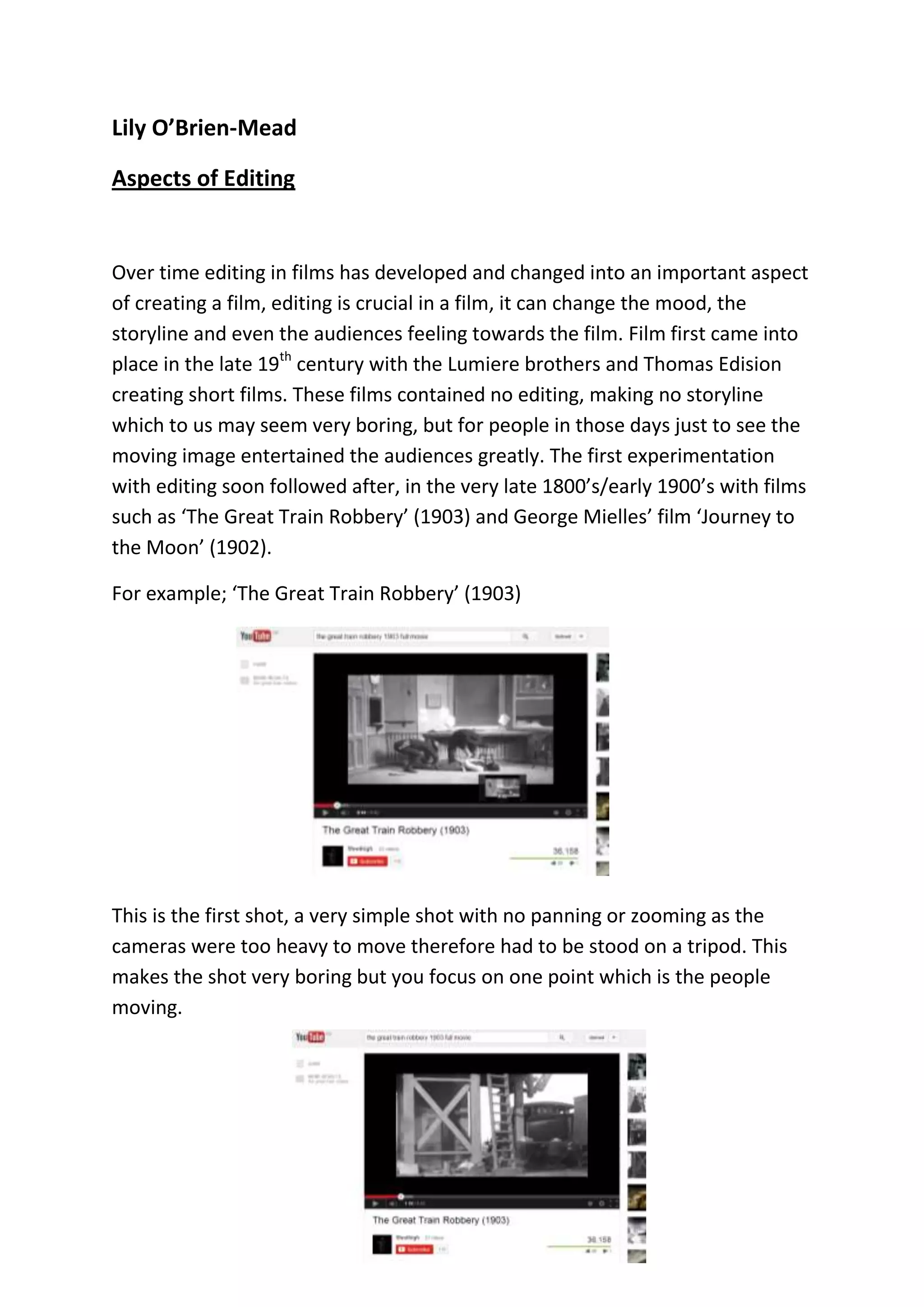
For example; ‘The Great Train Robbery’ (1903)

This is the first shot, a very simple shot with no panning or zooming as the
cameras were too heavy to move therefore had to be stood on a tripod. This
makes the shot very boring but you focus on one point which is the people
moving.
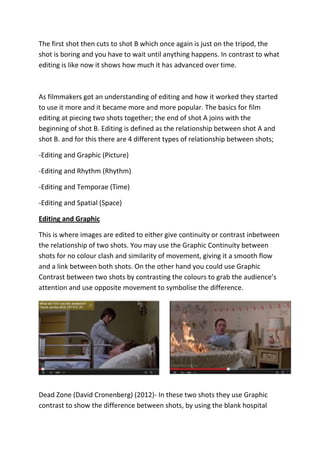
The first shot then cuts to shot B which once again is just on the tripod, the
shot is boring and you have to wait until anything happens. In contrast to what
editing is like now it shows how much it has advanced over time.

As filmmakers got an understanding of editing and how it worked they started
to use it more and it became more and more popular. The basics for film
editing at piecing two shots together; the end of shot A joins with the
beginning of shot B. Editing is defined as the relationship between shot A and
shot B. and for this there are 4 different types of relationship between shots;
-Editing and Graphic (Picture)
-Editing and Rhythm (Rhythm)
-Editing and Temporae (Time)
-Editing and Spatial (Space)
Editing and Graphic
This is where images are edited to either give continuity or contrast inbetween
the relationship of two shots. You may use the Graphic Continuity between
shots for no colour clash and similarity of movement, giving it a smooth flow
and a link between both shots. On the other hand you could use Graphic
Contrast between two shots by contrasting the colours to grab the audience’s
attention and use opposite movement to symbolise the difference.

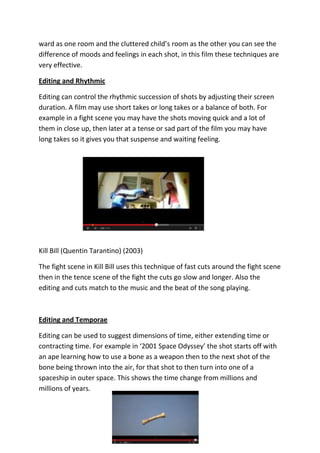
Dead Zone (David Cronenberg) (2012)- In these two shots they use Graphic
contrast to show the difference between shots, by using the blank hospital
ward as one room and the cluttered child’s room as the other you can see the
difference of moods and feelings in each shot, in this film these techniques are
very effective.
Editing and Rhythmic
Editing can control the rhythmic succession of shots by adjusting their screen
duration. A film may use short takes or long takes or a balance of both. For
example in a fight scene you may have the shots moving quick and a lot of
them in close up, then later at a tense or sad part of the film you may have
long takes so it gives you that suspense and waiting feeling.

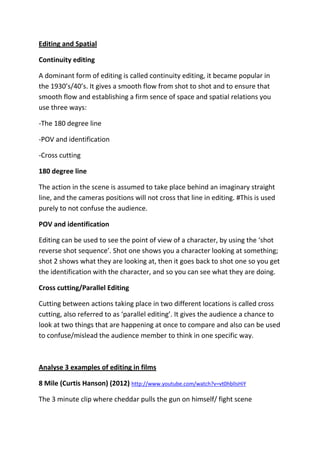
Kill Bill (Quentin Tarantino) (2003)
The fight scene in Kill Bill uses this technique of fast cuts around the fight scene
then in the tence scene of the fight the cuts go slow and longer. Also the
editing and cuts match to the music and the beat of the song playing.

Editing and Temporae
Editing can be used to suggest dimensions of time, either extending time or
contracting time. For example in ‘2001 Space Odyssey’ the shot starts off with
an ape learning how to use a bone as a weapon then to the next shot of the
bone being thrown into the air, for that shot to then turn into one of a
spaceship in outer space. This shows the time change from millions and
millions of years.
Editing and Spatial
Continuity editing
A dominant form of editing is called continuity editing, it became popular in
the 1930’s/40’s. It gives a smooth flow from shot to shot and to ensure that
smooth flow and establishing a firm sence of space and spatial relations you
use three ways:
-The 180 degree line
-POV and identification
-Cross cutting
180 degree line
The action in the scene is assumed to take place behind an imaginary straight
line, and the cameras positions will not cross that line in editing. #This is used
purely to not confuse the audience.
POV and identification
Editing can be used to see the point of view of a character, by using the ‘shot
reverse shot sequence’. Shot one shows you a character looking at something;
shot 2 shows what they are looking at, then it goes back to shot one so you get
the identification with the character, and so you can see what they are doing.
Cross cutting/Parallel Editing
Cutting between actions taking place in two different locations is called cross
cutting, also referred to as ‘parallel editing’. It gives the audience a chance to
look at two things that are happening at once to compare and also can be used
to confuse/mislead the audience member to think in one specific way.

Analyse 3 examples of editing in films
8 Mile (Curtis Hanson) (2012) http://www.youtube.com/watch?v=vt0hblIsHiY
The 3 minute clip where cheddar pulls the gun on himself/ fight scene
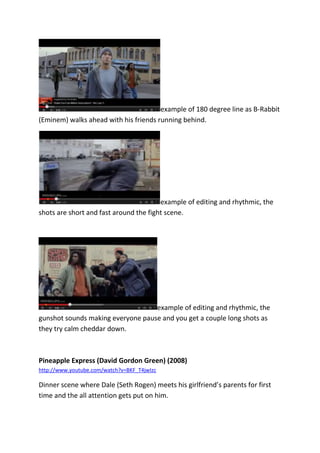
example of 180 degree line as B-Rabbit
(Eminem) walks ahead with his friends running behind.

example of editing and rhythmic, the
shots are short and fast around the fight scene.

example of editing and rhythmic, the
gunshot sounds making everyone pause and you get a couple long shots as
they try calm cheddar down.

Pineapple Express (David Gordon Green) (2008)
http://www.youtube.com/watch?v=BKF_T4jwIzc

Dinner scene where Dale (Seth Rogen) meets his girlfriend’s parents for first
time and the all attention gets put on him.
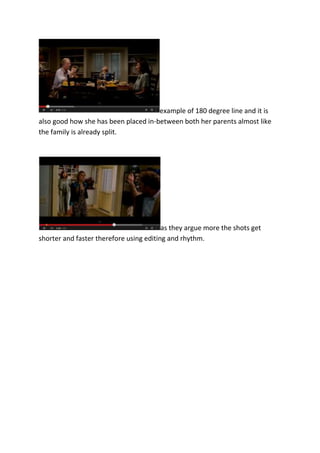
example of 180 degree line and it is
also good how she has been placed in-between both her parents almost like
the family is already split.

as they argue more the shots get
shorter and faster therefore using editing and rhythm.

Editing techniques

  • 1.
    Lily O’Brien-Mead Aspects ofEditing Over time editing in films has developed and changed into an important aspect of creating a film, editing is crucial in a film, it can change the mood, the storyline and even the audiences feeling towards the film. Film first came into place in the late 19th century with the Lumiere brothers and Thomas Edision creating short films. These films contained no editing, making no storyline which to us may seem very boring, but for people in those days just to see the moving image entertained the audiences greatly. The first experimentation with editing soon followed after, in the very late 1800’s/early 1900’s with films such as ‘The Great Train Robbery’ (1903) and George Mielles’ film ‘Journey to the Moon’ (1902). For example; ‘The Great Train Robbery’ (1903) This is the first shot, a very simple shot with no panning or zooming as the cameras were too heavy to move therefore had to be stood on a tripod. This makes the shot very boring but you focus on one point which is the people moving.
  • 2.
    The first shotthen cuts to shot B which once again is just on the tripod, the shot is boring and you have to wait until anything happens. In contrast to what editing is like now it shows how much it has advanced over time. As filmmakers got an understanding of editing and how it worked they started to use it more and it became more and more popular. The basics for film editing at piecing two shots together; the end of shot A joins with the beginning of shot B. Editing is defined as the relationship between shot A and shot B. and for this there are 4 different types of relationship between shots; -Editing and Graphic (Picture) -Editing and Rhythm (Rhythm) -Editing and Temporae (Time) -Editing and Spatial (Space) Editing and Graphic This is where images are edited to either give continuity or contrast inbetween the relationship of two shots. You may use the Graphic Continuity between shots for no colour clash and similarity of movement, giving it a smooth flow and a link between both shots. On the other hand you could use Graphic Contrast between two shots by contrasting the colours to grab the audience’s attention and use opposite movement to symbolise the difference. Dead Zone (David Cronenberg) (2012)- In these two shots they use Graphic contrast to show the difference between shots, by using the blank hospital
  • 3.
    ward as oneroom and the cluttered child’s room as the other you can see the difference of moods and feelings in each shot, in this film these techniques are very effective. Editing and Rhythmic Editing can control the rhythmic succession of shots by adjusting their screen duration. A film may use short takes or long takes or a balance of both. For example in a fight scene you may have the shots moving quick and a lot of them in close up, then later at a tense or sad part of the film you may have long takes so it gives you that suspense and waiting feeling. Kill Bill (Quentin Tarantino) (2003) The fight scene in Kill Bill uses this technique of fast cuts around the fight scene then in the tence scene of the fight the cuts go slow and longer. Also the editing and cuts match to the music and the beat of the song playing. Editing and Temporae Editing can be used to suggest dimensions of time, either extending time or contracting time. For example in ‘2001 Space Odyssey’ the shot starts off with an ape learning how to use a bone as a weapon then to the next shot of the bone being thrown into the air, for that shot to then turn into one of a spaceship in outer space. This shows the time change from millions and millions of years.
  • 4.
    Editing and Spatial Continuityediting A dominant form of editing is called continuity editing, it became popular in the 1930’s/40’s. It gives a smooth flow from shot to shot and to ensure that smooth flow and establishing a firm sence of space and spatial relations you use three ways: -The 180 degree line -POV and identification -Cross cutting 180 degree line The action in the scene is assumed to take place behind an imaginary straight line, and the cameras positions will not cross that line in editing. #This is used purely to not confuse the audience. POV and identification Editing can be used to see the point of view of a character, by using the ‘shot reverse shot sequence’. Shot one shows you a character looking at something; shot 2 shows what they are looking at, then it goes back to shot one so you get the identification with the character, and so you can see what they are doing. Cross cutting/Parallel Editing Cutting between actions taking place in two different locations is called cross cutting, also referred to as ‘parallel editing’. It gives the audience a chance to look at two things that are happening at once to compare and also can be used to confuse/mislead the audience member to think in one specific way. Analyse 3 examples of editing in films 8 Mile (Curtis Hanson) (2012) http://www.youtube.com/watch?v=vt0hblIsHiY The 3 minute clip where cheddar pulls the gun on himself/ fight scene
  • 5.
    example of 180degree line as B-Rabbit (Eminem) walks ahead with his friends running behind. example of editing and rhythmic, the shots are short and fast around the fight scene. example of editing and rhythmic, the gunshot sounds making everyone pause and you get a couple long shots as they try calm cheddar down. Pineapple Express (David Gordon Green) (2008) http://www.youtube.com/watch?v=BKF_T4jwIzc Dinner scene where Dale (Seth Rogen) meets his girlfriend’s parents for first time and the all attention gets put on him.
  • 6.
    example of 180degree line and it is also good how she has been placed in-between both her parents almost like the family is already split. as they argue more the shots get shorter and faster therefore using editing and rhythm.