Understanding the fundamentals and applications of edge computing.
Edge Computing
Introduction
This presentation covers the essential aspects of
Edge Computing, including its definition,
benefits, and significant applications in various
industries.
Overview
01
Definition of Edge Computing
Edge Computing is a distributed computing
paradigm that brings computation and data
storage closer to the location where it is needed.
By processing data at the edge of the network,
rather than relying on centralized data centers, it
reduces latency, improves speed, and enhances
the efficiency of applications that require real-
time data analysis.
Benefits of Edge
Computing
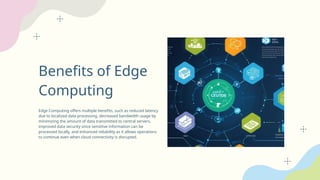
Edge Computing offers multiple benefits, such as reduced latency
due to localized data processing, decreased bandwidth usage by
minimizing the amount of data transmitted to central servers,
improved data security since sensitive information can be
processed locally, and enhanced reliability as it allows operations
to continue even when cloud connectivity is disrupted.
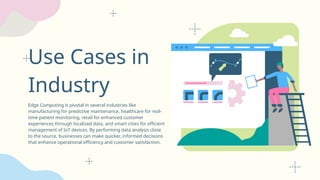
Use Cases in
Industry
Edge Computing is pivotal in several industries like
manufacturing for predictive maintenance, healthcare for real-
time patient monitoring, retail for enhanced customer
experiences through localized data, and smart cities for efficient
management of IoT devices. By performing data analysis close
to the source, businesses can make quicker, informed decisions
that enhance operational efficiency and customer satisfaction.
Architecture
02
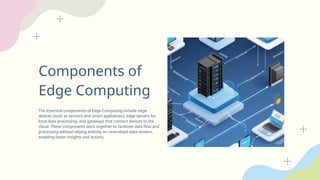
Components of
Edge Computing
The essential components of Edge Computing include edge
devices (such as sensors and smart appliances), edge servers for
local data processing, and gateways that connect devices to the
cloud. These components work together to facilitate data flow and
processing without relying entirely on centralized data centers,
enabling faster insights and actions.
Data Processing at the Edge
Data Processing at the Edge involves analytics
performed on data as it is created or collected,
rather than sending it to a far-off cloud for
processing. This minimizes latency and allows for
immediate responses, which is crucial for
applications requiring real-time insights like
autonomous vehicles, smart home systems, and
industrial automation.
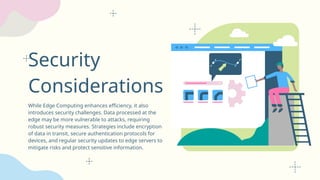
Security
Considerations
While Edge Computing enhances efficiency, it also
introduces security challenges. Data processed at the
edge may be more vulnerable to attacks, requiring
robust security measures. Strategies include encryption
of data in transit, secure authentication protocols for
devices, and regular security updates to edge servers to
mitigate risks and protect sensitive information.
Conclusions
Edge Computing revolutionizes how data is processed
and utilized, providing significant benefits such as
reduced latency, improved security, and enhanced
operational efficiency across various industries. As
technology evolves, understanding its architecture and
use cases will be essential for leveraging its full
potential.
CREDITS: This presentation template was created by Slidesgo,
and includes icons, infographics & images by Freepik
Do you have any questions?
Thank you!

Download Adobe XD Pro Crack Full Version 2025

  • 1.
    Understanding the fundamentalsand applications of edge computing. Edge Computing
  • 2.
    Introduction This presentation coversthe essential aspects of Edge Computing, including its definition, benefits, and significant applications in various industries.
  • 3.
  • 4.
    Definition of EdgeComputing Edge Computing is a distributed computing paradigm that brings computation and data storage closer to the location where it is needed. By processing data at the edge of the network, rather than relying on centralized data centers, it reduces latency, improves speed, and enhances the efficiency of applications that require real- time data analysis.
  • 5.
    Benefits of Edge Computing EdgeComputing offers multiple benefits, such as reduced latency due to localized data processing, decreased bandwidth usage by minimizing the amount of data transmitted to central servers, improved data security since sensitive information can be processed locally, and enhanced reliability as it allows operations to continue even when cloud connectivity is disrupted.
  • 6.
    Use Cases in Industry EdgeComputing is pivotal in several industries like manufacturing for predictive maintenance, healthcare for real- time patient monitoring, retail for enhanced customer experiences through localized data, and smart cities for efficient management of IoT devices. By performing data analysis close to the source, businesses can make quicker, informed decisions that enhance operational efficiency and customer satisfaction.
  • 7.
  • 8.
    Components of Edge Computing Theessential components of Edge Computing include edge devices (such as sensors and smart appliances), edge servers for local data processing, and gateways that connect devices to the cloud. These components work together to facilitate data flow and processing without relying entirely on centralized data centers, enabling faster insights and actions.
  • 9.
    Data Processing atthe Edge Data Processing at the Edge involves analytics performed on data as it is created or collected, rather than sending it to a far-off cloud for processing. This minimizes latency and allows for immediate responses, which is crucial for applications requiring real-time insights like autonomous vehicles, smart home systems, and industrial automation.
  • 10.
    Security Considerations While Edge Computingenhances efficiency, it also introduces security challenges. Data processed at the edge may be more vulnerable to attacks, requiring robust security measures. Strategies include encryption of data in transit, secure authentication protocols for devices, and regular security updates to edge servers to mitigate risks and protect sensitive information.
  • 11.
    Conclusions Edge Computing revolutionizeshow data is processed and utilized, providing significant benefits such as reduced latency, improved security, and enhanced operational efficiency across various industries. As technology evolves, understanding its architecture and use cases will be essential for leveraging its full potential.
  • 12.
    CREDITS: This presentationtemplate was created by Slidesgo, and includes icons, infographics & images by Freepik Do you have any questions? Thank you!