
Download to read offline

![Motivation [1/2]
• Nowadays we are facing a massive shift away from the standard,
centralized computing model that is provided through cloud computing
paradigm.
• The shift is now towards the distribution of computing power back to the
edge of the network.
• Edge network is the idea of connecting sensors to programmable
automation controllers (PAC) which handle processing, storage, and
communication.
• The basic concept of edge computing is to leverage new generation
technologies, processes, services, and applications that are built to take
an advantage of new infrastructure.](https://image.slidesharecdn.com/edgecomputingsystemforlarge-scaledistributedsensingsystems-180313161649/85/Edge-computing-system-for-large-scale-distributed-sensing-systems-3-320.jpg)
![Motivation [2/2]
• Extending Cloud computing paradigm
• Try to overcome idea “one size fits all”
• Help Cloud in new use cases and applications
like autonomous cars, delivery drones, sensing
systems etc.](https://image.slidesharecdn.com/edgecomputingsystemforlarge-scaledistributedsensingsystems-180313161649/85/Edge-computing-system-for-large-scale-distributed-sensing-systems-4-320.jpg)
![Main Problem [1/2]
• The problem with the current model is that heavily
involves centralized architecture.
• Issues such as latency or small-time delays, security,
privacy, network reliability, performance and many
others are extremely difficult to completely overcome in
centralized computing models.
• Even a small problem can set a motion to bigger
complicated issues.](https://image.slidesharecdn.com/edgecomputingsystemforlarge-scaledistributedsensingsystems-180313161649/85/Edge-computing-system-for-large-scale-distributed-sensing-systems-5-320.jpg)
![Main Problem [2/2]
• Cloud computing has driven an incredible
amount of innovation over the last 20 years.
• It is too far away from the most interesting things
that are happening around us.
• It is too slow to react to change in the real world.
• Edge computing is here to help Cloud computing](https://image.slidesharecdn.com/edgecomputingsystemforlarge-scaledistributedsensingsystems-180313161649/85/Edge-computing-system-for-large-scale-distributed-sensing-systems-6-320.jpg)
![How to solve a problem [1/4]
• One possible solution is Edge computing
• Edge, is right next to where the action is.
• It's already in the densest urban areas where most of
humans and their devices live, and where commerce
happens.
• Put processing closer to the edge of the network pre-
process data and send to the cloud](https://image.slidesharecdn.com/edgecomputingsystemforlarge-scaledistributedsensingsystems-180313161649/85/Edge-computing-system-for-large-scale-distributed-sensing-systems-7-320.jpg)
![How to solve a problem [2/4]
• System we propose is influenced by few proven
systems in both academia and industry:
• Orchestration engine from Google called Borg, that
helps Google run their workloads efficiently with
maximum resource utilization
• Chord, lookup protocol by MIT for fast data lookup in
distributed p2p environment
• Log-structured merge-tree (LSM tree) append only
key-value data structure for efficient data storage
presented by Patrick O'Neil.](https://image.slidesharecdn.com/edgecomputingsystemforlarge-scaledistributedsensingsystems-180313161649/85/Edge-computing-system-for-large-scale-distributed-sensing-systems-8-320.jpg)
![How to solve a problem [2/4]
• System we propose is influenced by few proven
systems in both academia and industry:
• Orchestration engine from Google called Borg, that
helps Google run their workloads efficiently with
maximum resource utilization
• Chord, lookup protocol by MIT for fast data lookup in
distributed p2p environment
• Log-structured merge-tree (LSM tree) append only
key-value data structure for efficient data storage
presented by Patrick O'Neil.](https://image.slidesharecdn.com/edgecomputingsystemforlarge-scaledistributedsensingsystems-180313161649/85/Edge-computing-system-for-large-scale-distributed-sensing-systems-9-320.jpg)
![How to solve a problem [2/4]
• System we propose is influenced by few proven
systems in both academia and industry:
• Orchestration engine from Google called Borg, that
helps Google run their workloads efficiently with
maximum resource utilization
• Chord, lookup protocol by MIT for fast data lookup in
distributed p2p environment
• Log-structured merge-tree (LSM tree) append only
key-value data structure for efficient data storage
presented by Patrick O'Neil.](https://image.slidesharecdn.com/edgecomputingsystemforlarge-scaledistributedsensingsystems-180313161649/85/Edge-computing-system-for-large-scale-distributed-sensing-systems-10-320.jpg)
![How to solve a problem [3/4]
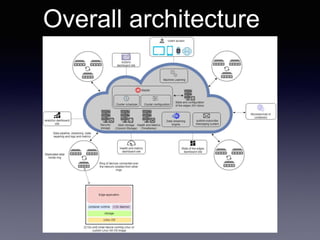
• Separate geographic area where sensing systems are,
in 'micro data-centers' that collect and (pre)process data
• Every node in micro datacenter should run two
processes:
• minion process that communicate with the cloud,
container engine process, and rest of the nodes in
micro datacenter (replication, lookup)
• container engine that runs applications in containers
providing isolation and maximum resource utilization](https://image.slidesharecdn.com/edgecomputingsystemforlarge-scaledistributedsensingsystems-180313161649/85/Edge-computing-system-for-large-scale-distributed-sensing-systems-11-320.jpg)
![How to solve a problem [4/4]
• We propose few programming models for users of this system:
• batch jobs, for standard batch processing over some collection of data
• events, this type of job should react when some specific event happened
in the system, or pass some predefined threshold
• streaming jobs, should continually do some (pre)processing on data as it
gets (long running jobs)
• services, user defined jobs that do not fit in any of the previous categories
• Jobs contains DAG when transits from operation to operation to prevent data
loss and starting jobs from start if fail happened](https://image.slidesharecdn.com/edgecomputingsystemforlarge-scaledistributedsensingsystems-180313161649/85/Edge-computing-system-for-large-scale-distributed-sensing-systems-12-320.jpg)

The document discusses the transition from centralized cloud computing to edge computing, which aims to distribute computing power closer to data sources for improved performance and reduced latency. It proposes a system design influenced by existing technologies that incorporates micro data-centers to process and manage data at the network edge. The paper outlines potential programming models for these systems and highlights the need for future developments in monitoring, security, and service integration.


