+
Self-Determination Theory
Theory of Achievement Goals
QED529 Discovery & Peer Teaching
Session 3
By Michelle Choy
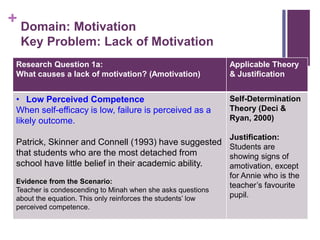
+ Domain: Motivation
Key Problem: Lack of Motivation
:
Research Question 1a:
What causes a lack of motivation? (Amotivation)
Applicable Theory
& Justification
• Low Perceived Competence
When self-efficacy is low, failure is perceived as a
likely outcome.
Patrick, Skinner and Connell (1993) have suggested
that students who are the most detached from
school have little belief in their academic ability.
Evidence from the Scenario:
Teacher is condescending to Minah when she asks questions
about the equation. This only reinforces the students’ low
perceived competence.
Self-Determination
Theory (Deci &
Ryan, 2000)
Justification:
Students are
showing signs of
amotivation, except
for Annie who is the
teacher’s favourite
pupil.
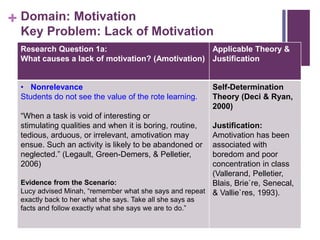
+ Domain: Motivation
Key Problem: Lack of Motivation
Research Question 1a:
What causes a lack of motivation? (Amotivation)
Applicable Theory &
Justification
• Nonrelevance
Students do not see the value of the rote learning.
“When a task is void of interesting or
stimulating qualities and when it is boring, routine,
tedious, arduous, or irrelevant, amotivation may
ensue. Such an activity is likely to be abandoned or
neglected.” (Legault, Green-Demers, & Pelletier,
2006)
Evidence from the Scenario:
Lucy advised Minah, “remember what she says and repeat
exactly back to her what she says. Take all she says as
facts and follow exactly what she says we are to do.”
Self-Determination
Theory (Deci & Ryan,
2000)
Justification:
Amotivation has been
associated with
boredom and poor
concentration in class
(Vallerand, Pelletier,
Blais, Brie`re, Senecal,
& Vallie`res, 1993).
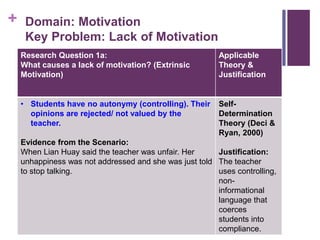
+ Domain: Motivation
Key Problem: Lack of Motivation
Research Question 1a:
What causes a lack of motivation? (Extrinsic
Motivation)
Applicable
Theory &
Justification
• Students have no autonymy (controlling). Their
opinions are rejected/ not valued by the
teacher.
Evidence from the Scenario:
When Lian Huay said the teacher was unfair. Her
unhappiness was not addressed and she was just told
to stop talking.
Self-
Determination
Theory (Deci &
Ryan, 2000)
Justification:
The teacher
uses controlling,
non-
informational
language that
coerces
students into
compliance.
+
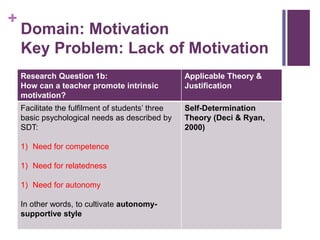
Domain: Motivation
Key Problem: Lack of Motivation
Research Question 1b:
How can a teacher promote intrinsic
motivation?
Applicable Theory &
Justification
Facilitate the fulfilment of students’ three
basic psychological needs as described by
SDT:
1) Need for competence
1) Need for relatedness
1) Need for autonomy
In other words, to cultivate autonomy-
supportive style
Self-Determination
Theory (Deci & Ryan,
2000)
+ Domain: Motivation
Key Problem: Lack of Motivation
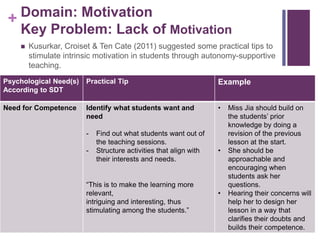
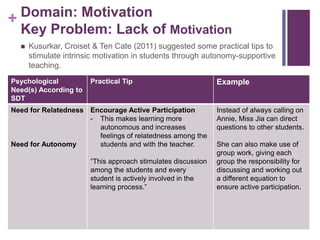
 Kusurkar, Croiset & Ten Cate (2011) suggested some practical tips to
stimulate intrinsic motivation in students through autonomy-supportive
teaching.
Psychological Need(s)
According to SDT
Practical Tip Example
Need for Competence Identify what students want and
need
- Find out what students want out of
the teaching sessions.
- Structure activities that align with
their interests and needs.
“This is to make the learning more
relevant,
intriguing and interesting, thus
stimulating among the students.”
• Miss Jia should build on
the students’ prior
knowledge by doing a
revision of the previous
lesson at the start.
• She should be
approachable and
encouraging when
students ask her
questions.
• Hearing their concerns will
help her to design her
lesson in a way that
clarifies their doubts and
builds their competence.
+ Domain: Motivation
Key Problem: Lack of Motivation
 Kusurkar, Croiset & Ten Cate (2011) suggested some practical tips to
stimulate intrinsic motivation in students through autonomy-supportive
teaching.
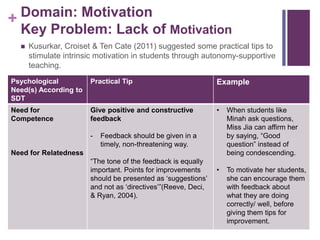
Psychological
Need(s) According to
SDT
Practical Tip Example
Need for
Competence
Need for Relatedness
Give positive and constructive
feedback
- Feedback should be given in a
timely, non-threatening way.
“The tone of the feedback is equally
important. Points for improvements
should be presented as ‘suggestions’
and not as ‘directives’”(Reeve, Deci,
& Ryan, 2004).
• When students like
Minah ask questions,
Miss Jia can affirm her
by saying, “Good
question” instead of
being condescending.
• To motivate her students,
she can encourage them
with feedback about
what they are doing
correctly/ well, before
giving them tips for
improvement.
+ Domain: Motivation
Key Problem: Lack of Motivation
 Kusurkar, Croiset & Ten Cate (2011) suggested some practical tips to
stimulate intrinsic motivation in students through autonomy-supportive
teaching.
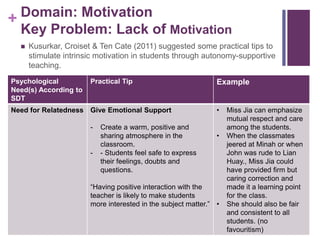
Psychological
Need(s) According to
SDT
Practical Tip Example
Need for Relatedness Give Emotional Support
- Create a warm, positive and
sharing atmosphere in the
classroom.
- - Students feel safe to express
their feelings, doubts and
questions.
“Having positive interaction with the
teacher is likely to make students
more interested in the subject matter.”
• Miss Jia can emphasize
mutual respect and care
among the students.
• When the classmates
jeered at Minah or when
John was rude to Lian
Huay., Miss Jia could
have provided firm but
caring correction and
made it a learning point
for the class.
• She should also be fair
and consistent to all
students. (no
favouritism)
+ Domain: Motivation
Key Problem: Lack of Motivation
 Kusurkar, Croiset & Ten Cate (2011) suggested some practical tips to
stimulate intrinsic motivation in students through autonomy-supportive
teaching.
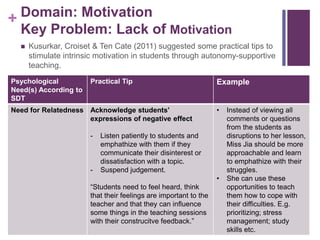
Psychological
Need(s) According to
SDT
Practical Tip Example
Need for Relatedness Acknowledge students’
expressions of negative effect
- Listen patiently to students and
emphathize with them if they
communicate their disinterest or
dissatisfaction with a topic.
- Suspend judgement.
“Students need to feel heard, think
that their feelings are important to the
teacher and that they can influence
some things in the teaching sessions
with their construcitve feedback.”
• Instead of viewing all
comments or questions
from the students as
disruptions to her lesson,
Miss Jia should be more
approachable and learn
to emphathize with their
struggles.
• She can use these
opportunities to teach
them how to cope with
their difficulties. E.g.
prioritizing; stress
management; study
skills etc.
+ Domain: Motivation
Key Problem: Lack of Motivation
 Kusurkar, Croiset & Ten Cate (2011) suggested some practical tips to
stimulate intrinsic motivation in students through autonomy-supportive
teaching.
Psychological
Need(s) According to
SDT
Practical Tip Example
Need for Relatedness
Need for Autonomy
Encourage Active Participation
- This makes learning more
autonomous and increases
feelings of relatedness among the
students and with the teacher.
“This approach stimulates discussion
among the students and every
student is actively involved in the
learning process.”
Instead of always calling on
Annie, Miss Jia can direct
questions to other students.
She can also make use of
group work, giving each
group the responsibility for
discussing and working out
a different equation to
ensure active participation.
+ Domain: Motivation
Key Problem: Lack of Motivation
 Kusurkar, Croiset & Ten Cate (2011) suggested some practical tips to
stimulate intrinsic motivation in students through autonomy-supportive
teaching.
Psychological
Need(s) According to
SDT
Practical Tip Example
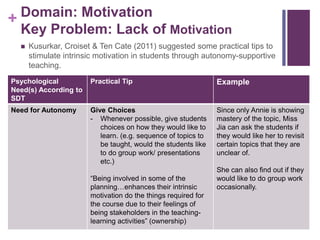
Need for Autonomy Give Choices
- Whenever possible, give students
choices on how they would like to
learn. (e.g. sequence of topics to
be taught, would the students like
to do group work/ presentations
etc.)
“Being involved in some of the
planning…enhances their intrinsic
motivation do the things required for
the course due to their feelings of
being stakeholders in the teaching-
learning activities” (ownership)
Since only Annie is showing
mastery of the topic, Miss
Jia can ask the students if
they would like her to revisit
certain topics that they are
unclear of.
She can also find out if they
would like to do group work
occasionally.
+ Domain: Motivation
Key Problem: Lack of Motivation
 Kusurkar, Croiset & Ten Cate (2011) suggested some practical tips to
stimulate intrinsic motivation in students through autonomy-supportive
teaching.
Psychological
Need(s) According to
SDT
Practical Tip Example
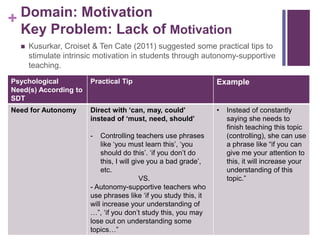
Need for Autonomy Direct with ‘can, may, could’
instead of ‘must, need, should’
- Controlling teachers use phrases
like ‘you must learn this’, ‘you
should do this’. ‘if you don’t do
this, I will give you a bad grade’,
etc.
VS.
- Autonomy-supportive teachers who
use phrases like ‘if you study this, it
will increase your understanding of
…”, ‘if you don’t study this, you may
lose out on understanding some
topics…”
• Instead of constantly
saying she needs to
finish teaching this topic
(controlling), she can use
a phrase like “if you can
give me your attention to
this, it will increase your
understanding of this
topic.”
+ Domain: Motivation
Key Problem: Lack of Motivation
 Kusurkar, Croiset & Ten Cate (2011) suggested some practical tips to
stimulate intrinsic motivation in students through autonomy-supportive
teaching.
Psychological
Need(s) According to
SDT
Practical Tip Example
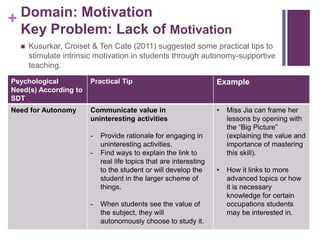
Need for Autonomy Communicate value in
uninteresting activities
- Provide rationale for engaging in
uninteresting activities.
- Find ways to explain the link to
real life topics that are interesting
to the student or will develop the
student in the larger scheme of
things.
- When students see the value of
the subject, they will
autonomously choose to study it.
• Miss Jia can frame her
lessons by opening with
the “Big Picture”
(explaining the value and
importance of mastering
this skill).
• How it links to more
advanced topics or how
it is necessary
knowledge for certain
occupations students
may be interested in.
+Domain: Motivation
Key Problem: Poor Instructional Strategy
Research Question 2:
What are the Classroom structure and
Instructional strategies that lead to a mastery
goal orientation?
Applicable Theory &
Justification
On mastery goal orientation, Ames (1992) qualified
that the focus of attention is on the intrinsic value
of learning as well as effort utilization.
“One’s sense of efficacy is based on the belief that
effort will lead to success or a sense of mastery.”
Theory of Achievement Goals
- Performance Goals vs Mastery
Goals (Ames & Archer, 1987,
1988)
Justification:
Miss Jia’s students are showing signs
of performance goal orientation such
as avoidance of challenging tasks; low
self-concept and superficial, short-term
learning strategies such as
memorising.
Teacher promotes rote learning which students do not see the value of
(Performance Goal Oriented).
+Domain: Motivation
Key Problem: Poor Instructional Strategy
Research Question 2:
What are the Classroom structure and
Instructional strategies that lead to a mastery
goal orientation?
Applicable Theory &
Justification
Ames (1992) suggests that “these structures
include, but are not limited to, the design of
tasks and learning activities, evaluation
practices and use of rewards, and distribution
of authority of responsibility.”
Theory of Achievement
Goals
- Performance Goals vs
Mastery Goals (Ames &
Archer, 1987, 1988)
+Domain: Motivation
Key Problem: Poor Instructional Strategy
Research Question 2:
What are the Classroom structure and
Instructional strategies that lead to a mastery
goal orientation?
Applicable Theory &
Justification
In short, Ames studied three structures:
• Tasks (Design of learning activities)
• Evaluation and Recognition (Students’
perceptions of the meaning of the evaluative
information)
• Authority (Teacher’s orientation toward autonomy
and the degree to which teachers involve children
in decision making)
Theory of Achievement
Goals
- Performance Goals vs
Mastery Goals (Ames &
Archer, 1987, 1988)
+
Domain: Motivation
Key Problem: Poor Instructional Strategy
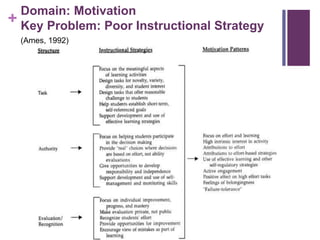
(Ames, 1992)
+ Domain: Motivation
Key Problem: Poor Instructional Strategy
Structure Instructional Strategy for the
Scenario (Solution)
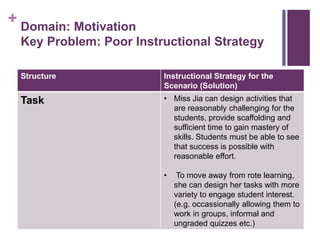
Task • Miss Jia can design activities that
are reasonably challenging for the
students, provide scaffolding and
sufficient time to gain mastery of
skills. Students must be able to see
that success is possible with
reasonable effort.
• To move away from rote learning,
she can design her tasks with more
variety to engage student interest.
(e.g. occassionally allowing them to
work in groups, informal and
ungraded quizzes etc.)
+ Domain: Motivation
Key Problem: Poor Instructional Strategy
Structure Instructional Strategy for the
Scenario (Solution)
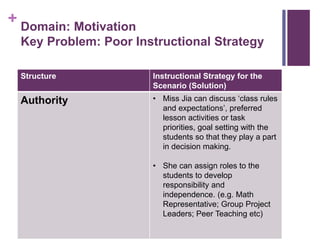
Authority • Miss Jia can discuss ‘class rules
and expectations’, preferred
lesson activities or task
priorities, goal setting with the
students so that they play a part
in decision making.
• She can assign roles to the
students to develop
responsibility and
independence. (e.g. Math
Representative; Group Project
Leaders; Peer Teaching etc)
+ Domain: Motivation
Key Problem: Poor Instructional Strategy
Structure Instructional Strategy for the
Scenario (Solution)
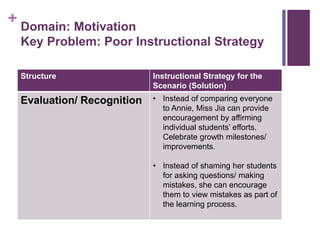
Evaluation/ Recognition • Instead of comparing everyone
to Annie, Miss Jia can provide
encouragement by affirming
individual students’ efforts.
Celebrate growth milestones/
improvements.
• Instead of shaming her students
for asking questions/ making
mistakes, she can encourage
them to view mistakes as part of
the learning process.
+
List Of References
 Ames, C. (1992). Classrooms: Goals, structures, and student motivation. Journal Of
Educational Psychology, 84(3), 261-271. doi:10.1037/0022-0663.84.3.261
 Kusurkar RA, Croiset G, Ten Cate TJ. (2011). Twelve tips to stimulate intrinsic motivation in
students through autonomy-supportive classroom teaching derived from self-determination
theory. Medical teacher, 33(12), 978-982.
 Legault, L., Green-Demers, I., & Pelletier, L. (2006). Why do high school students lack
motivation in the classroom? Toward an understanding of academic amotivation and the role
of social support. Journal of Educational Psychology, 98, 567-582.
 Patrick, B. C., Skinner, E. A., & Connell, J. P. (1993). What motivates children’s behavior and
emotion? Joint effects of perceived control and autonomy in the academic domain. Journal
of Personality and Social Psychology, 65, 781–791.
 Reeve J, Deci EL, Ryan RM.( 2004). Self-Determination Theory: A dialectical framework for
understanding sociocultural influences on student motivation. In: McInerney DM, van Etten
S, editors. Big theories revisited. USA: Information Age Publishing Inc. pp 31–60.
 Vallerand, R. J., Pelletier, L. G., Blais, M. R., Brie`re, N. M., Senecal, C.,& Vallie`res, E. F.
(1993). On the assessment of intrinsic, extrinsic, and amotivation in education: Evidence on
the concurrent and construct validity of the Academic Motivation Scale. Educational and
Psychological Measurement, 53,150–172.

QED529 Peer Teaching Session 3- Motivation

  • 1.
    + Self-Determination Theory Theory ofAchievement Goals QED529 Discovery & Peer Teaching Session 3 By Michelle Choy
  • 2.
    + Domain: Motivation KeyProblem: Lack of Motivation : Research Question 1a: What causes a lack of motivation? (Amotivation) Applicable Theory & Justification • Low Perceived Competence When self-efficacy is low, failure is perceived as a likely outcome. Patrick, Skinner and Connell (1993) have suggested that students who are the most detached from school have little belief in their academic ability. Evidence from the Scenario: Teacher is condescending to Minah when she asks questions about the equation. This only reinforces the students’ low perceived competence. Self-Determination Theory (Deci & Ryan, 2000) Justification: Students are showing signs of amotivation, except for Annie who is the teacher’s favourite pupil.
  • 3.
    + Domain: Motivation KeyProblem: Lack of Motivation Research Question 1a: What causes a lack of motivation? (Amotivation) Applicable Theory & Justification • Nonrelevance Students do not see the value of the rote learning. “When a task is void of interesting or stimulating qualities and when it is boring, routine, tedious, arduous, or irrelevant, amotivation may ensue. Such an activity is likely to be abandoned or neglected.” (Legault, Green-Demers, & Pelletier, 2006) Evidence from the Scenario: Lucy advised Minah, “remember what she says and repeat exactly back to her what she says. Take all she says as facts and follow exactly what she says we are to do.” Self-Determination Theory (Deci & Ryan, 2000) Justification: Amotivation has been associated with boredom and poor concentration in class (Vallerand, Pelletier, Blais, Brie`re, Senecal, & Vallie`res, 1993).
  • 4.
    + Domain: Motivation KeyProblem: Lack of Motivation Research Question 1a: What causes a lack of motivation? (Extrinsic Motivation) Applicable Theory & Justification • Students have no autonymy (controlling). Their opinions are rejected/ not valued by the teacher. Evidence from the Scenario: When Lian Huay said the teacher was unfair. Her unhappiness was not addressed and she was just told to stop talking. Self- Determination Theory (Deci & Ryan, 2000) Justification: The teacher uses controlling, non- informational language that coerces students into compliance.
  • 5.
    + Domain: Motivation Key Problem:Lack of Motivation Research Question 1b: How can a teacher promote intrinsic motivation? Applicable Theory & Justification Facilitate the fulfilment of students’ three basic psychological needs as described by SDT: 1) Need for competence 1) Need for relatedness 1) Need for autonomy In other words, to cultivate autonomy- supportive style Self-Determination Theory (Deci & Ryan, 2000)
  • 6.
    + Domain: Motivation KeyProblem: Lack of Motivation  Kusurkar, Croiset & Ten Cate (2011) suggested some practical tips to stimulate intrinsic motivation in students through autonomy-supportive teaching. Psychological Need(s) According to SDT Practical Tip Example Need for Competence Identify what students want and need - Find out what students want out of the teaching sessions. - Structure activities that align with their interests and needs. “This is to make the learning more relevant, intriguing and interesting, thus stimulating among the students.” • Miss Jia should build on the students’ prior knowledge by doing a revision of the previous lesson at the start. • She should be approachable and encouraging when students ask her questions. • Hearing their concerns will help her to design her lesson in a way that clarifies their doubts and builds their competence.
  • 7.
    + Domain: Motivation KeyProblem: Lack of Motivation  Kusurkar, Croiset & Ten Cate (2011) suggested some practical tips to stimulate intrinsic motivation in students through autonomy-supportive teaching. Psychological Need(s) According to SDT Practical Tip Example Need for Competence Need for Relatedness Give positive and constructive feedback - Feedback should be given in a timely, non-threatening way. “The tone of the feedback is equally important. Points for improvements should be presented as ‘suggestions’ and not as ‘directives’”(Reeve, Deci, & Ryan, 2004). • When students like Minah ask questions, Miss Jia can affirm her by saying, “Good question” instead of being condescending. • To motivate her students, she can encourage them with feedback about what they are doing correctly/ well, before giving them tips for improvement.
  • 8.
    + Domain: Motivation KeyProblem: Lack of Motivation  Kusurkar, Croiset & Ten Cate (2011) suggested some practical tips to stimulate intrinsic motivation in students through autonomy-supportive teaching. Psychological Need(s) According to SDT Practical Tip Example Need for Relatedness Give Emotional Support - Create a warm, positive and sharing atmosphere in the classroom. - - Students feel safe to express their feelings, doubts and questions. “Having positive interaction with the teacher is likely to make students more interested in the subject matter.” • Miss Jia can emphasize mutual respect and care among the students. • When the classmates jeered at Minah or when John was rude to Lian Huay., Miss Jia could have provided firm but caring correction and made it a learning point for the class. • She should also be fair and consistent to all students. (no favouritism)
  • 9.
    + Domain: Motivation KeyProblem: Lack of Motivation  Kusurkar, Croiset & Ten Cate (2011) suggested some practical tips to stimulate intrinsic motivation in students through autonomy-supportive teaching. Psychological Need(s) According to SDT Practical Tip Example Need for Relatedness Acknowledge students’ expressions of negative effect - Listen patiently to students and emphathize with them if they communicate their disinterest or dissatisfaction with a topic. - Suspend judgement. “Students need to feel heard, think that their feelings are important to the teacher and that they can influence some things in the teaching sessions with their construcitve feedback.” • Instead of viewing all comments or questions from the students as disruptions to her lesson, Miss Jia should be more approachable and learn to emphathize with their struggles. • She can use these opportunities to teach them how to cope with their difficulties. E.g. prioritizing; stress management; study skills etc.
  • 10.
    + Domain: Motivation KeyProblem: Lack of Motivation  Kusurkar, Croiset & Ten Cate (2011) suggested some practical tips to stimulate intrinsic motivation in students through autonomy-supportive teaching. Psychological Need(s) According to SDT Practical Tip Example Need for Relatedness Need for Autonomy Encourage Active Participation - This makes learning more autonomous and increases feelings of relatedness among the students and with the teacher. “This approach stimulates discussion among the students and every student is actively involved in the learning process.” Instead of always calling on Annie, Miss Jia can direct questions to other students. She can also make use of group work, giving each group the responsibility for discussing and working out a different equation to ensure active participation.
  • 11.
    + Domain: Motivation KeyProblem: Lack of Motivation  Kusurkar, Croiset & Ten Cate (2011) suggested some practical tips to stimulate intrinsic motivation in students through autonomy-supportive teaching. Psychological Need(s) According to SDT Practical Tip Example Need for Autonomy Give Choices - Whenever possible, give students choices on how they would like to learn. (e.g. sequence of topics to be taught, would the students like to do group work/ presentations etc.) “Being involved in some of the planning…enhances their intrinsic motivation do the things required for the course due to their feelings of being stakeholders in the teaching- learning activities” (ownership) Since only Annie is showing mastery of the topic, Miss Jia can ask the students if they would like her to revisit certain topics that they are unclear of. She can also find out if they would like to do group work occasionally.
  • 12.
    + Domain: Motivation KeyProblem: Lack of Motivation  Kusurkar, Croiset & Ten Cate (2011) suggested some practical tips to stimulate intrinsic motivation in students through autonomy-supportive teaching. Psychological Need(s) According to SDT Practical Tip Example Need for Autonomy Direct with ‘can, may, could’ instead of ‘must, need, should’ - Controlling teachers use phrases like ‘you must learn this’, ‘you should do this’. ‘if you don’t do this, I will give you a bad grade’, etc. VS. - Autonomy-supportive teachers who use phrases like ‘if you study this, it will increase your understanding of …”, ‘if you don’t study this, you may lose out on understanding some topics…” • Instead of constantly saying she needs to finish teaching this topic (controlling), she can use a phrase like “if you can give me your attention to this, it will increase your understanding of this topic.”
  • 13.
    + Domain: Motivation KeyProblem: Lack of Motivation  Kusurkar, Croiset & Ten Cate (2011) suggested some practical tips to stimulate intrinsic motivation in students through autonomy-supportive teaching. Psychological Need(s) According to SDT Practical Tip Example Need for Autonomy Communicate value in uninteresting activities - Provide rationale for engaging in uninteresting activities. - Find ways to explain the link to real life topics that are interesting to the student or will develop the student in the larger scheme of things. - When students see the value of the subject, they will autonomously choose to study it. • Miss Jia can frame her lessons by opening with the “Big Picture” (explaining the value and importance of mastering this skill). • How it links to more advanced topics or how it is necessary knowledge for certain occupations students may be interested in.
  • 14.
    +Domain: Motivation Key Problem:Poor Instructional Strategy Research Question 2: What are the Classroom structure and Instructional strategies that lead to a mastery goal orientation? Applicable Theory & Justification On mastery goal orientation, Ames (1992) qualified that the focus of attention is on the intrinsic value of learning as well as effort utilization. “One’s sense of efficacy is based on the belief that effort will lead to success or a sense of mastery.” Theory of Achievement Goals - Performance Goals vs Mastery Goals (Ames & Archer, 1987, 1988) Justification: Miss Jia’s students are showing signs of performance goal orientation such as avoidance of challenging tasks; low self-concept and superficial, short-term learning strategies such as memorising. Teacher promotes rote learning which students do not see the value of (Performance Goal Oriented).
  • 15.
    +Domain: Motivation Key Problem:Poor Instructional Strategy Research Question 2: What are the Classroom structure and Instructional strategies that lead to a mastery goal orientation? Applicable Theory & Justification Ames (1992) suggests that “these structures include, but are not limited to, the design of tasks and learning activities, evaluation practices and use of rewards, and distribution of authority of responsibility.” Theory of Achievement Goals - Performance Goals vs Mastery Goals (Ames & Archer, 1987, 1988)
  • 16.
    +Domain: Motivation Key Problem:Poor Instructional Strategy Research Question 2: What are the Classroom structure and Instructional strategies that lead to a mastery goal orientation? Applicable Theory & Justification In short, Ames studied three structures: • Tasks (Design of learning activities) • Evaluation and Recognition (Students’ perceptions of the meaning of the evaluative information) • Authority (Teacher’s orientation toward autonomy and the degree to which teachers involve children in decision making) Theory of Achievement Goals - Performance Goals vs Mastery Goals (Ames & Archer, 1987, 1988)
  • 17.
    + Domain: Motivation Key Problem:Poor Instructional Strategy (Ames, 1992)
  • 18.
    + Domain: Motivation KeyProblem: Poor Instructional Strategy Structure Instructional Strategy for the Scenario (Solution) Task • Miss Jia can design activities that are reasonably challenging for the students, provide scaffolding and sufficient time to gain mastery of skills. Students must be able to see that success is possible with reasonable effort. • To move away from rote learning, she can design her tasks with more variety to engage student interest. (e.g. occassionally allowing them to work in groups, informal and ungraded quizzes etc.)
  • 19.
    + Domain: Motivation KeyProblem: Poor Instructional Strategy Structure Instructional Strategy for the Scenario (Solution) Authority • Miss Jia can discuss ‘class rules and expectations’, preferred lesson activities or task priorities, goal setting with the students so that they play a part in decision making. • She can assign roles to the students to develop responsibility and independence. (e.g. Math Representative; Group Project Leaders; Peer Teaching etc)
  • 20.
    + Domain: Motivation KeyProblem: Poor Instructional Strategy Structure Instructional Strategy for the Scenario (Solution) Evaluation/ Recognition • Instead of comparing everyone to Annie, Miss Jia can provide encouragement by affirming individual students’ efforts. Celebrate growth milestones/ improvements. • Instead of shaming her students for asking questions/ making mistakes, she can encourage them to view mistakes as part of the learning process.
  • 21.
    + List Of References Ames, C. (1992). Classrooms: Goals, structures, and student motivation. Journal Of Educational Psychology, 84(3), 261-271. doi:10.1037/0022-0663.84.3.261  Kusurkar RA, Croiset G, Ten Cate TJ. (2011). Twelve tips to stimulate intrinsic motivation in students through autonomy-supportive classroom teaching derived from self-determination theory. Medical teacher, 33(12), 978-982.  Legault, L., Green-Demers, I., & Pelletier, L. (2006). Why do high school students lack motivation in the classroom? Toward an understanding of academic amotivation and the role of social support. Journal of Educational Psychology, 98, 567-582.  Patrick, B. C., Skinner, E. A., & Connell, J. P. (1993). What motivates children’s behavior and emotion? Joint effects of perceived control and autonomy in the academic domain. Journal of Personality and Social Psychology, 65, 781–791.  Reeve J, Deci EL, Ryan RM.( 2004). Self-Determination Theory: A dialectical framework for understanding sociocultural influences on student motivation. In: McInerney DM, van Etten S, editors. Big theories revisited. USA: Information Age Publishing Inc. pp 31–60.  Vallerand, R. J., Pelletier, L. G., Blais, M. R., Brie`re, N. M., Senecal, C.,& Vallie`res, E. F. (1993). On the assessment of intrinsic, extrinsic, and amotivation in education: Evidence on the concurrent and construct validity of the Academic Motivation Scale. Educational and Psychological Measurement, 53,150–172.