ED 116 993
AUTHOR
TITLE
INSTITUTION
SPONS AGENCY
PUB DATE
NOTE
AVAILABLE FROM
EDRS PRICE
DESCRIPTORS
ABSTRACT
DOCUMENT RESUME
SO 008 819
Hanvey, Robert G.
An Attainable Global Perspective.
Denver Univ., Colo. Center for Teaching International
Relations.; New York Friends Group, Inc., New York.
Center for War/Peace Studies.
National Endowment for the Humanities (NFAH),
Washington, D.C.
Nov 75
31p.'
Center for War/Peace Studies, 218 East 18th Street,
New York, New York 10003 ($1.00)
MF-$0.76 Plus Postage. HC Not Available from EDRS.
*Conceptual Schemes; Cross Cultural Studies;
*Cultural Awareness; Decision Making; Elementary
Secondary Education; Futures (of Society); *Global
Approach; School Role;"Social Studies; *Teaching
Techniques; Values; World Affairs; *World Problems
A more complete understanding of global perspective
is provided in this essay through an examination of the modes
of
thought, sensitivities, intellectual skills, and explanatory
capacities which contribute to the formation of a global
perspective.
With an emphasis on both a formal and informal educational
level, the
essay is divided into five sections which examine the
requirements
for an attainable global perspective. Section 1, Perspective
Consciousness, underscores the need to recognize the concept
that
everyone's perspective is shaped by subtle influences and that
others
may have different perspectives. Section 2, State of Vq: Planet
Awareness, examines the problems and solutions for increasing
the
ability of individuals to intelligently interpret information about
world conditions. Section 3, Cross Cultural Awareness,
describes the
different degrees of -cross- cultural awareness and the,necessity
to
reach a stage beyond empathy where one has the capacity'to
imagine
oneself in a role within the context of a foreign culture. Section
4,
Knowledge of GlObal Dynamics, analyzes the world as an
interdependent
system where the issue of growth may be the predominant
contemporary
problem. Section 5, A.;--z1.11Ass of Human Choices,
emphasizes that
increased global' iperspectiVb will require difficult value
decisions
about the solutions to our world problems. (Author 'DE)
******1s*********************************************
*****************
D)cuments acquired by ERIC include many informal un blished
* materials not available from other sources. ERIC makes eve
effort *
* to obtain the best copy available. Nevertheless, items of ma
inal *
* reproducibility are often encountered and this affects the qua
ity *
* of the microfiche and hardcopy reproductions ERIC makes
availab e *
* via the ERIC Document Reproduction Service (EDRS). EDTS
is not
* responsible for the quality of the original document.
Reproduct ons *
* supplied by EUS are the best that can be made from the
original. *
*****************************************************
*****************
CENTER FOR
WAR/PEACE
STUDIES
U.S. DEPARTMENT OF HEALTH,
EDUCATION & WELFARE
NATIONAL INSTITUTE OF
EDUCATION
THIS DOCUMENT ,-HAS BEEN REPRO-
DUCED EXACTLY AS RECEIVED FROM
(HE PERSON OR ORGANIZATION ORIGIN-
ATING IT POINTS OF VIEW OR OPINIONS
STATED DO NOT NECESSARILY REPRE-
SENT OFFICIAL NATIONAL INSTITUTE OF
EDUCATION POSITION OR POLICY
PERMISSION TO REPRODUCE THIS
COPYRIGHTED MATERIAL BY MICRO.
Fl HE ONLY HAS BEE RANTED Y
TO ERIC AND ORGANIZATIONS OPERAT
ING UNDER AGREEMENTS WITH THE NA
TIONAL INSTITUTE OF EDUCATION
FURTHER REPRODUCTION OUTSIDE
THE ERIC SYSTEM REQUIRES PERMIS
SION OF THE COPYRIGHT OWNER "
jg";;1--
/Om 
ittali(11111100°
An
Attainable
Global
Perspective
ROBERT G. HANVEY
This exploration was made possible partly through a grant
from the National Endowment for the Humanities to the
CENTER FOR TEACHING 'INTERNATIONAL RELATIONS,
which commissioned Robert G. Hanvey to undertake the
task. It is published by the Center for War/Peace Studies.
CENTER FOR TEACHING INTERNATIONAL RELATIONS
Graduate School of International Studies
University of Denver, Denver, CO 80210
CENTER FOR WAR/PEACE STUDIES
218 East 18th Street, New York, NY 10003
An Attainable Global Perspective
Robert G. Hanvey
CONTENTS
Introduction
Dimension 1: Perspective Consciousness
Dimension 2: "State of the Planet" Awareness
Dimension 3: Cross-cultural Awareness
Dimension 4: Knowledge of Global Dynamics
Dimension 5: Awareness of Human Choices
8
13
This e .say is a beginning effort to define some elements of
what we call a
global perspective to flesh out some of the things- we will need
to know
and understand,,if we are to cope with the challenges of an
increasingly inter-
dependent world. The views are those of the author, published
here to begin
the discussion, debate, and analysis which will be necessary for
a widespread
and more complete understanding of what global perspectives
are and how
they can become part of the school curriculum.
Another exploration of questions raised for education by
interdependence
is the publication A New Civic Literacy: American Education
and Global
Interdependence by Ward Morehouse, Interdependence Series #
3, published
by the Aspen Institute for Humanist;c Studies, Rosedale Road,
P.O. Box 2820,
Princeton, NJ 08540. This is available at $1.00 per copy.
Robert G. Hanvey
An Attainable Global Perspective
Introduction
This is an attempt to describe certain modes of thought,
sensitivities, intellectual skills, and explanatory capacities
whiCh might in some measure contribute to the formation of
a global perspective and which young people In the U.S.
might actually he able to acquire in the course of their for -
mal and informal education. That is what-is- meant here by an
attainable global perspective. By speaking in such terms, we
imply a modesty of goals. This indeed is our orientation, to
provide some contrast with the general practice of stating
objectives in ideal and often extreme terms.
What is a global perspective? Operationally,we will say that
it consists partly of the modes of thought, skills, etc. that
will be discussed in the following pages. But as conceived
here a global perspective is not a quantum, something you
either have or don't have. It is a blend of many things and
any given individual may be rich in certain elements and
relatively lacking in others. The educational goal broadly
seen may be to socialize_ significant collectivities of people so
that the important elements of a global perspective are r epre-
sented in the group. Viewed in this way a global perspective
may be a variable trait possessed in some form and degree by
a population, with the precise character of that perspective
determined by the specialized capaciues, predispositions, and
attitudes of the group's members. The implication of this
notion, of course, is that diversified talents and inclinations
can be encouraged and that standardized educational effects
are not required. Every individual does not have to be
brought to the same level of intellectual and moral develop-
ment in order for a population to be moving in the direction
of a more global perspective.
In keeping with modesty of aspirations it is especially.
important at the outset to admit the limited impact of for-
mal schooling and the often profound impact of informal
socialization. Schools are hard put to match the drama and
appeal of the mass media or the grip on behavior and attitude
2
exerted by the peer group. Furthermore, whatever is learned
while young is continuously reshaped by later experience.
The world view of an American farmer will no doubt reflect
his schooling to some extent, but it is likely to be most impor -
tantly influenced by exigencies associated with his role as a
farmer and by attitudes currently held by his most important
reference group other farmers.
If adult role and informal agencies of socialization are
very important, can the schools contribute meaningfully?
Yes, especially if they are able to stake out areas of special
competence. The schools must select a niche that comple-
ments the other educative agencies of the society. To the
extent that those other agencies and influences work against
a global perspective the schools can perform a corrective
function; to the extent that the other agencies are glib and
superficial the schools can seek to be more thorough; to the
extent that the other agencies have blind spots the schools
can work to supply the missing detail; to the extent that the
other agencies direct the attention to the short-term extra-
ordinary event the schools cart assert the value of examining
the long-term situation or trend (which is sometimes extra-
ordinary in its own right).
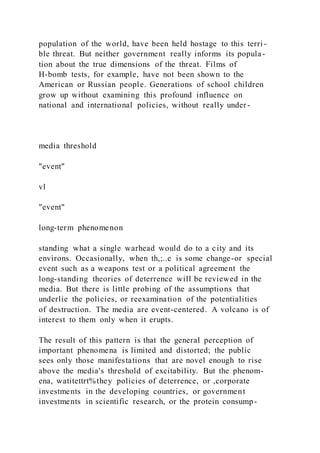
Consider, for example, public information and socializa-
tion in the U.S. with respect to nuclear weapons policies. For
many years the governments of the U.S. and the USSR have
influenced each other in multiple ways by developing, main-
taining, and threatening to use nuclear weapons of awesome
destructiveness. The populations of each country, and the
population of the world, have been held hostage to this terri -
ble threat. But neither government really informs its popula-
tion about the true dimensions of the threat. Films of
H-bomb tests, for example, have not been shown to the
American or Russian people. Generations of school children
grow up without examining this profound influence on
national and international policies, without really under-
media threshold
"event"
vl
"event"
long-term phenomenon
standing what a single warhead would do to a city and its
environs. Occasionally, when th,;..e is some change-or special
event such as a weapons test or a political agreement the
long-standing theories of deterrence will be reviewed in the
media. But there is little probing of the assumptions that
underlie the policies, or reexamination of the potentialities
of destruction. The media are event-centered. A volcano is of
interest to them only when it erupts.
The result of this pattern is that the general perception of
important phenomena is limited and distorted; the public
sees only those manifestations that are novel enough to rise
above the media's threshold of excitability. But the phenom-
ena, watitettrt%they policies of deterrence, or ,corporate
investments in the developing countries, or government
investments in scientific research, or the protein consump-
tion habits of industrialized populations, continue to affect
our lives, visible or, not.
In fairness to the media it must be admitted that such
phenomena are not, by and large, intrinsically interesting to
most people. To specialized groups, yes, but not to broad
publics. And interest is what keeps newspapers and television
stations alive. It must also be admitted that some newspapers
provide extremely important resources for broad p'iblic edu-
cation and that the television networks occasionally reach
millions with significant documentaries and background
stories. But the general characterization of the media as
event-centered is not, I think, unreasonable.
The media, of course, are more than event- centered. They
are culture-bound and culture-generating. That is, they re-
flect the culture and reinforce it but are also capable of
turning it in new directions. The culture says, "Consume!"
and the media transmit that message ingeniously, seduc-
tively, repetitively, persuasively. Very persuasively. And the
audience responds to the cultural command. It does not
question what it is told to consume. Electric heating is
3
clean be the proud owner of an all-electric house. Be sure
that the new car can reach 60 miles per hour in ten seconds,
even with the air conditioner on. Buy the lawn fertilizer with
the weed killer built in. Then the times change and the mes-
sages change. Consume, yes, but also conserve. And watch
for environmental effects. And the media, always there on
the growing edge of cultural transformation, pass the new
messages along with the same devotion to technical quality
am' the same servility to whatever it is currently correct to
believe in that particular society. the messages may be social-
ly useful or not. But the influence is there, the long reach
into every home and hotel room and bar, the powerful rein-
forcing of enduring cultural ideas, themes, stereotypes,
coupled with the equally powerful capacity to mobilize alto-
gether new patterns of belief and opinion almost overnight.
If this is the way the media are: event-centered, and
potent servants of both traditional and emergent elements of
the national culture, what then for the schools? The schools,
after all, are also carriers of the national culture. But the
schools must stake out a niche that balances and corrects the
media. The schools may be bearers of culture but they are
also agents of an academic tradition that encourages scrutiny
of that which seems conventional and obvious. If the media
direct attention to events, the schools must look beneath the
apparent event at the phenomena really involved. If the
media say, "Believe this way!" the schools must reveal that
in other times and other places people believed and now
believe in quite different ways. At the very least every young
person should have experiences in school which demonstrate
in a lasting fashion that (1) there are substrata to the visible
event and (2) culture affects the perception of human affairs.
Thus educated, the person's reactions to reports in the media
should be, minimally, "There may be more there than meets
the eye," and "Other eyes might see it differently." Those
are truisms but the schools can put flesh on them.
DIMENSION 1
Perspective Consciousness
the recognition or awareness on the part of the individual that
he or she has a
view of the world that is not universally shared, that this view
of the world
has been and continues to,be shaped by influences that often
escape con-
scious detection, and that others have views of the world that
are profoundly
different from one's own
Few of us in our lives can actually transcend the view -
point presented by the common carriers of information and
almost none of us can transcend the cognitive mapping pre-
sented by the culture we grew up in. But with effort we can
at least develop a dim sense that we have a perspective, that
it can be shaped by subtle influences, that others have differ -
ent perspectives. This recognition of the existence, the mall e-
ability, and the diversity Of perspective we might call per -
spective consciousness. Such an acknowledgement is an im-
portant step in the development of a perspective that can
legitimately be called global.
Achieving perspective consciousness is no small ace=
plishment. It is probably true that most people in most soci -
eties do -not sense the uniqueness of their own or their
society's worla view. Herman Kahn in The Emerging Japa-
nese Superstate tells the following anecdote:
The Japanese do not think of themselves as being
racist. I once brought sharp surprise to a number of
senior Americans and Japanese with whom I was hav-
ing dinner by suggesting that in some ways Japan is the
most racist nation in the world. One of them asked me
to explain what I meant. I started, of course, with the
obvious point that the Japanese, at least in comparison
with other groups, are relatively pure racially. There
are, so to speak, no blond Japanese, no red-haired
Japanese, no blue-eyed Japanese. And the attitude of
the Japanese toward miscegenation is very different
from that of, say, the French or the Chinese. If some-
body is born of a mixed marriage in France or China
but grows up perfectly familiar with and skilled in the
indigenous culture, he is largely accepted. That is not
true in Japan. The children of mixed marriages are
more or less permanently barred from participating
fully and comfortably in the society. Those bars also
hold against children born in Japan but of Korean or
Chinese parentage. One crucial point in the discussion
was that the Japanese do not normally notice that they
discriminate against these minorities, because the dis-
4
crimination is so thorough that the issue usually does
not arise [my italics] . I asked the Japanese if they
could imagine, for example, having a General of Kore-
an parentage. They could not. I pointed out that it
was perfectly possible in China.*
It could be argued that people are very aware of differ -
ences in perspective, or at least of opinion. The Japanese may
helbe blind to t racism, but Americans are surely aware of
the racist elemlts in their own society and keenly aware
that different factions within the society have different views
4 appropriate behavior with respect to minorities. And if the
media are important shapers of perspective, isn't it true that
conflict and dispute are the main diet of the press and elec-
tronic media? Anyone exposed to these influences must cer-
tainly know very early in life that people differ radically in
their perspectives.
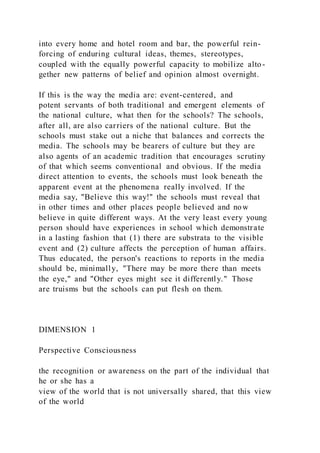
Opinion and Perspective
Here, I think, one must make a distinction between opin-
ion and perspective. Opinion is the surface layer, the con-
scious outcropping of perspective. But there are deep and
hidden layers of perspective that may be more important in
orienting behavior. In such deep layers lies the Japanese view
of other ethnic groups. Korean inferiority, note, is not a
matter of opinion to the Japanese. It is profoundly assumed
and thus not recognized as racism by the Japanese. Similarly,
in the deep layers of Western civilization has been the
assumption that human dominance over nature is both at-
tainable and desirable. This, too, until recently, has not been
a matter of opinion.
One of the interesting things that reform and protest
movements do is to carry out mining operations in the deep
layers. They dredge to the surface aspects of perspective that
Herman Kahn, The Emerging Japanese Superstate (Prentice-
Hall,
1970), pp. 72,73.
perspective
opinion
ordinarily unexamined
assumptions,
evaluations,
explanations,
conceptions of
time, space,
causality, etc.
yyliall
5
have never before seen the light of day. Once made.visible,
these nay become the foci of debate, matters of opinion.
The environmental movement surfaced the assumption of
man's right to dominion over nature and thus posed some
philosophical choices that had previously escaped notice, The
feminist movement raised, the consciousness of women and
men with respect to."woman's place." They labeled the most
commonplace behaviors and. attitudes "chauvinist," and thus
revealed the deeper layers of perspective in action.
I have suggested that with effort we can develop in the
young at least a dim sense, a groping recognition of the fact
that they have a perspective. And this is very different fr om
knowing that they have opinions. At the present time the
schools and the media socialize all of us to he traders-in
opinion. We learn this through .discussion and debate,
through the contentious format of forums and organizational
meetings, through talk shows and newspaper columnists. We
learn, especially, that the individual is expected to have opin-
ions and to be willing to assert them. And we learn tacit rules
about "tolerating" differences in opinions so asserted.
We can also learn, if we approach the task with a sure
sense of purpose, how to probe the deep layers of perspec-
tive. A variety of specialists and social commentators regu-
larly operate in these realms and there are well-developed
methods and techniques. Some of these methods can be
learned and practiced. For example, some (but not all) values
clarification exercises can heighten awareness of otherwise
unrevealed aspects of perspective. At the very least if should
be possible to teach almost any young person to recognize a
probe of the deep layers when he sees it. Such probes come
in many forms, from the ironic humor of a "Doonesbury"
cartoon strip to the pop sociology of a book like Future
Shock.
There are practical steps that schools can take to develop
perspective consciousness in students and to develop other
dimensions that will contribute to the enhancement of a
global perspective. We turn, now, to those other dimensions.
DIMENSION 2
"State of the Planet" Awareness
awareness of prevailing world conditions and developments,
including emer-
gent-conditions and tr
conditions, resource
science and technol
nds, e.g. population gtoWth, migrations, economic
and physical environent, political developments,
y, ealth, ilk:nation and intra-nation conflicts, etc.
O
For most people in the world direct experience beyond picture
of world conditions? That question matters because
the local community is infrequent or nonexistent. It is not it is'
difficult to imagine a global perspective that does not
uncommon to meet resiaents of'Chicago neighborhoods who
jaielude a reasonably dependable sense of what shape the
have never traveled the few miles to the central business/ world
is in.
district, or sophisticated New Yoi.ktaxicab dr",
never been further south than i delphia. If this is true for
a geographically mobile society like the U.S. it is even more a
fact for other parts of the world. Tourism, urban migrations,
commerce, and business travel notwithstanding, most people
live out their live§ in rather circumscribed local suiroundings.
Communication Media and Planet Awareness
But direct experience is not the way that contemporary
peoples learn about their world. Margaret Mead writes:
Only yesterday, a New Guinea native's only contact
with modern civilization may have been a trade knife
that was passed from hand to hand into his village or
an airplane seen in the sky; today, as soon as he enters
the smallest frontier settlement, he meets the transistor
radio. tIntil yesterday, the village dwellers everywhere
were cut off from the urban life of their own country;
today radio and television bring them sounds and sights
cities all over the world.*
Nonliterate villager or suburban housewife, if doesn't
matter that one stays close to home. Information travels,
rapidly and far. News of a border crisis in the Middle East
reaches within hours the shopkeeper in Nairobi, the steel
worker insSweden, the PeruVian villpger. There is now a dem-
onstrated ;,techntcalcaNcity for simultaneous transmission of
messages ,to almost tKentire human species, The character
of the messages is something else again. Here we must ask,
Do the messages received on those millions of transistor
radios and television sets contribute meaningfully to a valid
41
* Margaret Mead; Culture and Commitment (Natural History
Press/
Doubleday, 1970), p. 71.
6
Generally speaking, the media in almost every country
will transmit news from around the world. As we discussed
earlier, the fundamental quality of news is its focus on the
extraordinary event. An outbreak of influenza is news;
endemic malaria is not. A rapid decline in values on the
world's stock excha-nges is news; the long-standing poverty of
hundreds of millions is not. So, there are significant limits
and distortions in the view of the wkirld conveyed by news
media. Nonetheless, the prospect is not entirely bleak. For
one thing, the characteristic interests of the news media can
be exploited; events can be staged in such a way as tos call
attention to world conditions not ordinarily juaged news-
worthy. A world conference can be con 'ened on food or
population or pollution problems. The conference itself is-
news. More importantly, the condition that gives rise to the
conference takes on a neWlevel of visibility--worldwide. And
the news media are the instruments of this increased
awareness.
Communication media, of course, transmit more than
news. The local community's images of the world outside are
drawn to a substantial degree from the make - believe, world of
cinema and television drama. Tie distortions associated with
dramatic presentations are well documented. The lifeways
and cultural types of other countries are frequently carica-
tured; ironically, the lifeways and types of one's own society
are also commonly caricatured. While the export of films and
television series from a country may mean an improved bal-
ance of payments, it by no means assures an improved bal -
ance of perspective. The world consumers of Aanerican tele-
vision and film can be excused for believing that, the U.S.
population consists largely of ranchers, doctors, policemen,
and gangsters.
if
'°1
Limits to Understanding
There are other sources of distortion. Political ideology
chokes off the flow ''1. some inhumation, the defense and
security syndrome nations blocks still other intormatiop,
and the selective disinterest of audiences constricts yet other
channels. As an instance of the first, Americans until recently
have had little access to inforimition about Cuba under
Castro. As an example of the second '-,the testing, of nuclear
weapons by the French and the ImIiansIkrecent years pro-
duced few hard details about site, yield, fallow. etc. (Govern-
ments have ways to obtain the intOrmation; puhlics do not.) As
ti- patterns of audience interest and disinterest consider how
little attention is paid to the affairs of small rations, or to
conditions in the rural areas of the world. And) with no com-
plaint from the audience.
Finally, there is the matter of the technical nature of
world data. There aie now unprecedented resources for gen
crating information shout the state of the planet, and for
sharing and processing the inhumation in order to obtain a
sense of the important patterns. But the procedures are high-
ly technical and the results expressed in technical terms. A
certain level of education is required to see the full signifi:
cance of the data. The case of ozone in the stratosphere is
instructive.
While environmental scientists are concerned about too-
high ozone levels in the air of cities (since it produces emphy-
sema-like effects) there is also concern about the possible
depletion of ozone in the stratosphere. Ozone in the strato-
sphere blocks out much of the sun's ultraviolet radiation.
Such radiation is so harmful that scientists believe that sur -
face life did not evolve on the earth until after the ozone
layer had been formed. There is now a real possibility that
gases released into the air by man will redu,_7e this ozone by
significant amounts. One villain is the propellant gas used in
aerosol cans. This gas is very inert in the atmosphere (which
is why it can be mixed with the many compounds found in
spray cans), but recent research has shown that it breaks
down under certain wavelengths of 'ultraviolet light. When it
breaks down, chlorine is released, which acts as a catalyst and
destroys ozone. Thus, the gas escapes into the atmosphere
when the spray can is used; it does not degrade in the atmos-
phere (since it does not react with other gases); some of it
seeps into the stratosphere, is broken down by ultraviolet
light, and the released chlorine destroys ozone. Predicted
results: increased number of skin cancer cases, possible biCt-
logical damage to vegetation and some insect species, possible
effects on plankton in the oceans, possible effects on climate.
This is a world condition. Even if we stop using aerosol
cans now, piopellant gas which might destroy an estimated S
percent of the planet's ozone layer has already been released.
If the propellant gases continue to be produced and produc-
tion increases at its present annual rate, then ozone depletion
might reach 30 percent by lq94.* ,
These projections are not certainties. Furthermore, the
ozone, even if depleted. will eventually build to original
revels if the destructive agents ere controlled. So the situation
is not necessarily dire. But there is a basis for concern. The
"Stratospheric Pollution: Mult!T Threats to Earth's Ozone."
- Science, October 2 5, 1974, pp. 3.1S-338.
question is, Who will understand and share that concern'? Can
a problem like stratospheric ozone depletion he widely com-
prehended so that it becomes a living part of what a general
populace 'vows about the planer? Or are such problems
fated to stay Within the private realms of specialists'?
Overcoming the Limitations
This is an instance where the energies of the schools, prop-
erly directed, might resolve the question in favor of the gen-
eral populace. It' from the earliest grades on students ex-
amined and puzzled over cases where seemingly innocent be-
haviors the diet rich in animal protein, the lavish use of
fertilizer u n the suburban lawn and golf course were shown
to have effects that were both unintended and global in
scope, then there could be a receptivity for the kind of infor -
mation involved iu the ozone case. The ozone situation
would not seem forbidding; it would be another instance of a
'model already documented. Students would have a frame-
work within which to handle it. As for the technical aspects
of the ozone .situation, these do not seem beyond the reach
of science and social studies departments that focus coopera-
tively on the technical dimensions of significant planetary
conditions. It may be true that school programs are not typi -
cally organized for such qe,-.task, but it is not outside the
boundaries of our predilections or our capacities.
Suppose the schools do not Work at the task of increasing
the ability of individuals to consume information intelli -
gently about world conditions, or even at the simpler task of
transmitting raw information about such conditions. Sup-
pose, for example, that the schools choose to ignore environ-
mental conditions, problems of world resources, trends in
population, the economic circumstances of various world re-
gions, political developments, social movements, changes in
technology, developments in world law, etc. Can a "state of
the planet" awareness be achieved without the participation
of formal educational institutions? I suspect so. Despite the
flaws and distortions of the media there is simply no ques-
tion that people everywhere are being reached with a flow of
information …
U.S. Copyright Law
(title 17 of U.S. code)
governs the reproduction
and redistribution of
copyrighted material.
Downloading this
document for the
purpose of
redistribution is
prohibited.
Boix
Mansilla
&
Chua,
2016
1
Signature
Pedagogies
in
Global
Competence
Education:
Understanding
quality
teaching
practice
Veronica
Boix
Mansilla
&
Flossie
Chua
Interdisciplinary
and
Global
Studies
--‐
Internal
Working
Paper
Address
for
Correspondence:
Veronica
Boix
Mansilla
Project
Zero
Harvard
Graduate
School
of
Education
Boix
Mansilla
&
Chua,
2016
2
“What
I
thought,
since
all
the
movies
that
I
saw,
is
that
they
would
be
more
poor,
that
they
[e--‐ pals
in
South
Africa]
would
not
have
a
city,
that
their
homes
would
be
made
out
of
dried
up
mud…
I
was
really
surprised
because
they
looked
nothing
like
that…
they
have
a
lot
of
the
things
that
we
do,
they
have
video
games
and
a
city…
I
was
really
surprised….
‘cause
they
have
good
teeth,
real
clothes,
full
hair.
[Working
with
our
South
African
e--‐ Pals]
is
cool
because
we
can
talk
with
people
from
different
continents…
We
can
see
how
people
on
the
other
side
of
the
world
live,
and
what
they
do,
not
at
all
as
I
imagined
it…”
Richard,
Grade
4
New
York
Overview
Preparing
our
youth
for
a
time
of
unprecedented
social,
economic
and
environmental
global
interdependence
requires
that
we
reconsider
what
matters
most
to
teach
and
learn
and
what
kind
of
learning
might
prove
most
effective.
A
fast--‐ growing
literature
on
global
competence
instruction
and
assessment
is
shedding
light
on
the
opportunities
and
challenges
we
face.
Introducing
new
countries
and
festivals
into
already
crowded
curricula
or
proposing
forced
connections
between
quadratic
equations
and
farming
in
Namibia
will
not
yield
the
deep
learning
we
seek.
Teaching
for
global
competence,
goes
beyond
delivering
new
content
through
transmission--‐ centered
pedagogies.
Rather,
we
argue
here,
it
calls
for
a
pedagogical
approach
uniquely
tailored
to
nurturing
deep,
relevant,
and
sustained
global
learning.
In
this
paper,
we
propose
that
successful
preparation
of
our
youth
for
the
contemporary
world
requires
that
we
seriously
address
four
fundamental
questions:
1. What
are
the
global
competence
learning
outcomes
we
seek?
2. What
kind
of
instruction
effectively
nurtures
deep
and
relevant
global
learning?
3. What
does
quality
teaching
for
global
competence
look
like?
4. How
do
we
prepare
teachers
to
teach
for
global
competence
with
depth?
To
address
these
questions
we
draw
on
an
empirical
study
of
exemplary
practices
in
global
competence
education.1
Through
a
series
of
case
studies,
we
investigated
how
award--‐ winning
global
education
teachers
create
conditions
to
foster
global
competence.
To
understand
the
promise
and
power
of
their
pedagogy,
we
visited
their
classrooms,
documented
selected
lessons
and
interviewed
them
before
during
and
after
their
units.
We
also
interviewed
students,
analyzed
student
work
and
curricular
materials.
Close
analysis
of
these
master
teachers’
practices
in
the
form
of
individual
case
studies
and
comparatively
1 This
study
was
made
possible
by
the
Longview
foundation.
We
thank
Jennifer
Manise
for
he
unwavering
support
of
this
multi--‐ year
investigation and her leadership in the field of Global
Education.
Boix
Mansilla
&
Chua,
2016
3
across
cases
has
enabled
us
to
identify
and
illustrate
a
series
of
signature
pedagogies
in
global
education—i.e.
units
of
instructional
practice
that
may
prove
uniquely
potent
in
nurturing
globally
competent
youth.
Here,
we
introduce
a
“signature
pedagogies”
approach
to
global
education
and
illustrate
it
with
two
cases
of
exemplary
teaching
in
elementary
public
school
classrooms.
We
first
revisit
global
competence
as
the
capacity
and
disposition
to
understand
and
act
on
issues
of
global
significance
(Boix
Mansilla
&
Jackson,
2011)
and
place
this
definition
in
the
larger
context
of
the
learning
theories
that
inform
it.
Next,
we
turn
to
quality
instructional
designs
by
introducing
a
signature
pedagogy
approach
to
teaching
for
global
competence.
We
then
illustrate
signature
pedagogies
[herein
SP]
using
two
elementary
school
case
studies.
We
conclude
by
examining
the
implications
of
a
SP
approach
for
teacher
education,
share
currently
unanswered
questions,
and
outline
next
steps.
I.
Educating
for
“Global
Competence”--‐
What
are
the
learning
outcomes
we
seek?
A
constructivist
view
of
deep,
long--‐ lasting,
and
relevant
learning
We
define
global
competence
as
the
capacity
and
disposition
to
understand
and
act
on
issues
of
global
significance
(Boix
Mansilla
&
Jackson
2011)2.
Developed
collaboratively
by
Asia
Society
and
the
CCSSO,
and
informed
by
Harvard
Project
Zero’s
research
on
learning
and
instruction,
this
definition
builds
on
a
few
key
premises
about
the
kind
of
learning
necessary
for
preparing
our
youth
for
the
world.
Firstly,
global
competence
is
cast
as
a
capacity
to
understand
--‐ --‐
to
use
disciplinary
concepts,
theories,
ideas,
methods
or
findings
in
novel
situations,
to
solve
problems,
produce
explanations,
create
products
or
interpret
phenomena
in
novel
ways
(Boix
Mansilla
&
Gardner
1999,
Wiske
1999).
With
its
focus
on
disciplinary
and
interdisciplinary
understanding,
this
definition
embodies
deep
subject
matter
learning.
Secondly,
if
“understanding”
speaks
of
depth
and
flexibility
in
subject
matter
expertise,
“global
competence”
as
a
disposition
speaks
of
depth
in
terms
of
student
ownership
and
transformation.
Dispositions
involve
the
ability
to
think
with
information,
the
sensitivity
to
opportunities
in
the
real
world
to
do
that,
and
an
inclination
to
do
so
over
time
(Perkins,
Tishman,
Ritchhart,
Donis,
&
Andrade,
2000).
Dispositions
are
about
the
‘residuals’
of
learning
beyond
formal
contexts
(Sizer
1984);
they
are
about
the
“kind
of
person”
a
student
will
become
(Boix
Mansilla
&
Gardner
2000).
Focusing
on
dispositions
directs
2
This
definition
was
developed
at
the
Council
of
Chief
State
School
Officers.
The
Global
Competence
committee
was
led
by
Asia
Society’s
Tony
Jackson.
Its
published
articulation
and
exemplification
was
informed
by
research
conducted
by
Veronica
Boix
Mansilla
at
Project
Zero,
Harvard
Graduate
School
of
Education.
Boix
Mansilla
&
Chua,
2016
4
our
educational
efforts
to
nurturing
young
people’s
habits
of
mind
or
orientation
towards
globally
competent
thinking
and
behaviors.
Finally,
as
global
competence
focuses
on
issues
of
global
significance
and
action
to
improve
conditions,
learning
must
be
visibly
relevant
to
students
and
the
world.
When
significance
is
considered,
global
competence
curricula
becomes
a
call
for
authenticity,
for
carefully
looking
to
the
contemporary
world
for
topics
that
matter
most
to
examine.
Beyond
knowledge,
skills,
attitudes
and
behaviors
Our
treatment
of
global
competence
also
favors
an
integrated
view
of
learning,
targeting
a
complement
of
practices
such
as
“investigating
the
world,”
“taking
perspective”,
“communicating
across
difference”,
and
“taking
action”
(see
Graphic
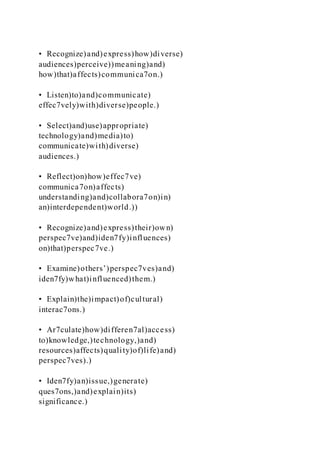
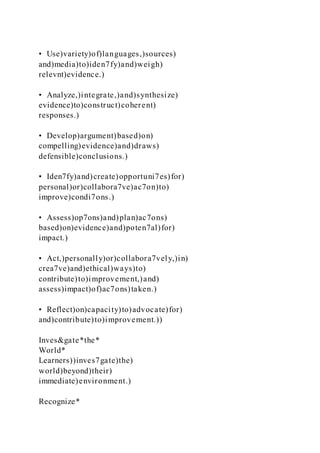
1).
Such
characterization
puts
a
premium
on
meaningful
and
purposeful
units
•  Recognize)and)express)how)diverse)
audiences)perceive))meaning)and)
how)that)affects)communica7on.)
•  Listen)to)and)communicate)
effec7vely)with)diverse)people.)
•  Select)and)use)appropriate)
technology)and)media)to)
communicate)with)diverse)
audiences.)
•  Reflect)on)how)effec7ve)
communica7on)affects)
understanding)and)collabora7on)in)
an)interdependent)world.))
•  Recognize)and)express)their)own)
perspec7ve)and)iden7fy)influences)
on)that)perspec7ve.)
•  Examine)others’)perspec7ves)and)
iden7fy)what)influenced)them.)
•  Explain)the)impact)of)cultural)
interac7ons.)
•  Ar7culate)how)differen7al)access)
to)knowledge,)technology,)and)
resources)affects)quality)of)life)and)
perspec7ves).)
•  Iden7fy)an)issue,)generate)
ques7ons,)and)explain)its)
significance.)
•  Use)variety)of)languages,)sources)
and)media)to)iden7fy)and)weigh)
relevnt)evidence.)
•  Analyze,)integrate,)and)synthesize)
evidence)to)construct)coherent)
responses.)
•  Develop)argument)based)on)
compelling)evidence)and)draws)
defensible)conclusions.)
•  Iden7fy)and)create)opportuni7es)for)
personal)or)collabora7ve)ac7on)to)
improve)condi7ons.)
•  Assess)op7ons)and)plan)ac7ons)
based)on)evidence)and)poten7al)for)
impact.)
•  Act,)personally)or)collabora7vely,)in)
crea7ve)and)ethical)ways)to)
contribute)to)improvement,)and)
assess)impact)of)ac7ons)taken.)
•  Reflect)on)capacity)to)advocate)for)
and)contribute)to)improvement.))
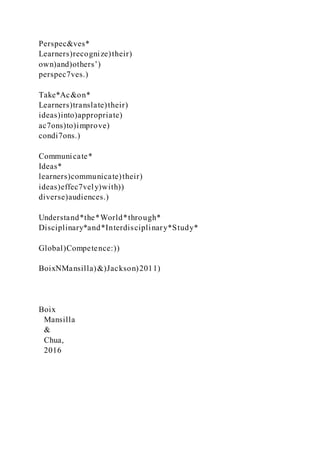
Inves&gate*the*
World*
Learners))inves7gate)the)
world)beyond)their)
immediate)environment.)
Recognize*
Perspec&ves*
Learners)recognize)their)
own)and)others’)
perspec7ves.)
Take*Ac&on*
Learners)translate)their)
ideas)into)appropriate)
ac7ons)to)improve)
condi7ons.)
Communicate*
Ideas*
learners)communicate)their)
ideas)effec7vely)with))
diverse)audiences.)
Understand*the*World*through*
Disciplinary*and*Interdisciplinary*Study*
Global)Competence:))
BoixNMansilla)&)Jackson)2011)
Boix
Mansilla
&
Chua,
2016
5
of
practice
in
the
world,
thus
moving
global
competence
beyond
itemized
lists
of
“knowledge,
skills,
attitudes
and
behaviors”
(Lagerman
1989,
Gibonne
2006).
While
such
lists
may
help
teachers
navigate
the
complex
multidisciplinary
space
of
global
education,
rich
and
deep
global
competence
learning
pays
attention
to
the
inseparable
interaction
of
knowledge,
skills,
attitudes
and
behaviors.
This
holistic
view
of
global
competence
learning
makes
authentic
purposes
for
learning
more
visible
to
students,
whether
they
seek
to
understand
human
impact
on
the
environment
as
an
example
of
“investigating
the
world”
or
make
sense
of
belief
systems
different
from
their
own
as
a
way
to
“take
perspective”.
Integrated
practices
of
global
competence
like
the
ones
proposed
add
relevance
and
meaning
to
students’
learning
experiences,
facilitating
meaningful
transfer
of
learning
beyond
classroom
walls.
Quality
teaching
enhances
students’
sensitivity
to
opportunities
to
employ
the
competencies
they
have
developed
productively
in
life
beyond
school.
In
sum,
if
we
are
to
prepare
our
youth
effectively
for
the
world,
we
need
clarity
about
the
kind
of
learning
we
are
after.
Our
proposed
constructivist
approach
puts
a
premium
on
global
competence
as
deep,
relevant,
and
long
lasting.
Learning
that
highlights
the
key
role
of
disciplinary
and
interdisciplinary
expertise
foregrounds
an
integrated
view
of
complex
learning
capacities
such
as
investigating
the
world
or
taking
perspective,
and
aims
at
the
development
of
habits
of
mind
or
dispositions—attending
to
the
long--‐
terms
residuals
of
learning
and
transfer.
II.
Teaching
for
global
competence:
How
should
we
design
instruction
for
the
kind
of
learning
we
are
after?
Conceptions
of
learning
like
the
ones
described
above
demand
carefully
tailored
pedagogical
approaches
that
effectively
nurture
the
kind
of
learning
we
are
after.
Pedagogical
recommendations
abound
in
the
global
education
literature
today.
They
address
generic
teaching
practices
such
as
cooperative
learning,
interdisciplinary
themes,
community--‐ based
learning
and
portfolio
assessment
(Asia
Society,
2011;
Appleyard
and
McLean,
2011;
Longview
Foundation
2008,
Merryfield,
1994;
Roberts,
2007;
Zhao,
2010).
They
also
include
instruction
specifically
tailored
to
global
content
such
as
comparing
civilizations
(Asia
Society,
2011;
Koziol,
2012;
Merryfield,
2002)
or
interpreting
sources
from
distant
places
(Lapayese,
2003;
Vaino--‐ Mattila,
2009).
These
recommendations
offer
productive
instructional
directions
for
practicing
teachers
and
teacher
educators.
Yet
implementing
them
with
quality
requires
that
we
understand
how
exactly
a
given
learning
experience
is
designed
to
maximize
students’
global
competence.
For
example,
upper
elementary
school
teachers
teaching
about
ancient
civilizations
often
design
compare--‐ and--‐ contrast
activities
for
student--‐ selected
topics:
e.g.,
food,
sports,
activities,
government,
or
natural
resources.
Such
activities
might
develop
students’
comparison
skills
and
provide
specific
information
about
Boix
Mansilla
&
Chua,
2016
6
civilizations,
but
they
fail
to
foreground
why
certain
comparisons
matter.
Instead,
comparing
civilizations
to
understand
why
they
rise
and
collapse
puts
knowledge
and
skills
in
service
of
a
larger
inquiry
with
clear
past
and
present
significance.
Engaging
in
purposeful
inquiry
and
building
a
robust
mental
schema
for
the
rise
and
fall
of
civilizations
will
support
students
to
‘think
with’
the
information
they
acquire
to
understand
this
broader
phenomenon.
More
importantly,
students
thus
educated
may
use
their
understanding
as
a
“lens”
to
understanding
contemporary
developments
–from
climate
instability,
to
overfishing,
population
explosion,
war--‐ --‐
that
might
put
our
civilization
at
risk.
What
makes
for
more
versus
less
compelling
learning
experiences
in
global
education?
How
can
we
design
instruction
that
goes
beyond
information
acquisition
and
nurtures
young
people’s
capacity
and
disposition
to
understand
and
act
in
the
world?
Signature
pedagogies
in
global
education:
our
contribution
“Signature
pedagogy,”
a
term
advanced
by
Lee
Shulman
(2005)
in
the
post--‐ secondary
education
context,
refers
to
a
pervasive
set
of
practices
used
to
prepare
scholarly
practitioners
to
“think,
perform
and
act
with
integrity”
in
their
professional
domain
(Shulman,
2005,
p.52).
Examples
of
signature
pedagogies
vary
greatly
across
professional
domains,
and
include
diagnostic
rounds
in
medicine,
case
method
in
law
and
business,
critiques
in
engineering
and
art
studios.
In
its
original
application
to
professional
learning,
a
signature
pedagogy
approach
assumes
that
quality
teaching
is
deliberate,
pervasive
and
persistent;
teaching
reveals
learners’
prior
assumptions,
…
How do the authors define global competence--how does that
definition differ from that of Hanvey’s?
What is a “signature pedagogy”? Provide one example from any
US teaching you have been exposed to and any Chinese
equivalent.
What makes “signature pedagogies” powerful approaches to
quality teaching for global competence?
4. Review pages 8-17 and identify which of her “signature
pedagogies” you find the most interesting and potentially use in
your classroom teaching and why.

Ed 116 993 authortitleinstitutionspons agencypu