DOCUMENT RESUME
ED 053 046 SO 001 680
AUTHOR Brady, Marion; Brady, Howard L.
TITLE A Rationale for Social Studies.
INSTITUTION Florida State Dept. of Education, Tallahassee. Div
of Elementary and Secondary Education.
PUB DATE 71
NOTE 73p.
EDRS PRICE EDRS Price MF-$0.65 HC-$3.29
DESCRIPTORS Concept Teaching, Critical Thinking, *Curriculum
Design, Elementary Grades, Group Behavior, *Group
Dynamics, *Human Relations, *Inquiry Training,
Interdisciplinary Approach, Secondary Grades, Social
Behavior, Social Sciences, *Social Studies, Values
IDENTIFIERS *Values Education
ABSTRACT
Only a few general principles are provided as a
foundation for an effective program. However, what is new is the
emphasis on 'Leman groups as a basis for organizing a single social
studies discipline. Some questions are suggested concerning what
should be investigated about groups, and what the students need to
understand. 1) What causes human groups to form, to change, to
disintegrate? 2) What holds groups together--ideas, beliefs, values?
3) How are these ideas expressed in groups --art, artifacts, rituals,
myths? 4) How is group control acquired, exercised, maintained, or
lost? 5) What is acceptable behavior within the group? 6) Who
interacts with whom, why, and how? 7) How is the group affected by
other groups or its environment? 8) What creates conflict and how is
it resolved? These are questions equally useful in the study of
nations or neighborhoods, culture, or classroom cliques. Questions
such as these require the student to use all the cognitive processes
and lead him to discover powerful concepts. Critical thinking skills
lead to understanding and creative generalizations about human
behavior: observation, classification, measurement, inference,
hypotheses making and verification, prediction, definition,
interpretation, and the use of relationships. The objective, rational
study of values and value differences are the essential ground for
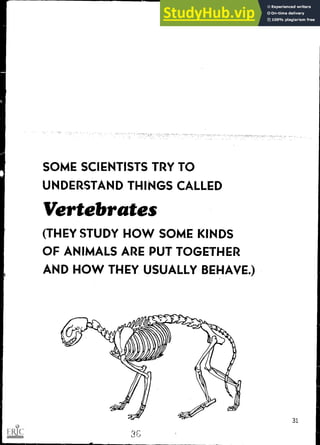
the content and process with first hand observation of social action
as the most powerful learning tool. (Author/SBE)
Ns,
fo
Soc. lies
Marion Brady
Howard L. Brady
"PERMISSION TO REPRODUCE THIS COPY-
RIGHTED MATERIAL HAS BEEN GRANTED
JC4k'S elkOR3eLL.
V-02.._itaatkt,
TO ERIC AND ORGANIZATIONS OPERATING
UNDER AGREEMENTS WITH THE U.S. OFFICE
OF EDUCATION. FURTHER REPRODUCTION
OUTSIDE THE ERIC SYSTEM REQUIRES PER
MISSION OF THE COPYRIGHT OWNER.-
in cooperation with
Patricia Spears
Consultant, Social Studies
Division of Elementary and Secondary Education
Tallahassee, Florida
2
U.S. DEPARTMENT OF HEALTH.
EDUCATION & WELFARE
OFFICE OF EDUCATION
THIS DOCUMENT HAS BEEN REPRO-
DUCED EXACTLY AS RECEIVED FROM
THE PERSON OR ORGANIZATION ORIG-
INATING IT, POINTS OF VIEW OR OPIN-
IONS STATED DO NOT NECESSARILY
REPRESENT OFFICIAL OFFICE OF EDU,
CATION POSITION OR POLICY.
Division of Elementary and Secondary Education
Bureau of Curriculum and Instruction
Shelley S. Boone, Director
Department of Education
Tallahassee, Florida
Floyd T. Christian, Commissioner
1
Copyright 1971 by STATE DEPARTMENT OF EDUCATION, Tallahassee, Florida.
Foreword
It has been some years since the publication of the last social
studies guide. During these years, major changes in instruction have
occurred in language arts, physical science, mathematics, and other
school subjects. Generally, these changes have been welcomed and
accepted.
Much has been happening in the social studies also. A great many
ideas and techniques for improving our social studies classes are being
proposed and discussed. However, it would be inaccurate to say that
change of any consequence has found wide acceptance. For most stu-
dents, the new social studies seems years away.
It is not surprising that change comes more slowly to the social
studies than to other content areas. Man is the subject of the social
studies, and man is inherently complex. Many approaches are possible
but not all of these approaches build toward a coherent, articulated
program.
If a study of man is to have focus, balance, and internal consist-
ency, choices are necessary. Certain objectives will have to be rejected.
Chosen objectives will have to be ranked in order of emphasis. Teach-
ing strategies consistent with these objectives must be determined.
In short, this area of study needs a rationale.
That is the purpose of this short publication. It attempts to present,
as clearly and concisely as possible, a rationale for social studies. We
believe that it encompasses much of what the literature in the field
calls "new," that it is consistent with good learning theory, and that it
is grounded firmly in sound social science. We hope it is a step toward
a new social studies for Florida schools.
'441"411 :c"
4
Contents
PROCESS
CONTENT 27
NOTES 57
VALUES 58
INQUIRY 60
INSTRUCTIONAL MATERIALS 62
MORE COMMENTS ON MATERIALS 64
STANDARDIZED TESTS 65
EVALUATION 66
SOME FURTHER READING 68
. X' Y.."...
2
What's Happening
In Our Social Studies Classes?
rI
LET'S TAKE A LOOK
FROM A CLASSROOM DISCUSSION:
"The Federal Government needs money for the kinds of operations
we've been discussing. How many different sources of federal revenue
can you name? Ram On?"
"Well, there's federal income tax, of course, and corporation taxes,
import duties, taxes on cigarettes and liquor, and, uh ..."
"Very good. Can anyone else add to this list? Tony?"
"Isn't there some kind of federal tax on long-distance telephone
calls?"
"Right. What about some sources of revenue that aren't called
taxes? Does anybody remember any? Yes, Jim?"
"When I applied for my citizen's band radio license, I had to pay a
license fee. Isn't this another kind of revenue?"
"License fees are a significant source of federal revenue. Let's
look at the chart on page 327 to see the relative importance of these
taxes and revenue sources."
3
8
4
FROM AN EXAM PAPER:
13. Before they came to New England, some of the
Pilgrims lived in the city of (a) Amsterdam,
(b) Paris, (c) Leyden, (d) Lisbon.
14. The first governor of the Massachusetts Bay
Colony was (a) Miles Standish, (b) John Winthrop,
(c) John Smith, (d) Roger Williams.
15. The founders of Harvard College were most interested
in preparing students to be (a) ministers, (b) doctors,
(c) lawyers, (d) political leaders.
9
FROM ANOTHER DISCUSSION:
"Pretty good, Jim. You've given all but one of the factors that tended
to hold the Greek city-states together. Which one did he leave out?"
"I know!"
"O.K., Janet."
"Language. All the Greeks spoke the same language, and this was
a common bond between them."
"Do you agree, Nick?"
"Yeah, I'm pretty sure that's the last one."
"Right. Now let's move on to the reasons the Greek city-states
didn't combine into a single political entity. Hazel?"
"Well, for one thing, Greece is a very mountainous place. it was
hard to get from city to city and so the poor communication was a
problem."
"Good start. What was another factor?"
"Well, uh ... just a second ... I can close my eyes and almost ...
Jealousy! That was another problem."
"O.K. Let's give someone else a chance."
5
in
FROM A 5th GRADE
HOMEWORK ASSIGNMENT:
"For tonight, I'd like you to continue reading about Latin America
the four pages which discuss Argentina.
"Pay particular attention to the main ways that the people of
Argentina make a living, and be able to locate the areas in Argentina
where these occupations are important."
11
SOME BEHAVIORAL OBJECTIVES
FOR A STUDY UNIT:
Given a list of the ten largest nations of the world by population,
the student will be able to identify the major political leader and the
political and economic systems utilized in at least nine of those nations.
The student will be able to name the military alliances in which the
United States participates, and identify the member nations in each
alliance.
2 7
FOR YEARS,
EDUCATORS HAVE AGREED THAT
A PRIMARY GOAL OF OUR
SCHOOLS IS
Teaching Students To Think.
71'n":1!! e.?,f
TAKE ANOTHER LOOK AT
THOSE TYPICAL SAMPLES
WE JUST PASSED
CLASSROOM
DALOGUE
EXAM PAPER
HOMEWORK
ASSIGNMENT
DISCUSSION
WHAT KIND OF "THINKING"
ARE WE TEACHING?
1 4
PAL
9
10
IN THESE EXAMPLES
AND IN OUR
SOCIAL STUDIES CLASSROOMS-
MUCH OF THE THINKING
WE ARE TEACHING IS
Remembering
15
BUT THERE'S MORE TO
Thinking
THAN
Remembering
11
16
BESIDES "REMEMBERING,"
THERE ARE THE THINKING PROCESSES
Comparing
Classifying
Generalizing
(- JUST TO BEGIN A LIST)
ONE OF THE BETTER-KNOWN LISTS
OF THINKING SKILLS IS THIS ONE:
1.00 Knowledge [Remembering]
2.00 Comprehension
3.00 Application
4.00 Analysis
5.00 Synthesis
6.00 Evaluation
From,
BENJAMIN S. BLOOM, ED.,
TAXONOMY OF EDUCATIONAL OBJECTIVES,
COGNITIVE DOMAIN, LONGMANS, GREEN, 1956.
is
13
IF WE MAINTAIN THAT WE'RE
TEACHING STUDENTS TO THINK,
THEY MUST BE ENGAGED
IN ALL THESE PROCESSES.
19
HERE'S A FAIRLY SIMPLE
COMPOSITE LIST OF THESE
THINKING SKILLS:
Recall
Compare
Abstract
Classify
Integrate
Infer
Hypothesize
Generalize
Predict
15
20
THE AMERICAN ASSOCIATION FOR THE
ADVANCEMENT OF SCIENCE (AAAS)
HAS DEVELOPED AN ELEMENTARY
SCIENCE PROGRAM. THE PROGRAM
LISTS THESE THINKING SKILLS:
Observe
Classify
Measure
Infer
Make Hypotheses
Verify Hypotheses
Predict
Define Operationally
Interpret Data
16 Use Relationships
21
+r, Mtfi,151.145,
V4140 WOULD STUDENTS BE DOING
IF INSTRUCTION/4Am XCTIVITIES
EM TO USE THESE
REQUIRED TVI
THINKING SKILLS?
LET'S -10
2 2,
18
DISCUSSION:
"Of course that's, a problem," Ellen retorted, "but I don't think it's
as serious as Jack says it is."
"I'm with Ellen," said Cliff. "Sure, U.S. Presidents have compli-
cated personalities, but that doesn't mean you can't call them 'strong'
or 'weak.' She means mostly that when presidential candidates are
campaigning, they either come on like they're going to change things
or they don't."
"Thanks, Cliff," continued Ellen. "All I'm saying is that, in the
eight campaigns I've studied so far, Americans seem more interested
in domestic than foreign affairs at election time, and, when things are
going good, they aren't interested in social reform or anything else that
threatens change."
Jack tried again. "Just the same, I think you ought to work out
what you mean by 'strong' and 'weak' and put that in a preface or
something."
23
Generalizing From
Historical Content
FROM AN EXAM PAPER:
3. Here is an Indian story about how the earth was created. Read
it over carefully, and when you have finished, try to decide which of the
. .
Indian tribes we have studied would be most likely to believe it was true.
Give all the reasons you can for your answer.
Inferring From Data
19
24
20
ANOTHER DISCUSSION:
"It just doesn't make any sense," repeated Jill. "These two sub-
divisions were built at the same time, are almost exactly the same size,
are the same distance from downtown, and have houses in the same
price range...."
"And yet one has twice as much vandalism as the other," con-
tinued Carlos.
"Maybe the police patrol one better than the other," volunteered
Cynthia.
"Checked that," said Jill. "No difference."
"Well, it certainly isn't accidental," Mr. Fokes observed. "It's been
the same way for nearly fifteen years."
"Yeah. But why ... why?"
First-Hand Data Collection
Direct Data Analysis
25
A HOMEWORK ASSIGNMENT:
For tonight
A recent book (Ardrey's The Territorial Imperative) suggests that
all animals, including humans, have a built-in drive to possess a terri-
tory, and will fight if that territory is invaded. Skim your world history
text and see if the record of conflicts there seems to support this
hypothesis. Support your opinion.
Hypothesis Testing
Using Historical Data
;:jn 21
',7777,77.1117:IrrInTiMnTilr:r^VVRI,147,,,M7,27Y
BEHAVIORAL OBJECTIVES:
4. Upon completion of this unit, the student will:
A. Be able to classify and categorize major personality
characteristics of randomly selected Saturday morn-
ing TV cartoon characters.
B. Be able, on the basis of the above activity, to make
inferences about personality traits considered desir-
able in American culture.
22
Expected Analytical
Operations
IF WE ATTEMPT TO DEVISE CLASSROOM
ACTIVITIES OR EXAM QUESTIONS THAT
USE THESE THINKING SKILLS
Cognitive Processes
-WE DISCOVER QUICKLY THAT THEY
OVERLAP EACH OTHER QUITE A BIT.
(A SINGLE QUESTION MIGHT INVOLVE
THE STUDENTS IN TWO OR THREE
SKILLS.) 23
24
SO, WE CAN USE ANY GOOD
COGNITIVE SKILLS LIST.
BUT (AND THIS IS BASIC)
WE MUST CONTINUALLY INVOLVE OUR
STUDENTS IN A VARIETY OF THESE
VERY IMPORTANT THINKING
PROCESSES-
PROCESSES WHICH TEACH THE
STUDENTS TO CREATE NEW IDEAS,
NOT JUST SOAK UP OLD KNOWLEDGE.
c)9
IT IS A MISTAKE TO ASSUME THAT
STUDENTS WITH LOW ABILITY CAN
ENGAGE IN ONLY CERTAIN COGNITIVE
PROCESSES, WHILE STUDENTS WITH
GREATER ABILITY CAN USE ALL
THINKING SKILLS.
EVERY CHILD USES A FULL RANGE OF
COGNITIVE PROCESSES IN SIMPLE WAYS
LONG BEFORE HE STARTS SCHOOL.
WHAT WE NEED ARE CLASSROOM
ACTIVITIES WHICH HELP STUDENTS
BECOME INCREASINGLY SKILLFUL IN
APPLYING ALL THESE PROCESSES.
3 n
25
26
THERE ARE THOSE WHO FEEL THAT
TEACHING THE YOUNG TO THINK
IS ENOUGH. IT ISN'T.
COGNITIVE PROCESSES HAVE TO BE
APPLIED. EACH AREA OF STUDY
HAS ITS OWN
3.1
_
r
THE OBJECTIVE OF
ALL THESE THINKING
PROCESSES IS
Understanding
28
TO "UNDERSTAND"
MEANS TO KNOW HOW A THING
IS PUT TOGETHER AND
HOW IT USUALLY BEHAVES.
30
SOME SCIENTISTS TRY TO
UNDERSTAND THINGS CALLED
Atoms
(THEY STUDY HOW ATOMS ARE PUT
TOGETHER AND HOW THEY
USUALLY BEHAVE.)
r-7
-J
SOME SCIENTISTS TRY TO
UNDERSTAND THINGS CALLED
Vertebrates
(THEY STUDY HOW SOME KINDS
OF ANIMALS ARE PUT TOGETHER
AND HOW THEY USUALLY BEHAVE.)
3G
32
OTHER SCIENTISTS TRY TO
UNDERSTAND THINGS CALLED
Structural FQrces
(THEY STUDY HOW MECHANICAL.
SYSTEMS ARE PUT TOGETHER
AND HOW THEY USUALLY BEHAVE.)
tal
SOCIAL SCIENTISTS TRY To
UNDERSTAND THINGS CALLED
Human Groups
33
(SOCIAL SCIENTISTS STUDY
HOW HUMAN GROUPS
ARE PUT TOGETHER AND
HOW THEY USUALLY BEHAVE.)
3r)
HUMAN GROUPS DIFFER, OF COURSE.
w
cn
w
z
SOME ARE SMALL
SUPREME COURT
37
38
EGYPTIANS
SOME ARE
ANCIENT-
d
NATIONAL ORGANIZATION OF WOMEN
SOME ARE NEW
N.A.S.A.
39
40
FLAT EARTH SOCIETY
SOME GROUPS ARE
RELATIVELY SIMPLE-
S. P. C. A.
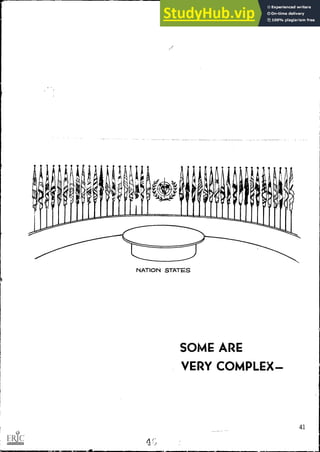
NATION STATES
SOME ARE
VERY COMPLEX
41
BUDDH ISTS
SOME HUMAN GROUPS
LAST FOR CENTURIES-
ROMAN S
HOW-ARE-WE-GONNA- GET-OUT-OF-
TH IS - STUCK- E.LEVA roR ?
SOME FOR ONLY A FEW MOMENTS
43
Q3
BUT WITH ALL THEIR DIFFERENCES,
SOCIAL SCIENTISTS AGREE
THAT HUMAN GROUPS ARE
MORE ALIKE THAN DIFFERENT.
IN FACT, HUMAN GROUPS ARE
ENOUGH ALIKE THAT AN INTENSIVE
STUDY OF A F6W CAN TEACH
MUCH ABOUT ALL.
Social Class
SOCIAL CLASS STRUCTURE IS JUST ONE
OF MANY CHARACTERISTICS WHICH
MOST HUMAN GROUPS SHARE.
!
.!
!.
imi!
ErommyslEm
Em1
111111111111111111
kumwma.ram!
pmm .
=uri
!miciman
imaii N.
..
10
..
WE CAN USE SHARED CHARACTERISTICS
AS A GUIDE FOR THE STUDY OF ANY
HUMAN GROUP. 47
The traditional social studies disciplines do not fit together to form
a recognizable, coherent whole; each has grown in random fashion, de-
veloping its own jargon, peculiar emphases, and poorly defined bound-
aries. The disciplines overlap haphazardly and extensively. There is
need for an approach to social studies that can give unity and simplicity.
This unity and simplicity can be obtained only when the focus of
study can be made precise. We must draw boundaries around some-
thing small enough to be intellectually manageable, and coherent
enough to provide a network of related ideas. Identifying human groups
as the explicit phenomena with which social studies deals is an easy
but essential first step.
Studying human groups in the social sciences is not revolutionary.
History, anthropology, sociology, social psychology, political science,
economics, and geography have always studied human groups. What is
new is emphasis on human groups as a basis for organizing a single
social studies discipline.
48
WHAT KINDS OF THINGS
SHOULD WE BE INVESTIGATING
ABOUT HUMAN GROUPS?
WHAT DOES THE STUDENT
NEED TO UNDERSTAND?
SOME QUESTIONS CAN BE SUGGESTED-
WHAT CAUSES HUMAN GROUPS
To Form?
To Change?
To Disintegrate?
50
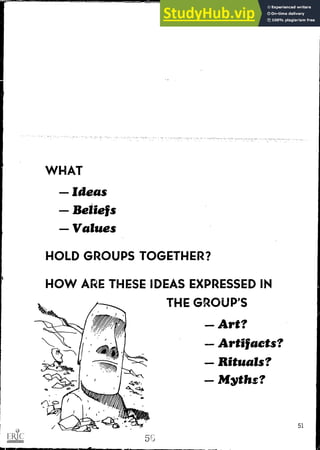
WHAT
Ideas
Beliefs
Values
HOLD GROUPS TOGETHER?
HOW ARE THESE IDEAS EXPRESSED IN
THE GROUP'S
Art?
Artifacts?
Rituals?
Myths?
51
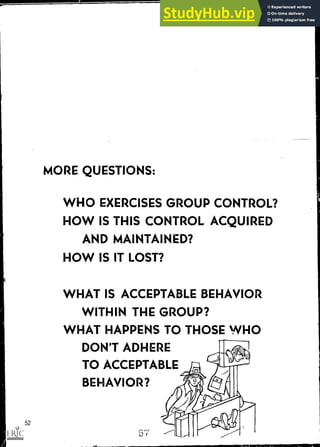
MORE QUESTIONS:
WHO EXERCISES GROUP CONTROL?
HOW IS THIS CONTROL ACQUIRED
AND MAINTAINED?
HOW IS IT LOST?
WHAT IS ACCEPTABLE BEHAVIOR
WITHIN THE GROUP?
WHAT HAPPENS TO THOSE WHO
DON'T ADHERE
TO ACCEPTABLE
BEHAVIOR?
52
WHO INTERACTS WITH WHOM?
WHAT KIND OF INTERACTION?
WHY DO THEY INTERACT?
HOW IS THE GROUP AFFECTED BY
OTHER GROUPS?
ITS ENVIRONMENT?
WHAT CREATES CONFLICT?
HOW IS THE CONFLICT RESOLVED?
THESE ARE "UNIVERSAL" QUESTIONS,
EQUALLY USEFUL IN THE STUDY OF
NATIONS OR NEIGHBORHOODS,
CULTURES OR CLASSROOM CLIQUES.
QUESTIONS SUCH AS THESE REQUIRE
THE STUDENT TO USE ALL THE
COGMT!VF. PROCESSES,
THEY LEAD HIM TO DISCOVER POWERFUL
CONCEPTS, CONCEPTS WHICH
ENCOMPASS AND STRUCTURE VAST
AMOUNTS OF INFORMATION
AND LEAD ULTIMATELY TOWARD
54 UNDERSTANDING- OUR REAL GOAL.
5'1
PROCESS AND CONTENT IN THE FORMS
WE HAVE PROPOSED LEAD THE
STUDENT AWAY FROM PARTICULARISTIC
KNOWLEDGE, AND FORCE HIM TO
CREATE AND REFINE GENERALIZATIONS.
PARTICULARISTIC KNOWLEDGE IS
USEFUL ONLY IN SPECIFIC, PECULIAR
CIRCUMSTANCES. GENERALIZATIONS
ABOUT HUMAN BEHAVIOR ARE
UNIVERSALLY USEFUL. THEY ARE THE
KEY TO RELEVANCE IN THE SOCIAL
STUDIES.
LS
VALUES:
The call for teaching values in the schools is growing stronger. If
we investigate the motives for this demand, we find that many people
are rightfully upset by certain kinds of behavior that increasingly char-
acterize our youththe penchant for violence, the obvious increase in
drug use, juvenile crime for "kicks," and similar phenomena.
The most frequent diagnosis of the cause of these kinds of behavior
is, "These young people have not been taught the proper values." If we
assume this diagnosis is correct, then we are faced with two difficult
questions:
Which values are we supposed to teach?
What techniques can we use to teach them successfully?
Let's start with the second question firstthe techniques for
teaching values.
Merely telling students "what's right"which values they ought
to holdhas little positive effect. Frequently, in fact, students assert
their independence by pursuing different, even opposite values.
Learning values, like learning to swim or ride a bicycle, requires
participative exercise. The only values that can be learned in the class-
room are those that can be practiced in the classroom. Simple expo-
sure does not produce acceptance. If the student is given the oppor-
tunity to test a value experimentally, and discover the "value of the
value" for himself, only then will he truly accept it.
Values can be successfully learned in the classroom if the teacher
helps the student develop the processes of value exploration, com-
parison, and evaluation, and then provides opportunities for the stu-
dent to practice these processes.
The first question, "Which values are we supposed to teach?" is
especially difficult. Teaching what "ought to be" inevitably creates
conflicts. There is not now, nor is there ever likely to be, general agree-
ment in America about what "ought to be." "Freedom" to one man is
"anarchy" to a second and "tyranny" to a third. Attempts to teach what
"ought to be" will either paralyze social studies with irresolvable con-
flict, or else move dangerously close to totalitarian concepts of edu-
58 cation.
62
Co we ignore values, then, because of this? Emphatically, no! Two
areas of common value agreement in Western culture are a belief in
the basic worth of the individual and a belief in rationality. The first of
these values is largely learned within the confines of the child's home.
Since it is not a process, there is little that can be done directly in the
classroom to teach it except by the example of our own actions. It is
the second of these valuesrationalityfor which the school has a
defilite and direct responsibility. Rational processesavoiding pre-
mature judgment, collecting and weighing evidence, evaluating alter-
native conclusions can be practiced and refined in the classroom.
Furthermore, rationality will provide a sound basis for the student to
eveluate what "ought to be" for himself. This is an essential skill, for
in a changing world, no generation has all the answers for its successors.
There is another reason for emphasizing the study of values. When
we begin to study human groups that differ from our own, shared values
are perhaps the most important source of insight into group behavior.
Objective, rational study of values and value differences are essential
to social studies.
All of these pieces fit together. If a student is going to make an
intelligent appraisal of any value, he must know the alternatives. Our
responsibilities are these:
Our schools must provide opportunities for students to explore
openly and without fear all values and their probable consequences.
We must help our students avoid the error of accepting ideas which
are not true, just because they are passed on by some authority. If
we teach our students to accept values without question, we re-
duce their ability to think and act creatively.
We must help the student avoid the opposite errorrejection of a
value just because it is old. Students frequently tend to reject tra-
ditional ways, and rational appraisal of old but sound values can
prevent such rejection.
The content and process of the social science we advocate is
grounded in a concern for the development of values by the student.
Within the school's sphere of responsibility, rationality is the founda-
tion of intellectual development and maturity.
INQUIRY:
In times when the world changed little or not at all, most of what
the young needed to know was already known by the elders. The young
respected their elders' knowledge, for its practicality was demonstrated
daily. If the teachers in those times assumed an authoritarian stance,
it fitted the situation.
But this is not such a time. Most of the knowledge we need to cope
with our problems we don't yet possess, and even that which is known
must be accepted as tentative. This is true in every area of study, but it
is particularly true in social studies. We just don't know much about
social man, and what little we know, we don't know how to use very
effectively. When teachers in these times assume an authoritarian
stance, it seems rather inappropriate.
What is appropriate? The extent of our ignorance suggests first of
all that the main task is not merely to transmit but to expand knowl-
edge. Our ignorance seems also to demand of all of us a considerable
humility. We teachers know more, certainly, but not so much that we
differ significantly from our students in our relationship to knowledge.
In these circumstances, a partnership is appropriate. Together,
teachers and students should raise questions about social man, sug-
gest possible answers and exploration, design ways to determine the
truth or usefulness of those answers, and begin to shape theories and
generalizations. Together, teachers and students should make mis-
takes, should follow blind alleys, should know frustration and failure.
And these experiences should be valued, for they are both ways of
learning and evidence of honest inquiry.
60
Unfortunately, we generally don't value such experiences. Most of
us are afraid of publicly taking risks, afraid of failing, afraid of being
imperfect, and afraid of not knowing, in advance, all the right answers.
Traditional instruction, which makes most use of the relatively simple
mental process of memory, isn't too thre6tening. Our guarantee that
we'll know the answers is the reassurance that we've been through it
all many times before. The student's guarantee against failure, if he
cares, is that he's been through it the night before. When the name of
the game is mostly "remember" and not "inquire," everyone at least
has the security of knowing how to play, even if he doesn't play
very well.
And so we are likely to resist change, particularly those of us who
have been most successful in the old game. If we suspect that we
might not do as well in a different context, we'll likely complain that the
new way isn't really worthwhile and may hold out for "real education"
meaning memory work. Or, even more likely, when presented with a
different way of approaching social studies, we'll righteously declare
that "we've been doing that for years!"
If students and teachers are able to overcome their resistance to
change, and accept the methods of inquiry, a new classroom spirit
emerges. Participation and involvement in the learning process become
exciting and stimulating for both teacher and student.
Times change, and teaching fads come and go, but "inquiry" is no
fad. Inquiry is the path to understanding, the logical response to the
desire to make things better in a world that won't stand still.
,r5
INSTRUCTIONAL MATERIALS:
We're sometimes quick to maintain that no real change in teaching
is possible until the quality of classroom materials is improved. Give us
the tools, we say, and we'll do the job. Perhaps conveniently, this posi-
tion places the responsibility for improvement on the administrators
who decide how available funds will be distributed, or on the tax-
payers who decide how much money will be spent on the education of
the young.
There is, of course, no denying the importance of good instruc-
tional materials. We need all the help we can get. But the improvement
of social studies teaching does not hinge on a constant supply of new
materials. The "new" social studies isn't in a film can or game box or
soon-to-be-released textbook series. Exciting, relevant, and effective
instruction is certainly easier with some of the new materials, but the
most poorly equipped classroom in the state can still support sophis-
ticated learning activities rivaling those possible with the new aids.
Consider that most common of all social studies instructional sup-
portsthe American history textbook. It seems at first glance to be a
most awkward tool to use in trying to understand human behavior. We
ordinarily begin a study of something to be understood by grouping it
with similar things so that they can be viewed simultaneously. If we
want to understand hurricanes, we place all the available data about
individual hurricanes together so that similarities and regularities are
apparent. If we want to understand cancerous growths, we begin by
separating them from noncancerous growths, and we proceed by further
sorting and classifying on the basis of shared characteristics.
Most history books don't do that. They tell a story, and in the story
"like" things are not placed together. The first account of a depression
may occur on page 62, the second on page 114, the third still later, and
so on. The "like" things (depressions or the qualities of popular leaders
or the reasons Americans feel justified in going to war) are so separated
in the book and in classroom instruction that comparison becomes ex-
62
tremely difficult. The isolated event may make interesting reading or
telling, but it is a poor basis for generalizing. And generalizations are
the practical, useful products of systematic study.
But this doesn't mean that new materials are necessary. For the
student trying to gain insight into a puzzling aspect of human behavior,
the textbook contains potentially useful data for comparative study.
The data in the text can be used to investigate questions such as these:
Are Presidents more likely to be re-elected during
difficult times?
In what similar ways have minorities reacted to
discrimination? What has been the effect of
their reactions?
Is rebellion in America increasing? Decreasing? Cyclical?
Are there liberal and conservative eras?
Is religious feeling constant or does it vary?
Is there pattern or regularity in whatever change
occurs? To what might the peaks and valleys of
religious feeling be attributed?
Once questions such as these are raised, the student's task is
to abstract and rearrange the relevant data, making it work for him
in ways the textbook author did not, in fact, could not, anticipate. The
text may not have all the answers, but it can provide the student with
enough data to form tentative conclusions, and guide his search for
additional evidence.
What can be done with traditional history books is equally possible
with other instructional materials. New process and content objectives
can suggest uses for traditional materials which will allow them to rival
the best of the new instructional aids.
63
4V t
MORE COMMENTS ON MATERIALS:
Traditionally, social studies, like most other subjects, has leaned
heavily on textbooks and other printed materials. The problem with
printed materials is that somehow they imply to teachers and students
alike that the basic sources for learning are on paper, that everything
important about the course is on those printed pages. Consequently,
(and often despite the teacher's best intentions), the field of inquiry
for the student is extremely limited and sterile. The student becomes
increasingly more dependent upon remote data and third-hand obser-
vation. The skills he needs in his adult lifethe ability to collect,
analyze, and evaluate the live, rich data surrounding himare not
sharpened by his educational experience.
We tend to forget that in learning almost anything, there is no sub-
stitute for involvement. We learn to read by reading, to golf by golfing,
and to analyze by analyzing. Learning to study human groups is no
exception. Printed materials can help, but real depth of understanding
requires direct experiences.
If the focus of our study is human groups, the fact that every group
has characteristics similar to all other groups is very convenient. Every
classroom is a potential laboratory. Every school club and team, every
informal organization, every clique generates a never-ceasing stream
of information about how human groups are organized and how they
operate. Being accessible, they can be observed directly and con-
stantly. They are not covered by copyright laws, the information they
produce is always fresh and new, students who read less well than the
average are not at a disadvantage, and no special equipment or mate-
rials are necessary.
Certainly there is a place for printed materialsfor the comment
of the expert, for additional evidencebut first-hand observation of
social action is the most powerful learning tool.
64
STANDARDIZED TESTS:
Despite the fact that almost no teacher will admit teaching for
standardized tests, a possible drop in student test scores is almost
always cited as a reason for a reluctance to try new ideas. As a conse-
quence, teachers frequently teach what they think the testmakers are
going to test, and the testmakers test what they think the teachers are
teaching. The whole cycle is continually reinforced by the expectations
of students, parents, administrators, and college admissions officers.
It's easy to condemn the situation, and also easy to overstate its
seriousness. It may even be true that the test designers are ahead of
many teachers, for in recent years there has been a steady increase in
test items which are self-contained and include all the data to be
analyzed. These kinds of questions require the student to demonstrate
analytical skills rather than recall ability. Interestingly enough, it is also
true that many teachers who emphasize higher-level- cognitive skills
are finding improvement in the student's ability to recall specific
factual information.
But even if the tests weren't changing and the ability to recall
were not improved by combining it with other cognitive processes, it
would still be a mistake not to teach as well as we know how. Standard-
ized tests do change to reflect changes in instruction, as experience in
the other content areas amply demonstrates. They will change in social
studies also, as broader process and content objectives are adopted.
65
66
EVALUATION:
The question "How do I evaluate?" (which translated, frequently
means "How do I determine and defend my grades?"), is easy or diffi-
cult depending upon what one is trying to evaluate. In social studies,
we've usually made the task easy, but we've done it by evaluating only
one cognitive processrecall.
But now we are saying we want students to think, and have begun
to define more precisely what we mean by "thinking." Thinking means
recalling, but it also means classifying, hypothesizing, and engaging in
the full range of cognitive processes. Further, we want students to be
able to apply these cognitive processes to. social phenomena, to the
analysis of how human groups are put together and how they usually
behave.
How are we to know what students can do and how well they can
do it? By making judgments about performance, by asking not, "What
do they know?" but "What can they do?" If we want to determine
whether a student can draw inferences, we have to give him data and
ask him to draw inferences. If we want to evaluate his ability to hypoth-
esize, he must be required to hypothesize. Can he apply these processes
to social phenomena? The evaluation must require him to demonstrate
that ability.
Unfortunately, if we accept this expanded basis for evaluation, we
are faced with new and difficult problems. When we ask students to
recall, we base our evaluation of their performance mostly on the quan-
tity of their responses. But when we ask them to hypothesize or infer,
responses will differ both quantitatively and qualitatively. Do two
"good" hypotheses equal four "fair" and seven "poor" hypotheses?
What is a "fair" hypothesis? A "poor" one?
There is no evading the issue. The more complex and sophisticated
the objective, the greater the difficulties of evaluation. An increase in
subjective judgments by the teacher is inevitable. There are no simple
criteria for evaluating the quality of a student's cognitive processes
applied to that most complex of all phenomenahuman behavior.
n
v
THIS RATIONALE IS, PERHAPS, SOME
WHAT FRUSTRATING. IT DOES NOT
OUTLINE SPECIFIC COURSE CONTENT;
IT DOES NOT SUGGEST SEQUENTIAL
CLASSROOM ACTIVITIES; AND IT DOES
NOT STATE OBJECTIVES THAT COULD
BE USED TO DEVELOP THESE ACTIVITIES.
WE HAVE ATTEMPTED ONLY TO
CLARIFY A FEW GENERAL PRINCIPLES
PRINCIPLES THAT CAN PROVIDE A
FOUNDATION FOR A COHERENT,
EFFECTIVE SOCIAL STUDIES PROGRAM.
THE TASK OF BUILDING THAT PROGRAM
LIES AHEAD.
71
SOME FURTHER READING
Readings which may keep you thinking about some
of the ideas in this rationale.
Bagby, Philip. Culture and History, University of California Press, Berkeley,
1959.
History sometimes seems isolated from the rest of the social sciences.
In this book the author explores a marriage between history and cultural
anthropology.
Benedict, Ruth. The Chrysanthemum and the Sword, Houghton Mifflin,
Boston, 1946.
Ruth Benedict is spokesman for the group of social scientists that
studied the culture of Japan for the U.S. Government during World
War II. The book suggests the kinds of questions and observations that
help one get "inside" another culture.
Bruner, Jerome S. The Process of Education, Harvard University Press, Cam-
bridge, 1961.
This brief but important book forcefully argues that efficient and mean-
ingful learning provides the student with a mental framework of concepts
and relationships between concepts.
Fischer, D. H. Historians' Fallacies, Harper & Row, New York, 1970.
A presentation of common fallacies that occur in historical thinking. The
author is an excellent historian as well as critic of other hiFtorical writers.
Hall, Edward T. The Silent Language, Doubleday & Co., Garden City, New York,
1959; The Hidden Dimension, Doubleday & Co., Garden City, New York, 1966.
Fascinating reading. Both books point out the frequent narrowness of the
study of man and suggest important new concerns.
Larabee, H. A. Reliable Knowledge: Scientific Methods in the Social Studies,
Houghton Mifflin, Boston, 1964.
An elaborate and comprehensive description of the logical processes in
social science obtaining and analyzing data, forming and testing
hypotheses, etc.
Massialas, Byron G. and Zevin, Jack. Creative Encounters in the Classroom:
Teaching and Learning through Discovery, John Wiley & Sons, Inc., Nev,
York, 1967.
Provides a feeling for the kind of classroom atmosphere that makes
inquiry easier.
Mills, C. Wright. The Sociological Imagination, Oxford University Press, New
York, 1959, pages 139-142.
68 Some interesting observations about interdisciplinary social science.
Postman, Neil and Weingartner, Charles. Teaching as a Subversive Activity,
Delacorte Press, New York, 1969.
Proposes (just as the title suggests) a form of subversion teaching stu-
dents to ask real, and therefore sometimes unwelcome and threatening,
questions.
Redfield, Robert. Human Nature and the Study of Society, University of Chi-
cago Press, Chicago, 1962, pages 417-439.
A beautifully written essay outlining a content for social studies.
Redfield, Robert. The Little Community, University of Chicago Press, 1955.
A helpful summary of the variety of methods used by social scientists in
the study of human groups.
Rosenblatt, Louise M. Literature as Exploration (revised ed.), Noble & Noble
Publishers, Inc., New York, 1968, pages 3-24.
A forceful reminder that literature and the social sciences, having
humanity in common, are irrevocably intertwined. Both are concerned
with examining the fundamental concepts of human nature and society
in an attempt to foster a sounder understanding of life and nourish the
development of balanced, humane personalities.
Toffler, Alvin. Future Shock, Random House, New York, 1970, pages 353-378.
Argues that if today's school systems are to prepare students for life in
the future, "education must shift into the future tense," with one of its
prime objectives being to increase the individual's "cope-ability" the
speed and economy with which he can adapt to continual change.
Williams, Robin Jr. American Society: A Sociological Interpretation, 2nd. ed.,
Alfred A. Knopf, New York, 1970.
Especially interesting is Chapter 11, "Values and Beliefs in American
Society."
PERIODICALS
Brady, Marion. "A New Social Studies," Phi Beta Kappan, October 1966,
page 68; "The Key Concept," Social Education, November 1967, page 601.
These articles describe a unified approach to social science curriculum
that uses the dominant ideas of a group as the primary key to under-
standing human behavior.
Vogt, Evon F. and Roberts, John M. "A Study of Values," Scientific American,
Volume 195, Number 1, July 1956, page 25.
This article describes five groups with highly different cultures, all living
in the same kind of environment in New Mexico. Each group's way of life
is found to be intimately connected with that group's idea structure.
'73

A Rationale For Social Studies

  • 1.
    DOCUMENT RESUME ED 053046 SO 001 680 AUTHOR Brady, Marion; Brady, Howard L. TITLE A Rationale for Social Studies. INSTITUTION Florida State Dept. of Education, Tallahassee. Div of Elementary and Secondary Education. PUB DATE 71 NOTE 73p. EDRS PRICE EDRS Price MF-$0.65 HC-$3.29 DESCRIPTORS Concept Teaching, Critical Thinking, *Curriculum Design, Elementary Grades, Group Behavior, *Group Dynamics, *Human Relations, *Inquiry Training, Interdisciplinary Approach, Secondary Grades, Social Behavior, Social Sciences, *Social Studies, Values IDENTIFIERS *Values Education ABSTRACT Only a few general principles are provided as a foundation for an effective program. However, what is new is the emphasis on 'Leman groups as a basis for organizing a single social studies discipline. Some questions are suggested concerning what should be investigated about groups, and what the students need to understand. 1) What causes human groups to form, to change, to disintegrate? 2) What holds groups together--ideas, beliefs, values? 3) How are these ideas expressed in groups --art, artifacts, rituals, myths? 4) How is group control acquired, exercised, maintained, or lost? 5) What is acceptable behavior within the group? 6) Who interacts with whom, why, and how? 7) How is the group affected by other groups or its environment? 8) What creates conflict and how is it resolved? These are questions equally useful in the study of nations or neighborhoods, culture, or classroom cliques. Questions such as these require the student to use all the cognitive processes and lead him to discover powerful concepts. Critical thinking skills lead to understanding and creative generalizations about human behavior: observation, classification, measurement, inference, hypotheses making and verification, prediction, definition, interpretation, and the use of relationships. The objective, rational study of values and value differences are the essential ground for the content and process with first hand observation of social action as the most powerful learning tool. (Author/SBE)
  • 3.
    Ns, fo Soc. lies Marion Brady HowardL. Brady "PERMISSION TO REPRODUCE THIS COPY- RIGHTED MATERIAL HAS BEEN GRANTED JC4k'S elkOR3eLL. V-02.._itaatkt, TO ERIC AND ORGANIZATIONS OPERATING UNDER AGREEMENTS WITH THE U.S. OFFICE OF EDUCATION. FURTHER REPRODUCTION OUTSIDE THE ERIC SYSTEM REQUIRES PER MISSION OF THE COPYRIGHT OWNER.- in cooperation with Patricia Spears Consultant, Social Studies Division of Elementary and Secondary Education Tallahassee, Florida 2 U.S. DEPARTMENT OF HEALTH. EDUCATION & WELFARE OFFICE OF EDUCATION THIS DOCUMENT HAS BEEN REPRO- DUCED EXACTLY AS RECEIVED FROM THE PERSON OR ORGANIZATION ORIG- INATING IT, POINTS OF VIEW OR OPIN- IONS STATED DO NOT NECESSARILY REPRESENT OFFICIAL OFFICE OF EDU, CATION POSITION OR POLICY.
  • 4.
    Division of Elementaryand Secondary Education Bureau of Curriculum and Instruction Shelley S. Boone, Director Department of Education Tallahassee, Florida Floyd T. Christian, Commissioner 1 Copyright 1971 by STATE DEPARTMENT OF EDUCATION, Tallahassee, Florida.
  • 5.
    Foreword It has beensome years since the publication of the last social studies guide. During these years, major changes in instruction have occurred in language arts, physical science, mathematics, and other school subjects. Generally, these changes have been welcomed and accepted. Much has been happening in the social studies also. A great many ideas and techniques for improving our social studies classes are being proposed and discussed. However, it would be inaccurate to say that change of any consequence has found wide acceptance. For most stu- dents, the new social studies seems years away. It is not surprising that change comes more slowly to the social studies than to other content areas. Man is the subject of the social studies, and man is inherently complex. Many approaches are possible but not all of these approaches build toward a coherent, articulated program. If a study of man is to have focus, balance, and internal consist- ency, choices are necessary. Certain objectives will have to be rejected. Chosen objectives will have to be ranked in order of emphasis. Teach- ing strategies consistent with these objectives must be determined. In short, this area of study needs a rationale. That is the purpose of this short publication. It attempts to present, as clearly and concisely as possible, a rationale for social studies. We believe that it encompasses much of what the literature in the field calls "new," that it is consistent with good learning theory, and that it is grounded firmly in sound social science. We hope it is a step toward a new social studies for Florida schools. '441"411 :c" 4
  • 6.
    Contents PROCESS CONTENT 27 NOTES 57 VALUES58 INQUIRY 60 INSTRUCTIONAL MATERIALS 62 MORE COMMENTS ON MATERIALS 64 STANDARDIZED TESTS 65 EVALUATION 66 SOME FURTHER READING 68
  • 7.
  • 8.
    2 What's Happening In OurSocial Studies Classes? rI LET'S TAKE A LOOK
  • 9.
    FROM A CLASSROOMDISCUSSION: "The Federal Government needs money for the kinds of operations we've been discussing. How many different sources of federal revenue can you name? Ram On?" "Well, there's federal income tax, of course, and corporation taxes, import duties, taxes on cigarettes and liquor, and, uh ..." "Very good. Can anyone else add to this list? Tony?" "Isn't there some kind of federal tax on long-distance telephone calls?" "Right. What about some sources of revenue that aren't called taxes? Does anybody remember any? Yes, Jim?" "When I applied for my citizen's band radio license, I had to pay a license fee. Isn't this another kind of revenue?" "License fees are a significant source of federal revenue. Let's look at the chart on page 327 to see the relative importance of these taxes and revenue sources." 3 8
  • 10.
    4 FROM AN EXAMPAPER: 13. Before they came to New England, some of the Pilgrims lived in the city of (a) Amsterdam, (b) Paris, (c) Leyden, (d) Lisbon. 14. The first governor of the Massachusetts Bay Colony was (a) Miles Standish, (b) John Winthrop, (c) John Smith, (d) Roger Williams. 15. The founders of Harvard College were most interested in preparing students to be (a) ministers, (b) doctors, (c) lawyers, (d) political leaders. 9
  • 11.
    FROM ANOTHER DISCUSSION: "Prettygood, Jim. You've given all but one of the factors that tended to hold the Greek city-states together. Which one did he leave out?" "I know!" "O.K., Janet." "Language. All the Greeks spoke the same language, and this was a common bond between them." "Do you agree, Nick?" "Yeah, I'm pretty sure that's the last one." "Right. Now let's move on to the reasons the Greek city-states didn't combine into a single political entity. Hazel?" "Well, for one thing, Greece is a very mountainous place. it was hard to get from city to city and so the poor communication was a problem." "Good start. What was another factor?" "Well, uh ... just a second ... I can close my eyes and almost ... Jealousy! That was another problem." "O.K. Let's give someone else a chance." 5 in
  • 12.
    FROM A 5thGRADE HOMEWORK ASSIGNMENT: "For tonight, I'd like you to continue reading about Latin America the four pages which discuss Argentina. "Pay particular attention to the main ways that the people of Argentina make a living, and be able to locate the areas in Argentina where these occupations are important." 11
  • 13.
    SOME BEHAVIORAL OBJECTIVES FORA STUDY UNIT: Given a list of the ten largest nations of the world by population, the student will be able to identify the major political leader and the political and economic systems utilized in at least nine of those nations. The student will be able to name the military alliances in which the United States participates, and identify the member nations in each alliance. 2 7
  • 14.
    FOR YEARS, EDUCATORS HAVEAGREED THAT A PRIMARY GOAL OF OUR SCHOOLS IS Teaching Students To Think.
  • 15.
    71'n":1!! e.?,f TAKE ANOTHERLOOK AT THOSE TYPICAL SAMPLES WE JUST PASSED CLASSROOM DALOGUE EXAM PAPER HOMEWORK ASSIGNMENT DISCUSSION WHAT KIND OF "THINKING" ARE WE TEACHING? 1 4 PAL 9
  • 16.
    10 IN THESE EXAMPLES ANDIN OUR SOCIAL STUDIES CLASSROOMS- MUCH OF THE THINKING WE ARE TEACHING IS Remembering 15
  • 17.
    BUT THERE'S MORETO Thinking THAN Remembering 11 16
  • 18.
    BESIDES "REMEMBERING," THERE ARETHE THINKING PROCESSES Comparing Classifying Generalizing (- JUST TO BEGIN A LIST)
  • 19.
    ONE OF THEBETTER-KNOWN LISTS OF THINKING SKILLS IS THIS ONE: 1.00 Knowledge [Remembering] 2.00 Comprehension 3.00 Application 4.00 Analysis 5.00 Synthesis 6.00 Evaluation From, BENJAMIN S. BLOOM, ED., TAXONOMY OF EDUCATIONAL OBJECTIVES, COGNITIVE DOMAIN, LONGMANS, GREEN, 1956. is 13
  • 20.
    IF WE MAINTAINTHAT WE'RE TEACHING STUDENTS TO THINK, THEY MUST BE ENGAGED IN ALL THESE PROCESSES. 19
  • 21.
    HERE'S A FAIRLYSIMPLE COMPOSITE LIST OF THESE THINKING SKILLS: Recall Compare Abstract Classify Integrate Infer Hypothesize Generalize Predict 15 20
  • 22.
    THE AMERICAN ASSOCIATIONFOR THE ADVANCEMENT OF SCIENCE (AAAS) HAS DEVELOPED AN ELEMENTARY SCIENCE PROGRAM. THE PROGRAM LISTS THESE THINKING SKILLS: Observe Classify Measure Infer Make Hypotheses Verify Hypotheses Predict Define Operationally Interpret Data 16 Use Relationships 21
  • 23.
    +r, Mtfi,151.145, V4140 WOULDSTUDENTS BE DOING IF INSTRUCTION/4Am XCTIVITIES EM TO USE THESE REQUIRED TVI THINKING SKILLS? LET'S -10 2 2,
  • 24.
    18 DISCUSSION: "Of course that's,a problem," Ellen retorted, "but I don't think it's as serious as Jack says it is." "I'm with Ellen," said Cliff. "Sure, U.S. Presidents have compli- cated personalities, but that doesn't mean you can't call them 'strong' or 'weak.' She means mostly that when presidential candidates are campaigning, they either come on like they're going to change things or they don't." "Thanks, Cliff," continued Ellen. "All I'm saying is that, in the eight campaigns I've studied so far, Americans seem more interested in domestic than foreign affairs at election time, and, when things are going good, they aren't interested in social reform or anything else that threatens change." Jack tried again. "Just the same, I think you ought to work out what you mean by 'strong' and 'weak' and put that in a preface or something." 23 Generalizing From Historical Content
  • 25.
    FROM AN EXAMPAPER: 3. Here is an Indian story about how the earth was created. Read it over carefully, and when you have finished, try to decide which of the . . Indian tribes we have studied would be most likely to believe it was true. Give all the reasons you can for your answer. Inferring From Data 19 24
  • 26.
    20 ANOTHER DISCUSSION: "It justdoesn't make any sense," repeated Jill. "These two sub- divisions were built at the same time, are almost exactly the same size, are the same distance from downtown, and have houses in the same price range...." "And yet one has twice as much vandalism as the other," con- tinued Carlos. "Maybe the police patrol one better than the other," volunteered Cynthia. "Checked that," said Jill. "No difference." "Well, it certainly isn't accidental," Mr. Fokes observed. "It's been the same way for nearly fifteen years." "Yeah. But why ... why?" First-Hand Data Collection Direct Data Analysis 25
  • 27.
    A HOMEWORK ASSIGNMENT: Fortonight A recent book (Ardrey's The Territorial Imperative) suggests that all animals, including humans, have a built-in drive to possess a terri- tory, and will fight if that territory is invaded. Skim your world history text and see if the record of conflicts there seems to support this hypothesis. Support your opinion. Hypothesis Testing Using Historical Data ;:jn 21
  • 28.
    ',7777,77.1117:IrrInTiMnTilr:r^VVRI,147,,,M7,27Y BEHAVIORAL OBJECTIVES: 4. Uponcompletion of this unit, the student will: A. Be able to classify and categorize major personality characteristics of randomly selected Saturday morn- ing TV cartoon characters. B. Be able, on the basis of the above activity, to make inferences about personality traits considered desir- able in American culture. 22 Expected Analytical Operations
  • 29.
    IF WE ATTEMPTTO DEVISE CLASSROOM ACTIVITIES OR EXAM QUESTIONS THAT USE THESE THINKING SKILLS Cognitive Processes -WE DISCOVER QUICKLY THAT THEY OVERLAP EACH OTHER QUITE A BIT. (A SINGLE QUESTION MIGHT INVOLVE THE STUDENTS IN TWO OR THREE SKILLS.) 23
  • 30.
    24 SO, WE CANUSE ANY GOOD COGNITIVE SKILLS LIST. BUT (AND THIS IS BASIC) WE MUST CONTINUALLY INVOLVE OUR STUDENTS IN A VARIETY OF THESE VERY IMPORTANT THINKING PROCESSES- PROCESSES WHICH TEACH THE STUDENTS TO CREATE NEW IDEAS, NOT JUST SOAK UP OLD KNOWLEDGE. c)9
  • 31.
    IT IS AMISTAKE TO ASSUME THAT STUDENTS WITH LOW ABILITY CAN ENGAGE IN ONLY CERTAIN COGNITIVE PROCESSES, WHILE STUDENTS WITH GREATER ABILITY CAN USE ALL THINKING SKILLS. EVERY CHILD USES A FULL RANGE OF COGNITIVE PROCESSES IN SIMPLE WAYS LONG BEFORE HE STARTS SCHOOL. WHAT WE NEED ARE CLASSROOM ACTIVITIES WHICH HELP STUDENTS BECOME INCREASINGLY SKILLFUL IN APPLYING ALL THESE PROCESSES. 3 n 25
  • 32.
    26 THERE ARE THOSEWHO FEEL THAT TEACHING THE YOUNG TO THINK IS ENOUGH. IT ISN'T. COGNITIVE PROCESSES HAVE TO BE APPLIED. EACH AREA OF STUDY HAS ITS OWN 3.1
  • 33.
  • 34.
    THE OBJECTIVE OF ALLTHESE THINKING PROCESSES IS Understanding 28
  • 35.
    TO "UNDERSTAND" MEANS TOKNOW HOW A THING IS PUT TOGETHER AND HOW IT USUALLY BEHAVES.
  • 36.
    30 SOME SCIENTISTS TRYTO UNDERSTAND THINGS CALLED Atoms (THEY STUDY HOW ATOMS ARE PUT TOGETHER AND HOW THEY USUALLY BEHAVE.) r-7 -J
  • 37.
    SOME SCIENTISTS TRYTO UNDERSTAND THINGS CALLED Vertebrates (THEY STUDY HOW SOME KINDS OF ANIMALS ARE PUT TOGETHER AND HOW THEY USUALLY BEHAVE.) 3G
  • 38.
    32 OTHER SCIENTISTS TRYTO UNDERSTAND THINGS CALLED Structural FQrces (THEY STUDY HOW MECHANICAL. SYSTEMS ARE PUT TOGETHER AND HOW THEY USUALLY BEHAVE.)
  • 39.
    tal SOCIAL SCIENTISTS TRYTo UNDERSTAND THINGS CALLED Human Groups 33
  • 40.
    (SOCIAL SCIENTISTS STUDY HOWHUMAN GROUPS ARE PUT TOGETHER AND HOW THEY USUALLY BEHAVE.) 3r)
  • 41.
  • 42.
  • 43.
  • 44.
  • 45.
    NATIONAL ORGANIZATION OFWOMEN SOME ARE NEW N.A.S.A. 39
  • 46.
    40 FLAT EARTH SOCIETY SOMEGROUPS ARE RELATIVELY SIMPLE- S. P. C. A.
  • 47.
  • 48.
    BUDDH ISTS SOME HUMANGROUPS LAST FOR CENTURIES- ROMAN S
  • 49.
    HOW-ARE-WE-GONNA- GET-OUT-OF- TH IS- STUCK- E.LEVA roR ? SOME FOR ONLY A FEW MOMENTS 43 Q3
  • 50.
    BUT WITH ALLTHEIR DIFFERENCES, SOCIAL SCIENTISTS AGREE THAT HUMAN GROUPS ARE MORE ALIKE THAN DIFFERENT.
  • 51.
    IN FACT, HUMANGROUPS ARE ENOUGH ALIKE THAT AN INTENSIVE STUDY OF A F6W CAN TEACH MUCH ABOUT ALL.
  • 52.
  • 53.
    SOCIAL CLASS STRUCTUREIS JUST ONE OF MANY CHARACTERISTICS WHICH MOST HUMAN GROUPS SHARE. ! .! !. imi! ErommyslEm Em1 111111111111111111 kumwma.ram! pmm . =uri !miciman imaii N. .. 10 .. WE CAN USE SHARED CHARACTERISTICS AS A GUIDE FOR THE STUDY OF ANY HUMAN GROUP. 47
  • 54.
    The traditional socialstudies disciplines do not fit together to form a recognizable, coherent whole; each has grown in random fashion, de- veloping its own jargon, peculiar emphases, and poorly defined bound- aries. The disciplines overlap haphazardly and extensively. There is need for an approach to social studies that can give unity and simplicity. This unity and simplicity can be obtained only when the focus of study can be made precise. We must draw boundaries around some- thing small enough to be intellectually manageable, and coherent enough to provide a network of related ideas. Identifying human groups as the explicit phenomena with which social studies deals is an easy but essential first step. Studying human groups in the social sciences is not revolutionary. History, anthropology, sociology, social psychology, political science, economics, and geography have always studied human groups. What is new is emphasis on human groups as a basis for organizing a single social studies discipline. 48
  • 55.
    WHAT KINDS OFTHINGS SHOULD WE BE INVESTIGATING ABOUT HUMAN GROUPS? WHAT DOES THE STUDENT NEED TO UNDERSTAND? SOME QUESTIONS CAN BE SUGGESTED-
  • 56.
    WHAT CAUSES HUMANGROUPS To Form? To Change? To Disintegrate? 50
  • 57.
    WHAT Ideas Beliefs Values HOLD GROUPS TOGETHER? HOWARE THESE IDEAS EXPRESSED IN THE GROUP'S Art? Artifacts? Rituals? Myths? 51
  • 58.
    MORE QUESTIONS: WHO EXERCISESGROUP CONTROL? HOW IS THIS CONTROL ACQUIRED AND MAINTAINED? HOW IS IT LOST? WHAT IS ACCEPTABLE BEHAVIOR WITHIN THE GROUP? WHAT HAPPENS TO THOSE WHO DON'T ADHERE TO ACCEPTABLE BEHAVIOR? 52
  • 59.
    WHO INTERACTS WITHWHOM? WHAT KIND OF INTERACTION? WHY DO THEY INTERACT? HOW IS THE GROUP AFFECTED BY OTHER GROUPS? ITS ENVIRONMENT? WHAT CREATES CONFLICT? HOW IS THE CONFLICT RESOLVED?
  • 60.
    THESE ARE "UNIVERSAL"QUESTIONS, EQUALLY USEFUL IN THE STUDY OF NATIONS OR NEIGHBORHOODS, CULTURES OR CLASSROOM CLIQUES. QUESTIONS SUCH AS THESE REQUIRE THE STUDENT TO USE ALL THE COGMT!VF. PROCESSES, THEY LEAD HIM TO DISCOVER POWERFUL CONCEPTS, CONCEPTS WHICH ENCOMPASS AND STRUCTURE VAST AMOUNTS OF INFORMATION AND LEAD ULTIMATELY TOWARD 54 UNDERSTANDING- OUR REAL GOAL. 5'1
  • 61.
    PROCESS AND CONTENTIN THE FORMS WE HAVE PROPOSED LEAD THE STUDENT AWAY FROM PARTICULARISTIC KNOWLEDGE, AND FORCE HIM TO CREATE AND REFINE GENERALIZATIONS. PARTICULARISTIC KNOWLEDGE IS USEFUL ONLY IN SPECIFIC, PECULIAR CIRCUMSTANCES. GENERALIZATIONS ABOUT HUMAN BEHAVIOR ARE UNIVERSALLY USEFUL. THEY ARE THE KEY TO RELEVANCE IN THE SOCIAL STUDIES.
  • 62.
  • 63.
    VALUES: The call forteaching values in the schools is growing stronger. If we investigate the motives for this demand, we find that many people are rightfully upset by certain kinds of behavior that increasingly char- acterize our youththe penchant for violence, the obvious increase in drug use, juvenile crime for "kicks," and similar phenomena. The most frequent diagnosis of the cause of these kinds of behavior is, "These young people have not been taught the proper values." If we assume this diagnosis is correct, then we are faced with two difficult questions: Which values are we supposed to teach? What techniques can we use to teach them successfully? Let's start with the second question firstthe techniques for teaching values. Merely telling students "what's right"which values they ought to holdhas little positive effect. Frequently, in fact, students assert their independence by pursuing different, even opposite values. Learning values, like learning to swim or ride a bicycle, requires participative exercise. The only values that can be learned in the class- room are those that can be practiced in the classroom. Simple expo- sure does not produce acceptance. If the student is given the oppor- tunity to test a value experimentally, and discover the "value of the value" for himself, only then will he truly accept it. Values can be successfully learned in the classroom if the teacher helps the student develop the processes of value exploration, com- parison, and evaluation, and then provides opportunities for the stu- dent to practice these processes. The first question, "Which values are we supposed to teach?" is especially difficult. Teaching what "ought to be" inevitably creates conflicts. There is not now, nor is there ever likely to be, general agree- ment in America about what "ought to be." "Freedom" to one man is "anarchy" to a second and "tyranny" to a third. Attempts to teach what "ought to be" will either paralyze social studies with irresolvable con- flict, or else move dangerously close to totalitarian concepts of edu- 58 cation. 62
  • 64.
    Co we ignorevalues, then, because of this? Emphatically, no! Two areas of common value agreement in Western culture are a belief in the basic worth of the individual and a belief in rationality. The first of these values is largely learned within the confines of the child's home. Since it is not a process, there is little that can be done directly in the classroom to teach it except by the example of our own actions. It is the second of these valuesrationalityfor which the school has a defilite and direct responsibility. Rational processesavoiding pre- mature judgment, collecting and weighing evidence, evaluating alter- native conclusions can be practiced and refined in the classroom. Furthermore, rationality will provide a sound basis for the student to eveluate what "ought to be" for himself. This is an essential skill, for in a changing world, no generation has all the answers for its successors. There is another reason for emphasizing the study of values. When we begin to study human groups that differ from our own, shared values are perhaps the most important source of insight into group behavior. Objective, rational study of values and value differences are essential to social studies. All of these pieces fit together. If a student is going to make an intelligent appraisal of any value, he must know the alternatives. Our responsibilities are these: Our schools must provide opportunities for students to explore openly and without fear all values and their probable consequences. We must help our students avoid the error of accepting ideas which are not true, just because they are passed on by some authority. If we teach our students to accept values without question, we re- duce their ability to think and act creatively. We must help the student avoid the opposite errorrejection of a value just because it is old. Students frequently tend to reject tra- ditional ways, and rational appraisal of old but sound values can prevent such rejection. The content and process of the social science we advocate is grounded in a concern for the development of values by the student. Within the school's sphere of responsibility, rationality is the founda- tion of intellectual development and maturity.
  • 65.
    INQUIRY: In times whenthe world changed little or not at all, most of what the young needed to know was already known by the elders. The young respected their elders' knowledge, for its practicality was demonstrated daily. If the teachers in those times assumed an authoritarian stance, it fitted the situation. But this is not such a time. Most of the knowledge we need to cope with our problems we don't yet possess, and even that which is known must be accepted as tentative. This is true in every area of study, but it is particularly true in social studies. We just don't know much about social man, and what little we know, we don't know how to use very effectively. When teachers in these times assume an authoritarian stance, it seems rather inappropriate. What is appropriate? The extent of our ignorance suggests first of all that the main task is not merely to transmit but to expand knowl- edge. Our ignorance seems also to demand of all of us a considerable humility. We teachers know more, certainly, but not so much that we differ significantly from our students in our relationship to knowledge. In these circumstances, a partnership is appropriate. Together, teachers and students should raise questions about social man, sug- gest possible answers and exploration, design ways to determine the truth or usefulness of those answers, and begin to shape theories and generalizations. Together, teachers and students should make mis- takes, should follow blind alleys, should know frustration and failure. And these experiences should be valued, for they are both ways of learning and evidence of honest inquiry. 60
  • 66.
    Unfortunately, we generallydon't value such experiences. Most of us are afraid of publicly taking risks, afraid of failing, afraid of being imperfect, and afraid of not knowing, in advance, all the right answers. Traditional instruction, which makes most use of the relatively simple mental process of memory, isn't too thre6tening. Our guarantee that we'll know the answers is the reassurance that we've been through it all many times before. The student's guarantee against failure, if he cares, is that he's been through it the night before. When the name of the game is mostly "remember" and not "inquire," everyone at least has the security of knowing how to play, even if he doesn't play very well. And so we are likely to resist change, particularly those of us who have been most successful in the old game. If we suspect that we might not do as well in a different context, we'll likely complain that the new way isn't really worthwhile and may hold out for "real education" meaning memory work. Or, even more likely, when presented with a different way of approaching social studies, we'll righteously declare that "we've been doing that for years!" If students and teachers are able to overcome their resistance to change, and accept the methods of inquiry, a new classroom spirit emerges. Participation and involvement in the learning process become exciting and stimulating for both teacher and student. Times change, and teaching fads come and go, but "inquiry" is no fad. Inquiry is the path to understanding, the logical response to the desire to make things better in a world that won't stand still. ,r5
  • 67.
    INSTRUCTIONAL MATERIALS: We're sometimesquick to maintain that no real change in teaching is possible until the quality of classroom materials is improved. Give us the tools, we say, and we'll do the job. Perhaps conveniently, this posi- tion places the responsibility for improvement on the administrators who decide how available funds will be distributed, or on the tax- payers who decide how much money will be spent on the education of the young. There is, of course, no denying the importance of good instruc- tional materials. We need all the help we can get. But the improvement of social studies teaching does not hinge on a constant supply of new materials. The "new" social studies isn't in a film can or game box or soon-to-be-released textbook series. Exciting, relevant, and effective instruction is certainly easier with some of the new materials, but the most poorly equipped classroom in the state can still support sophis- ticated learning activities rivaling those possible with the new aids. Consider that most common of all social studies instructional sup- portsthe American history textbook. It seems at first glance to be a most awkward tool to use in trying to understand human behavior. We ordinarily begin a study of something to be understood by grouping it with similar things so that they can be viewed simultaneously. If we want to understand hurricanes, we place all the available data about individual hurricanes together so that similarities and regularities are apparent. If we want to understand cancerous growths, we begin by separating them from noncancerous growths, and we proceed by further sorting and classifying on the basis of shared characteristics. Most history books don't do that. They tell a story, and in the story "like" things are not placed together. The first account of a depression may occur on page 62, the second on page 114, the third still later, and so on. The "like" things (depressions or the qualities of popular leaders or the reasons Americans feel justified in going to war) are so separated in the book and in classroom instruction that comparison becomes ex- 62
  • 68.
    tremely difficult. Theisolated event may make interesting reading or telling, but it is a poor basis for generalizing. And generalizations are the practical, useful products of systematic study. But this doesn't mean that new materials are necessary. For the student trying to gain insight into a puzzling aspect of human behavior, the textbook contains potentially useful data for comparative study. The data in the text can be used to investigate questions such as these: Are Presidents more likely to be re-elected during difficult times? In what similar ways have minorities reacted to discrimination? What has been the effect of their reactions? Is rebellion in America increasing? Decreasing? Cyclical? Are there liberal and conservative eras? Is religious feeling constant or does it vary? Is there pattern or regularity in whatever change occurs? To what might the peaks and valleys of religious feeling be attributed? Once questions such as these are raised, the student's task is to abstract and rearrange the relevant data, making it work for him in ways the textbook author did not, in fact, could not, anticipate. The text may not have all the answers, but it can provide the student with enough data to form tentative conclusions, and guide his search for additional evidence. What can be done with traditional history books is equally possible with other instructional materials. New process and content objectives can suggest uses for traditional materials which will allow them to rival the best of the new instructional aids. 63 4V t
  • 69.
    MORE COMMENTS ONMATERIALS: Traditionally, social studies, like most other subjects, has leaned heavily on textbooks and other printed materials. The problem with printed materials is that somehow they imply to teachers and students alike that the basic sources for learning are on paper, that everything important about the course is on those printed pages. Consequently, (and often despite the teacher's best intentions), the field of inquiry for the student is extremely limited and sterile. The student becomes increasingly more dependent upon remote data and third-hand obser- vation. The skills he needs in his adult lifethe ability to collect, analyze, and evaluate the live, rich data surrounding himare not sharpened by his educational experience. We tend to forget that in learning almost anything, there is no sub- stitute for involvement. We learn to read by reading, to golf by golfing, and to analyze by analyzing. Learning to study human groups is no exception. Printed materials can help, but real depth of understanding requires direct experiences. If the focus of our study is human groups, the fact that every group has characteristics similar to all other groups is very convenient. Every classroom is a potential laboratory. Every school club and team, every informal organization, every clique generates a never-ceasing stream of information about how human groups are organized and how they operate. Being accessible, they can be observed directly and con- stantly. They are not covered by copyright laws, the information they produce is always fresh and new, students who read less well than the average are not at a disadvantage, and no special equipment or mate- rials are necessary. Certainly there is a place for printed materialsfor the comment of the expert, for additional evidencebut first-hand observation of social action is the most powerful learning tool. 64
  • 70.
    STANDARDIZED TESTS: Despite thefact that almost no teacher will admit teaching for standardized tests, a possible drop in student test scores is almost always cited as a reason for a reluctance to try new ideas. As a conse- quence, teachers frequently teach what they think the testmakers are going to test, and the testmakers test what they think the teachers are teaching. The whole cycle is continually reinforced by the expectations of students, parents, administrators, and college admissions officers. It's easy to condemn the situation, and also easy to overstate its seriousness. It may even be true that the test designers are ahead of many teachers, for in recent years there has been a steady increase in test items which are self-contained and include all the data to be analyzed. These kinds of questions require the student to demonstrate analytical skills rather than recall ability. Interestingly enough, it is also true that many teachers who emphasize higher-level- cognitive skills are finding improvement in the student's ability to recall specific factual information. But even if the tests weren't changing and the ability to recall were not improved by combining it with other cognitive processes, it would still be a mistake not to teach as well as we know how. Standard- ized tests do change to reflect changes in instruction, as experience in the other content areas amply demonstrates. They will change in social studies also, as broader process and content objectives are adopted. 65
  • 71.
    66 EVALUATION: The question "Howdo I evaluate?" (which translated, frequently means "How do I determine and defend my grades?"), is easy or diffi- cult depending upon what one is trying to evaluate. In social studies, we've usually made the task easy, but we've done it by evaluating only one cognitive processrecall. But now we are saying we want students to think, and have begun to define more precisely what we mean by "thinking." Thinking means recalling, but it also means classifying, hypothesizing, and engaging in the full range of cognitive processes. Further, we want students to be able to apply these cognitive processes to. social phenomena, to the analysis of how human groups are put together and how they usually behave. How are we to know what students can do and how well they can do it? By making judgments about performance, by asking not, "What do they know?" but "What can they do?" If we want to determine whether a student can draw inferences, we have to give him data and ask him to draw inferences. If we want to evaluate his ability to hypoth- esize, he must be required to hypothesize. Can he apply these processes to social phenomena? The evaluation must require him to demonstrate that ability. Unfortunately, if we accept this expanded basis for evaluation, we are faced with new and difficult problems. When we ask students to recall, we base our evaluation of their performance mostly on the quan- tity of their responses. But when we ask them to hypothesize or infer, responses will differ both quantitatively and qualitatively. Do two "good" hypotheses equal four "fair" and seven "poor" hypotheses? What is a "fair" hypothesis? A "poor" one? There is no evading the issue. The more complex and sophisticated the objective, the greater the difficulties of evaluation. An increase in subjective judgments by the teacher is inevitable. There are no simple criteria for evaluating the quality of a student's cognitive processes applied to that most complex of all phenomenahuman behavior. n v
  • 72.
    THIS RATIONALE IS,PERHAPS, SOME WHAT FRUSTRATING. IT DOES NOT OUTLINE SPECIFIC COURSE CONTENT; IT DOES NOT SUGGEST SEQUENTIAL CLASSROOM ACTIVITIES; AND IT DOES NOT STATE OBJECTIVES THAT COULD BE USED TO DEVELOP THESE ACTIVITIES. WE HAVE ATTEMPTED ONLY TO CLARIFY A FEW GENERAL PRINCIPLES PRINCIPLES THAT CAN PROVIDE A FOUNDATION FOR A COHERENT, EFFECTIVE SOCIAL STUDIES PROGRAM. THE TASK OF BUILDING THAT PROGRAM LIES AHEAD. 71
  • 73.
    SOME FURTHER READING Readingswhich may keep you thinking about some of the ideas in this rationale. Bagby, Philip. Culture and History, University of California Press, Berkeley, 1959. History sometimes seems isolated from the rest of the social sciences. In this book the author explores a marriage between history and cultural anthropology. Benedict, Ruth. The Chrysanthemum and the Sword, Houghton Mifflin, Boston, 1946. Ruth Benedict is spokesman for the group of social scientists that studied the culture of Japan for the U.S. Government during World War II. The book suggests the kinds of questions and observations that help one get "inside" another culture. Bruner, Jerome S. The Process of Education, Harvard University Press, Cam- bridge, 1961. This brief but important book forcefully argues that efficient and mean- ingful learning provides the student with a mental framework of concepts and relationships between concepts. Fischer, D. H. Historians' Fallacies, Harper & Row, New York, 1970. A presentation of common fallacies that occur in historical thinking. The author is an excellent historian as well as critic of other hiFtorical writers. Hall, Edward T. The Silent Language, Doubleday & Co., Garden City, New York, 1959; The Hidden Dimension, Doubleday & Co., Garden City, New York, 1966. Fascinating reading. Both books point out the frequent narrowness of the study of man and suggest important new concerns. Larabee, H. A. Reliable Knowledge: Scientific Methods in the Social Studies, Houghton Mifflin, Boston, 1964. An elaborate and comprehensive description of the logical processes in social science obtaining and analyzing data, forming and testing hypotheses, etc. Massialas, Byron G. and Zevin, Jack. Creative Encounters in the Classroom: Teaching and Learning through Discovery, John Wiley & Sons, Inc., Nev, York, 1967. Provides a feeling for the kind of classroom atmosphere that makes inquiry easier. Mills, C. Wright. The Sociological Imagination, Oxford University Press, New York, 1959, pages 139-142. 68 Some interesting observations about interdisciplinary social science.
  • 74.
    Postman, Neil andWeingartner, Charles. Teaching as a Subversive Activity, Delacorte Press, New York, 1969. Proposes (just as the title suggests) a form of subversion teaching stu- dents to ask real, and therefore sometimes unwelcome and threatening, questions. Redfield, Robert. Human Nature and the Study of Society, University of Chi- cago Press, Chicago, 1962, pages 417-439. A beautifully written essay outlining a content for social studies. Redfield, Robert. The Little Community, University of Chicago Press, 1955. A helpful summary of the variety of methods used by social scientists in the study of human groups. Rosenblatt, Louise M. Literature as Exploration (revised ed.), Noble & Noble Publishers, Inc., New York, 1968, pages 3-24. A forceful reminder that literature and the social sciences, having humanity in common, are irrevocably intertwined. Both are concerned with examining the fundamental concepts of human nature and society in an attempt to foster a sounder understanding of life and nourish the development of balanced, humane personalities. Toffler, Alvin. Future Shock, Random House, New York, 1970, pages 353-378. Argues that if today's school systems are to prepare students for life in the future, "education must shift into the future tense," with one of its prime objectives being to increase the individual's "cope-ability" the speed and economy with which he can adapt to continual change. Williams, Robin Jr. American Society: A Sociological Interpretation, 2nd. ed., Alfred A. Knopf, New York, 1970. Especially interesting is Chapter 11, "Values and Beliefs in American Society." PERIODICALS Brady, Marion. "A New Social Studies," Phi Beta Kappan, October 1966, page 68; "The Key Concept," Social Education, November 1967, page 601. These articles describe a unified approach to social science curriculum that uses the dominant ideas of a group as the primary key to under- standing human behavior. Vogt, Evon F. and Roberts, John M. "A Study of Values," Scientific American, Volume 195, Number 1, July 1956, page 25. This article describes five groups with highly different cultures, all living in the same kind of environment in New Mexico. Each group's way of life is found to be intimately connected with that group's idea structure. '73