ECOTOURISM
A better way to conserve the ecosystem
By: Subhalaxmi Swain
B.TECH(Biotechnology 3rd year)
Institute of Technical Education and
Research, SOA deemed to be university
Bhubaneswar, 751030
1. What is ecotourism?
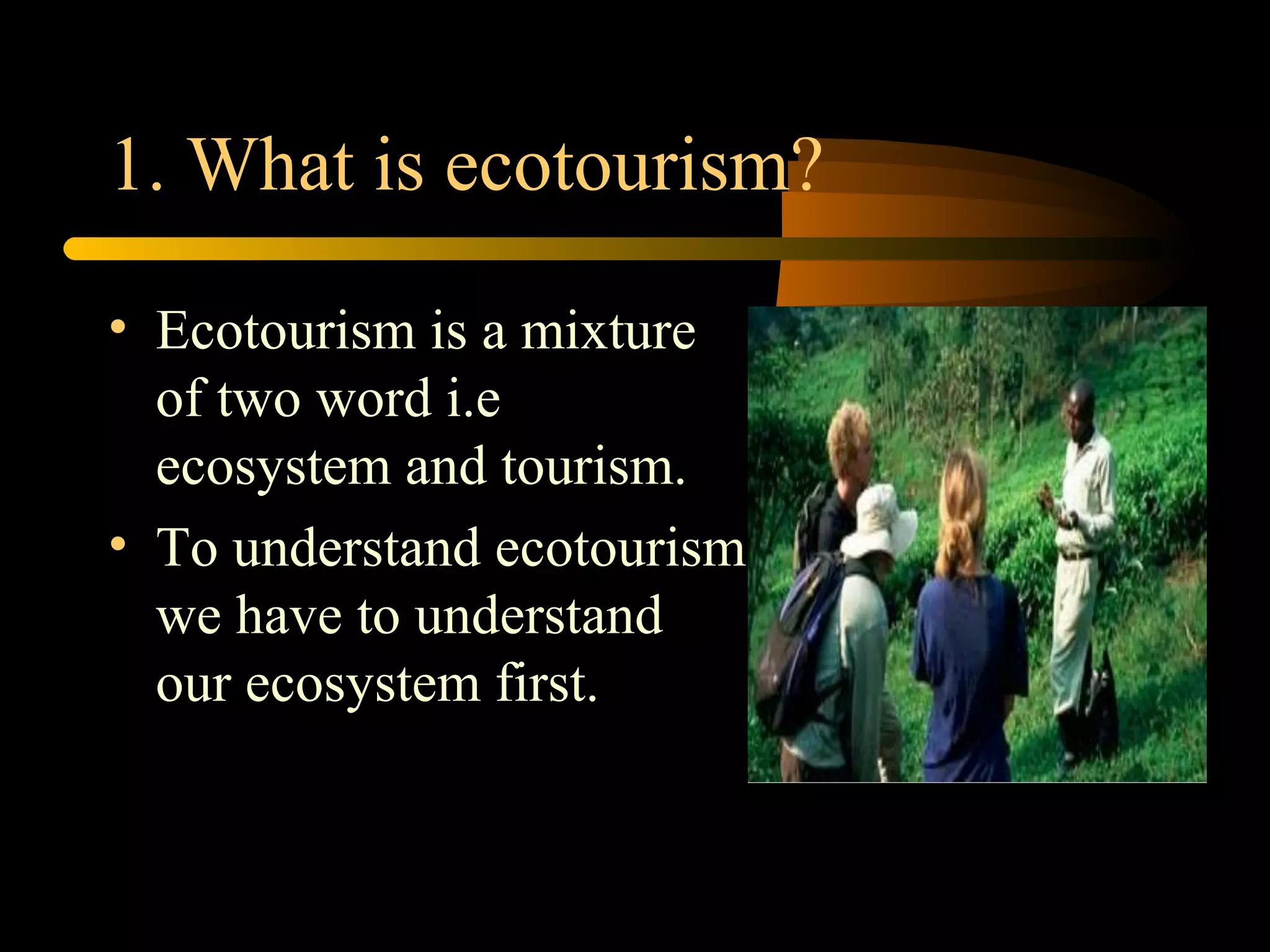
• Ecotourism is a mixture
of two word i.e
ecosystem and tourism.
• To understand ecotourism
we have to understand
our ecosystem first.
ECOSYSTEM
• An ecosystem is a unit of
biological organisation
interacting with the
physical evironment such
that the flow of energy and
mass leads to characteristic
trophic structure and
materials.
Tourism
• The practice of travelling for pleasure.
• This also involve the personal interest to travel
to natural area to know some more fact about
it.
• So when a person is travelling to a ecosystem
to know more about that ecosystem and also
for the conservation of the evironment is
termed as ecotourism
The main reason behind the
ecotourism
• The main reason behind ecotourism is the
need to unite communities, conservation
and well-managed travel.
• Ecotourism serves different purposes
which include; provision of funds for
conservation of ecology, encourages
development economically and also benefits
the local communities through political
empowerment
Why should people go for
ecotourism
• helping conserve nature in a faraway place
• educating tourists about the place they are
travelling to
• respecting the culture of people who live
there
• the conservation of animal and plant species
that are in danger of becoming extinct
• leaving a small carbon footprint
•. It majorly focuses on the social
travels, sustainable environment
and personal growth. It brings out
an insight to tourists on the
effects that human beings have
on the environment and also is
intended to foster the
appreciation of the natural
resources.
Principles of ecotourism
•The first principle is that ecotourism
has to do with travel to natural
destinations.
•These places/ destinations are more
often than not remote areas and can
either be inhabited or uninhabited
• Usually these areas are under
environmental protection of some
kind at international, national,
communal or private level.
• Ecotourism is meant to enable or
encourage environmental awareness.
This means that ecotourism should
provide education for both residents
of communities living in the
neighborhood and the tourists
• Ecotourism encourages
cultural preservation since it
provides a platform for
cultural interaction between
the locals and tourists.
• By the help of this
ecotourism we can also
conserve the natural
resources ,the animals and
also the entire ecosystem
Benefits of ecotourism to local
communities
Famous ecotourism place in
odisha
•Mangalajodi
•Similipal tiger
reserve
•Debrigarh
Sanctuary
•Kuldiha Sanctuary
Mangalajodi is an old village
Under Tangi, ,Odisha
Block in khorda district
Of Odisha at the
Northern edge of Chillika
Lake. Scenic beauty of this village and its vast
wetland attracts the visitors.
MANGALAJODI ODISHA
• Similipal is located in Mayurbhanj
district in the state. 'Similipal' was
chosen as one of the nine prime
locations for tiger conservation
under the 'Project Tiger' launched in
the year 1973 in the country.
Government of India declared
Simlipal as a biosphere reserve in
1994. UNESCO added this national
park to its list of Biosphere Reserves
in May 2009.
SIMILIPAL TIGER /
BIOSPHERE RESERVE
DEBRIGARH SANCTUARY
•is situated in Baragarh district and is
about 40 km from Sambalpur and 320 km
from Bhubaneswar. Debrigarh Wildlife
Sanctuary comprises of Lohara and
Debrigarh Reserved Forests.
•The sanctuary is famous for its sylvan
beauty and wild lives could be sighted
very easily.
• The forest type is dry
deciduous and filled with
varied flora and fauna.
Debrigarh tract lies in the
Chhatisgarh-Dandakaranya
region of Deccan Peninsular.
• The Ushakothi water fall is a
major attraction. The
Debrigarh area is like an
emerald nestled in the serene
blue waters of Hirakud dam.
Indian bison, chowsingha and
water birds are the prime
KULDIHA SANCTUARY
• is situated in Balasore
district and is about 31
km from Balasore and
260 km from
Bhubaneswar. Preferable
time of visit is from
November to mid
February. Sighting of
Elephant, Gaur and Giant
Squirrel etc.
Advantages of ecotourism
• Ecotourism benefits the local community as
it enables the provision of employment and
infrastructural development.
• By traveling to new places the tourist learns
about local plants and animals that he'd
otherwise not have encountered.
• Ecotourism brings the tourist closer to
nature, open up the tourist's mind to new
ideas along with new perspectives on life
and other people
Disadvantages of ecotourism
• Ecotourism may lead to an increase in
population around an area; there may also
be excessive building of resorts in areas
where park popularity is very high.
• While this ensures high revenues, it also
increases pressure on land, reducing
opportunities for local people to make a
living off the land.
• This is because things like
energy sources can be
depleted so as to
accommodate the hordes of
tourists visiting an area.
• Overcrowding in tourist
venues may endanger
protected areas
Issues in ecotourism
• The perception of locals is a problem facing
ecotourism.
• Inadequacy of information is one of the
issues plaguing ecotourism. An increased
amount of quality information is needed
about actual and potential economic
contributions from nature tourism ventures
and practices
• The risks associated with
ecotourism are also issues
that plague it, these risks
include poor management
which may lead to
unregulated nature tourism
which may in turn corrode
local culture and damage
the environment.
All about ecotourism
Ecotourism

Ecotourism

  • 1.
    ECOTOURISM A better wayto conserve the ecosystem By: Subhalaxmi Swain B.TECH(Biotechnology 3rd year) Institute of Technical Education and Research, SOA deemed to be university Bhubaneswar, 751030
  • 2.
    1. What isecotourism? • Ecotourism is a mixture of two word i.e ecosystem and tourism. • To understand ecotourism we have to understand our ecosystem first.
  • 3.
    ECOSYSTEM • An ecosystemis a unit of biological organisation interacting with the physical evironment such that the flow of energy and mass leads to characteristic trophic structure and materials.
  • 4.
    Tourism • The practiceof travelling for pleasure. • This also involve the personal interest to travel to natural area to know some more fact about it. • So when a person is travelling to a ecosystem to know more about that ecosystem and also for the conservation of the evironment is termed as ecotourism
  • 5.
    The main reasonbehind the ecotourism • The main reason behind ecotourism is the need to unite communities, conservation and well-managed travel. • Ecotourism serves different purposes which include; provision of funds for conservation of ecology, encourages development economically and also benefits the local communities through political empowerment
  • 6.
    Why should peoplego for ecotourism • helping conserve nature in a faraway place • educating tourists about the place they are travelling to • respecting the culture of people who live there • the conservation of animal and plant species that are in danger of becoming extinct • leaving a small carbon footprint
  • 7.
    •. It majorlyfocuses on the social travels, sustainable environment and personal growth. It brings out an insight to tourists on the effects that human beings have on the environment and also is intended to foster the appreciation of the natural resources.
  • 8.
    Principles of ecotourism •Thefirst principle is that ecotourism has to do with travel to natural destinations. •These places/ destinations are more often than not remote areas and can either be inhabited or uninhabited
  • 9.
    • Usually theseareas are under environmental protection of some kind at international, national, communal or private level. • Ecotourism is meant to enable or encourage environmental awareness. This means that ecotourism should provide education for both residents of communities living in the neighborhood and the tourists
  • 10.
    • Ecotourism encourages culturalpreservation since it provides a platform for cultural interaction between the locals and tourists. • By the help of this ecotourism we can also conserve the natural resources ,the animals and also the entire ecosystem Benefits of ecotourism to local communities
  • 11.
    Famous ecotourism placein odisha •Mangalajodi •Similipal tiger reserve •Debrigarh Sanctuary •Kuldiha Sanctuary
  • 12.
    Mangalajodi is anold village Under Tangi, ,Odisha Block in khorda district Of Odisha at the Northern edge of Chillika Lake. Scenic beauty of this village and its vast wetland attracts the visitors. MANGALAJODI ODISHA
  • 13.
    • Similipal islocated in Mayurbhanj district in the state. 'Similipal' was chosen as one of the nine prime locations for tiger conservation under the 'Project Tiger' launched in the year 1973 in the country. Government of India declared Simlipal as a biosphere reserve in 1994. UNESCO added this national park to its list of Biosphere Reserves in May 2009. SIMILIPAL TIGER / BIOSPHERE RESERVE
  • 14.
    DEBRIGARH SANCTUARY •is situatedin Baragarh district and is about 40 km from Sambalpur and 320 km from Bhubaneswar. Debrigarh Wildlife Sanctuary comprises of Lohara and Debrigarh Reserved Forests. •The sanctuary is famous for its sylvan beauty and wild lives could be sighted very easily.
  • 15.
    • The foresttype is dry deciduous and filled with varied flora and fauna. Debrigarh tract lies in the Chhatisgarh-Dandakaranya region of Deccan Peninsular. • The Ushakothi water fall is a major attraction. The Debrigarh area is like an emerald nestled in the serene blue waters of Hirakud dam. Indian bison, chowsingha and water birds are the prime
  • 16.
    KULDIHA SANCTUARY • issituated in Balasore district and is about 31 km from Balasore and 260 km from Bhubaneswar. Preferable time of visit is from November to mid February. Sighting of Elephant, Gaur and Giant Squirrel etc.
  • 17.
    Advantages of ecotourism •Ecotourism benefits the local community as it enables the provision of employment and infrastructural development. • By traveling to new places the tourist learns about local plants and animals that he'd otherwise not have encountered. • Ecotourism brings the tourist closer to nature, open up the tourist's mind to new ideas along with new perspectives on life and other people
  • 18.
    Disadvantages of ecotourism •Ecotourism may lead to an increase in population around an area; there may also be excessive building of resorts in areas where park popularity is very high. • While this ensures high revenues, it also increases pressure on land, reducing opportunities for local people to make a living off the land.
  • 19.
    • This isbecause things like energy sources can be depleted so as to accommodate the hordes of tourists visiting an area. • Overcrowding in tourist venues may endanger protected areas
  • 20.
    Issues in ecotourism •The perception of locals is a problem facing ecotourism. • Inadequacy of information is one of the issues plaguing ecotourism. An increased amount of quality information is needed about actual and potential economic contributions from nature tourism ventures and practices
  • 21.
    • The risksassociated with ecotourism are also issues that plague it, these risks include poor management which may lead to unregulated nature tourism which may in turn corrode local culture and damage the environment.
  • 22.