Presentation On Ecosystem
Session 2017-2019
PRESENTED BY
B.R. ADITYA
1
An Ecosystem is a community of living and non living
organism in conjunction with their environment like air,
water, water and minerals soil etc.
There is a great variety of ecosystems in existence, all of
them are characterized by general structural and functional
attributes.
Definition: Any unit that includes all of the organisms
(i.e., “the community”) in a given area interacting with the
physical environment so that the flow of energy leads to
clearly defined tropic structure, biotic diversity, and
material cycles (i.e., exchange of materials between living
and nonliving parts) within the system (E. Odum 1971)
3
5Fig: Typical Ecosystem
6
Fig : Aquatic Ecosystem
8
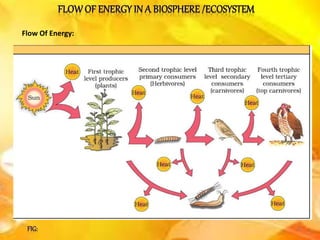
Flow Of Energy:
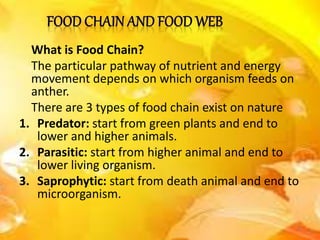
What is Food Chain?
The particular pathway of nutrient and energy
movement depends on which organism feeds on
anther.
There are 3 types of food chain exist on nature
1. Predator: start from green plants and end to
lower and higher animals.
2. Parasitic: start from higher animal and end to
lower living organism.
3. Saprophytic: start from death animal and end to
microorganism.
9
Fig : Typical Food chain 10
Decomposers
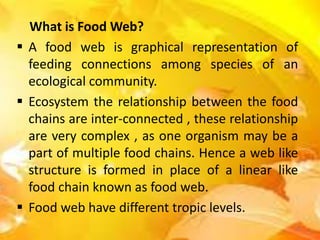
What is Food Web?
 A food web is graphical representation of
feeding connections among species of an
ecological community.
 Ecosystem the relationship between the food
chains are inter-connected , these relationship
are very complex , as one organism may be a
part of multiple food chains. Hence a web like
structure is formed in place of a linear like
food chain known as food web.
 Food web have different tropic levels.
11
Fig: Food Web 12
Fig: Diagrammatic representation of tropic level in an ecosystem 13
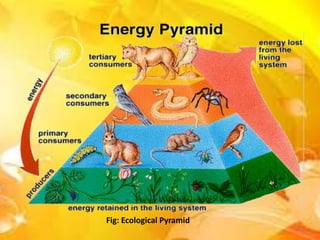
• Ecological Pyramid: An energy pyramid is a
presentation of the trophic levels in an ecosystem.
• Energy from the sun is transferred through the
ecosystem by passing through various trophic
levels.
• Roughly 10% of the energy is transferred from
one trophic level to next, thus preventing a large
number of trophic levels. There must be higher
amounts of biomass at the bottom of the pyramid
to support the energy and biomass requirements
of the higher trophic levels.
14
Fig: Ecological Pyramid
15
16
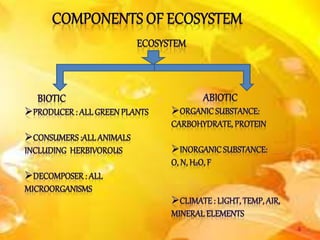
An ecosystem is a functional unit of nature and comprises
abiotic a components are inorganic materials air, water and soil
whereas biotic components are producers consumers and
decomposers.
17

ecosystem

  • 1.
    Presentation On Ecosystem Session2017-2019 PRESENTED BY B.R. ADITYA 1
  • 3.
    An Ecosystem isa community of living and non living organism in conjunction with their environment like air, water, water and minerals soil etc. There is a great variety of ecosystems in existence, all of them are characterized by general structural and functional attributes. Definition: Any unit that includes all of the organisms (i.e., “the community”) in a given area interacting with the physical environment so that the flow of energy leads to clearly defined tropic structure, biotic diversity, and material cycles (i.e., exchange of materials between living and nonliving parts) within the system (E. Odum 1971) 3
  • 5.
  • 6.
  • 7.
    Fig : AquaticEcosystem
  • 8.
  • 9.
    What is FoodChain? The particular pathway of nutrient and energy movement depends on which organism feeds on anther. There are 3 types of food chain exist on nature 1. Predator: start from green plants and end to lower and higher animals. 2. Parasitic: start from higher animal and end to lower living organism. 3. Saprophytic: start from death animal and end to microorganism. 9
  • 10.
    Fig : TypicalFood chain 10 Decomposers
  • 11.
    What is FoodWeb?  A food web is graphical representation of feeding connections among species of an ecological community.  Ecosystem the relationship between the food chains are inter-connected , these relationship are very complex , as one organism may be a part of multiple food chains. Hence a web like structure is formed in place of a linear like food chain known as food web.  Food web have different tropic levels. 11
  • 12.
  • 13.
    Fig: Diagrammatic representationof tropic level in an ecosystem 13
  • 14.
    • Ecological Pyramid:An energy pyramid is a presentation of the trophic levels in an ecosystem. • Energy from the sun is transferred through the ecosystem by passing through various trophic levels. • Roughly 10% of the energy is transferred from one trophic level to next, thus preventing a large number of trophic levels. There must be higher amounts of biomass at the bottom of the pyramid to support the energy and biomass requirements of the higher trophic levels. 14
  • 15.
  • 16.
    16 An ecosystem isa functional unit of nature and comprises abiotic a components are inorganic materials air, water and soil whereas biotic components are producers consumers and decomposers.
  • 17.