

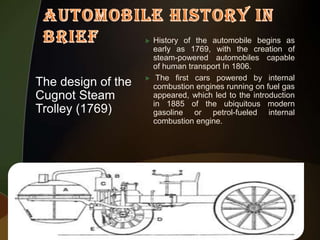
The design of the
Cugnot Steam
Trolley (1769)



History of the automobile begins as
early as 1769, with the creation of
steam-powered automobiles capable
of human transport In 1806.
The first cars powered by internal
combustion engines running on fuel gas
appeared, which led to the introduction
in 1885 of the ubiquitous modern
gasoline or petrol-fueled internal
combustion engine.
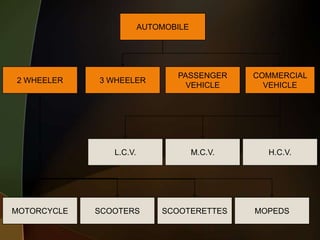
AUTOMOBILE

2 WHEELER

3 WHEELER

L.C.V.

MOTORCYCLE

SCOOTERS

PASSENGER
VEHICLE

COMMERCIAL
VEHICLE

M.C.V.

H.C.V.

SCOOTERETTES

MOPEDS
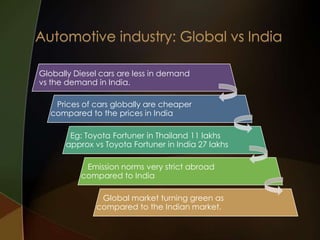
Globally Diesel cars are less in demand
vs the demand in India.
Prices of cars globally are cheaper
compared to the prices in India
Eg: Toyota Fortuner in Thailand 11 lakhs
approx vs Toyota Fortuner in India 27 lakhs

Emission norms very strict abroad
compared to India
Global market turning green as
compared to the Indian market.
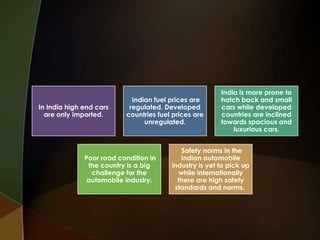
In India high end cars
are only imported.

Indian fuel prices are
regulated. Developed
countries fuel prices are
unregulated.

Poor road condition in
the country is a big
challenge for the
automobile industry.

India is more prone to
hatch back and small
cars while developed
countries are inclined
towards spacious and
luxurious cars.

Safety norms in the
Indian automobile
industry is yet to pick up
while internationally
there are high safety
standards and norms.
•

•

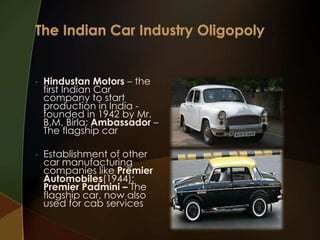
Hindustan Motors – the
first Indian Car
company to start
production in India founded in 1942 by Mr.
B.M. Birla; Ambassador –
The flagship car
Establishment of other
car manufacturing
companies like Premier
Automobiles(1944);
Premier Padmini – The
flagship car, now also
used for cab services
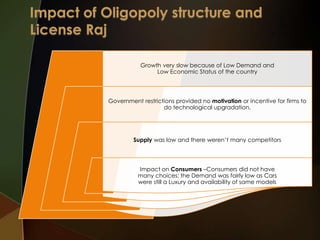
Growth very slow because of Low Demand and
Low Economic Status of the country

Government restrictions provided no motivation or incentive for firms to
do technological upgradation.

Supply was low and there weren’t many competitors

Impact on Consumers –Consumers did not have
many choices; the Demand was fairly low as Cars
were still a Luxury and availability of same models
•

•

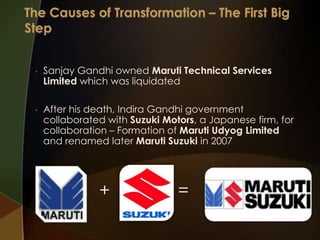
Sanjay Gandhi owned Maruti Technical Services
Limited which was liquidated

After his death, Indira Gandhi government
collaborated with Suzuki Motors, a Japanese firm, for
collaboration – Formation of Maruti Udyog Limited
and renamed later Maruti Suzuki in 2007

+

=
•

Policy changes introduced in 2 doses:
1.
Partial de-regulation in 1985 – eased
licensing requirements, allowed
selective capacity-expansion, partial
relaxation of controls with regard to
foreign collaboration, imports.
However, trade and investment
regulations continued,
constraining
growth of big business houses.
2. 1991 policy changes – Dispensed
with bulk controls and regulations

•

Partial de-regulation allowed
technology inflow into India
•

New Industrial Policy in July 1991 by Congress
Government led by Mr. Narsimha Rao:


•

It introduced Liberalization policies – Abolishment
of License Raj

April 1993 – Government removed motor cars from
list of industries reserved for compulsory licensing
•

•

•

New firms, including
foreign players, entered
with modern engineering,
efficient processes and
modern shop-floor layouts
Indian automobile industry
grew at 14.31% per annum
in post-1991 era
compared to 8.56% per
annum during 1985-91
Delicencing of sector
attracted many major
Global OEMs (GM, Ford,
Honda, Hyundai etc.) to
start assembly in India
Finance Bill 2006 – reduction of excise duty
on small motor vehicles, reduction in duty of
raw materials from 10% to in-between 5%7.5% - Infrastructure boost

Extension of 150% weighted tax deduction
on R&D expenditure – increase in budgetary
allocation towards R&D
Allowing automatic approval for foreign
equity investment upto 100%, with no
minimum investment criteria
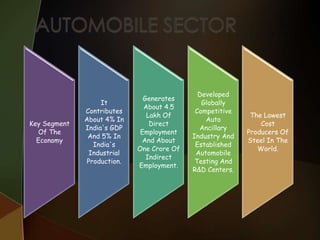
Key Segment
Of The
Economy

It
Contributes
About 4% In
India's GDP
And 5% In
India's
Industrial
Production.

Generates
About 4.5
Lakh Of
Direct
Employment
And About
One Crore Of
Indirect
Employment.
Developed
Globally
Competitive
Auto
Ancillary
Industry And
Established
Automobile
Testing And
R&D Centers.

The Lowest
Cost
Producers Of
Steel In The
World.
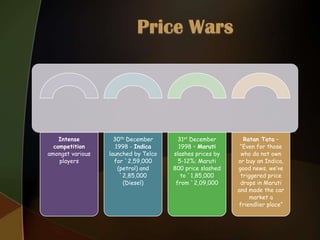
Intense
competition
amongst various
players

30th December
1998 - Indica
launched by Telco
for `2,59,000
(petrol) and
`2,85,000
(Diesel)

31st December
1998 – Maruti
slashes prices by
5-12%; Maruti
800 price slashed
to `1,85,000
from `2,09,000

Ratan Tata –
“Even for those
who do not own
or buy an Indica,
good news, we’ve
triggered price
drops in Maruti
and made the car
market a
friendlier place”
•

Tata has come up with ` 1 Lakh car – Tata
Nano

•

This again has created price war

•

Nissan-Renault to develop a $3000 car using
India’s “frugal engineering expertise”

•

Bajaj to experiment with the idea of a small
car
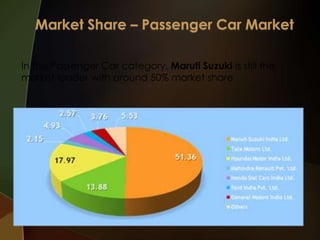
In the Passenger Car category, Maruti Suzuki is still the
market leader with around 50% market share
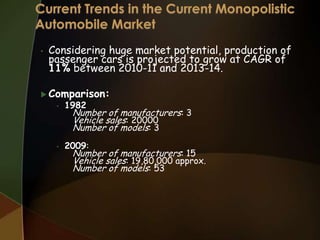
•

Considering huge market potential, production of
passenger cars is projected to grow at CAGR of
11% between 2010-11 and 2013-14.

 Comparison:
•

1982

•

2009:

Number of manufacturers: 3
Vehicle sales: 20000
Number of models: 3
Number of manufacturers: 15
Vehicle sales: 19,80,000 approx.
Number of models: 53
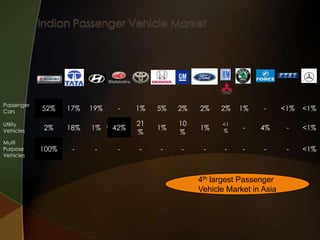
Passenger
Cars

52%

17%

19%

-

1%

5%

2%

2%

2%

1%

-

<1%

<1%

Utility
Vehicles

2%

18%

1%

42%

21
%

1%

10
%

1%

<1
%

-

4%

-

<1%

Multi
Purpose
Vehicles

100%

-

-

-

-

-

-

-

-

-

-

-

<1%

4th largest Passenger
Vehicle Market in Asia
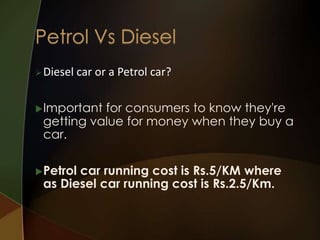
 Diesel

car or a Petrol car?

 Important

for consumers to know they're
getting value for money when they buy a
car.

 Petrol

car running cost is Rs.5/KM where
as Diesel car running cost is Rs.2.5/Km.




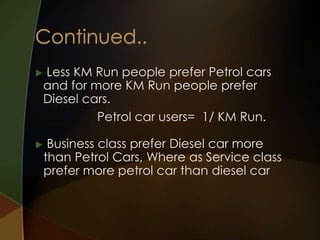
Less KM Run people prefer Petrol cars
and for more KM Run people prefer
Diesel cars.
Petrol car users= 1/ KM Run.
Business class prefer Diesel car more
than Petrol Cars, Where as Service class
prefer more petrol car than diesel car
100
82
90

78

72
80

62

70
60

51
44

45

50

Petrol
39

32

Diesel
Both

40
30
14

20
10

21

18

5

10
10

12
6

4

0
Better Resale Value

More Fuel
Consumption

More Comfortable

More Expensive for
Maintenance

More Economic

More Happier
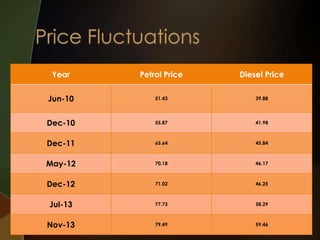
Year

Petrol Price

Diesel Price

Jun-10

51.43

39.88

Dec-10

55.87

41.98

Dec-11

65.64

45.84

May-12

70.18

46.17

Dec-12

71.02

46.25

Jul-13

77.73

58.29

Nov-13

79.49

59.46
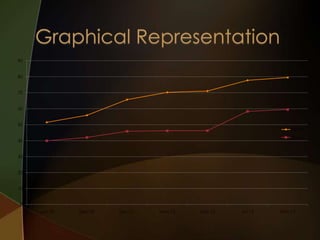
90
80
70
60
50

Petrol

Diesel

40
30
20
10
0
Jun-10

Dec-10

Dec-11

May-12

Dec-12

Jul-13

Nov-13








Customer like to go for Petrol vehicle for
advantage of less maintenance cost and
less Purchase price
Customer like to go for Diesel vehicle for
getting the advantage of extra Mileage &
better features
Customer buying a Diesel vehicle is not
much bothered about the price of the
vehicle
Customer buying Petrol vehicle is not much
bothered about the mileage of the vehicle
 Convergence

of government policies
 Economy’s growth
 Increase in People’s purchasing power.
 Pursuit of better lifestyle
 Growth in the road infrastructure
 Relatively

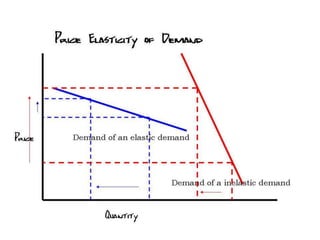
inelastic demand for Mercedes
car owner compared to a Maruti Suzuki
car owner who will have a relatively
elastic demand
when it comes to charging him for
service .
This is because owner of mercedes wont
mind in paying higher amount.
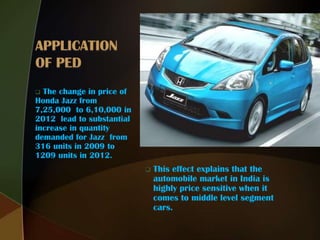
The change in price of
Honda Jazz from
7,25,000 to 6,10,000 in
2012 lead to substantial
increase in quantity
demanded for Jazz from
316 units in 2009 to
1209 units in 2012.




This effect explains that the
automobile market in India is
highly price sensitive when it
comes to middle level segment
cars.
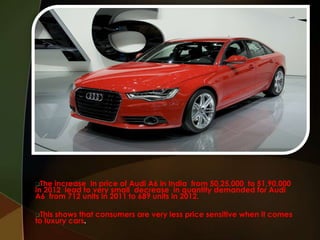
The

increase in price of Audi A6 in India from 50,25,000 to 51,90,000
in 2012 lead to very small decrease in quantity demanded for Audi
A6 from 712 units in 2011 to 689 units in 2012.
This

shows that consumers are very less price sensitive when it comes
to luxury cars.
 CRISIL

Reports

 http://auto.indiamart.com/
 http://www.wikinvest.com
 http://india-reports.in
 http://wheelsunplugged.in/
 http://en.wikipedia.org
Economics ppt

Economics ppt

  • 2.
     The design ofthe Cugnot Steam Trolley (1769)  History of the automobile begins as early as 1769, with the creation of steam-powered automobiles capable of human transport In 1806. The first cars powered by internal combustion engines running on fuel gas appeared, which led to the introduction in 1885 of the ubiquitous modern gasoline or petrol-fueled internal combustion engine.
  • 3.
  • 4.
    Globally Diesel carsare less in demand vs the demand in India. Prices of cars globally are cheaper compared to the prices in India Eg: Toyota Fortuner in Thailand 11 lakhs approx vs Toyota Fortuner in India 27 lakhs Emission norms very strict abroad compared to India Global market turning green as compared to the Indian market.
  • 5.
    In India highend cars are only imported. Indian fuel prices are regulated. Developed countries fuel prices are unregulated. Poor road condition in the country is a big challenge for the automobile industry. India is more prone to hatch back and small cars while developed countries are inclined towards spacious and luxurious cars. Safety norms in the Indian automobile industry is yet to pick up while internationally there are high safety standards and norms.
  • 6.
    • • Hindustan Motors –the first Indian Car company to start production in India founded in 1942 by Mr. B.M. Birla; Ambassador – The flagship car Establishment of other car manufacturing companies like Premier Automobiles(1944); Premier Padmini – The flagship car, now also used for cab services
  • 7.
    Growth very slowbecause of Low Demand and Low Economic Status of the country Government restrictions provided no motivation or incentive for firms to do technological upgradation. Supply was low and there weren’t many competitors Impact on Consumers –Consumers did not have many choices; the Demand was fairly low as Cars were still a Luxury and availability of same models
  • 8.
    • • Sanjay Gandhi ownedMaruti Technical Services Limited which was liquidated After his death, Indira Gandhi government collaborated with Suzuki Motors, a Japanese firm, for collaboration – Formation of Maruti Udyog Limited and renamed later Maruti Suzuki in 2007 + =
  • 9.
    • Policy changes introducedin 2 doses: 1. Partial de-regulation in 1985 – eased licensing requirements, allowed selective capacity-expansion, partial relaxation of controls with regard to foreign collaboration, imports. However, trade and investment regulations continued, constraining growth of big business houses. 2. 1991 policy changes – Dispensed with bulk controls and regulations • Partial de-regulation allowed technology inflow into India
  • 10.
    • New Industrial Policyin July 1991 by Congress Government led by Mr. Narsimha Rao:  • It introduced Liberalization policies – Abolishment of License Raj April 1993 – Government removed motor cars from list of industries reserved for compulsory licensing
  • 11.
    • • • New firms, including foreignplayers, entered with modern engineering, efficient processes and modern shop-floor layouts Indian automobile industry grew at 14.31% per annum in post-1991 era compared to 8.56% per annum during 1985-91 Delicencing of sector attracted many major Global OEMs (GM, Ford, Honda, Hyundai etc.) to start assembly in India
  • 12.
    Finance Bill 2006– reduction of excise duty on small motor vehicles, reduction in duty of raw materials from 10% to in-between 5%7.5% - Infrastructure boost Extension of 150% weighted tax deduction on R&D expenditure – increase in budgetary allocation towards R&D Allowing automatic approval for foreign equity investment upto 100%, with no minimum investment criteria
  • 14.
    Key Segment Of The Economy It Contributes About4% In India's GDP And 5% In India's Industrial Production. Generates About 4.5 Lakh Of Direct Employment And About One Crore Of Indirect Employment. Developed Globally Competitive Auto Ancillary Industry And Established Automobile Testing And R&D Centers. The Lowest Cost Producers Of Steel In The World.
  • 15.
    Intense competition amongst various players 30th December 1998- Indica launched by Telco for `2,59,000 (petrol) and `2,85,000 (Diesel) 31st December 1998 – Maruti slashes prices by 5-12%; Maruti 800 price slashed to `1,85,000 from `2,09,000 Ratan Tata – “Even for those who do not own or buy an Indica, good news, we’ve triggered price drops in Maruti and made the car market a friendlier place”
  • 16.
    • Tata has comeup with ` 1 Lakh car – Tata Nano • This again has created price war • Nissan-Renault to develop a $3000 car using India’s “frugal engineering expertise” • Bajaj to experiment with the idea of a small car
  • 17.
    In the PassengerCar category, Maruti Suzuki is still the market leader with around 50% market share
  • 18.
    • Considering huge marketpotential, production of passenger cars is projected to grow at CAGR of 11% between 2010-11 and 2013-14.  Comparison: • 1982 • 2009: Number of manufacturers: 3 Vehicle sales: 20000 Number of models: 3 Number of manufacturers: 15 Vehicle sales: 19,80,000 approx. Number of models: 53
  • 19.
  • 20.
     Diesel car ora Petrol car?  Important for consumers to know they're getting value for money when they buy a car.  Petrol car running cost is Rs.5/KM where as Diesel car running cost is Rs.2.5/Km.
  • 21.
      Less KM Runpeople prefer Petrol cars and for more KM Run people prefer Diesel cars. Petrol car users= 1/ KM Run. Business class prefer Diesel car more than Petrol Cars, Where as Service class prefer more petrol car than diesel car
  • 22.
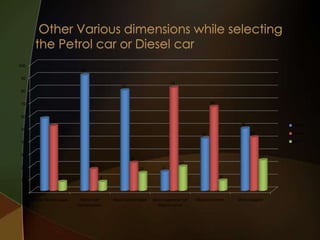
    100 82 90 78 72 80 62 70 60 51 44 45 50 Petrol 39 32 Diesel Both 40 30 14 20 10 21 18 5 10 10 12 6 4 0 Better Resale Value MoreFuel Consumption More Comfortable More Expensive for Maintenance More Economic More Happier
  • 23.
  • 24.
  • 25.
        Customer like togo for Petrol vehicle for advantage of less maintenance cost and less Purchase price Customer like to go for Diesel vehicle for getting the advantage of extra Mileage & better features Customer buying a Diesel vehicle is not much bothered about the price of the vehicle Customer buying Petrol vehicle is not much bothered about the mileage of the vehicle
  • 26.
     Convergence of governmentpolicies  Economy’s growth  Increase in People’s purchasing power.  Pursuit of better lifestyle  Growth in the road infrastructure
  • 27.
     Relatively inelastic demandfor Mercedes car owner compared to a Maruti Suzuki car owner who will have a relatively elastic demand when it comes to charging him for service . This is because owner of mercedes wont mind in paying higher amount.
  • 29.
    The change inprice of Honda Jazz from 7,25,000 to 6,10,000 in 2012 lead to substantial increase in quantity demanded for Jazz from 316 units in 2009 to 1209 units in 2012.   This effect explains that the automobile market in India is highly price sensitive when it comes to middle level segment cars.
  • 30.
    The increase in priceof Audi A6 in India from 50,25,000 to 51,90,000 in 2012 lead to very small decrease in quantity demanded for Audi A6 from 712 units in 2011 to 689 units in 2012. This shows that consumers are very less price sensitive when it comes to luxury cars.
  • 32.
     CRISIL Reports  http://auto.indiamart.com/ http://www.wikinvest.com  http://india-reports.in  http://wheelsunplugged.in/  http://en.wikipedia.org