Farhana Asim (8)
Khadija Riasat (42)
Dedication:
“We dedicate our International Finance Project to Allah Almighty who has
made it possible for us to work & then to our Respectable teacher .
Who provided us with all the guidelines to prove ourselves. We are
grateful to them for giving us this opportunity to explore new
dimensions and to help us in making this project. We are indebted to
them for giving us following opportunity which will help us in a long
run. Insha'Allah.”
JAPAN INDUSTRY SECTORS:
 The Japanese economy was one of the earliest in Asia to
industrialize. During the Meiji restoration period in the
mid-19th century, the Japanese government actively
pursued Western-style reforms and development –
hiring more than 3,000 Westerners to teach modern
science, mathematics and technology to Japan.
 Japan's major export industries include automobiles,
consumer electronics (see Electronics industry in Japan),
computers, semiconductors, copper, steel. Additional key
industries in Japan's economy are petrochemicals,
pharmaceuticals, bio-industry, shipbuilding, aerospace,
textiles, and foods. Japanese manufacturing industry is
heavily dependent on imported raw and fuels.
 Japan is also the world’s largest electronics manufacturer
with prominent companies such as Sony, Casio, Mitsubishi
Electric, Panasonic, Canon, Fujitsu, Nikon, Yamaha etc.
Japanese electronic products are renowned for their
innovation and quality. However the turmoil from the 2011
tsunami/earthquake disaster greatly affected its industries,
dropping Japan from the 8th highest industrial production
growth rate in the world in 2010 to the 8th worst in 2011.
 Despite the historical significance of Japanese
manufacturing, Services are the dominant component
of the economy – contributing to 71.4 percent of the
GDP in 2012. Major services in Japan include banking,
insurance, retailing, transportation and
telecommunications.
 The Tokyo Stock Exchange is the third largest stock
exchange in the world by market capitalization – with a
total market capitalization of US$3.3 trillion as of December
2011. Japan is also home to 326 companies from the Forbes
Global 2000.
 We have selected industry sector (automobiles) of
japan and 5 companies are
Toyota
Nissan
Honda
Suzuki
Mitsubishi
INTRODUCTION OF THE
COMPANIES
TOYOTA
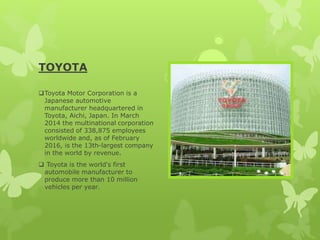
Toyota Motor Corporation is a
Japanese automotive
manufacturer headquartered in
Toyota, Aichi, Japan. In March
2014 the multinational corporation
consisted of 338,875 employees
worldwide and, as of February
2016, is the 13th-largest company
in the world by revenue.
 Toyota is the world's first
automobile manufacturer to
produce more than 10 million
vehicles per year.
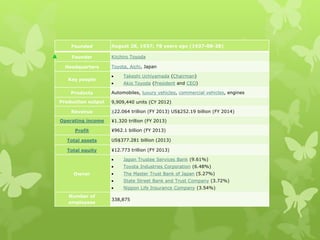
Founded August 28, 1937; 78 years ago (1937-08-28)
Founder Kiichiro Toyoda
Headquarters Toyota, Aichi, Japan
Key people
 Takeshi Uchiyamada (Chairman)
 Akio Toyoda (President and CEO)
Products Automobiles, luxury vehicles, commercial vehicles, engines
Production output 9,909,440 units (CY 2012)
Revenue ¥22.064 trillion (FY 2013) US$252.19 billion (FY 2014)
Operating income ¥1.320 trillion (FY 2013)
Profit ¥962.1 billion (FY 2013)
Total assets US$377.281 billion (2013)
Total equity ¥12.773 trillion (FY 2013)
Owner
 Japan Trustee Services Bank (9.61%)
 Toyota Industries Corporation (6.48%)
 The Master Trust Bank of Japan (5.27%)
 State Street Bank and Trust Company (3.72%)
 Nippon Life Insurance Company (3.54%)
Number of
employees
338,875
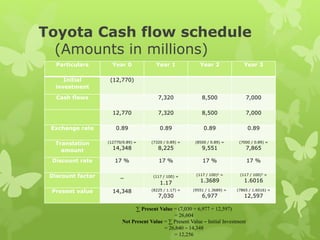
Toyota Cash flow schedule
(Amounts in millions)
Particulars Year 0 Year 1 Year 2 Year 3
Initial
investment
(12,770)
Cash flows 7,320 8,500 7,000
12,770 7,320 8,500 7,000
Exchange rate 0.89 0.89 0.89 0.89
Translation
amount
(12770/0.89) =
14,348
(7320 / 0.89) =
8,225
(8500 / 0.89) =
9,551
(7000 / 0.89) =
7,865
Discount rate 17 % 17 % 17 % 17 %
Discount factor _ (117 / 100) =
1.17
(117 / 100)2 =
1.3689
(117 / 100)3 =
1.6016
Present value 14,348 (8225 / 1.17) =
7,030
(9551 / 1.3689) =
6,977
(7865 / 1.6016) =
12,597
∑ Present Value = (7,030 + 6,977 + 12,597)
= 26,604
Net Present Value = ∑ Present Value – Initial Investment
= 26,640 – 14,348
= 12,256
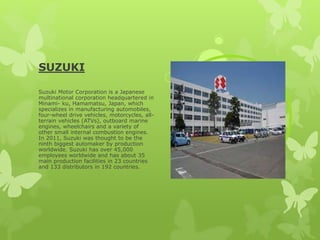
SUZUKI
Suzuki Motor Corporation is a Japanese
multinational corporation headquartered in
Minami- ku, Hamamatsu, Japan, which
specializes in manufacturing automobiles,
four-wheel drive vehicles, motorcycles, all-
terrain vehicles (ATVs), outboard marine
engines, wheelchairs and a variety of
other small internal combustion engines.
In 2011, Suzuki was thought to be the
ninth biggest automaker by production
worldwide. Suzuki has over 45,000
employees worldwide and has about 35
main production facilities in 23 countries
and 133 distributors in 192 countries.
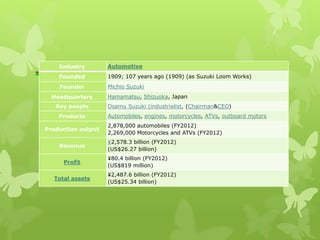
Industry Automotive
Founded 1909; 107 years ago (1909) (as Suzuki Loom Works)
Founder Michio Suzuki
Headquarters Hamamatsu, Shizuoka, Japan
Key people Osamu Suzuki (industrialist, (Chairman&CEO)
Products Automobiles, engines, motorcycles, ATVs, outboard motors
Production output
2,878,000 automobiles (FY2012)
2,269,000 Motorcycles and ATVs (FY2012)
Revenue
¥2,578.3 billion (FY2012)
(US$26.27 billion)
Profit
¥80.4 billion (FY2012)
(US$819 million)
Total assets
¥2,487.6 billion (FY2012)
(US$25.34 billion)
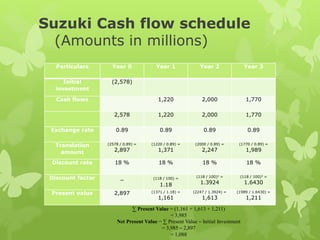
Suzuki Cash flow schedule
(Amounts in millions)
Particulars Year 0 Year 1 Year 2 Year 3
Initial
investment
(2,578)
Cash flows 1,220 2,000 1,770
2,578 1,220 2,000 1,770
Exchange rate 0.89 0.89 0.89 0.89
Translation
amount
(2578 / 0.89) =
2,897
(1220 / 0.89) =
1,371
(2000 / 0.89) =
2,247
(1770 / 0.89) =
1,989
Discount rate 18 % 18 % 18 % 18 %
Discount factor _ (118 / 100) =
1.18
(118 / 100)2 =
1.3924
(118 / 100)3 =
1.6430
Present value 2,897 (1371 / 1.18) =
1,161
(2247 / 1.3924) =
1,613
(1989 / 1.6430) =
1,211
∑ Present Value = (1,161 + 1,613 + 1,211)
= 3,985
Net Present Value = ∑ Present Value – Initial Investment
= 3,985 – 2,897
= 1,088
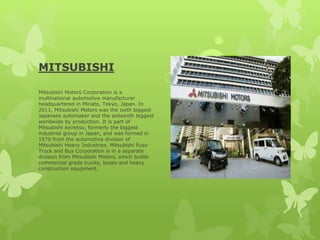
MITSUBISHI
Mitsubishi Motors Corporation is a
multinational automotive manufacturer
headquartered in Minato, Tokyo, Japan. In
2011, Mitsubishi Motors was the sixth biggest
Japanese automaker and the sixteenth biggest
worldwide by production. It is part of
Mitsubishi keiretsu, formerly the biggest
industrial group in Japan, and was formed in
1970 from the automotive division of
Mitsubishi Heavy Industries. Mitsubishi Fuso
Truck and Bus Corporation is in a separate
division from Mitsubishi Motors, which builds
commercial grade trucks, buses and heavy
construction equipment.
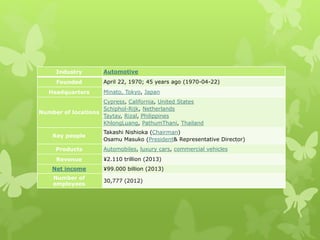
Industry Automotive
Founded April 22, 1970; 45 years ago (1970-04-22)
Headquarters Minato, Tokyo, Japan
Number of locations
Cypress, California, United States
Schiphol-Rijk, Netherlands
Taytay, Rizal, Philippines
KhlongLuang, PathumThani, Thailand
Key people
Takashi Nishioka (Chairman)
Osamu Masuko (President& Representative Director)
Products Automobiles, luxury cars, commercial vehicles
Revenue ¥2.110 trillion (2013)
Net income ¥99.000 billion (2013)
Number of
employees
30,777 (2012)
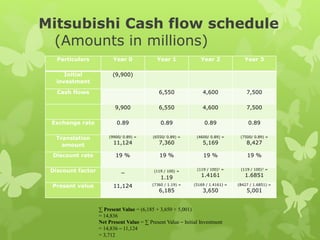
Mitsubishi Cash flow schedule
(Amounts in millions)
Particulars Year 0 Year 1 Year 2 Year 3
Initial
investment
(9,900)
Cash flows 6,550 4,600 7,500
9,900 6,550 4,600 7,500
Exchange rate 0.89 0.89 0.89 0.89
Translation
amount
(9900/ 0.89) =
11,124
(6550/ 0.89) =
7,360
(4600/ 0.89) =
5,169
(7500/ 0.89) =
8,427
Discount rate 19 % 19 % 19 % 19 %
Discount factor _ (119 / 100) =
1.19
(119 / 100)2 =
1.4161
(119 / 100)3 =
1.6851
Present value 11,124 (7360 / 1.19) =
6,185
(5169 / 1.4161) =
3,650
(8427 / 1.6851) =
5,001
∑ Present Value = (6,185 + 3,650 + 5,001)
= 14,836
Net Present Value = ∑ Present Value – Initial Investment
= 14,836 – 11,124
= 3,712
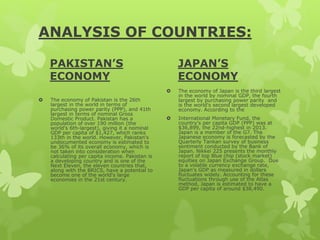
ANALYSIS OF COUNTRIES:
PAKISTAN’S
ECONOMY
 The economy of Pakistan is the 26th
largest in the world in terms of
purchasing power parity (PPP), and 41th
largest in terms of nominal Gross
Domestic Product. Pakistan has a
population of over 190 million (the
world's 6th-largest), giving it a nominal
GDP per capita of $1,427, which ranks
133th in the world. However, Pakistan's
undocumented economy is estimated to
be 36% of its overall economy, which is
not taken into consideration when
calculating per capita income. Pakistan is
a developing country and is one of the
Next Eleven, the eleven countries that,
along with the BRICS, have a potential to
become one of the world's large
economies in the 21st century.
JAPAN’S
ECONOMY
 The economy of Japan is the third largest
in the world by nominal GDP, the fourth
largest by purchasing power parity and
is the world's second largest developed
economy. According to the
 International Monetary Fund, the
country's per capita GDP (PPP) was at
$36,899, the 22nd-highest in 2013.
Japan is a member of the G7. The
Japanese economy is forecasted by the
Quarterly Tankan survey of business
sentiment conducted by the Bank of
Japan. Nikkei 225 presents the monthly
report of top Blue chip (stock market)
equities on Japan Exchange Group. Due
to a volatile currency exchange rate,
Japan's GDP as measured in dollars
fluctuates widely. Accounting for these
fluctuations through use of the Atlas
method, Japan is estimated to have a
GDP per capita of around $38,490.
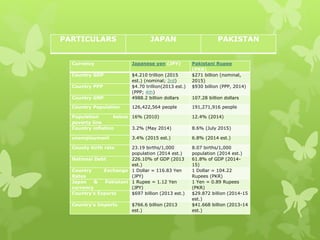
Currency Japanese yen (JPY) Pakistani Rupee
(PKR)
Country GDP $4.210 trillion (2015
est.) (nominal; 3rd)
$271 billion (nominal,
2015)
Country PPP $4.70 trillion(2013 est.)
(PPP; 4th)
$930 billion (PPP, 2014)
Country GNP 4988.2 billion dollars 107.28 billion dollars
Country Population 126,422,564 people 191,271,916 people
Population below
poverty line
16% (2010) 12.4% (2014)
Country inflation 3.2% (May 2014) 8.6% (July 2015)
unemployment 3.4% (2015 est.) 6.8% (2014 est.)
County birth rate 23.19 births/1,000
population (2014 est.)
8.07 births/1,000
population (2014 est.)
National Debt 226.10% of GDP (2013
est.)
61.8% of GDP (2014-
15)
Country Exchange
Rates
1 Dollar = 116.83 Yen
(JPY)
1 Dollar = 104.22
Rupees (PKR)
Japan & Pakistani
currency
1 Rupee = 1.12 Yen
(JPY)
1 Yen = 0.89 Rupees
(PKR)
Country’s Exports $697 billion (2013 est.) $29.872 billion (2014-15
est.)
Country’s Imports $766.6 billion (2013
est.)
$41.668 billion (2013-14
est.)
PARTICULARS JAPAN PAKISTAN
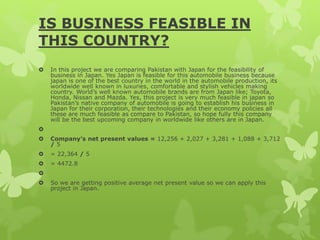
IS BUSINESS FEASIBLE IN
THIS COUNTRY?
 In this project we are comparing Pakistan with Japan for the feasibility of
business in Japan. Yes Japan is feasible for this automobile business because
japan is one of the best country in the world in the automobile production, its
worldwide well known in luxuries, comfortable and stylish vehicles making
country. World’s well known automobile brands are from Japan like; Toyota,
Honda, Nissan and Mazda. Yes, this project is very much feasible in japan so
Pakistan’s native company of automobile is going to establish his business in
Japan for their corporation, their technologies and their economy policies all
these are much feasible as compare to Pakistan, so hope fully this company
will be the best upcoming company in worldwide like others are in Japan.

 Company’s net present values = 12,256 + 2,027 + 3,281 + 1,088 + 3,712
/ 5
 = 22,364 / 5
 = 4472.8

 So we are getting positive average net present value so we can apply this
project in Japan.

International finance

  • 2.
  • 3.
    Dedication: “We dedicate ourInternational Finance Project to Allah Almighty who has made it possible for us to work & then to our Respectable teacher . Who provided us with all the guidelines to prove ourselves. We are grateful to them for giving us this opportunity to explore new dimensions and to help us in making this project. We are indebted to them for giving us following opportunity which will help us in a long run. Insha'Allah.”
  • 5.
    JAPAN INDUSTRY SECTORS: The Japanese economy was one of the earliest in Asia to industrialize. During the Meiji restoration period in the mid-19th century, the Japanese government actively pursued Western-style reforms and development – hiring more than 3,000 Westerners to teach modern science, mathematics and technology to Japan.  Japan's major export industries include automobiles, consumer electronics (see Electronics industry in Japan), computers, semiconductors, copper, steel. Additional key industries in Japan's economy are petrochemicals, pharmaceuticals, bio-industry, shipbuilding, aerospace, textiles, and foods. Japanese manufacturing industry is heavily dependent on imported raw and fuels.
  • 6.
     Japan isalso the world’s largest electronics manufacturer with prominent companies such as Sony, Casio, Mitsubishi Electric, Panasonic, Canon, Fujitsu, Nikon, Yamaha etc. Japanese electronic products are renowned for their innovation and quality. However the turmoil from the 2011 tsunami/earthquake disaster greatly affected its industries, dropping Japan from the 8th highest industrial production growth rate in the world in 2010 to the 8th worst in 2011.  Despite the historical significance of Japanese manufacturing, Services are the dominant component of the economy – contributing to 71.4 percent of the GDP in 2012. Major services in Japan include banking, insurance, retailing, transportation and telecommunications.  The Tokyo Stock Exchange is the third largest stock exchange in the world by market capitalization – with a total market capitalization of US$3.3 trillion as of December 2011. Japan is also home to 326 companies from the Forbes Global 2000.
  • 8.
     We haveselected industry sector (automobiles) of japan and 5 companies are Toyota Nissan Honda Suzuki Mitsubishi
  • 14.
  • 15.
    TOYOTA Toyota Motor Corporationis a Japanese automotive manufacturer headquartered in Toyota, Aichi, Japan. In March 2014 the multinational corporation consisted of 338,875 employees worldwide and, as of February 2016, is the 13th-largest company in the world by revenue.  Toyota is the world's first automobile manufacturer to produce more than 10 million vehicles per year.
  • 16.
    Founded August 28,1937; 78 years ago (1937-08-28) Founder Kiichiro Toyoda Headquarters Toyota, Aichi, Japan Key people  Takeshi Uchiyamada (Chairman)  Akio Toyoda (President and CEO) Products Automobiles, luxury vehicles, commercial vehicles, engines Production output 9,909,440 units (CY 2012) Revenue ¥22.064 trillion (FY 2013) US$252.19 billion (FY 2014) Operating income ¥1.320 trillion (FY 2013) Profit ¥962.1 billion (FY 2013) Total assets US$377.281 billion (2013) Total equity ¥12.773 trillion (FY 2013) Owner  Japan Trustee Services Bank (9.61%)  Toyota Industries Corporation (6.48%)  The Master Trust Bank of Japan (5.27%)  State Street Bank and Trust Company (3.72%)  Nippon Life Insurance Company (3.54%) Number of employees 338,875
  • 17.
    Toyota Cash flowschedule (Amounts in millions) Particulars Year 0 Year 1 Year 2 Year 3 Initial investment (12,770) Cash flows 7,320 8,500 7,000 12,770 7,320 8,500 7,000 Exchange rate 0.89 0.89 0.89 0.89 Translation amount (12770/0.89) = 14,348 (7320 / 0.89) = 8,225 (8500 / 0.89) = 9,551 (7000 / 0.89) = 7,865 Discount rate 17 % 17 % 17 % 17 % Discount factor _ (117 / 100) = 1.17 (117 / 100)2 = 1.3689 (117 / 100)3 = 1.6016 Present value 14,348 (8225 / 1.17) = 7,030 (9551 / 1.3689) = 6,977 (7865 / 1.6016) = 12,597 ∑ Present Value = (7,030 + 6,977 + 12,597) = 26,604 Net Present Value = ∑ Present Value – Initial Investment = 26,640 – 14,348 = 12,256
  • 19.
    SUZUKI Suzuki Motor Corporationis a Japanese multinational corporation headquartered in Minami- ku, Hamamatsu, Japan, which specializes in manufacturing automobiles, four-wheel drive vehicles, motorcycles, all- terrain vehicles (ATVs), outboard marine engines, wheelchairs and a variety of other small internal combustion engines. In 2011, Suzuki was thought to be the ninth biggest automaker by production worldwide. Suzuki has over 45,000 employees worldwide and has about 35 main production facilities in 23 countries and 133 distributors in 192 countries.
  • 20.
    Industry Automotive Founded 1909;107 years ago (1909) (as Suzuki Loom Works) Founder Michio Suzuki Headquarters Hamamatsu, Shizuoka, Japan Key people Osamu Suzuki (industrialist, (Chairman&CEO) Products Automobiles, engines, motorcycles, ATVs, outboard motors Production output 2,878,000 automobiles (FY2012) 2,269,000 Motorcycles and ATVs (FY2012) Revenue ¥2,578.3 billion (FY2012) (US$26.27 billion) Profit ¥80.4 billion (FY2012) (US$819 million) Total assets ¥2,487.6 billion (FY2012) (US$25.34 billion)
  • 21.
    Suzuki Cash flowschedule (Amounts in millions) Particulars Year 0 Year 1 Year 2 Year 3 Initial investment (2,578) Cash flows 1,220 2,000 1,770 2,578 1,220 2,000 1,770 Exchange rate 0.89 0.89 0.89 0.89 Translation amount (2578 / 0.89) = 2,897 (1220 / 0.89) = 1,371 (2000 / 0.89) = 2,247 (1770 / 0.89) = 1,989 Discount rate 18 % 18 % 18 % 18 % Discount factor _ (118 / 100) = 1.18 (118 / 100)2 = 1.3924 (118 / 100)3 = 1.6430 Present value 2,897 (1371 / 1.18) = 1,161 (2247 / 1.3924) = 1,613 (1989 / 1.6430) = 1,211 ∑ Present Value = (1,161 + 1,613 + 1,211) = 3,985 Net Present Value = ∑ Present Value – Initial Investment = 3,985 – 2,897 = 1,088
  • 23.
    MITSUBISHI Mitsubishi Motors Corporationis a multinational automotive manufacturer headquartered in Minato, Tokyo, Japan. In 2011, Mitsubishi Motors was the sixth biggest Japanese automaker and the sixteenth biggest worldwide by production. It is part of Mitsubishi keiretsu, formerly the biggest industrial group in Japan, and was formed in 1970 from the automotive division of Mitsubishi Heavy Industries. Mitsubishi Fuso Truck and Bus Corporation is in a separate division from Mitsubishi Motors, which builds commercial grade trucks, buses and heavy construction equipment.
  • 24.
    Industry Automotive Founded April22, 1970; 45 years ago (1970-04-22) Headquarters Minato, Tokyo, Japan Number of locations Cypress, California, United States Schiphol-Rijk, Netherlands Taytay, Rizal, Philippines KhlongLuang, PathumThani, Thailand Key people Takashi Nishioka (Chairman) Osamu Masuko (President& Representative Director) Products Automobiles, luxury cars, commercial vehicles Revenue ¥2.110 trillion (2013) Net income ¥99.000 billion (2013) Number of employees 30,777 (2012)
  • 25.
    Mitsubishi Cash flowschedule (Amounts in millions) Particulars Year 0 Year 1 Year 2 Year 3 Initial investment (9,900) Cash flows 6,550 4,600 7,500 9,900 6,550 4,600 7,500 Exchange rate 0.89 0.89 0.89 0.89 Translation amount (9900/ 0.89) = 11,124 (6550/ 0.89) = 7,360 (4600/ 0.89) = 5,169 (7500/ 0.89) = 8,427 Discount rate 19 % 19 % 19 % 19 % Discount factor _ (119 / 100) = 1.19 (119 / 100)2 = 1.4161 (119 / 100)3 = 1.6851 Present value 11,124 (7360 / 1.19) = 6,185 (5169 / 1.4161) = 3,650 (8427 / 1.6851) = 5,001 ∑ Present Value = (6,185 + 3,650 + 5,001) = 14,836 Net Present Value = ∑ Present Value – Initial Investment = 14,836 – 11,124 = 3,712
  • 27.
    ANALYSIS OF COUNTRIES: PAKISTAN’S ECONOMY The economy of Pakistan is the 26th largest in the world in terms of purchasing power parity (PPP), and 41th largest in terms of nominal Gross Domestic Product. Pakistan has a population of over 190 million (the world's 6th-largest), giving it a nominal GDP per capita of $1,427, which ranks 133th in the world. However, Pakistan's undocumented economy is estimated to be 36% of its overall economy, which is not taken into consideration when calculating per capita income. Pakistan is a developing country and is one of the Next Eleven, the eleven countries that, along with the BRICS, have a potential to become one of the world's large economies in the 21st century. JAPAN’S ECONOMY  The economy of Japan is the third largest in the world by nominal GDP, the fourth largest by purchasing power parity and is the world's second largest developed economy. According to the  International Monetary Fund, the country's per capita GDP (PPP) was at $36,899, the 22nd-highest in 2013. Japan is a member of the G7. The Japanese economy is forecasted by the Quarterly Tankan survey of business sentiment conducted by the Bank of Japan. Nikkei 225 presents the monthly report of top Blue chip (stock market) equities on Japan Exchange Group. Due to a volatile currency exchange rate, Japan's GDP as measured in dollars fluctuates widely. Accounting for these fluctuations through use of the Atlas method, Japan is estimated to have a GDP per capita of around $38,490.
  • 28.
    Currency Japanese yen(JPY) Pakistani Rupee (PKR) Country GDP $4.210 trillion (2015 est.) (nominal; 3rd) $271 billion (nominal, 2015) Country PPP $4.70 trillion(2013 est.) (PPP; 4th) $930 billion (PPP, 2014) Country GNP 4988.2 billion dollars 107.28 billion dollars Country Population 126,422,564 people 191,271,916 people Population below poverty line 16% (2010) 12.4% (2014) Country inflation 3.2% (May 2014) 8.6% (July 2015) unemployment 3.4% (2015 est.) 6.8% (2014 est.) County birth rate 23.19 births/1,000 population (2014 est.) 8.07 births/1,000 population (2014 est.) National Debt 226.10% of GDP (2013 est.) 61.8% of GDP (2014- 15) Country Exchange Rates 1 Dollar = 116.83 Yen (JPY) 1 Dollar = 104.22 Rupees (PKR) Japan & Pakistani currency 1 Rupee = 1.12 Yen (JPY) 1 Yen = 0.89 Rupees (PKR) Country’s Exports $697 billion (2013 est.) $29.872 billion (2014-15 est.) Country’s Imports $766.6 billion (2013 est.) $41.668 billion (2013-14 est.) PARTICULARS JAPAN PAKISTAN
  • 29.
    IS BUSINESS FEASIBLEIN THIS COUNTRY?  In this project we are comparing Pakistan with Japan for the feasibility of business in Japan. Yes Japan is feasible for this automobile business because japan is one of the best country in the world in the automobile production, its worldwide well known in luxuries, comfortable and stylish vehicles making country. World’s well known automobile brands are from Japan like; Toyota, Honda, Nissan and Mazda. Yes, this project is very much feasible in japan so Pakistan’s native company of automobile is going to establish his business in Japan for their corporation, their technologies and their economy policies all these are much feasible as compare to Pakistan, so hope fully this company will be the best upcoming company in worldwide like others are in Japan.   Company’s net present values = 12,256 + 2,027 + 3,281 + 1,088 + 3,712 / 5  = 22,364 / 5  = 4472.8   So we are getting positive average net present value so we can apply this project in Japan.