Official Statistics
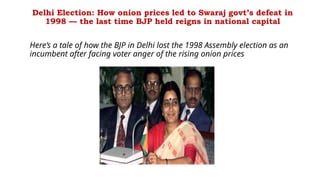
Delhi Election: How onion prices led to Swaraj govt’s defeat in
1998 — the last time BJP held reigns in national capital
Here’s a tale of how the BJP in Delhi lost the 1998 Assembly election as an
incumbent after facing voter anger of the rising onion prices
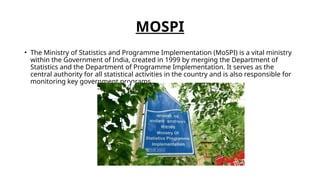
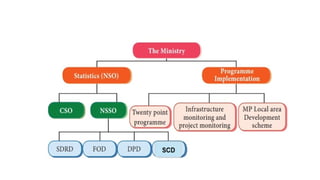
MOSPI
• The Ministry of Statistics and Programme Implementation (MoSPI) is a vital ministry
within the Government of India, created in 1999 by merging the Department of
Statistics and the Department of Programme Implementation. It serves as the
central authority for all statistical activities in the country and is also responsible for
monitoring key government programs.
NSSO
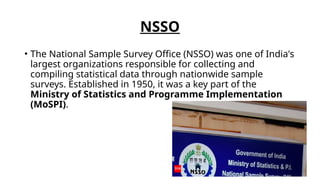
• The National Sample Survey Office (NSSO) was one of India's
largest organizations responsible for collecting and
compiling statistical data through nationwide sample
surveys. Established in 1950, it was a key part of the
Ministry of Statistics and Programme Implementation
(MoSPI).
Key Functions and Activities
• Socio-Economic Surveys: The NSSO regularly conducted surveys on topics such as
employment and unemployment, consumer expenditure, health, education, and
social consumption.
• Annual Survey of Industries (ASI): It was also responsible for conducting the ASI,
which provides detailed data on the organized manufacturing sector, including
information on employment, capital, and production.
• Price and Agricultural Statistics: The NSSO collected data on rural and urban
prices, which were used in the calculation of price indices. It also assisted in the
improvement of agricultural statistics by supervising crop estimation surveys
conducted by state agencies.
• Urban Frame Survey (UFS): To ensure comprehensive data collection in urban
areas, the NSSO maintained and updated a frame of urban blocks to be used as
sampling units for its surveys.
NSSO
•The NSSO has four divisions:
1)Survey Design and Research Division (SDRD), Headquarter at
Kolkata.
2)The Field Operations Division (FOD), Headquarter at New Delhi
3)The Data Processing Division (DPD)
4)Survey Co-ordination Division
FOD is conducting field work of various surveys, viz,
1)Socio-Economic Survey (SE),
2)Annual Survey of Industries (ASI),
3)Urban Frame Survey (UFS),
4)Time Use Survey (TUS)
5)Agriculture Surveys
6)ASUSE (Annual Survey on Unincorporated Sector Enterprises)
7)ASSSE (Annual Survey of Service Sector Enterprises)
8)HCES (Household consumption expenditure survey)
9)Price Collection Surveys like Rural Price Collection (RPC), Consumer Price Index
CPI (U), Wholesale Price Index (WPI), and
10)Other ad-hoc surveys like Periodic Labour Force Survey (PLFS), etc.
CSO
• The Central Statistical Office (CSO) was a key statistical
agency in India, responsible for coordinating statistical
activities and compiling major economic indicators. It was
part of the Ministry of Statistics and Programme
Implementation (MoSPI).
Key Functions
• National Accounts: Compile and release official macroeconomic statistics, including
India's Gross Domestic Product (GDP), Gross Value Added (GVA), and other national
income estimates.
• Industrial Statistics: Conduct the Annual Survey of Industries (ASI) to collect detailed
data on the factory sector and compile the Index of Industrial Production (IIP), a key
economic indicator of industrial growth.
• Economic Censuses: Undertake periodic Economic Censuses to gather data on all non-
agricultural establishments across the country.
• Coordination: Coordinate statistical work among various central and state government
departments to ensure a cohesive and standardized statistical system.
• Training and Standards: Provide training in official statistics and maintain statistical
standards in the country.
PREVIOUS YEAR QUESTIONS
1. Which of the following is the nodal agency for planning
the statistical system of India and for compiling National
Accounts Statistics?
A.Reserve Bank of India (RBI)
B.Central Statistical Office (CSO)
C.Indian Statistical Institute (ISI)
D.National Sample Survey Office (NSSO)
• Right answer
• The Central Statistical Office (CSO) was the primary body
responsible for these functions before the formation of the
National Statistical Office (NSO).
2. The National Sample Survey Office (NSSO) is primarily
responsible for:
A. Compiling the Index of Industrial Production (IIP).
B. Conducting large-scale sample surveys on socio-economic
topics.
C. Managing the Indian Statistical Service cadre.
D. Conducting the decennial Census of India.
• The core function of the NSSO is to collect data through
nationwide sample surveys on various socio-economic issues
like employment and consumer expenditure.
3. Which of the following bodies were merged in 2019 to
form the National Statistical Office (NSO) under MoSPI?
A.Reserve Bank of India (RBI) and Central Statistics Office
(CSO)
B.Ministry of Home Affairs and Ministry of Statistics and
Programme Implementation
C.Central Statistics Office (CSO) and National Sample Survey
Office (NSSO)
D.National Sample Survey Office (NSSO) and Indian Statistical
Institute (ISI)
Answer- C
4. The Annual Survey of Industries (ASI) is conducted by:
A.The Labour Bureau
B.The National Sample Survey Office (NSSO)
C.The Central Statistics Office (CSO)
D.The Ministry of Commerce and Industry
• Answer- C
5. The Economic Census in India is conducted to collect
data on:
A.All non-agricultural establishments in the country.
B.Only agricultural establishments.
C.The financial status of households.
D.Employment statistics in the public sector only.
Right answer
The Economic Census is a comprehensive count of all
economic units engaged in non-agricultural activities in India.
6. Which of the following is not a function of the National
Statistical Office (NSO)?
A.Conducting large-scale sample surveys.
B.Conducting the decennial Census of India.
C.Compilation of National Accounts Statistics.
D.Compiling the Index of Industrial Production (IIP).
Right answer
The Census is conducted by the Office of the Registrar
General and Census Commissioner, which falls under the
Ministry of Home Affairs.
7. The National Sample Survey Office (NSSO) was set up in
which year?
a) 1947
b) 1950
c) 1956
d) 1961
Answer: b) 1950
8. Which of the following is NOT a function of the Central
Statistics Office (CSO) (before the merger)?
a) Providing estimates of National Income.
b) Providing data related to employment.
c) Conducting the Annual Survey of Industries.
d) Coordinating statistical activities in India.
Answer: b) Providing data related to employment. (This was
the primary function of the NSSO).
9. In which year were the NSSO and CSO merged to form
the National Statistical Office (NSO)?
(A) 2017
(B) 2018
(C) 2019
(D) 2020
Answer- (C) 2019
10. Which of the following bodies is responsible for the
collection of data on agricultural production and prices at
the state level?
(A) National Statistical Office (NSO)
(B) Ministry of Agriculture
(C) Directorates of Economics & Statistics (DES)
(D) Reserve Bank of India (RBI)
Answer-(C) Directorates of Economics & Statistics (DES)
11. The merger of NSSO and CSO was aimed at:
(A) Reducing government expenditure
(B) Enhancing the efficiency and coherence of statistical
operations
(C) Decentralizing statistical functions
(D) Increasing the number of surveys conducted
Answer- (B) Enhancing the efficiency and coherence of
statistical operations
12. The National Statistical Commission (NSC), an apex
advisory body on statistical matters, was set up on the
recommendations of which committee?
(A) M. S. Swaminathan Committee
(B) P. C. Mahalanobis Committee
(C) C. Rangarajan Commission
(D) Tendulkar Committee
Answer-(C) C. Rangarajan Commission
13. Which organization is responsible for compiling and
releasing the Consumer Price Index (CPI) in India?
(A) Reserve Bank of India (RBI)
(B) Ministry of Finance
(C) National Statistical Office (NSO)
(D) National Sample Survey Office (NSSO)
Answer- (C) National Statistical Office (NSO)
14. The 'National Accounts Statistics' publication,
containing data on GDP, is released by:
(A) National Sample Survey Office (NSSO)
(B) Central Statistical Office (CSO)
(C) Reserve Bank of India (RBI)
(D) Ministry of Finance
Answer-(B) Central Statistical Office (CSO)
15. Which one of the following is the apex body for the co-
ordination of statistical activities in India?
a) Reserve Bank of India (RBI)
b) Planning Commission
c) National Statistical Commission (NSC)
d) Ministry of Statistics and Pro- gramme Implementation
(MoSPI)
Answer-c) National Statistical Commission (NSC)
CENSUS
Meaning
A census is the complete enumeration of all items in a
population at a specified time.
In statistics, it refers to the process of collecting, compiling,
analyzing, and publishing data about every member of the
population.
In India, it mainly refers to the Population Census, but the
method can be applied in various fields (agriculture, industry,
etc.).
Features
Complete enumeration – Every individual/unit is counted.
Specified reference date – Data refers to a fixed point in
time.
Universality – Covers the whole population.
Periodicity – Conducted at regular intervals (in India, every
10 years).
Government responsibility – Usually conducted by a
national government authority
Census in India
• First Census: 1872 (non-synchronous).
• First synchronous census: 1881.
• Conducted every 10 years by the Office of the Registrar
General and Census Commissioner, India.
• Latest completed census: 2011.
• 2021 Census delayed due to COVID-19.
Types of Census
• De facto Census – Counts people where they are found on
census day.
• De jure Census – Counts people at their usual place of
residence.
• Housing Census – Information about dwellings, facilities,
and amenities.
• Agricultural Census – Data on farms, land use, crop
patterns, etc.
• Economic Census – Data on business establishments,
workforce, income generation.
Advantages
• Accurate and comprehensive.
• Provides benchmark data for planning and policy.
• Basis for sample surveys.
• Helps in socio-economic analysis.
Limitations
• Costly and time-consuming.
• Requires a large workforce and strict supervision.
• Not suitable for frequently changing populations.
• Possibility of undercounting or overcounting.
Agricultural Statistics
Meaning
• Agricultural statistics are numerical data related to
agricultural production, productivity, land use, inputs,
prices, etc.
• They help measure agricultural performance and guide
policy-making.
Covers data on:
• Land use statistics – Cultivated land, fallow land, forest area,
etc.
• Crop area and production – Acreage, yield, total output.
• Irrigation statistics – Sources, coverage, efficiency.
• Livestock statistics – Population, breeds, production of milk,
meat, eggs.
• Agricultural inputs – Fertilizer use, seeds, machinery, labor.
• Prices and marketing – Wholesale/retail prices, market
arrivals.
• Weather statistics – Rainfall, temperature, drought conditions.
Sources of Agricultural Statistics in India
• Land Records System
• Maintained by village revenue agencies.
• Provides area under crops, land use, irrigation data.
• Sample Surveys
• Crop cutting experiments (for yield estimation).
• National Sample Survey Office (NSSO) surveys.
• Agricultural Census
• Conducted every 5 years.
• Provides data on operational holdings, land distribution, tenancy.
• Livestock Census
• Conducted every 5 years.
• Data on cattle, poultry, etc.
• Market Intelligence
• Data from Agricultural Produce Market Committees (APMCs).
• Remote Sensing
• Satellite data for crop acreage and condition.
Importance
• Helps in food security planning.
• Assists in price stabilization policies.
• Guides allocation of subsidies and credit.
• Supports research in agriculture.
• Aids in monitoring progress of agricultural schemes.
Limitations
• Delay in publication of data.
• Incomplete coverage in remote areas.
• Outdated land records in some states.
• Lack of uniformity in data collection methods
Recent Improvements
• Digitization of land records.
• Use of satellite imagery and drones for crop estimation.
• Real-time market price monitoring through apps.
• Integration of weather data with crop forecasting.
PREVIOUS YEAR QUESTIONS
Q1. The first synchronous census in India was conducted in:
(a) 1872
(b) 1881
(c) 1891
(d) 1901
• Answer-(b) 1881
Q2. De facto census means:
(a) Counting people at their usual place of residence
(b) Counting people where they are found on census day
(c) Counting houses instead of people
(d) Counting agricultural holdings
• Answer-(b) Counting people where they are found on census
day
Q3. The Registrar General and Census Commissioner of
India works under:
(a) Ministry of Agriculture
(b) Ministry of Home Affairs
(c) Ministry of Statistics and Programme Implementation
(d) NITI Aayog
Answer-(b) Ministry of Home Affairs
Q4. Agricultural statistics deal primarily with:
(a) Industrial production data
(b) Crop production, land use, and agricultural inputs
(c) Population growth rates
(d) Housing data
• Answer-(b) Crop production, land use, and agricultural
inputs
Q5. Which of the following is not a source of agricultural
statistics in India?
(a) Land records system
(b) Agricultural Census
(c) Livestock Census
(d) Population Census
• Answer-(d) Population Census
Q6. Remote sensing in agriculture is primarily used for:
(a) Estimating industrial output
(b) Crop acreage and condition monitoring
(c) Counting population
(d) Conducting economic surveys
• Answer-(b) Crop acreage and condition monitoring
Q7. A major limitation of agricultural statistics in India is:
(a) Real-time reporting
(b) Delay in publication of data
(c) Use of modern satellite techniques
(d) Availability of multiple sources
• Answer-(b) Delay in publication of data
Q8. Which of the following methods is common to both
population census and agricultural census?
(a) Sample survey
(b) Remote sensing
(c) Complete enumeration
(d) Crop cutting
• Answer-(c) Complete enumeration
Q9. In India, the first agricultural census was conducted in:
(a) 1950-51
(b) 1960-61
(c) 1970-71
(d) 1980-81
• Answer-(c) 1970-71
Q10. The primary use of census data is:
(a) Marketing research
(b) Planning and policy formulation
(c) Private company profit analysis
(d) None of the above
• Answer-(b) Planning and policy formulation
Q11. The Agricultural Census in India is conducted every:
(a) 3 years
(b) 4 years
(c) 5 years
(d) 10 years
• Answer-(c) 5 years
Official Statistics
• The Programme Implementation wing of MOSPI focuses
on monitoring, evaluation, and coordination of important
government schemes and projects to ensure timely
completion, effective use of funds, and achievement of
intended results.
Main Functions
• Monitoring of Infrastructure Projects
• Keeps track of large and important projects costing ₹150 crore and above in
sectors like power, railways, roads, telecom, petroleum, etc.
• Identifies delays, cost overruns, and suggests corrective measures.
• Monitoring of Plan Schemes
• Reviews 20-point Programme (TPP) performance — covering poverty alleviation,
employment, housing, education, and environment.
• Collects progress reports from ministries and states, prepares consolidated reports.
• Monitoring of Member of Parliament Local Area Development Scheme
(MPLADS)
• Tracks fund release and utilization under MPLADS.
• Ensures assets created under MPLADS meet guidelines and benefit local
communities.
• Evaluation of Programmes
• Conducts studies and impact assessments of major government initiatives.
• Suggests policy improvements based on findings.
MLALADS
Odisha
• With effect from the 2020-21 fiscal year, each MLA is allocated ₹3
crore per year, broken down into:
• ₹2 crore: General Component
• ₹0.5 crore: Education Component
• ₹0.5 crore: Road Component
MPLADS
From April 1, 2023, with the introduction of the eSAKSHI portal,
the full ₹5 crore entitlement is authorized in one instalment at
the start of the financial year or the MP's term.
20-Point Programme (TPP)
• The Twenty Point Programme was first announced in 1975 to
promote social justice, reduce poverty, and improve the quality
of life for the poor. It has been revised several times — the
latest version is TPP-2006, implemented from 1 April 2007.
Objectives
• Eradicate poverty.
• Improve living standards of the poor.
• Promote employment and education.
• Provide basic infrastructure in rural and urban areas.
• Ensure environmental protection.
Main Components
A. Eradication of Poverty
• Poverty alleviation programmes (e.g., rural employment).
• Employment generation in rural areas.
• Self-employment schemes for the poor.
• Housing for the poor.
• Education for all.
B. Raising Productivity
• Land reforms.
• Irrigation and water management.
• Increased food grain production.
• Improved credit for farmers.
• Small-scale industries promotion.
• Promotion of renewable energy.
. Improving Quality of Life
• Health for all.
• Protection of the environment.
• Drinking water supply.
• Electrification of villages.
• Welfare of Scheduled Castes, Scheduled Tribes, and women.
• Development of backward areas.
• Public distribution system strengthening.
• Nutrition programmes.
• Urban slum improvement.
Monitoring
• Implemented by States/UTs and Central Ministries.
• Progress is monitored by MOSPI at the national level.
• Uses physical and financial targets to track performance.
PREVIOUS YEAR QUESTIONS
Q1. The original aim of the 20-Point Programme was to:
a) Increase GDP growth
b) Eradicate poverty and improve living standards of the poor
c) Modernise industries
d) Improve India’s foreign trade
Answer: b) Eradicate poverty and improve living
standards of the poor
Q2. The 20-Point Programme in India was first introduced in:
a) 1965
b) 1975
c) 1980
d) 1991
Answer: b) 1975
Q3. How many broad categories are the 20 points grouped
into?
a) 2
b) 3
c) 4
d) 5
Answer: b) 3
Q4. Which of these is a scheme under the poverty alleviation
component of the 20-Point Programme?
a) MPLADS
b) PMAY (Housing for All)
c) BharatNet
d) UDAN
Answer: b) PMAY (Housing for All)
Q5. Which of the following is not a focus area of the 20-Point
Programme?
a) Eradication of poverty
b) Raising productivity
c) Improving quality of life
d) Defence modernization
Answer: d) Defence modernisation
Q6. Which ministry monitors the 20-Point Programme at the
national level?
a) Ministry of Rural Development
b) Ministry of Statistics and Programme Implementation
(MOSPI)
c) NITI Aayog
d) Ministry of Finance
Answer: b) Ministry of Statistics and Programme
Implementation (MOSPI)
Q7. The latest version of the 20-Point Programme, known as
TPP-2006, was implemented from:
a) 1 January 2006
b) 1 April 2006
c) 1 April 2007
d) 1 January 2007
Answer: c) 1 April 2007
Q8. Protection of forests and environment is a part of which
category?
a) Eradication of poverty
b) Raising productivity
c) Improving quality of life
d) Industrial growth
Answer: c) Improving quality of life
Q9. Who is responsible for the implementation of TPP at the
state level?
a) State Planning Boards
b) State Statistical Bureaus and Nodal Departments
c) Local NGOs
d) NITI Aayog
Answer: b) State Statistical Bureaus and Nodal
Departments
Q10. Monitoring of TPP progress is done on a:
a) Weekly basis
b) Monthly basis
c) Quarterly basis
d) Yearly basis
Answer: c) Quarterly basis
Q11. Which of these is an employment generation
programme under TPP?
a) PMGSY
b) MGNREGA
c) GST
d) Make in India
Answer: b) MGNREGA
Official Statistics p0wer point download

Official Statistics p0wer point download

  • 1.
  • 2.
    Delhi Election: Howonion prices led to Swaraj govt’s defeat in 1998 — the last time BJP held reigns in national capital Here’s a tale of how the BJP in Delhi lost the 1998 Assembly election as an incumbent after facing voter anger of the rising onion prices
  • 4.
    MOSPI • The Ministryof Statistics and Programme Implementation (MoSPI) is a vital ministry within the Government of India, created in 1999 by merging the Department of Statistics and the Department of Programme Implementation. It serves as the central authority for all statistical activities in the country and is also responsible for monitoring key government programs.
  • 6.
    NSSO • The NationalSample Survey Office (NSSO) was one of India's largest organizations responsible for collecting and compiling statistical data through nationwide sample surveys. Established in 1950, it was a key part of the Ministry of Statistics and Programme Implementation (MoSPI).
  • 7.
    Key Functions andActivities • Socio-Economic Surveys: The NSSO regularly conducted surveys on topics such as employment and unemployment, consumer expenditure, health, education, and social consumption. • Annual Survey of Industries (ASI): It was also responsible for conducting the ASI, which provides detailed data on the organized manufacturing sector, including information on employment, capital, and production. • Price and Agricultural Statistics: The NSSO collected data on rural and urban prices, which were used in the calculation of price indices. It also assisted in the improvement of agricultural statistics by supervising crop estimation surveys conducted by state agencies. • Urban Frame Survey (UFS): To ensure comprehensive data collection in urban areas, the NSSO maintained and updated a frame of urban blocks to be used as sampling units for its surveys.
  • 8.
    NSSO •The NSSO hasfour divisions: 1)Survey Design and Research Division (SDRD), Headquarter at Kolkata. 2)The Field Operations Division (FOD), Headquarter at New Delhi 3)The Data Processing Division (DPD) 4)Survey Co-ordination Division
  • 9.
    FOD is conductingfield work of various surveys, viz, 1)Socio-Economic Survey (SE), 2)Annual Survey of Industries (ASI), 3)Urban Frame Survey (UFS), 4)Time Use Survey (TUS) 5)Agriculture Surveys 6)ASUSE (Annual Survey on Unincorporated Sector Enterprises) 7)ASSSE (Annual Survey of Service Sector Enterprises) 8)HCES (Household consumption expenditure survey) 9)Price Collection Surveys like Rural Price Collection (RPC), Consumer Price Index CPI (U), Wholesale Price Index (WPI), and 10)Other ad-hoc surveys like Periodic Labour Force Survey (PLFS), etc.
  • 10.
    CSO • The CentralStatistical Office (CSO) was a key statistical agency in India, responsible for coordinating statistical activities and compiling major economic indicators. It was part of the Ministry of Statistics and Programme Implementation (MoSPI).
  • 11.
    Key Functions • NationalAccounts: Compile and release official macroeconomic statistics, including India's Gross Domestic Product (GDP), Gross Value Added (GVA), and other national income estimates. • Industrial Statistics: Conduct the Annual Survey of Industries (ASI) to collect detailed data on the factory sector and compile the Index of Industrial Production (IIP), a key economic indicator of industrial growth. • Economic Censuses: Undertake periodic Economic Censuses to gather data on all non- agricultural establishments across the country. • Coordination: Coordinate statistical work among various central and state government departments to ensure a cohesive and standardized statistical system. • Training and Standards: Provide training in official statistics and maintain statistical standards in the country.
  • 12.
  • 13.
    1. Which ofthe following is the nodal agency for planning the statistical system of India and for compiling National Accounts Statistics? A.Reserve Bank of India (RBI) B.Central Statistical Office (CSO) C.Indian Statistical Institute (ISI) D.National Sample Survey Office (NSSO) • Right answer • The Central Statistical Office (CSO) was the primary body responsible for these functions before the formation of the National Statistical Office (NSO).
  • 14.
    2. The NationalSample Survey Office (NSSO) is primarily responsible for: A. Compiling the Index of Industrial Production (IIP). B. Conducting large-scale sample surveys on socio-economic topics. C. Managing the Indian Statistical Service cadre. D. Conducting the decennial Census of India. • The core function of the NSSO is to collect data through nationwide sample surveys on various socio-economic issues like employment and consumer expenditure.
  • 15.
    3. Which ofthe following bodies were merged in 2019 to form the National Statistical Office (NSO) under MoSPI? A.Reserve Bank of India (RBI) and Central Statistics Office (CSO) B.Ministry of Home Affairs and Ministry of Statistics and Programme Implementation C.Central Statistics Office (CSO) and National Sample Survey Office (NSSO) D.National Sample Survey Office (NSSO) and Indian Statistical Institute (ISI) Answer- C
  • 16.
    4. The AnnualSurvey of Industries (ASI) is conducted by: A.The Labour Bureau B.The National Sample Survey Office (NSSO) C.The Central Statistics Office (CSO) D.The Ministry of Commerce and Industry • Answer- C
  • 17.
    5. The EconomicCensus in India is conducted to collect data on: A.All non-agricultural establishments in the country. B.Only agricultural establishments. C.The financial status of households. D.Employment statistics in the public sector only. Right answer The Economic Census is a comprehensive count of all economic units engaged in non-agricultural activities in India.
  • 18.
    6. Which ofthe following is not a function of the National Statistical Office (NSO)? A.Conducting large-scale sample surveys. B.Conducting the decennial Census of India. C.Compilation of National Accounts Statistics. D.Compiling the Index of Industrial Production (IIP). Right answer The Census is conducted by the Office of the Registrar General and Census Commissioner, which falls under the Ministry of Home Affairs.
  • 19.
    7. The NationalSample Survey Office (NSSO) was set up in which year? a) 1947 b) 1950 c) 1956 d) 1961 Answer: b) 1950
  • 20.
    8. Which ofthe following is NOT a function of the Central Statistics Office (CSO) (before the merger)? a) Providing estimates of National Income. b) Providing data related to employment. c) Conducting the Annual Survey of Industries. d) Coordinating statistical activities in India. Answer: b) Providing data related to employment. (This was the primary function of the NSSO).
  • 21.
    9. In whichyear were the NSSO and CSO merged to form the National Statistical Office (NSO)? (A) 2017 (B) 2018 (C) 2019 (D) 2020 Answer- (C) 2019
  • 22.
    10. Which ofthe following bodies is responsible for the collection of data on agricultural production and prices at the state level? (A) National Statistical Office (NSO) (B) Ministry of Agriculture (C) Directorates of Economics & Statistics (DES) (D) Reserve Bank of India (RBI) Answer-(C) Directorates of Economics & Statistics (DES)
  • 23.
    11. The mergerof NSSO and CSO was aimed at: (A) Reducing government expenditure (B) Enhancing the efficiency and coherence of statistical operations (C) Decentralizing statistical functions (D) Increasing the number of surveys conducted Answer- (B) Enhancing the efficiency and coherence of statistical operations
  • 24.
    12. The NationalStatistical Commission (NSC), an apex advisory body on statistical matters, was set up on the recommendations of which committee? (A) M. S. Swaminathan Committee (B) P. C. Mahalanobis Committee (C) C. Rangarajan Commission (D) Tendulkar Committee Answer-(C) C. Rangarajan Commission
  • 25.
    13. Which organizationis responsible for compiling and releasing the Consumer Price Index (CPI) in India? (A) Reserve Bank of India (RBI) (B) Ministry of Finance (C) National Statistical Office (NSO) (D) National Sample Survey Office (NSSO) Answer- (C) National Statistical Office (NSO)
  • 26.
    14. The 'NationalAccounts Statistics' publication, containing data on GDP, is released by: (A) National Sample Survey Office (NSSO) (B) Central Statistical Office (CSO) (C) Reserve Bank of India (RBI) (D) Ministry of Finance Answer-(B) Central Statistical Office (CSO)
  • 27.
    15. Which oneof the following is the apex body for the co- ordination of statistical activities in India? a) Reserve Bank of India (RBI) b) Planning Commission c) National Statistical Commission (NSC) d) Ministry of Statistics and Pro- gramme Implementation (MoSPI) Answer-c) National Statistical Commission (NSC)
  • 29.
  • 30.
    Meaning A census isthe complete enumeration of all items in a population at a specified time. In statistics, it refers to the process of collecting, compiling, analyzing, and publishing data about every member of the population. In India, it mainly refers to the Population Census, but the method can be applied in various fields (agriculture, industry, etc.).
  • 31.
    Features Complete enumeration –Every individual/unit is counted. Specified reference date – Data refers to a fixed point in time. Universality – Covers the whole population. Periodicity – Conducted at regular intervals (in India, every 10 years). Government responsibility – Usually conducted by a national government authority
  • 32.
    Census in India •First Census: 1872 (non-synchronous). • First synchronous census: 1881. • Conducted every 10 years by the Office of the Registrar General and Census Commissioner, India. • Latest completed census: 2011. • 2021 Census delayed due to COVID-19.
  • 33.
    Types of Census •De facto Census – Counts people where they are found on census day. • De jure Census – Counts people at their usual place of residence. • Housing Census – Information about dwellings, facilities, and amenities. • Agricultural Census – Data on farms, land use, crop patterns, etc. • Economic Census – Data on business establishments, workforce, income generation.
  • 34.
    Advantages • Accurate andcomprehensive. • Provides benchmark data for planning and policy. • Basis for sample surveys. • Helps in socio-economic analysis.
  • 35.
    Limitations • Costly andtime-consuming. • Requires a large workforce and strict supervision. • Not suitable for frequently changing populations. • Possibility of undercounting or overcounting.
  • 36.
  • 37.
    Meaning • Agricultural statisticsare numerical data related to agricultural production, productivity, land use, inputs, prices, etc. • They help measure agricultural performance and guide policy-making.
  • 38.
    Covers data on: •Land use statistics – Cultivated land, fallow land, forest area, etc. • Crop area and production – Acreage, yield, total output. • Irrigation statistics – Sources, coverage, efficiency. • Livestock statistics – Population, breeds, production of milk, meat, eggs. • Agricultural inputs – Fertilizer use, seeds, machinery, labor. • Prices and marketing – Wholesale/retail prices, market arrivals. • Weather statistics – Rainfall, temperature, drought conditions.
  • 39.
    Sources of AgriculturalStatistics in India • Land Records System • Maintained by village revenue agencies. • Provides area under crops, land use, irrigation data. • Sample Surveys • Crop cutting experiments (for yield estimation). • National Sample Survey Office (NSSO) surveys. • Agricultural Census • Conducted every 5 years. • Provides data on operational holdings, land distribution, tenancy. • Livestock Census • Conducted every 5 years. • Data on cattle, poultry, etc. • Market Intelligence • Data from Agricultural Produce Market Committees (APMCs). • Remote Sensing • Satellite data for crop acreage and condition.
  • 40.
    Importance • Helps infood security planning. • Assists in price stabilization policies. • Guides allocation of subsidies and credit. • Supports research in agriculture. • Aids in monitoring progress of agricultural schemes.
  • 41.
    Limitations • Delay inpublication of data. • Incomplete coverage in remote areas. • Outdated land records in some states. • Lack of uniformity in data collection methods
  • 42.
    Recent Improvements • Digitizationof land records. • Use of satellite imagery and drones for crop estimation. • Real-time market price monitoring through apps. • Integration of weather data with crop forecasting.
  • 43.
  • 44.
    Q1. The firstsynchronous census in India was conducted in: (a) 1872 (b) 1881 (c) 1891 (d) 1901 • Answer-(b) 1881
  • 45.
    Q2. De factocensus means: (a) Counting people at their usual place of residence (b) Counting people where they are found on census day (c) Counting houses instead of people (d) Counting agricultural holdings • Answer-(b) Counting people where they are found on census day
  • 46.
    Q3. The RegistrarGeneral and Census Commissioner of India works under: (a) Ministry of Agriculture (b) Ministry of Home Affairs (c) Ministry of Statistics and Programme Implementation (d) NITI Aayog Answer-(b) Ministry of Home Affairs
  • 47.
    Q4. Agricultural statisticsdeal primarily with: (a) Industrial production data (b) Crop production, land use, and agricultural inputs (c) Population growth rates (d) Housing data • Answer-(b) Crop production, land use, and agricultural inputs
  • 48.
    Q5. Which ofthe following is not a source of agricultural statistics in India? (a) Land records system (b) Agricultural Census (c) Livestock Census (d) Population Census • Answer-(d) Population Census
  • 49.
    Q6. Remote sensingin agriculture is primarily used for: (a) Estimating industrial output (b) Crop acreage and condition monitoring (c) Counting population (d) Conducting economic surveys • Answer-(b) Crop acreage and condition monitoring
  • 50.
    Q7. A majorlimitation of agricultural statistics in India is: (a) Real-time reporting (b) Delay in publication of data (c) Use of modern satellite techniques (d) Availability of multiple sources • Answer-(b) Delay in publication of data
  • 51.
    Q8. Which ofthe following methods is common to both population census and agricultural census? (a) Sample survey (b) Remote sensing (c) Complete enumeration (d) Crop cutting • Answer-(c) Complete enumeration
  • 52.
    Q9. In India,the first agricultural census was conducted in: (a) 1950-51 (b) 1960-61 (c) 1970-71 (d) 1980-81 • Answer-(c) 1970-71
  • 53.
    Q10. The primaryuse of census data is: (a) Marketing research (b) Planning and policy formulation (c) Private company profit analysis (d) None of the above • Answer-(b) Planning and policy formulation
  • 54.
    Q11. The AgriculturalCensus in India is conducted every: (a) 3 years (b) 4 years (c) 5 years (d) 10 years • Answer-(c) 5 years
  • 56.
  • 57.
    • The ProgrammeImplementation wing of MOSPI focuses on monitoring, evaluation, and coordination of important government schemes and projects to ensure timely completion, effective use of funds, and achievement of intended results.
  • 58.
    Main Functions • Monitoringof Infrastructure Projects • Keeps track of large and important projects costing ₹150 crore and above in sectors like power, railways, roads, telecom, petroleum, etc. • Identifies delays, cost overruns, and suggests corrective measures. • Monitoring of Plan Schemes • Reviews 20-point Programme (TPP) performance — covering poverty alleviation, employment, housing, education, and environment. • Collects progress reports from ministries and states, prepares consolidated reports. • Monitoring of Member of Parliament Local Area Development Scheme (MPLADS) • Tracks fund release and utilization under MPLADS. • Ensures assets created under MPLADS meet guidelines and benefit local communities. • Evaluation of Programmes • Conducts studies and impact assessments of major government initiatives. • Suggests policy improvements based on findings.
  • 59.
    MLALADS Odisha • With effectfrom the 2020-21 fiscal year, each MLA is allocated ₹3 crore per year, broken down into: • ₹2 crore: General Component • ₹0.5 crore: Education Component • ₹0.5 crore: Road Component MPLADS From April 1, 2023, with the introduction of the eSAKSHI portal, the full ₹5 crore entitlement is authorized in one instalment at the start of the financial year or the MP's term.
  • 60.
    20-Point Programme (TPP) •The Twenty Point Programme was first announced in 1975 to promote social justice, reduce poverty, and improve the quality of life for the poor. It has been revised several times — the latest version is TPP-2006, implemented from 1 April 2007. Objectives • Eradicate poverty. • Improve living standards of the poor. • Promote employment and education. • Provide basic infrastructure in rural and urban areas. • Ensure environmental protection.
  • 61.
    Main Components A. Eradicationof Poverty • Poverty alleviation programmes (e.g., rural employment). • Employment generation in rural areas. • Self-employment schemes for the poor. • Housing for the poor. • Education for all.
  • 62.
    B. Raising Productivity •Land reforms. • Irrigation and water management. • Increased food grain production. • Improved credit for farmers. • Small-scale industries promotion. • Promotion of renewable energy.
  • 63.
    . Improving Qualityof Life • Health for all. • Protection of the environment. • Drinking water supply. • Electrification of villages. • Welfare of Scheduled Castes, Scheduled Tribes, and women. • Development of backward areas. • Public distribution system strengthening. • Nutrition programmes. • Urban slum improvement.
  • 64.
    Monitoring • Implemented byStates/UTs and Central Ministries. • Progress is monitored by MOSPI at the national level. • Uses physical and financial targets to track performance.
  • 65.
  • 66.
    Q1. The originalaim of the 20-Point Programme was to: a) Increase GDP growth b) Eradicate poverty and improve living standards of the poor c) Modernise industries d) Improve India’s foreign trade Answer: b) Eradicate poverty and improve living standards of the poor
  • 67.
    Q2. The 20-PointProgramme in India was first introduced in: a) 1965 b) 1975 c) 1980 d) 1991 Answer: b) 1975
  • 68.
    Q3. How manybroad categories are the 20 points grouped into? a) 2 b) 3 c) 4 d) 5 Answer: b) 3
  • 69.
    Q4. Which ofthese is a scheme under the poverty alleviation component of the 20-Point Programme? a) MPLADS b) PMAY (Housing for All) c) BharatNet d) UDAN Answer: b) PMAY (Housing for All)
  • 70.
    Q5. Which ofthe following is not a focus area of the 20-Point Programme? a) Eradication of poverty b) Raising productivity c) Improving quality of life d) Defence modernization Answer: d) Defence modernisation
  • 71.
    Q6. Which ministrymonitors the 20-Point Programme at the national level? a) Ministry of Rural Development b) Ministry of Statistics and Programme Implementation (MOSPI) c) NITI Aayog d) Ministry of Finance Answer: b) Ministry of Statistics and Programme Implementation (MOSPI)
  • 72.
    Q7. The latestversion of the 20-Point Programme, known as TPP-2006, was implemented from: a) 1 January 2006 b) 1 April 2006 c) 1 April 2007 d) 1 January 2007 Answer: c) 1 April 2007
  • 73.
    Q8. Protection offorests and environment is a part of which category? a) Eradication of poverty b) Raising productivity c) Improving quality of life d) Industrial growth Answer: c) Improving quality of life
  • 74.
    Q9. Who isresponsible for the implementation of TPP at the state level? a) State Planning Boards b) State Statistical Bureaus and Nodal Departments c) Local NGOs d) NITI Aayog Answer: b) State Statistical Bureaus and Nodal Departments
  • 75.
    Q10. Monitoring ofTPP progress is done on a: a) Weekly basis b) Monthly basis c) Quarterly basis d) Yearly basis Answer: c) Quarterly basis
  • 76.
    Q11. Which ofthese is an employment generation programme under TPP? a) PMGSY b) MGNREGA c) GST d) Make in India Answer: b) MGNREGA