Interest Rates and Monetary Policy
Chapter 34
Copyright © 2015 McGraw-Hill Education. All rights reserved. No reproduction or distribution without the prior written consent of McGraw-Hill Education.
34-2
Monetary Policy
• Monetary policy is the central bank’s attempt
to control the quantity of money and interest
rates to achieve its goals.
• Goals of the federal Reserve in the U.S. include
• Price stability
• Full employment
• Economic growth
• A central bank can control money supply
through banking system and interest rates in
money market.LO1
34-3
Money Market
• Market interest rate is determined through
interaction of demand for money and supply
of money in money market.
• Demand for money comes from households
and firms.
• Supply of money comes from the Federal
Reserve through the banking system.
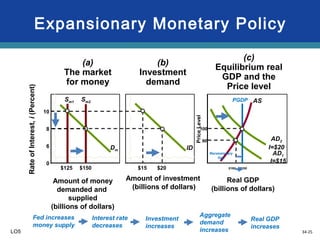
LO1
34-4
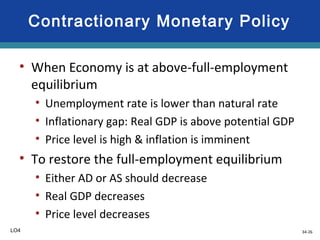
Interest Rates
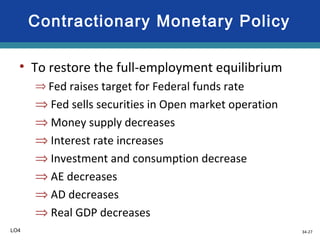
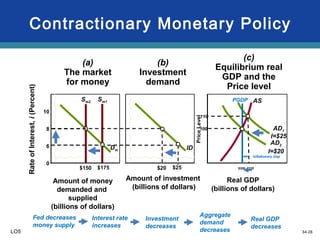
• Interest rate is an opportunity cost of holding
money - the price paid for the use of money
• There are many different interest rates in
economy
• Short-term interest rate is determined in money
market.
• Other interest rates follow the short-term
interest rate changes.
LO1
34-5
Demand for Money
• Two reasons for holding money
• Transactions demand
• Money as medium of exchange
• Households and firms need money for making
payments – they need to carry cash or keep funds in
checking accounts.
• Asset demand
• Money as store of value
• Households and firms keep money for later spending
purpose
LO1
34-6
Transaction Demand for Money
• Transactions demand, Dt
• When households and firms want to spend
more, then must hold more money.
• Households’ income (real GDP)↑
⇒spending↑⇒ money demand↑
• Independent of the interest rate
LO1
34-7
Asset Demand for Money
• Asset demand, Da
• Money is one of many alternatives of store of
value
• Other store of value (e.g. bonds) pays interest
rate. Interest rate is an opportunity cost of
holding money rather than bonds.
• Interest rate↑⇒demand for bonds↑
⇒demand for money↓
• Varies inversely with the interest rate
LO1
34-8
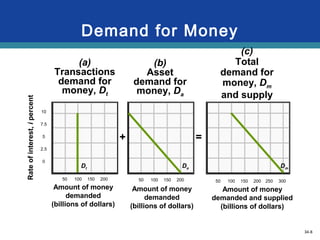
Demand for MoneyRateofinterest,ipercent
10
7.5
5
2.5
0
50 100 150 200 50 100 150 200 50 100 150 200 250 300
Amount of money
demanded
(billions of dollars)
Amount of money
demanded
(billions of dollars)
Amount of money
demanded and supplied
(billions of dollars)
=+
(a)
Transactions
demand for
money, Dt
(b)
Asset
demand for
money, Da
(c)
Total
demand for
money, Dm
and supply
Dt Da Dm
LO1 33-8
34-9
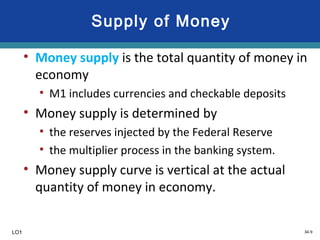
Supply of Money
• Money supply is the total quantity of money in
economy
• M1 includes currencies and checkable deposits
• Money supply is determined by
• the reserves injected by the Federal Reserve
• the multiplier process in the banking system.
• Money supply curve is vertical at the actual
quantity of money in economy.
LO1
34-10
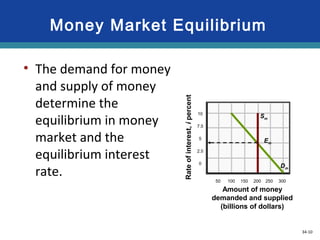
Money Market Equilibrium
Rateofinterest,ipercent
10
7.5
5
2.5
0
50 100 150 200 250 300
Amount of money
demanded and supplied
(billions of dollars)
Dm
Sm
LO1 33-10
• The demand for money
and supply of money
determine the
equilibrium in money
market and the
equilibrium interest
rate.
Em
34-11
Equilibrium Interest Rates
• Changes in money demand or money supply
affect the equilibrium interest rate.
• The Federal Reserve controls the money supply.
By changing money supply the Federal Reserve
can control the equilibrium interest rate in
money market.
• However, the Federal Reserve cannot control both
money supply and interest rate. It must choose a
combination of money supply and interest rate
along the money demand curve.
LO1
34-12
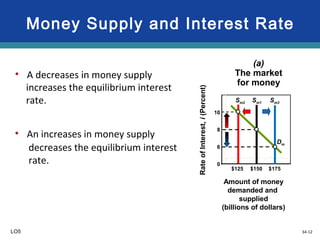
Money Supply and Interest Rate
10
8
6
0
RateofInterest,i(Percent)
Amount of money
demanded and
supplied
(billions of dollars)
$125 $150 $175
Sm2 Sm1 Sm3
Dm
(a)
The market
for money
LO5
• A decreases in money supply
• An increases in money supply
increases the equilibrium interest
rate.
decreases the equilibrium interest
rate.
34-13
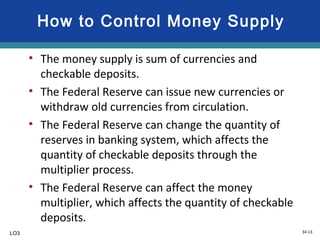
How to Control Money Supply
• The money supply is sum of currencies and
checkable deposits.
• The Federal Reserve can issue new currencies or
withdraw old currencies from circulation.
• The Federal Reserve can change the quantity of
reserves in banking system, which affects the
quantity of checkable deposits through the
multiplier process.
• The Federal Reserve can affect the money
multiplier, which affects the quantity of checkable
deposits.
LO3
34-14
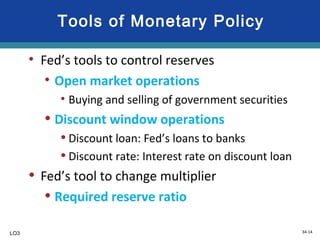
Tools of Monetary Policy
• Fed’s tools to control reserves
• Open market operations
• Buying and selling of government securities
• Discount window operations
• Discount loan: Fed’s loans to banks
• Discount rate: Interest rate on discount loan
• Fed’s tool to change multiplier
• Required reserve ratio
LO3
34-15
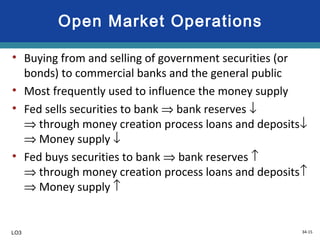
Open Market Operations
• Buying from and selling of government securities (or
bonds) to commercial banks and the general public
• Most frequently used to influence the money supply
• Fed sells securities to bank ⇒ bank reserves ↓
⇒ through money creation process loans and deposits↓
⇒ Money supply ↓
• Fed buys securities to bank ⇒ bank reserves ↑
⇒ through money creation process loans and deposits↑
⇒ Money supply ↑
LO3
34-16
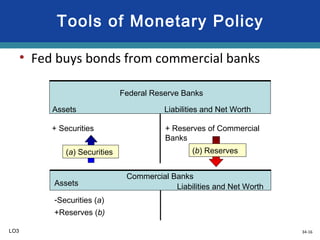
Tools of Monetary Policy
• Fed buys bonds from commercial banks
Assets Liabilities and Net Worth
Federal Reserve Banks
+ Securities + Reserves of Commercial
Banks
(b) Reserves
Commercial Banks
-Securities (a)
+Reserves (b)
Assets Liabilities and Net Worth
(a) Securities
LO3
34-17
Open Market Operations
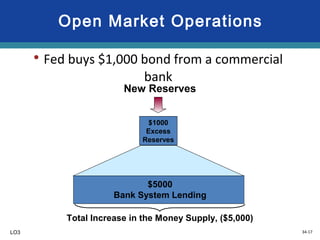
• Fed buys $1,000 bond from a commercial
bank
New Reserves
$5000
Bank System Lending
Total Increase in the Money Supply, ($5,000)
$1000
Excess
Reserves
LO3
34-18
Discount Windows Operations
• The discount loans
• Short term loans
• The Fed changes the discount rate to encourage or
discourage banks to borrow from the Fed
• Passive monetary policy tool – it depends on bank’s
decision on borrowing from the Fed
• Lender of last resort: if no other banks want to make a
loan, the Fed stands to make the loan.
• Term auction facility
• Introduced December 2007
• Banks bid for the right to borrow reserves
• Guaranteed amount lent by the Fed
LO3
34-19
Required Reserve Ratio
• The reserve ratio
• Changes the money multiplier
• Reserve ratio last changed in 1992
• Interest on reserves
• Lower interest rate or even negative interest rate
will discourage banks to hold excess reserves
LO3
34-20
Federal Funds
• Federal Funds: Interbank overnight loans
• Each bank must meet its reserve requirement every
day. Banks with short of reserves borrow funds
from other banks with excess reserves.
• Federal funds rate: Interest rate on the federal funds
• The federal funds rate is determined by the demand
and supply of the federal funds
• Demand and supply of the federal funds are affected
by loans, deposits and reserves in banking system
34-21
The Federal Funds Rate
• The federal funds rate affects all other bank interest
rates
• Instead of trying to affect all interest rates in economy, the
Federal Reserve targets the federal funds rate which in turn
sets other interest rates
• FOMC (Federal Open Market Committee) conducts
open market operations to achieve the target
• Open market operations directly affect the bank reserves
• Reserves ↑ ⇒ Supply of Federal funds ↑ & Demand for
Federal funds ↓ ⇒ federal funds rate ↓
• Reserves ↓ ⇒ Supply of Federal funds ↓ & Demand for
Federal funds ↑ ⇒ federal funds rate ↑
34-22
Monetary Policy
• Two types of Monetary Policy
• Expansionary monetary policy: Used to “Expand”
the economy during a recession by “Expanding”
money supply
• Contractionary (Restrictive) monetary policy:
Used to “Contract” the economy during inflation
by “contracting” money supply
LO4
34-23
Expansionary Monetary Policy
• When Economy is at below-full-employment
equilibrium
• Unemployment rate is higher than natural rate
• Recessionary gap: Real GDP is below potential GDP
• To restore the full-employment equilibrium
• Either AD or AS should increase
• Real GDP increases
• Unemployment rate decreases
LO4
34-24
Expansionary Monetary Policy
• To restore the full-employment equilibrium
⇒ Fed lowers target for Federal funds rate
⇒ Fed buys securities in Open market operation
⇒ Money supply increases
⇒ Interest rate decreases
⇒ Investment and consumption increase
⇒ AE increases
⇒ AD increases
⇒ Real GDP increases
LO4
34-25
Expansionary Monetary Policy
10
8
6
0
RateofInterest,i(Percent)
Amount of money
demanded and
supplied
(billions of dollars)
Amount of investment
(billions of dollars)
PriceLevel
Real GDP
(billions of dollars)
$180 $200$125 $150 $15 $20
100
90
Sm1 Sm2
ID
AD1
I=$15
AD2
I=$20
(a)
The market
for money
(b)
Investment
demand
(c)
Equilibrium real
GDP and the
Price level
AS
LO5
Recessionary
Gap
PGDP
Dm
Fed increases
money supply
Investment
increases
Aggregate
demand
increases
Interest rate
decreases
Real GDP
increases
34-26
Contractionary Monetary Policy
• When Economy is at above-full-employment
equilibrium
• Unemployment rate is lower than natural rate
• Inflationary gap: Real GDP is above potential GDP
• Price level is high & inflation is imminent
• To restore the full-employment equilibrium
• Either AD or AS should decrease
• Real GDP decreases
• Price level decreases
LO4
34-27
Contractionary Monetary Policy
• To restore the full-employment equilibrium
⇒ Fed raises target for Federal funds rate
⇒ Fed sells securities in Open market operation
⇒ Money supply decreases
⇒ Interest rate increases
⇒ Investment and consumption decrease
⇒ AE decreases
⇒ AD decreases
⇒ Real GDP decreases
LO4
34-28
Contractionary Monetary Policy
10
8
6
0
RateofInterest,i(Percent)
Amount of money
demanded and
supplied
(billions of dollars)
Amount of investment
(billions of dollars)
PriceLevel
Real GDP
(billions of dollars)
$220$200$175$150 $25$20
100
110
Sm1Sm2
ID
AD1
I=$25
AD2
I=$20
(a)
The market
for money
(b)
Investment
demand
(c)
Equilibrium real
GDP and the
Price level
AS
LO5
Inflationary Gap
PGDP
Dm
Fed decreases
money supply
Investment
decreases
Aggregate
demand
decreases
Interest rate
increases
Real GDP
decreases
34-29
Evaluation and Issues
• Advantages over fiscal policy
• Speed and flexibility
• Change the target federal funds rate
immediately
• Change the money supply by any amount
• Reverse the policy course easily if necessary
• Isolation from political pressure
• Federal Reserve officers are appointed and
serve for a long term
LO6
34-30
Problems and Complications
• Lags: May not show effects in timely manner
• Even though it can affect interest rate quickly, it takes time
to affect money supply and investment spending
• Passive: Fed cannot directly affect aggregate demand,
but rely on banks’ and firms’ actions
• Cyclical asymmetry: Not effective during depression
• When expected return on projects are low and risk is high,
low interest rate will not affect investment decision
• Liquidity trap: When interest rate is already low near
zero, it cannot further lower the interest rate to
stimulate investment.
LO5 33-30
34-31
Taylor Rule
• Due to lags, discretionary monetary policy may cause
instability of economy
• Set a simple rule for monetary policy
• Set a target inflation rate (2%)
• Set a target real interest rate (2%)
• At full employment, the Fed maintains the target
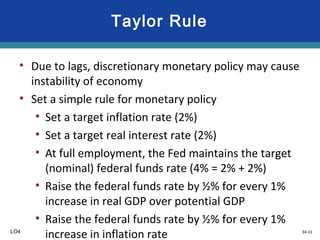
(nominal) federal funds rate (4% = 2% + 2%)
• Raise the federal funds rate by ½% for every 1%
increase in real GDP over potential GDP
• Raise the federal funds rate by ½% for every 1%
increase in inflation rateLO4
34-32
Recent U.S. Monetary Policy
• Highly active in recent decades
• Responded with quick and innovative actions
during the recent financial crisis and the
severe recession
• Critics contend the Fed contributed to the
crisis by keeping the Federal funds rate too
low for too long
LO6
34-33
Long Run Effect of Monetary
Policy
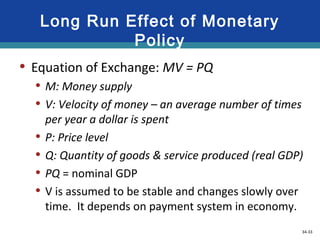
• Equation of Exchange: MV = PQ
• M: Money supply
• V: Velocity of money – an average number of times
per year a dollar is spent
• P: Price level
• Q: Quantity of goods & service produced (real GDP)
• PQ = nominal GDP
• V is assumed to be stable and changes slowly over
time. It depends on payment system in economy.
LO5 33-33
34-34
Long Run Effect of Monetary
Policy
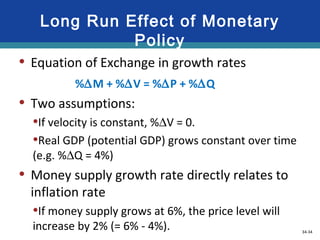
• Equation of Exchange in growth rates
%∆M + %∆V = %∆P + %∆Q
• Two assumptions:
•If velocity is constant, %∆V = 0.
•Real GDP (potential GDP) grows constant over time
(e.g. %∆Q = 4%)
• Money supply growth rate directly relates to
inflation rate
•If money supply grows at 6%, the price level will
increase by 2% (= 6% - 4%).
LO5 33-34

Econ789 chapter034

  • 1.
    Interest Rates andMonetary Policy Chapter 34 Copyright © 2015 McGraw-Hill Education. All rights reserved. No reproduction or distribution without the prior written consent of McGraw-Hill Education.
  • 2.
    34-2 Monetary Policy • Monetarypolicy is the central bank’s attempt to control the quantity of money and interest rates to achieve its goals. • Goals of the federal Reserve in the U.S. include • Price stability • Full employment • Economic growth • A central bank can control money supply through banking system and interest rates in money market.LO1
  • 3.
    34-3 Money Market • Marketinterest rate is determined through interaction of demand for money and supply of money in money market. • Demand for money comes from households and firms. • Supply of money comes from the Federal Reserve through the banking system. LO1
  • 4.
    34-4 Interest Rates • Interestrate is an opportunity cost of holding money - the price paid for the use of money • There are many different interest rates in economy • Short-term interest rate is determined in money market. • Other interest rates follow the short-term interest rate changes. LO1
  • 5.
    34-5 Demand for Money •Two reasons for holding money • Transactions demand • Money as medium of exchange • Households and firms need money for making payments – they need to carry cash or keep funds in checking accounts. • Asset demand • Money as store of value • Households and firms keep money for later spending purpose LO1
  • 6.
    34-6 Transaction Demand forMoney • Transactions demand, Dt • When households and firms want to spend more, then must hold more money. • Households’ income (real GDP)↑ ⇒spending↑⇒ money demand↑ • Independent of the interest rate LO1
  • 7.
    34-7 Asset Demand forMoney • Asset demand, Da • Money is one of many alternatives of store of value • Other store of value (e.g. bonds) pays interest rate. Interest rate is an opportunity cost of holding money rather than bonds. • Interest rate↑⇒demand for bonds↑ ⇒demand for money↓ • Varies inversely with the interest rate LO1
  • 8.
    34-8 Demand for MoneyRateofinterest,ipercent 10 7.5 5 2.5 0 50100 150 200 50 100 150 200 50 100 150 200 250 300 Amount of money demanded (billions of dollars) Amount of money demanded (billions of dollars) Amount of money demanded and supplied (billions of dollars) =+ (a) Transactions demand for money, Dt (b) Asset demand for money, Da (c) Total demand for money, Dm and supply Dt Da Dm LO1 33-8
  • 9.
    34-9 Supply of Money •Money supply is the total quantity of money in economy • M1 includes currencies and checkable deposits • Money supply is determined by • the reserves injected by the Federal Reserve • the multiplier process in the banking system. • Money supply curve is vertical at the actual quantity of money in economy. LO1
  • 10.
    34-10 Money Market Equilibrium Rateofinterest,ipercent 10 7.5 5 2.5 0 50100 150 200 250 300 Amount of money demanded and supplied (billions of dollars) Dm Sm LO1 33-10 • The demand for money and supply of money determine the equilibrium in money market and the equilibrium interest rate. Em
  • 11.
    34-11 Equilibrium Interest Rates •Changes in money demand or money supply affect the equilibrium interest rate. • The Federal Reserve controls the money supply. By changing money supply the Federal Reserve can control the equilibrium interest rate in money market. • However, the Federal Reserve cannot control both money supply and interest rate. It must choose a combination of money supply and interest rate along the money demand curve. LO1
  • 12.
    34-12 Money Supply andInterest Rate 10 8 6 0 RateofInterest,i(Percent) Amount of money demanded and supplied (billions of dollars) $125 $150 $175 Sm2 Sm1 Sm3 Dm (a) The market for money LO5 • A decreases in money supply • An increases in money supply increases the equilibrium interest rate. decreases the equilibrium interest rate.
  • 13.
    34-13 How to ControlMoney Supply • The money supply is sum of currencies and checkable deposits. • The Federal Reserve can issue new currencies or withdraw old currencies from circulation. • The Federal Reserve can change the quantity of reserves in banking system, which affects the quantity of checkable deposits through the multiplier process. • The Federal Reserve can affect the money multiplier, which affects the quantity of checkable deposits. LO3
  • 14.
    34-14 Tools of MonetaryPolicy • Fed’s tools to control reserves • Open market operations • Buying and selling of government securities • Discount window operations • Discount loan: Fed’s loans to banks • Discount rate: Interest rate on discount loan • Fed’s tool to change multiplier • Required reserve ratio LO3
  • 15.
    34-15 Open Market Operations •Buying from and selling of government securities (or bonds) to commercial banks and the general public • Most frequently used to influence the money supply • Fed sells securities to bank ⇒ bank reserves ↓ ⇒ through money creation process loans and deposits↓ ⇒ Money supply ↓ • Fed buys securities to bank ⇒ bank reserves ↑ ⇒ through money creation process loans and deposits↑ ⇒ Money supply ↑ LO3
  • 16.
    34-16 Tools of MonetaryPolicy • Fed buys bonds from commercial banks Assets Liabilities and Net Worth Federal Reserve Banks + Securities + Reserves of Commercial Banks (b) Reserves Commercial Banks -Securities (a) +Reserves (b) Assets Liabilities and Net Worth (a) Securities LO3
  • 17.
    34-17 Open Market Operations •Fed buys $1,000 bond from a commercial bank New Reserves $5000 Bank System Lending Total Increase in the Money Supply, ($5,000) $1000 Excess Reserves LO3
  • 18.
    34-18 Discount Windows Operations •The discount loans • Short term loans • The Fed changes the discount rate to encourage or discourage banks to borrow from the Fed • Passive monetary policy tool – it depends on bank’s decision on borrowing from the Fed • Lender of last resort: if no other banks want to make a loan, the Fed stands to make the loan. • Term auction facility • Introduced December 2007 • Banks bid for the right to borrow reserves • Guaranteed amount lent by the Fed LO3
  • 19.
    34-19 Required Reserve Ratio •The reserve ratio • Changes the money multiplier • Reserve ratio last changed in 1992 • Interest on reserves • Lower interest rate or even negative interest rate will discourage banks to hold excess reserves LO3
  • 20.
    34-20 Federal Funds • FederalFunds: Interbank overnight loans • Each bank must meet its reserve requirement every day. Banks with short of reserves borrow funds from other banks with excess reserves. • Federal funds rate: Interest rate on the federal funds • The federal funds rate is determined by the demand and supply of the federal funds • Demand and supply of the federal funds are affected by loans, deposits and reserves in banking system
  • 21.
    34-21 The Federal FundsRate • The federal funds rate affects all other bank interest rates • Instead of trying to affect all interest rates in economy, the Federal Reserve targets the federal funds rate which in turn sets other interest rates • FOMC (Federal Open Market Committee) conducts open market operations to achieve the target • Open market operations directly affect the bank reserves • Reserves ↑ ⇒ Supply of Federal funds ↑ & Demand for Federal funds ↓ ⇒ federal funds rate ↓ • Reserves ↓ ⇒ Supply of Federal funds ↓ & Demand for Federal funds ↑ ⇒ federal funds rate ↑
  • 22.
    34-22 Monetary Policy • Twotypes of Monetary Policy • Expansionary monetary policy: Used to “Expand” the economy during a recession by “Expanding” money supply • Contractionary (Restrictive) monetary policy: Used to “Contract” the economy during inflation by “contracting” money supply LO4
  • 23.
    34-23 Expansionary Monetary Policy •When Economy is at below-full-employment equilibrium • Unemployment rate is higher than natural rate • Recessionary gap: Real GDP is below potential GDP • To restore the full-employment equilibrium • Either AD or AS should increase • Real GDP increases • Unemployment rate decreases LO4
  • 24.
    34-24 Expansionary Monetary Policy •To restore the full-employment equilibrium ⇒ Fed lowers target for Federal funds rate ⇒ Fed buys securities in Open market operation ⇒ Money supply increases ⇒ Interest rate decreases ⇒ Investment and consumption increase ⇒ AE increases ⇒ AD increases ⇒ Real GDP increases LO4
  • 25.
    34-25 Expansionary Monetary Policy 10 8 6 0 RateofInterest,i(Percent) Amountof money demanded and supplied (billions of dollars) Amount of investment (billions of dollars) PriceLevel Real GDP (billions of dollars) $180 $200$125 $150 $15 $20 100 90 Sm1 Sm2 ID AD1 I=$15 AD2 I=$20 (a) The market for money (b) Investment demand (c) Equilibrium real GDP and the Price level AS LO5 Recessionary Gap PGDP Dm Fed increases money supply Investment increases Aggregate demand increases Interest rate decreases Real GDP increases
  • 26.
    34-26 Contractionary Monetary Policy •When Economy is at above-full-employment equilibrium • Unemployment rate is lower than natural rate • Inflationary gap: Real GDP is above potential GDP • Price level is high & inflation is imminent • To restore the full-employment equilibrium • Either AD or AS should decrease • Real GDP decreases • Price level decreases LO4
  • 27.
    34-27 Contractionary Monetary Policy •To restore the full-employment equilibrium ⇒ Fed raises target for Federal funds rate ⇒ Fed sells securities in Open market operation ⇒ Money supply decreases ⇒ Interest rate increases ⇒ Investment and consumption decrease ⇒ AE decreases ⇒ AD decreases ⇒ Real GDP decreases LO4
  • 28.
    34-28 Contractionary Monetary Policy 10 8 6 0 RateofInterest,i(Percent) Amountof money demanded and supplied (billions of dollars) Amount of investment (billions of dollars) PriceLevel Real GDP (billions of dollars) $220$200$175$150 $25$20 100 110 Sm1Sm2 ID AD1 I=$25 AD2 I=$20 (a) The market for money (b) Investment demand (c) Equilibrium real GDP and the Price level AS LO5 Inflationary Gap PGDP Dm Fed decreases money supply Investment decreases Aggregate demand decreases Interest rate increases Real GDP decreases
  • 29.
    34-29 Evaluation and Issues •Advantages over fiscal policy • Speed and flexibility • Change the target federal funds rate immediately • Change the money supply by any amount • Reverse the policy course easily if necessary • Isolation from political pressure • Federal Reserve officers are appointed and serve for a long term LO6
  • 30.
    34-30 Problems and Complications •Lags: May not show effects in timely manner • Even though it can affect interest rate quickly, it takes time to affect money supply and investment spending • Passive: Fed cannot directly affect aggregate demand, but rely on banks’ and firms’ actions • Cyclical asymmetry: Not effective during depression • When expected return on projects are low and risk is high, low interest rate will not affect investment decision • Liquidity trap: When interest rate is already low near zero, it cannot further lower the interest rate to stimulate investment. LO5 33-30
  • 31.
    34-31 Taylor Rule • Dueto lags, discretionary monetary policy may cause instability of economy • Set a simple rule for monetary policy • Set a target inflation rate (2%) • Set a target real interest rate (2%) • At full employment, the Fed maintains the target (nominal) federal funds rate (4% = 2% + 2%) • Raise the federal funds rate by ½% for every 1% increase in real GDP over potential GDP • Raise the federal funds rate by ½% for every 1% increase in inflation rateLO4
  • 32.
    34-32 Recent U.S. MonetaryPolicy • Highly active in recent decades • Responded with quick and innovative actions during the recent financial crisis and the severe recession • Critics contend the Fed contributed to the crisis by keeping the Federal funds rate too low for too long LO6
  • 33.
    34-33 Long Run Effectof Monetary Policy • Equation of Exchange: MV = PQ • M: Money supply • V: Velocity of money – an average number of times per year a dollar is spent • P: Price level • Q: Quantity of goods & service produced (real GDP) • PQ = nominal GDP • V is assumed to be stable and changes slowly over time. It depends on payment system in economy. LO5 33-33
  • 34.
    34-34 Long Run Effectof Monetary Policy • Equation of Exchange in growth rates %∆M + %∆V = %∆P + %∆Q • Two assumptions: •If velocity is constant, %∆V = 0. •Real GDP (potential GDP) grows constant over time (e.g. %∆Q = 4%) • Money supply growth rate directly relates to inflation rate •If money supply grows at 6%, the price level will increase by 2% (= 6% - 4%). LO5 33-34

Editor's Notes

  • #2 This chapter starts by introducing the transactions and asset demand for money and explaining how the interaction of the demand and supply of money determine the interest rates in the market. Banks’ balance sheets are used to explain how open market operations is effective in changing the money supply. We will learn about tools other than open market operations that the Fed might use to manipulate the money supply and the reasons that these tools are chosen, or not chosen. We will then evaluate expansionary and restrictive monetary policy, conditions under which these policies should be used, and how they impact interest rates, investment, and aggregate demand. We close with a discussion of issues related to monetary policy and current monetary policy.
  • #5 Understanding interest rates is a key economic concept. For example, imagine a gentleman who was beginning a new career working for an investment firm. He did not have a business background, but he was a salesman. One evening as he was discussing his new career with an economist friend, he told his friend that the reason his firm could offer investors a much higher return than the banks was because his firm had been around for over 100 years and, therefore, was considered “safer” than a bank and did not have to purchase insurance to safeguard depositors’ funds like banks did. The economist stopped him and had to explain to him that actually it was the opposite: His firm had to pay a higher interest rate to investors to compensate the investors for their increased risk with his firm because their investments were not insured.
  • #6 People hold money for many different reasons. One reason is that it is convenient to have money available to purchase necessary goods and services. This is referred to as the transactions demand, or Dt. The larger the value of all goods and services exchanged in the economy, the larger the amount of money that will be needed to handle all of the transactions. The second reason for holding money is the asset demand or Da. People like to hold some of their financial assets as money because money is the most liquid of all financial assets. If an emergency arises where you need funds in a hurry, you will have access to those funds quickly. The disadvantage to holding money as an asset is that it is a non-productive asset. If you bury a pile of money in the backyard, when you dig it up ten years later, it will be the same amount that you buried, and ten years later the purchasing power of the money has probably declined. The amount of money demanded as an asset is inversely related to the interest rates, meaning as interest rates go up, the demand for money as an asset goes down and vice versa.
  • #12 Just like in other resource markets, there is an equilibrium interest rate that will cause the supply of money available to equal the demand for money. This rate can be thought of as the market-determined price that borrowers must pay for using someone else’s money over some period of time.
  • #15 Open market operations are used by the Fed to increase or decrease the commercial bank reserves available which, in turn, will affect the amount of money available in the economy. In addition to open market operations, the Fed has three other tools available. The Fed can change the reserve ratio, which will affect the ability of commercial banks to lend. If the reserve ratio is increased, the money multiplier will decrease and vice versa. As the “lender of last resort,” the Fed makes short-term loans to banks to cover unexpected and immediate needs for additional funds. The rate that the Fed charges the banks is called the discount rate. In providing the loan, the Fed increases the reserves of the borrowing bank. Since there are no required reserves against loans from the Fed, all new reserves are considered excess reserves, and as such, they enhance the ability of the bank to lend. If the Fed raises the discount rate, it discourages banks from borrowing, and if it lowers the rate, it encourages banks to borrow. The term auction facility is another way that the Fed can alter bank reserves. Twice a month, the Fed auctions off the right for banks to borrow reserves for 28- and 84-day periods. This tool allows the Fed to guarantee that the amount of reverses it wishes to lend will be borrowed and, therefore, will be available as excess reserves in the banking system to increase lending.
  • #17 As part of their open-market operations, the Fed will buy or sell government bonds. If they purchase the bonds from commercial banks, the commercial banks are in effect transferring part of their holding of securities to the Fed, which creates new reserves for the banks in their accounts at the Fed. By increasing the commercial banks’ reserves, the Fed has increased their lending capacity.
  • #18 When the Fed buys government bonds from commercial banks, it increases the assets of the Fed and increases the reserves of the commercial banks. This will increase the lending ability of the commercial banks.
  • #19 In addition to open market operations, the Fed has three other tools available. The Fed can change the reserve ratio, which will affect the ability of commercial banks to lend. If the reserve ratio is increased, the money multiplier will decrease and vice versa. As the “lender of last resort,” the Fed makes short-term loans to banks to cover unexpected and immediate needs for additional funds. The rate that the Fed charges the banks is called the discount rate. In providing the loan, the Fed increases the reserves of the borrowing bank. Since there are no required reserves against loans from the Fed, all new reserves are considered excess reserves, and as such, they enhance the ability of the bank to lend. If the Fed raises the discount rate, it discourages banks from borrowing, and if it lowers the rate, it encourages banks to borrow. The term auction facility is another way that the Fed can alter bank reserves. Twice a month, the Fed auctions off the right for banks to borrow reserves for 28- and 84-day periods. This tool allows the Fed to guarantee that the amount of reverses it wishes to lend will be borrowed and, therefore, will be available as excess reserves in the banking system to increase lending.
  • #20 The open market operations are the most important tool in the Fed’s arsenal. It gives the Fed great flexibility in controlling the money supply, and the impact on the money supply is swift. The other tools are typically only used in special circumstances. For example, the last change in the reserve ratio came in 1992 and was done more to shore up banks and thrifts in the aftermath of the 1990-1991 recession than to impact the money supply. In 2008, federal law was changed so that the Federal Reserve could for the first time pay banks interest on reserves. By changing the interest rate the Federal Reserve can encourage or discourage banks to keep reserves, thereby influencing the amount of lending banks do.
  • #21 Instead of leaving excess reserves at the Federal Reserve Banks, which typically pay less interest than commercial banks, when banks have excess reserves, they will prefer to loan them to other banks that temporarily need the money to meet their own reserve requirements. The rate charged by the commercial bank on these overnight loans is referred to as the federal funds rate. It serves as the equilibrium rate for this market of bank reserves. The Federal Reserve targets this rate by manipulating the supply of reserves that are offered in the market. Typically this is done by buying or selling government bonds. The FOMC meets regularly to choose a desired federal funds rate and then directs the Federal Reserve Bank of New York to undertake the open market operations needed to achieve that rate.
  • #22 Instead of leaving excess reserves at the Federal Reserve Banks, which typically pay less interest than commercial banks, when banks have excess reserves, they will prefer to loan them to other banks that temporarily need the money to meet their own reserve requirements. The rate charged by the commercial bank on these overnight loans is referred to as the federal funds rate. It serves as the equilibrium rate for this market of bank reserves. The Federal Reserve targets this rate by manipulating the supply of reserves that are offered in the market. Typically this is done by buying or selling government bonds. The FOMC meets regularly to choose a desired federal funds rate and then directs the Federal Reserve Bank of New York to undertake the open market operations needed to achieve that rate.
  • #24 During times of recession and unemployment, as in the past couple of years, the Fed will initiate expansionary monetary policy. The idea is to increase the supply of money in the economy in order to increase borrowing and spending. One of the problems with the recovery today is that while spending has increased some, borrowing is actually down. It seems ironic that when people save instead of borrow, it can actually be detrimental to the economy. If the Fed feels the economy is overheating or heading into a period of inflation, it will switch to restrictive monetary policy. This policy involves increasing the interest rate to reduce borrowing and spending, which should curtail the expansion of aggregate demand and keep prices down.
  • #25 During times of recession and unemployment, as in the past couple of years, the Fed will initiate expansionary monetary policy. The idea is to increase the supply of money in the economy in order to increase borrowing and spending. One of the problems with the recovery today is that while spending has increased some, borrowing is actually down. It seems ironic that when people save instead of borrow, it can actually be detrimental to the economy. If the Fed feels the economy is overheating or heading into a period of inflation, it will switch to restrictive monetary policy. This policy involves increasing the interest rate to reduce borrowing and spending, which should curtail the expansion of aggregate demand and keep prices down.
  • #26 An expansionary monetary policy that shifts the money supply curve rightward in (a) lowers the interest rate from 10% to 8% which results in the investment spending in (b) to increase from $15 to $20 billion and causes aggregate demand to increase. This shifts the aggregate demand curve rightward from AD1 to AD2 in (c) so that real GDP rises to the full employment level at $200 billion.
  • #27 During times of rising inflation, the Fed will switch to a more restrictive monetary policy. In order to keep prices down, the Fed will increase the interest rate in order to reduce borrowing and spending, which will hopefully slow the expansion of aggregate demand that is driving up the price levels.
  • #28 During times of rising inflation, the Fed will switch to a more restrictive monetary policy. In order to keep prices down, the Fed will increase the interest rate in order to reduce borrowing and spending, which will hopefully slow the expansion of aggregate demand that is driving up the price levels.
  • #29 An expansionary monetary policy that shifts the money supply curve rightward in (a) lowers the interest rate from 10% to 8% which results in the investment spending in (b) to increase from $15 to $20 billion and causes aggregate demand to increase. This shifts the aggregate demand curve rightward from AD1 to AD2 in (c) so that real GDP rises to the full employment level at $200 billion.
  • #30 Compared to fiscal policy, which involved the government changing its taxing and spending policies, monetary policy has several advantages. It can quickly be changed to fit the current economic conditions, and because the members of the Fed’s Board of Governors served fixed terms and are appointed, not elected, they are not subject to the political pressures that Congress is under.
  • #32 The Taylor rule was developed by economist John Taylor and builds upon the theory that most economists have which is that central banks are willing to tolerate a small positive inflation rate if doing so helps the economy achieve its potential output. The Taylor Rule assumes that the Fed has a 2% target inflation rate and follows three basic rules when setting its target for the Federal funds rate: (1) When real GDP = potential GDP and inflation is at the target rate of 2%, the Federal funds rate should be 4%. (2) For each 1% increase of real GDP above potential GDP, the Fed should raise the real Federal funds rate by ½%. (3) For each 1% increase in the inflation rate above the 2% target rate, the Fed should raise the real Federal funds rate by ½%.
  • #33 Given the fact that the recession was declared to have officially ended in June of 2009, many economists will continue to debate whether the Fed’s actions helped or hindered the recovery. Over the past decade, the Fed has acted quickly to attempt to stimulate the economy, even lowering the Federal funds rate to almost zero.