Development of managerial andentrepreneurial skills of young eco-farmersviajoint VET curricula, enhanced
qualificationprofile, assessmentstandardandsustainable cooperationsynergies (ecoFAR)
597256-EPP-1-2018-1-BG-EPPKA3-VET-JQ
WP5: Joint qualification curricula for acquisition of managerial
and entrepreneurial skills by farmers at eco-farm SME
Module 6: Legislation in eco-farming
Author: Canakkale Onsekiz Mart University, Turkey
Table of contents
• 6.1 Legislation of eco-farming products at EU level
– 6.1.1Organicproduction
– 6.1.2Labeling of organicproducts
– 6.1.3 Animal health care welfare legislation
– 6.1.4 Safety legislation and environmental protection
• 6.2 Legislation of eco-farming products at National level
– 6.2.1 Where to find information about legislation at national level?
(Bulgaria, Greece, Slovenia and Turkey)
• 6.3 Certifying your products (Bulgaria, Greece, Slovenia and Turkey)
– 6.3.1 Preparing for the documents for the certification procedures
6.1.1 Organic production
Under Regulation (EC) № 834/2007 of 28 June 2007 on organic production
and labeling of organic products and repealing Regulation (EEC) № 2092/91
assumes that:
• The objectives of the organic production policy are embedded in the
objectives of the Common Agricultural Policy (CAP) by ensuring that
farmers receive a fair return for complying with the organic production
rules.
• The growing consumer demand for organic products creates conditions for
further development and expansion of the market in those products and
thus for an increase in the return of eco-farmers engaged in organic
production.
6.1 Legislation of eco-farming products at EU level
6.1.1 Organic production
• Organic production is an overall system of farm management and
food production that combines best environmental practices, the
preservation of natural resources, the application of high animal
welfare standards and a production method in line with the
preference of certain consumers for products produced using
natural substances and processes.
https://eur-lex.europa.eu/legal-
content/EN/TXT/?qid=1396535236920&uri=CELEX:32007R0834
6.1 Legislation of eco-farming products at EU level
6.1.1 Organic production
• Organic production sector is on the increase in most of the EU member
countries. Growth in consumer demand in recent years is particularly
remarkable.
• Recent reforms of the common agricultural policy, with its emphasis on
market-orientation and the supply of quality products to meet consumer
demands, are likely to further stimulate the market in organic product.
• Against this background the legislation on organic production plays an
increasingly important role in the eco-farming policy framework and is
closely related to developments in eco-farming markets.
6.1 Legislation of eco-farming products at EU level
6.1.1 Organic production
• Community legal framework governing the sector of organic production
should pursue the objective of ensuring fair competition and a proper
functioning of the internal market in organic products, and of
maintaining and justifying consumer confidence in products labelled as
organic.
• It should further aim at providing conditions under which this sector can
progress in line with production and market developments.
https://eur-lex.europa.eu/legal-
content/EN/TXT/?qid=1396535236920&uri=CELEX:32007R0834
6.1 Legislation of eco-farming products at EU level
6.1.1 Organic production
• The European Action Plan for Organic Food and Farming proposes to
improve and reinforce the community's organic farming standards and
import and inspection requirements.
• In this regard, the council called on the commission to review the
community legal framework in this field with a view to ensure
simplification and overall coherence and in particular to establish
principles encouraging harmonization of standards and to reduce the
level of detail.
6.1 Legislation of eco-farming products at EU level
6.1.1 Organic production
• It is defined more explicitly the objectives, principles and rules applicable to
organic production, in order to contribute to transparency and consumer
confidence as well as to a harmonized perception of the concept of organic
production.
• General organic production rules should be established with regard to
plant, livestock, and aquaculture production, including the rules for
collection of wild plants and seaweeds, rules on conversion along with the
rules on production of processed food, including feed and organic yeast.
https://eur-lex.europa.eu/legal-content/EN/TXT/?qid=1396535236920&uri=CELEX:32007R0834
6.1 Legislation of eco-farming products at EU level
6.1.1 Organic production
• Development of organic production should be facilitated further, in particular by
fostering the use of new techniques and substances better suited to organic
production.
• Genetically modified organisms and products produced from or by GMOs are
incompatible with the concept of organic production and consumers' perception
of organic products. They should therefore not be used in organic farming or in
the processing of organic products.
• The aim is to have the lowest possible presence of GMOs in organic products.
The existing labelling thresholds represent ceilings which are exclusively linked
to the adventitious and technically unavoidable presence of GMOs.
6.1 Legislation of eco-farming products at EU level
6.1.1 Organic production
• Organic farming should primarily rely on renewable resources within
locally organized agricultural systems.
• In order to minimize the use of non-renewable resources, wastes and
by-products of plant and animal origin should be recycled to return
nutrients to the land.
• Organic plant production should contribute to maintaining and
enhancing soil fertility as well as to preventing soil erosion.
• Plants should preferably be fed through the soil eco-system and not
through soluble fertilizers added to the soil.
6.1 Legislation of eco-farming products at EU level
6.1.1 Organic production
• The essential elements of the organic plant production management system
are soil fertility management, choice of species and varieties, multiannual
crop rotation, recycling organic materials and cultivation techniques.
Additional fertilizers, soil conditioners and plant protection products should
only be used if they are compatible with the objectives and principles of
organic production.
• Livestock production is fundamental to the organization of agricultural
production on organic holdings in so far as it provides the necessary organic
matter and nutrients for cultivated land and accordingly contributes towards
soil improvement and the development of sustainable agriculture.
6.1 Legislation of eco-farming products at EU level
Example: Honey production
• Honey trade in many parts of the world is governed by regulations.
• These regulations fall into two broad categories i.e.,
– They are used to ensure that a product sold as honey really is honey,
and not an adulterated substance or false Honey.
– They are used to ensure that any honey is safe to eat, and is not
contaminated with anything harmful to human health
https://eur-lex.europa.eu/legal-
content/EN/TXT/?qid=1396535236920&uri=CELEX:32007R0834
6.1 Legislation of eco-farming products at EU level
• The main purpose of these regulations are to maintain standards of
honey and keep consumers safe.
• Legislation with the greatest implications for countries wishing to export
their honey to the EU is Directive 96/23/EC.
• This Directive determines that for a country to be eligible to export
honey to the EU, it must be included in a list of 'third countries' which
have shown that they are monitoring chemical residues.
• It is necessary for countries to establish national monitoring systems for
honey, for residues of antibiotics, pesticides and heavy metals.
6.1 Legislation of eco-farming products at EU level
• Residue Monitoring Plans (RMPs) which show how these residues are
being monitored must be submitted annually to the EU for approval.
• It is important to understand that because a EU country is denied access
to the EU market as a result of this legislation, this doesn’t mean that
their honey is of low quality. It means that the necessary procedures and
paperwork have not been put in place to prove that the honey quality is
being monitored regularly.
https://eur-lex.europa.eu/legal-
content/EN/TXT/?qid=1396535236920&uri=CELEX:32007R0834
6.1 Legislation of eco-farming products at EU level
Important organic products of Bulgaria
• Organic wheat
• Organic barley
• Organic corn
• Organic fruits, berries and nuts
• Organic fresh vegetables (including melons and strawberries)
• Organic aromatic and medicinal plants
6.1 Legislation of eco-farming products at EU level
Major organic agricultural products of Turkey
• Dried apricots
• Hazelnuts
• Dried figs
• Apple juice
• Frozen fruits
• Lentils
• Frozen vegetables
6.1 Legislation of eco-farming products at EU level
Major organic animal husbandry products of Turkey
• Cow milk
• Veal
• Sheep meat
• Goat meat
• Beehives
• Eggs
6.1 Legislation of eco-farming products at EU level
Important organic products of Slovenia
• Organic olives
• Organic grapes
• Organic fruits
• Organic vegetables
• Organic green fodder
• Organic cereals
• Top-selling organic products are: fresh vegetables, dairy products and
cereals
6.1 Legislation of eco-farming products at EU level
Important organic products of Greece
• Kalamata olives
• Halkidiki green olives
• Organic olive oil
• Organic capia peppers
• Organic sea fennel
6.1 Legislation of eco-farming products at EU level
6.1.2 Labelling of organic products
• Each plant and animal product has the label of organic onto it.
• A product shall be regarded as bearing terms referring to the organic
production method where, in the labelling, advertising material or
commercial documents, such a product, its ingredients or feed materials
are described in terms suggesting to the purchaser that the product, its
ingredients or feed materials have been obtained in accordance with the
rules laid down in this legislation under the Article No. 23, Labelling use of
terms referring to organic production in eco-farming.
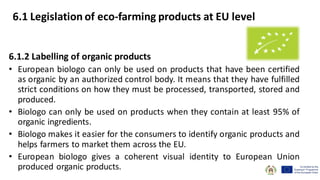
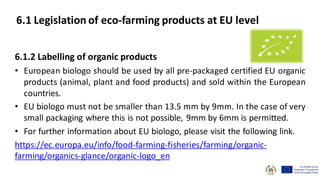
• Example: European biologo
https://ec.europa.eu/food/sites/food/files/animals/docs/aw_other_aspects_labell
ing_report_en.pdf
6.1 Legislation of eco-farming products at EU level
6.1.2 Labelling of organic products
• European biologo can only be used on products that have been certified
as organic by an authorized control body. It means that they have fulfilled
strict conditions on how they must be processed, transported, stored and
produced.
• Biologo can only be used on products when they contain at least 95% of
organic ingredients.
• Biologo makes it easier for the consumers to identify organic products and
helps farmers to market them across the EU.
• European biologo gives a coherent visual identity to European Union
produced organic products.
6.1 Legislation of eco-farming products at EU level
6.1.2 Labelling of organic products
• European biologo should be used by all pre-packaged certified EU organic
products (animal, plant and food products) and sold within the European
countries.
• EU biologo must not be smaller than 13.5 mm by 9mm. In the case of very
small packaging where this is not possible, 9mm by 6mm is permitted.
• For further information about EU biologo, please visit the following link.
https://ec.europa.eu/info/food-farming-fisheries/farming/organic-
farming/organics-glance/organic-logo_en
6.1 Legislation of eco-farming products at EU level
6.1.3 Animal health care welfare legislation
• Animal health care is the practice of reducing the need for veterinary
treatment and minimizing morbidity and mortality.
• This is achieved through the development of a preventive health
program, including regular prophylactic examinations.
• The veterinarian in charge of the farm monitors the animal health,
taking into account the epidemiological data of the region.
• He/she should use medicines responsibly to avoid creating resistance in
pathogenic microorganisms.
https://ec.europa.eu/food/sites/food/files/animals/docs/comm_ahac_201
81203_pres-04.pdf
6.1 Legislation of eco-farming products at EU level
6.1.3 Animal health care welfare legislation
• Maintaining good animal health also largely depends on the eco-farmer
who,
– provides good nutrition for all animals.
– applies rotational grazing to other species of animals to control the
spread of parasitic diseases.
– applies quarantine to purchased animals on the holding.
– caters for animal welfare based on the "five freedoms" as required by
the European Union.
https://ec.europa.eu/food/sites/food/files/animals/docs/comm_ahac_201
81203_pres-04.pdf
6.1 Legislation of eco-farming products at EU level
6.1.4 Safety legislation and environmental protection
• The scope of the directive has been extended three times to
cover, respectively, the management of waste from the mining
industry, the safety of offshore oil and gas production.
• In recent years, environmental policy has made significant
progress, for example in the area of energy policy, as reflected in
the concurrently developed EU climate and energy package or in
the roadmap for a competitive low carbon economy by 2050.
https://ec.europa.eu/food/sites/food/files/animals/docs/aw_othe
r_aspects_labelling_report_en.pdf
6.1 Legislation of eco-farming products at EU level
6.1.4 Safety legislation and environmental protection
• The basic framework includes:
a) Environmental action programs
The programs set out nine priority objectives, including: nature
conservation, greater environmental sustainability, sustainable growth
with low carbon intensity in resource efficiency and combating
environmental risks to health.
b) Horizontal strategies
In 2001, the EU launched its Sustainable Development Strategy to
promote growth and employment with an environmental dimension.
6.1 Legislation of eco-farming products at EU level
6.1.4 Safety legislation and environmental protection
c) International environmental cooperation
The EU is a major player in international environmental negotiations.
It is a party to numerous environmental agreements on a global,
regional scale, on a wide range of issues such as nature and
biodiversity, climate change and transboundary air or water pollution.
6.1 Legislation of eco-farming products at EU level
6.1.4 Safety legislationand environmental protection
The Union also helped shape several important international
agreements in 2015 at the UN level, such as the 2030 Agenda for
Sustainable Development (which includes the 17 Sustainable
Development Goals (SDGs) and 169 sub-objectives), the Paris
Agreement on Climate Change FP from Sendai to reduce disaster risk.
In the same year, the EU also became a party to the Convention on
International Trade in Endangered Species of Wild Fauna and Flora
(CITES).
6.1 Legislation of eco-farming products at EU level
6.1.4 Safety legislation and environmental protection
d) Environmental Impact Assessment and Public Participation
Some projects (private or public) that are likely to have a significant
environmental impact, such as the construction of a motorway or an
airport, are subject to environmental impact assessment.
Environmental issues are included at the planning stage and possible
consequences are considered before the project is approved or
authorized to ensure a high level of environmental protection.
6.1 Legislation of eco-farming products at EU level
6.1.4 Safety legislation and environmental protection
e) Implementation and monitoring
EU environmental legislation includes directives, regulations and
decisions. The effectiveness of EU environmental policy is largely
determined by its implementation at national, regional and local
level, with unsatisfactory implementation and implementation being
monitored. Monitoring is crucial - both to the state of the
environment and to the degree of implementation of EU
environmental legislation.
6.1 Legislation of eco-farming products at EU level
6.1.4 Safety legislation and environmental protection
The European Parliament plays an important role in formulating EU
environmental legislation. It calls for greater security of investment in
support of environmental policy and for efforts to combat climate
change, as well as to take greater account of environmental issues more
and better, other policies.
6.1 Legislation of eco-farming products at EU level
6.2 Legislation of eco-farming products at national level
• There are different legislations for eco-farming products at national level
in each country.
• Such legislations are followed while exporting, importing, marketing,
storing, packing, labeling and selling the eco-farming products have
separate and different legislations which have been implemented at
national level.
• All of the people, companies, firms and government sector institutions
and organizations, which are directly or indirectly related to the
production and business of eco-farming products, they are strictly
bound to follow and implement the legislations of national level.
The main focused production in terms of eco-farming is the plant products.
Legislation about Different plant products on National level has been decided by
the Ministry of Agriculture and Forestry along with the cooperation and
understanding of Provincial and District Directorate Centers of Agriculture and
Forestry all over in the country.
National legislations for plant production - Turkey
This legislation lies under the Article No: 8 (Law: RG-15/2/2014-28914) of the
Turkish Ministry of Agriculture and Forestry.
a) This article describes that any plant product is produced under the control of
the eco-farming entrepreneur by signing a contract with the authorized
institution.
b) The eco-farming entrepreneur who will grow eco-farm plant products is taken
to the transition period first.
6.2 Legislation of eco-farming products at national level
c) This transition period may increase or decrease as a result of the examination
of the record of land in previous years, used application practices, general
situation of the Region, risk situation and management and the Crops that will
be grown in future.
d) It would be decided by the authorized body to accept the period of previous
activities as part of the transition period according to the following criteria,
1- If it would be proved with the help of documentations that is land has
not been used for at least three years for any eco-farming activities before then
this time period is considered as part of the transition period, except the
legislations mentioned in Annex a and b of this law.
2- The above mentioned period is considered as part of the transition period,
as a result of the certification of eco-farming production area with an official
document that it is included in the areas related to mandatory environmental and
rural protection.
e) The transition period can also be reduced by the committee with the proposal of
the controlling authority/institution in case where it has been required to use any
kind of chemical input by the state for disease or insect pests control in previous
three to five years.
f) Conventional plant products of the same species and variety that cannot be easily
distinguished from these products cannot be produced at the same time in the same
eco-farming enterprise.
https://www.mevzuat.gov.tr/MevzuatMetin/1.5.5262-20100311.pdf
6.2 Legislation of eco-farming products at national level
• Ministry of agriculture, food and forestry – Laws
https://www.mzh.government.bg/bg/normativni-aktove/zakoni/
• Law on plant protection:
https://www.mzh.government.bg/media/filer_public/2020/06/10/zakon_za
_zashchita_na_rasteniiata.pdf
• Law to support agricultural farmers
https://www.mzh.government.bg/media/filer_public/2018/10/09/zpzp.pdf
National legislations for plant production – Bulgaria
• Legislation in Fresh Fruit and Vegetables:
http://www.minagric.gr/index.php/el/for-farmer-2/crop-
production/oporokipeytika/287-nopa-oporokipeytika
• Bio / Eco Products Legislation:
http://www.minagric.gr/index.php/el/for-farmer-
2/biologikgeorgiaktinotrofia/641-eunikinomothesiabiologika
• Regulations of fresh and vulnerable agricultural products: Article 14
- Law 4587/2018 https://www.lawspot.gr/nomikes-
plirofories/nomothesia/n-4587-2018/arthro-14-nomos-4587-2018-
rythmiseis-nopon-kai
National legislations for plant production – Greece
Directive 2009/128/EC of the European Parliament and of the Council
of 21 October 2009 establishing a framework for Community action to
achieve the sustainable use of pesticides (hereinafter: Directive
2009/128/EC) was implemented by adopting the Plant Protection
Products Act (Uradni List RS (UL RS; Official Gazette of the Republic of
Slovenia) No 83/12) hereinafter: ZFfS-1) and other implementing
regulations transposing the provisions of the Directive. In December
2012 the Government of the Republic of Slovenia adopted the National
Action Programme for achieving sustainable use of plant protection
products 2012-2022.
https://ec.europa.eu/food/sites/food/files/plant/docs/pesticides_sup_nap
_svn-rev_en.pdf
National Legislations for Plant Production – Slovenia
• The law on animal production:
https://www.lex.bg/laws/ldoc/2134934528
• Regulations: Ministry of agriculture, food and forestry
https://www.iasrj.eu/%D0%B4%D0%BE%D0%BA%D1%83%D0%BC%D
0%B5%D0%BD%D1%82%D0%B8/%D0%BF%D1%80%D0%B0%D0%B2
%D0%B8%D0%BB%D0%BD%D0%B8%D1%86%D0%B8
National legislations for animal production – Bulgaria
• Regulations on livestock and livestock facilities and other
provisions:(Law 4056/2012 as appearing in the Hellenic
Government Gazette A-52 / 12-3-2012) ) https://www.e-
nomothesia.gr/kat-agrotike-anaptukse/ktenotrophia/n-4056-
2012.html
National legislations for animal production – Greece
• In eco-farm breeding of livestock, breeds that are capable of adapting to
environmental conditions and resistant to diseases are selected.
• For this purpose, priority is given to local animal breeds and hybrids that
have adapted to that region.
• Natural methods of reproduction are used in eco-farm animal breeding.
• Moreover, artificial insemination is also allowed in eco-farm animal
breeding.
• Cloning and embryo transfer methods are not allowed in eco-farm animal
production in Turkey.
• All of the above regulations come under the Article No: 16 (Law: RG-
24/5/2013-28656 as appearing in Turkish Government Gazette)
https://www.mevzuat.gov.tr/mevzuat?MevzuatNo=14217&MevzuatTur=7
&MevzuatTertip=5
National legislations for animal production – Turkey
National legislations for animal production – Slovenia
The main law about animal production is Zakon o živinoreji (ZŽiv) – UL 18/2002
Source: https://www.gzs.si/Default.aspx?tabid=43833
• This law lays down the objectives of livestock the conditions and method of rearing and
smooth rearing. It is regulating the methods of animal husbandry and fodder base,
breeding programs, modification and preservation of the properties of domestic
animals, transfer of selection achievements in breeding, preservation of genetic
variability, genetic reserves and indigenous breeds, professional tasks and services in
the field of livestock farming and genetic banks in livestock farming, livestock farming,
educational and research work , transport and the market in breeding material, means
of providing funds for the exercise of this law and oversight of the implementation of
this law.
All legislation is described in the link below (in Slovene language):
https://www.gzs.si/zbornica_kmetijskih_in_zivilskih_podjetij/vsebina/Nacionalna-
zakonodaja
National legislations for animal production – Slovenia
We add some data for animal production in Slovenia. In the survey on animal
production (KME-ŽIV/L) we try to estimate the production of meat, hen’s eggs and
cows’, ewes’ and goats’ milk in Slovenia in view of requirements of European
statistical legislation. To this end we use all available data sources (statistical and
administrativesources), which are combined with some expert estimates.
• https://www.stat.si/StatWeb/File/DocSysFile/8054
• https://www.stat.si/dokument/5299/revisionofstatisticaldatamegeneral.pdf
• https://arhiv.kis.si/pls/kis/!kis.web?m=4&j=EN
Ministry of agriculture, food and forestry - Laws
• Law on animal care:
https://www.mzh.government.bg/media/filer_public/2018/02
/27/zakon_za_zashchita_na_zhivotnite_v_sila_ot_31012008_g
_obn_dv_br13_ot_8_fevruari_2008g_izm_dv_br80_ot_9_okto
mvri_2009g_izm_dv_br8_ot_25_ianuari_2011.pdf
National legislations for animal health care welfare – Bulgaria
• Regulations on livestock and livestock facilities and other
provisions:(Law 4056/2012 as appearing in the Hellenic
Government Gazette A-52 / 12-3-2012) ) https://www.e-
nomothesia.gr/kat-agrotike-anaptukse/ktenotrophia/n-4056-
2012.html
National legislations for animal health care welfare – Greece
• National legislations for animal health care welfare regulations come under
the Article No: 19 (Law: RG-10/1/2016-30297 as appearing in Turkish
Government Gazette).
• The floor of the animal shelters should be smooth but not slippery.
• The minimum half of the total floor area should be hard and flat.
• All animals should be able to reach the pastures, outdoor exercise or open
shelter areas.
• Transportation of animals, from one place to another, is done under stress-
free circumstances and in short delay of time. Please, visit the following link
for further details.
https://www.mevzuat.gov.tr/mevzuat?MevzuatNo=14217&MevzuatTur=7&Mev
zuatTertip=5
National legislations for animal health care welfare – Turkey
• The main law about animal production is: Zakon o živinoreji
(ZŽiv) – UL 18/2002.
• In the 6. Article: (Animals adapted to breeding) this law prescribe
that “Domestic animals must be reared in such a way as to satisfy
their biological needs, that they are not disturbed by their
physical needs and their behavior, that their adaptation capacity
is not exceeded and that they comply with the regulations
governing the protection of animals and veterinary surgeons.”
• Source: https://www.gzs.si/Default.aspx?tabid=43833
National Legislations for Animal Health Care Welfare – Slovenia
6.2.1 Where to find information about legislation at national level?
In Turkey
• Legislation on the eco-farming products of plant and animal has been published in the Official
Newspaper in 24 December, 1994 according to the Turkish Law No: 22145.
• This legislation was renewed later according to the revisions made according to the European
Union regulations.
• This revised legislation has been published in the official newspaper on 11 July 2002 under the law
No: 24812 that changed the name of the regulation and was renamed as ‘Regulation on Principles
and Practice of organic farming’.
• The revisions are still in progress and the latest legislation of 2015 has been published in the
official newspaper in 22.07.2015 under the law No:29422 - https://ec.europa.eu/info/food-farming-
fisheries/farming/organic-farming/organic-production-and-products_en#organicproductionrules
6.2 Legislation of eco-farming products at national level
6.2.1 Where to find information about legislation at national level?
In Slovenia, the information about the legislations at national level are found into the following given
links.
• Sources:
– https://www.managementstudyguide.com/social-entrepreneurship.htm
– https://www.toppr.com/guides/business-management-and-entrepreneurship/social-entrepreneurship/meaning-and-
concept-social-entrepreneurship/
– http://www.pisrs.si/Pis.web/pregledPredpisa?id=ZAKO6175
• Video:
– https://www.youtube.com/watch?v=9_g5RqwW51I&list=PL6HxSyThhJKcEyEqOTRRVuj1QoqaYY7xI
6.2 Legislation of eco-farming products at national level
6.2.1 Where to find information about legislation at national level?
In Bulgaria,
The information about the legislations at national level are found into the following
given links:-
Sources:
https://lex.bg/bg/laws/ldoc/2137187968
https://www.lex.bg/bg/laws/ldoc/2137187968
https://www.bi-gd.org/site/bg/proekti-2/tekushti-proekti/111-newbieproject
6.2 Legislation of eco-farming products at national level
6.2.1 Where to find information about legislation at national level?
In Greece,
• Regulation on the bio / organic production of agricultural products and the relevant
indications on agricultural products and foodstuff: (KYA 245090/31-01-2006)
http://www.a-cert.org/files/Legislation/288_fek_157_b_10.02.2006.pdf
• Regulation concerning the derogatory approval of the import of birds, in an organic egg
production unit, up to 18 weeks of age that have not been bred biologically: (KYA
245100/06-02-2006) http://www.a-
cert.org/files/Legislation/288_kya_245100_06.02.2006.pdf and (KYA 245243/22-05-
2006) http://www.a-cert.org/files/Legislation/288_kya_245243_22.05.2006.pdf
• Creation of a Database of Biological Propagation Material and by way of derogation
approving the use of non-biological propagating material: (KYA 288915/27-11-2006)
http://www.a-cert.org/files/Legislation/288_fek_1785_b_7.12.2006.pdf
6.2 Legislation of eco-farming products at national level
• Regulation on the bio / organic production of agricultural products and the
relevant indications on agricultural products and foodstuff: (ΚΥA 336650/ 29-12-
2006) http://www.a-cert.org/files/Legislation/288_ya_336650_29.12.2006.pdf
and (ΚΥΑ 296851/05-07-2007) http://www.a-
cert.org/files/Legislation/288_fek_1114_b_05.07.2007.pdf
• Additional measures for organic livestock farming, due to catastrophic fires, in
fire-affected areas: (KYA 335273/06-11-2007) http://www.a-
cert.org/files/Legislation/288_kya335273bg26-10-2007.pdf and (ΚΥΑ 305814/18-
07-2008) http://www.a-cert.org/files/Legislation/288_1.pdf
6.2 Legislation of eco-farming products at national level
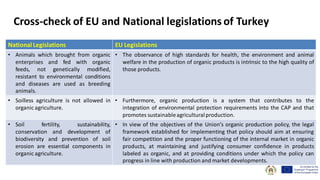
Cross-check of EU and National legislations of Turkey
National Legislations EU Legislations
• Animals which brought from organic
enterprises and fed with organic
feeds, not genetically modified,
resistant to environmental conditions
and diseases are used as breeding
animals.
• The observance of high standards for health, the environment and animal
welfare in the production of organic products is intrinsic to the high quality of
those products.
• Soilless agriculture is not allowed in
organic agriculture.
• Furthermore, organic production is a system that contributes to the
integration of environmental protection requirements into the CAP and that
promotes sustainableagriculturalproduction.
• Soil fertility, sustainability,
conservation and development of
biodiversity and prevention of soil
erosion are essential components in
organic agriculture.
• In view of the objectives of the Union’s organic production policy, the legal
framework established for implementing that policy should aim at ensuring
fair competition and the proper functioning of the internal market in organic
products, at maintaining and justifying consumer confidence in products
labeled as organic, and at providing conditions under which the policy can
progress in line with production and market developments.
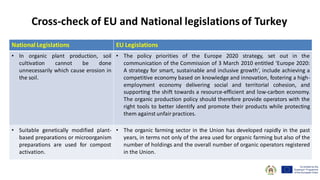
Cross-check of EU and National legislations of Turkey
National Legislations EU Legislations
• In organic plant production, soil
cultivation cannot be done
unnecessarily which cause erosion in
the soil.
• The policy priorities of the Europe 2020 strategy, set out in the
communication of the Commission of 3 March 2010 entitled ‘Europe 2020:
A strategy for smart, sustainable and inclusive growth’, include achieving a
competitive economy based on knowledge and innovation, fostering a high-
employment economy delivering social and territorial cohesion, and
supporting the shift towards a resource-efficient and low-carbon economy.
The organic production policy should therefore provide operators with the
right tools to better identify and promote their products while protecting
them against unfair practices.
• Suitable genetically modified plant-
based preparations or microorganism
preparations are used for compost
activation.
• The organic farming sector in the Union has developed rapidly in the past
years, in terms not only of the area used for organic farming but also of the
number of holdings and the overall number of organic operators registered
in the Union.
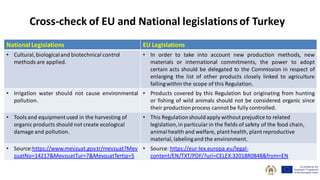
Cross-check of EU and National legislations of Turkey
National Legislations EU Legislations
• Cultural,biologicaland biotechnical control
methods are applied.
• In order to take into account new production methods, new
materials or international commitments, the power to adopt
certain acts should be delegated to the Commission in respect of
enlarging the list of other products closely linked to agriculture
fallingwithin the scope of this Regulation.
• Irrigation water should not cause environmental
pollution.
• Products covered by this Regulation but originating from hunting
or fishing of wild animals should not be considered organic since
their production process cannot be fully controlled.
• Toolsand equipmentused in the harvesting of
organic products should not create ecological
damage and pollution.
• This Regulationshouldapply without prejudice to related
legislation,in particularin the fields of safety of the food chain,
animalhealth and welfare, planthealth, plant reproductive
material, labelingand the environment.
• Source:https://www.mevzuat.gov.tr/mevzuat?Mev
zuatNo=14217&MevzuatTur=7&MevzuatTertip=5
• Source: https://eur-lex.europa.eu/legal-
content/EN/TXT/PDF/?uri=CELEX:32018R0848&from=EN
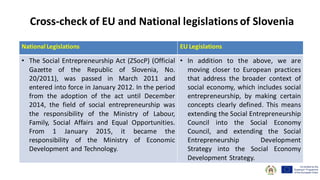
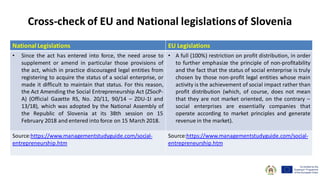
Cross-check of EU and National legislations of Slovenia
National Legislations EU Legislations
• The Social Entrepreneurship Act (ZSocP) (Official
Gazette of the Republic of Slovenia, No.
20/2011), was passed in March 2011 and
entered into force in January 2012. In the period
from the adoption of the act until December
2014, the field of social entrepreneurship was
the responsibility of the Ministry of Labour,
Family, Social Affairs and Equal Opportunities.
From 1 January 2015, it became the
responsibility of the Ministry of Economic
Development and Technology.
• In addition to the above, we are
moving closer to European practices
that address the broader context of
social economy, which includes social
entrepreneurship, by making certain
concepts clearly defined. This means
extending the Social Entrepreneurship
Council into the Social Economy
Council, and extending the Social
Entrepreneurship Development
Strategy into the Social Economy
Development Strategy.
Cross-check of EU and National legislations of Slovenia
National Legislations EU Legislations
• Since the act has entered into force, the need arose to
supplement or amend in particular those provisions of
the act, which in practice discouraged legal entities from
registering to acquire the status of a social enterprise, or
made it difficult to maintain that status. For this reason,
the Act Amending the Social Entrepreneurship Act (ZSocP-
A) (Official Gazette RS, No. 20/11, 90/14 – ZDU-1I and
13/18), which was adopted by the National Assembly of
the Republic of Slovenia at its 38th session on 15
February 2018 and entered into force on 15 March 2018.
• A full (100%) restriction on profit distribution, in order
to further emphasize the principle of non-profitability
and the fact that the status of social enterprise is truly
chosen by those non-profit legal entities whose main
activity is the achievement of social impact rather than
profit distribution (which, of course, does not mean
that they are not market oriented, on the contrary –
social enterprises are essentially companies that
operate according to market principles and generate
revenue in the market).
Source:https://www.managementstudyguide.com/social-
entrepreneurship.htm
Source:https://www.managementstudyguide.com/social-
entrepreneurship.htm
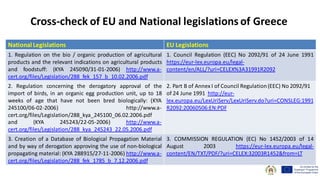
Cross-check of EU and National legislations of Greece
National Legislations EU Legislations
1. Regulation on the bio / organic production of agricultural
products and the relevant indications on agricultural products
and foodstuff: (KYA 245090/31-01-2006) http://www.a-
cert.org/files/Legislation/288_fek_157_b_10.02.2006.pdf
1. Council Regulation (EEC) No 2092/91 of 24 June 1991
https://eur-lex.europa.eu/legal-
content/en/ALL/?uri=CELEX%3A31991R2092
2. Regulation concerning the derogatory approval of the
import of birds, in an organic egg production unit, up to 18
weeks of age that have not been bred biologically: (KYA
245100/06-02-2006) http://www.a-
cert.org/files/Legislation/288_kya_245100_06.02.2006.pdf
and (KYA 245243/22-05-2006) http://www.a-
cert.org/files/Legislation/288_kya_245243_22.05.2006.pdf
2. Part B of Annex I of Council Regulation(EEC) No 2092/91
of 24 June 1991 http://eur-
lex.europa.eu/LexUriServ/LexUriServ.do?uri=CONSLEG:1991
R2092:20060506:EN:PDF
3. Creation of a Database of Biological Propagation Material
and by way of derogation approving the use of non-biological
propagating material: (KYA 288915/27-11-2006) http://www.a-
cert.org/files/Legislation/288_fek_1785_b_7.12.2006.pdf
3. COMMISSION REGULATION (EC) No 1452/2003 of 14
August 2003 https://eur-lex.europa.eu/legal-
content/EN/TXT/PDF/?uri=CELEX:32003R1452&from=LT
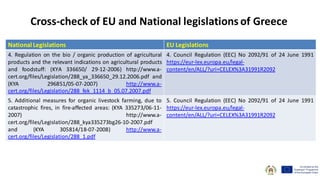
National Legislations EU Legislations
4. Regulation on the bio / organic production of agricultural
products and the relevant indications on agricultural products
and foodstuff: (ΚΥA 336650/ 29-12-2006) http://www.a-
cert.org/files/Legislation/288_ya_336650_29.12.2006.pdf and
(ΚΥΑ 296851/05-07-2007) http://www.a-
cert.org/files/Legislation/288_fek_1114_b_05.07.2007.pdf
4. Council Regulation (EEC) No 2092/91 of 24 June 1991
https://eur-lex.europa.eu/legal-
content/en/ALL/?uri=CELEX%3A31991R2092
5. Additional measures for organic livestock farming, due to
catastrophic fires, in fire-affected areas: (KYA 335273/06-11-
2007) http://www.a-
cert.org/files/Legislation/288_kya335273bg26-10-2007.pdf
and (ΚΥΑ 305814/18-07-2008) http://www.a-
cert.org/files/Legislation/288_1.pdf
5. Council Regulation (EEC) No 2092/91 of 24 June 1991
https://eur-lex.europa.eu/legal-
content/en/ALL/?uri=CELEX%3A31991R2092
Cross-check of EU and National legislations of Greece
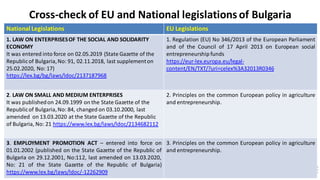
Cross-check of EU and National legislations of Bulgaria
National Legislations EU Legislations
1. LAW ON ENTERPRISESOF THE SOCIAL AND SOLIDARITY
ECONOMY
It was entered into force on 02.05.2019 (State Gazette of the
Republicof Bulgaria,No: 91, 02.11.2018, last supplementon
25.02.2020, No: 17)
https://lex.bg/bg/laws/ldoc/2137187968
1. Regulation (EU) No 346/2013 of the European Parliament
and of the Council of 17 April 2013 on European social
entrepreneurship funds
https://eur-lex.europa.eu/legal-
content/EN/TXT/?uri=celex%3A32013R0346
2. LAW ON SMALL AND MEDIUM ENTERPRISES
It was publishedon 24.09.1999 on the State Gazette of the
Republicof Bulgaria,No: 84, changed on 03.10.2000, last
amended on 13.03.2020 at the State Gazette of the Republic
of Bulgaria, No: 21 https://www.lex.bg/laws/ldoc/2134682112
2. Principles on the common European policy in agriculture
and entrepreneurship.
3. EMPLOYMENT PROMOTION ACT – entered into force on
01.01.2002 (published on the State Gazette of the Republic of
Bulgaria on 29.12.2001, No:112, last amended on 13.03.2020,
No: 21 of the State Gazette of the Republic of Bulgaria)
https://www.lex.bg/laws/ldoc/-12262909
3. Principles on the common European policy in agriculture
and entrepreneurship.
Cross-check of EU and National legislations of Bulgaria
National Legislations EU Legislations
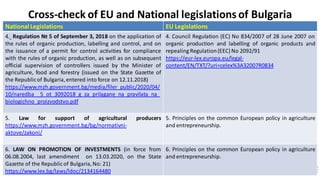
4. Regulation № 5 of September 3, 2018 on the application of
the rules of organic production, labelling and control, and on
the issuance of a permit for control activities for compliance
with the rules of organic production, as well as on subsequent
official supervision of controllers issued by the Minister of
agriculture, food and forestry (issued on the State Gazette of
the Republicof Bulgaria,entered into force on 12.11.2018)
https://www.mzh.government.bg/media/filer_public/2020/04/
10/naredba__5_ot_3092018_g_za_prilagane_na_pravilata_na_
biologichno_proizvodstvo.pdf
4. Council Regulation (EC) No 834/2007 of 28 June 2007 on
organic production and labelling of organic products and
repealing Regulation(EEC) No 2092/91
https://eur-lex.europa.eu/legal-
content/EN/TXT/?uri=celex%3A32007R0834
5. Law for support of agricultural producers
https://www.mzh.government.bg/bg/normativni-
aktove/zakoni/
5. Principles on the common European policy in agriculture
and entrepreneurship.
6. LAW ON PROMOTION OF INVESTMENTS (in force from
06.08.2004, last amendment on 13.03.2020, on the State
Gazette of the Republicof Bulgaria,No: 21)
https://www.lex.bg/laws/ldoc/2134164480
6. Principles on the common European policy in agriculture
and entrepreneurship.
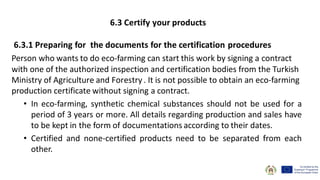
6.3.1 Preparing for the documents for the certification procedures
Person who wants to do eco-farming can start this work by signing a contract
with one of the authorized inspection and certification bodies from the Turkish
Ministry of Agriculture and Forestry . It is not possible to obtain an eco-farming
production certificate without signing a contract.
• In eco-farming, synthetic chemical substances should not be used for a
period of 3 years or more. All details regarding production and sales have
to be kept in the form of documentations according to their dates.
• Certified and none-certified products need to be separated from each
other.
6.3 Certify your products
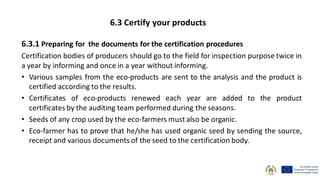
6.3.1 Preparing for the documents for the certification procedures
Certification bodies of producers should go to the field for inspection purpose twice in
a year by informing and once in a year without informing.
• Various samples from the eco-products are sent to the analysis and the product is
certified according to the results.
• Certificates of eco-products renewed each year are added to the product
certificates by the auditing team performed during the seasons.
• Seeds of any crop used by the eco-farmers must also be organic.
• Eco-farmer has to prove that he/she has used organic seed by sending the source,
receipt and various documents of the seed to the certification body.
6.3 Certify your products
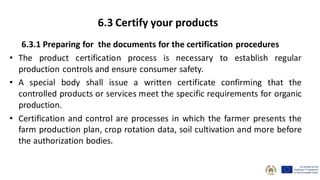
6.3.1 Preparing for the documents for the certification procedures
• The product certification process is necessary to establish regular
production controls and ensure consumer safety.
• A special body shall issue a written certificate confirming that the
controlled products or services meet the specific requirements for organic
production.
• Certification and control are processes in which the farmer presents the
farm production plan, crop rotation data, soil cultivation and more before
the authorization bodies.
6.3 Certify your products
6.3.1 Preparing for the documents for the
certification procedures
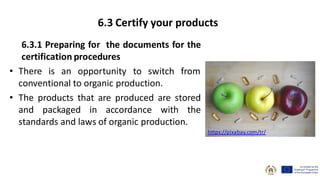
• There is an opportunity to switch from
conventional to organic production.
• The products that are produced are stored
and packaged in accordance with the
standards and laws of organic production.
6.3 Certify your products
https://pixabay.com/tr/
Certification bodies in Turkey
• IMO
• ECOCERTSA
• ETKO
• BCS
• EKO-TAR
• ICEA
• CERES
• ORSER
Source: http://www.gidabilimi.com/tr/forum-146/9-dier-sertifika-ve-belgeler/25-organik-
sertifikasi-veren-turkiye-deki-kuruluslar
6.3 Certify your products
Certification bodies in Bulgaria
Links for the certification bodies in Bulgaria
• https://ec.europa.eu/agriculture/ofis_public/actor_cbeu/ctrl.cfm?targetUrl=view&cb
eu_id=337
• https://ec.europa.eu/agriculture/ofis_public/actor_cbeu/ctrl.cfm?targetUrl=view&cb
eu_id=930
• https://ec.europa.eu/agriculture/ofis_public/actor_cbeu/ctrl.cfm?targetUrl=view&cb
eu_id=342
• https://ec.europa.eu/agriculture/ofis_public/actor_cbeu/ctrl.cfm?targetUrl=view&cb
eu_id=789
• https://ec.europa.eu/agriculture/ofis_public/actor_cbeu/ctrl.cfm?targetUrl=view&cb
eu_id=810
6.3 Certify your products
Certification bodies in Greece
Links for the certification bodies in Greece
• https://ec.europa.eu/agriculture/ofis_public/actor_cbeu/ctrl.cfm?targetUrl=view&cb
eu_id=196
• https://ec.europa.eu/agriculture/ofis_public/actor_cbeu/ctrl.cfm?targetUrl=view&cb
eu_id=434
• https://ec.europa.eu/agriculture/ofis_public/actor_cbeu/ctrl.cfm?targetUrl=view&cb
eu_id=195
• https://ec.europa.eu/agriculture/ofis_public/actor_cbeu/ctrl.cfm?targetUrl=view&cb
eu_id=231
• https://ec.europa.eu/agriculture/ofis_public/actor_cbeu/ctrl.cfm?targetUrl=view&cb
eu_id=189
6.3 Certify your products
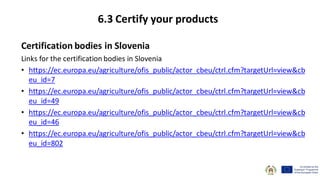
Certification bodies in Slovenia
Links for the certification bodies in Slovenia
• https://ec.europa.eu/agriculture/ofis_public/actor_cbeu/ctrl.cfm?targetUrl=view&cb
eu_id=7
• https://ec.europa.eu/agriculture/ofis_public/actor_cbeu/ctrl.cfm?targetUrl=view&cb
eu_id=49
• https://ec.europa.eu/agriculture/ofis_public/actor_cbeu/ctrl.cfm?targetUrl=view&cb
eu_id=46
• https://ec.europa.eu/agriculture/ofis_public/actor_cbeu/ctrl.cfm?targetUrl=view&cb
eu_id=802
6.3 Certify your products
Disclaimer
For further information, relatedto the ECO AGRI project, please visit the project’swebsite at www.ecofarm-
manager.eu or visit us at https://www.facebook.com/Ecofar2018/.
Downloadour mobile app at https://play.google.com/store/apps/details?id=com.ecofar.mobile.
The EuropeanCommission's support for the production of this publicationdoes not constitutean endorsement of
the contents, which reflect the views only of the authors, and the Commission cannot be held responsible for any
use which may be made of the information contained therein.

Ecofar wp5 module 6 English

  • 1.
    Development of managerialandentrepreneurial skills of young eco-farmersviajoint VET curricula, enhanced qualificationprofile, assessmentstandardandsustainable cooperationsynergies (ecoFAR) 597256-EPP-1-2018-1-BG-EPPKA3-VET-JQ WP5: Joint qualification curricula for acquisition of managerial and entrepreneurial skills by farmers at eco-farm SME Module 6: Legislation in eco-farming Author: Canakkale Onsekiz Mart University, Turkey
  • 2.
    Table of contents •6.1 Legislation of eco-farming products at EU level – 6.1.1Organicproduction – 6.1.2Labeling of organicproducts – 6.1.3 Animal health care welfare legislation – 6.1.4 Safety legislation and environmental protection • 6.2 Legislation of eco-farming products at National level – 6.2.1 Where to find information about legislation at national level? (Bulgaria, Greece, Slovenia and Turkey) • 6.3 Certifying your products (Bulgaria, Greece, Slovenia and Turkey) – 6.3.1 Preparing for the documents for the certification procedures
  • 3.
    6.1.1 Organic production UnderRegulation (EC) № 834/2007 of 28 June 2007 on organic production and labeling of organic products and repealing Regulation (EEC) № 2092/91 assumes that: • The objectives of the organic production policy are embedded in the objectives of the Common Agricultural Policy (CAP) by ensuring that farmers receive a fair return for complying with the organic production rules. • The growing consumer demand for organic products creates conditions for further development and expansion of the market in those products and thus for an increase in the return of eco-farmers engaged in organic production. 6.1 Legislation of eco-farming products at EU level
  • 4.
    6.1.1 Organic production •Organic production is an overall system of farm management and food production that combines best environmental practices, the preservation of natural resources, the application of high animal welfare standards and a production method in line with the preference of certain consumers for products produced using natural substances and processes. https://eur-lex.europa.eu/legal- content/EN/TXT/?qid=1396535236920&uri=CELEX:32007R0834 6.1 Legislation of eco-farming products at EU level
  • 5.
    6.1.1 Organic production •Organic production sector is on the increase in most of the EU member countries. Growth in consumer demand in recent years is particularly remarkable. • Recent reforms of the common agricultural policy, with its emphasis on market-orientation and the supply of quality products to meet consumer demands, are likely to further stimulate the market in organic product. • Against this background the legislation on organic production plays an increasingly important role in the eco-farming policy framework and is closely related to developments in eco-farming markets. 6.1 Legislation of eco-farming products at EU level
  • 6.
    6.1.1 Organic production •Community legal framework governing the sector of organic production should pursue the objective of ensuring fair competition and a proper functioning of the internal market in organic products, and of maintaining and justifying consumer confidence in products labelled as organic. • It should further aim at providing conditions under which this sector can progress in line with production and market developments. https://eur-lex.europa.eu/legal- content/EN/TXT/?qid=1396535236920&uri=CELEX:32007R0834 6.1 Legislation of eco-farming products at EU level
  • 7.
    6.1.1 Organic production •The European Action Plan for Organic Food and Farming proposes to improve and reinforce the community's organic farming standards and import and inspection requirements. • In this regard, the council called on the commission to review the community legal framework in this field with a view to ensure simplification and overall coherence and in particular to establish principles encouraging harmonization of standards and to reduce the level of detail. 6.1 Legislation of eco-farming products at EU level
  • 8.
    6.1.1 Organic production •It is defined more explicitly the objectives, principles and rules applicable to organic production, in order to contribute to transparency and consumer confidence as well as to a harmonized perception of the concept of organic production. • General organic production rules should be established with regard to plant, livestock, and aquaculture production, including the rules for collection of wild plants and seaweeds, rules on conversion along with the rules on production of processed food, including feed and organic yeast. https://eur-lex.europa.eu/legal-content/EN/TXT/?qid=1396535236920&uri=CELEX:32007R0834 6.1 Legislation of eco-farming products at EU level
  • 9.
    6.1.1 Organic production •Development of organic production should be facilitated further, in particular by fostering the use of new techniques and substances better suited to organic production. • Genetically modified organisms and products produced from or by GMOs are incompatible with the concept of organic production and consumers' perception of organic products. They should therefore not be used in organic farming or in the processing of organic products. • The aim is to have the lowest possible presence of GMOs in organic products. The existing labelling thresholds represent ceilings which are exclusively linked to the adventitious and technically unavoidable presence of GMOs. 6.1 Legislation of eco-farming products at EU level
  • 10.
    6.1.1 Organic production •Organic farming should primarily rely on renewable resources within locally organized agricultural systems. • In order to minimize the use of non-renewable resources, wastes and by-products of plant and animal origin should be recycled to return nutrients to the land. • Organic plant production should contribute to maintaining and enhancing soil fertility as well as to preventing soil erosion. • Plants should preferably be fed through the soil eco-system and not through soluble fertilizers added to the soil. 6.1 Legislation of eco-farming products at EU level
  • 11.
    6.1.1 Organic production •The essential elements of the organic plant production management system are soil fertility management, choice of species and varieties, multiannual crop rotation, recycling organic materials and cultivation techniques. Additional fertilizers, soil conditioners and plant protection products should only be used if they are compatible with the objectives and principles of organic production. • Livestock production is fundamental to the organization of agricultural production on organic holdings in so far as it provides the necessary organic matter and nutrients for cultivated land and accordingly contributes towards soil improvement and the development of sustainable agriculture. 6.1 Legislation of eco-farming products at EU level
  • 12.
    Example: Honey production •Honey trade in many parts of the world is governed by regulations. • These regulations fall into two broad categories i.e., – They are used to ensure that a product sold as honey really is honey, and not an adulterated substance or false Honey. – They are used to ensure that any honey is safe to eat, and is not contaminated with anything harmful to human health https://eur-lex.europa.eu/legal- content/EN/TXT/?qid=1396535236920&uri=CELEX:32007R0834 6.1 Legislation of eco-farming products at EU level
  • 13.
    • The mainpurpose of these regulations are to maintain standards of honey and keep consumers safe. • Legislation with the greatest implications for countries wishing to export their honey to the EU is Directive 96/23/EC. • This Directive determines that for a country to be eligible to export honey to the EU, it must be included in a list of 'third countries' which have shown that they are monitoring chemical residues. • It is necessary for countries to establish national monitoring systems for honey, for residues of antibiotics, pesticides and heavy metals. 6.1 Legislation of eco-farming products at EU level
  • 14.
    • Residue MonitoringPlans (RMPs) which show how these residues are being monitored must be submitted annually to the EU for approval. • It is important to understand that because a EU country is denied access to the EU market as a result of this legislation, this doesn’t mean that their honey is of low quality. It means that the necessary procedures and paperwork have not been put in place to prove that the honey quality is being monitored regularly. https://eur-lex.europa.eu/legal- content/EN/TXT/?qid=1396535236920&uri=CELEX:32007R0834 6.1 Legislation of eco-farming products at EU level
  • 15.
    Important organic productsof Bulgaria • Organic wheat • Organic barley • Organic corn • Organic fruits, berries and nuts • Organic fresh vegetables (including melons and strawberries) • Organic aromatic and medicinal plants 6.1 Legislation of eco-farming products at EU level
  • 16.
    Major organic agriculturalproducts of Turkey • Dried apricots • Hazelnuts • Dried figs • Apple juice • Frozen fruits • Lentils • Frozen vegetables 6.1 Legislation of eco-farming products at EU level
  • 17.
    Major organic animalhusbandry products of Turkey • Cow milk • Veal • Sheep meat • Goat meat • Beehives • Eggs 6.1 Legislation of eco-farming products at EU level
  • 18.
    Important organic productsof Slovenia • Organic olives • Organic grapes • Organic fruits • Organic vegetables • Organic green fodder • Organic cereals • Top-selling organic products are: fresh vegetables, dairy products and cereals 6.1 Legislation of eco-farming products at EU level
  • 19.
    Important organic productsof Greece • Kalamata olives • Halkidiki green olives • Organic olive oil • Organic capia peppers • Organic sea fennel 6.1 Legislation of eco-farming products at EU level
  • 20.
    6.1.2 Labelling oforganic products • Each plant and animal product has the label of organic onto it. • A product shall be regarded as bearing terms referring to the organic production method where, in the labelling, advertising material or commercial documents, such a product, its ingredients or feed materials are described in terms suggesting to the purchaser that the product, its ingredients or feed materials have been obtained in accordance with the rules laid down in this legislation under the Article No. 23, Labelling use of terms referring to organic production in eco-farming. • Example: European biologo https://ec.europa.eu/food/sites/food/files/animals/docs/aw_other_aspects_labell ing_report_en.pdf 6.1 Legislation of eco-farming products at EU level
  • 21.
    6.1.2 Labelling oforganic products • European biologo can only be used on products that have been certified as organic by an authorized control body. It means that they have fulfilled strict conditions on how they must be processed, transported, stored and produced. • Biologo can only be used on products when they contain at least 95% of organic ingredients. • Biologo makes it easier for the consumers to identify organic products and helps farmers to market them across the EU. • European biologo gives a coherent visual identity to European Union produced organic products. 6.1 Legislation of eco-farming products at EU level
  • 22.
    6.1.2 Labelling oforganic products • European biologo should be used by all pre-packaged certified EU organic products (animal, plant and food products) and sold within the European countries. • EU biologo must not be smaller than 13.5 mm by 9mm. In the case of very small packaging where this is not possible, 9mm by 6mm is permitted. • For further information about EU biologo, please visit the following link. https://ec.europa.eu/info/food-farming-fisheries/farming/organic- farming/organics-glance/organic-logo_en 6.1 Legislation of eco-farming products at EU level
  • 23.
    6.1.3 Animal healthcare welfare legislation • Animal health care is the practice of reducing the need for veterinary treatment and minimizing morbidity and mortality. • This is achieved through the development of a preventive health program, including regular prophylactic examinations. • The veterinarian in charge of the farm monitors the animal health, taking into account the epidemiological data of the region. • He/she should use medicines responsibly to avoid creating resistance in pathogenic microorganisms. https://ec.europa.eu/food/sites/food/files/animals/docs/comm_ahac_201 81203_pres-04.pdf 6.1 Legislation of eco-farming products at EU level
  • 24.
    6.1.3 Animal healthcare welfare legislation • Maintaining good animal health also largely depends on the eco-farmer who, – provides good nutrition for all animals. – applies rotational grazing to other species of animals to control the spread of parasitic diseases. – applies quarantine to purchased animals on the holding. – caters for animal welfare based on the "five freedoms" as required by the European Union. https://ec.europa.eu/food/sites/food/files/animals/docs/comm_ahac_201 81203_pres-04.pdf 6.1 Legislation of eco-farming products at EU level
  • 25.
    6.1.4 Safety legislationand environmental protection • The scope of the directive has been extended three times to cover, respectively, the management of waste from the mining industry, the safety of offshore oil and gas production. • In recent years, environmental policy has made significant progress, for example in the area of energy policy, as reflected in the concurrently developed EU climate and energy package or in the roadmap for a competitive low carbon economy by 2050. https://ec.europa.eu/food/sites/food/files/animals/docs/aw_othe r_aspects_labelling_report_en.pdf 6.1 Legislation of eco-farming products at EU level
  • 26.
    6.1.4 Safety legislationand environmental protection • The basic framework includes: a) Environmental action programs The programs set out nine priority objectives, including: nature conservation, greater environmental sustainability, sustainable growth with low carbon intensity in resource efficiency and combating environmental risks to health. b) Horizontal strategies In 2001, the EU launched its Sustainable Development Strategy to promote growth and employment with an environmental dimension. 6.1 Legislation of eco-farming products at EU level
  • 27.
    6.1.4 Safety legislationand environmental protection c) International environmental cooperation The EU is a major player in international environmental negotiations. It is a party to numerous environmental agreements on a global, regional scale, on a wide range of issues such as nature and biodiversity, climate change and transboundary air or water pollution. 6.1 Legislation of eco-farming products at EU level
  • 28.
    6.1.4 Safety legislationandenvironmental protection The Union also helped shape several important international agreements in 2015 at the UN level, such as the 2030 Agenda for Sustainable Development (which includes the 17 Sustainable Development Goals (SDGs) and 169 sub-objectives), the Paris Agreement on Climate Change FP from Sendai to reduce disaster risk. In the same year, the EU also became a party to the Convention on International Trade in Endangered Species of Wild Fauna and Flora (CITES). 6.1 Legislation of eco-farming products at EU level
  • 29.
    6.1.4 Safety legislationand environmental protection d) Environmental Impact Assessment and Public Participation Some projects (private or public) that are likely to have a significant environmental impact, such as the construction of a motorway or an airport, are subject to environmental impact assessment. Environmental issues are included at the planning stage and possible consequences are considered before the project is approved or authorized to ensure a high level of environmental protection. 6.1 Legislation of eco-farming products at EU level
  • 30.
    6.1.4 Safety legislationand environmental protection e) Implementation and monitoring EU environmental legislation includes directives, regulations and decisions. The effectiveness of EU environmental policy is largely determined by its implementation at national, regional and local level, with unsatisfactory implementation and implementation being monitored. Monitoring is crucial - both to the state of the environment and to the degree of implementation of EU environmental legislation. 6.1 Legislation of eco-farming products at EU level
  • 31.
    6.1.4 Safety legislationand environmental protection The European Parliament plays an important role in formulating EU environmental legislation. It calls for greater security of investment in support of environmental policy and for efforts to combat climate change, as well as to take greater account of environmental issues more and better, other policies. 6.1 Legislation of eco-farming products at EU level
  • 32.
    6.2 Legislation ofeco-farming products at national level • There are different legislations for eco-farming products at national level in each country. • Such legislations are followed while exporting, importing, marketing, storing, packing, labeling and selling the eco-farming products have separate and different legislations which have been implemented at national level. • All of the people, companies, firms and government sector institutions and organizations, which are directly or indirectly related to the production and business of eco-farming products, they are strictly bound to follow and implement the legislations of national level.
  • 33.
    The main focusedproduction in terms of eco-farming is the plant products. Legislation about Different plant products on National level has been decided by the Ministry of Agriculture and Forestry along with the cooperation and understanding of Provincial and District Directorate Centers of Agriculture and Forestry all over in the country. National legislations for plant production - Turkey This legislation lies under the Article No: 8 (Law: RG-15/2/2014-28914) of the Turkish Ministry of Agriculture and Forestry. a) This article describes that any plant product is produced under the control of the eco-farming entrepreneur by signing a contract with the authorized institution. b) The eco-farming entrepreneur who will grow eco-farm plant products is taken to the transition period first. 6.2 Legislation of eco-farming products at national level
  • 34.
    6.2 Legislation ofeco-farming products at national level c) This transition period may increase or decrease as a result of the examination of the record of land in previous years, used application practices, general situation of the Region, risk situation and management and the Crops that will be grown in future. d) It would be decided by the authorized body to accept the period of previous activities as part of the transition period according to the following criteria, 1- If it would be proved with the help of documentations that is land has not been used for at least three years for any eco-farming activities before then this time period is considered as part of the transition period, except the legislations mentioned in Annex a and b of this law.
  • 35.
    2- The abovementioned period is considered as part of the transition period, as a result of the certification of eco-farming production area with an official document that it is included in the areas related to mandatory environmental and rural protection. e) The transition period can also be reduced by the committee with the proposal of the controlling authority/institution in case where it has been required to use any kind of chemical input by the state for disease or insect pests control in previous three to five years. f) Conventional plant products of the same species and variety that cannot be easily distinguished from these products cannot be produced at the same time in the same eco-farming enterprise. https://www.mevzuat.gov.tr/MevzuatMetin/1.5.5262-20100311.pdf 6.2 Legislation of eco-farming products at national level
  • 36.
    • Ministry ofagriculture, food and forestry – Laws https://www.mzh.government.bg/bg/normativni-aktove/zakoni/ • Law on plant protection: https://www.mzh.government.bg/media/filer_public/2020/06/10/zakon_za _zashchita_na_rasteniiata.pdf • Law to support agricultural farmers https://www.mzh.government.bg/media/filer_public/2018/10/09/zpzp.pdf National legislations for plant production – Bulgaria
  • 37.
    • Legislation inFresh Fruit and Vegetables: http://www.minagric.gr/index.php/el/for-farmer-2/crop- production/oporokipeytika/287-nopa-oporokipeytika • Bio / Eco Products Legislation: http://www.minagric.gr/index.php/el/for-farmer- 2/biologikgeorgiaktinotrofia/641-eunikinomothesiabiologika • Regulations of fresh and vulnerable agricultural products: Article 14 - Law 4587/2018 https://www.lawspot.gr/nomikes- plirofories/nomothesia/n-4587-2018/arthro-14-nomos-4587-2018- rythmiseis-nopon-kai National legislations for plant production – Greece
  • 38.
    Directive 2009/128/EC ofthe European Parliament and of the Council of 21 October 2009 establishing a framework for Community action to achieve the sustainable use of pesticides (hereinafter: Directive 2009/128/EC) was implemented by adopting the Plant Protection Products Act (Uradni List RS (UL RS; Official Gazette of the Republic of Slovenia) No 83/12) hereinafter: ZFfS-1) and other implementing regulations transposing the provisions of the Directive. In December 2012 the Government of the Republic of Slovenia adopted the National Action Programme for achieving sustainable use of plant protection products 2012-2022. https://ec.europa.eu/food/sites/food/files/plant/docs/pesticides_sup_nap _svn-rev_en.pdf National Legislations for Plant Production – Slovenia
  • 39.
    • The lawon animal production: https://www.lex.bg/laws/ldoc/2134934528 • Regulations: Ministry of agriculture, food and forestry https://www.iasrj.eu/%D0%B4%D0%BE%D0%BA%D1%83%D0%BC%D 0%B5%D0%BD%D1%82%D0%B8/%D0%BF%D1%80%D0%B0%D0%B2 %D0%B8%D0%BB%D0%BD%D0%B8%D1%86%D0%B8 National legislations for animal production – Bulgaria
  • 40.
    • Regulations onlivestock and livestock facilities and other provisions:(Law 4056/2012 as appearing in the Hellenic Government Gazette A-52 / 12-3-2012) ) https://www.e- nomothesia.gr/kat-agrotike-anaptukse/ktenotrophia/n-4056- 2012.html National legislations for animal production – Greece
  • 41.
    • In eco-farmbreeding of livestock, breeds that are capable of adapting to environmental conditions and resistant to diseases are selected. • For this purpose, priority is given to local animal breeds and hybrids that have adapted to that region. • Natural methods of reproduction are used in eco-farm animal breeding. • Moreover, artificial insemination is also allowed in eco-farm animal breeding. • Cloning and embryo transfer methods are not allowed in eco-farm animal production in Turkey. • All of the above regulations come under the Article No: 16 (Law: RG- 24/5/2013-28656 as appearing in Turkish Government Gazette) https://www.mevzuat.gov.tr/mevzuat?MevzuatNo=14217&MevzuatTur=7 &MevzuatTertip=5 National legislations for animal production – Turkey
  • 42.
    National legislations foranimal production – Slovenia The main law about animal production is Zakon o živinoreji (ZŽiv) – UL 18/2002 Source: https://www.gzs.si/Default.aspx?tabid=43833 • This law lays down the objectives of livestock the conditions and method of rearing and smooth rearing. It is regulating the methods of animal husbandry and fodder base, breeding programs, modification and preservation of the properties of domestic animals, transfer of selection achievements in breeding, preservation of genetic variability, genetic reserves and indigenous breeds, professional tasks and services in the field of livestock farming and genetic banks in livestock farming, livestock farming, educational and research work , transport and the market in breeding material, means of providing funds for the exercise of this law and oversight of the implementation of this law. All legislation is described in the link below (in Slovene language): https://www.gzs.si/zbornica_kmetijskih_in_zivilskih_podjetij/vsebina/Nacionalna- zakonodaja
  • 43.
    National legislations foranimal production – Slovenia We add some data for animal production in Slovenia. In the survey on animal production (KME-ŽIV/L) we try to estimate the production of meat, hen’s eggs and cows’, ewes’ and goats’ milk in Slovenia in view of requirements of European statistical legislation. To this end we use all available data sources (statistical and administrativesources), which are combined with some expert estimates. • https://www.stat.si/StatWeb/File/DocSysFile/8054 • https://www.stat.si/dokument/5299/revisionofstatisticaldatamegeneral.pdf • https://arhiv.kis.si/pls/kis/!kis.web?m=4&j=EN
  • 44.
    Ministry of agriculture,food and forestry - Laws • Law on animal care: https://www.mzh.government.bg/media/filer_public/2018/02 /27/zakon_za_zashchita_na_zhivotnite_v_sila_ot_31012008_g _obn_dv_br13_ot_8_fevruari_2008g_izm_dv_br80_ot_9_okto mvri_2009g_izm_dv_br8_ot_25_ianuari_2011.pdf National legislations for animal health care welfare – Bulgaria
  • 45.
    • Regulations onlivestock and livestock facilities and other provisions:(Law 4056/2012 as appearing in the Hellenic Government Gazette A-52 / 12-3-2012) ) https://www.e- nomothesia.gr/kat-agrotike-anaptukse/ktenotrophia/n-4056- 2012.html National legislations for animal health care welfare – Greece
  • 46.
    • National legislationsfor animal health care welfare regulations come under the Article No: 19 (Law: RG-10/1/2016-30297 as appearing in Turkish Government Gazette). • The floor of the animal shelters should be smooth but not slippery. • The minimum half of the total floor area should be hard and flat. • All animals should be able to reach the pastures, outdoor exercise or open shelter areas. • Transportation of animals, from one place to another, is done under stress- free circumstances and in short delay of time. Please, visit the following link for further details. https://www.mevzuat.gov.tr/mevzuat?MevzuatNo=14217&MevzuatTur=7&Mev zuatTertip=5 National legislations for animal health care welfare – Turkey
  • 47.
    • The mainlaw about animal production is: Zakon o živinoreji (ZŽiv) – UL 18/2002. • In the 6. Article: (Animals adapted to breeding) this law prescribe that “Domestic animals must be reared in such a way as to satisfy their biological needs, that they are not disturbed by their physical needs and their behavior, that their adaptation capacity is not exceeded and that they comply with the regulations governing the protection of animals and veterinary surgeons.” • Source: https://www.gzs.si/Default.aspx?tabid=43833 National Legislations for Animal Health Care Welfare – Slovenia
  • 48.
    6.2.1 Where tofind information about legislation at national level? In Turkey • Legislation on the eco-farming products of plant and animal has been published in the Official Newspaper in 24 December, 1994 according to the Turkish Law No: 22145. • This legislation was renewed later according to the revisions made according to the European Union regulations. • This revised legislation has been published in the official newspaper on 11 July 2002 under the law No: 24812 that changed the name of the regulation and was renamed as ‘Regulation on Principles and Practice of organic farming’. • The revisions are still in progress and the latest legislation of 2015 has been published in the official newspaper in 22.07.2015 under the law No:29422 - https://ec.europa.eu/info/food-farming- fisheries/farming/organic-farming/organic-production-and-products_en#organicproductionrules 6.2 Legislation of eco-farming products at national level
  • 49.
    6.2.1 Where tofind information about legislation at national level? In Slovenia, the information about the legislations at national level are found into the following given links. • Sources: – https://www.managementstudyguide.com/social-entrepreneurship.htm – https://www.toppr.com/guides/business-management-and-entrepreneurship/social-entrepreneurship/meaning-and- concept-social-entrepreneurship/ – http://www.pisrs.si/Pis.web/pregledPredpisa?id=ZAKO6175 • Video: – https://www.youtube.com/watch?v=9_g5RqwW51I&list=PL6HxSyThhJKcEyEqOTRRVuj1QoqaYY7xI 6.2 Legislation of eco-farming products at national level
  • 50.
    6.2.1 Where tofind information about legislation at national level? In Bulgaria, The information about the legislations at national level are found into the following given links:- Sources: https://lex.bg/bg/laws/ldoc/2137187968 https://www.lex.bg/bg/laws/ldoc/2137187968 https://www.bi-gd.org/site/bg/proekti-2/tekushti-proekti/111-newbieproject 6.2 Legislation of eco-farming products at national level
  • 51.
    6.2.1 Where tofind information about legislation at national level? In Greece, • Regulation on the bio / organic production of agricultural products and the relevant indications on agricultural products and foodstuff: (KYA 245090/31-01-2006) http://www.a-cert.org/files/Legislation/288_fek_157_b_10.02.2006.pdf • Regulation concerning the derogatory approval of the import of birds, in an organic egg production unit, up to 18 weeks of age that have not been bred biologically: (KYA 245100/06-02-2006) http://www.a- cert.org/files/Legislation/288_kya_245100_06.02.2006.pdf and (KYA 245243/22-05- 2006) http://www.a-cert.org/files/Legislation/288_kya_245243_22.05.2006.pdf • Creation of a Database of Biological Propagation Material and by way of derogation approving the use of non-biological propagating material: (KYA 288915/27-11-2006) http://www.a-cert.org/files/Legislation/288_fek_1785_b_7.12.2006.pdf 6.2 Legislation of eco-farming products at national level
  • 52.
    • Regulation onthe bio / organic production of agricultural products and the relevant indications on agricultural products and foodstuff: (ΚΥA 336650/ 29-12- 2006) http://www.a-cert.org/files/Legislation/288_ya_336650_29.12.2006.pdf and (ΚΥΑ 296851/05-07-2007) http://www.a- cert.org/files/Legislation/288_fek_1114_b_05.07.2007.pdf • Additional measures for organic livestock farming, due to catastrophic fires, in fire-affected areas: (KYA 335273/06-11-2007) http://www.a- cert.org/files/Legislation/288_kya335273bg26-10-2007.pdf and (ΚΥΑ 305814/18- 07-2008) http://www.a-cert.org/files/Legislation/288_1.pdf 6.2 Legislation of eco-farming products at national level
  • 53.
    Cross-check of EUand National legislations of Turkey National Legislations EU Legislations • Animals which brought from organic enterprises and fed with organic feeds, not genetically modified, resistant to environmental conditions and diseases are used as breeding animals. • The observance of high standards for health, the environment and animal welfare in the production of organic products is intrinsic to the high quality of those products. • Soilless agriculture is not allowed in organic agriculture. • Furthermore, organic production is a system that contributes to the integration of environmental protection requirements into the CAP and that promotes sustainableagriculturalproduction. • Soil fertility, sustainability, conservation and development of biodiversity and prevention of soil erosion are essential components in organic agriculture. • In view of the objectives of the Union’s organic production policy, the legal framework established for implementing that policy should aim at ensuring fair competition and the proper functioning of the internal market in organic products, at maintaining and justifying consumer confidence in products labeled as organic, and at providing conditions under which the policy can progress in line with production and market developments.
  • 54.
    Cross-check of EUand National legislations of Turkey National Legislations EU Legislations • In organic plant production, soil cultivation cannot be done unnecessarily which cause erosion in the soil. • The policy priorities of the Europe 2020 strategy, set out in the communication of the Commission of 3 March 2010 entitled ‘Europe 2020: A strategy for smart, sustainable and inclusive growth’, include achieving a competitive economy based on knowledge and innovation, fostering a high- employment economy delivering social and territorial cohesion, and supporting the shift towards a resource-efficient and low-carbon economy. The organic production policy should therefore provide operators with the right tools to better identify and promote their products while protecting them against unfair practices. • Suitable genetically modified plant- based preparations or microorganism preparations are used for compost activation. • The organic farming sector in the Union has developed rapidly in the past years, in terms not only of the area used for organic farming but also of the number of holdings and the overall number of organic operators registered in the Union.
  • 55.
    Cross-check of EUand National legislations of Turkey National Legislations EU Legislations • Cultural,biologicaland biotechnical control methods are applied. • In order to take into account new production methods, new materials or international commitments, the power to adopt certain acts should be delegated to the Commission in respect of enlarging the list of other products closely linked to agriculture fallingwithin the scope of this Regulation. • Irrigation water should not cause environmental pollution. • Products covered by this Regulation but originating from hunting or fishing of wild animals should not be considered organic since their production process cannot be fully controlled. • Toolsand equipmentused in the harvesting of organic products should not create ecological damage and pollution. • This Regulationshouldapply without prejudice to related legislation,in particularin the fields of safety of the food chain, animalhealth and welfare, planthealth, plant reproductive material, labelingand the environment. • Source:https://www.mevzuat.gov.tr/mevzuat?Mev zuatNo=14217&MevzuatTur=7&MevzuatTertip=5 • Source: https://eur-lex.europa.eu/legal- content/EN/TXT/PDF/?uri=CELEX:32018R0848&from=EN
  • 56.
    Cross-check of EUand National legislations of Slovenia National Legislations EU Legislations • The Social Entrepreneurship Act (ZSocP) (Official Gazette of the Republic of Slovenia, No. 20/2011), was passed in March 2011 and entered into force in January 2012. In the period from the adoption of the act until December 2014, the field of social entrepreneurship was the responsibility of the Ministry of Labour, Family, Social Affairs and Equal Opportunities. From 1 January 2015, it became the responsibility of the Ministry of Economic Development and Technology. • In addition to the above, we are moving closer to European practices that address the broader context of social economy, which includes social entrepreneurship, by making certain concepts clearly defined. This means extending the Social Entrepreneurship Council into the Social Economy Council, and extending the Social Entrepreneurship Development Strategy into the Social Economy Development Strategy.
  • 57.
    Cross-check of EUand National legislations of Slovenia National Legislations EU Legislations • Since the act has entered into force, the need arose to supplement or amend in particular those provisions of the act, which in practice discouraged legal entities from registering to acquire the status of a social enterprise, or made it difficult to maintain that status. For this reason, the Act Amending the Social Entrepreneurship Act (ZSocP- A) (Official Gazette RS, No. 20/11, 90/14 – ZDU-1I and 13/18), which was adopted by the National Assembly of the Republic of Slovenia at its 38th session on 15 February 2018 and entered into force on 15 March 2018. • A full (100%) restriction on profit distribution, in order to further emphasize the principle of non-profitability and the fact that the status of social enterprise is truly chosen by those non-profit legal entities whose main activity is the achievement of social impact rather than profit distribution (which, of course, does not mean that they are not market oriented, on the contrary – social enterprises are essentially companies that operate according to market principles and generate revenue in the market). Source:https://www.managementstudyguide.com/social- entrepreneurship.htm Source:https://www.managementstudyguide.com/social- entrepreneurship.htm
  • 58.
    Cross-check of EUand National legislations of Greece National Legislations EU Legislations 1. Regulation on the bio / organic production of agricultural products and the relevant indications on agricultural products and foodstuff: (KYA 245090/31-01-2006) http://www.a- cert.org/files/Legislation/288_fek_157_b_10.02.2006.pdf 1. Council Regulation (EEC) No 2092/91 of 24 June 1991 https://eur-lex.europa.eu/legal- content/en/ALL/?uri=CELEX%3A31991R2092 2. Regulation concerning the derogatory approval of the import of birds, in an organic egg production unit, up to 18 weeks of age that have not been bred biologically: (KYA 245100/06-02-2006) http://www.a- cert.org/files/Legislation/288_kya_245100_06.02.2006.pdf and (KYA 245243/22-05-2006) http://www.a- cert.org/files/Legislation/288_kya_245243_22.05.2006.pdf 2. Part B of Annex I of Council Regulation(EEC) No 2092/91 of 24 June 1991 http://eur- lex.europa.eu/LexUriServ/LexUriServ.do?uri=CONSLEG:1991 R2092:20060506:EN:PDF 3. Creation of a Database of Biological Propagation Material and by way of derogation approving the use of non-biological propagating material: (KYA 288915/27-11-2006) http://www.a- cert.org/files/Legislation/288_fek_1785_b_7.12.2006.pdf 3. COMMISSION REGULATION (EC) No 1452/2003 of 14 August 2003 https://eur-lex.europa.eu/legal- content/EN/TXT/PDF/?uri=CELEX:32003R1452&from=LT
  • 59.
    National Legislations EULegislations 4. Regulation on the bio / organic production of agricultural products and the relevant indications on agricultural products and foodstuff: (ΚΥA 336650/ 29-12-2006) http://www.a- cert.org/files/Legislation/288_ya_336650_29.12.2006.pdf and (ΚΥΑ 296851/05-07-2007) http://www.a- cert.org/files/Legislation/288_fek_1114_b_05.07.2007.pdf 4. Council Regulation (EEC) No 2092/91 of 24 June 1991 https://eur-lex.europa.eu/legal- content/en/ALL/?uri=CELEX%3A31991R2092 5. Additional measures for organic livestock farming, due to catastrophic fires, in fire-affected areas: (KYA 335273/06-11- 2007) http://www.a- cert.org/files/Legislation/288_kya335273bg26-10-2007.pdf and (ΚΥΑ 305814/18-07-2008) http://www.a- cert.org/files/Legislation/288_1.pdf 5. Council Regulation (EEC) No 2092/91 of 24 June 1991 https://eur-lex.europa.eu/legal- content/en/ALL/?uri=CELEX%3A31991R2092 Cross-check of EU and National legislations of Greece
  • 60.
    Cross-check of EUand National legislations of Bulgaria National Legislations EU Legislations 1. LAW ON ENTERPRISESOF THE SOCIAL AND SOLIDARITY ECONOMY It was entered into force on 02.05.2019 (State Gazette of the Republicof Bulgaria,No: 91, 02.11.2018, last supplementon 25.02.2020, No: 17) https://lex.bg/bg/laws/ldoc/2137187968 1. Regulation (EU) No 346/2013 of the European Parliament and of the Council of 17 April 2013 on European social entrepreneurship funds https://eur-lex.europa.eu/legal- content/EN/TXT/?uri=celex%3A32013R0346 2. LAW ON SMALL AND MEDIUM ENTERPRISES It was publishedon 24.09.1999 on the State Gazette of the Republicof Bulgaria,No: 84, changed on 03.10.2000, last amended on 13.03.2020 at the State Gazette of the Republic of Bulgaria, No: 21 https://www.lex.bg/laws/ldoc/2134682112 2. Principles on the common European policy in agriculture and entrepreneurship. 3. EMPLOYMENT PROMOTION ACT – entered into force on 01.01.2002 (published on the State Gazette of the Republic of Bulgaria on 29.12.2001, No:112, last amended on 13.03.2020, No: 21 of the State Gazette of the Republic of Bulgaria) https://www.lex.bg/laws/ldoc/-12262909 3. Principles on the common European policy in agriculture and entrepreneurship.
  • 61.
    Cross-check of EUand National legislations of Bulgaria National Legislations EU Legislations 4. Regulation № 5 of September 3, 2018 on the application of the rules of organic production, labelling and control, and on the issuance of a permit for control activities for compliance with the rules of organic production, as well as on subsequent official supervision of controllers issued by the Minister of agriculture, food and forestry (issued on the State Gazette of the Republicof Bulgaria,entered into force on 12.11.2018) https://www.mzh.government.bg/media/filer_public/2020/04/ 10/naredba__5_ot_3092018_g_za_prilagane_na_pravilata_na_ biologichno_proizvodstvo.pdf 4. Council Regulation (EC) No 834/2007 of 28 June 2007 on organic production and labelling of organic products and repealing Regulation(EEC) No 2092/91 https://eur-lex.europa.eu/legal- content/EN/TXT/?uri=celex%3A32007R0834 5. Law for support of agricultural producers https://www.mzh.government.bg/bg/normativni- aktove/zakoni/ 5. Principles on the common European policy in agriculture and entrepreneurship. 6. LAW ON PROMOTION OF INVESTMENTS (in force from 06.08.2004, last amendment on 13.03.2020, on the State Gazette of the Republicof Bulgaria,No: 21) https://www.lex.bg/laws/ldoc/2134164480 6. Principles on the common European policy in agriculture and entrepreneurship.
  • 62.
    6.3.1 Preparing forthe documents for the certification procedures Person who wants to do eco-farming can start this work by signing a contract with one of the authorized inspection and certification bodies from the Turkish Ministry of Agriculture and Forestry . It is not possible to obtain an eco-farming production certificate without signing a contract. • In eco-farming, synthetic chemical substances should not be used for a period of 3 years or more. All details regarding production and sales have to be kept in the form of documentations according to their dates. • Certified and none-certified products need to be separated from each other. 6.3 Certify your products
  • 63.
    6.3.1 Preparing forthe documents for the certification procedures Certification bodies of producers should go to the field for inspection purpose twice in a year by informing and once in a year without informing. • Various samples from the eco-products are sent to the analysis and the product is certified according to the results. • Certificates of eco-products renewed each year are added to the product certificates by the auditing team performed during the seasons. • Seeds of any crop used by the eco-farmers must also be organic. • Eco-farmer has to prove that he/she has used organic seed by sending the source, receipt and various documents of the seed to the certification body. 6.3 Certify your products
  • 64.
    6.3.1 Preparing forthe documents for the certification procedures • The product certification process is necessary to establish regular production controls and ensure consumer safety. • A special body shall issue a written certificate confirming that the controlled products or services meet the specific requirements for organic production. • Certification and control are processes in which the farmer presents the farm production plan, crop rotation data, soil cultivation and more before the authorization bodies. 6.3 Certify your products
  • 65.
    6.3.1 Preparing forthe documents for the certification procedures • There is an opportunity to switch from conventional to organic production. • The products that are produced are stored and packaged in accordance with the standards and laws of organic production. 6.3 Certify your products https://pixabay.com/tr/
  • 66.
    Certification bodies inTurkey • IMO • ECOCERTSA • ETKO • BCS • EKO-TAR • ICEA • CERES • ORSER Source: http://www.gidabilimi.com/tr/forum-146/9-dier-sertifika-ve-belgeler/25-organik- sertifikasi-veren-turkiye-deki-kuruluslar 6.3 Certify your products
  • 67.
    Certification bodies inBulgaria Links for the certification bodies in Bulgaria • https://ec.europa.eu/agriculture/ofis_public/actor_cbeu/ctrl.cfm?targetUrl=view&cb eu_id=337 • https://ec.europa.eu/agriculture/ofis_public/actor_cbeu/ctrl.cfm?targetUrl=view&cb eu_id=930 • https://ec.europa.eu/agriculture/ofis_public/actor_cbeu/ctrl.cfm?targetUrl=view&cb eu_id=342 • https://ec.europa.eu/agriculture/ofis_public/actor_cbeu/ctrl.cfm?targetUrl=view&cb eu_id=789 • https://ec.europa.eu/agriculture/ofis_public/actor_cbeu/ctrl.cfm?targetUrl=view&cb eu_id=810 6.3 Certify your products
  • 68.
    Certification bodies inGreece Links for the certification bodies in Greece • https://ec.europa.eu/agriculture/ofis_public/actor_cbeu/ctrl.cfm?targetUrl=view&cb eu_id=196 • https://ec.europa.eu/agriculture/ofis_public/actor_cbeu/ctrl.cfm?targetUrl=view&cb eu_id=434 • https://ec.europa.eu/agriculture/ofis_public/actor_cbeu/ctrl.cfm?targetUrl=view&cb eu_id=195 • https://ec.europa.eu/agriculture/ofis_public/actor_cbeu/ctrl.cfm?targetUrl=view&cb eu_id=231 • https://ec.europa.eu/agriculture/ofis_public/actor_cbeu/ctrl.cfm?targetUrl=view&cb eu_id=189 6.3 Certify your products
  • 69.
    Certification bodies inSlovenia Links for the certification bodies in Slovenia • https://ec.europa.eu/agriculture/ofis_public/actor_cbeu/ctrl.cfm?targetUrl=view&cb eu_id=7 • https://ec.europa.eu/agriculture/ofis_public/actor_cbeu/ctrl.cfm?targetUrl=view&cb eu_id=49 • https://ec.europa.eu/agriculture/ofis_public/actor_cbeu/ctrl.cfm?targetUrl=view&cb eu_id=46 • https://ec.europa.eu/agriculture/ofis_public/actor_cbeu/ctrl.cfm?targetUrl=view&cb eu_id=802 6.3 Certify your products
  • 70.
    Disclaimer For further information,relatedto the ECO AGRI project, please visit the project’swebsite at www.ecofarm- manager.eu or visit us at https://www.facebook.com/Ecofar2018/. Downloadour mobile app at https://play.google.com/store/apps/details?id=com.ecofar.mobile. The EuropeanCommission's support for the production of this publicationdoes not constitutean endorsement of the contents, which reflect the views only of the authors, and the Commission cannot be held responsible for any use which may be made of the information contained therein.