ORGANIC
 FOOD
What is organic food?
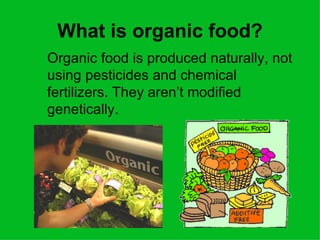
Organic food is produced naturally, not
using pesticides and chemical
fertilizers. They aren’t modified
genetically.
What is organic farming?
It is a type of agriculture which doesn’t use
chemical products and produces organic
food.
Labels
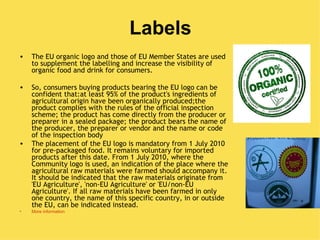
•   The EU organic logo and those of EU Member States are used
    to supplement the labelling and increase the visibility of
    organic food and drink for consumers.

•   So, consumers buying products bearing the EU logo can be
    confident that:at least 95% of the product's ingredients of
    agricultural origin have been organically produced;the
    product complies with the rules of the official inspection
    scheme; the product has come directly from the producer or
    preparer in a sealed package; the product bears the name of
    the producer, the preparer or vendor and the name or code
    of the inspection body
•   The placement of the EU logo is mandatory from 1 July 2010
    for pre-packaged food. It remains voluntary for imported
    products after this date. From 1 July 2010, where the
    Community logo is used, an indication of the place where the
    agricultural raw materials were farmed should accompany it.
    It should be indicated that the raw materials originate from
    'EU Agriculture', 'non-EU Agriculture' or 'EU/non-EU
    Agriculture'. If all raw materials have been farmed in only
    one country, the name of this specific country, in or outside
    the EU, can be indicated instead.
•   More information
ORGANIC FARMING EU
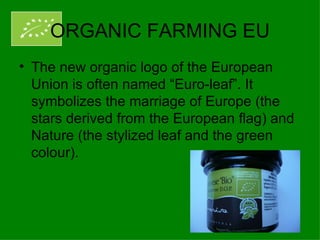
• The new organic logo of the European
  Union is often named “Euro-leaf”. It
  symbolizes the marriage of Europe (the
  stars derived from the European flag) and
  Nature (the stylized leaf and the green
  colour).
Organic farming:
             why is it good?
Because:
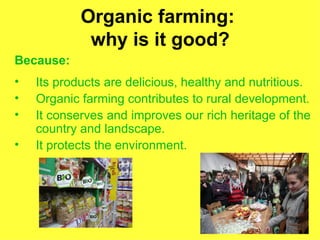
•   Its products are delicious, healthy and nutritious.
•   Organic farming contributes to rural development.
•   It conserves and improves our rich heritage of the
    country and landscape.
•   It protects the environment.
• These products are produced without pesticides
  and chemical products, they use organic fertilizer.
• Farmers don’t use genetically adapted organisms.
• They don’t breed animals artificially
• Animal’s welfare is respected.
• Additives are limited.
• It is strictly regulated by European laws.


  Organic fertilizer
ORGANIC FARMING IN
            GERMANY
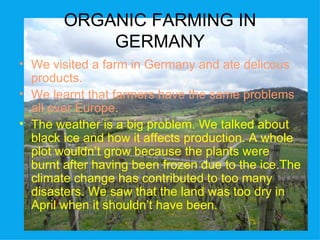
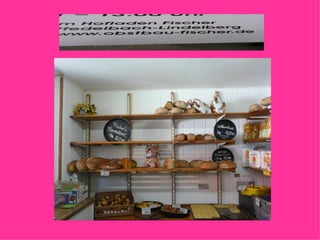
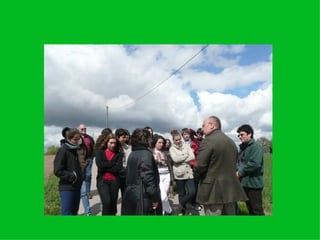
• We visited a farm in Germany and ate delicous
  products.
• We learnt that farmers have the same problems
  all over Europe.
• The weather is a big problem. We talked about
  black ice and how it affects production. A whole
  plot wouldn’t grow because the plants were
  burnt after having been frozen due to the ice.The
  climate change has contributed to too many
  disasters. We saw that the land was too dry in
  April when it shouldn’t have been.
Farmers in the Basque Country
In the Basque country farmers are
disappearing (average age is older),
getting land is an issue and intensification
of farming has increased. However, in the
Basque Country the situation (the crisis) is
so bad now that people are starting to
return to the land, young people want to
grow food and more women are starting to
become producers.
The strategic lines of action of EHNE to deal with these increasing problems:
•   Training – not only technical but political – the aim is to change the model not reproduce it
•   Awareness raising – work with a range of people – not just farmers but social movements,
    feminist groups, immigrants, schools etc. - through talks/debates/workshops/local festivals etc.
•   Alliances – also important to form alliances – e.g. with local groups mentioned above, but also
    international such as Via Campesina.
•   Access to markets and consumption:
•   making sure that the projects they work on are transformative and have an impact/effect. He
    talked about accumulated knowledge – for example challenging some of the regulations stopping
    small farmers processing food on site (as they always have done) - working with an individual
    farmer to show that it is possible/safe and then using that knowledge and example to support
    other farmers to challenge these regulations.
•   Creating local infrastructure so that big companies don't come and buy up all the produce (e.g. of
    'president' buying up all the milk for brie) and take all of the profit out of the area. Work
    collectively and with the local (not global) market.
•   Sschool dinners – if the schools or local authorities block the proposal of local & organic food, go
    direct to the parents – they care more about the health of their children.
•   Links with small local businesses (independent shops and restaurants)
•   Campaigns against big supermarkets
•   Transparent markets – showing very clearly how much you are paying the producers. They did a
    price comparison (shopping basket), and found that what cost 20 euros direct to the producer,
    cost 50 in a small shop and 60 in a supermarket.
Read the article
Suggestions:
• 4. DBH presentations
• Videos
• Fill in this questionnaire about organic
  food
END
Ainitze Diez
Ane Gomez
Egoitz Iradier

Organic food ainitzeaneegoitz

  • 1.
  • 2.
    What is organicfood? Organic food is produced naturally, not using pesticides and chemical fertilizers. They aren’t modified genetically.
  • 3.
    What is organicfarming? It is a type of agriculture which doesn’t use chemical products and produces organic food.
  • 4.
    Labels • The EU organic logo and those of EU Member States are used to supplement the labelling and increase the visibility of organic food and drink for consumers. • So, consumers buying products bearing the EU logo can be confident that:at least 95% of the product's ingredients of agricultural origin have been organically produced;the product complies with the rules of the official inspection scheme; the product has come directly from the producer or preparer in a sealed package; the product bears the name of the producer, the preparer or vendor and the name or code of the inspection body • The placement of the EU logo is mandatory from 1 July 2010 for pre-packaged food. It remains voluntary for imported products after this date. From 1 July 2010, where the Community logo is used, an indication of the place where the agricultural raw materials were farmed should accompany it. It should be indicated that the raw materials originate from 'EU Agriculture', 'non-EU Agriculture' or 'EU/non-EU Agriculture'. If all raw materials have been farmed in only one country, the name of this specific country, in or outside the EU, can be indicated instead. • More information
  • 5.
    ORGANIC FARMING EU •The new organic logo of the European Union is often named “Euro-leaf”. It symbolizes the marriage of Europe (the stars derived from the European flag) and Nature (the stylized leaf and the green colour).
  • 6.
    Organic farming: why is it good? Because: • Its products are delicious, healthy and nutritious. • Organic farming contributes to rural development. • It conserves and improves our rich heritage of the country and landscape. • It protects the environment.
  • 7.
    • These productsare produced without pesticides and chemical products, they use organic fertilizer. • Farmers don’t use genetically adapted organisms. • They don’t breed animals artificially • Animal’s welfare is respected. • Additives are limited. • It is strictly regulated by European laws. Organic fertilizer
  • 8.
    ORGANIC FARMING IN GERMANY • We visited a farm in Germany and ate delicous products. • We learnt that farmers have the same problems all over Europe. • The weather is a big problem. We talked about black ice and how it affects production. A whole plot wouldn’t grow because the plants were burnt after having been frozen due to the ice.The climate change has contributed to too many disasters. We saw that the land was too dry in April when it shouldn’t have been.
  • 11.
    Farmers in theBasque Country In the Basque country farmers are disappearing (average age is older), getting land is an issue and intensification of farming has increased. However, in the Basque Country the situation (the crisis) is so bad now that people are starting to return to the land, young people want to grow food and more women are starting to become producers.
  • 12.
    The strategic linesof action of EHNE to deal with these increasing problems: • Training – not only technical but political – the aim is to change the model not reproduce it • Awareness raising – work with a range of people – not just farmers but social movements, feminist groups, immigrants, schools etc. - through talks/debates/workshops/local festivals etc. • Alliances – also important to form alliances – e.g. with local groups mentioned above, but also international such as Via Campesina. • Access to markets and consumption: • making sure that the projects they work on are transformative and have an impact/effect. He talked about accumulated knowledge – for example challenging some of the regulations stopping small farmers processing food on site (as they always have done) - working with an individual farmer to show that it is possible/safe and then using that knowledge and example to support other farmers to challenge these regulations. • Creating local infrastructure so that big companies don't come and buy up all the produce (e.g. of 'president' buying up all the milk for brie) and take all of the profit out of the area. Work collectively and with the local (not global) market. • Sschool dinners – if the schools or local authorities block the proposal of local & organic food, go direct to the parents – they care more about the health of their children. • Links with small local businesses (independent shops and restaurants) • Campaigns against big supermarkets • Transparent markets – showing very clearly how much you are paying the producers. They did a price comparison (shopping basket), and found that what cost 20 euros direct to the producer, cost 50 in a small shop and 60 in a supermarket. Read the article
  • 13.
    Suggestions: • 4. DBHpresentations • Videos • Fill in this questionnaire about organic food
  • 14.