REGULATION (EU) No 1169/2011 OF THE EUROPEAN
PARLIAMENT AND OF THE COUNCIL
of 25 October 2011
on the provision of food information to consumers, amending
Regulations (EC) No 1924/2006 and (EC) No 1925/2006 of the
European Parliament and of the Council, and repealing
Commission Directive 87/250/EEC, Council Directive 90/496/
EEC, Commission Directive 1999/10/EC, Directive 2000/13/EC
of the European Parliament and of the Council, Commission
Directives 2002/67/EC and 2008/5/EC and Commission
Regulation (EC) No 608/2004
European Food Information for Consumers
Regulation (EU) No 1169/2011
•  Brings together general food labelling and nutrition
labelling into one piece of legislation.
•  Published in November 2011 – transition to the
new labelling began.
•  Most of the general labelling requirements apply
from 13 December 2014, with mandatory nutrition
declarations needed for most prepacked foods
from 13 December 2016.
Basic Principles
•  High level of protection for consumers’ health &
interests
•  Assist in the free movement of foodstuffs – EU
Internal Market
•  Food information should not be misleading and
should be provided in a clear, accurate and easy
to understand format so the consumer can make
‘informed’ choices
Article 1- Scope
•  Covers business operators at all stages of
food chain concerning provision of information
to consumers:
•  Food intended for the final consumer
•  Foods delivered by mass caterers
•  Foods intended for supply to mass
caterers
•  Also applies to catering services provided by
transport leaving from the EU Member States
•  Airline catering
Definition of food information
Information concerning a food and made available
to the final consumer by means of:
•  A label,
•  Other accompanying material,
•  Or any other means including modern
technology tools or verbal communication.
List of mandatory particulars
a.  name of the food*
b.  list of ingredients
c.  ‘allergens’ as listed in Annex II
d.  quantity of certain ingredients or category of
ingredients
e.  net quantity of the food*
f.  date of minimum durability or "use by" date
g.  any special storage conditions and/or conditions
of use
h.  name or business name and address of the food
business operator
List of mandatory particulars
i.  country of origin or place of provenance (where
provided for in Article 26)
j.  instructions for use where it would be difficult to
make appropriate use of the food in the absence
of such instructions
k.  alcoholic strength by volume for beverages
containing more than 1.2 % by volume of alcohol*
l.  nutrition declaration
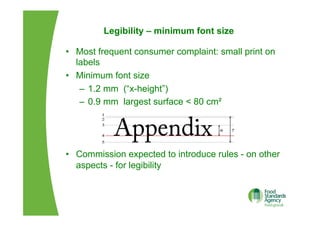
Legibility – minimum font size
•  Most frequent consumer complaint: small print on
labels
•  Minimum font size
–  1.2 mm (“x-height”)
–  0.9 mm largest surface < 80 cm²
•  Commission expected to introduce rules - on other
aspects - for legibility
Additional mandatory information
Substances causing allergies or intolerances:
•  No change in the list of 14 substances or products
causing allergies or intolerances (Annex II).
•  Allergens must be indicated in the list of
ingredients with a clear reference to the name of
the substance or product.
•  In the absence of a list of ingredients, the
presence of any allergens must be indicated by
use of the word ‘contains’ followed by the name of
the substance.
•  The declaration of allergens is not required where
the name of the food clearly refers to the
substance.
Additional mandatory information
Substances causing allergies or intolerances:
–  The name of the substance as listed in Annex II
must be emphasised through a typeset that
clearly distinguishes it from the rest of the list of
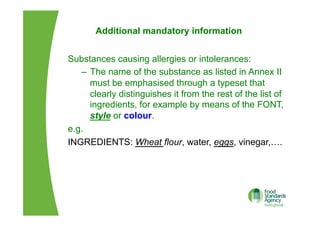
ingredients, for example by means of the FONT,
style or colour.
e.g.
INGREDIENTS: Wheat flour, water, eggs, vinegar,….
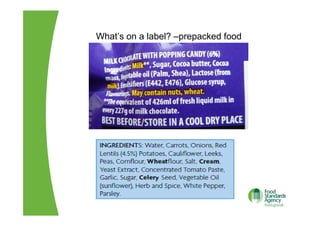
What’s on a label? –prepacked food
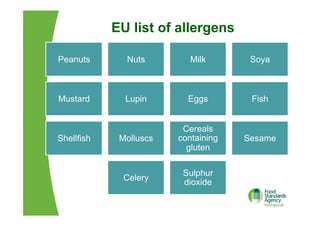
EU list of allergens
Peanuts Nuts Milk Soya
Mustard Lupin Eggs Fish
Shellfish Molluscs
Cereals
containing
gluten
Sesame
Celery
Sulphur
dioxide
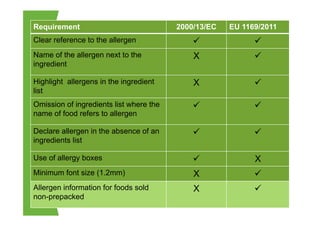
Requirement 2000/13/EC EU 1169/2011
Clear reference to the allergen ü ü
Name of the allergen next to the
ingredient
X ü
Highlight allergens in the ingredient
list
X ü
Omission of ingredients list where the
name of food refers to allergen
ü ü
Declare allergen in the absence of an
ingredients list
ü ü
Use of allergy boxes ü X
Minimum font size (1.2mm) X ü
Allergen information for foods sold
non-prepacked
X ü
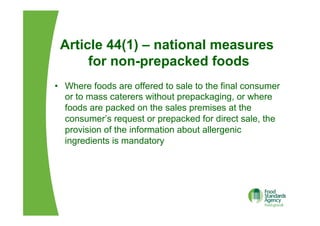
Article 44(1) – national measures
for non-prepacked foods
•  Where foods are offered to sale to the final consumer
or to mass caterers without prepackaging, or where
foods are packed on the sales premises at the
consumer’s request or prepacked for direct sale, the
provision of the information about allergenic
ingredients is mandatory
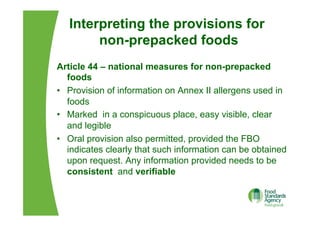
Interpreting the provisions for
non-prepacked foods
Article 44 – national measures for non-prepacked
foods
•  Provision of information on Annex II allergens used in
foods
•  Marked in a conspicuous place, easy visible, clear
and legible
•  Oral provision also permitted, provided the FBO
indicates clearly that such information can be obtained
upon request. Any information provided needs to be
consistent and verifiable
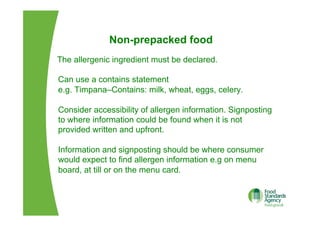
The allergenic ingredient must be declared.
Can use a contains statement
e.g. Timpana–Contains: milk, wheat, eggs, celery.
Consider accessibility of allergen information. Signposting
to where information could be found when it is not
provided written and upfront.
Information and signposting should be where consumer
would expect to find allergen information e.g on menu
board, at till or on the menu card.
Non-prepacked food
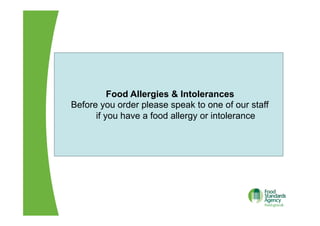
Food Allergies & Intolerances
Before you order please speak to one of our staff
if you have a food allergy or intolerance
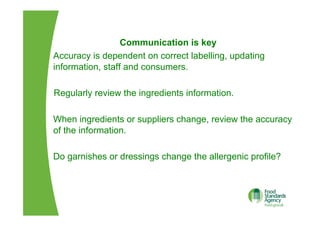
Communication is key
Accuracy is dependent on correct labelling, updating
information, staff and consumers.
Regularly review the ingredients information.
When ingredients or suppliers change, review the accuracy
of the information.
Do garnishes or dressings change the allergenic profile?
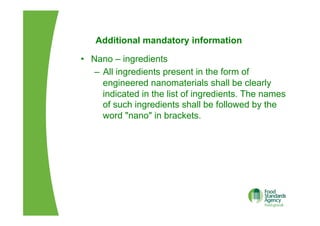
Additional mandatory information
•  Nano – ingredients
–  All ingredients present in the form of
engineered nanomaterials shall be clearly
indicated in the list of ingredients. The names
of such ingredients shall be followed by the
word "nano" in brackets.
Additional mandatory information
“contains a source of phenylalanine”
if aspartame/aspartame-acesulfame salt is designated in
the list of ingredients by its specific name.
“contains aspartame (a source of phenylalanine)”
if aspartame/aspartame- acesulfame salt is designated
in the list of ingredients only by the E number.
Additional mandatory information
Beverages with caffeine content > 150 mg/l
(other than coffee or tea) must be labelled
"High caffeine content. Not recommended for
children or pregnant or breast-feeding women" and
quote the actual caffeine content in mg per 100ml.
Foods other than beverages, where caffeine is
added with a physiological purpose
"Contains caffeine. Not recommended for children
or pregnant women" and quote the actual caffeine
content in mg per 100ml.
Nutrition information
•  At the moment, foods and drinks do not have to
provide nutrition information on pack (unless they
make a nutrition or health claim about the product
or vitamins and/or minerals have been added to
the food).
•  However, nutrition information will become
compulsory in the near future and there will be
some small changes to the format required.
Nutritional Declaration
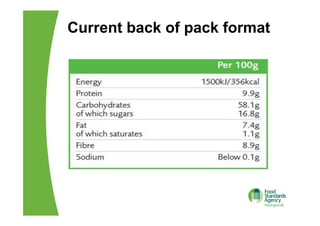
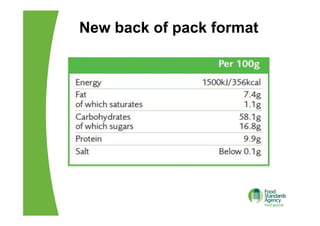
The mandatory nutrition declaration shall include the
following:
(a) energy value (in kJ and kcal) and
(b) fat, saturates, carbohydrate, sugars, protein and
salt * (expressed in g)
* salt = salt equivalent = sodium × 2,5
Where appropriate, a statement indicating that the salt
content is exclusively due to the presence of naturally
occurring sodium may appear close to the
nutrition declaration.
Current back of pack format
New back of pack format
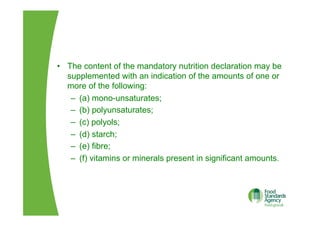
•  The content of the mandatory nutrition declaration may be
supplemented with an indication of the amounts of one or
more of the following:
–  (a) mono-unsaturates;
–  (b) polyunsaturates;
–  (c) polyols;
–  (d) starch;
–  (e) fibre;
–  (f) vitamins or minerals present in significant amounts.
Exemptions from mandatory nutritional
declarations
•  Foods listed in Annex V
•  Packaging or containers the largest surface of which
has an area of less than 25 cm²
•  Beverages containing > 1.2 % of alcohol
•  Commission will report by Dec 2014 on whether
alcoholic beverages should in the future bear a list of
ingredients and a nutrition declaration.
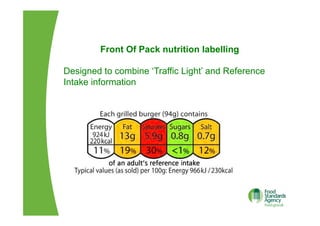
Front Of Pack nutrition labelling
Designed to combine ‘Traffic Light’ and Reference
Intake information
Mandatory origin declaration
•  Where failure to indicate this might mislead the consumer as to
the true country of origin or place of provenance of the food.
•  For meat falling within the Combined Nomenclature (‘CN’) codes
(Annex IV) – this means fresh or frozen pork, lamb, goat meat
and poultry are now the subject of Commission Implementing
Rules.
•  Also mandatory for
•  Virgin olive oils
•  Honey
•  Fish
•  Poultry meat imported from third countries
December 2013 – New implementing rules on the
mandatory origin labelling of unprocessed meat from
sheep, goats, pigs and poultry.
December 2013 – Commission reported on the
economic impacts of extending mandatory origin
labelling of all types of meat used as an ingredient in
foods.
By December 2014 the Commission must provide
reports, based on FIC, on possible extension of
mandatory origin labelling to:
- other unprocessed meats not already covered by
mandatory origin labelling rules such as horse,
rabbit, game meat;
- milk;
- milk as an ingredient in dairy products;
- single ingredient foods;
- unprocessed foods;
- ingredients representing > 50% of a food.
Quantitative Indications
•  When the ingredient
–  appears in the name of the food or is
usually associated with that name by the
consumer;
–  is emphasised on the labelling in words,
pictures or graphics; or
–  is essential to characterise a food and to
distinguish it from products with which it
might be confused because of its name or
appearance.
Distance selling
•  In the case of foods offered for sale by means of
distance communication, mandatory food information
to be available before purchase is concluded and to
appear on the material supporting the distance selling
or be provided through other appropriate means
clearly identified by the food business operator
•  All mandatory information to be available at the
moment of delivery
European Food Information for Consumers
Regulation
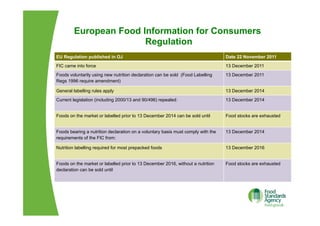
EU Regulation published in OJ 	 Date 22 November 2011 	
FIC came into force 	 13 December 2011 	
Foods voluntarily using new nutrition declaration can be sold (Food Labelling
Regs 1996 require amendment)	
13 December 2011	
General labelling rules apply 	 13 December 2014	
Current legislation (including 2000/13 and 90/496) repealed: 	 13 December 2014	
Foods on the market or labelled prior to 13 December 2014 can be sold until	 Food stocks are exhausted 	
Foods bearing a nutrition declaration on a voluntary basis must comply with the
requirements of the FIC from: 	
13 December 2014	
Nutrition labelling required for most prepacked foods 	 13 December 2016	
Foods on the market or labelled prior to 13 December 2016, without a nutrition
declaration can be sold until 	
Food stocks are exhausted
Sources of information
[
European Commission (FIC Regulation and Commission Q & A)
http://ec.europa.eu/food/food/labellingnutrition/foodlabelling/proposed_legislation_en.htm
Nutrition Labelling Guidance
https://www.gov.uk/government/publications/technical-guidance-on-nutrition-labelling
On line training
http://www.food.gov.uk/enforcement/enforcetrainfund/onlinetraining/food-labelling-training-online/
Food allergy / intolerance
British Retail Consortium (Guidance on food allergens)
http://www.brc.org.uk/downloads/Guidance%20on%20Allergen%20Labelling.pdf
FSA advice
• FSA allergy pages for tools, advice and guidance: http://food.gov.uk/policy-advice/allergyintol/
• Allergy E-learning http://allergytraining.food.gov.uk/
• Consumer advice http://food.gov.uk/multimedia/pdfs/publication/allergy-leaflet.pdf
• EU Food Information for Consumers Regulation
http://eur-lex.europa.eu/LexUriServ/LexUriServ.do?uri=OJ:L:2011:304:0018:0063:EN:PDF
Russell Napier
Standards and Labelling Team
Regulatory Policy Branch
Food Standards Agency in Scotland
Russell.Napier@foodstandards.gsi.gov.uk

EU Food Information for Consumers

  • 2.
    REGULATION (EU) No1169/2011 OF THE EUROPEAN PARLIAMENT AND OF THE COUNCIL of 25 October 2011 on the provision of food information to consumers, amending Regulations (EC) No 1924/2006 and (EC) No 1925/2006 of the European Parliament and of the Council, and repealing Commission Directive 87/250/EEC, Council Directive 90/496/ EEC, Commission Directive 1999/10/EC, Directive 2000/13/EC of the European Parliament and of the Council, Commission Directives 2002/67/EC and 2008/5/EC and Commission Regulation (EC) No 608/2004
  • 3.
    European Food Informationfor Consumers Regulation (EU) No 1169/2011 •  Brings together general food labelling and nutrition labelling into one piece of legislation. •  Published in November 2011 – transition to the new labelling began. •  Most of the general labelling requirements apply from 13 December 2014, with mandatory nutrition declarations needed for most prepacked foods from 13 December 2016.
  • 4.
    Basic Principles •  Highlevel of protection for consumers’ health & interests •  Assist in the free movement of foodstuffs – EU Internal Market •  Food information should not be misleading and should be provided in a clear, accurate and easy to understand format so the consumer can make ‘informed’ choices
  • 5.
    Article 1- Scope • Covers business operators at all stages of food chain concerning provision of information to consumers: •  Food intended for the final consumer •  Foods delivered by mass caterers •  Foods intended for supply to mass caterers •  Also applies to catering services provided by transport leaving from the EU Member States •  Airline catering
  • 6.
    Definition of foodinformation Information concerning a food and made available to the final consumer by means of: •  A label, •  Other accompanying material, •  Or any other means including modern technology tools or verbal communication.
  • 7.
    List of mandatoryparticulars a.  name of the food* b.  list of ingredients c.  ‘allergens’ as listed in Annex II d.  quantity of certain ingredients or category of ingredients e.  net quantity of the food* f.  date of minimum durability or "use by" date g.  any special storage conditions and/or conditions of use h.  name or business name and address of the food business operator
  • 8.
    List of mandatoryparticulars i.  country of origin or place of provenance (where provided for in Article 26) j.  instructions for use where it would be difficult to make appropriate use of the food in the absence of such instructions k.  alcoholic strength by volume for beverages containing more than 1.2 % by volume of alcohol* l.  nutrition declaration
  • 9.
    Legibility – minimumfont size •  Most frequent consumer complaint: small print on labels •  Minimum font size –  1.2 mm (“x-height”) –  0.9 mm largest surface < 80 cm² •  Commission expected to introduce rules - on other aspects - for legibility
  • 10.
    Additional mandatory information Substancescausing allergies or intolerances: •  No change in the list of 14 substances or products causing allergies or intolerances (Annex II). •  Allergens must be indicated in the list of ingredients with a clear reference to the name of the substance or product. •  In the absence of a list of ingredients, the presence of any allergens must be indicated by use of the word ‘contains’ followed by the name of the substance. •  The declaration of allergens is not required where the name of the food clearly refers to the substance.
  • 11.
    Additional mandatory information Substancescausing allergies or intolerances: –  The name of the substance as listed in Annex II must be emphasised through a typeset that clearly distinguishes it from the rest of the list of ingredients, for example by means of the FONT, style or colour. e.g. INGREDIENTS: Wheat flour, water, eggs, vinegar,….
  • 12.
    What’s on alabel? –prepacked food
  • 13.
    EU list ofallergens Peanuts Nuts Milk Soya Mustard Lupin Eggs Fish Shellfish Molluscs Cereals containing gluten Sesame Celery Sulphur dioxide
  • 14.
    Requirement 2000/13/EC EU1169/2011 Clear reference to the allergen ü ü Name of the allergen next to the ingredient X ü Highlight allergens in the ingredient list X ü Omission of ingredients list where the name of food refers to allergen ü ü Declare allergen in the absence of an ingredients list ü ü Use of allergy boxes ü X Minimum font size (1.2mm) X ü Allergen information for foods sold non-prepacked X ü
  • 15.
    Article 44(1) –national measures for non-prepacked foods •  Where foods are offered to sale to the final consumer or to mass caterers without prepackaging, or where foods are packed on the sales premises at the consumer’s request or prepacked for direct sale, the provision of the information about allergenic ingredients is mandatory
  • 16.
    Interpreting the provisionsfor non-prepacked foods Article 44 – national measures for non-prepacked foods •  Provision of information on Annex II allergens used in foods •  Marked in a conspicuous place, easy visible, clear and legible •  Oral provision also permitted, provided the FBO indicates clearly that such information can be obtained upon request. Any information provided needs to be consistent and verifiable
  • 17.
    The allergenic ingredientmust be declared. Can use a contains statement e.g. Timpana–Contains: milk, wheat, eggs, celery. Consider accessibility of allergen information. Signposting to where information could be found when it is not provided written and upfront. Information and signposting should be where consumer would expect to find allergen information e.g on menu board, at till or on the menu card. Non-prepacked food
  • 18.
    Food Allergies &Intolerances Before you order please speak to one of our staff if you have a food allergy or intolerance
  • 19.
    Communication is key Accuracyis dependent on correct labelling, updating information, staff and consumers. Regularly review the ingredients information. When ingredients or suppliers change, review the accuracy of the information. Do garnishes or dressings change the allergenic profile?
  • 21.
    Additional mandatory information • Nano – ingredients –  All ingredients present in the form of engineered nanomaterials shall be clearly indicated in the list of ingredients. The names of such ingredients shall be followed by the word "nano" in brackets.
  • 22.
    Additional mandatory information “containsa source of phenylalanine” if aspartame/aspartame-acesulfame salt is designated in the list of ingredients by its specific name. “contains aspartame (a source of phenylalanine)” if aspartame/aspartame- acesulfame salt is designated in the list of ingredients only by the E number.
  • 23.
    Additional mandatory information Beverageswith caffeine content > 150 mg/l (other than coffee or tea) must be labelled "High caffeine content. Not recommended for children or pregnant or breast-feeding women" and quote the actual caffeine content in mg per 100ml. Foods other than beverages, where caffeine is added with a physiological purpose "Contains caffeine. Not recommended for children or pregnant women" and quote the actual caffeine content in mg per 100ml.
  • 24.
    Nutrition information •  Atthe moment, foods and drinks do not have to provide nutrition information on pack (unless they make a nutrition or health claim about the product or vitamins and/or minerals have been added to the food). •  However, nutrition information will become compulsory in the near future and there will be some small changes to the format required.
  • 25.
    Nutritional Declaration The mandatorynutrition declaration shall include the following: (a) energy value (in kJ and kcal) and (b) fat, saturates, carbohydrate, sugars, protein and salt * (expressed in g) * salt = salt equivalent = sodium × 2,5 Where appropriate, a statement indicating that the salt content is exclusively due to the presence of naturally occurring sodium may appear close to the nutrition declaration.
  • 26.
    Current back ofpack format
  • 27.
    New back ofpack format
  • 28.
    •  The contentof the mandatory nutrition declaration may be supplemented with an indication of the amounts of one or more of the following: –  (a) mono-unsaturates; –  (b) polyunsaturates; –  (c) polyols; –  (d) starch; –  (e) fibre; –  (f) vitamins or minerals present in significant amounts.
  • 29.
    Exemptions from mandatorynutritional declarations •  Foods listed in Annex V •  Packaging or containers the largest surface of which has an area of less than 25 cm² •  Beverages containing > 1.2 % of alcohol •  Commission will report by Dec 2014 on whether alcoholic beverages should in the future bear a list of ingredients and a nutrition declaration.
  • 30.
    Front Of Packnutrition labelling Designed to combine ‘Traffic Light’ and Reference Intake information
  • 31.
    Mandatory origin declaration • Where failure to indicate this might mislead the consumer as to the true country of origin or place of provenance of the food. •  For meat falling within the Combined Nomenclature (‘CN’) codes (Annex IV) – this means fresh or frozen pork, lamb, goat meat and poultry are now the subject of Commission Implementing Rules. •  Also mandatory for •  Virgin olive oils •  Honey •  Fish •  Poultry meat imported from third countries
  • 32.
    December 2013 –New implementing rules on the mandatory origin labelling of unprocessed meat from sheep, goats, pigs and poultry. December 2013 – Commission reported on the economic impacts of extending mandatory origin labelling of all types of meat used as an ingredient in foods.
  • 33.
    By December 2014the Commission must provide reports, based on FIC, on possible extension of mandatory origin labelling to: - other unprocessed meats not already covered by mandatory origin labelling rules such as horse, rabbit, game meat; - milk; - milk as an ingredient in dairy products; - single ingredient foods; - unprocessed foods; - ingredients representing > 50% of a food.
  • 34.
    Quantitative Indications •  Whenthe ingredient –  appears in the name of the food or is usually associated with that name by the consumer; –  is emphasised on the labelling in words, pictures or graphics; or –  is essential to characterise a food and to distinguish it from products with which it might be confused because of its name or appearance.
  • 35.
    Distance selling •  Inthe case of foods offered for sale by means of distance communication, mandatory food information to be available before purchase is concluded and to appear on the material supporting the distance selling or be provided through other appropriate means clearly identified by the food business operator •  All mandatory information to be available at the moment of delivery
  • 36.
    European Food Informationfor Consumers Regulation EU Regulation published in OJ Date 22 November 2011 FIC came into force 13 December 2011 Foods voluntarily using new nutrition declaration can be sold (Food Labelling Regs 1996 require amendment) 13 December 2011 General labelling rules apply 13 December 2014 Current legislation (including 2000/13 and 90/496) repealed: 13 December 2014 Foods on the market or labelled prior to 13 December 2014 can be sold until Food stocks are exhausted Foods bearing a nutrition declaration on a voluntary basis must comply with the requirements of the FIC from: 13 December 2014 Nutrition labelling required for most prepacked foods 13 December 2016 Foods on the market or labelled prior to 13 December 2016, without a nutrition declaration can be sold until Food stocks are exhausted
  • 37.
    Sources of information [ EuropeanCommission (FIC Regulation and Commission Q & A) http://ec.europa.eu/food/food/labellingnutrition/foodlabelling/proposed_legislation_en.htm Nutrition Labelling Guidance https://www.gov.uk/government/publications/technical-guidance-on-nutrition-labelling On line training http://www.food.gov.uk/enforcement/enforcetrainfund/onlinetraining/food-labelling-training-online/ Food allergy / intolerance British Retail Consortium (Guidance on food allergens) http://www.brc.org.uk/downloads/Guidance%20on%20Allergen%20Labelling.pdf FSA advice • FSA allergy pages for tools, advice and guidance: http://food.gov.uk/policy-advice/allergyintol/ • Allergy E-learning http://allergytraining.food.gov.uk/ • Consumer advice http://food.gov.uk/multimedia/pdfs/publication/allergy-leaflet.pdf • EU Food Information for Consumers Regulation http://eur-lex.europa.eu/LexUriServ/LexUriServ.do?uri=OJ:L:2011:304:0018:0063:EN:PDF
  • 38.
    Russell Napier Standards andLabelling Team Regulatory Policy Branch Food Standards Agency in Scotland Russell.Napier@foodstandards.gsi.gov.uk