FOOD SECURITY ACT,
FOOD PROCESSING
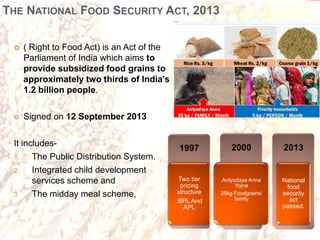
THE NATIONAL FOOD SECURITY ACT, 2013
 ( Right to Food Act) is an Act of the
Parliament of India which aims to
provide subsidized food grains to
approximately two thirds of India's
1.2 billion people.
 Signed on 12 September 2013
It includes-
1. The Public Distribution System.
2. Integrated child development
services scheme and
3. The midday meal scheme,
1997
Two tier
pricing
structure
:BPL And
APL
2000
Antyodaya Anna
Yojna
25kg Foodgrains/
family
2013
National
food
security
act
passed.
PUBLIC DISTRIBUTION SYSTEM(1947)
 Under Ministry of consumer affairs, food and public distribution.
 To provide for food and nutritional security by ensuring access to adequate
quantity of quality food at affordable prices.
 Coverage up to 75% of the rural and up to 50% of the urban population
INTEGRATED CHILD DEVELOPMENT SERVICES SCHEME(1975)
 Under Ministry of women and child development.
 To provide food, preschool education and primary healthcare to children under 6
years of age and their mothers
 To reduce the incidence of mortality, malnutrition.
MID DAY MEAL SCHEME(1995)
 Under Ministry of Human Resource Development.
 School meal Programme-provides hot cooked meal to children of primary and
upper primary classes.
 Free lunches on working days encouraging children, to attend school regularly.
LIMITATIONS OF NFSA
 Adult needs nearly 14kg food grains , NFSA gives only 5kg per person.
 FCI storage capacity insufficient.
 Importing food grains during drought years is little tough
 Focusing majorly on cereals neglecting pulses, edible oils, fruits,
vegetables, milk to combat malnutrition.
 Parliamentary committee recommendation :GPS tracking of trucks,
CCTVs to prevent diversion is not implemented.
 Household identification eligible for the scheme: a big challenge.
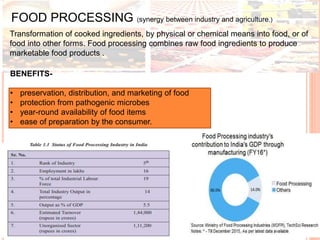
FOOD PROCESSING (synergy between industry and agriculture.)
Transformation of cooked ingredients, by physical or chemical means into food, or of
food into other forms. Food processing combines raw food ingredients to produce
marketable food products .
BENEFITS-
• preservation, distribution, and marketing of food
• protection from pathogenic microbes
• year-round availability of food items
• ease of preparation by the consumer.
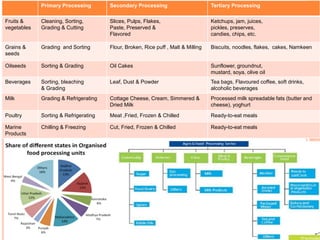
Primary Processing Secondary Processing Tertiary Processing
Fruits &
vegetables
Cleaning, Sorting,
Grading & Cutting
Slices, Pulps, Flakes,
Paste, Preserved &
Flavored
Ketchups, jam, juices,
pickles, preserves,
candies, chips, etc.
Grains &
seeds
Grading and Sorting Flour, Broken, Rice puff , Malt & Milling Biscuits, noodles, flakes, cakes, Namkeen
Oilseeds Sorting & Grading Oil Cakes Sunflower, groundnut,
mustard, soya, olive oil
Beverages Sorting, bleaching
& Grading
Leaf, Dust & Powder Tea bags, Flavoured coffee, soft drinks,
alcoholic beverages
Milk Grading & Refrigerating Cottage Cheese, Cream, Simmered &
Dried Milk
Processed milk spreadable fats (butter and
cheese), yoghurt
Poultry Sorting & Refrigerating Meat ,Fried, Frozen & Chilled Ready-to-eat meals
Marine
Products
Chilling & Freezing Cut, Fried, Frozen & Chilled Ready-to-eat meals
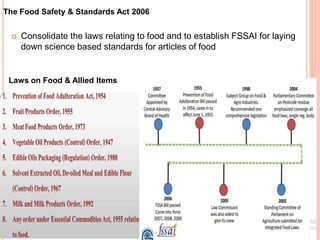
 Consolidate the laws relating to food and to establish FSSAI for laying
down science based standards for articles of food
Laws on Food & Allied Items
The Food Safety & Standards Act 2006
FUNCTIONS OF AUTHORITY
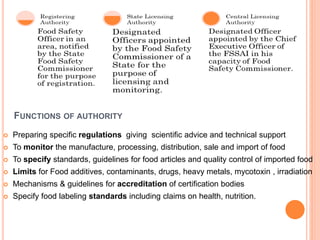
 Preparing specific regulations giving scientific advice and technical support
 To monitor the manufacture, processing, distribution, sale and import of food
 To specify standards, guidelines for food articles and quality control of imported food
 Limits for Food additives, contaminants, drugs, heavy metals, mycotoxin , irradiation
 Mechanisms & guidelines for accreditation of certification bodies
 Specify food labeling standards including claims on health, nutrition.
NEW ADDITIONS TO THE ACT:
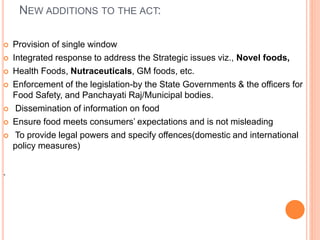
 Provision of single window
 Integrated response to address the Strategic issues viz., Novel foods,
 Health Foods, Nutraceuticals, GM foods, etc.
 Enforcement of the legislation-by the State Governments & the officers for
Food Safety, and Panchayati Raj/Municipal bodies.
 Dissemination of information on food
 Ensure food meets consumers’ expectations and is not misleading
 To provide legal powers and specify offences(domestic and international
policy measures)
.
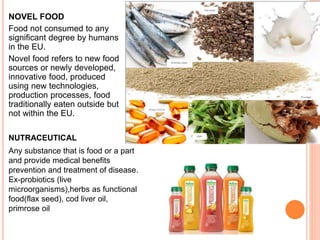
NOVEL FOOD
Food not consumed to any
significant degree by humans
in the EU.
Novel food refers to new food
sources or newly developed,
innovative food, produced
using new technologies,
production processes, food
traditionally eaten outside but
not within the EU.
Any substance that is food or a part
and provide medical benefits
prevention and treatment of disease.
Ex-probiotics (live
microorganisms),herbs as functional
food(flax seed), cod liver oil,
primrose oil
NUTRACEUTICAL
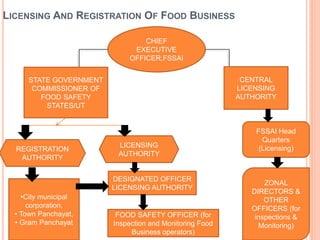
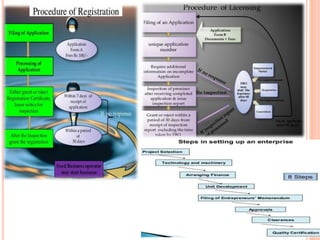
LICENSING AND REGISTRATION OF FOOD BUSINESS
CHIEF
EXECUTIVE
OFFICER,FSSAI
CENTRAL
LICENSING
AUTHORITY
STATE GOVERNMENT
COMMISSIONER OF
FOOD SAFETY
STATES/UT
REGISTRATION
AUTHORITY
LICENSING
AUTHORITY
•City municipal
corporation,
• Town Panchayat,
• Gram Panchayat
DESIGNATED OFFICER
LICENSING AUTHORITY
FOOD SAFETY OFFICER (for
Inspection and Monitoring Food
Business operators)
FSSAI Head
Quarters
(Licensing)
ZONAL
DIRECTORS &
OTHER
OFFICERS (for
inspections &
Monitoring)
GOVERNMENT
INITIATIVES
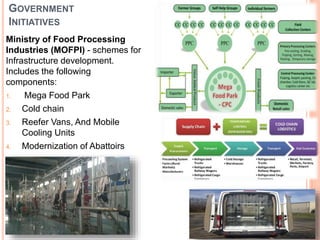
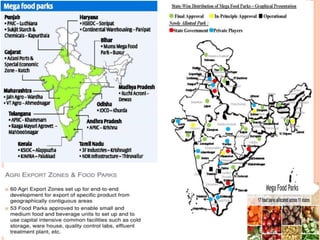
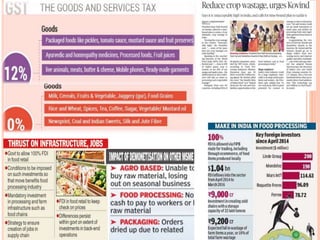
Ministry of Food Processing
Industries (MOFPI) - schemes for
Infrastructure development.
Includes the following
components:
1. Mega Food Park
2. Cold chain
3. Reefer Vans, And Mobile
Cooling Units
4. Modernization of Abattoirs
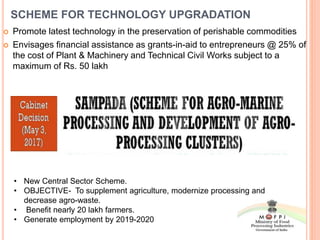
SCHEME FOR TECHNOLOGY UPGRADATION
 Promote latest technology in the preservation of perishable commodities
 Envisages financial assistance as grants-in-aid to entrepreneurs @ 25% of
the cost of Plant & Machinery and Technical Civil Works subject to a
maximum of Rs. 50 lakh
• New Central Sector Scheme.
• OBJECTIVE- To supplement agriculture, modernize processing and
decrease agro-waste.
• Benefit nearly 20 lakh farmers.
• Generate employment by 2019-2020
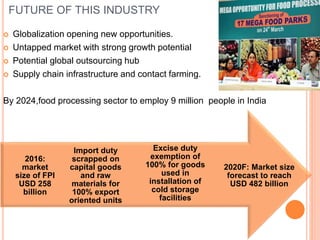
FUTURE OF THIS INDUSTRY
 Globalization opening new opportunities.
 Untapped market with strong growth potential
 Potential global outsourcing hub
 Supply chain infrastructure and contact farming.
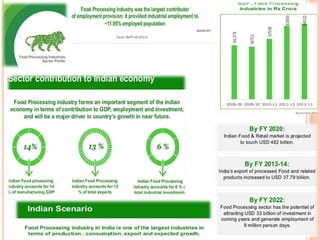
By 2024,food processing sector to employ 9 million people in India
2020F: Market size
forecast to reach
USD 482 billion
Excise duty
exemption of
100% for goods
used in
installation of
cold storage
facilities
Import duty
scrapped on
capital goods
and raw
materials for
100% export
oriented units
2016:
market
size of FPI
USD 258
billion
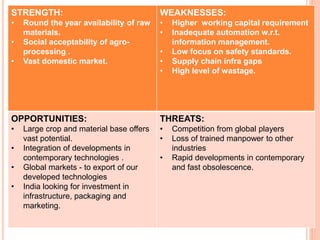
STRENGTH:
• Round the year availability of raw
materials.
• Social acceptability of agro-
processing .
• Vast domestic market.
WEAKNESSES:
• Higher working capital requirement
• Inadequate automation w.r.t.
information management.
• Low focus on safety standards.
• Supply chain infra gaps
• High level of wastage.
OPPORTUNITIES:
• Large crop and material base offers
vast potential.
• Integration of developments in
contemporary technologies .
• Global markets - to export of our
developed technologies
• India looking for investment in
infrastructure, packaging and
marketing.
THREATS:
• Competition from global players
• Loss of trained manpower to other
industries
• Rapid developments in contemporary
and fast obsolescence.
THANK YOU

Food Security Act ,Food Processing

  • 1.
  • 2.
    THE NATIONAL FOODSECURITY ACT, 2013  ( Right to Food Act) is an Act of the Parliament of India which aims to provide subsidized food grains to approximately two thirds of India's 1.2 billion people.  Signed on 12 September 2013 It includes- 1. The Public Distribution System. 2. Integrated child development services scheme and 3. The midday meal scheme, 1997 Two tier pricing structure :BPL And APL 2000 Antyodaya Anna Yojna 25kg Foodgrains/ family 2013 National food security act passed.
  • 3.
    PUBLIC DISTRIBUTION SYSTEM(1947) Under Ministry of consumer affairs, food and public distribution.  To provide for food and nutritional security by ensuring access to adequate quantity of quality food at affordable prices.  Coverage up to 75% of the rural and up to 50% of the urban population INTEGRATED CHILD DEVELOPMENT SERVICES SCHEME(1975)  Under Ministry of women and child development.  To provide food, preschool education and primary healthcare to children under 6 years of age and their mothers  To reduce the incidence of mortality, malnutrition. MID DAY MEAL SCHEME(1995)  Under Ministry of Human Resource Development.  School meal Programme-provides hot cooked meal to children of primary and upper primary classes.  Free lunches on working days encouraging children, to attend school regularly.
  • 4.
    LIMITATIONS OF NFSA Adult needs nearly 14kg food grains , NFSA gives only 5kg per person.  FCI storage capacity insufficient.  Importing food grains during drought years is little tough  Focusing majorly on cereals neglecting pulses, edible oils, fruits, vegetables, milk to combat malnutrition.  Parliamentary committee recommendation :GPS tracking of trucks, CCTVs to prevent diversion is not implemented.  Household identification eligible for the scheme: a big challenge.
  • 5.
    FOOD PROCESSING (synergybetween industry and agriculture.) Transformation of cooked ingredients, by physical or chemical means into food, or of food into other forms. Food processing combines raw food ingredients to produce marketable food products . BENEFITS- • preservation, distribution, and marketing of food • protection from pathogenic microbes • year-round availability of food items • ease of preparation by the consumer.
  • 6.
    Primary Processing SecondaryProcessing Tertiary Processing Fruits & vegetables Cleaning, Sorting, Grading & Cutting Slices, Pulps, Flakes, Paste, Preserved & Flavored Ketchups, jam, juices, pickles, preserves, candies, chips, etc. Grains & seeds Grading and Sorting Flour, Broken, Rice puff , Malt & Milling Biscuits, noodles, flakes, cakes, Namkeen Oilseeds Sorting & Grading Oil Cakes Sunflower, groundnut, mustard, soya, olive oil Beverages Sorting, bleaching & Grading Leaf, Dust & Powder Tea bags, Flavoured coffee, soft drinks, alcoholic beverages Milk Grading & Refrigerating Cottage Cheese, Cream, Simmered & Dried Milk Processed milk spreadable fats (butter and cheese), yoghurt Poultry Sorting & Refrigerating Meat ,Fried, Frozen & Chilled Ready-to-eat meals Marine Products Chilling & Freezing Cut, Fried, Frozen & Chilled Ready-to-eat meals
  • 8.
     Consolidate thelaws relating to food and to establish FSSAI for laying down science based standards for articles of food Laws on Food & Allied Items The Food Safety & Standards Act 2006
  • 10.
    FUNCTIONS OF AUTHORITY Preparing specific regulations giving scientific advice and technical support  To monitor the manufacture, processing, distribution, sale and import of food  To specify standards, guidelines for food articles and quality control of imported food  Limits for Food additives, contaminants, drugs, heavy metals, mycotoxin , irradiation  Mechanisms & guidelines for accreditation of certification bodies  Specify food labeling standards including claims on health, nutrition.
  • 11.
    NEW ADDITIONS TOTHE ACT:  Provision of single window  Integrated response to address the Strategic issues viz., Novel foods,  Health Foods, Nutraceuticals, GM foods, etc.  Enforcement of the legislation-by the State Governments & the officers for Food Safety, and Panchayati Raj/Municipal bodies.  Dissemination of information on food  Ensure food meets consumers’ expectations and is not misleading  To provide legal powers and specify offences(domestic and international policy measures) .
  • 12.
    NOVEL FOOD Food notconsumed to any significant degree by humans in the EU. Novel food refers to new food sources or newly developed, innovative food, produced using new technologies, production processes, food traditionally eaten outside but not within the EU. Any substance that is food or a part and provide medical benefits prevention and treatment of disease. Ex-probiotics (live microorganisms),herbs as functional food(flax seed), cod liver oil, primrose oil NUTRACEUTICAL
  • 13.
    LICENSING AND REGISTRATIONOF FOOD BUSINESS CHIEF EXECUTIVE OFFICER,FSSAI CENTRAL LICENSING AUTHORITY STATE GOVERNMENT COMMISSIONER OF FOOD SAFETY STATES/UT REGISTRATION AUTHORITY LICENSING AUTHORITY •City municipal corporation, • Town Panchayat, • Gram Panchayat DESIGNATED OFFICER LICENSING AUTHORITY FOOD SAFETY OFFICER (for Inspection and Monitoring Food Business operators) FSSAI Head Quarters (Licensing) ZONAL DIRECTORS & OTHER OFFICERS (for inspections & Monitoring)
  • 17.
    GOVERNMENT INITIATIVES Ministry of FoodProcessing Industries (MOFPI) - schemes for Infrastructure development. Includes the following components: 1. Mega Food Park 2. Cold chain 3. Reefer Vans, And Mobile Cooling Units 4. Modernization of Abattoirs
  • 19.
    SCHEME FOR TECHNOLOGYUPGRADATION  Promote latest technology in the preservation of perishable commodities  Envisages financial assistance as grants-in-aid to entrepreneurs @ 25% of the cost of Plant & Machinery and Technical Civil Works subject to a maximum of Rs. 50 lakh • New Central Sector Scheme. • OBJECTIVE- To supplement agriculture, modernize processing and decrease agro-waste. • Benefit nearly 20 lakh farmers. • Generate employment by 2019-2020
  • 21.
    FUTURE OF THISINDUSTRY  Globalization opening new opportunities.  Untapped market with strong growth potential  Potential global outsourcing hub  Supply chain infrastructure and contact farming. By 2024,food processing sector to employ 9 million people in India 2020F: Market size forecast to reach USD 482 billion Excise duty exemption of 100% for goods used in installation of cold storage facilities Import duty scrapped on capital goods and raw materials for 100% export oriented units 2016: market size of FPI USD 258 billion
  • 22.
    STRENGTH: • Round theyear availability of raw materials. • Social acceptability of agro- processing . • Vast domestic market. WEAKNESSES: • Higher working capital requirement • Inadequate automation w.r.t. information management. • Low focus on safety standards. • Supply chain infra gaps • High level of wastage. OPPORTUNITIES: • Large crop and material base offers vast potential. • Integration of developments in contemporary technologies . • Global markets - to export of our developed technologies • India looking for investment in infrastructure, packaging and marketing. THREATS: • Competition from global players • Loss of trained manpower to other industries • Rapid developments in contemporary and fast obsolescence.
  • 23.