VV ECMO in ARDS- Multidisciplinary
management
Dr. P. SHASHIDHAR,
MD,FNB,EDIC.,
CONSULTANT INTENSIVIST
Yashoda hospitals secbad
Case 1
MDT
• CT surgeon/ vascular surgeon
• Perfusionist
• Nursing team
• Respiratory therapist
• Physiotherapist
• Infection control team
• INTENSIVIST
• Others
• Why ECMO?
• Indications of ECMO
Bridge to recovery
Bridge to transplant
Indications
One or more of the following:
• Hypoxemic respiratory failure (PaO2/FiO2
< 80 mm Hg), after optimal medical
management, including, in the absence of
contraindications, a trial of prone
positioning.
• Hypercapneic respiratory failure (pH <
7.25), despite optimal conventional
mechanical ventilation (respiratory rate 35
bpm and plateau pressure [Pplat] ≤ 30 cm
H2O and driving pressures of > 16cm H2O
• Initiation
• Management
patient related & circuit related
• Trouble shooting
• Weaning
• Decannulation
Goals of care
• Physiologic optimization
• Oxygenation & clearance of CO2
• Treating reversible cause of respiratory
failure
• Lung rest
• Minimizing VILI
• Additional like minimizing sedation and
promoting spontaneous breaths
Daily care of the ECMO Patient
• Circuit Settings
• Blood Pressure
• Laboratory Values
• Echocardiography
• Assessment of Bleeding
• Sedation
• Nutrition and physical therapy
• Invasive Procedures
Circuit related management
• 1.Blood flow
• 2.oxygenation
• 3.CO2 Removal
• 4.Anticoagulation
• 5.Circuit monitors & Alarms
• 6.Component & Circuit Changes
• 7.Traveling
Blood flow
• For VV ECMO 60-80 cc/kg
• For cardiac support 3L/min/mt2
• Around 60 cc/kg
• Max flow intially lowest possible gradually
• Calcualte DO2/VO2 ratio ratio >3 should
be adequate.
• Oxygenation
• SPO2 80-85% acceptable
• CO2 removal
• Sweep gas flow usually 1:1
• For only CO2 removal 1:15.
Anticoagulation and ECMO
• Before Initiating - CBC, PT INR, aPTT, and
fibrinogen.
• Initiation of Anticoagulation Heparin 50-
100 units/kg
• Monitoring of Anticoagulation -aPTT / ACT
• HIT (4T score)
• Argatroban / Bivalirudin (direct thrombin
inhibitors)
• Circuit alarms and monitors
• For safety of patient
• Component change if required
• Transportation and planning
Patient Related Management
• 1.Hemodynamics
• 2.Ventilator Management
• 3.Sedation
• 4.Blood Volume & Fluid Balance
• 5.Temperature
• 6.Renal & Nutrition
• 7.Infection & Antibiotics
• 8.Positioning
• 9.Bleeding & Procedures
Blood Pressure
• The blood pressure should be measured
invasively, traditionally in the right radial in
V-A ECMO.
• Just like in any ICU patient, the MAP
should be maintained to allow for
adequate organ perfusion.
• Vasopressors and inotropes may be used
in ECMO patients in similar doses to
patients who are not on ECLS.
Mechanical Ventilation and ECMO
• Limit FiO2 (40-50) as hyperoxia can cause
reabsorption atelectasis and damage lung
tissue.
• Maintain Pplateau(25) low to prevent
barotrauma.
• Use low tidal volumes to protect the lung from
volutrauma.(Driving pressure 10-15 rate 10-12
I:E 2:1.)
• Maintain PEEP (10-15) to avoid atelectrauma
and total consolidation of the lung.
• First 24 hrs Deep sedation with resting
lung settings
• PCV 25/15 I:E 2:1 rate 5-12 FIO2 40-50%
• After 24-48 hrs Moderate to minimal
sedation
• PCV 20/10 I:E 2:1 rate 5 plus spontaneous
breaths FIO2 40-50%
• After 48hrs Minimal sedation
• PCV or CPAP to continue
• RECRUITEMENT TRIALS
• if TV >4 ml/kg, conduct CILLEYs test
• CPAP with 25 cm or PSV 25/10 rate 5 I:E
3:1 for 10 min/hr.
• Tracheostomy by day 3-5.
• Refractory hypoxemia proning on ECMO
• Blood Volume & Fluid Balance
• Temperature
• Renal & Nutrition
• Infection & Antibiotics
Assessment of Bleeding
• Intracranial bleeding
• GI Bleeding
• Intrathoracic bleeding
• Pericardial bleeding
• Retroperitoneal bleeding
• Cannulation site bleeding
• Surgical site bleeding
Invasive Procedures
• Arterial Line Insertion
• Central Venous Cahteter Insertion
• Bronchoscopy
• Chest Tube Insertion
• Patients Requiring Surgery
Weaning from ECMO
• The native lungs are providing ≥ 70-80%
of oxygenation.
• Pulmonary compliance and airway
resistance allow for ventilation at
reasonable pressures.
• The FiO2 provided by the ventilator is ≤
50-60%.
• The PaCO2 can be maintained at a near-
normal level within the range of acceptable
ventilator settings.
• The sweep gas flow to the oxygenator is
reduced to zero.
• The patient is observed for signs of
respiratory distress.
• The tidal volumes, minute ventilation and
respiratory rate are measured on the
ventilator.
• The patient's vital signs are monitored.
• Serial blood gases are taken to monitor
the gas exchange of the native lungs.
• Typically patients are trialled "off sweep"
for a period of 24 hours before a decision
is made to decannulate.
Decannulation
• Heparin to be off 30-60mt prior to decannulation.
• The VV lines are removed under LA.
• Pursestring sutures are placed by the surgical
team, and the lines are withdrawn sequentially.
• Pressure is placed on the site until bleeding
stops.
• When removing a venous cannula in a
spontaneously breathing patient, there is a risk
of entraining air through the sideholes, so a
valsalva maneuver can be employed to prevent
this.
Troubleshooting:Hypoxemia
• Circuit Shunt
• Low FIO2 in sweep gas
• Malfunctioning Oxygenator
• Recirculation
Pre- and Post-Membrane Gases
• To assess the function of the membrane
oxygenator.
• The pre-membrane gas pO2 is 40-70.
• The post-membrane gas pO2 is 300-500.
• If the increase in pO2 is lower than
expected, then this implies there is a
problem with the membrane.
• In V-V ECMO, if the pre-membrane pO2 is
much higher then this implies there is a
"recirculation".
Troubleshooting: Chatter
• Chatter is caused by a supply-demand mismatch
between the pump speed and the blood supply
to the pump.
• The pump creates a negative gradient and tries
to "suck" blood from the patient into the circuit.
• If there isn't enough blood available to flow into
the circuit, then the negative pressure relative to
the atmosphere causes the circuit to twist and
straighten.
• It is important to distinguish chatter from normal
pulsations in the circuit from the patient's cardiac
cycle
• Temporarily lower the RPM of the pump
until the chatter resolves.
• Administer an intravenous fluid bolus
appropriate for the given clinical scenario
(e.g. crystalloid, albumin, or blood
products).
• Restore the pump speed and see if the
chatter persists.
• A kinked or malpositioned drainage cannula
causing the vein to collapse, or "suck down"; this
can be identified by an x-ray or
echocardiography.
• This is especially common with an Avalon
catheter, as the flow is exquisitely sensitive to
position and it can chatter very easily.
• Increased intraabdominal pressure.
• Increased intrathoracic pressure.
• Haemorrhage.
Troubleshooting: Dropping Flows
• Low flows can lead to clotting in the circuit.
• Low flows are usually indicative of a
sinister process which needs to be
addressed.
• Make sure the pump speed is at the target
RPM.
• Inspect the circuit for kinks or occlusions.
• Inspect the membrane for large clots.
• Inspect the cannula sites to ensure there
has been no malposition.
• Inspect the circuit for chatter and look for
other signs of fluid responsiveness.
• It is reasonable to try a bolus of fluid if
pt.has intravascular volume depletion.
• If the above measures do not solve the
problem, then consult surgical team.
• Cannula position may be checked with a
chest x ray or echo.
• If a patient is centrally cannulated, then an
echo is extremely important to help rule
out central obstruction.
Troubleshooting: Bleeding Cannula
Site
• Alert the surgical team that inserted the
cannulas.
• Ensure the cannula is positioned properly
at the skin.
• Place absorbent dressings at the site.
• Apply firm sustained manual pressure for
5-15 minutes.
• Heparin may need to be temporarily
discontinued.
• Correction of coagulopathy: aim for a
near-normal INR, platelets >50-100,
fibrinogen >1.5gm.
• A surgical repair might be necessary,
either at the bedside or in the operating
room.
Troubleshooting: Hemolysis
• Anemia.
• Increased bilirubin, LDH, and free Hb.
• Pigment nephropathy: dark urine, or high
potassium in CRRT effluent if patient is on
dialysis.
• Relatively high pump speeds.
• Malposition of the drainage cannula
causing a "suck down" effect in the IVC or
SVC.
• Thrombosis of the centrifugal pump.
• Transfuse red blood cells as necessary to
maintain an appropriate hemoglobin level.
• A trial of reduced pump speed may be
warranted.
• Repositioning of the drainage cannula may
be necessary if a "suck down" effect is
seen.
Troubleshooting: Air in the Circuit
• IF Small amount of air
• This will not cause the circuit to
malfunction, but it should be removed
immediately.
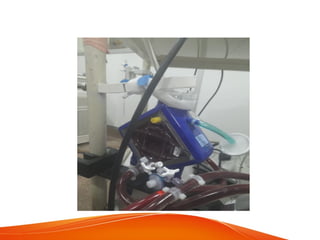
• Try to vent the air by removing the yellow
cap on the venous side of the oxygenator
(this is sometimes called "burping" the
circuit).
• Try to identify the source of the air.
• If large amount of air in the circuit
• This is an emergency, as an "air lock" can
cause flow to arrest in the circuit.
• Call for help immediately.
• Try to vent the air by "burping the circuit",
but if there is an air lock, this will not help.
• Do not clamp or cut any tubing until a plan
has been made to replace the circuit.
Troubleshooting: Pump Failure
• Before troubleshooting pump failure, call
for help from the perfusionist, ICU staff
and surgical staff immediately
• Insufficient power provided to turn the
motor of the centrifugal pump.
• Malfunction of the motor itself.
• Displacement of the centrifugal impeller.
RESPIRATORY AND VENTILATORY
MANAGEMENT
• Lung protective ventilation – ultra low tv
4ml/kg body wt, rate 10-15, peep 10-15,
plateau <25.
• Bronchoscopy
• Tracheostomy
• Refractory hypoxemia proning on ECMO
• Sedation and analgesia

ECMO part -2 Updated guidelines on life support

  • 1.
    VV ECMO inARDS- Multidisciplinary management Dr. P. SHASHIDHAR, MD,FNB,EDIC., CONSULTANT INTENSIVIST Yashoda hospitals secbad
  • 3.
  • 4.
    MDT • CT surgeon/vascular surgeon • Perfusionist • Nursing team • Respiratory therapist • Physiotherapist • Infection control team • INTENSIVIST • Others
  • 5.
    • Why ECMO? •Indications of ECMO Bridge to recovery Bridge to transplant
  • 6.
    Indications One or moreof the following: • Hypoxemic respiratory failure (PaO2/FiO2 < 80 mm Hg), after optimal medical management, including, in the absence of contraindications, a trial of prone positioning. • Hypercapneic respiratory failure (pH < 7.25), despite optimal conventional mechanical ventilation (respiratory rate 35 bpm and plateau pressure [Pplat] ≤ 30 cm H2O and driving pressures of > 16cm H2O
  • 7.
    • Initiation • Management patientrelated & circuit related • Trouble shooting • Weaning • Decannulation
  • 8.
    Goals of care •Physiologic optimization • Oxygenation & clearance of CO2 • Treating reversible cause of respiratory failure • Lung rest • Minimizing VILI • Additional like minimizing sedation and promoting spontaneous breaths
  • 9.
    Daily care ofthe ECMO Patient • Circuit Settings • Blood Pressure • Laboratory Values • Echocardiography • Assessment of Bleeding • Sedation • Nutrition and physical therapy • Invasive Procedures
  • 10.
    Circuit related management •1.Blood flow • 2.oxygenation • 3.CO2 Removal • 4.Anticoagulation • 5.Circuit monitors & Alarms • 6.Component & Circuit Changes • 7.Traveling
  • 11.
    Blood flow • ForVV ECMO 60-80 cc/kg • For cardiac support 3L/min/mt2 • Around 60 cc/kg • Max flow intially lowest possible gradually • Calcualte DO2/VO2 ratio ratio >3 should be adequate.
  • 12.
    • Oxygenation • SPO280-85% acceptable • CO2 removal • Sweep gas flow usually 1:1 • For only CO2 removal 1:15.
  • 13.
    Anticoagulation and ECMO •Before Initiating - CBC, PT INR, aPTT, and fibrinogen. • Initiation of Anticoagulation Heparin 50- 100 units/kg • Monitoring of Anticoagulation -aPTT / ACT • HIT (4T score) • Argatroban / Bivalirudin (direct thrombin inhibitors)
  • 14.
    • Circuit alarmsand monitors • For safety of patient • Component change if required • Transportation and planning
  • 15.
    Patient Related Management •1.Hemodynamics • 2.Ventilator Management • 3.Sedation • 4.Blood Volume & Fluid Balance • 5.Temperature • 6.Renal & Nutrition • 7.Infection & Antibiotics • 8.Positioning • 9.Bleeding & Procedures
  • 16.
    Blood Pressure • Theblood pressure should be measured invasively, traditionally in the right radial in V-A ECMO. • Just like in any ICU patient, the MAP should be maintained to allow for adequate organ perfusion. • Vasopressors and inotropes may be used in ECMO patients in similar doses to patients who are not on ECLS.
  • 17.
    Mechanical Ventilation andECMO • Limit FiO2 (40-50) as hyperoxia can cause reabsorption atelectasis and damage lung tissue. • Maintain Pplateau(25) low to prevent barotrauma. • Use low tidal volumes to protect the lung from volutrauma.(Driving pressure 10-15 rate 10-12 I:E 2:1.) • Maintain PEEP (10-15) to avoid atelectrauma and total consolidation of the lung.
  • 18.
    • First 24hrs Deep sedation with resting lung settings • PCV 25/15 I:E 2:1 rate 5-12 FIO2 40-50% • After 24-48 hrs Moderate to minimal sedation • PCV 20/10 I:E 2:1 rate 5 plus spontaneous breaths FIO2 40-50% • After 48hrs Minimal sedation • PCV or CPAP to continue
  • 19.
    • RECRUITEMENT TRIALS •if TV >4 ml/kg, conduct CILLEYs test • CPAP with 25 cm or PSV 25/10 rate 5 I:E 3:1 for 10 min/hr. • Tracheostomy by day 3-5. • Refractory hypoxemia proning on ECMO
  • 20.
    • Blood Volume& Fluid Balance • Temperature • Renal & Nutrition • Infection & Antibiotics
  • 21.
    Assessment of Bleeding •Intracranial bleeding • GI Bleeding • Intrathoracic bleeding • Pericardial bleeding • Retroperitoneal bleeding • Cannulation site bleeding • Surgical site bleeding
  • 22.
    Invasive Procedures • ArterialLine Insertion • Central Venous Cahteter Insertion • Bronchoscopy • Chest Tube Insertion • Patients Requiring Surgery
  • 23.
    Weaning from ECMO •The native lungs are providing ≥ 70-80% of oxygenation. • Pulmonary compliance and airway resistance allow for ventilation at reasonable pressures. • The FiO2 provided by the ventilator is ≤ 50-60%. • The PaCO2 can be maintained at a near- normal level within the range of acceptable ventilator settings.
  • 24.
    • The sweepgas flow to the oxygenator is reduced to zero. • The patient is observed for signs of respiratory distress. • The tidal volumes, minute ventilation and respiratory rate are measured on the ventilator. • The patient's vital signs are monitored. • Serial blood gases are taken to monitor the gas exchange of the native lungs.
  • 25.
    • Typically patientsare trialled "off sweep" for a period of 24 hours before a decision is made to decannulate.
  • 26.
    Decannulation • Heparin tobe off 30-60mt prior to decannulation. • The VV lines are removed under LA. • Pursestring sutures are placed by the surgical team, and the lines are withdrawn sequentially. • Pressure is placed on the site until bleeding stops. • When removing a venous cannula in a spontaneously breathing patient, there is a risk of entraining air through the sideholes, so a valsalva maneuver can be employed to prevent this.
  • 27.
    Troubleshooting:Hypoxemia • Circuit Shunt •Low FIO2 in sweep gas • Malfunctioning Oxygenator • Recirculation
  • 28.
    Pre- and Post-MembraneGases • To assess the function of the membrane oxygenator. • The pre-membrane gas pO2 is 40-70. • The post-membrane gas pO2 is 300-500. • If the increase in pO2 is lower than expected, then this implies there is a problem with the membrane. • In V-V ECMO, if the pre-membrane pO2 is much higher then this implies there is a "recirculation".
  • 29.
    Troubleshooting: Chatter • Chatteris caused by a supply-demand mismatch between the pump speed and the blood supply to the pump. • The pump creates a negative gradient and tries to "suck" blood from the patient into the circuit. • If there isn't enough blood available to flow into the circuit, then the negative pressure relative to the atmosphere causes the circuit to twist and straighten. • It is important to distinguish chatter from normal pulsations in the circuit from the patient's cardiac cycle
  • 30.
    • Temporarily lowerthe RPM of the pump until the chatter resolves. • Administer an intravenous fluid bolus appropriate for the given clinical scenario (e.g. crystalloid, albumin, or blood products). • Restore the pump speed and see if the chatter persists.
  • 31.
    • A kinkedor malpositioned drainage cannula causing the vein to collapse, or "suck down"; this can be identified by an x-ray or echocardiography. • This is especially common with an Avalon catheter, as the flow is exquisitely sensitive to position and it can chatter very easily. • Increased intraabdominal pressure. • Increased intrathoracic pressure. • Haemorrhage.
  • 32.
    Troubleshooting: Dropping Flows •Low flows can lead to clotting in the circuit. • Low flows are usually indicative of a sinister process which needs to be addressed.
  • 33.
    • Make surethe pump speed is at the target RPM. • Inspect the circuit for kinks or occlusions. • Inspect the membrane for large clots. • Inspect the cannula sites to ensure there has been no malposition. • Inspect the circuit for chatter and look for other signs of fluid responsiveness.
  • 34.
    • It isreasonable to try a bolus of fluid if pt.has intravascular volume depletion. • If the above measures do not solve the problem, then consult surgical team. • Cannula position may be checked with a chest x ray or echo. • If a patient is centrally cannulated, then an echo is extremely important to help rule out central obstruction.
  • 35.
    Troubleshooting: Bleeding Cannula Site •Alert the surgical team that inserted the cannulas. • Ensure the cannula is positioned properly at the skin. • Place absorbent dressings at the site. • Apply firm sustained manual pressure for 5-15 minutes.
  • 36.
    • Heparin mayneed to be temporarily discontinued. • Correction of coagulopathy: aim for a near-normal INR, platelets >50-100, fibrinogen >1.5gm. • A surgical repair might be necessary, either at the bedside or in the operating room.
  • 37.
    Troubleshooting: Hemolysis • Anemia. •Increased bilirubin, LDH, and free Hb. • Pigment nephropathy: dark urine, or high potassium in CRRT effluent if patient is on dialysis.
  • 38.
    • Relatively highpump speeds. • Malposition of the drainage cannula causing a "suck down" effect in the IVC or SVC. • Thrombosis of the centrifugal pump.
  • 39.
    • Transfuse redblood cells as necessary to maintain an appropriate hemoglobin level. • A trial of reduced pump speed may be warranted. • Repositioning of the drainage cannula may be necessary if a "suck down" effect is seen.
  • 40.
    Troubleshooting: Air inthe Circuit • IF Small amount of air • This will not cause the circuit to malfunction, but it should be removed immediately. • Try to vent the air by removing the yellow cap on the venous side of the oxygenator (this is sometimes called "burping" the circuit). • Try to identify the source of the air.
  • 42.
    • If largeamount of air in the circuit • This is an emergency, as an "air lock" can cause flow to arrest in the circuit. • Call for help immediately. • Try to vent the air by "burping the circuit", but if there is an air lock, this will not help. • Do not clamp or cut any tubing until a plan has been made to replace the circuit.
  • 43.
    Troubleshooting: Pump Failure •Before troubleshooting pump failure, call for help from the perfusionist, ICU staff and surgical staff immediately • Insufficient power provided to turn the motor of the centrifugal pump. • Malfunction of the motor itself. • Displacement of the centrifugal impeller.
  • 45.
    RESPIRATORY AND VENTILATORY MANAGEMENT •Lung protective ventilation – ultra low tv 4ml/kg body wt, rate 10-15, peep 10-15, plateau <25. • Bronchoscopy • Tracheostomy • Refractory hypoxemia proning on ECMO • Sedation and analgesia