Every Child Has Options
Elizabeth Kaman
Crime Prevention – Unit 9 Final
November 19, 2013ElizabethKaman_Unit9_FinalAssignment
 Juveniles locked up in detention centers all across the country are coming
together. They formed an alliance – to keep troubled kids out of the juvenile
justice system.
 Provides at-risk kids with positive and consistent peer contact to promote
healthy development and positive decision making by giving each child options.
 Organized by juveniles who chose not to make the right choices, these
incarcerated teens are helping other’s see that they have the ability to make a
difference before it’s too late.
 The most successful programs are those that prevent kids from engaging in
criminal activity in the first place.
ElizabethKaman_Unit9_FinalAssignment
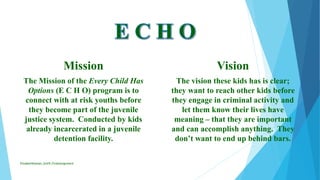
Mission
The Mission of the Every Child Has
Options (E C H O) program is to
connect with at risk youths before
they become part of the juvenile
justice system. Conducted by kids
already incarcerated in a juvenile
detention facility.
Vision
The vision these kids has is clear;
they want to reach other kids before
they engage in criminal activity and
let them know their lives have
meaning – that they are important
and can accomplish anything. They
don’t want to end up behind bars.
ElizabethKaman_Unit9_FinalAssignment
 20% of all children are
considered delinquent at some
point during their adolescence.
 A large number of kids are
pressured into delinquency due
to some type of social
disadvantage.
 Doing poorly in academics is
also another large contributor to
juvenile delinquency (tjjd.gov,
2013).
ElizabethKaman_Unit9_FinalAssignment
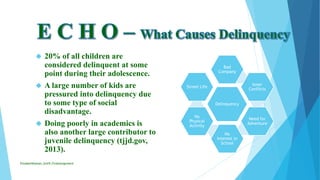
Delinquency
Bad
Company
Inner
Conflicts
Need for
Adventure
No
Interest in
School
No
Physical
Activity
Street Life
 There are many reasons for needing to prevent juveniles from
becoming delinquents. One of the most recognized concerns is that
criminal activity puts these kids at an elevated risk for drug and alcohol
abuse, dropping out of school, injuring themselves or others, early
pregnancy or sexually transmitted diseases, or even incarceration at an
early age.
 Most adult criminals started their illegal activities when they were
adolescents (tjjd.gov, 2013).
 Saving kids from early criminal habits, saves them from a wasted, non-
productive life.
ElizabethKaman_Unit9_FinalAssignment
 Behavior change through cordial interaction,
role modeling, and by role-playing positive,
new behaviors with other teens who they can
relate to.
 Addresses current issues the high risk teen is
currently experiencing in his/her life. Real
life problems.
 Building trusting relationships for more
effective behavior change.
 Making the out of control kid understand
that you have also been where they are now –
letting them know, “You Don’t Want to
Come Here”! (Gingrich, P., 2011).ElizabethKaman_Unit9_FinalAssignment
 Assemblies are set up at specified
juvenile detention centers that are
run by the incarcerated children;
average age 16 years, known as The
First Team.
 After successfully completing their
course with The First Team, the
high-risk kids are then placed in a
continuation program run by
volunteers, according to their
specific needs.
ElizabethKaman_Unit9_FinalAssignment
 Two weeks will be spent with the ECHO First Team,
interacting individually and in groups with the troubled
teens, focusing on real-life events, attitude, behavior,
choices and what life is really like once you get convicted
of a crime as a juvenile. The continuation program
follows:
 Individual and/or Family Counseling
 Aggression Replacement Training
 Drug and Alcohol Abuse Treatment
 Education and Truancy Interventions
 Mentoring – Personal or Academic Levels
ElizabethKaman_Unit9_FinalAssignment
 Children learn what they live.
 If a child is having issues at home, or at
school and have no one to confide in, this
program can give them the opportunity to
express their feelings and concerns with
kids their own age who they feel
understand what they’re going through.
They will feel safe.
 They will gain the confidence to enable
them to make sound, reasonable decisions
that will help them succeed as an adult.
ElizabethKaman_Unit9_FinalAssignment
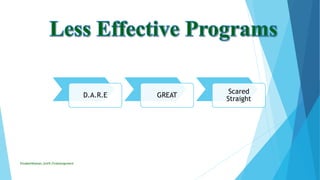
D.A.R.E GREAT
Scared
Straight
 The DARE program, founded in 1983, has been
found to be ineffective in keeping kids off drugs.
 The program has not shown to prevent drug use in
elementary, middle or even high school students.
 DARE has actually been associated with elevated
drug use.
 Kids who have graduated from the program show
no long-term knowledge or memory of the
program.
 DARE gives parents a false sense of security about
their children and drugs (procon.org, 2013).
ElizabethKaman_Unit9_FinalAssignment
 GREAT is the only program specifically
designated to reduce gang activity that has been
boldly evaluated.
 The assessments showed only very slight positive
results associated with gang membership,
delinquency, thrill seeking teens, and attitudes
about law enforcement.
 An issue regarding gathering statistics on this
program is that most of the research involves
minors and requires obtaining consent for the
child’s participation (ncjrs.gov, 2002).
ElizabethKaman_Unit9_FinalAssignment
 Inmates who participate in this program are often very
aggressive and rely on fear and intimidation to frighten
the troubled kids – to keep them in line.
 Results show that not only is this program ineffective, it
confirms that kids who go through this program are at
greater risk for committing crimes in the future
(crimesolutions.gov, 2013).
 Basically, kids can’t usually be scared or intimidated
that way. Not by an adult. Teenagers know everything.
They need to hear the facts from someone their own
age, someone who they can really relate to.
ElizabethKaman_Unit9_FinalAssignment
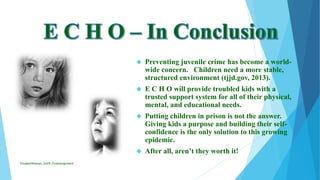
 Preventing juvenile crime has become a world-
wide concern. Children need a more stable,
structured environment (tjjd.gov, 2013).
 E C H O will provide troubled kids with a
trusted support system for all of their physical,
mental, and educational needs.
 Putting children in prison is not the answer.
Giving kids a purpose and building their self-
confidence is the only solution to this growing
epidemic.
 After all, aren’t they worth it!
ElizabethKaman_Unit9_FinalAssignment
References
Crime Solutions (2013). Juvenile Awareness Programs. Retrieved from
http://www.crimesolutions.gov/PracticeDetails.aspx?ID=4
Gingrich, P. (2012). Retrieved from http://www.youtube.com/watch?v=g3lw6PMjj40
Procon.org (2013). Is The DARE Program Good for America’s Kids (K-12)? Retrieved from
http://dare.procon.org
Texas Juvenile Justice Department (2013). Delinquency Prevention in Texas. Retrieved from
http://www.tjjd.texas.gov/aboutus/agency_mission.aspx
U.S. Department of Justice (2002). Responding to Gangs: Evaluation and Research. Retrieved
from https://www.mcjrs.gov/pdffiles1/nij/190351.pdf
ElizabethKaman_Unit9_FinalAssignment

Echo - Every Child Has Options

  • 1.
    Every Child HasOptions Elizabeth Kaman Crime Prevention – Unit 9 Final November 19, 2013ElizabethKaman_Unit9_FinalAssignment
  • 2.
     Juveniles lockedup in detention centers all across the country are coming together. They formed an alliance – to keep troubled kids out of the juvenile justice system.  Provides at-risk kids with positive and consistent peer contact to promote healthy development and positive decision making by giving each child options.  Organized by juveniles who chose not to make the right choices, these incarcerated teens are helping other’s see that they have the ability to make a difference before it’s too late.  The most successful programs are those that prevent kids from engaging in criminal activity in the first place. ElizabethKaman_Unit9_FinalAssignment
  • 3.
    Mission The Mission ofthe Every Child Has Options (E C H O) program is to connect with at risk youths before they become part of the juvenile justice system. Conducted by kids already incarcerated in a juvenile detention facility. Vision The vision these kids has is clear; they want to reach other kids before they engage in criminal activity and let them know their lives have meaning – that they are important and can accomplish anything. They don’t want to end up behind bars. ElizabethKaman_Unit9_FinalAssignment
  • 4.
     20% ofall children are considered delinquent at some point during their adolescence.  A large number of kids are pressured into delinquency due to some type of social disadvantage.  Doing poorly in academics is also another large contributor to juvenile delinquency (tjjd.gov, 2013). ElizabethKaman_Unit9_FinalAssignment Delinquency Bad Company Inner Conflicts Need for Adventure No Interest in School No Physical Activity Street Life
  • 5.
     There aremany reasons for needing to prevent juveniles from becoming delinquents. One of the most recognized concerns is that criminal activity puts these kids at an elevated risk for drug and alcohol abuse, dropping out of school, injuring themselves or others, early pregnancy or sexually transmitted diseases, or even incarceration at an early age.  Most adult criminals started their illegal activities when they were adolescents (tjjd.gov, 2013).  Saving kids from early criminal habits, saves them from a wasted, non- productive life. ElizabethKaman_Unit9_FinalAssignment
  • 6.
     Behavior changethrough cordial interaction, role modeling, and by role-playing positive, new behaviors with other teens who they can relate to.  Addresses current issues the high risk teen is currently experiencing in his/her life. Real life problems.  Building trusting relationships for more effective behavior change.  Making the out of control kid understand that you have also been where they are now – letting them know, “You Don’t Want to Come Here”! (Gingrich, P., 2011).ElizabethKaman_Unit9_FinalAssignment
  • 7.
     Assemblies areset up at specified juvenile detention centers that are run by the incarcerated children; average age 16 years, known as The First Team.  After successfully completing their course with The First Team, the high-risk kids are then placed in a continuation program run by volunteers, according to their specific needs. ElizabethKaman_Unit9_FinalAssignment
  • 8.
     Two weekswill be spent with the ECHO First Team, interacting individually and in groups with the troubled teens, focusing on real-life events, attitude, behavior, choices and what life is really like once you get convicted of a crime as a juvenile. The continuation program follows:  Individual and/or Family Counseling  Aggression Replacement Training  Drug and Alcohol Abuse Treatment  Education and Truancy Interventions  Mentoring – Personal or Academic Levels ElizabethKaman_Unit9_FinalAssignment
  • 9.
     Children learnwhat they live.  If a child is having issues at home, or at school and have no one to confide in, this program can give them the opportunity to express their feelings and concerns with kids their own age who they feel understand what they’re going through. They will feel safe.  They will gain the confidence to enable them to make sound, reasonable decisions that will help them succeed as an adult. ElizabethKaman_Unit9_FinalAssignment
  • 10.
  • 11.
     The DAREprogram, founded in 1983, has been found to be ineffective in keeping kids off drugs.  The program has not shown to prevent drug use in elementary, middle or even high school students.  DARE has actually been associated with elevated drug use.  Kids who have graduated from the program show no long-term knowledge or memory of the program.  DARE gives parents a false sense of security about their children and drugs (procon.org, 2013). ElizabethKaman_Unit9_FinalAssignment
  • 12.
     GREAT isthe only program specifically designated to reduce gang activity that has been boldly evaluated.  The assessments showed only very slight positive results associated with gang membership, delinquency, thrill seeking teens, and attitudes about law enforcement.  An issue regarding gathering statistics on this program is that most of the research involves minors and requires obtaining consent for the child’s participation (ncjrs.gov, 2002). ElizabethKaman_Unit9_FinalAssignment
  • 13.
     Inmates whoparticipate in this program are often very aggressive and rely on fear and intimidation to frighten the troubled kids – to keep them in line.  Results show that not only is this program ineffective, it confirms that kids who go through this program are at greater risk for committing crimes in the future (crimesolutions.gov, 2013).  Basically, kids can’t usually be scared or intimidated that way. Not by an adult. Teenagers know everything. They need to hear the facts from someone their own age, someone who they can really relate to. ElizabethKaman_Unit9_FinalAssignment
  • 14.
     Preventing juvenilecrime has become a world- wide concern. Children need a more stable, structured environment (tjjd.gov, 2013).  E C H O will provide troubled kids with a trusted support system for all of their physical, mental, and educational needs.  Putting children in prison is not the answer. Giving kids a purpose and building their self- confidence is the only solution to this growing epidemic.  After all, aren’t they worth it! ElizabethKaman_Unit9_FinalAssignment
  • 15.
    References Crime Solutions (2013).Juvenile Awareness Programs. Retrieved from http://www.crimesolutions.gov/PracticeDetails.aspx?ID=4 Gingrich, P. (2012). Retrieved from http://www.youtube.com/watch?v=g3lw6PMjj40 Procon.org (2013). Is The DARE Program Good for America’s Kids (K-12)? Retrieved from http://dare.procon.org Texas Juvenile Justice Department (2013). Delinquency Prevention in Texas. Retrieved from http://www.tjjd.texas.gov/aboutus/agency_mission.aspx U.S. Department of Justice (2002). Responding to Gangs: Evaluation and Research. Retrieved from https://www.mcjrs.gov/pdffiles1/nij/190351.pdf ElizabethKaman_Unit9_FinalAssignment

Editor's Notes

  • #4 http://www.tjjd.texas.gov/aboutus/agency_mission.aspx
  • #10 https://www.crimesolutions.gov/TopicDetails.aspx?ID=62#Overview
  • #11 http://www.tjjd.texas.gov/publications/reports/RPTOTH200902.pdf
  • #12 http://dare.procon.org/
  • #13 https://www.ncjrs.gov/pdffiles1/nij/190351.pdf
  • #14 http://www.crimesolutions.gov/PracticeDetails.aspx?ID=4