1 
Chapter 3 
Radiation Integrals 
ECE 5318/6352 
Antenna Engineering 
Dr. Stuart Long
2 
 
VECTOR POTENTIALS 
Mathematical tool used to simplify calculation of 
radiated fields and 
E H 
Radiation Fields 
,E H 
Vector Potentials 
, 
FA 
Sources 
,J M
3 
Coordinate system for computing radiating fields 
Fig. 3.2 (b) Coordinate system for computing 
fields radiated by sources. Source not at origin 
source 
points 
field 
points 
 
 

4 
Electric Field Strength [V/m] 
Magnetic Field Strength [A/m] 
Electric Volume Current Density [A/m²] 
Magnetic Volume Current Density [V/m²] 
J HE M 
 
DEFINITIONS
5 
 
DEFINITIONS 
(CONT) 
Electric Vector Potential [Wb/m] 
Electrical Scalar Potential [V] 
Magnetic Vector Potential [A-sec/m] 
Magnetic Scalar Potential [A] 
A F m e
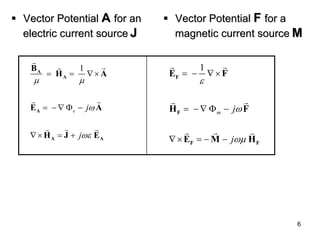
6 
 
Vector Potential 
A for an 
electric current source 
J 
 
Vector Potential 
F for a 
magnetic current source 
M 
1ejj       AAAAABHAEAHJE    1mjj       FFFFEFHFEMH   
7 
 
Vector Potential 
A for an 
electric current source 
J 
 
Vector Potential 
F for a 
magnetic current source 
M 
22' ejkRvjkedvR         AAAJAJ4     22' mjkRvjkedvR         FFFMFM4    
8 
 
The total fields are 
FHEEEAFA    11j 
(solutions derived in Sect. 3.5) 
(also for surface and linear currents) 
FFAEAHHH   j11 
[3-29a] 
[3-30a]
9 
 
FAR FIELD RADIATION 
 22Dr r 
Fields are essentially TEM to rAAEjAEjA         FFHjFHjF        
10 
 
FAR FIELDS RADIATION 
(CONT) 
 22Dr r 
Fields are essentially TEM to rFFFFEHEH         AAAAEHEH          
11 
 
DUALITY 
Identical equations for fields due to A and F 
for J ≠ 0 
M0 
 
 
for J 0 
M ≠ 0 
 
 
EA HA J A k  
HF -EF M F k   
 
 
 
 
 
 
 
 

12 
 
RECIPROCITY 
 
Assume LINEAR, ISOTROPIC 
(but not necessarily homogeneous) materials 
give sources J1 , M1 E1 , H1 
and J2 , M2 E2 , H2
13 
 
RECIPROCITY 
(CONT) 
 
Lorentz Reciprocity Theorem 
(also valid for fields away from finite sources – far fields) 
each integral is called a “REACTION” 
of fields (E, H ) to the sources (J, M ) 
' 1212' 2121dvdvvv MHJEMHJE 
[3-66]
14 
 
For two antennas 
equivalence of power transferred in 
both directions for two antennas (p.147) 
 
RECIPROCITY 
(CONT)
15 
equivalence of transmit 
and receive mode radiation 
patterns (p.148) 
 
For radiation patterns 
 
RECIPROCITY 
(CONT)

Ece5318 ch3

  • 1.
    1 Chapter 3 Radiation Integrals ECE 5318/6352 Antenna Engineering Dr. Stuart Long
  • 2.
    2  VECTORPOTENTIALS Mathematical tool used to simplify calculation of radiated fields and E H Radiation Fields ,E H Vector Potentials , FA Sources ,J M
  • 3.
    3 Coordinate systemfor computing radiating fields Fig. 3.2 (b) Coordinate system for computing fields radiated by sources. Source not at origin source points field points   
  • 4.
    4 Electric FieldStrength [V/m] Magnetic Field Strength [A/m] Electric Volume Current Density [A/m²] Magnetic Volume Current Density [V/m²] J HE M  DEFINITIONS
  • 5.
    5  DEFINITIONS (CONT) Electric Vector Potential [Wb/m] Electrical Scalar Potential [V] Magnetic Vector Potential [A-sec/m] Magnetic Scalar Potential [A] A F m e
  • 6.
    6  VectorPotential A for an electric current source J  Vector Potential F for a magnetic current source M 1ejj       AAAAABHAEAHJE    1mjj       FFFFEFHFEMH   
  • 7.
    7  VectorPotential A for an electric current source J  Vector Potential F for a magnetic current source M 22' ejkRvjkedvR         AAAJAJ4     22' mjkRvjkedvR         FFFMFM4    
  • 8.
    8  Thetotal fields are FHEEEAFA    11j (solutions derived in Sect. 3.5) (also for surface and linear currents) FFAEAHHH   j11 [3-29a] [3-30a]
  • 9.
    9  FARFIELD RADIATION  22Dr r Fields are essentially TEM to rAAEjAEjA         FFHjFHjF        
  • 10.
    10  FARFIELDS RADIATION (CONT)  22Dr r Fields are essentially TEM to rFFFFEHEH         AAAAEHEH          
  • 11.
    11  DUALITY Identical equations for fields due to A and F for J ≠ 0 M0   for J 0 M ≠ 0   EA HA J A k  HF -EF M F k           
  • 12.
    12  RECIPROCITY  Assume LINEAR, ISOTROPIC (but not necessarily homogeneous) materials give sources J1 , M1 E1 , H1 and J2 , M2 E2 , H2
  • 13.
    13  RECIPROCITY (CONT)  Lorentz Reciprocity Theorem (also valid for fields away from finite sources – far fields) each integral is called a “REACTION” of fields (E, H ) to the sources (J, M ) ' 1212' 2121dvdvvv MHJEMHJE [3-66]
  • 14.
    14  Fortwo antennas equivalence of power transferred in both directions for two antennas (p.147)  RECIPROCITY (CONT)
  • 15.
    15 equivalence oftransmit and receive mode radiation patterns (p.148)  For radiation patterns  RECIPROCITY (CONT)