Charles Moyes (cwm55) and Mengxiang Jiang (mj294)
                                                                                   Week of April 18, 2012


        Brain-Computer Interface using Multi-Channel
                  Electroencephalography
Current Progress
We modified the firmware to use ADC sleep mode to improve accuracy and to save power. We began
rewriting our firmware to use the TRT Tiny Real-Time kernel, but we encountered issues with the AVR
Studio 5 compiler (no tasks were getting scheduled, even with Bruce’s example code).
    We wrote an OpenGL real-time serial data plotting software program in C that gathers data from the
UNIX USB serial port device /dev/usb/ttyUSB0. We used this software to measure our EEG waveforms
and noticed artifacts due to eye movement, blinking, and forehead movement (a good thing, since that tells
us it works). We observed beta and theta brain waves measured from electrodes placed on our frontal lobes.
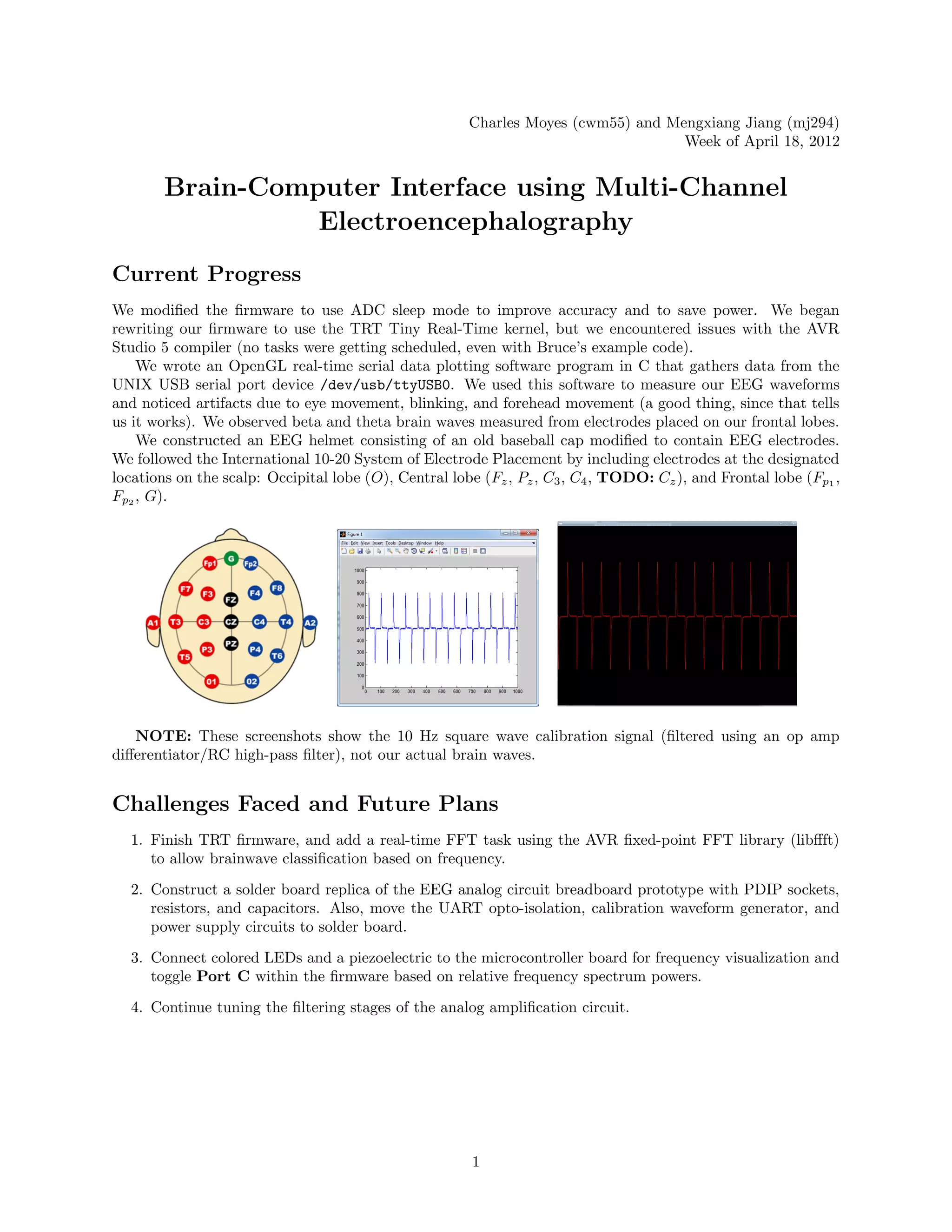
    We constructed an EEG helmet consisting of an old baseball cap modified to contain EEG electrodes.
We followed the International 10-20 System of Electrode Placement by including electrodes at the designated
locations on the scalp: Occipital lobe (O), Central lobe (Fz , Pz , C3 , C4 , TODO: Cz ), and Frontal lobe (Fp1 ,
Fp2 , G).


   NOTE: These screenshots show the 10 Hz square wave calibration signal (filtered using an op amp
differentiator/RC high-pass filter), not our actual brain waves.


Challenges Faced and Future Plans
  1. Finish TRT firmware, and add a real-time FFT task using the AVR fixed-point FFT library (libffft)
     to allow brainwave classification based on frequency.
  2. Construct a solder board replica of the EEG analog circuit breadboard prototype with PDIP sockets,
     resistors, and capacitors. Also, move the UART opto-isolation, calibration waveform generator, and
     power supply circuits to solder board.
  3. Connect colored LEDs and a piezoelectric to the microcontroller board for frequency visualization and
     toggle Port C within the firmware based on relative frequency spectrum powers.

  4. Continue tuning the filtering stages of the analog amplification circuit.


                                                       1

Ece4760 progress report2

  • 1.
    Charles Moyes (cwm55)and Mengxiang Jiang (mj294) Week of April 18, 2012 Brain-Computer Interface using Multi-Channel Electroencephalography Current Progress We modified the firmware to use ADC sleep mode to improve accuracy and to save power. We began rewriting our firmware to use the TRT Tiny Real-Time kernel, but we encountered issues with the AVR Studio 5 compiler (no tasks were getting scheduled, even with Bruce’s example code). We wrote an OpenGL real-time serial data plotting software program in C that gathers data from the UNIX USB serial port device /dev/usb/ttyUSB0. We used this software to measure our EEG waveforms and noticed artifacts due to eye movement, blinking, and forehead movement (a good thing, since that tells us it works). We observed beta and theta brain waves measured from electrodes placed on our frontal lobes. We constructed an EEG helmet consisting of an old baseball cap modified to contain EEG electrodes. We followed the International 10-20 System of Electrode Placement by including electrodes at the designated locations on the scalp: Occipital lobe (O), Central lobe (Fz , Pz , C3 , C4 , TODO: Cz ), and Frontal lobe (Fp1 , Fp2 , G). NOTE: These screenshots show the 10 Hz square wave calibration signal (filtered using an op amp differentiator/RC high-pass filter), not our actual brain waves. Challenges Faced and Future Plans 1. Finish TRT firmware, and add a real-time FFT task using the AVR fixed-point FFT library (libffft) to allow brainwave classification based on frequency. 2. Construct a solder board replica of the EEG analog circuit breadboard prototype with PDIP sockets, resistors, and capacitors. Also, move the UART opto-isolation, calibration waveform generator, and power supply circuits to solder board. 3. Connect colored LEDs and a piezoelectric to the microcontroller board for frequency visualization and toggle Port C within the firmware based on relative frequency spectrum powers. 4. Continue tuning the filtering stages of the analog amplification circuit. 1