Closing the Word Gap 
Strategies for Speaking with Young Children 
Dr. Trisha Craig 
Wheelock College – Singapore 
September 20, 2014 
inspire a world of good WHEELOCK 
COLLEGE - SINGAPORE
How many words will you hear in the 
next 10 minutes? 
Somewhere between 1500 and 2000 
inspire a world of good WHEELOCK 
COLLEGE - 
SINGAPORE
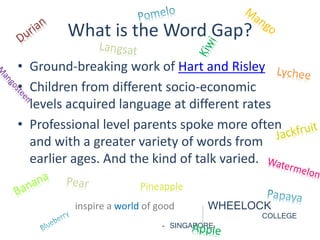
What is the Word Gap? 
• Ground-breaking work of Hart and Risley 
• Children from different socio-economic 
levels acquired language at different rates 
• Professional level parents spoke more often 
and with a greater variety of words from 
earlier ages. And the kind of talk varied. 
Pineapple 
inspire a world of good WHEELOCK 
COLLEGE 
- SINGAPORE
What is the Word Gap? 
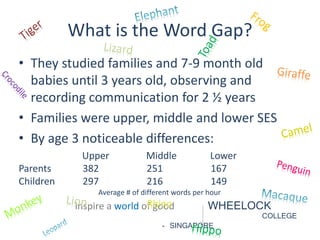
• They studied families and 7-9 month old 
babies until 3 years old, observing and 
recording communication for 2 ½ years 
• Families were upper, middle and lower SES 
• By age 3 noticeable differences: 
Upper Middle Lower 
Parents 382 251 167 
Children 297 216 149 
Average # of different words per hour 
Rhino 
inspire a world of good WHEELOCK 
COLLEGE 
- SINGAPORE
What is the Word Gap? 
• By age 3, the difference in the number of 
words the high SES child has heard compared 
to a low SES child: 
30,000,000 
inspire a world of good WHEELOCK 
COLLEGE 
Engine- eSrINGAPORE
What is the Word Gap? 
• Moats (1999) estimated that advantaged 
children entered primary school with a 
vocabulary of about 20,000 words compared 
with linguistically disadvantaged children who 
knew 5,000 words on average. 
inspire a world of good WHEELOCK 
COLLEGE 
Train- SINGAPORE
Not just words, but how we speak 
• Children from low SES homes are more likely to hear 
‘command language’ and prohibitions rather than 
affirmations; opposite of high SES children 
• High SES parents are more likely to ask questions and engage 
in conversational ‘turns’ with children 
• Children from higher SES homes are more likely to have been 
read to: Adams (1990) found that poor children entered P1 
with just 25 hours of having been read to compared with 
1,000-1,700 hours for children from better-off families 
inspire a world of good WHEELOCK 
COLLEGE 
Get dres- seSdINGAPORE
What is the long term effect? 
• Many children enter kindergarten lagging 
behind their peers 
• Test performance in P-3 is strongly related to 
early language proficiency 
inspire a world of good WHEELOCK 
COLLEGE 
Mint gr-eeSInNGAPORE
Narrowing the Word Gap 
• Because the word gap has such long term 
implications, there are public policy issues 
• First, some of the newest science: 
http://www.youtube.com/watch?v=qLoEUEDqagQ 
• And research based public policy intervention: 
http://www.bbc.com/news/magazine-26439798 
inspire a world of good WHEELOCK 
COLLEGE 
What w- ilSl INGAPORE 
happen?
Will Concerted Efforts Help? 
• We still don’t know but important that the efforts are 
being followed by researchers to test the effects of 
interventions 
• There is a limit to what policies and interventions can 
do: many observers have pointed out that 
disadvantaged families face many obstacles, not just 
language gaps 
• Targeting families and what goes on at home – 
preschool can help – Dana Suskind is now moving 
her research into the classroom 
inspire a world of good WHEELOCK 
COLLEGE - 
SINGAPORE
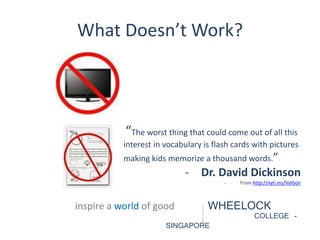
What Doesn’t Work? 
“The worst thing that could come out of all this 
interest in vocabulary is flash cards with pictures 
making kids memorize a thousand words.” 
- Dr. David Dickinson 
inspire a world of good WHEELOCK 
COLLEGE - 
SINGAPORE 
- From http://nyti.ms/VylGon
What Does Work? 
The Three T’s 
Dr. Dana Suskind from the University of Chicago has 
suggested the 3 T’s as a core behavioural strategy 
parents and teachers can use to help build vocabulary 
• Tune In 
• Talk More 
• Take Turns 
inspire a world of good WHEELOCK 
COLLEGE - 
SINGAPORE
Tune In 
• Tune In means 
– Paying attention 
– Taking cues from the interests of the child – 
what does the child want to talk about 
• In the classroom, listen to their conversations 
• At home, focus on what child is saying 
– Young children will switch attention, you need to 
keep up; tuning in is a dynamic activity 
inspire a world of good WHEELOCK 
COLLEGE - 
SINGAPORE
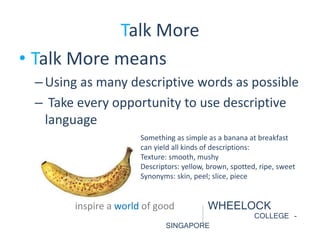
Talk More 
• Talk More means 
– Using as many descriptive words as possible 
– Take every opportunity to use descriptive 
language 
Something as simple as a banana at breakfast 
can yield all kinds of descriptions: 
Texture: smooth, mushy 
Descriptors: yellow, brown, spotted, ripe, sweet 
Synonyms: skin, peel; slice, piece 
inspire a world of good WHEELOCK 
COLLEGE - 
SINGAPORE
Take Turns 
• Take Turns means 
– Conversational turns 
– Back and forth 
– This giving the child a chance to speak is 
very important for language development; 
even when the language is not command 
driven, it can’t be just the parent or teacher 
doing all the talking 
inspire a world of good WHEELOCK 
COLLEGE - 
SINGAPORE
What Can Help? 
In the Classroom: 
• One study showed gains when preschoolers were 
asked to do personal narration with trained 
volunteers 
• Classrooms where children given the opportunity for 
maximum learning, esp. by extending their learning 
through questions and responses but a US study 
found only 15% of classrooms can be described that 
way 
inspire a world of good WHEELOCK 
COLLEGE - 
SINGAPORE
What Can Help? 
In the Classroom: 
• Dickinson and Tabors found that children in 
preschool typically spend 60% of their time not 
engaged in any conversation. 
• Natural conversations, reading books while asking 
lots of questions (What do you think happens next? 
Why did she do that?), helping identify words during 
playtime. 
inspire a world of good WHEELOCK 
COLLEGE - 
SINGAPORE
What Can Help? 
At Home: 
• In households where mother tongue is spoken, important for 
parents to use that to converse with infants and toddlers 
• Talk with child, not at him – encourage conversational turns 
by asking questions and responding to child’s statements and 
interest 
• Talk at length about past experiences: ‘remember we went to 
grandma’s birthday party: who was there, what happened,’ 
etc. Use more elaborate descriptions to elicit questions. 
• Use a positive tone; avoid relying on commands and directives 
• Use words in context to reinforce their meaning: pan, bowl, 
measuring cup, spices, rolling pin, whisk, etc. while baking 
with a child helps connect vocabulary words and concepts. 
inspire a world of good WHEELOCK 
COLLEGE - 
SINGAPORE
What Can Help? 
Both at School and at Home : 
• Reading. How often does reading occur in Singaporean 
preschool classrooms? 
– Ideal is at least daily. US and Sweden show declines 
• Strategies for reading (from Strickland) 
– Explain new and sophisticated vocabulary (act it out, use kid friendly 
terms) 
– Discuss narrative structure with children (who are the characters, 
what is the setting, what is the problem) 
– Link dilemmas or situations to child’s own life (what would she do?) 
– Ask child to make predictions about what is going to happen next 
– Focus on the printed text – underline with your finger the left to right 
motion of reading, literally point out words 
inspire a world of good WHEELOCK 
COLLEGE - 
SINGAPORE
What Can Help? 
School-Home Partnership: 
• Preschool teachers can help parents by explaining 
the importance of talk for language development 
• Suggest strategies to parents for talking to their 
children 
• Tell parents your strategy in class to help build 
vocabulary 
• Explain the vocabulary you are working on in class 
and ask parents to help reinforce that at home 
inspire a world of good WHEELOCK 
COLLEGE - 
SINGAPORE
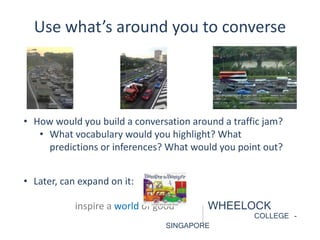
Use what’s around you to converse 
• How would you build a conversation around a traffic jam? 
• What vocabulary would you highlight? What 
predictions or inferences? What would you point out? 
inspire a world of good WHEELOCK 
COLLEGE - 
SINGAPORE 
• Later, can expand on it:
Want to Know More? 
• http://www.aecf.org/m/resourcedoc/aecf-30millionwordgap- 
2011.pdf 
• http://www.naeyc.org/tyc/article/the-word-gap 
• Risley and Hart 
• http://fcd-us. 
org/sites/default/files/Multilingual%20Children%20Beyond 
%20Myths%20and%20Towards%20Best%20Practices.pdf 
• http://www.nytimes.com/2013/10/22/us/language-gap-study- 
bolsters-a-push-for-pre-k.html?pagewanted=all&_r=0 
• http://prek.spps.org/uploads/class_findings_in_pre-k_ 
year.pdf 
• http://tmw.org/tmw-initiative/ 
inspire a world of good WHEELOCK 
COLLEGE - 
SINGAPORE

ECDA 2014: Closing the Word Gap

  • 1.
    Closing the WordGap Strategies for Speaking with Young Children Dr. Trisha Craig Wheelock College – Singapore September 20, 2014 inspire a world of good WHEELOCK COLLEGE - SINGAPORE
  • 2.
    How many wordswill you hear in the next 10 minutes? Somewhere between 1500 and 2000 inspire a world of good WHEELOCK COLLEGE - SINGAPORE
  • 3.
    What is theWord Gap? • Ground-breaking work of Hart and Risley • Children from different socio-economic levels acquired language at different rates • Professional level parents spoke more often and with a greater variety of words from earlier ages. And the kind of talk varied. Pineapple inspire a world of good WHEELOCK COLLEGE - SINGAPORE
  • 4.
    What is theWord Gap? • They studied families and 7-9 month old babies until 3 years old, observing and recording communication for 2 ½ years • Families were upper, middle and lower SES • By age 3 noticeable differences: Upper Middle Lower Parents 382 251 167 Children 297 216 149 Average # of different words per hour Rhino inspire a world of good WHEELOCK COLLEGE - SINGAPORE
  • 5.
    What is theWord Gap? • By age 3, the difference in the number of words the high SES child has heard compared to a low SES child: 30,000,000 inspire a world of good WHEELOCK COLLEGE Engine- eSrINGAPORE
  • 6.
    What is theWord Gap? • Moats (1999) estimated that advantaged children entered primary school with a vocabulary of about 20,000 words compared with linguistically disadvantaged children who knew 5,000 words on average. inspire a world of good WHEELOCK COLLEGE Train- SINGAPORE
  • 7.
    Not just words,but how we speak • Children from low SES homes are more likely to hear ‘command language’ and prohibitions rather than affirmations; opposite of high SES children • High SES parents are more likely to ask questions and engage in conversational ‘turns’ with children • Children from higher SES homes are more likely to have been read to: Adams (1990) found that poor children entered P1 with just 25 hours of having been read to compared with 1,000-1,700 hours for children from better-off families inspire a world of good WHEELOCK COLLEGE Get dres- seSdINGAPORE
  • 8.
    What is thelong term effect? • Many children enter kindergarten lagging behind their peers • Test performance in P-3 is strongly related to early language proficiency inspire a world of good WHEELOCK COLLEGE Mint gr-eeSInNGAPORE
  • 9.
    Narrowing the WordGap • Because the word gap has such long term implications, there are public policy issues • First, some of the newest science: http://www.youtube.com/watch?v=qLoEUEDqagQ • And research based public policy intervention: http://www.bbc.com/news/magazine-26439798 inspire a world of good WHEELOCK COLLEGE What w- ilSl INGAPORE happen?
  • 10.
    Will Concerted EffortsHelp? • We still don’t know but important that the efforts are being followed by researchers to test the effects of interventions • There is a limit to what policies and interventions can do: many observers have pointed out that disadvantaged families face many obstacles, not just language gaps • Targeting families and what goes on at home – preschool can help – Dana Suskind is now moving her research into the classroom inspire a world of good WHEELOCK COLLEGE - SINGAPORE
  • 11.
    What Doesn’t Work? “The worst thing that could come out of all this interest in vocabulary is flash cards with pictures making kids memorize a thousand words.” - Dr. David Dickinson inspire a world of good WHEELOCK COLLEGE - SINGAPORE - From http://nyti.ms/VylGon
  • 12.
    What Does Work? The Three T’s Dr. Dana Suskind from the University of Chicago has suggested the 3 T’s as a core behavioural strategy parents and teachers can use to help build vocabulary • Tune In • Talk More • Take Turns inspire a world of good WHEELOCK COLLEGE - SINGAPORE
  • 13.
    Tune In •Tune In means – Paying attention – Taking cues from the interests of the child – what does the child want to talk about • In the classroom, listen to their conversations • At home, focus on what child is saying – Young children will switch attention, you need to keep up; tuning in is a dynamic activity inspire a world of good WHEELOCK COLLEGE - SINGAPORE
  • 14.
    Talk More •Talk More means – Using as many descriptive words as possible – Take every opportunity to use descriptive language Something as simple as a banana at breakfast can yield all kinds of descriptions: Texture: smooth, mushy Descriptors: yellow, brown, spotted, ripe, sweet Synonyms: skin, peel; slice, piece inspire a world of good WHEELOCK COLLEGE - SINGAPORE
  • 15.
    Take Turns •Take Turns means – Conversational turns – Back and forth – This giving the child a chance to speak is very important for language development; even when the language is not command driven, it can’t be just the parent or teacher doing all the talking inspire a world of good WHEELOCK COLLEGE - SINGAPORE
  • 16.
    What Can Help? In the Classroom: • One study showed gains when preschoolers were asked to do personal narration with trained volunteers • Classrooms where children given the opportunity for maximum learning, esp. by extending their learning through questions and responses but a US study found only 15% of classrooms can be described that way inspire a world of good WHEELOCK COLLEGE - SINGAPORE
  • 17.
    What Can Help? In the Classroom: • Dickinson and Tabors found that children in preschool typically spend 60% of their time not engaged in any conversation. • Natural conversations, reading books while asking lots of questions (What do you think happens next? Why did she do that?), helping identify words during playtime. inspire a world of good WHEELOCK COLLEGE - SINGAPORE
  • 18.
    What Can Help? At Home: • In households where mother tongue is spoken, important for parents to use that to converse with infants and toddlers • Talk with child, not at him – encourage conversational turns by asking questions and responding to child’s statements and interest • Talk at length about past experiences: ‘remember we went to grandma’s birthday party: who was there, what happened,’ etc. Use more elaborate descriptions to elicit questions. • Use a positive tone; avoid relying on commands and directives • Use words in context to reinforce their meaning: pan, bowl, measuring cup, spices, rolling pin, whisk, etc. while baking with a child helps connect vocabulary words and concepts. inspire a world of good WHEELOCK COLLEGE - SINGAPORE
  • 19.
    What Can Help? Both at School and at Home : • Reading. How often does reading occur in Singaporean preschool classrooms? – Ideal is at least daily. US and Sweden show declines • Strategies for reading (from Strickland) – Explain new and sophisticated vocabulary (act it out, use kid friendly terms) – Discuss narrative structure with children (who are the characters, what is the setting, what is the problem) – Link dilemmas or situations to child’s own life (what would she do?) – Ask child to make predictions about what is going to happen next – Focus on the printed text – underline with your finger the left to right motion of reading, literally point out words inspire a world of good WHEELOCK COLLEGE - SINGAPORE
  • 20.
    What Can Help? School-Home Partnership: • Preschool teachers can help parents by explaining the importance of talk for language development • Suggest strategies to parents for talking to their children • Tell parents your strategy in class to help build vocabulary • Explain the vocabulary you are working on in class and ask parents to help reinforce that at home inspire a world of good WHEELOCK COLLEGE - SINGAPORE
  • 21.
    Use what’s aroundyou to converse • How would you build a conversation around a traffic jam? • What vocabulary would you highlight? What predictions or inferences? What would you point out? inspire a world of good WHEELOCK COLLEGE - SINGAPORE • Later, can expand on it:
  • 22.
    Want to KnowMore? • http://www.aecf.org/m/resourcedoc/aecf-30millionwordgap- 2011.pdf • http://www.naeyc.org/tyc/article/the-word-gap • Risley and Hart • http://fcd-us. org/sites/default/files/Multilingual%20Children%20Beyond %20Myths%20and%20Towards%20Best%20Practices.pdf • http://www.nytimes.com/2013/10/22/us/language-gap-study- bolsters-a-push-for-pre-k.html?pagewanted=all&_r=0 • http://prek.spps.org/uploads/class_findings_in_pre-k_ year.pdf • http://tmw.org/tmw-initiative/ inspire a world of good WHEELOCK COLLEGE - SINGAPORE