(eBook PDF) PharmacyManagement (Custom Edition)
(3e) install download
https://ebookluna.com/product/ebook-pdf-pharmacy-management-
custom-edition-3e/
Download more ebook instantly today - Get yours now at ebookluna.com
2.
Pharmacy Management
3rd edition
ACustom Edition for
The University of Sydney
A
Custom
Edition
for
The
University
of
Sydney
Pharmacy
Management
3rd
edition
Pearsonis the world’s leading learning company. Our education business combines 150 years of experience in
publishing with the latest learning technology and online support. We help people learn whatever, wherever and
however they choose.
Pearson Custom works for educators. We partner with you to build course-specific materials, designed to
facilitate student success. We open the door to a wealth of content and technology and walk you through the
process of selecting or creating the custom resources to meet your goals.
To get in touch, email custom@pearson.com.au.
9781488613852_C.indd 1 22/02/16 11:59 AM
3.
3
OBJECTIVES
The primary objectiveof this chapter is to introduce you to the concept of SHRM and to advance
your thinking about the process of effective SHRM.The chapter challenges the perspectives most
HRtextbooksofferbyemphasisingtheprocessofeffectiveHRstrategyandpractice,andtheneed
for a human-centred approach. Readers’ analytical skills for transforming management theory
and research into innovative HRM practice are developed through examples and application
of the CHRM decision-making framework. Researchers, students, educators, managers and
practitioners interested in updating their understanding of the latest thinking and practical
techniques in the HR field will find the chapter equally useful.
After reading this chapter, you should be able to:
■ discuss key HRM terminology, concepts and definitions
■ describe why HRM is important to organisations
■ identify the previous and current management paradigms
■ define SHRM and discuss the process of effective SHRM
■ identify the essential elements of the strategic approach to HRM
■ describe some of the tools for analysing HR problems successfully
■ discuss the factors required to establish an effective HR environment
■ discuss the tenets of the CHRM decision-making framework for managing workers effectively
■ describe the six steps that make up the CHRM decision-making framework, and explain how
they are dynamically applied in a business context.
NATURE, ORIGINS AND IMPLICATIONS OF HUMAN RESOURCE
MANAGEMENT
The traditional management process involves planning, organising, leading and controlling the
human, financial and material resources of the organisation. These resources can come either from
You have just taken an HR position with an accounting firm. The firm, which started up six years ago
with 16 employees, has grown considerably in that time and now employs more than 80 people.
Up until now, the firm has not had a dedicated HR manager. The firm’s rapid growth, however, has
highlighted the need for a more organised approach to managing its human assets. As such, you
have been employed to design and implement an HR strategy that will help the firm realise its
strategic objectives. What are the key things that you will need to understand in order to develop
effective HR policies and practices for the organisation?
HRM CHALLENGE
PHARMACY MANAGEMENT 3RD EDITION PART 1
A Publication from Pearson Custom Publishing for The University of Sydney page 3
Hartel, C. and Fujimoto, Y. 2015 ‘Effective strategic human resource management’, Human Resource Management, 3rd edn. Pearson Australia, (a division of Pearson Australia Group Pty Ltd), pp. 2–37.
4.
PART 1 FOUNDATIONPRINCIPLES OF EFFECTIVE STRATEGIC HUMAN RESOURCE MANAGEMENT
4
within the organisation or from sources external to the organisation. For example, financial resources
can be obtained from profits reinvested in the organisation (internal) or from increasing creditors
or shareholders (external). Similarly, human resources can be internal to the organisation (i.e. an
organisation’s employees) or external (e.g. consultants and contractors).
As an organisation grows in size,oversight of these management activities is divided and distributed
among the different departments that make up the organisation’s formal structure; for example,
the management of financial resources becomes the responsibility of the finance department, while
the management of people becomes the responsibility of the human resources department. Human
resource management (HRM), therefore, can be defined as being ‘a distinctive approach to employee
management which seeks to achieve competitive advantage through the strategic deployment of a
highly committed and capable workforce using an integrated array of cultural, structural and personal
techniques’ (Storey, 1995, p. 5). Even when there are a formal HR department and HR specialists,
HRM can be effective only if managers share the responsibility of supporting workers to thrive so
that the organisation also thrives (Ulrich, 2005).
Overall, HRM includes strategy development and analysis; policy-making, implementation and
enforcement; and alignment of systems, processes and procedures to ensure a workforce that is
engaged in achieving the organisation’s goals. In other words, HRM comprises the activities involved
in monitoring, innovating, planning and evaluating worker performance, including:
■ people audit: to know what cognitive, affective and behavioural qualities your workers possess
■ safeguarding your people’s wellbeing: to ensure a positive work environment for your workers,
including adherence to occupational health and safety (OHS) and employment legislation,
supporting resilience and positive employer–employee relations
■ research: to monitor, evaluate and innovate workers’ attitudes, skills and behaviours on a
continual basis
■ job analysis,evaluation and classification: to identify necessary skills and desired worker qualities
■ job design and work design: to clarify work performance, scheduling and relations
■ HR planning: to ensure an equilibrium between labour demand and supply
■ attraction, recruitment and selection: to find and hire the right people for the right job
■ onboarding, training and development: to socialise workers; develop their strengths; encourage
positive cognitive, affective and behavioural qualities; and further their careers
■ engagement and performance management: to motivate and provide ongoing regular
performance feedback to enable workers to nurture the cognitive, affective and behavioural
qualities that will assist them and the organisation to thrive
■ managing compensation, rewards and benefits: to ensure remuneration and benefits are
adequate for acquiring the right people, retaining talent and optimising performance.
The history of HRM
The idea of HRM developed as a result of changes in the organisational environment that demanded
organisations find better ways of looking after their people and ensuring that their full potential could
be brought to the organisation. As our knowledge of human behaviour and organisations advances,
so does our understanding of how best to manage people in organisations.
Many perspectives have contributed to the evolution of HRM, and it is important that we have
some understanding of these. It is generally agreed that the earliest foundations of HRM are in the
PART 1 PHARMACY MANAGEMENT 3RD EDITION
page 4 A Publication from Pearson Custom Publishing for The University of Sydney
Hartel, C. and Fujimoto, Y. 2015 ‘Effective strategic human resource management’, Human Resource Management, 3rd edn. Pearson Australia, (a division of Pearson Australia Group Pty Ltd), pp. 2–37.
5.
EFFECTIVE STRATEGIC HUMANRESOURCE MANAGEMENT: PRINCIPLES AND PROCESSES CHAPTER 1 5
field of personnel. The transformation from personnel management to human resource manage-
ment was shaped by a number of developments in the management field, beginning in 1910 with the
scientific management paradigm.
The scientific management paradigm
The scientific management paradigm, also known asTaylorism, advocated there could be ‘one best way’
for people to conduct their work tasks, replacing the old rule-of-thumb method for managing people
and work with fact-finding and specific time and method standards (seeTaylor, 1911).This perspective
placed an emphasis on production and efficiency, but was soon considered to be impersonal and
dehumanising for most organisational contexts. Taylorism is not dead, however, as evidenced by the
way many call centres are managed and evaluated (e.g. measurement of time spent per call).
The human relations movement
The scientific management paradigm evolved into the human relations movement in the 1920s.
Originated by the Hawthorne studies, the human relations perspective changed the focus of
management from production to a joint focus on people and production, with emphasis being placed
on communication and the need to treat employees with dignity and respect. Under this paradigm,
management was required to focus on individual differences,interpersonal relations,group behaviour,
employee attitudes, leadership and communication.
Organisational behaviour
The human relations movement gave way in the 1960s to organisational behaviour (OB), which
is the study of the individual’s and the group’s cognitions, affect (e.g. emotions and moods) and
behaviours within an organisation. Combining the micro perspective of human relations and the
macro perspective of management, OB looks at how people deal with being part of an organisation
and why they work in a certain way.
The field of OB contributed to the behavioural science approach to HRM. The new thinking
was that people would be motivated to perform better if they were more satisfied in their jobs. In
order for this to occur, work tasks had to be redesigned to be more interesting and challenging.This
perspective focused management attention on dynamic systems, organisational culture and climate,
employee participation, with an emphasis on both economic and humanistic concerns.
The modern view of HRM continues to draw on the principles of OB for the purpose of reaping
competitive advantage for organisations through people. Organisations are said to have a competitive
advantage when they have a process, system or source of capital that is superior to that of their
competitors.The types of capital relating to human resources are elaborated below.
1. Social capital refers to the value that can be placed on networks and relationships among people
(Youndt & Snell, 2004). An organisation’s social capital includes not only the number and
quality of relationships among employees within the organisation, but also the characteristics
of relationships among employees and individuals in other organisations and the community.
When an organisation’s social capital is high, the organisation is gaining from its people’s
positive behaviours and the sharing of knowledge from the relationships among its people.
2. Cultural capital refers to the value that can be placed on the values and beliefs shared
by organisational members, such as integrity, honesty, sustainability, corporate social
responsibility, collaboration and quality.When an organisation’s cultural capital is high,
the organisation is minimising its risk exposure and increasing the likelihood of customer,
employee and shareholder loyalty.
PHARMACY MANAGEMENT 3RD EDITION PART 1
A Publication from Pearson Custom Publishing for The University of Sydney page 5
Hartel, C. and Fujimoto, Y. 2015 ‘Effective strategic human resource management’, Human Resource Management, 3rd edn. Pearson Australia, (a division of Pearson Australia Group Pty Ltd), pp. 2–37.
6.
PART 1 FOUNDATIONPRINCIPLES OF EFFECTIVE STRATEGIC HUMAN RESOURCE MANAGEMENT
6
3. Human capital refers to the value that can be placed on people’s knowledge, skills, abilities
and expertise (Youndt & Snell, 2004). An organisation’s human capital is well developed
when its people possess the positive cognitive, affective and behavioural qualities the
organisation needs to maintain a competitive advantage.
PLEASE READ
Härtel, C. E. J. (1999), ‘Global vision: Recognizing our organizational paradigms: Lessons from a historical
review of the contribution of work psychology from three continents to occupational health and safety
management’, Society for Industrial & Organizational Psychology, Inc., October, <www.siop.org/tip/backissues/
TipOcto99/12Hartel.aspx>.
Long, B. (2007), ‘Strategic human resource management and the worker’s experience’, Journal of Individual
Employment Rights, vol. 12, no. 3, pp. 265–82.
Despite the historical development of HRM described above, the HRM style of an individual
organisation depends on its philosophies about people.We discuss these next.
HRM styles and philosophies
In order to have an input into the design and implementation of the goals and strategies of an organis-
ation, HR practitioners need to possess an accurate understanding of the organisation’s external
environment, operating environment, culture and structure. They also need to understand what the
organisation does on a day-to-day basis, as well as how to help organisational members deal with and
adapt to change. As the external and internal circumstances of an organisation and its people change
with time, so too do the skills and knowledge requirements of managers and HR practitioners.
There is no doubt that organisations are faced with conflicting pressures to minimise costs and
maximise efficiency, and that there is a need both for control and to ensure satisfactory relationships
with all stakeholders, including employees. In working to achieve these objectives, managers can
either emphasise task performance or people issues, and they have a choice as to how they treat their
employees. HRM styles can thus be differentiated in terms of being control- or resource-based.
In the control-based style, the organisation employs people to work and, therefore, it needs to
organise tasks and processes to ensure employees can work to their full capacity. In contrast, the
resource-based view assumes that people are valuable to the organisation when they hold something,
such as skills or knowledge, that the organisation cannot copy or substitute (Barney & Clark, 2007).
Hence,given opportunities to learn and grow,employees can provide the organisation with capabilities
and capital through the development of knowledge, skills, positive attitudes and social relationships.
Organisations tend to adopt a philosophy that combines both control- and resource-based
styles (Bamberger & Meshoulam, 2000), based upon the view senior management holds on how
an organisation and its employees should be managed. For example, an organisation can choose to
minimise cost through emphasising control and efficiency (traditional or transactional philosophy),
to look after employees while maintaining high levels of control (paternalistic philosophy), to
maximise employee contribution and the application of skills and knowledge for the benefit of the
organisation (commitment philosophy), or to acknowledge the legitimacy of stakeholder views and
seek decisions that are satisfactory to all parties involved (collaborative philosophy).
HR as a human-centred strategic management process
To address the challenges and opportunities they face, organisations engage in strategic management.
Strategic management is the process of managing with a long-term (or strategic) focus, and
largely comprises developing organisational strategy, including strategy formulation and strategy
PART 1 PHARMACY MANAGEMENT 3RD EDITION
page 6 A Publication from Pearson Custom Publishing for The University of Sydney
Hartel, C. and Fujimoto, Y. 2015 ‘Effective strategic human resource management’, Human Resource Management, 3rd edn. Pearson Australia, (a division of Pearson Australia Group Pty Ltd), pp. 2–37.
7.
EFFECTIVE STRATEGIC HUMANRESOURCE MANAGEMENT: PRINCIPLES AND PROCESSES CHAPTER 1 7
implementation. Regardless of the particular circumstances (e.g. nature of the business, nature of
the workforce) of an organisation, overall, what is important for human resource management is that
human-centred decisions are made, putting human cognitive, affective and behavioural qualities at
the ‘heart’ of dynamic strategy formulation and implementation processes.
Strategy formulation includes setting a mission, vision, strategy, goals and values, coupled
with a consideration of the external environment (i.e. opportunities and threats) and the internal
environment (i.e. strengths and weaknesses) of the organisation, using a SWOT analysis (that is,
analysis of strengths, weaknesses, opportunities and threats).
■ The organisational mission communicates to stakeholders why the organisation exists in the first
place, what it is here to do and what it stands for.The mission is the organisation’s purpose.
■ The organisational vision is a short and inspiring statement communicating to stakeholders
what the organisation wants to be in the future.
■ The organisation’s strategy is the organisation’s action plan for becoming what its leadership
envisions for it. Organisational strategy has three levels.The corporate level refers to decisions
relating to which industry the organisation wants to be involved in and how organisational
resources will be allocated.The business level refers to decisions surrounding how the
organisation will operate within a given industry.The functional level refers to decisions
relating to operational functions within the business, such as the financial strategy, marketing
strategy or HR strategy.
■ The value statement communicates to stakeholders the set of principles and beliefs that the
organisation will use to guide its behaviour in the pursuit of its vision.These principles and
beliefs are designed to shape how members of the organisation think and act on a day-to-day
basis.
PLEASE READ
Visit The Nature Conservancy’s website to see their vision, mission and values: <www.nature.org/about-us/
vision-mission/index.htm>.
What is the difference between HRM and SHRM?
Human resource management implements the activities required to support organisational decisions.
To be effective, these HRM activities must be aligned with the strategic direction of the organisation.
Strategic human resource management (SHRM) achieves this alignment by integrating HRM into
the strategic decision-making process of the organisation.Thus, the main focus of SHRM is strategy,
whereas the main focus of HRM is practice.
At this point in our discussion, it is important to acknowledge that not all organisations execute
SHRM effectively. Indeed, the finding from a 2010 Gallup survey (Gallup Consulting, 2010) that
only 18 per cent of Australian workers (and only 11 per cent of workers worldwide) are engaged with
their work shows that managing people effectively is not easy.
Despite that, however, SHRM plays a significant role in organisational effectiveness, and there
is substantial research evidence showing a positive correlation between how effectively workers are
managed and the organisation’s economic results (Pfeffer &Veiga,1999).For example,the 2010 Gallup
report showed that organisations ranked in the top quarter in terms of employee engagement enjoyed,
compared with organisations ranked in the bottom quarter, 37 per cent less absenteeism, 49 per cent
fewer safety incidents, 60 per cent fewer quality defects, and they were 18 per cent more productive
(Gallup Consulting, 2010).
PHARMACY MANAGEMENT 3RD EDITION PART 1
A Publication from Pearson Custom Publishing for The University of Sydney page 7
Hartel, C. and Fujimoto, Y. 2015 ‘Effective strategic human resource management’, Human Resource Management, 3rd edn. Pearson Australia, (a division of Pearson Australia Group Pty Ltd), pp. 2–37.
8.
PART 1 FOUNDATIONPRINCIPLES OF EFFECTIVE STRATEGIC HUMAN RESOURCE MANAGEMENT
8
In brief, effective strategy and practices for managing people can deliver:
■ increased productivity and less waste
■ greater collaborative problem-solving
■ increased employee loyalty
■ fewer industrial problems and counterproductive behaviours
■ better skills in handling equipment
■ improved customer satisfaction and patronage
■ fewer accidents and an improved safety climate
■ lower turnover and absenteeism
■ increased administrative, process and product innovation.
Managing people effectively is critical in order for an organisation to be able to achieve its
objectives, deliver results and be successful. An effective HRM strategy is one that is congruent
with the organisation’s business objectives; compatible with the culture in which the organisation
operates; provides clarity, meaning and flexibility; and focused on human-centred decision-making.
Effective HRM, therefore, entails intelligent decision-making processes, which involve HR-focused
environmental scanning, and HR-oriented problem and opportunity identification, verification,
implementation and evaluation in relation to its core activities. These elements are designed to
enhance HR’s strategic ability, and form the basis of the Co-adaptive Human Resource Management
(CHRM) framework described later in this chapter.
STRATEGIC HUMAN RESOURCE MANAGEMENT
The strategic human resource management (SHRM) process is driven by planning, foresight and
analytical decision-making about the strategic fit between workers’affective,behavioural and cognitive
qualities and organisational objectives. Effective SHRM involves understanding both the internal and
external operational requirements of the business, as well as its social and behavioural requirements.
From this, it is clear that SHRM integrates two ideas. The first is the notion that an organisation’s
people are important factors to consider in both strategy formulation and strategy implementation.
The second is that the organisation’s HR practices are critical to ensuring the organisation has the
human-oriented capital it requires to be sustainable.
A number of activities flow out of the HR strategy, such as structuring the organisation, designing
jobs and work processes, staffing, training, reward systems and performance management. All of
these activities are reflected in HRM policies and practices.
The main strategic concerns of SHRM include:
■ developing optimal strengths from employees’ affective, behavioural and cognitive qualities
■ the quantity and quality of employees required to meet organisational objectives
■ identifying effective ways to attract, recruit and select the right people
■ how to deploy each individual’s unique qualities to support organisational performance
through job design, training, performance management and organisational structure
■ motivating workers to attain productivity targets while maintaining the qualities required
for a positive work environment (e.g. ethical climate, collaboration, diversity openness,
meaningful work, future orientation, dignity, trust)
PART 1 PHARMACY MANAGEMENT 3RD EDITION
page 8 A Publication from Pearson Custom Publishing for The University of Sydney
Hartel, C. and Fujimoto, Y. 2015 ‘Effective strategic human resource management’, Human Resource Management, 3rd edn. Pearson Australia, (a division of Pearson Australia Group Pty Ltd), pp. 2–37.
PART 1 FOUNDATIONPRINCIPLES OF EFFECTIVE STRATEGIC HUMAN RESOURCE MANAGEMENT
10
decisions are made and for what short-term and long-term goals, and how people are communicated
with and managed depend on the organisation’s technology, structure, size, life-cycle stage and
strategy.
Similar to the model proposed by Jackson and Schuler (1995), Kochan and Barocci (1985)
provided an analytical framework for identifying the causal links between environmental changes,
HRM policies and practices, and the needs and goals of stakeholders (see Figure 1.2). Kochan and
Barocci emphasised that analysis must recognise that HRM policies and practices need to adopt
and respond to changes both inside and outside the organisation. Any such analysis, they said, must
be grounded in an accurate and comprehensive understanding of the history of the organisation,
including ‘shifts in the economic, legal, socio-political, demographic and technological contexts
affecting the employment relationship’ in the organisation of interest (Kochan & Barocci, 1985, p. 5).
FIGURE 1.2 Framework for analysing HRM and industrial relations (IR) at the level of the firm
Source: Reprinted with permission of Thomas A. Kochan and Thomas A. Barocci (1985).
External environment
Human resource management
Economic Sociopolitical Labour market Technological
Strategies and policies
HRM/IR system effectiveness
Workplace interactions HRM functions
Goal attainment of employees,
employers, labour organisations and
public policies
The model by Klatt, Murdick and Schuster (1978) emphasises the importance of taking a systems
approach with a focus on doing so at the planning and development stages (see Figure 1.3).Thus, in
deciding on business objectives, an organisation would also think through the HR implications, such
as what types of employee knowledge, skills and behaviours are required to achieve these objectives,
how the organisation should be structured to achieve these objectives, and what systems are required
to ensure that individuals know what behaviours are required and are held accountable for such.
The next model we discuss in this chapter is the SHRM framework by Lundy and Cowling
(1996). Following Butler, Ferris and Napier (1991), these authors take a different perspective on
HRM.They recognise that the SHRM process is a decision-making process and present it through
PART 1 PHARMACY MANAGEMENT 3RD EDITION
page 10 A Publication from Pearson Custom Publishing for The University of Sydney
Hartel, C. and Fujimoto, Y. 2015 ‘Effective strategic human resource management’, Human Resource Management, 3rd edn. Pearson Australia, (a division of Pearson Australia Group Pty Ltd), pp. 2–37.
11.
EFFECTIVE STRATEGIC HUMANRESOURCE MANAGEMENT: PRINCIPLES AND PROCESSES CHAPTER 1 11
the widely accepted decision-making technique of analysis, plan, implementation and evaluation
(see Figure 1.4 on page 12). In this textbook, we share and build on their perspective of SHRM as a
decision-making process.
The final model we discuss is Tsui’s multiple constituency model (1990), which recognises that an
organisation has a number of constituents (or stakeholders) and, thus, when an organisation takes a
course of action that satisfies one constituent it is possible that other constituents will not be satisfied.
For instance, management may view a strategy to improve innovation as being extremely successful
in increasing the number of new products to market, whereas the organisation’s shareholders may
view this strategy as being only partially successful or even unsuccessful if it did not bring about the
financial return they were expecting. Lower-level employees, too, may view the strategy as being
a failure if it has created a work environment that impacts negatively on their work–life balance.
Tsui’s model identifies the need for HR practitioners to identify the relevant constituencies for the
organisation and strategies for managing them to secure organisational survival.
SHRM models and effective decision-making
As you can see, the commonly used models describe what is involved in SHRM and the links between
the environment and HRM practices.They do not, however, provide a clear process for identifying
and addressing HRM issues, nor do they enable people to assess the appropriateness or effectiveness
of potential HR actions and activities. In reality, the environment within which an organisation
FIGURE 1.3 The human resource system in the business environment
Source: Klatt, Murdick & Schuster (1978). Reproduced with permission of McGraw-Hill Education.
Legal Political Historic
MANAGING HUMAN
RESOURCES:
THE SETTING
1. Human resources in the
business system (business
objectives)
MANAGING HUMAN
RESOURCES:
THE TOTAL
ORGANISATION
4. Staffing the organisation
5. Organisation development
6. Developing organisational
capabilities
7. The reward system
8. Administering the reward
system
9. The collective bargaining
process
10. Measuring and controlling
organisational performance
Social
Economic
Cultural
Competitors
Customers
MANAGING HUMAN
RESOURCES:
THE INDIVIDUAL
11. Communicating
12. Managerial leadership
13. Appraising and resourcing
for performance
14. Managing by objectives
15. Managing change in the
HR system
2. Behavioural
systems in
business
3. Organisation
and HR needs
planning
Organisational
and individual
outputs
Human
resource
system
Feedback
Outputs
Inputs
Feedback
PHARMACY MANAGEMENT 3RD EDITION PART 1
A Publication from Pearson Custom Publishing for The University of Sydney page 11
Hartel, C. and Fujimoto, Y. 2015 ‘Effective strategic human resource management’, Human Resource Management, 3rd edn. Pearson Australia, (a division of Pearson Australia Group Pty Ltd), pp. 2–37.
12.
PART 1 FOUNDATIONPRINCIPLES OF EFFECTIVE STRATEGIC HUMAN RESOURCE MANAGEMENT
12
operates is constantly changing on multiple levels, which means that, in order for the organisation to
be responsive to current needs, the analytical framework adopted by decision-makers must involve a
dynamic, adaptive process.
Effective decision-making has been proven to arise from a process of seeking information,
identifying and evaluating alternatives, and then selecting the ‘best’ alternative based on the current
situation (Härtel & Härtel, 1997). What was successful in the past may not be successful now.
This is a point made by Lundy and Cowling (1996), who underscore the vast amount of evidence
showing that HRM often fails to add value within an organisation because it does not take a strategic
perspective, does not engage in planning behaviour and frequently fails to consider its interventions
in relation to other features of the organisation. Moreover, it is important that both positive and
negative outcomes are identified and analysed so that learning may occur. For these reasons, the
FIGURE 1.4 Strategic human resource management
Source: Lundy & Cowling (1996).
Environmental factors:
Labour
Educational
Demographic
Legislative
Economic
Capabilities in:
Structure
Systems
Processes
Selection
Strategic plan
Performance
assessment
Training and
development
Rewards
Employee
relations
Environmental scanning
Internal capability analysis
Develop HR strategy
Stable environment
Control and maintain
Manually supportive
Evaluate effectiveness
Implementation needs
Statement of philosophy
Definition of core effectiveness
criteria/mission statement
Design of HR
activities
Dynamic environment
Manage change
PART 1 PHARMACY MANAGEMENT 3RD EDITION
page 12 A Publication from Pearson Custom Publishing for The University of Sydney
Hartel, C. and Fujimoto, Y. 2015 ‘Effective strategic human resource management’, Human Resource Management, 3rd edn. Pearson Australia, (a division of Pearson Australia Group Pty Ltd), pp. 2–37.
13.
EFFECTIVE STRATEGIC HUMANRESOURCE MANAGEMENT: PRINCIPLES AND PROCESSES CHAPTER 1 13
CHRM decision-making framework presented in this textbook (see the next section) combines the
frameworks for analysing the process of SHRM with those based on non-linear decision-making
techniques.
The CHRM decision-making framework describes a process that will help you to make optimal
and timely HR decisions for your organisation. It will show you how environmental influences are
interconnected, as are the HRM activities that can be used to address SHRM issues.
THE CHRM MODEL AND DECISION-MAKING FRAMEWORK
Good intentions are not enough to manage people effectively. Managers must not only understand
what they are trying to achieve with their strategy and practices for managing people in their
organisation, but also understand how to implement these strategies and practices. It is the role of
the manager to create an organisational environment that facilitates engagement by empowering
employees to give their best to achieving organisational objectives. Managers need a clear process to
align the cognitive, affective and behavioural qualities of their people with organisational objectives.
Such a process needs to facilitate managing people within a dynamic organisational context in a
way that improves performance and stakeholder wellbeing. Furthermore, for effective SHRM, this
process needs to be continuous and co-adaptive, with ongoing monitoring of the environment,
constant responses to HR-related opportunities and threats, and regular evaluation, with the aim of
continuous improvement.This process enables decision-makers to be better informed and to make
better decisions.
The Co-adaptive Human Resource Management (CHRM) decision-making framework was
developed to address this need. It is used throughout this textbook to teach you a way to think about
and analyse an organisation, its environment and issues as a whole.The CHRM model integrates the
two components of strategic management, namely human-centred strategy formulation and strategy
implementation. It also depicts the linking of organisational culture, strategies and structure with the
execution of HR policies and practices.
In HRM, what you try to implement does not always work or may not work as well as you might
have hoped.The dynamic-process framework entails a continuous loop of environmental screening,
identification and evaluation of potential opportunities and threats, and development and assessment
of actions and outcomes.The dynamic nature of the model means that, when the evaluation process
reveals a gap, you return to whatever part of the model will assist you to rethink and modify your plan
as necessary. In so doing, the CHRM model recognises the co-adaptive nature of effective strategies
and systems for managing people. Hence, ‘co-adaptive’ means that the environment (e.g. people’s
behaviour, government regulations) adapts to your HRM interventions and, subsequently, you need
to adapt your HRM intervention to these responses, and so on.
Engaging in a co-adaptive process, such as the CHRM decision-making framework, is the best
way to obtain up-to-date information on the organisation’s current situation. Application of the
CHRM decision-making framework provides a time-specific description of:
■ the HR-focused context or environment in which the organisation operates and over which it
has little control
■ people’s cognitive, affective and behavioural qualities, and the relevant organisational
practices and policies involved in the organisation
■ the profile of HR-oriented opportunities and threats, including how the business can grow
and who or what will stand in its way, both internally and externally to the organisation
PHARMACY MANAGEMENT 3RD EDITION PART 1
A Publication from Pearson Custom Publishing for The University of Sydney page 13
Hartel, C. and Fujimoto, Y. 2015 ‘Effective strategic human resource management’, Human Resource Management, 3rd edn. Pearson Australia, (a division of Pearson Australia Group Pty Ltd), pp. 2–37.
14.
PART 1 FOUNDATIONPRINCIPLES OF EFFECTIVE STRATEGIC HUMAN RESOURCE MANAGEMENT
14
■ the assessment of risks and rewards associated with pursuing the plan.This is one of the most
important parts of the plan because it involves an ‘assessment of everything that can go wrong
and right, and a discussion of how the [HRM] team can respond’ (Sahlman, 1997, p. 99).
The CHRM decision-making framework consists of six steps. Steps 1 to 4 relate to the human-
centred strategy formulation process, and Steps 5 and 6 relate to the human-centred strategy
implementation process.Whereas Steps 1 to 4 should be taken as being a shared responsibility between
senior management and HR professionals (Huselid, Becker & Beatty, 2005), Steps 5 and 6 are usually
driven specifically by HR professionals to support the people management strategy chosen. Before
discussing the steps in the CHRM decision-making framework in detail, it is important to note that
the steps are not necessarily consecutive in time, and they may overlap with or recycle to former or
later steps, depending on the information gained and decisions taken within a step.
The management activities or elements of SHRM identified as being part of Step 4 (e.g. job
analysis and design, staffing, training, performance management) are the tools used by organisations
to manage people.Thus, the decision-making process associated with the CHRM model guides the
nature and use of these tools within the organisation. At Step 4, it is necessary to discuss the critical
decision of how to arrange these tools or activities, or how to relate them to each other, in order to
connect them into a whole.
Any decision-making process an organisation undertakes should be informed by careful analysis
of the problems and opportunities it faces; unfortunately, it is the reality that many organisations
respond to such problems and opportunities without appropriately analysing them. Here are two key
questions that should be considered:
1. Do all potential problems and opportunities need to be analysed?
2. If they do, can past assessments using the decision-making framework be reused?
The answer to the first question is ‘yes’. Fully understanding the causes and effects of potential
problems and opportunities will minimise surprises and enable proactive planning. The answer to
the second question is an emphatic ‘no’.What has been successful in the past may not lead to success
in the future due to constant changes in the internal and external environments of the organisation.
So, the ‘take-home’ message is that it is important to analyse the time-specific situation surrounding
every opportunity and threat.
The following sections describe the CHRM decision-making framework.
Part I: Strategy formulation process
In practice, managers tend to focus on solving concrete problems that exist right now (Boland et al.,
2001; Mezias & Starbuck, 2003), thus overlooking any new trends and/or variables that might lead
to future success. However, a number of management scholars have stressed the importance for
organisations to identify a robust process of strategic-problem formulation in order to enable them to
succeed in the future (Argyris & Schön, 1974; Denrell, 2003; Ramaprasad & Mitroff, 1987).As people
‘make’ organisations, HR issues should be the focal orientation of the strategy-formulation process.
The first four steps of the CHRM decision-making framework can help ensure that this occurs.
Step 1: Screening HR-oriented environmental factors
As a first step, it is crucial that managers scrutinise the environment in which they are operating,
with a focus on human resources.Tsui’s multiple constituency model (1990) can be used as the focal
point in approaching this activity.The rationale for screening of HR-oriented environmental factors
is supported by research undertaken around the strategic management process, which repeatedly
PART 1 PHARMACY MANAGEMENT 3RD EDITION
page 14 A Publication from Pearson Custom Publishing for The University of Sydney
Hartel, C. and Fujimoto, Y. 2015 ‘Effective strategic human resource management’, Human Resource Management, 3rd edn. Pearson Australia, (a division of Pearson Australia Group Pty Ltd), pp. 2–37.
15.
EFFECTIVE STRATEGIC HUMANRESOURCE MANAGEMENT: PRINCIPLES AND PROCESSES CHAPTER 1 15
confirms the importance of human relationships (e.g. suppliers, customers, employees and unions)
in creating a distinctive organisational advantage (Colbert, 2004).
Screening of HR-oriented environmental factors is critical throughout the SHRM process and
requires managers to engage in a continual learning process whereby features of both the internal
and external operating environments are continually examined to identify existing or potential gaps
in relation to the cognitive, affective and behavioural qualities of an organisation’s people. Examples
of what to consider in screening are presented inTable 1.1.
TABLE 1.1 Screening of HR-oriented environmental factors
Internal environments External environments
• Ownership of the organisation
(e.g. public or private sector, private
or public companies, and mergers
or acquisitions)
• Size of the organisation (e.g. as
simple or complex structures)
• Organisational strategy
• Organisational structure (e.g. bureaucratic,
adhocratic, professional, centralised,
divisionalised and ‘flat’ vs. ‘tall’)
• Organisational culture
• Organisational history
• Resources
• Physical factors
• Technology
• Economic factors
• The labour market
• Industrial relations
• Political factors
• Social factors (e.g. social and community attitudes)
• Demographics (e.g. age, gender, minority groups and
education)
• Industry trends (e.g. service industries, telecommuting and
privatisation)
• Cultural factors (e.g. employee rights, and work and leisure)
• International factors (e.g. turbulent international
environment, economic cycles, competitive and
entrepreneurial cultures, international competitiveness vs.
international efficiency)
Screening HR-oriented environmental factors involves consideration of:
■ historical environmental effects, and how the organisation arrived at its current situation
(this may involve things such as the history of the relationship with unions and customers)
■ present factors and their effects on the organisation and, in particular, HR policies and
procedures
■ future trends and their expected impact on the organisation and its people.
Internal environment
In order to be effective in SHRM, the organisation must make an assessment of its current internal
environment and compare it with the agreed vision of the future. It must then create an action plan
to attain its vision. Finally, the organisation must evaluate whether it has achieved this vision by
assessing its newly achieved situation.The assessment of the organisation’s present situation involves
an analysis of its strategy, structure and culture, and of how these impact on one another.The results
of this analysis are then assessed in relation to the organisation’s HR policy and practices.
Some of the key features to consider in an analysis of an organisation’s internal environment are
its ownership, size, strategy, structure, culture, history and resources, which need to be integrated.
These features are briefly described next.
Organisational ownership
An individual, a group of individuals, the government or shareholders may own the organisation.
The values of the organisation’s owners impact on the direction of the organisation as well as on the
PHARMACY MANAGEMENT 3RD EDITION PART 1
A Publication from Pearson Custom Publishing for The University of Sydney page 15
Hartel, C. and Fujimoto, Y. 2015 ‘Effective strategic human resource management’, Human Resource Management, 3rd edn. Pearson Australia, (a division of Pearson Australia Group Pty Ltd), pp. 2–37.
16.
PART 1 FOUNDATIONPRINCIPLES OF EFFECTIVE STRATEGIC HUMAN RESOURCE MANAGEMENT
16
organisational climate. For instance, government-owned organisations operate in the public interest,
whereas shareholder-owned organisations operate for the profitability of the organisation (through
share price and dividend income).
Organisational size
In a review of the literature,Verheul (2003) determined that firm size plays a role in shaping HRM
practices and people’s day-to-day relationships and functions. Small organisations have less need
for developed and formalised practices because there tends to be direct communication between
employees and the owner–manager. Small businesses also rely more on developing employee
commitment to the firm rather than trying to control employee behaviour. Larger organisations,
on the other hand, tend to face greater pressure to obtain economies of scale (where average cost
per item is reduced by sharing the costs over a greater number of items). These organisations are
more visible in society, and their actions have wider implications for the environment than do those
of small family-owned businesses. As such, these larger organisations are more likely to have well-
developed and formalised HRM, and often conduct HRM functions (e.g. training) in-house.Thus,
organisational size impacts on the structure, direction and HR activities of the organisation.
Organisational strategy
Organisational strategy involves the course (or courses) of action necessary to meet the basic
long-term goals and objectives of an organisation. It is important that an organisation continually
assess both its strategic direction against prevailing organisational goals and its positioning relative
to competitors. The organisation must also assess its ability to sustain its existing strategy while
promoting employee wellbeing, taking into account the current HR environment in which it operates.
Organisational structure
Organisational structure is concerned with the management levels, sectional arrangements and
responsibilities necessary to execute organisational strategy. Specifically, organisational structure has
three components: the designation of formal reporting relationships; the organisation of individuals
into groups, groups into departments, and departments into the firm; and the designation of systems
for communicating, coordinating and integrating.Thus, the choice of organisational structure, which
determines which people are assigned to what groups and departments, significantly affects how
people interact with one another. For instance, in a highly centralised structure, there are many levels
of authority and control, and decision-making resides solely with senior management. In contrast,
decentralised structures consist of few management levels and greater employee involvement,
because decision-making is delegated to the lower-level employees who are affected by the
decision.
Effective integration of HR activities within an organisation’s structure is critical to effective
SHRM. Molineux and Härtel (2004) suggest four levels of HR architecture: design, infrastructure,
operations and assurance. They argue it is important to consider the level in the organisation at
which each factor is located. For instance, HR design should remain as a ‘core corporate function’,
handled only by the upper levels of the organisation so that it can be integrated with organisational
strategy and culture; HR infrastructure should be a centralised service; the operational HR functions
should be decentralised to the lower levels in the organisation; and assurance of the HR system should
also be a core corporate function.
Organisational culture
Management consultant Peter Drucker famously remarked, ‘Culture eats strategy for breakfast’ (e.g.
see <www.europeanbusinessreview.com/?p=6529>), referring to the power of culture to influence
organisational drive and sustainability. Organisational culture refers to a system of shared beliefs,
values and assumptions that guides individual behaviour within the organisation. An organisation’s
culture is generally thought to reflect the ways in which people within an organisation have learned
PART 1 PHARMACY MANAGEMENT 3RD EDITION
page 16 A Publication from Pearson Custom Publishing for The University of Sydney
Hartel, C. and Fujimoto, Y. 2015 ‘Effective strategic human resource management’, Human Resource Management, 3rd edn. Pearson Australia, (a division of Pearson Australia Group Pty Ltd), pp. 2–37.
17.
EFFECTIVE STRATEGIC HUMANRESOURCE MANAGEMENT: PRINCIPLES AND PROCESSES CHAPTER 1 17
to cope with the internal and external environments, and the acceptance of what works and what
does not work is subsequently passed along to new employees as ‘the way things are done around
here’. Consequently, an organisation’s culture is unique, reflecting the characteristics of the people,
the organisation and the environment, in the past and the present (Härtel & Ashkanasy, 2011).
Thus, even if two organisations were structured exactly the same, the meaning of their cultures to
organisational members may be different.
In order to analyse an organisation’s culture, it is important to understand the attributes – both
visible (artefacts and behaviour) and invisible (beliefs, values and assumptions) – of which it is
comprised.
■ Artefacts are the material and non-material objects and patterns that intentionally or
unintentionally communicate information about the organisation’s technology, beliefs, values,
assumptions and culture.
■ Patterns of behaviour are the repeated rites and rituals within the organisation that
communicate information about the organisation’s technology, beliefs, values, assumptions
and culture.
■ Beliefs are what people in the organisation believe in their mind to be true or not true – that
is, realities and non-realities – and values are what people really care about or in which they
have invested emotions. Ethical and moral codes are composite systems of beliefs, values and
judgements.
■ Underlying assumptions are the beliefs and values that people in the organisation hold at
the subconscious level of thought (unlike the beliefs and values described above, which are
expressed at a conscious level).
Organisational culture is a crucial, but often overlooked, management tool, and it is an important
responsibility of HRM to ensure that the organisational culture is healthy for its people. Härtel
(2008) identifies the features of a healthy emotional culture, which include high levels of perceived
trust, justice, psychological safety, diversity openness, positive leadership, citizenship behaviours, and
the qualities associated with engagement (e.g. meaningful work, growth opportunities, more positive
than negative emotional experiences) and psychological capital (i.e. hope, optimism, resilience, self-
efficacy). Härtel (2008) identifies several actions organisations can take to build a healthy emotional
culture and avoid a toxic emotional workplace, which include those provided below.
■ The features of the work environment that are indicative of a positive or toxic work
environment should be monitored and reviewed, and additional attention and support
should be provided to those areas where gaps are identified. Such monitoring would include
ongoing assessment of employees’ wellbeing and ‘perceptions of the workplace environment
as positive, respectful, inclusive and psychologically safe; leaders and co-workers as
trustworthy, fair (supportive) and diversity open; and policies and decision-making as
interactionally, procedurally and distributively just’ (Härtel, 2008, p. 1277).
■ HR policies should be founded on ‘principles of organisational justice and include strategies
for ensuring positive workplace relationships, constructive conflict management, and
diversity openness’ (Härtel, 2008, p. 1277).
■ These HR policies and strategies need to be ‘implemented by managers fully trained and
supported in the underpinning skills and practices’ (Härtel, 2008, p. 1277).This means that
performance management is undertaken in ways that build on employees’ strengths and
support high-quality workplace relationships and behaviours.
PHARMACY MANAGEMENT 3RD EDITION PART 1
A Publication from Pearson Custom Publishing for The University of Sydney page 17
Hartel, C. and Fujimoto, Y. 2015 ‘Effective strategic human resource management’, Human Resource Management, 3rd edn. Pearson Australia, (a division of Pearson Australia Group Pty Ltd), pp. 2–37.
18.
PART 1 FOUNDATIONPRINCIPLES OF EFFECTIVE STRATEGIC HUMAN RESOURCE MANAGEMENT
18
Organisational history
‘Organisational history’ refers to the way in which the organisation has operated in the past, including
past decisions, relationships and strategies. Organisational history is important because the quality
of past relationships with stakeholders, such as unions, the environment and regulatory bodies,
can constrain or facilitate present and future organisational behaviours. Organisational history also
captures the qualities, values and philosophy of the organisation’s founder. Understanding both
where the organisation has come from, and where it currently is, are important factors in developing
a profile of the organisation and identifying its strengths and weaknesses. Organisational history is
also an important indicator of the performance of HRM: an organisational history characterised
by integrity and positive stakeholder relationships demonstrates the value-adding role HRM has
played, whereas an organisational history characterised by violations of trust and procedurally unfair
employment practices fosters an adversarial relationship with management, thereby diminishing the
ability to engage workers in work and organisational change initiatives.
Organisational resources
Organisational resources are the inputs an organisation requires in order to produce its goods or
services.These include finance, raw materials, and the cognitive, affective and behavioural qualities
and social capital of organisational members.
Integration of strategy, structure, culture, history and resources
HRM and organisational strategy, structure, culture, history and resources are intertwined, and
changes in one are likely to have repercussions for one or more of the others. For instance, as
organisations grow larger, centralised decision-making becomes less effective due to the increasing
complexity of each decision.Thus, organisations that pursue a strategy of growth will be more likely
to change to a more decentralised, flattened structure, with decisions being broken into smaller
elements and devolved to lower levels. Subsequently, organisational culture and resources will need to
be aligned with both strategy and structure to facilitate the greater responsibility and authority at the
lower levels of the organisation. HRM is responsible for the activities that enable alignment among
culture, strategy, structure, history and resources, including hiring the right people, developing the
required skills through training, and rewarding desired behaviours. HRM that proactively integrates
all aspects of the internal environment with HRM results in high-calibre employees with attitudes,
skills and knowledge that match the needs of the organisation.
External environment
Organisations operate in environments that are constantly changing, and HRM needs to adapt
accordingly. Organisations are continuously faced with technological change, new governments and
legislation, increasingly sophisticated customers, globalisation of markets, different organisational
forms (e.g. virtual organisations), and different attitudes and customer tastes. Most organisations
find that what worked in the past will not work in the future. Subsequently, their decisions need to be
informed by up-to-date information about the external environment.
Screening of HR-oriented environmental factors may reveal changes that present the organisation
with new opportunities or result in problems with its existing structures and practices.Coupled with the
other activities identified in the CHRM decision-making framework, screening enables organisations
to build alternative HR scenarios of the future.
Physical factors
‘Physical factors’ refer to the actual environment in which the organisation is located or where its
goods and services are produced. These factors include weather patterns (such as droughts, dust
storms, tropical cyclones or floods) and the characteristics of the environment (such as desert, coastal
or the presence of earthquake fault lines).
PART 1 PHARMACY MANAGEMENT 3RD EDITION
page 18 A Publication from Pearson Custom Publishing for The University of Sydney
Hartel, C. and Fujimoto, Y. 2015 ‘Effective strategic human resource management’, Human Resource Management, 3rd edn. Pearson Australia, (a division of Pearson Australia Group Pty Ltd), pp. 2–37.
19.
EFFECTIVE STRATEGIC HUMANRESOURCE MANAGEMENT: PRINCIPLES AND PROCESSES CHAPTER 1 19
Technological factors
‘Technological factors’ refer to the level of infrastructure and automation in the economy. These
factors include roads, airports, availability of electricity, healthcare and communication, as well as the
rate of technological change, technology adoption (e.g.Web 2.0, mobile phones, Facebook,Twitter),
and the level of development of products and processes. (Refer to Chapter 5 for a detailed discussion
on technology and SHRM.)
Economic factors
‘Economic factors’ refer to the general state of the economy in which the organisation operates.These
factors include the current state of the business cycle (whether the business is expanding, contracting
or entering maturity), the level of unemployment, availability of credit, interest rates and inflation
rates.These factors impact on the strategic direction of the organisation, influencing decisions such
as whether it will pursue expansion or diversification of its business. Economic factors also impact
on HRM in terms of expected wages. Different economies have different wage expectations; for
instance, the 2013 minimum hourly wage in China ranged from AU$1.35 to AU$2.06 (RMB8.70
to RMB13.30), whereas in Australia it was AU$15.96. (See Chapter 3 for a discussion on ethics
and labour.)
Labour market
‘Labour market’ refers to the availability of qualified personnel in the marketplace. Labour market
conditions include unemployment levels, demographic diversity and market structure (Jackson &
Schuler, 1995). Unemployment levels represent an imbalance in the supply of labour relative to the
demand for labour.The unemployment level presents a significant challenge to the SHRM activities
of an organisation. For instance, when the supply of qualified people is low, organisations may need
to increase the attractiveness of their vacancies by offering higher compensation or other desirable
benefits.Alternatively, the organisation can attempt to train existing employees to fill vacant positions,
or develop the capacity in the local labour pool. (See Chapter 8 for a discussion of labour markets
and recruitment and selection.)
Industrial relations
‘Industrial relations’ refers to the relationship between an organisation’s management and its
employees, with particular reference to negotiation of workplace conditions and employment
contracts. Generally, the employee in the relationship is represented by a labour union (a group
of workers, usually external to the organisation, that is appointed to represent the best interests of
all employees within the particular industry). Organisational considerations in terms of industrial
relations include requirements around negotiation of wages, working hours and training. (See
Chapter 3 for a detailed discussion on industrial relations and employment law.)
Political and legal factors
‘Political and legal factors’ refer to the government activity, laws and regulations with which an
organisation must comply. Different countries have different legal requirements and vary in the
degree to which legislation governs organisational actions. For instance, European countries generally
have more extensive legal requirements than does Australia. In European countries, organisations
are required to set aside specific funds for training and development (Jackson & Schuler, 1995).
In particular, these factors include political stability, political risk, export restrictions, taxes and
corruption, as well as laws governing wages, environmental protection, copyright, and worker safety.
(Refer to Chapter 3 for a discussion on workplace safety and the law.)
Social factors
‘Social factors’ refer to the social and community attitudes that impact on the organisation’s strategy.
For instance, public demand for a clean environment constrains an organisation’s options for waste
PHARMACY MANAGEMENT 3RD EDITION PART 1
A Publication from Pearson Custom Publishing for The University of Sydney page 19
Hartel, C. and Fujimoto, Y. 2015 ‘Effective strategic human resource management’, Human Resource Management, 3rd edn. Pearson Australia, (a division of Pearson Australia Group Pty Ltd), pp. 2–37.
20.
PART 1 FOUNDATIONPRINCIPLES OF EFFECTIVE STRATEGIC HUMAN RESOURCE MANAGEMENT
20
removal, and affects product outcomes, such as the amount of energy a company’s appliances use.
Political unrest, corruption and war present ethical and logistical constraints. Federal, state and local
laws developed in response to community pressure both impose constraints on, and also provide
opportunities for, the organisation in relation to such factors as employee rights, occupational health
and safety, and minimum hours and wages. (See Chapter 3 for a discussion on the employment
relationship and labour law.)
Demographic factors
‘Demographic factors’ refer to the characteristics of the population in which the organisation
operates. These factors include age, population size and distribution, degree of migration and
education, income levels and ethnic affiliation. Demographic factors impact on the characteristics
and values of stakeholders within the organisation (workers and managers), as well as on those of
stakeholders external to the organisation (customers,shareholders,political groups and governments).
Demographic shifts hold important implications for HR practices, such as recruitment and retention
strategies, allocation of holidays, training programs and communication mechanisms.
Diversity
Today, the workforce is composed of people who differ on a number of characteristics, such as
race, cultural background, gender, age, religion, education level, occupation, sexual orientation,
values, personalities, work behaviours, needs and aspirations. Diversity is, therefore, one of the most
important issues affecting SHRM.The organisation may need to alter the way it manages its people,
including training and development, compensation, job design and performance management, in
order to be responsive to the personal needs and responsibilities of its employees while ensuring a
work environment in which all are supported to contribute to their full potential. (Refer to Chapter
6 for a discussion on diversity.)
Industry trends
‘Industry trends’ refer to the developments within the industry that present opportunities and threats
to the organisation.These include the decisions of government, such as privatisation of government
services; the development of new modes of work, such as telecommuting (where employees perform
work offsite, as opposed to being located in a physical organisation); as well as the emergence of new
industries, such as the service industry. For example, in less developed economies, there are two main
types of industry: primary industries, such as mining and fishing, and secondary industries, such as
agriculture and manufacturing. In contrast, developed economies include tertiary industries, such
as the service industry, which includes transport, tourism and entertainment.
Cultural factors
‘Cultural factors’refer to the behaviours and customs particular to the peoples of a country.Differences
in human behaviour exist due to the need to adapt to the physical environment as well as to respond
to sociopolitical attitudes. Cultural factors may include the centrality of religion, respect for elders,
the behaviours that constitute romantic interest, rules for greeting others, conventions regarding
eye contact and interpersonal contact/space. An important consideration in people management for
HRM is the fact that there are usually different cultures within countries, with some referred to as
‘mainstream’ cultures and others as ‘minority’ cultures. For example, modern mainstream Australian
culture reflects the British colonisation of Australia, which began in 1788 (Appo & Härtel, 2003). A
number of minority cultures are apparent in Australia, such as the culture of its traditional owners, the
Aboriginal peoples, and the cultures of migrant and refugee groups, including Lebanese, Sudanese,
Greek, Italian, Indian and Chinese. (Refer to Chapter 6 for a discussion of individual, national and
international cultural differences.)
PART 1 PHARMACY MANAGEMENT 3RD EDITION
page 20 A Publication from Pearson Custom Publishing for The University of Sydney
Hartel, C. and Fujimoto, Y. 2015 ‘Effective strategic human resource management’, Human Resource Management, 3rd edn. Pearson Australia, (a division of Pearson Australia Group Pty Ltd), pp. 2–37.
FLAVIUS PHILOSTRATUS / ig / / CAP. καὶ σοὶ
ξυμβουλεύειν, ὁπόσα ἐμαυτὸν πέπεικα" / rn ς ἐπειδὴ γὰρ
κατέστησεν ἡμᾶς ὁ κατήγορος ἐς Ἂς > lal a a ᾽ τουτονὶ τὸν
ἀγῶνα, ἐσῆλθε τοὺς πολλοὺς οὐκ ἀληθὴς περὶ ἐμοῦ τε καὶ σοῦ δόξα'
σὲ μὲν γὰρ ὥοντο ξυμβούλῳ τῆς ἀκροάσεως ὀργῇ χρήσεσθαι, ‘ μ PN
ρ » ΡΥ ἸΧβῆσεσσυαι, 3. ἃ Xx bd a / “ Τ'.' Ν > δι’ ἣν κἂν ἀποκτεῖναί
με, ὅ TL ποτέ ἐστι TO ἀποa / > an κτεῖναι, ἐμὲ δ᾽ ἐκποιήσειν
ἐμαυτὸν τοῦ δικαστηρίου / e , a > “Ὁ / .] τρόποις, ὁπόσοι τοῦ
ἀποδρᾶναί εἰσιν, ἦσαν 8, a A 7 ᾽ 5) 7 > 5) ὦ βασιλεῦ, μυρίοι: καὶ
τούτων ἀκούων οὐκ és TO / oO 3 Ν προκαταγιγνώσκειν ἦλθον, οὐδὲ
κατεψηφισάμην al fol > 7 Ε > > / > τῆς σῆς ἀκροάσεως ὡς μὴ
TO εὐθὺ ἐχούσης, ἀλλὰ , a r cf ς iA A , ᾿ ξυνθέμενος τοῖς νόμοις
ἕστηκα ὑπὸ τῷ λόγῳ ΄ 7] vi , τούτου ξύμβουλος καὶ col
γίγνομαι. δίκαιον yap / Ν lal TO μὴ προκαταγιγνώσκειν, μηδὲ
καθῆσθαι πεπει/ σμένον, ὡς ἐγώ τί σε κακὸν εἴργασμαι, μηδ᾽ ὑπὲρ
a » / B / ον μὲν τοῦ ᾿Αρμενίου te καὶ Βαβυλωνίου καὶ ὅσοι a / /
φΦ (7 / τῶν ἐκείνῃ ἄρχουσιν, οἷς ἵππος τε παμπόλλη ἐστὶ n lal lal
> nr καὶ τοξεία πᾶσα Kal χρυσῆ γῆ καὶ ἀνδρῶν ὄχλος, A > = > 7
/ ’ 7 ὃν ἐγὼ οἶδα, ἀκούειν ξὺν γέλωτι τὸ πείσεσθαί τι e > > a “
3 “ 3 ΄ ὑπ᾽ αὐτῶν, ὅ σε καὶ τὴν ἀρχὴν ταύτην ἀφαιρή A a 7
σεται, KAT ἀνδρὸς δὲ σοφοῦ καὶ γυμνοῦ πιστεύειν, Ὁ 3 / “ pth’ ¢ /
> ὥς ἐστι τούτῳ ὅπλον ἐπὶ τὸν Ῥωμαίων avTo/ nr > , κράτορα, καὶ
προσδέχεσθαι ταῦτα Αἰγυπτίου / a an > an συκοφάντου λέγοντος,
ἃ μηδὲ τῆς ᾿Αθηνᾶς ποτε ἃ a A / > ΄ ἤκουσας, ἣν σεαυτοῦ
προορᾶν φής, εἰ μή, νὴ a ce Δία, ἡ κολακευτικὴ καὶ TO
συκοφαντεῖν οὕτω 288
23.
LIFE OF APOLLONIUS,BOOK VIII whose excellence I am
myself convinced. For since cHap. the accuser has plunged us into
this struggle, the Y™ many have been led to form a false opinion of
both myself and of you. They have come to imagine that in this
audience you will listen only to the counsels of anger, with the result
that you will even put me to death, whatever death means, and that
I in turn shall try to evade this tribunal in some of the many ways
there are,—and they were, my prince, myriad,—of escaping from it.
Though these rumours have reached my ears, I have not contracted
any prejudice against you, nor have I done you the injury of
supposing you will hear my cause otherwise than in accordance with
the strictest principles of equity ; for in conformity with the laws I
submit myself to their pronouncement. And I would advise you: also
to do the same; for justice demands that you should neither
prejudge the case, nor take your seat on the bench with your mind
made up to the belief Pleads his that 1 have done you any wrong. If
you were told PUnbS ,, that the Armenian, the Babylonian and other
foreign a mere potentates were about to inflict some disaster on
you,” which must lead to the loss of your empire, you would, I am
sure, laugh outright; although they have hosts of cavalry, all kinds of
archers, a goldbearing soil and, as I know full well, a teeming
population. And yet you distrust a philosopher, naked of means of
offence, and are ready to believe he is a menace to the autocrat of
the Romans,—all this on the mere word of an Egyptian sycophant.
Never did you hear such tales from Athene, whom you allege to be
your guardian spirit, unless indeed, great Heavens! their faculty of
flattering and falsely accusing others has so increased the influence
of 289 VOL. Il. U
24.
FLAVIUS PHILOSTRATUS Alal » / / CAP. TL νῦν τοῖς
ἀλιτηρίοις τούτοις ἐπιδέδωκεν, ὡς TOUS θ id “ ia) ¢ / » f εοὺς
ὑπὲρ μὲν TOV σμικρῶν Kal ὁπόσα ὀφθαλμίαι / > / > Ὁ a / n TE
εἰσι καὶ TO μὴ πυρέξαι, pond ἀνοιδῆσαί TL τῶν / > 7 4 / σπλάγχνων,
ἐπιτηδείους εἶναί cor ξυμβούλους / > Qn Ψ > / φάσκειν, ἰατρῶν
δίκην ἐφαπτομένους καὶ Oepa7 Ὁ“ lal 7 “ πεύοντας, ὅτου αὐτῶν
πονήρως ἔχοις, περὶ δὲ τῇ > rn an 7, 7 7 > ἃ ἀρχῇ καὶ τῷ σώματι
κινδυνεύοντί σοι μηθ᾽ ods / / / , φυλάττεσθαι χρὴ ξυμβουλεύειν
μήθ᾽ ὅ τι ἔσται b) ¢ σοι πρὸς αὐτοὺς ὅπλον διδάσκειν ἥκοντας,
GAN Φ / / > / > lal εἶναί σοι τοὺς συκοφάντας αἰγίδα ᾿Αθηνᾶς Kai
A a δέ Ν ς 4 “ / ἃ “Διὸς χεῖρα, εἰδέναι μὲν ὑπὲρ σοῦ φάσκοντας, ἃ
δ᾽ Ψ al / / δέ θ / μηδ᾽ οἱ θεοί, προεγρηγορότας δέ σου καὶ
προκαθεύ> / «e A dovtas, εἰ δὴ καθεύδουσιν οὗτοι, κακοῖς, φασιν,
> la} x 2 / / Μ΄ ον ἐπαντλοῦντες κακὰ καὶ τὰς ᾿Ιλιάδας ταύτας ἀεὶ
: ξυντιθέντες. ἦ . A > 5 ὅν a Καὶ τὸ μὲν ἱπποτροφεῖν αὐτοὺς
κἀπὶ ζευγῶν » > 2 A “Ὁ ε > és τὴν ἀγορὰν ἐκκυκλεῖσθαι
λευκῶν, καὶ ἡ ἐν > / na > / {ὃ ἀργύρῳ καὶ χρυσῷ οψοφαγία καὶ
μυριάδων lal / / 7 δύο καὶ τριῶν ἐωνημένα παιδικά, καὶ τὸ
μοιχεύειν 7 ἃ θ 7 a δέ aA μέν, ὃν λανθάνουσι χρόνον, γαμεῖν δέ, as ,
, .“ pal) > A an ἐμοίχευσαν, ὅταν ἐπ᾽ αὐταῖς ληφθῶσι, καὶ na a
al / οἱ κροτοῦντες αὐτοὺς ἐπὶ ταῖς καλαῖς νίκαις, , Ἃ iA > a »Ὸ
ἐπειδὰν φιλόσοφός τις ἢ ὕπατος, ἀδικῶν οὐδέν, et A es ΄, ete) Ree
Sere rn ἁλῷ μὲν ὑπὸ τούτων, ἀπόληται δὲ ὑπὸ σοῦ, 290
25.
LIFE OF APOLLONIUS,BOOK VIII these miscreants, that
you would pretend that cnap. whereas in insignificant matters, such
as sore-eyes,and Y!" avoidance of fevers and inflammation of the
bowels, the Gods are your apt advisers, manipulating and healing
you after the manner of physicians of any one of these maladies you
may be suffering from, they, nevertheless, in matters which imperil
your throne and your life, give you no counsel either as to the
persons you should guard against or as_ to the weapons you should
employ against them, but, instead of coming to your aid, leave you
to the tender mercies of false accusers, whom you regard as the
Aegis of Athene or the hand of Zeus, just because they assert that
they understand your welfare better even than do the gods, and that
they ever watch over you in the hours of their waking and sleeping,
if indeed these wretches can sleep after pouring out such wicked lies
and compiling ever and anon whole Iliads such as this one. That
they should keep horses and roll theatrically into the forum in
chariots drawn by snowy teams, that they should gorge themselves
off dishes of silver and gold, parade favourites that cost them two or
three myriad sesterces, that they should go on committing adultery
as long as they are not found out and then, and not before, marry
the victims of their lusts when they are caught redhanded, that their
splendid successes should be hailed with applause, as often as some
philosopher or consul, absolutely innocent, falls into their toils, and
is put to death by yourself—all this I am willing to concede to the
licence of these accursed wretches and to their brazen indifference
to the 201
26.
FLAVIUS PHILOSTRATUS cAP.δεδόσθω τῇ τῶν καταράτων
τρυφῇ Kal τῷ μήτε vil > a Μ rt ee θ a 5 , 4 νόμων αὐτοῖς ETL μήτ᾽
οφθαλμῶν εἰναι φόβον, τὸ >] / e / tal δ᾽ οὕτω τι ὑπὲρ τοὺς
ἀνθρώπους φρονεῖν, ὡς / 77 θ a 0 “ 5 Ν Ν oy Dp προγυγνώσκειν
βούλεσθαι τῶν θεῶν, ἐγὼ μὲν οὔτ 5 “ Ν > / δέδ ’ 2 / ἐπαινῶ καὶ
ἀκούων δέδια, σὺ δ᾽ εἰ προσδέξοιο, a! γράψονται καὶ σὲ ἴσως ὡς
διαβάλλοντα THY περὶ A θ / 60 > a / Tov θείου δόξαν, ἐλπὶς
yap Kal κατὰ σοῦ ξυγκείθ 7 / > δὰ ὃ al σεσθαι τοιαύτας γραφάς,
ἐπειδὰν μηδεὶς τοῖς τ a συκοφάνταις λοιπὸς ἢ" καὶ ξυνίημι μὲν
ἐπιτιμῶν al 3 7 Ψ 7 7 an , μᾶλλον ἢ ἀπολογούμενος, εἰρήσθω δέ μοι
ταῦθ lal / A > yy « lal > ὑπὲρ TOV νόμων, ODS εἰ μὴ ἄρχοντας
ἡγοῖο, οὐκ ἄρξεις. / S / Μ᾿ > / Tis οὖν ξυνήγορος ἔσται μοι
ἀπολογουμένῳ; / 5 φ 3 εἰ γὰρ καλέσαιμι τὸν Δία, ὑφ᾽ ᾧ
βεβιωκὼς οἶδα, γοητεύειν με φήσουσι Kal τὸν οὐρανὸν ἐς τὴν
a , 4S - > / γῆν ἄγειν. διαλεγώμεθα οὖν περὶ τούτου ἀνδρί, ὃ € /
ὃν τεθνάναι μὲν οἱ πολλοί φασιν, ἐγὼ δὲ οὔ φημι" - c Ἀ = / e Ν 4
ἔστι δὲ οὗτος ὁ πατὴρ ὁ GOS, ᾧ ἐγὼ τοσούτου val / ἄξιος, ὅσου
περ ἐκεῖνος σοί: σὲ μὲν γὰρ ἐποίησεν, an - 9S rn ὑπ᾽ ἐμοῦ δὲ
ἐγένετο. οὗτος, ὦ βασιλεῦ, ξυλλήπτωρ Qn / A x / 9 ἔσται μοι τῆς
ἀπολογίας, πολλῷ τἀμὰ βέλτιον ἢ ‘ Ul σὺ γιγνώσκων: ἀφίκετο μὲν
yap ἐς Αἴγυπτον οὔπω nr ral > / / αὐτοκράτωρ, θεοῖς τε τοῖς ἐν
Αἰγύπτῳ θύσων Kafel a / / μοὶ ὑπὲρ τῆς ἀρχῆς διαλεξόμενος.
ἐντυχὼν δέ μοι a 7 » κυ 5 ¥ ἡδὲ ” SY: a KOM@VTL τε καὶ ὧδε
ἐσταλμένῳ οὐδὲ ἤρετο οὐδὲ EV a / τ 9 pe a ® περὶ τοῦ σχήματος,
ἡγούμενος TO ἐν ἐμοὶ πᾶν εὖ ” > A yo D ae ς ΄ > Owe) ἔχειν, ἐμοῦ
δ᾽ ἕνεχ᾽ ἥκειν ὁμολογήσας, ἀπῆλθεν 292
27.
LIFE OF APOLLONIUS,BOOK VIII public eye and to law:
but that they should give crap. themselves the airs of superhuman
beings and ‘" presume to know better than the gods, I cannot
approve or allow ; and the mere rumour of it fills me with horror.
And if you allow such things to be, they will perhaps accuse even
yourself of offending against established religion. For we may expect
the sycophants to concoct such accusations against yourself, so soon
as they have exhausted the list of their other victims. 1 know that
my tone is rather that of a censor than that of a defendant; if so,
you must pardon me for thus speaking up in behalf of the laws, with
the recognition of whose authority by yourself stands and falls that
of your own. (ii) Who then will be my advocate while I am Repels
the defending myself? For if I called upon Zeus to pepe Nos help
me, under whom I am conscious of having passed my life, they will
accuse me of being a wizard and of bringing heaven down to earth.
Let us then appeal in this matter to one whom I deny to be dead,
although the many assert it, 1 mean your own father, who held me
in the same esteem in which you hold him ; for he made you, and
was in turn made by me. He, my prince, shall assist me in my
defence, because he knows my character much better than yourself;
for he came to Egypt before he was raised to the throne, as much to
converse with me about the Empire as to sacrifice to the gods of
Egypt. And when he found me with my long hair and dressed as I
am at this moment, he did not ask me a single question about my
costume, because he considered that everything about me was well;
but he admitted that he had come thither on my account, 293
28.
FLAVIUS PHILOSTRATUS >x Ὦ a GAP. ἐπαινέσας Kal
εἰπὼν μὲν ἃ μὴ πρὸς ἄλλον, ἀκούσας δ᾽ ἃ μὴ παρ᾽ ἄλλου: ἣ τε
διάνοια, ἢ ἐς τὸ δ μη ρ 1) »Ὦ €S ” > a wee , iy. bain x > a , ἄρχειν
ἐχρῆτο, ἐρρώσθη αὐτῷ wap ἐμοῦ μάλιστα, θ a "ὃ ς > e if > > ὃ /
μεθεστηκυῖα ἤδη ὑφ᾽ ἑτέρων, οὐκ ἀνεπιτηδείων 7 > / / « 7 ᾽
μέν, OV μὴν σοί γε δόξαι, οἱ yap μὴ ἄρχειν αὐτὸν / / > > a Ν >
πείθοντες Kal σὲ δήπου αὐτὸ ἀφῃροῦντο TO μετ > Ἂ “5 ΝΜ > an
“2 4 ἐκεῖνον ταῦτ᾽ ἔχειν, ἐμοῦ δὲ ξυμβουλεύοντος. e / > “ > - ἷ ΡῚ
4 » an ἑαυτόν τε μὴ ἀπαξιοῦν ἀρχῆς ἐπὶ θύρας αὐτῷ | ἴω / Qn A
φοιτώσης, ὑμᾶς TE κληρονόμους αὐτῆς ποιεῖσθαι, 5 wD / / > / /
ΝΜ εὖ ἔχειν τὴν γνώμην φήσας, αὐτός τε μέγας ἤρθη e a > > / /
Υ» 2 ἃ καὶ ὑμᾶς ἦρεν: εἰ δὲ γόητά pe ᾧετο, οὗδ᾽ ἂν a / / ξυνῆψέ μοι
κοινωνίαν φροντίδων, οὐδὲ yap — rn Ψ / Φ > / ΤΕ τοιαῦτα ἥκων
διελέγετο, οἷον: ἀνάγκασον τὰς Ν / fol / Μοίρας ἢ tov Δία, τύραννον
ἀποφῆναί pe ἢ / / eee | ᾽ na , Ψ τεράτευσαι διοσημίας ὑπὲρ ἐμοῦ,
δείξας τὸν ἥλιον 5. ὧν EN Ae ε 7 / 2 ve | ἀνίσχοντα μὲν ἀπὸ τῆς
ἑσπέρας, δυόμενον δέ, ὅθεν "7 > ΝΜ > ὃ » gS xX ἄρχεται. οὐ yap
ἄν μοι ἐπιτήδειος ἄρχειν ἔδοξεν, ἢ > ἈῸῈ ΡΨ 7 e Ν “A x / θ ͵ ἐμὲ
ἡγούμενος ἱκανὸν ταῦτα, ἢ σοφίσμασι θηρεύων > / A > al » La) Ἂ, .
4 ἀρχήν, ἣν ἀρεταῖς ἔδει κατακτᾶσθαι. καὶ μὴν Kal / / > « οἱ / /
δημοσίᾳ διελέχθην ἐν ἱερῷ, γοήτων δὲ Evvovaiar an a
φεύγουσι μὲν ἱερὰ θεῶν, ἐχθρὰ yap Tots περὶ τὴν ΄ / a oe > Ψ .:
a τέχνην, νύκτα δὲ Kal πᾶν, 6 TL ἀφεγγές, αὑτῶν / - a al » ’, >
προβαλλόμενοι, ov ξυγχωροῦσι τοῖς ἀνοήτοις οὐδὲ 9S 50...
ὀφθαλμοὺς ἔχειν οὔτε ὦτα. διελέχθη μοι καὶ ἰδίᾳ 294
29.
LIFE OF APOLLONIUS,BOOK VIII and after commending
me and saying to me things cHap, which he would have said to no
one else, and having ἢ heard from me what he would have heard
from no one else, he departed. 1 most confirmed him in his
aspirations for the throne, when others already sought to dissuade
him,—in no unfriendly spirit, I admit, though you anyhow cannot
agree with them; for those who tried to persuade him not to assume
the reins of Empire were assuredly on their way to deprive you also
of the succession to him which you now hold. But by my advice he
did not hold himself unworthy, he said, of the kingdom which lay
within his grasp and of making you the heirs thereto; and he fully
acknowledged the entire wisdom of my advice, and he was raised
himself to the pinnacle of greatness, as in turn he raised yourselves.
Now if he had looked upon me as a wizard, he would never have
taken me into his confidence, for he did not come and say such
things as this to me: Compel the Fates or compel Zeus to appoint
me tyrant, or to work miracles and portents in my behalf, and show
me the sun rising in the west and setting at the point where he
rises. For I should not have thought him a fit person for empire if he
had either considered me as an adept in such art, or resorted to
such tricks in pursuit of a crown which it behoved him to win by his
virtues alone. More than this my conversation with him was held
publicly in a temple, and wizards do not affect temples of the gods
as their places of reunion ; for such places are inimical to those who
deal in magic, and they cloak their art under the cover of night and
of every sort of darkness, so as to preclude their dupes from the use
of their eyes and ears. It is true that he also had a private conver295
30.
FLAVIUS PHILOSTRATUS :/ / “CAP μέν, παρετύγχανον δὲ
ὅμως Εὐφράτης καὶ Δίων, ¢ 4 / »Μ «ς > > / ὁ μὲν πολεμιώτατά μοι
ἔχων, ὁ δ᾽ οἰκειότατα, i / Δίωνα yap μὴ παυσαίμην γράφων ἐν
φίλοις. τίς ΟἿΆ oO > n lal av οὖν ἐπ᾿ ἀνδρῶν σοφῶν ἢ
μεταποιουμένων γε Ψ / - / / 3 σοφίας ἐς γόητας ἔλθοι λόγους ; Tis
δ᾽ οὐκ ἂν / , παραπλησίως φυλάξαιτο καὶ ἐν φίλοις καὶ ἐν a x / /
ἐχθροῖς κακὸς φαίνεσθαι; καὶ οἱ λόγοι ἦσαν 7 a s ἐναντιούμενοι
τοῖς γόησι' σὺ μὲν γὰρ ἴσως τὸν 7 a x n 7 an / πατέρα ἡγῇ τὸν
σεαυτοῦ βασιλείας ἐρῶντα γόησι LA Xx ς n a eee / δὲ. ἡ μᾶλλον ἢ
EAVTW πιστεῦσαι, καὶ ἀνάγκην ἐπὶ TOUS / 4 ,7 4 319 an ς / e
θεούς, ἵνα τούτου τύχοι, Tap ἐμοῦ εὑρέσθαι, ὁ δὲ a > y 4 7 »
τοῦτο μὲν καὶ πρὶν ἐς Αἴγυπτον ἥκειν ἔχειν WETO, a a Ὁ / > / ξ
μετὰ ταῦτα δ᾽ ὑπὲρ μειζόνων ἐμοὶ διελέγετο, ὑπὲρ / Ase 4 / / ¢
νόμων καὶ ὑπὲρ πλούτου δικαίου, θεοί τε ὡς θεραJ; e / > a cal
πευτέοι, καὶ ὁπόσα Tap αὐτῶν ἀγαθὰ τοῖς κατὰ / / a ͵ ε A τοὺς
νόμους ἄρχουσι, μαθεῖν ἤρα: ois πᾶσιν ἐναν7 n ξ / > 2 4 a τίον
χρῆμα οἱ γόητες, εἰ γὰρ ἰσχύοι ταῦτα, οὐκ / 7 ἔσται ἡ τέχνη. % A
Teer , Προσήκει δὲ, ὦ βασιλεῦ, κἀκεῖνα ἐπεσκέφθαι:" / ,ὔ > 7 /
τέχναι ὁπόσαι κατ᾽ ἀνθρώπους εἰσί, πράττουσι 7 7 a 2 ς be μὲν
ἄλλο ἄλλῃ, πᾶσαι δ᾽ ὑπὲρ χρημάτων, an id i / ς > > > Φ ai μὲν
σμικρῶν, ai δ᾽ ad μεγάλων, ai δ᾽ ἀφ᾽ ὧν / θρέψονται: καὶ οὐχ αἱ
βάναυσοι μόνον, ἀλλὰ an ” a / e / Kal TOV ἄλλων τεχνῶν Gopal
TE ομοίως καὶ 296
31.
LIFE OF APOLLONIUS,BOOK VIII sation with me, but there
were present at it beside cyap. myself Euphrates and Dion, one of
them my bitter δ" enemy, but the other my firmest friend; for may
there never come a time when I shall not reckon Dion among my
friends. Now I ask you, who would begin to talk wizardry in the
presence of wise men or of men anyhow laying claim to wisdom?
And who would not be equally on his guard both among friends and
among enemies of betraying his villainy ? And moreover our
conversation on that occasion was directed against wizards; for you
surely will not suppose that your own father when he was aspiring to
the throne set more confidence in wizards than in himself, or that he
got me to put pressure upon heaven, that he might obtain his
object, when, on the contrary, he was confident of winning the
crown before ever he came to Egypt ; and subsequently he had
more important matters to talk over with me, namely the laws and
the just acquisition of wealth, and how the gods ought to be
worshipped, and what blessings they have in store for those
monarchs who govern their people in accordance with the laws.
These are the subjects which he desired to learn about, and they are
all the direct opposite of wizardry; for if they count for anything at
all, there will be an end of the black art. (iii) And there is another
point, my prince, which Liberal merits your attention. The various
arts known to jy") 4. mankind, in spite of the difference of their
functions and achievements, are yet all concerned to make money,
some earning less, some earning more, and some just enough to
live upon; and not only the base mechanic arts, but of the rest those
which 297
32.
FLAVIUS PHILOSTRATUS CAP.ὑπόσοφοι, πλὴν ἀληθοῦς
φιλοσοφίας. καλῶ δὲ Α , σοφὰς μὲν ποιητικὴν μουσικὴν
ἀστρονομίαν, A / σοφιστὰς Kal τῶν ῥητόρων τοὺς μὴ ἀγοραίους,
/ ὑποσόφους δὲ ζωγραφίαν πλαστικὴν ἀγαλματο / 4 Xx a e
ποιοὺς κυβερνήτας γεωργούς, ἢν ταῖς ὥραις Ὁ “, e / / >
ἕπωνται, καὶ yap αἵδε αἱ τέχναι σοφίας οὐ πολὺ 5 a 4 λείπονται. ἔστι
δέ TL, ὦ βασιλεῦ, ψευδόσοφοί > / A id 4 Te καὶ ayelpovtes, ὃ
μὴ μαντικὴν ὑπολάβῃς, la) / ’ πολλοῦ μὲν yap ἀξία, ἢν ἀληθεύῃ, εἰ
δ᾽ ἐστὶ τέχνη, x / / οὔπω οἶδα, ἀλλὰ τοὺς γόητας ψευδοσόφους
φημί: by » 9 pe > a Ta yap οὐκ ὄντα εἶναι Kal τὰ ὄντα
ἀπιστεῖσθαι, “ / ipl A > / πάντα ταῦτα προστίθημι τῇ τῶν
ἐξαπατωμένων / Ν Ν Ν nw ΄ + ς - n δόξη, TO yap σοφὸν τῆς τέχνης
ἐπὶ TH τῶν > ΄ pte =) 7 > ,ὔ a ἐξαπατωμένων τε καὶ θυομένων
ἀνοίᾳ κεῖται, ς / / / a ἡ δὲ τέχνη φιλοχρήματοι πάντες, ἃ γὰρ lal a
, κομψεύονται, ταῦθ᾽ ὑπὲρ μισθοῦ σφισιν εὕρηται, 7ὕ » id / = 4
μαστεύουσι δ᾽ ὑπερβολὰς χρημάτων, ὑπαγόμενοι ε ‘eS ee ε ε 7 ,
> τοὺς ὁτουδὴ ἐρῶντας ὡς ἱκανοὶ πάντα. τίνα οὖν, r a rn #0 Ὁ , ὦ
βασιλεῦ, πλοῦτον περὶ ἡμᾶς ἰδὼν ψευδοσοφίαν an a a ἐπιτηδεύειν
με οἴει, καὶ ταῦτα τοῦ σοῦ πατρὸς κρείττω με ἡγουμένου χρημάτων ;
ὅτι δ᾽ ἀληθῆ 298
33.
LIFE OF APOLLONIUS,BOOK VIII are esteemed liberal! arts
as well as those which only cHap. border upon being liberal, and
true philosophy is the Y!! only exception. And by liberal arts I mean
poetry, music, astronomy, the art of the sophist and of the — orator,
the merely forensic kinds excepted ; and by the arts which border
upon liberal I mean those of the painter, modeller, sculptor,
navigator, agriculturist, in case the latter waits upon the seasons ;
for these arts are not very, inferior to the liberal professions. And on
the other hand, my prince, there are the pseudo-liberal arts of
jugglers, which I would not have you confuse with divination, for this
is highly esteemed, if it be genuine and tell the truth, though
whether it is an art, I am not yet sure. But I anyhow affirm wizards
to be professors of a pseudo-liberal art, for they get men to believe
that the unreal is real, and to distrust the real as unreal, and I
attribute all such effects to the imaginative fancy of the dupes; for
the cleverness of this art is relative to the folly of the persons who
are deceived by them, and who offer the sacrifices they prescribe ;
and its professors are given up wholly to filthy lucre, for all their
parade of skill is devised by them in hope of gain, and they are
always on the look out for big fortunes, and they try to persuade
people who are passionately attached to something or another that
they are capable of getting everything for them. Do you then find
me so opulent as to warrant me in supposing that I cultivate this
sort of false and illiberal wisdom, the _ more so as your own father
considered me to be above all pecuniary considerations? And to
show you that "TI translate the same word σοφός in this passage by
liberal, wise, and clever according to the context. 299
34.
FLAVIUS PHILOSTRATUS /a a OAP. λέγω, ποῦ μοι ἡ
ἐπιστολὴ τοῦ γενναίου τε Kal VII , / a θείου ἀνδρός ; ὅς με ἐν αὐτῇ
ἄδει Ta τε ἄλλα Kal τὸ πένεσθαι." / αὐτοκράτωρ Οὐεσπασιανὸς
᾿Απολλωνίῳ φιίλο/ σόφῳ χαίρειν. >] ,’ “Ki πάντες, ᾿Απολλώνιε, κατὰ
ταὐτά σοι φιλοa Ὠ σοφεῖν ἤθελον, σφόδρα ἂν εὐδαιμόνως ἔπραττε 7
φιλοσοφία τε καὶ πενία: φιλοσοφία μὲν ἀδεκάστως ἔχουσα, πενία δὲ
αὐθαιρέτως. Eppwco.” ag °¢ «ς Ν fal “Tad ὁ πατὴρ ὁ σὸς ὑπὲρ ἐμοῦ
ἀπολογείσθω, / > / - b] 7 φιλοσοφίας μὲν τὸ ἀδέκαστον,
πενίας δὲ τὸ αὐθαί/ lal ρετον ἐμοὶ ὁριζόμενος, ἐμέμνητο yap που Kal
τῶν »Μ ο,, 5 > / κατὰ τὴν Αἴγυπτον, or Εὐφράτης μὲν καὶ
πολλοὶ τῶν προσποιουμένων φιλοσοφεῖν προσιόντες αὐτῷ 7 WOO 9
pian of sk ) > / ᾽ χρήματα οὐδ᾽ ἀφανῶς ἤτουν, ἐγὼ δ᾽ οὐ μόνον οὐ
προσήειν ὑπὲρ χρημάτων, ἀλλὰ κἀκείνους ἐώθουν e ᾽ ς / ὃ / δὲ Ν 7
ὡς οὐχ ὑγιαίνοντας, διεβεβλήμην δὲ πρὸς χρήματα ὃ) nw lal > 94
μειράκιον ὧν ἔτι: τὰ γοῦν πατρῷα, λαμπρὰ δ᾽ ἣν > / a tala / oe ς / 2
an οὐσία ταῦτα, μιᾶς μόνης ἰδὼν ἡμέρας, ἀδελφοῖς TE τοῖς ἐμαυτοῦ
ἀφῆκα καὶ φίλοις, καὶ τῶν ξυγγενῶν an / an > Be / δὰ τοῖς πένησι,
μελετῶν που ἀφ᾽ “Ἑστίας τὸ μηδενὸς a ἰφ δεῖσθαι: ἐάσθω δὲ
Βαβυλὼν καὶ ᾿Ινδῶν ta ὑπὲρ f e Καύκασόν τε καὶ ποταμὸν Ὕφασιν,
δι᾿ ὧν ἐπο/ > nan > “ > 50 ρευόμην ἐμαυτῷ ὅμοιος" ἀλλὰ τῶν γε
ἐνταυθα καὶ fal A Le. τοῦ μὴ πρὸς ἀργύριον βλέπειν ποιοῦμαι
μάρτυρα > / “ ὃ n θ ’ / tov Λὠἰγύπτιον τοῦτον: δεινὰ yap
πεπρᾶχθαι τέ 300
35.
LIFE OF APOLLONIUS,BOOK VIII I speak the truth, here is
a letter to me from that cHap. noble and divine man, who in it
praises me more ‘! especially for my poverty. It runs thus: * The
autocrat Vespasian to Apollonius the philo- Vespasian’s sopher sends
greetings. ee Gea “Tf all men, Apollonius, were disposed to be
Apollonius philosophers in the same spirit as yourself, then the lot no
less of philosophy than of poverty would be an extremely happy
one; for your philosophy is pure and disinterested, and your poverty
is voluntary. Farewell.” Let this be your sire’s pleading in my behalf,
when he thus lays stress upon the disinterestedness of my
philosophy, and the voluntariness of my poverty. For I have no doubt
he had in mind the episode in Egypt, when Euphrates and several of
those who pretended to be philosophers approached him, and in no
obscure language begged for money ; whereas I myself not only did
not solicit him for money, but repudiated them as impostors for
doing so. And I also showed an aversion from money from my first
youth; for realising that my patrimony, and it was a considerable
property, was at best but a transitory toy, 1 gave it up to my
brothers and to my friends and to the poorer of my relatives, so
disciplining myself from my very home and hearth to want nothing. I
will not dwell upon Babylon and the parts of India beyond the
Caucasus and the river Hyphasis, through which I journeyed ever
true to myself. But in favour of my life here and no less of the fact
that I have never coveted money, I will invoke the testimony of this
Egyptian here ; for he accuses me of every sort of evil deed 301
LIFE OF APOLLONIUS,BOOK VIII and design, yet we hear
nothing from him of how CHAP. much money I made by these
villainies, nor of how ‘" much gain I had in view; indeed he thinks
me such a simpleton as to practise my wizardry for nothing, and
whereas others only commit its crimes for much money, he thinks
that I commit them for none at all. It is as if I cried my wares to the
public in such terms as the following: Come, O ye Dupes, for [ am a
wizard ; and I practise my art not for money, but .free, gratis, and
for nothing; and so you shall earn a great reward, for each of you
will go off with his heart’s desire, while I shall get away with nothing
but dangers and writs of accusation. (iv) But without descending to
such silly argu- Avoidance ments, I would like to ask the accuser
which of his ple pees counts I ought to take first. And yet why need
I ask him? for at the beginning of his speech he dwelt upon my
dress, and by Zeus, upon what I eat and what I do not eat. O divine
Pythagoras, do thou defend me upon these counts ; for we are put
upon our trial for a rule of life of which thou wast the discoverer, and
of which I am the humble partisan. For the earth, my prince, grows
everything for mankind ; and those who are pleased to Jive at peace
with the brute creation want nothing, for some fruits they can cull
from earth, others they win from her furrows, for she is the nurse of
men, as suits the seasons ; but these men, as it were deaf to the
cries of motherearth, whet their knife against her children in order to
get themselves dress and food. Here then is something which the
Brahmans of India themselves condemned, and which they taught
the naked sages of . Egypt also to condemn ; and from them
Pythagoras Rule of took his rule of life, and he was the first of
Hellenes ?¥thsor3s 392
’ LIFE OFAPOLLONIUS, BOOK VIII who had intercourse
with the Egyptians. And it cHap was his rule to give up and leave her
animals to the ‘" earth ; but all things which she grows, he declared,
were pure and undefiled, and ate of them accordingly, because they
were best adapted to nourish both body and soul. But the garments
which most men wear made of the hides of dead animals, he
declared to be impure ; and accordingly clad himself in linen, and on
the same principles had his shoes woven of byblus. And what were
the advantages which he derived from such purity? Many, and before
all the privilege of recognising his own soul. For he had existed in
the age when Troy was fighting about Helen, and he had been the
fairest of the sons of Panthus, and the best equipped of them all, yet
he died at so young an age as to excite the lamentations even of
Homer. Well after that he passed into several bodies according to the
decree of Adrastea, which transfers the soul from body to body, and
then he again resumed the form of man, and was born to
Mnesarchides of Samos, this time a sage instead of a barbarian, and
an lonian instead of a Trojan, and so immune from death that he did
not even forget that he was Euphorbus. I have then told you who
was the begetter of my own wisdom, and I have shown that it is no
discovery of my own, but an inheritance come to me from another.
And as for myself though I do not condemn or judge those who
make it part of their luxury to consume the red-plumaged bird, or
the fowls from Phasis or the land of the _ Paeones, which are
fattened up for their banquets by ' those who can deny nothing to
their bellies, and though I have never yet brought an accusation 395
VOL. 11. x
LIFE OF APOLLONIUS,BOOK VIII against anyone, because
they buy fish for their tables at greater prices than grand seigneurs
ever gave for their Corinthian chargers, and though I have never
grudged anyone his purple garment nor his soft raiment and
Pamphylian tissues—yet I am accused and put upon my trial, O ye
gods, because I indulge in asphodel and dessert of dried fruits and
pure delicacies of that kind. (v) Nor even is my mode of dress
protected from their calumnies, for the accuser is ready to steal even
that off my back, because it has such vast value for wizards. And yet
apart from my contention about the use of living animals and lifeless
things, according as he uses one or the other of which I regard a
man as impure or pure, in what way is linen better than wool? Was
not the latter taken from the back of the gentlest of animals, of a
creature beloved of the gods, who do not disdain themselves to be
shepherds, and, by Zeus, once held the fleece to be worthy of a
golden form, if it was really a god that did so, and if it be not a mere
story? On the other hand linen is grown and sown anywhere, and
there is no talk of gold in connection with it. Nevertheless, because
it is not plucked from the back of a living animal, the Indians regard
it as pure, and so do the Egyptians, and I myself and Pythagoras on
this account have adopted it as our garb when we are discoursing or
praying or offering sacrifice. And it is a pure substance under which
to sleep of a night, for to those who live as I do dreams bring the
truest of their revelations. (vi) Let us next defend ourselves from the
attack occasioned by the hair which we formerly wore, for one of the
counts of the accusation turns upon 3°7 bo >t CHAP. VIL The charge
of wearing linen only The charge of wearing long hair
42.
FLAVIUS PHILOSTRATUS / ς 4 CAP. KpiveT@ δὲ μὴ ὁ
Αἰγύπτιος, ἀλλὰ τὰ ξανθὰ Kai ἼΠ / / > OLEKTEVLO EVA μειράκια,
τοὺς ἐραστὰς ἐξαψάμενα ΝΣ id / ἣν 5 aA / e καὶ Tas ἑταίρας,
ἐφ᾽ as κωμάζει: Kal ἑαυτὰ μὲν 7 ’ ¢ nr ΄σ εὐδαίμονα ἡγείσθω καὶ
ζηλωτὰ τῆς κόμης καὶ τοῦ / > “ J / λειβομένου am’ αὐτῆς μύρου,
ἐμὲ δὲ ἀναφροδισίαν ἴω “ lal πᾶσαν Kal ἐραστὴν τοῦ μὴ ἐρᾶν.
εἰρήσεται γὰρ “ / nan πρὸς αὐτά: ὦ κακοδαίμονες, μὴ
TUKOPAVTELTE TO 7 δ a / Δωριέων εὕρεμα, τὸ yap κομᾶν ἐκ
Λακεδαιμονίων / n ἥκει, KATA τοὺς χρόνους ἐπιτηδευθὲν αὐτοῖς,
ἐς A 5 A ods μαχιμώτατα αὑτῶν εἶχον, Kal βασιλεὺς τῆς 7 / a /
Σπάρτης Λεωνίδας ἐγένετο κομῶν ὑπὲρ ἀνδρείας, a / a Kal τοῦ
σεμνὸς μὲν φίλοις, φοβερὸς δὲ ἐχθροῖς / al tA 3 / > 5» > rn
φαίνεσθαι: ταῦτά τοι Kal ἡ Σπάρτη ἐπ᾽ αὐτῷ a al +O Ἃ - / > /
Koma μεῖον οὐδὲν ἢ ἐπὶ Λυκούργῳ τε καὶ ‘dito. lal / , 7 > σοφοῦ δὲ
ἀνδρὸς κόμης φειδέσθω σίδηρος, οὐ yap / ae lal > / θεμιτὸν
ἐπάγειν αὐτόν, οὗ πᾶσαι μὲν αἰσθητηρίων — / “ 3 / ee / > ’ πηγαί,
πᾶσαι δ᾽ ὀμφαί, ὅθεν εὐχαί τε ἀναφαί / / ’ A νονται Kal σοφίας
ἑρμηνεὺς λόγος. ᾿Εμπεδοκλῆς / a / μὲν yap Kal στρόφιον τῶν
ἁλουργοτάτων περὶ t / a 3 4 αὐτὴν ἁρμόσας ἐσόβει περὶ τὰς
τῶν Ἑλλήνων / > » / ἀγυιάς, ὕμνους ξυντιθείς, ὡς θεὸς ἐξ
ἀνθρώπου » 2 Ν δὲ ᾽ / / / ἔσοιτο, ἐγὼ δὲ ἠμελημένῃ κόμῃ
χρώμενος, καὶ rn > > “ / 2 οὔπω τοιῶνδε ὕμνων ἐπ᾽ αὐτῇ Senbets,
ἐς γραφὰς shot a ve , a Ag ee ἄγομαι καὶ δικαστήρια. Kal τί φῶ Tov
᾿μπεt Ἃ a D4 9 » A δοκλέα; πότερ᾽ ἑαυτὸν ἢ τὴν τῶν ἐπ αὐτοῦ 5s
re ἐν, ὶ. 308
43.
LIFE OF APOLLONIUS,BOOK VIII the squalor thereof. But
surely the Egyptian is not cHap. entitled to judge me for this, but
rather the dandies ‘"! with their yellow and well-combed locks, who
seek by means of them to inflame the hearts of their lovers and the
mistresses of their revels. Let them congratulate and compliment
themselves upon their locks and on the myrrh which drips from them
; but think me everything that is unattractive, and if a lover of
anything, of abstention from love. For I am inclined to address them
thus: O ye poor wretches, do not falsely accuse an institution of the
Dorians; | for the wearing of your hair long has come down from the
Lacaedemonians who affected it in the period when they reached
the height of their military fame; and a king of Sparta, Leonidas,
wore his hair long in token of his bravery, and in order to appear
dignified to his friends, yet terrible to his enemies. For these reasons
Sparta wears her - hair long no less in his honour than in that of
Lycurgus and of Iphitus. And let every sage be careful that the iron
knife does not touch his hair, for it is impious to apply it thereto; so
far forth as in his head are all the springs of his senses, and all his
intuitions, and it is the source from which his prayers issue forth and
also his speech, the interpreter of his wisdom. And whereas
Empedocles fastened a fillet of deep purple around his hair, and
walked proudly about the streets of the Hellenes, composing hymns
to prove that he had passed from _humanity and was become a
god; I only wear my _ hair dishevelled, and I have never needed to
sing - such hymns about it, yet am hailed before the lawcourts as a
criminal. And what shall I say of Empedocles? Which had he most
reason to praise, 379
LIFE OF APOLLONIUS,BOOK VIII the man himself or his
contemporaries for their happi- crap. . ness, seeing that they never
levelled false accusation ‘" against him for such a reason ? (vii) But
let us say no more about my ΗΝ Borie ΠΟ cbaree has been cut off,
and the accusation has been fore- cation of stalled by the same
hatred which inspires the next 4P°/o™™s count, a much more
serious one from which I must now defend myself. For it is one
calculated to fill not only you, my prince, but Zeus himself with
apprehension. For he declares that men regard me as a god, and
that those who have been thunderstruck and rendered stark-mad by
myself proclaim this tenet in public. And yet before accusing me
there are things which they should have informed us of, to wit, by
what discourses, or by what miracles of word or deed I induced men
to pray to me; for I never talked among Hellenes of the goal and
origin of my soul’s past and future transformations, although I knew
full well what they were; nor did I ever disseminate such opinions
about myself ; nor go about in search of presages and oracular
strains, as is the instinct of candidates for divine honours. Nor do I
know of a single city in which a decree was passed that the citizens
should assemble and sacrifice in honour of Apollonius. And yet I
have been much esteemed in the several cities which asked for my
aid, whatever the objects were for which they asked it, and they
were such as these: that their sick might be healed of their diseases,
that both their initiations and their sacrifices might be rendered
more holy, that insolence and pride might be extirpated, and the
laws strengthened. And whereas the only reward which I obtained in
all this was that men were made much better than they were 311
46.
FLAVIUS PHILOSTRATUS GAP,νεσθαι, σοὶ δὲ ἐχαριζόμην
ταῦτα: ὥσπερ γὰρ ot τῶν βοῶν ἐπιστάται τὸ μὴ ἀτακτεῖν αὐτὰς
χαρίζονται τοῖς κεκτημένοις τὰς βοῦς, καὶ οἱ τῶν / a ποιμνίων
ἐπιμεληταὶ πιαίνουσιν αὐτὰ ἐς TO τῶν ῇ ) rn a πεπαμένων κέρδος,
νόσους TE ἀφαιροῦσι μελιττῶν “ ral / nr οἱ νομεῖς αὐτῶν, ὡς μὴ
ἀπόλοιτο τῷ δεσπότῃ lol . TO σμῆνος, οὕτω TOU Kal ἐγὼ τὰ
πολιτικὰ παύων / Ν 4 / [χά > > ἐλαττώματα σοὶ διωρθούμην Tas
πόλεις, ὥστ᾽ εἰ a / / 5 καὶ θεὸν ἡγοῦντό με, σοὶ κέρδος ἡ ἀπάτη
εἶχε, / Zz > “ / / ξὺν προθυμίᾳ γάρ που ἠκροῶντό μου, δεδιότες / ἃ
“ n 3 5 > a »” πράττειν, ἃ μὴ δοκεῖ θεῷ. ἄλλ᾿ οὐχὶ τοῦτο WOYTO,
c/ ἃν; 3 7 > , / 5» ὅτι δ᾽ ἐστί τις ἀνθρώπῳ πρὸς θεὸν ξυγγένεια,
δι ἃ / / ἊΝ lal ἣν μόνον ζῴων θεοὺς οἶδε, φιλοσοφεῖ δὲ καὶ ὑπὲρ a
la) / “4 / na / τῆς ἑαυτοῦ φύσεως Kal ὅπη μετέχει τοῦ θείου. > 3
a A φησὶ μὲν οὖν καὶ τὸ εἶδος αὐτὸ θεῷ ἐοικέναι, ὡς / A
ἀγαλματοποιία ἑρμηνεύει Kal χρώματα, τάς TE / Ε] / ἀρετὰς
θεόθεν ἥκειν ἐπ᾽ αὐτὸν πέπεισται, καὶ TOUS Qn ‘4 43 "4 μετέχοντας
αὐτῶν ἀγχιθέους τε εἶναι Kal θείους. x a / 4 Διδασκάλους δὲ τῆς
διανοίας ταύτης μὴ > / a > ὃ) ν᾽ ὃ / Αθηναίους καλῶμεν, ἐπειδὴ
τοὺς δικαίους Kal > / / > , τοὺς ᾿Ολυμπίους καὶ τὰς τοιάσδε
ἐπωνυμίας “ / . / πρῶτοι ἔθεντο, θειοτέρας, ὡς TO εἰκός, οὔσας 7 an
> / ἢ ἐπ᾽ ἀνθρώπῳ κεῖσθαι, ἀλλὰ τὸν ᾿Απόλλω TOV ΕῚ an an ΕῚ
7 > ¢ ἐν τῇ Πυθοῖ: ἀφίκετο μὲν yap ἐς τὸ ἱερὸν a fal ς a Ὕ / ”
αὐτοῦ Λυκοῦργος ὁ ἐκ THs Σπάρτης ἄρτι yeypapan val / / μένων
αὐτῷ τῶν νόμων, οἷς ἡ Λακεδαίμων τέ > > δι 9 / τακται,
προσειπὼν δ᾽ αὐτὸν ὁ ᾿Απόλλων Baca/ a / > lal a lal vier τὴν περὶ
αὐτοῦ δόξαν, ἐν ἀρχῇ τοῦ χρησμοῦ 312
47.
LIFE OF APOLLONIUS,BOOK VIII before, they were all so
many boons bestowed upon ΟΗΑΡ. yourself by me. For as cow-
herds, if they get the ἦτ cows into good order earn the gratitude of
their owners, and as shepherds fatten the sheep for the owner’s
profit, and as bee-keepers remove diseases from the hive, so that
the owner may not lose his swarm, so also I myself, I think, by
correcting the defects of their polities, improved the cities for your
benefit. Consequently if they did regard me as a god, the deception
brought profit to yourself ; for I am sure they were the more ready
to listen to me, because they feared to do that which a god
disapproved of. But in fact they entertained no such illusion, though
they were aware that there is between man and God a-certain
kinship which enables him alone of the animal creation to recognise
the Gods, and to speculate both about his own nature and the
manner in which it participates in the divine substance. Accordingly
man declares that his very form resembles God, as it is interpreted
by sculptors and painters ; and he is persuaded that his virtues
come to him from God, and that those who are endowed with such
virtues are near to God and divine. But we need not hail the
Athenians as the teachers of this opinion, because they were the
first to apply to men the titles of just and Olympic beings and the
like, though they are too divine, in all probability, to be applicable to
man, but we must mention the Apollo in the Pythian temple as their
author. For when Lycurgus from Sparta came to his temple, having
just penned his code for the regulation of the affairs of Lacedaemon,
Apollo addressed him, and weighed and examined the repu38
48.
CAP. Vil FLAVIUSPHILOSTRATUS 7 ΡῚ a / x Μ φάσκων
ἀπορεῖν, πότερα χρὴ θεὸν ἢ ἄνθρωπον an “ἃ / καλεῖν, προϊὼν δὲ
ἀποφαίνεται καὶ ψηφίζεται τὴν > / 7 ς > N > la > ἐπωνυμίαν
ταύτην, ws ἀνδρὶ ἀγαθῷ. καὶ οὐδεὶς 5 an » « Xx / b] ἐπὶ tov
Λυκοῦργον ἀγὼν ἧκεν, ἢ κίνδυνος ἐκ 7 Ν 7ὔ ς > / τούτων παρὰ
Λακεδαιμονίοις, ὡς ἀθανατίζοντα, / lal / ἐπεὶ μὴ ἐπέπληξε τῷ
Πυθίῳ προσρηθεὶς τούτοις, > X / fa / / / ἀλλὰ ξυνετίθεντο TH
μαντείῳ, πεπεισμένοι δήπου καὶ πρὸ τοῦ χρησμοῦ ταῦτα. lal > / “ Τὰ
δὲ Ἰνδῶν καὶ Αἰγυπτίων ταῦτα: ᾿Ινδοὺς Αἰγύπτιοι τὰ μὲν ἄλλα
συκοφαντοῦσι καὶ δια/ » “Ὁ Χ aaa. a 7 4 βάλλουσιν αὐτῶν τὰς ἐπὶ
τοῖς πράγμασι δόξας, / ἃ > n “ τὸν δὲ λόγον, ὃς ἐς τὸν
δημιουργὸν τῶν ὅλων a εἴρηται, οὕτω τι ἐπαινοῦσιν, ὡς καὶ
ἑτέρους na € , a διδάξασθαι ᾿Ινδῶν ὄντα. ὁ λόγος δὲ THs μὲν A
[2 7] / > / θ ὃ τῶν ὅλων γενέσεώς τε καὶ οὐσίας θεὸν δημιουρ 5
a x > aA A " γὸν οἶδε, TOD δὲ ἐνθυμηθῆναι ταῦτα αἰτιον TO
ἀγαθὸν εἶναι αὐτόν' ἐπεὶ τοίνυν ξυγγενῆ ταῦτα, 4 ἴω / b] a
ἔχομαι τοῦ λόγου καὶ φημὶ τοὺς ἀγαθοὺς τῶν 4 ΄ a » fiz δὲ ς δὰ 2p
EN, n ἀνθρώπων θεοῦ τι ἔχειν. κόσμος δὲ ὁ μὲν ἐπὶ θεῷ a / A /
δημιουργῷ κείμενος τὰ ἐν οὐρανῷ νομιξέσθω καὶ > / lal / «& /
ΝΜ τὰ ἐν θαλάττῃ καὶ γῇ πάντα, ὧν μετουσία Lon > / / Μ / > >
ἀνθρώποις, πλὴν τύχης. ἔστι δέ τις Kal ἐπ ᾽ er: Pe > ες , ae ἀνδρὶ
ἀγαθῷ κόσμος οὐχ ὑπερβάλλων Ta σοφίας £ “ > / > an / » ὃ Ν
μέτρα, ὅν που καὶ αὐτός, ὦ βασιλεῦ, φήσεις avopos 314
49.
LIFE OF APOLLONIUS,BOOK VIII tation he enjoyed ; and
at the commencement of his CHAP. oracle the god declares that he
is puzzled whether to call him a god or a man, but as he advances
he decides in favour of the former appellation and assigns it to him
as being a good man. And yet the Lacedaemonians never forced a
lawsuit on this account upon Lycurgus, nor threatened him on the
ground that he claimed to be immortal ; for he never rebuked the
Pythian god for so addressing him, but on the contrary the citizens
agreed with the oracle, for I believe they were already persuaded of
the fact before ever it was delivered. And the truth about the Indians
and the Egyptians is the following: The Egyptians falsely accuse the
Indians of several things and in particular find fault with their ideas
of conduct; but though they do so, they yet. approve of the account
which they have given of the creator of the Universe, and even have
taught it to others, though originally it belonged to the Indians. Now
this account recognises God as the creator of all things, who brought
them into being and sustains them; and it declares further that his
motive in designing was his goodness. Since then these notions
Theology of are kindred to one another, I carry the argument
4PUomus further and declare that good men have in their
composition something of God. And by the universe which depends
upon God the creator we must understand things in heaven and all
things in the sea and on earth, which are equally open to all men to
partake of, though their fortunes are not equal. But there is also a
universe dependent on the good man which does not transcend the
limits of wisdom, which I imagine you yourself, my prince, will allow
stands 310
50.
FLAVIUS PHILOSTRATUS CAP.δεῖσθαι θεῷ εἰκασμένου: καὶ
τί TO σχῆμα τοῦ “a ἴω id rn κόσμου τοῦδε; αἱ ψυχαὶ ἀτακτοῦσαι
μανικώτερον x UA a ἅπτονται παντὸς σχήματος, καὶ ἕωλοι μὲν αὐταῖς
/ / > > an A Sit νόμοι, σωφροσύνη δ᾽ οὐδαμοῦ, θεῶν δὲ τιμαὶ
ἄτιμοι, va ὙΠ οἱ a P λαλιᾶς δ᾽ ἐρῶσι καὶ τρυφῆς, ἐξ ὧν ἀργία φύεται
/ Μ / ς / πονηρὰ ξύμβουλος ἔργου παντός. αἱ δὲ μεθύουσαι δῶ
3 / δὲ / ψυχαὶ πηδῶσι μὲν ἐπὶ πολλά, TO OE σκίρτημα an » > “
ΟΣ > / / «ς / τοῦτο ἴσχει οὐδέν, οὐδ᾽ εἰ πάντα πίνοιεν, ὁπόσα, ς / /
Ἂν ὥσπερ ὁ μανδραγόρας, ὑπνηλὰ ἐνομίσθη. ἀλλὰ a 2 / ἃ > / rn ἃ, 3
/ δεῖ ἀνδρός, ὃς ἐπιμελήσεται TOD περὶ αὐτὰς κόσμου, N € 7 Ὡ e
» , > θεὸς ὑπὸ σοφίας ἥκων. οὑτοσὶ yap ἀπόχρη αὐτὰς 5 > ,
94? ἃ > ΄, aA ΄, ἐρώτων τε ἀπάγειν, ἐφ᾽ OVS ἀγριώτερον τῆς ξυνή¢
᾿ / οἱ θους ὁμιλίας ἐκφέρονται, καὶ φιλοχρηματίας, δι ἃ of aS / 35s N
/ ἣν οὔπω πᾶν ἔχειν φασίν, ἐπεὶ μὴ καὶ TO στόμα e / > / lal , /
ὑπέχουσιν ἐπιρρέοντι τῷ πλούτῳ. φόνων yap - ? 7Q7 ἀνασχεῖν μὲν
αὐτὰς μὴ προσάπτεσθαι οὐκ ἀδύνα" > / > a bY b Tov ἴσως
ἀνδρὶ τοιούτῳ, ἀπονῖψαι δὲ οὔτε ἐμοὶ A a a δυνατὸν οὔτε τῷ
πάντων δημιουργῷ θεῷ. hee ie A / ae! A ἔστω, βασιλεῦ, κατηγορία
καὶ ὑπὲρ τῆς / / c > 4 ᾿Εφέσου, ἐπειδὴ ἐσώθη, καὶ κρινέτω pe o
Αἰγύπτιος, «ς 4 / a a ” ὃ / Φ ὡς ἔστι πρόσφορον τῇ γραφῇ. ἔστι
γὰρ δήπου ἢ / / / x ΄ “Δ κατηγορία τοιαύτη: περὶ Σκύθας ἢ
Κελτούς, οἵ sf ” Ὰ ¢ n bd a / v ποταμὸν Ἴστρον ἢ Ῥῆνον οἰκοῦσι,
πόλις ὠκισται / an , / 4 “4 μείων οὐδὲν ᾿φέσου τῆς ἐν ᾿Ιωνίᾳ: ταύτην
ορμη316 i) Ay AP Σοῦ φρρι 0,
51.
LIFE OF APOLLONIUS,BOOK VIII in need of a man
fashioned in the image of God. cHAp. And what is the fashion of this
universe? There are ἦτ undisciplined souls which in their madness
clutch at every fashion, and they have laws which are out-ofdate and
vain; and there is no good sense among them, but the honours
which they pay to the gods really dishonour them; and they are in
love with idle chatter and luxury which breed idleness and sloth, the
worst of all practical advisers. And there are other souls which are
drunken and rush in all directions at once, though their antics lead
to nothing, nor could. do so, even if they drank all the drugs
accounted, as the Mandragoras is, to be soporific. Now you need a
man to administer and A human care for the universe of such souls,
a god sent down by “°° wisdom. For he is able to wean them from
the lusts ‘and passions, which they rush to satisfy with instincts too
fierce for ordinary society, and from their avarice, which is such that
they deny they have anything at all unless they can hold their
mouths open and have the stream of wealth flow into it. For perhaps
such a man as I speak of could even restrain them from committing
murder ; however, neither I myself nor even the God who created all
things, can wash off them the guilt of that. (viii) Let me now, my
prince, take the accusation The dewhich concerns Ephesus, since the
salvation of that Evhosws city was gained; and let the Egyptian be
my judge, from plague according as it bests suits his accusation. For
this is the sort of thing the accusation is. Let us suppose that among
the Scythians or Celts, who live along the rivers Ister and Rhine, a
city has been founded every whit as important as Ephesus in Ionia.
Here you have a sally-port of barbarians, who refuse 317
52.
Welcome to ourwebsite – the ideal destination for book lovers and
knowledge seekers. With a mission to inspire endlessly, we offer a
vast collection of books, ranging from classic literary works to
specialized publications, self-development books, and children's
literature. Each book is a new journey of discovery, expanding
knowledge and enriching the soul of the reade
Our website is not just a platform for buying books, but a bridge
connecting readers to the timeless values of culture and wisdom. With
an elegant, user-friendly interface and an intelligent search system,
we are committed to providing a quick and convenient shopping
experience. Additionally, our special promotions and home delivery
services ensure that you save time and fully enjoy the joy of reading.
Let us accompany you on the journey of exploring knowledge and
personal growth!
ebookluna.com


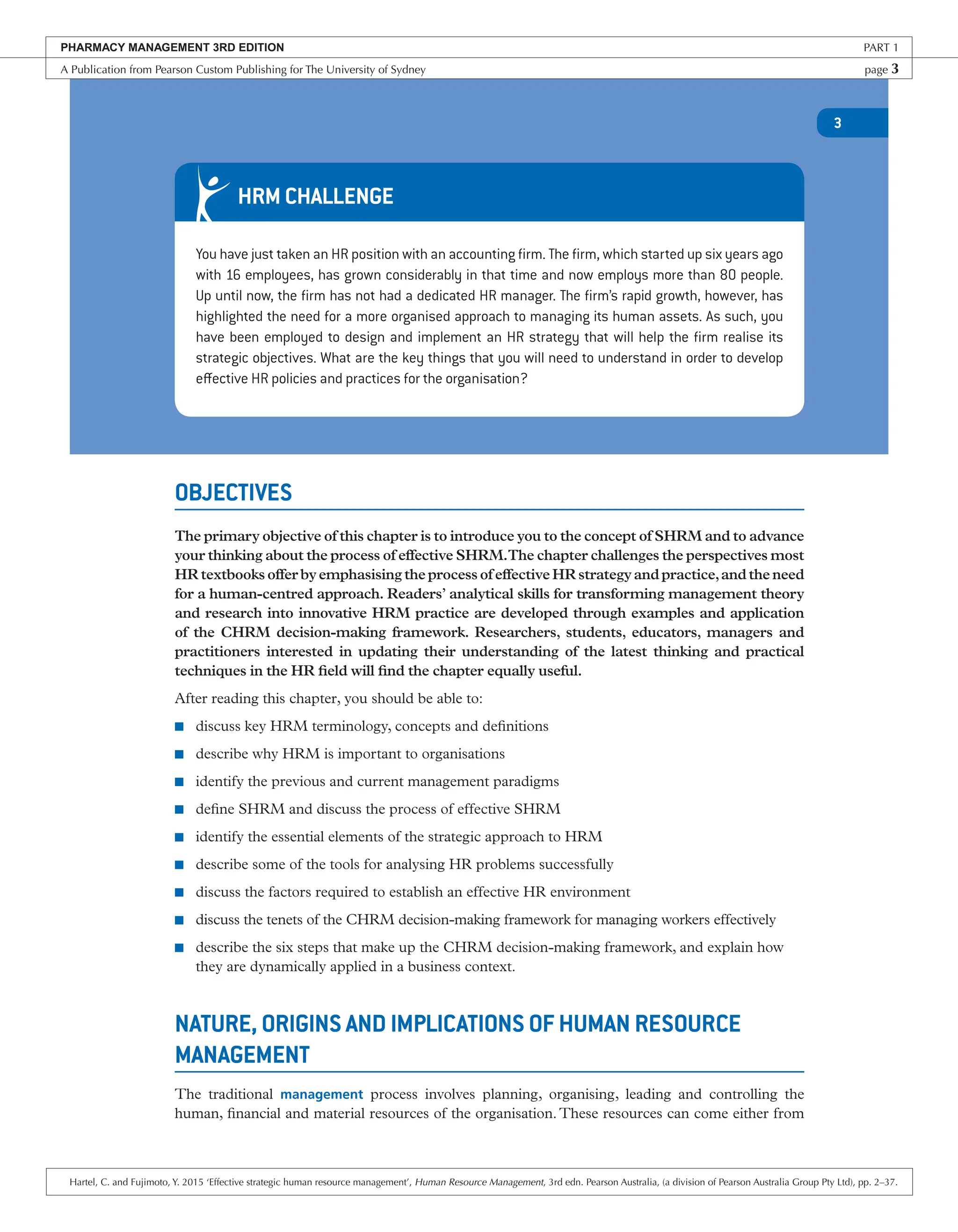
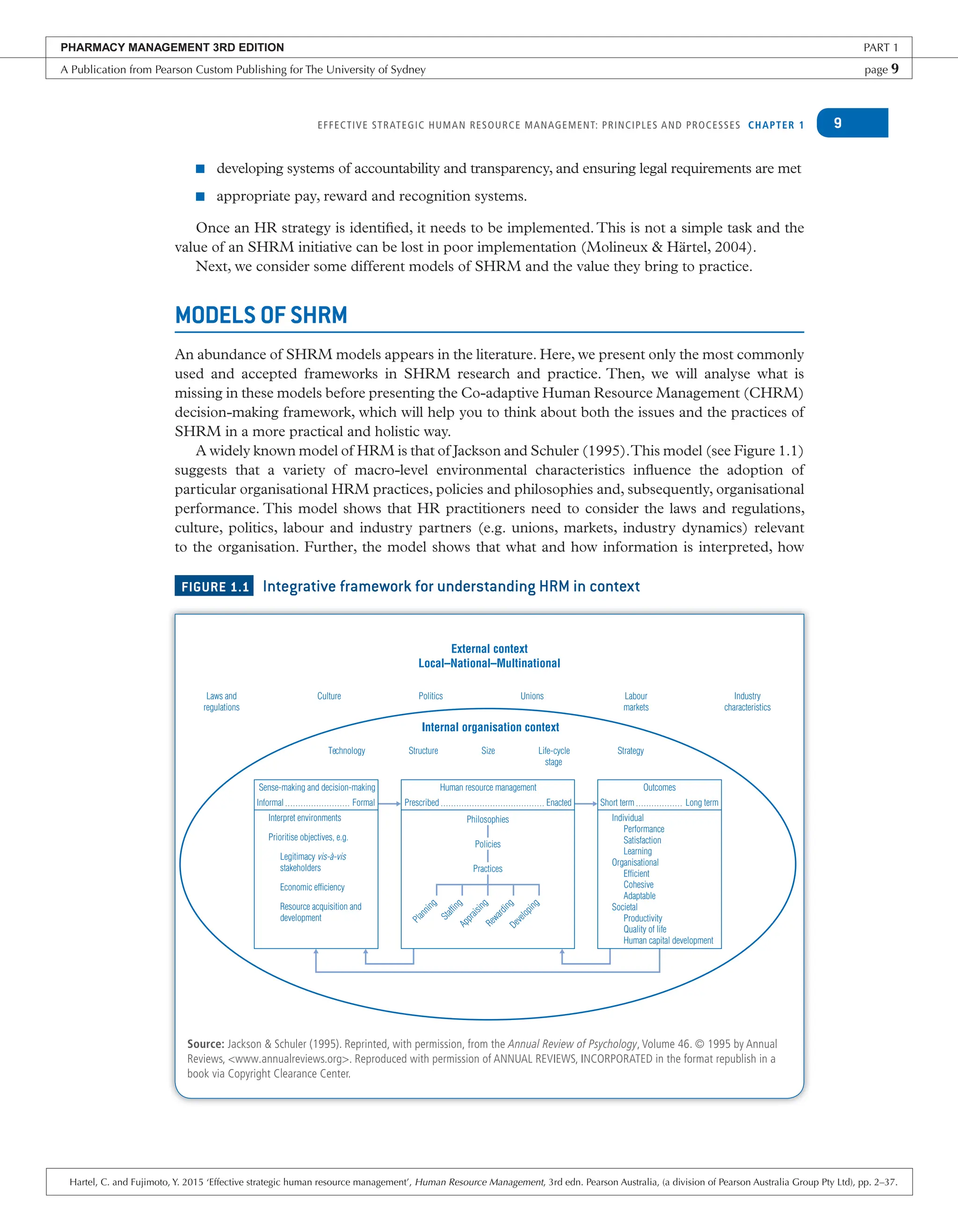
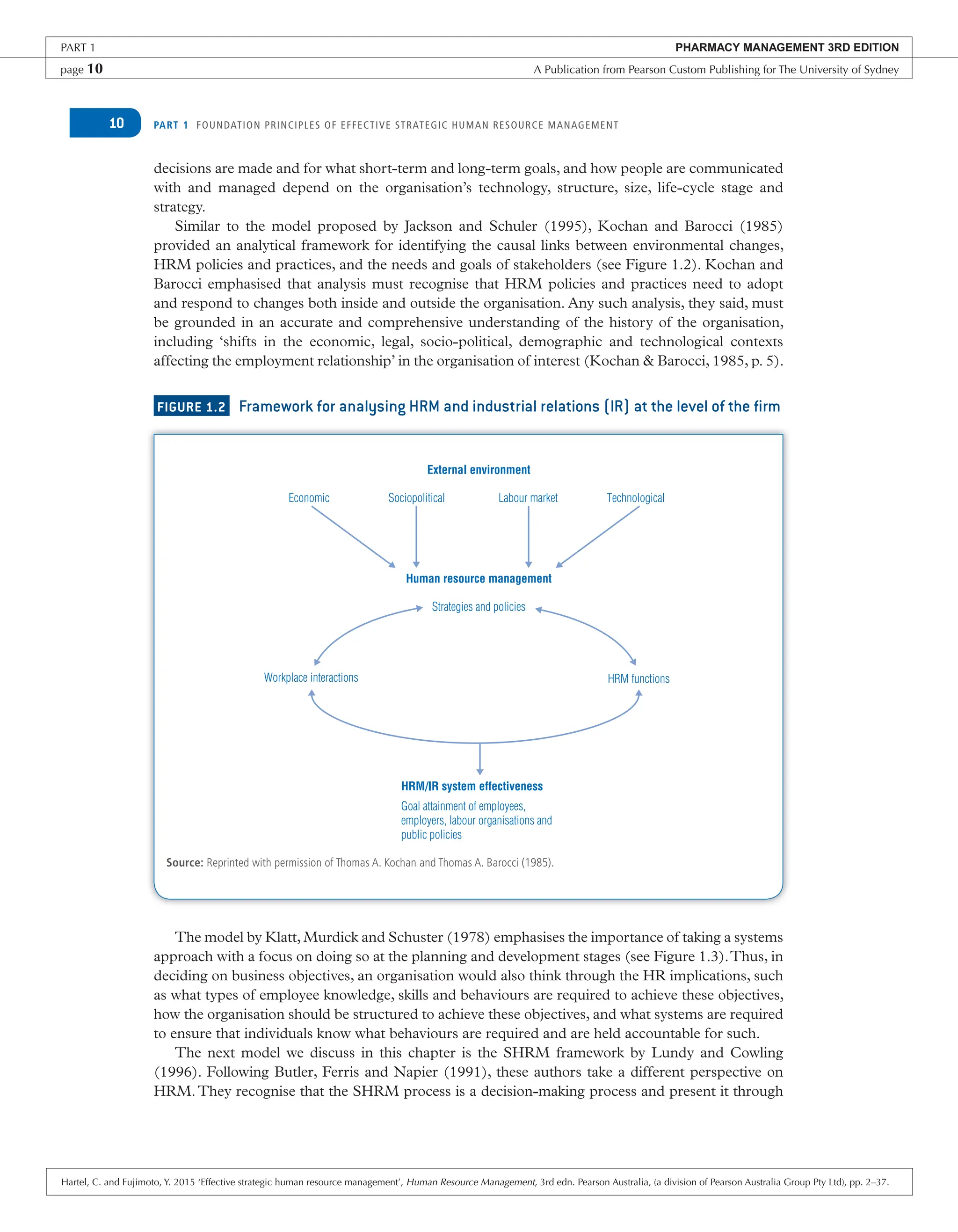
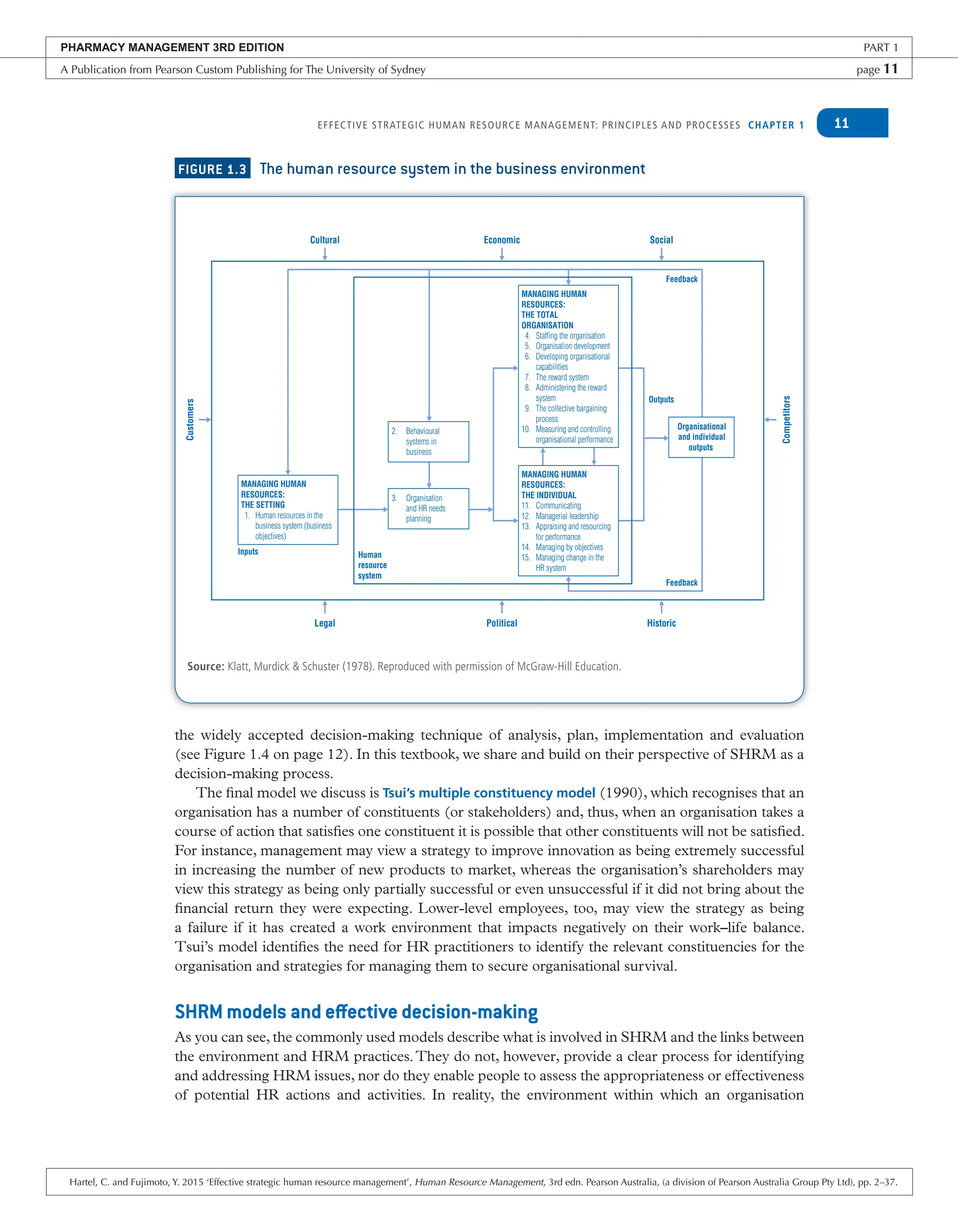
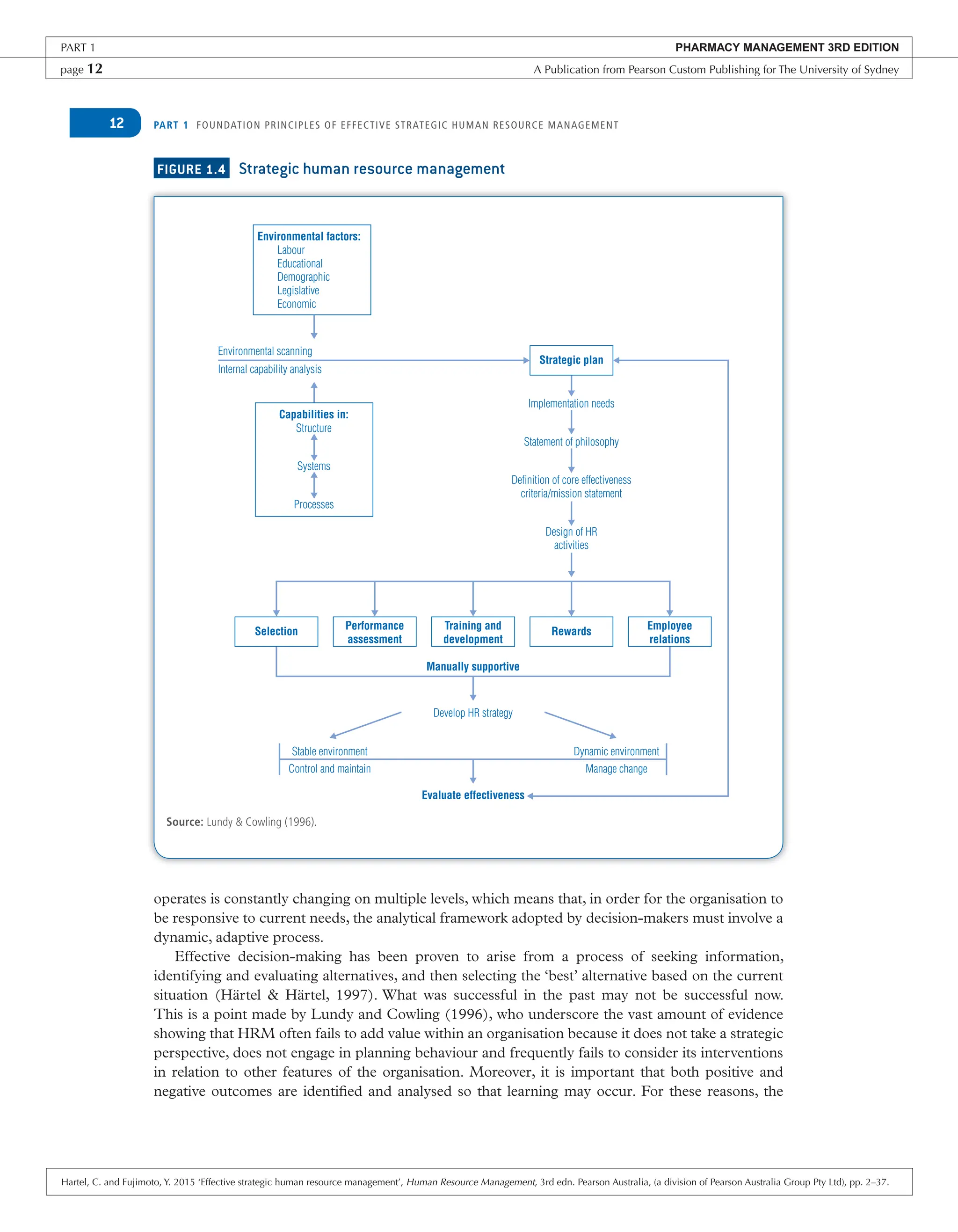
![PART 1 FOUNDATION PRINCIPLES OF EFFECTIVE STRATEGIC HUMAN RESOURCE MANAGEMENT
14
■ the assessment of risks and rewards associated with pursuing the plan.This is one of the most
important parts of the plan because it involves an ‘assessment of everything that can go wrong
and right, and a discussion of how the [HRM] team can respond’ (Sahlman, 1997, p. 99).
The CHRM decision-making framework consists of six steps. Steps 1 to 4 relate to the human-
centred strategy formulation process, and Steps 5 and 6 relate to the human-centred strategy
implementation process.Whereas Steps 1 to 4 should be taken as being a shared responsibility between
senior management and HR professionals (Huselid, Becker & Beatty, 2005), Steps 5 and 6 are usually
driven specifically by HR professionals to support the people management strategy chosen. Before
discussing the steps in the CHRM decision-making framework in detail, it is important to note that
the steps are not necessarily consecutive in time, and they may overlap with or recycle to former or
later steps, depending on the information gained and decisions taken within a step.
The management activities or elements of SHRM identified as being part of Step 4 (e.g. job
analysis and design, staffing, training, performance management) are the tools used by organisations
to manage people.Thus, the decision-making process associated with the CHRM model guides the
nature and use of these tools within the organisation. At Step 4, it is necessary to discuss the critical
decision of how to arrange these tools or activities, or how to relate them to each other, in order to
connect them into a whole.
Any decision-making process an organisation undertakes should be informed by careful analysis
of the problems and opportunities it faces; unfortunately, it is the reality that many organisations
respond to such problems and opportunities without appropriately analysing them. Here are two key
questions that should be considered:
1. Do all potential problems and opportunities need to be analysed?
2. If they do, can past assessments using the decision-making framework be reused?
The answer to the first question is ‘yes’. Fully understanding the causes and effects of potential
problems and opportunities will minimise surprises and enable proactive planning. The answer to
the second question is an emphatic ‘no’.What has been successful in the past may not lead to success
in the future due to constant changes in the internal and external environments of the organisation.
So, the ‘take-home’ message is that it is important to analyse the time-specific situation surrounding
every opportunity and threat.
The following sections describe the CHRM decision-making framework.
Part I: Strategy formulation process
In practice, managers tend to focus on solving concrete problems that exist right now (Boland et al.,
2001; Mezias & Starbuck, 2003), thus overlooking any new trends and/or variables that might lead
to future success. However, a number of management scholars have stressed the importance for
organisations to identify a robust process of strategic-problem formulation in order to enable them to
succeed in the future (Argyris & Schön, 1974; Denrell, 2003; Ramaprasad & Mitroff, 1987).As people
‘make’ organisations, HR issues should be the focal orientation of the strategy-formulation process.
The first four steps of the CHRM decision-making framework can help ensure that this occurs.
Step 1: Screening HR-oriented environmental factors
As a first step, it is crucial that managers scrutinise the environment in which they are operating,
with a focus on human resources.Tsui’s multiple constituency model (1990) can be used as the focal
point in approaching this activity.The rationale for screening of HR-oriented environmental factors
is supported by research undertaken around the strategic management process, which repeatedly
PART 1 PHARMACY MANAGEMENT 3RD EDITION
page 14 A Publication from Pearson Custom Publishing for The University of Sydney
Hartel, C. and Fujimoto, Y. 2015 ‘Effective strategic human resource management’, Human Resource Management, 3rd edn. Pearson Australia, (a division of Pearson Australia Group Pty Ltd), pp. 2–37.](https://image.slidesharecdn.com/6262-250715010906-108bd2ed/75/eBook-PDF-Pharmacy-Management-Custom-Edition-3e-14-2048.jpg)
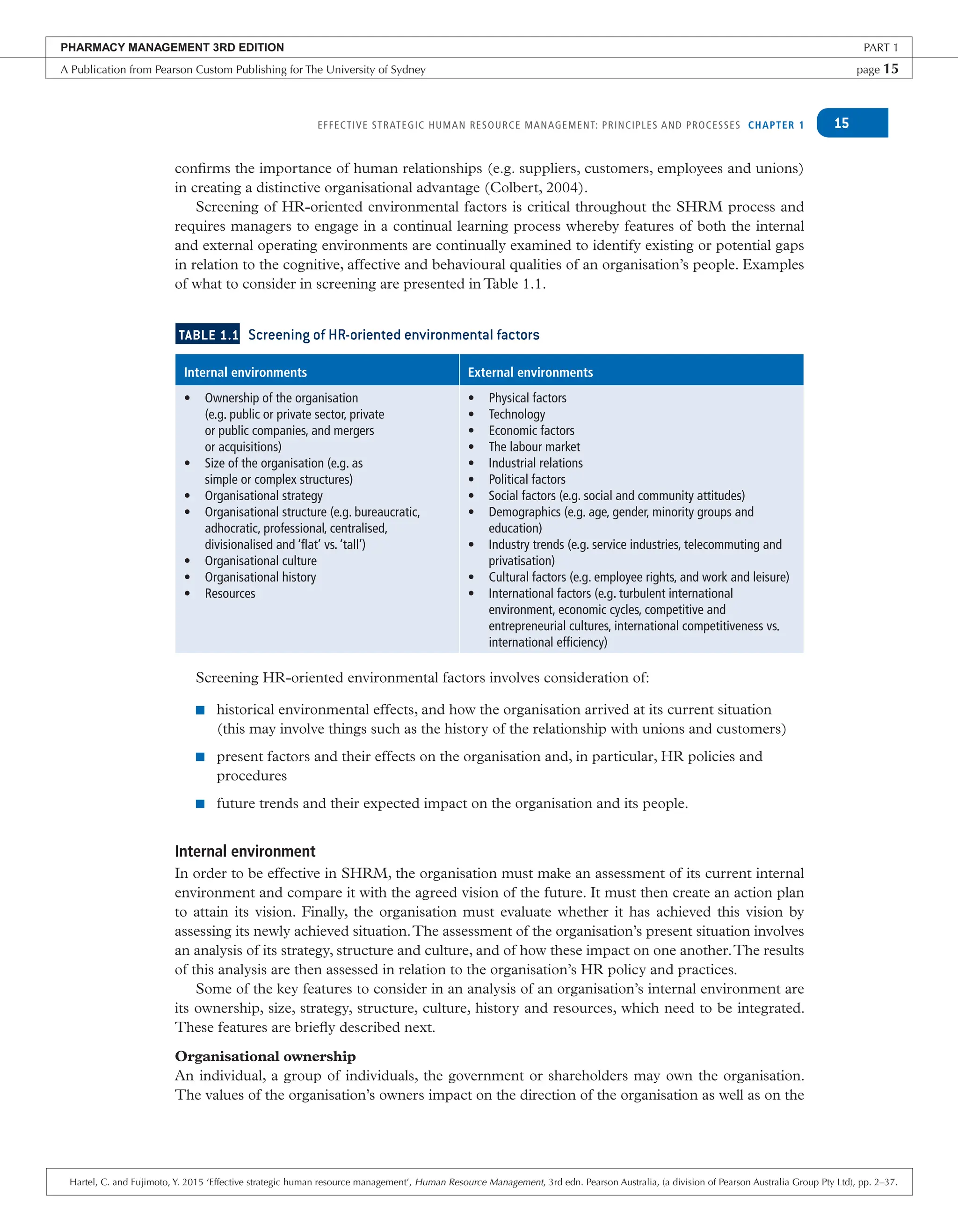

![FLAVIUS PHILOSTRATUS / ig / / CAP. καὶ σοὶ
ξυμβουλεύειν, ὁπόσα ἐμαυτὸν πέπεικα" / rn ς ἐπειδὴ γὰρ
κατέστησεν ἡμᾶς ὁ κατήγορος ἐς Ἂς > lal a a ᾽ τουτονὶ τὸν
ἀγῶνα, ἐσῆλθε τοὺς πολλοὺς οὐκ ἀληθὴς περὶ ἐμοῦ τε καὶ σοῦ δόξα'
σὲ μὲν γὰρ ὥοντο ξυμβούλῳ τῆς ἀκροάσεως ὀργῇ χρήσεσθαι, ‘ μ PN
ρ » ΡΥ ἸΧβῆσεσσυαι, 3. ἃ Xx bd a / “ Τ'.' Ν > δι’ ἣν κἂν ἀποκτεῖναί
με, ὅ TL ποτέ ἐστι TO ἀποa / > an κτεῖναι, ἐμὲ δ᾽ ἐκποιήσειν
ἐμαυτὸν τοῦ δικαστηρίου / e , a > “Ὁ / .] τρόποις, ὁπόσοι τοῦ
ἀποδρᾶναί εἰσιν, ἦσαν 8, a A 7 ᾽ 5) 7 > 5) ὦ βασιλεῦ, μυρίοι: καὶ
τούτων ἀκούων οὐκ és TO / oO 3 Ν προκαταγιγνώσκειν ἦλθον, οὐδὲ
κατεψηφισάμην al fol > 7 Ε > > / > τῆς σῆς ἀκροάσεως ὡς μὴ
TO εὐθὺ ἐχούσης, ἀλλὰ , a r cf ς iA A , ᾿ ξυνθέμενος τοῖς νόμοις
ἕστηκα ὑπὸ τῷ λόγῳ ΄ 7] vi , τούτου ξύμβουλος καὶ col
γίγνομαι. δίκαιον yap / Ν lal TO μὴ προκαταγιγνώσκειν, μηδὲ
καθῆσθαι πεπει/ σμένον, ὡς ἐγώ τί σε κακὸν εἴργασμαι, μηδ᾽ ὑπὲρ
a » / B / ον μὲν τοῦ ᾿Αρμενίου te καὶ Βαβυλωνίου καὶ ὅσοι a / /
φΦ (7 / τῶν ἐκείνῃ ἄρχουσιν, οἷς ἵππος τε παμπόλλη ἐστὶ n lal lal
> nr καὶ τοξεία πᾶσα Kal χρυσῆ γῆ καὶ ἀνδρῶν ὄχλος, A > = > 7
/ ’ 7 ὃν ἐγὼ οἶδα, ἀκούειν ξὺν γέλωτι τὸ πείσεσθαί τι e > > a “
3 “ 3 ΄ ὑπ᾽ αὐτῶν, ὅ σε καὶ τὴν ἀρχὴν ταύτην ἀφαιρή A a 7
σεται, KAT ἀνδρὸς δὲ σοφοῦ καὶ γυμνοῦ πιστεύειν, Ὁ 3 / “ pth’ ¢ /
> ὥς ἐστι τούτῳ ὅπλον ἐπὶ τὸν Ῥωμαίων avTo/ nr > , κράτορα, καὶ
προσδέχεσθαι ταῦτα Αἰγυπτίου / a an > an συκοφάντου λέγοντος,
ἃ μηδὲ τῆς ᾿Αθηνᾶς ποτε ἃ a A / > ΄ ἤκουσας, ἣν σεαυτοῦ
προορᾶν φής, εἰ μή, νὴ a ce Δία, ἡ κολακευτικὴ καὶ TO
συκοφαντεῖν οὕτω 288](https://image.slidesharecdn.com/6262-250715010906-108bd2ed/75/eBook-PDF-Pharmacy-Management-Custom-Edition-3e-22-2048.jpg)
![FLAVIUS PHILOSTRATUS cAP. δεδόσθω τῇ τῶν καταράτων
τρυφῇ Kal τῷ μήτε vil > a Μ rt ee θ a 5 , 4 νόμων αὐτοῖς ETL μήτ᾽
οφθαλμῶν εἰναι φόβον, τὸ >] / e / tal δ᾽ οὕτω τι ὑπὲρ τοὺς
ἀνθρώπους φρονεῖν, ὡς / 77 θ a 0 “ 5 Ν Ν oy Dp προγυγνώσκειν
βούλεσθαι τῶν θεῶν, ἐγὼ μὲν οὔτ 5 “ Ν > / δέδ ’ 2 / ἐπαινῶ καὶ
ἀκούων δέδια, σὺ δ᾽ εἰ προσδέξοιο, a! γράψονται καὶ σὲ ἴσως ὡς
διαβάλλοντα THY περὶ A θ / 60 > a / Tov θείου δόξαν, ἐλπὶς
yap Kal κατὰ σοῦ ξυγκείθ 7 / > δὰ ὃ al σεσθαι τοιαύτας γραφάς,
ἐπειδὰν μηδεὶς τοῖς τ a συκοφάνταις λοιπὸς ἢ" καὶ ξυνίημι μὲν
ἐπιτιμῶν al 3 7 Ψ 7 7 an , μᾶλλον ἢ ἀπολογούμενος, εἰρήσθω δέ μοι
ταῦθ lal / A > yy « lal > ὑπὲρ TOV νόμων, ODS εἰ μὴ ἄρχοντας
ἡγοῖο, οὐκ ἄρξεις. / S / Μ᾿ > / Tis οὖν ξυνήγορος ἔσται μοι
ἀπολογουμένῳ; / 5 φ 3 εἰ γὰρ καλέσαιμι τὸν Δία, ὑφ᾽ ᾧ
βεβιωκὼς οἶδα, γοητεύειν με φήσουσι Kal τὸν οὐρανὸν ἐς τὴν
a , 4S - > / γῆν ἄγειν. διαλεγώμεθα οὖν περὶ τούτου ἀνδρί, ὃ € /
ὃν τεθνάναι μὲν οἱ πολλοί φασιν, ἐγὼ δὲ οὔ φημι" - c Ἀ = / e Ν 4
ἔστι δὲ οὗτος ὁ πατὴρ ὁ GOS, ᾧ ἐγὼ τοσούτου val / ἄξιος, ὅσου
περ ἐκεῖνος σοί: σὲ μὲν γὰρ ἐποίησεν, an - 9S rn ὑπ᾽ ἐμοῦ δὲ
ἐγένετο. οὗτος, ὦ βασιλεῦ, ξυλλήπτωρ Qn / A x / 9 ἔσται μοι τῆς
ἀπολογίας, πολλῷ τἀμὰ βέλτιον ἢ ‘ Ul σὺ γιγνώσκων: ἀφίκετο μὲν
yap ἐς Αἴγυπτον οὔπω nr ral > / / αὐτοκράτωρ, θεοῖς τε τοῖς ἐν
Αἰγύπτῳ θύσων Kafel a / / μοὶ ὑπὲρ τῆς ἀρχῆς διαλεξόμενος.
ἐντυχὼν δέ μοι a 7 » κυ 5 ¥ ἡδὲ ” SY: a KOM@VTL τε καὶ ὧδε
ἐσταλμένῳ οὐδὲ ἤρετο οὐδὲ EV a / τ 9 pe a ® περὶ τοῦ σχήματος,
ἡγούμενος TO ἐν ἐμοὶ πᾶν εὖ ” > A yo D ae ς ΄ > Owe) ἔχειν, ἐμοῦ
δ᾽ ἕνεχ᾽ ἥκειν ὁμολογήσας, ἀπῆλθεν 292](https://image.slidesharecdn.com/6262-250715010906-108bd2ed/75/eBook-PDF-Pharmacy-Management-Custom-Edition-3e-26-2048.jpg)
![FLAVIUS PHILOSTRATUS / a a OAP. λέγω, ποῦ μοι ἡ
ἐπιστολὴ τοῦ γενναίου τε Kal VII , / a θείου ἀνδρός ; ὅς με ἐν αὐτῇ
ἄδει Ta τε ἄλλα Kal τὸ πένεσθαι." / αὐτοκράτωρ Οὐεσπασιανὸς
᾿Απολλωνίῳ φιίλο/ σόφῳ χαίρειν. >] ,’ “Ki πάντες, ᾿Απολλώνιε, κατὰ
ταὐτά σοι φιλοa Ὠ σοφεῖν ἤθελον, σφόδρα ἂν εὐδαιμόνως ἔπραττε 7
φιλοσοφία τε καὶ πενία: φιλοσοφία μὲν ἀδεκάστως ἔχουσα, πενία δὲ
αὐθαιρέτως. Eppwco.” ag °¢ «ς Ν fal “Tad ὁ πατὴρ ὁ σὸς ὑπὲρ ἐμοῦ
ἀπολογείσθω, / > / - b] 7 φιλοσοφίας μὲν τὸ ἀδέκαστον,
πενίας δὲ τὸ αὐθαί/ lal ρετον ἐμοὶ ὁριζόμενος, ἐμέμνητο yap που Kal
τῶν »Μ ο,, 5 > / κατὰ τὴν Αἴγυπτον, or Εὐφράτης μὲν καὶ
πολλοὶ τῶν προσποιουμένων φιλοσοφεῖν προσιόντες αὐτῷ 7 WOO 9
pian of sk ) > / ᾽ χρήματα οὐδ᾽ ἀφανῶς ἤτουν, ἐγὼ δ᾽ οὐ μόνον οὐ
προσήειν ὑπὲρ χρημάτων, ἀλλὰ κἀκείνους ἐώθουν e ᾽ ς / ὃ / δὲ Ν 7
ὡς οὐχ ὑγιαίνοντας, διεβεβλήμην δὲ πρὸς χρήματα ὃ) nw lal > 94
μειράκιον ὧν ἔτι: τὰ γοῦν πατρῷα, λαμπρὰ δ᾽ ἣν > / a tala / oe ς / 2
an οὐσία ταῦτα, μιᾶς μόνης ἰδὼν ἡμέρας, ἀδελφοῖς TE τοῖς ἐμαυτοῦ
ἀφῆκα καὶ φίλοις, καὶ τῶν ξυγγενῶν an / an > Be / δὰ τοῖς πένησι,
μελετῶν που ἀφ᾽ “Ἑστίας τὸ μηδενὸς a ἰφ δεῖσθαι: ἐάσθω δὲ
Βαβυλὼν καὶ ᾿Ινδῶν ta ὑπὲρ f e Καύκασόν τε καὶ ποταμὸν Ὕφασιν,
δι᾿ ὧν ἐπο/ > nan > “ > 50 ρευόμην ἐμαυτῷ ὅμοιος" ἀλλὰ τῶν γε
ἐνταυθα καὶ fal A Le. τοῦ μὴ πρὸς ἀργύριον βλέπειν ποιοῦμαι
μάρτυρα > / “ ὃ n θ ’ / tov Λὠἰγύπτιον τοῦτον: δεινὰ yap
πεπρᾶχθαι τέ 300](https://image.slidesharecdn.com/6262-250715010906-108bd2ed/75/eBook-PDF-Pharmacy-Management-Custom-Edition-3e-34-2048.jpg)
![FLAVIUS PHILOSTRATUS CAP. τῇ γῇ ἀνῆκεν, ἃ δ᾽ αὐτὴ
φύει, ἀκήρατα εἶναι φάσκων ἐσιτεῖτο, ἐπιτήδεια γὰρ σῶμα καὶ νοῦν
τρέφειν" ἐσθῆτά τε, ἣν ἀπὸ θνησειδίων οἱ πολλοὶ r > > / , > 7
φοροῦσιν, οὐ καθαρὰν εἶναι φήσας λίνον NT ς , rs > / σχετο,
καὶ TO ὑπόδημα κατὰ τὸν αὕτον λόγον βύβλου ἐπλέξατο. ἀπέλαυσέ
τε τοῦ καθαρὸς εἶναι πολλὰ μέν, πρῶτον δὲ τὸ τῆς ἑαυτοῦ ψυχῆς ᾽ /
’ / ἃ αἰσθέσθαι: γενόμενος γὰρ κατὰ τοὺς χρονοῦν», οὺς ς fal
€ / ς / 5 / lal la) ὑπὲρ τῆς λένης ἢ Τροία ἐμάχετο, καὶ τῶν TOU
Πάνθου παίδων κάλλιστος dv καὶ κάλλιστα > / > / Ν e/ / ς y ε /
ἐσταλμένος, ἀπέθανε μὲν οὕτω νέος, ὡς Καὶ Ομήρῳ παρασχεῖν
θρῆνον, παρελθὼν δ᾽ ἐς πλείω σώματα κατὰ τὸν ᾿Αδραστείας
θεσμόν, ὃν ψυχὴ ἐναλa 3 λάττει, πάλιν ἐπανῆλθεν ἐς ἀνθρώπου
εἶδος καὶ an / Μνησαρχίδῃ ἐτέχθη τῷ Σαμίῳ, σοφὸς ἐκ βαρβάρου
ov b] / e > / ε ᾽ καὶ Ἴων ἐκ Tpwos, καὶ ovT@ τι ἀθάνατος, ὡς μηδ
ὅτι Εὔφορβος ἣν ἐκλελῆσθαι. τὸν μὲν δὴ πρόΞ Ἰ A , γονον τῆς
ἐμαυτοῦ σοφίας εἴρηκα καὶ τὸ μὴ αὐτὸς ς 7 / ae oe es ae > εὑρών,
κληρονομήσας δὲ ἑτέρου ταῦτ᾽ ἔχειν. KAYO > / lal e lal ’ὔ μὲν
οὐ κρίνω τοὺς τρυφῶντας ὑπὲρ TOV φοινικίου » ᾿ a“ / ἃ ὄρνιθος,
οὐδ᾽ ὑπὲρ TOU ἐκ Φάσιδος ἢ Llavover, οὺς gialvovow & Tas αὑτῶν
δαῖτας οἱ TH γαστρὶ / δ᾽ » δέ χαριζόμενοι πάντα, οὐ ἐγραψάμην πω
ovoeva 304](https://image.slidesharecdn.com/6262-250715010906-108bd2ed/75/eBook-PDF-Pharmacy-Management-Custom-Edition-3e-38-2048.jpg)
![FLAVIUS PHILOSTRATUS e lal > / ἃ > A / x CAP. ὑπὲρ
τῶν ἰχθύων, Os ὠνοῦνται πλείονος ἢ TOUS VII / e / >) c /
κοππατίας ποτὲ οἱ λαμπροί, οὐδ᾽ ἁλουργίδος ἐβάσκηνα οὐδενί, οὐδὲ
ΠΙαμφύλου τινὸς ἢ μαλακῆς ἐσθῆτος, ἀσφοδέλου δέ, ὦ θεοί, καὶ
τραγημάτων al 7 καὶ καθαρᾶς ὀψοφαγίας γραφὴν φεύγω. Καὶ οὐδὲ
ἡ ἐσθὴς ἄσυλος, ἀλλὰ κἀκείνην λωποδυτεῖ pe ὁ κατήγορος ὡς
πολλοῦ ἀξίαν an / / > / © > / τοῖς γόησι. καίτοι ἀφελόντι τὸν
ὑπὲρ ἐμψύχων τε καὶ ἀψύχων λόγον, δι ὧν καθαρός τις ἢ a 7 ‘4 ς
>] / r Ν᾽, μὴ δοκεῖ, τί βελτίων ἡ ὀθόνη τοῦ ἐρίου; τὸ / 7 22 7 μέν
ye mpaotatov ζῴου ἐπέχθη καὶ σπουδαζομένου θεοῖς, of μὴ
ἀπαξιοῦσι τὸ ποιμαίνειν καί, /) > ’ / > Ἅ, “Ὁ » xX νὴ Δί᾽, ἠξίωσάν
ποτε αὐτὸ Kai χρυσοῦ εἴδους ἢ Va / / 7 / ε » θεοὶ ἢ λόγοι. λίνον δὲ
σπείρεται μέν, WS ετυχε, χρυσοῦ δὲ οὐδεὶς ἐπ’ αὐτῷ λόγος, ἀλλ᾽
ὅμως, ἐπειδὴ μὴ ἀπ᾽ ἐμψύχου ἐδρέφθη, καθαρὸν μὲν ᾿Ινδοῖς δοκεῖ,
καθαρὸν δὲ Αἰγυπτίοις, ἐμοὶ δὲ / a an / καὶ Ilv@ayopa διὰ τοῦτο
σχῆμα γέγονε διαλεγο/ > / Ov 0 x δὲ Χ μένοις εὐχομένοις θύουσι.
καθαρὸν δὲ καὶ τὸ ἐννυχεύειν ὑπ᾽ αὐτῷ, καὶ γὰρ τὰ ὀνείρατα τοῖς, ὡς
ἐγώ, διαιτωμένοις ἐτυμωτέρας τὰς αὑτῶν φήμας ἄγει. >] / ἢ id n
ΝΜ ε na Απολογώμεθα καὶ ὑπὲρ τῆς οὔσης ποτὲ ἡμῖν na κόμης,
ἐπειδή τις γραφὴ Kal αὐχμοῦ εὕρηται. 306](https://image.slidesharecdn.com/6262-250715010906-108bd2ed/75/eBook-PDF-Pharmacy-Management-Custom-Edition-3e-40-2048.jpg)
![FLAVIUS PHILOSTRATUS GAP, νεσθαι, σοὶ δὲ ἐχαριζόμην
ταῦτα: ὥσπερ γὰρ ot τῶν βοῶν ἐπιστάται τὸ μὴ ἀτακτεῖν αὐτὰς
χαρίζονται τοῖς κεκτημένοις τὰς βοῦς, καὶ οἱ τῶν / a ποιμνίων
ἐπιμεληταὶ πιαίνουσιν αὐτὰ ἐς TO τῶν ῇ ) rn a πεπαμένων κέρδος,
νόσους TE ἀφαιροῦσι μελιττῶν “ ral / nr οἱ νομεῖς αὐτῶν, ὡς μὴ
ἀπόλοιτο τῷ δεσπότῃ lol . TO σμῆνος, οὕτω TOU Kal ἐγὼ τὰ
πολιτικὰ παύων / Ν 4 / [χά > > ἐλαττώματα σοὶ διωρθούμην Tas
πόλεις, ὥστ᾽ εἰ a / / 5 καὶ θεὸν ἡγοῦντό με, σοὶ κέρδος ἡ ἀπάτη
εἶχε, / Zz > “ / / ξὺν προθυμίᾳ γάρ που ἠκροῶντό μου, δεδιότες / ἃ
“ n 3 5 > a »” πράττειν, ἃ μὴ δοκεῖ θεῷ. ἄλλ᾿ οὐχὶ τοῦτο WOYTO,
c/ ἃν; 3 7 > , / 5» ὅτι δ᾽ ἐστί τις ἀνθρώπῳ πρὸς θεὸν ξυγγένεια,
δι ἃ / / ἊΝ lal ἣν μόνον ζῴων θεοὺς οἶδε, φιλοσοφεῖ δὲ καὶ ὑπὲρ a
la) / “4 / na / τῆς ἑαυτοῦ φύσεως Kal ὅπη μετέχει τοῦ θείου. > 3
a A φησὶ μὲν οὖν καὶ τὸ εἶδος αὐτὸ θεῷ ἐοικέναι, ὡς / A
ἀγαλματοποιία ἑρμηνεύει Kal χρώματα, τάς TE / Ε] / ἀρετὰς
θεόθεν ἥκειν ἐπ᾽ αὐτὸν πέπεισται, καὶ TOUS Qn ‘4 43 "4 μετέχοντας
αὐτῶν ἀγχιθέους τε εἶναι Kal θείους. x a / 4 Διδασκάλους δὲ τῆς
διανοίας ταύτης μὴ > / a > ὃ) ν᾽ ὃ / Αθηναίους καλῶμεν, ἐπειδὴ
τοὺς δικαίους Kal > / / > , τοὺς ᾿Ολυμπίους καὶ τὰς τοιάσδε
ἐπωνυμίας “ / . / πρῶτοι ἔθεντο, θειοτέρας, ὡς TO εἰκός, οὔσας 7 an
> / ἢ ἐπ᾽ ἀνθρώπῳ κεῖσθαι, ἀλλὰ τὸν ᾿Απόλλω TOV ΕῚ an an ΕῚ
7 > ¢ ἐν τῇ Πυθοῖ: ἀφίκετο μὲν yap ἐς τὸ ἱερὸν a fal ς a Ὕ / ”
αὐτοῦ Λυκοῦργος ὁ ἐκ THs Σπάρτης ἄρτι yeypapan val / / μένων
αὐτῷ τῶν νόμων, οἷς ἡ Λακεδαίμων τέ > > δι 9 / τακται,
προσειπὼν δ᾽ αὐτὸν ὁ ᾿Απόλλων Baca/ a / > lal a lal vier τὴν περὶ
αὐτοῦ δόξαν, ἐν ἀρχῇ τοῦ χρησμοῦ 312](https://image.slidesharecdn.com/6262-250715010906-108bd2ed/75/eBook-PDF-Pharmacy-Management-Custom-Edition-3e-46-2048.jpg)
![CAP. Vil FLAVIUS PHILOSTRATUS 7 ΡῚ a / x Μ φάσκων
ἀπορεῖν, πότερα χρὴ θεὸν ἢ ἄνθρωπον an “ἃ / καλεῖν, προϊὼν δὲ
ἀποφαίνεται καὶ ψηφίζεται τὴν > / 7 ς > N > la > ἐπωνυμίαν
ταύτην, ws ἀνδρὶ ἀγαθῷ. καὶ οὐδεὶς 5 an » « Xx / b] ἐπὶ tov
Λυκοῦργον ἀγὼν ἧκεν, ἢ κίνδυνος ἐκ 7 Ν 7ὔ ς > / τούτων παρὰ
Λακεδαιμονίοις, ὡς ἀθανατίζοντα, / lal / ἐπεὶ μὴ ἐπέπληξε τῷ
Πυθίῳ προσρηθεὶς τούτοις, > X / fa / / / ἀλλὰ ξυνετίθεντο TH
μαντείῳ, πεπεισμένοι δήπου καὶ πρὸ τοῦ χρησμοῦ ταῦτα. lal > / “ Τὰ
δὲ Ἰνδῶν καὶ Αἰγυπτίων ταῦτα: ᾿Ινδοὺς Αἰγύπτιοι τὰ μὲν ἄλλα
συκοφαντοῦσι καὶ δια/ » “Ὁ Χ aaa. a 7 4 βάλλουσιν αὐτῶν τὰς ἐπὶ
τοῖς πράγμασι δόξας, / ἃ > n “ τὸν δὲ λόγον, ὃς ἐς τὸν
δημιουργὸν τῶν ὅλων a εἴρηται, οὕτω τι ἐπαινοῦσιν, ὡς καὶ
ἑτέρους na € , a διδάξασθαι ᾿Ινδῶν ὄντα. ὁ λόγος δὲ THs μὲν A
[2 7] / > / θ ὃ τῶν ὅλων γενέσεώς τε καὶ οὐσίας θεὸν δημιουρ 5
a x > aA A " γὸν οἶδε, TOD δὲ ἐνθυμηθῆναι ταῦτα αἰτιον TO
ἀγαθὸν εἶναι αὐτόν' ἐπεὶ τοίνυν ξυγγενῆ ταῦτα, 4 ἴω / b] a
ἔχομαι τοῦ λόγου καὶ φημὶ τοὺς ἀγαθοὺς τῶν 4 ΄ a » fiz δὲ ς δὰ 2p
EN, n ἀνθρώπων θεοῦ τι ἔχειν. κόσμος δὲ ὁ μὲν ἐπὶ θεῷ a / A /
δημιουργῷ κείμενος τὰ ἐν οὐρανῷ νομιξέσθω καὶ > / lal / «& /
ΝΜ τὰ ἐν θαλάττῃ καὶ γῇ πάντα, ὧν μετουσία Lon > / / Μ / > >
ἀνθρώποις, πλὴν τύχης. ἔστι δέ τις Kal ἐπ ᾽ er: Pe > ες , ae ἀνδρὶ
ἀγαθῷ κόσμος οὐχ ὑπερβάλλων Ta σοφίας £ “ > / > an / » ὃ Ν
μέτρα, ὅν που καὶ αὐτός, ὦ βασιλεῦ, φήσεις avopos 314](https://image.slidesharecdn.com/6262-250715010906-108bd2ed/75/eBook-PDF-Pharmacy-Management-Custom-Edition-3e-48-2048.jpg)