CHAPTER I
INTRODUCTION TO
HRM
CONCEPT OF HRM
 People are the most important resources of every
organization. No organization can exists and grow
without them.
 People become HR when they combine energy and physical
strength with knowledge, skills, attitudes and potential for
growth.
 Human Resource Management is proper and systematic
arrangement and handling human resource, their competencies
and energies in organization.
 HRM involves all the activities such as acquisition,
development, utilization and maintenance, necessary for
manpower management for a long period.
CONCEPT OF HRM
Acc to Robbins: HRM is a process consisting of
acquisition, development, motivation, and maintenance of
human resource to achieve organizational goals
Acc to Gibson: HRM is the process of accomplishing
organizational objectives by acquiring, retaining,
developing and properly using the human resources in an
organization.
CHARACTERISTICS OF HRM
 Managing People at Work
 Concerned with developing the employees
 Continuous Function
 Strategy focused
 Tools for human benefit
 Integration of mutual interest
 System oriented
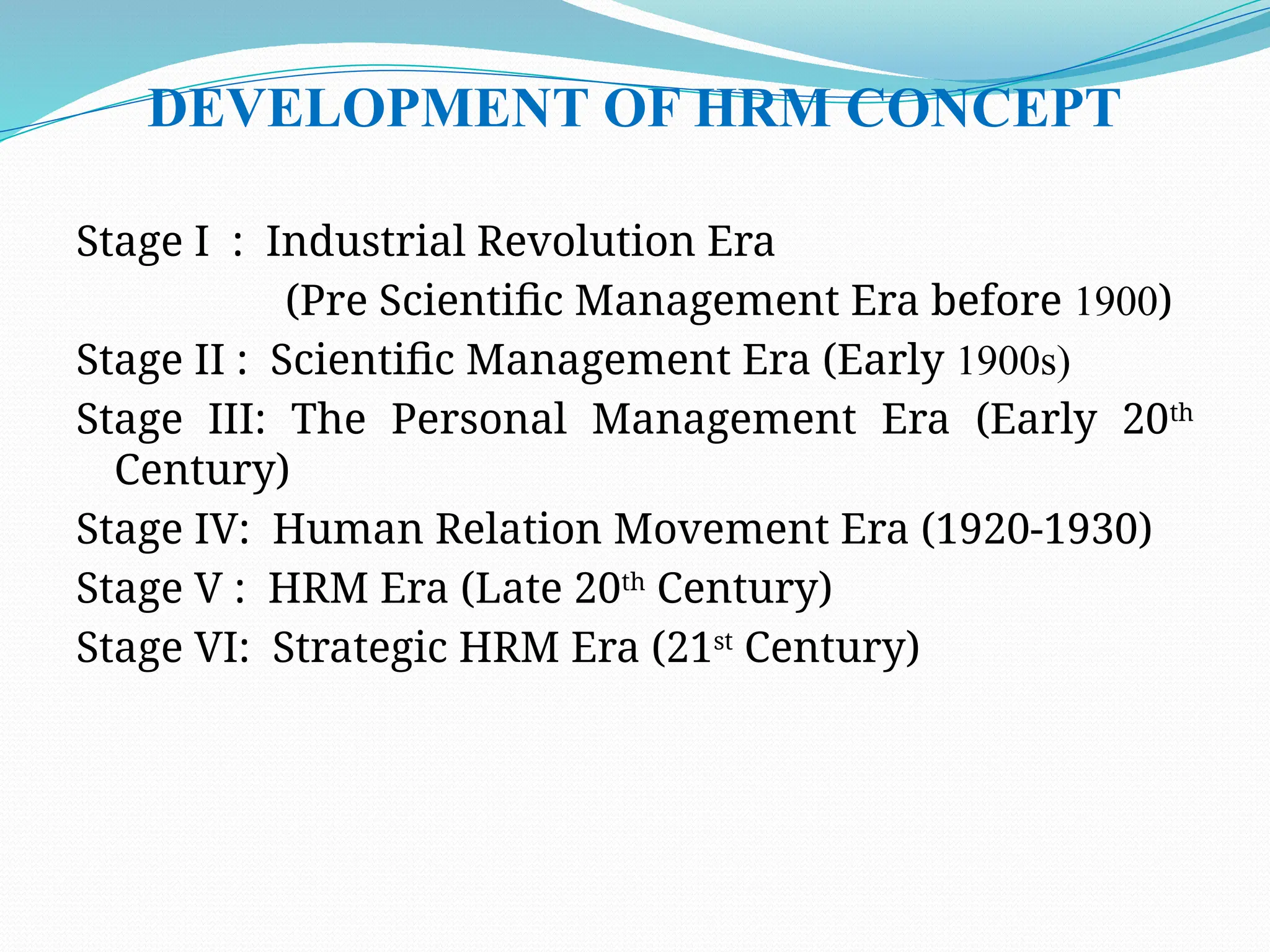
DEVELOPMENT OF HRM CONCEPT
Stage I : Industrial Revolution Era
(Pre Scientific Management Era before 1900)
Stage II : Scientific Management Era (Early 1900s)
Stage III: The Personal Management Era (Early 20th
Century)
Stage IV: Human Relation Movement Era (1920-1930)
Stage V : HRM Era (Late 20th
Century)
Stage VI: Strategic HRM Era (21st
Century)
DEVELOPMENT OF HRM CONCEPT
Stage I: Industrial Revolution Era(Pre Scientific
Management Era, before 1900)
 In this stage, people work alone or in such small groups
that their work relationship were easily handled.
 They had to work for long hours under very poor
conditions of health and hygiene
 Their incentives were not in accordance with their
workload.
 Two leading Contributor of that time are
 Robert Own, who was the first contributors to emphasize
human needs of employees.
 Andrew Ure, who recognized the HUMAN FACTOR and
provided workers with hot tea, medical treatment and
sickness payments.
DEVELOPMENT OF HRM CONCEPT
Stage II: Scientific Management Era (Early 1900s)
 F.W. Taylor popularized the concept of scientific
management through his book Principles of Scientific
Management in 1911.
 His principles consist of development and use of the
best way of doing work, scientific selection and
placement of workers, proper division of work,
harmonious relation among workers etc.
 The changes he brought to the management paved
the way to HRM.
 The main contribution of Taylor to management was
it led to the professionalization of management and
human engineering.
DEVELOPMENT OF HRM CONCEPT
Stage III: The Personal Management Era (Early 20th
Century)
 The personal management era mainly concentrated
on keeping employee records and ensuring
compliance with the stated policies.
 It emphasized to increase productivity through wage
increases and training, and enforcement of standard.
 It focused on dealing with trade unions and trying to
solve industrial disputes through collective
bargaining and other industrial relations
approaches.
DEVELOPMENT OF HRM CONCEPT
Stage IV: Human Relation Movement Era (1920-1930)
 In 1920s and 1930s Elton Mayo and his associates conducted
a study in the area of human behavior at work.
 Mayo and his associates concluded that HR managers beside
economic rewards should also focus on feelings, emotions, and
sentiments of employees.
 It was recognized that treating employees with respect would
improve employee satisfaction and help in achieving higher
productivity.
DEVELOPMENT OF HRM CONCEPT
Stage V: HRM Era (Late 20th
Century)
 This era evolved during the late 20th
century with the
introduction of new theories such as Maslow’s Need
Hierarchy Theory, Two Factor Theory etc.
 In this era, employees of an organization were
considered valuable resources. Greater attention was
given towards social responsibility and social well-
being.
 More emphasis was given to the relationship
between employers and employees. Employees ideas
and initiatives were encouraged.
DEVELOPMENT OF HRM CONCEPT
Stage VI: Strategic HRM Era (21st
Century)
 In SHRM, the importance of human resource is
considered for long-range strategic planning of the
organization.
 It supports individual goal and objectives with
corporate goals and objectives.
 It emphasizes to act as a facilitator and promotes a
participative approach rather than enforce rules in
dictatorial terms.
HRM ENVIRONMENT
 HRM environment involve all components of the
surroundings of business organization, which affects
its operations and determine effectiveness.
 A profitable business organization of today may not
be in same position in the future if HR managers are
unable to adapt business operations according to the
changing environment.
 Management needs to estimate and forecast
environmental influence in order to survive in a
competitive environment.
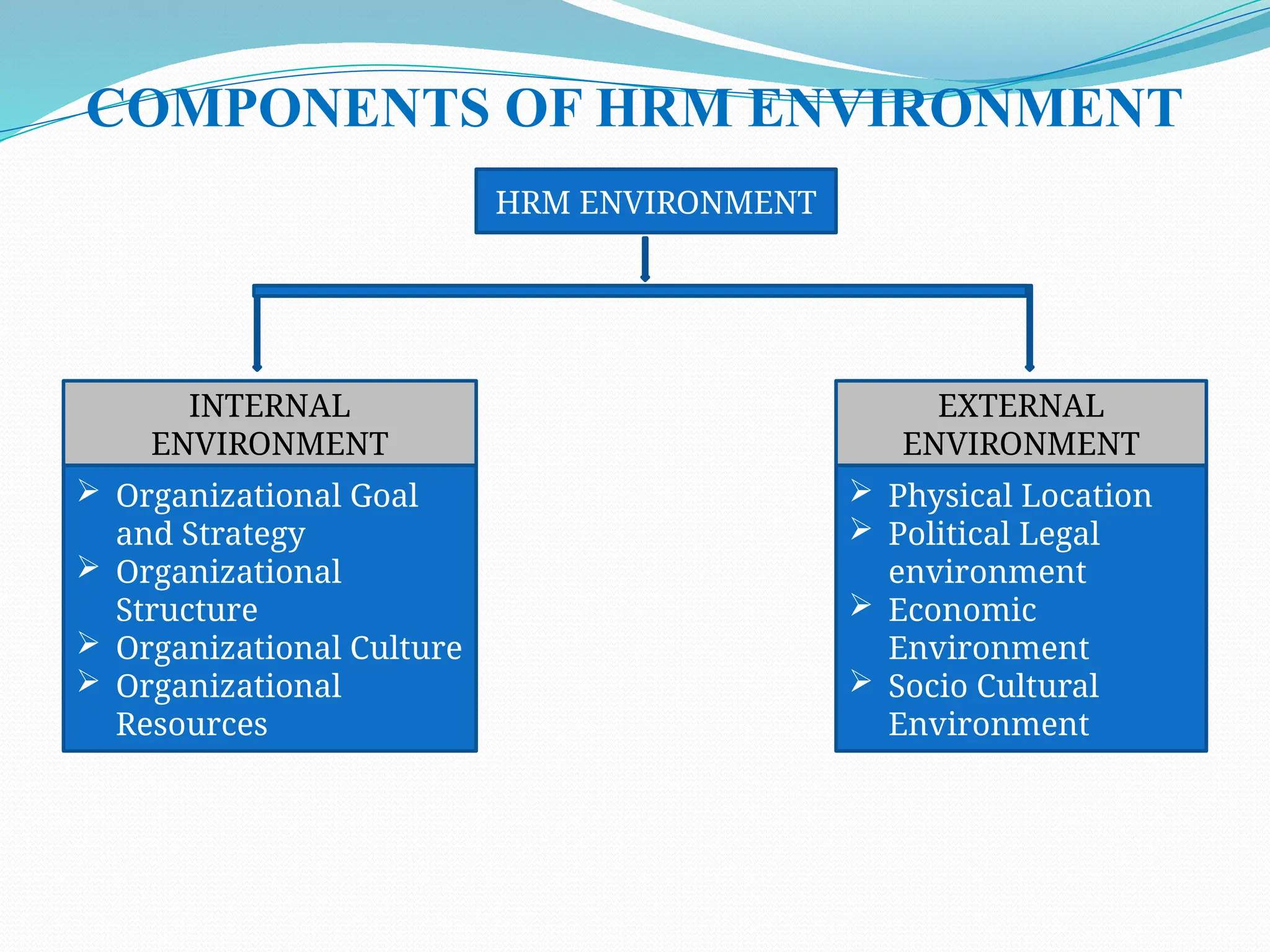
COMPONENTS OF HRM ENVIRONMENT
HRM ENVIRONMENT
INTERNAL
ENVIRONMENT
EXTERNAL
ENVIRONMENT
 Organizational Goal
and Strategy
 Organizational
Structure
 Organizational Culture
 Organizational
Resources
 Physical Location
 Political Legal
environment
 Economic
Environment
 Socio Cultural
Environment
ETHICS IN HRM
 Ethics is a set of moral principles and rules guiding
an individual’s behavior. It is the basis of
determining right or wrong in a given situation.
 Ethics govern the members of profession, business or
society so that the interest of people involved in these
organization are protected.
 Managerial Ethics is the standard of social norms
and values , truth and justice that is accepted by the
managers in the decision-making process.
SIGNIFICANCE OF ETHICAL CONSIDERATION
 Promotes goodwill and image
 Helps maintain better relation with stakeholders
 Less interference from government
 Promotes fair competition
 Promotes social responsibility
 Improve working environment
 Helps to increase the profitability
ETHICAL ISSUES OF HRM
 Competitive Intelligence
 Performance Appraisal
 Executive Compensation
 Safety and Health
 Employee discrimination
 Information distortion
ETHICAL ISSUES OF HRM
 Competitive Intelligence
It focuses on getting information about core
competitors, their strategies, activities and the effect of
such activities. These information can be obtained from
various sources such as advertisements, promotional
materials, reports etc. However, competitive intelligence
is not organizational spying.
 Performance Appraisal
Assessment of an employee’s performance is based on
observation and judgment. It is essential not only for
providing feedback to employees for their performance
but also for introduction of their efficiency development
plans. It is considered as an emerging ethical issue in
HRM.
ETHICAL ISSUES OF HRM
 Executive Compensation
The amount of base salary and incentives paid to the CEO of the
organization is an emerging issue of HRM.
 Safety and Health
Maintaining a safe working environment and taking necessary
measuring for protecting the health of employees is an emerging
ethical issues of HRM.
 Employee discrimination
Employee discrimination on the basis of race, gender, or religion is
an ethical issue that HR managers facing in day to day work.
 Information distortion
In some cases, managers need to maintain secrecy about internal
matters for organizational benefits. In such a situation, HR managers
may face problems relating to escaping the truth, distorting facts or
lying to others.
FACTORS AFFECTING ETHICS OF HRM
 Action of Top Managers
 Standard of HR Managers
 Organizational Culture
 Internal Environment
 Social Factors
FACTORS AFFECTING ETHICS OF HRM
 Action of Top Managers
They are the highest level in hierarchy and source of
ethical standards. If top level managers consider code of
conduct and morality in the course of the day to
activities, it is also followed by all the subordinates.
 Standard of HR Managers
HR managers are the source of ethical standards. They
formulate the rules, regulations, working procedures and
system for accomplishing goals.
 Organizational Culture
It is a system of shared belief held by the organization’s
members. It provides an impact on the ethical
consideration of all the members of the organization.
FACTORS AFFECTING ETHICS OF HRM
 Internal Environment
The internal environmental factors involves rules,
policies, procedures and practices implemented by the
managers and subordinates in regular activities. If the
internal system is not properly considered, it is become
difficult to maintain the standard of performance and
ethical value.
 Social Factors
A organization establishes, exists and grows in a
society. Every society involves some norms, values,
customs, tradition and laws. All HR managers need to
consider social value while doing business. It is taken as
unethical behavior if social norms and standard are not
taken into consideration.
STRATEGIC HRM (SHRM)
 Strategic HRM is a combination of Strategic
management and Human Resource management
 Strategic management is the process of identifying
and executing the organization’s mission by matching
its capabilities with the demands of its environment.
 Human Resource Management is proper and
systematic arrangement and handling human
resource, their competencies and energies in
organization.
 SHRM is a concept that integrates human resource
activities within firm’s overall strategic planning and
implementation.
STRATEGIC HRM (SHRM)
 Strategic HRM defines the organization’s intention
and plans on how its business goals should be
achieved through people.
 It emphasizes on three propositions
 Human Capital is the major source of competitive
advantage.
 It is people who implement the strategic plan
 A systematic approach should be adopted by defining
where the organization wants to go.
According to Miles and Snow, “ Strategic Human
Resource Management is a human resource system
that is tailored to the demands of the business
strategy.”
ROLE OF HRM FUNCTION IN STRATEGY
FORMULATION
 Formulation of Strategic Objectives
 Environmental Analysis
 Supply Competitive HR
 Opinion Survey of Employees
 Customer Expectation
 New Rules and Regulations
 Effective utilization of Resources
 Provides Competitive Advantage
ROLE OF HRM FUNCTION IN STRATEGY
FORMULATION
 Formulation of Strategic Objectives
The strategic objective focuses on long term activities and
performance of the organization. It needs detailed information
about how a strategic plan can be implemented in practice. HR
planning is part of strategic planning so it supports the
management for the formulation of the strategic objective.
 Environmental Analysis
Environmental analysis is one of the important significant part
of strategy formulation. It facilitates the management to
formulate a strategic plan by considering the strategic objectives
of the organization. HRM plays an important role in
environmental analysis by providing necessary information
about the changing environment.
ROLE OF HRM FUNCTION IN STRATEGY
FORMULATION
 Supply Competitive HR
HRM is an important source of supplying intelligent and
competitive manpower to various departments of the
organization. They provide support to the management for
collecting reliable information necessary for strategy
formulation. Competent employees also provide suggestions for
handling difficulties that may arise in the course of
implementation of strategies.
 Opinion Survey of Employees
HR involve both in the formulation and implementation of
strategic plans. Therefore all the employees must be positive
towards new plan and strategies. HRM system facilitates the
collection of opinions views and attitudes of employees
towards new plans and strategies. It supports the management
for taking necessary measures if it is required.
ROLE OF HRM FUNCTION IN STRATEGY
FORMULATION
 Customer Expectation
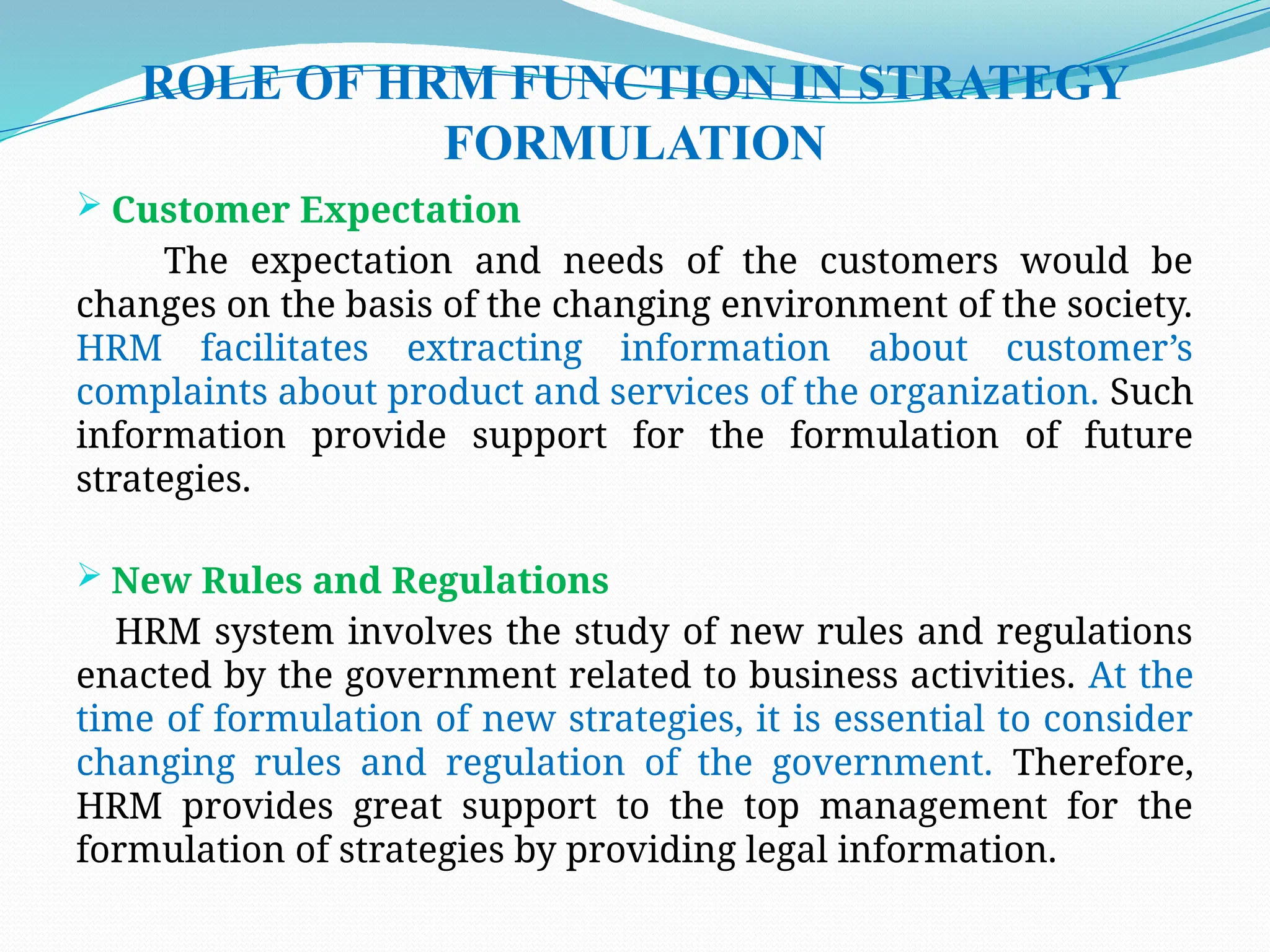
The expectation and needs of the customers would be
changes on the basis of the changing environment of the society.
HRM facilitates extracting information about customer’s
complaints about product and services of the organization. Such
information provide support for the formulation of future
strategies.
 New Rules and Regulations
HRM system involves the study of new rules and regulations
enacted by the government related to business activities. At the
time of formulation of new strategies, it is essential to consider
changing rules and regulation of the government. Therefore,
HRM provides great support to the top management for the
formulation of strategies by providing legal information.
ROLE OF HRM FUNCTION IN STRATEGY
FORMULATION
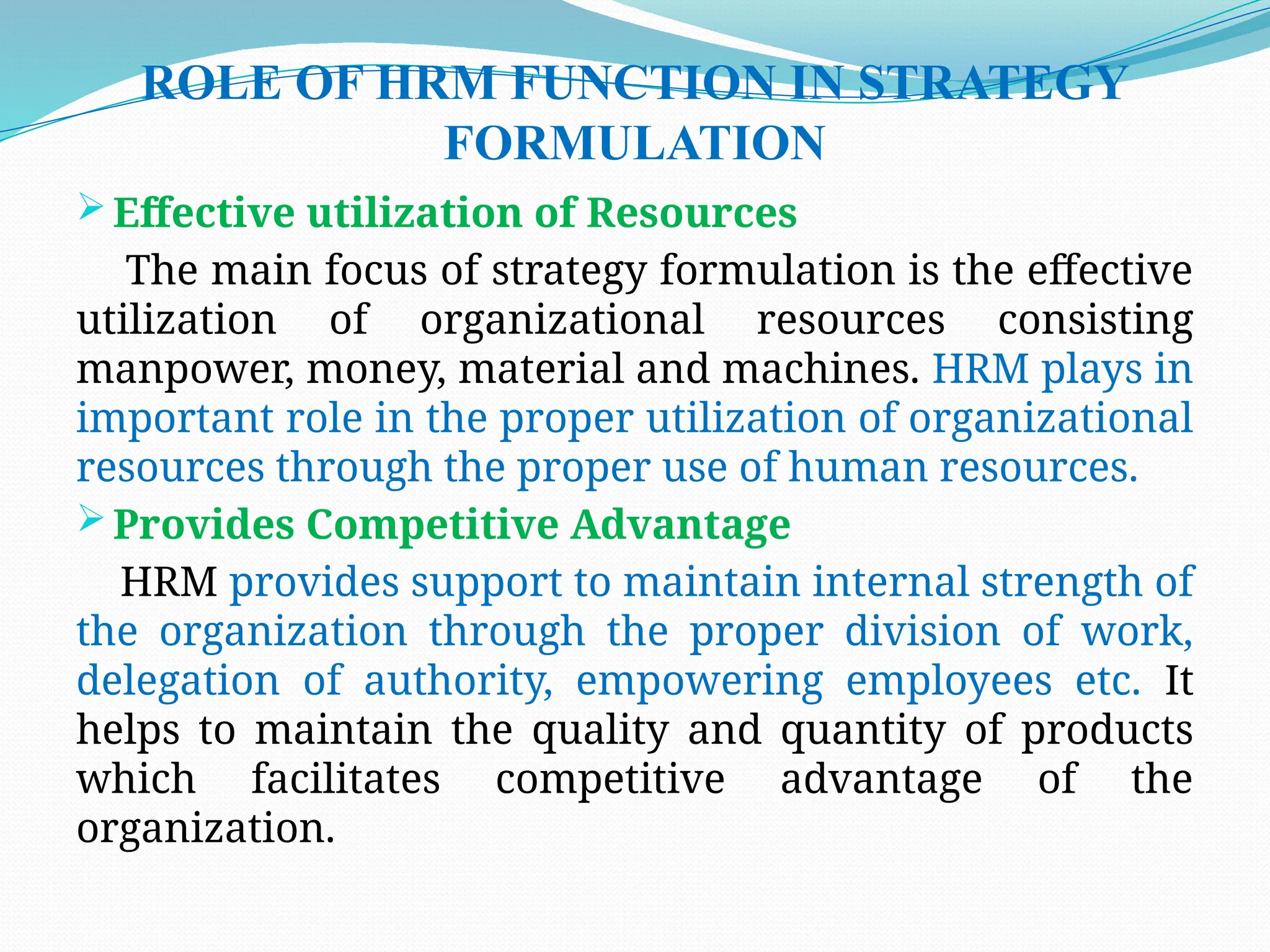
 Effective utilization of Resources
The main focus of strategy formulation is the effective
utilization of organizational resources consisting
manpower, money, material and machines. HRM plays in
important role in the proper utilization of organizational
resources through the proper use of human resources.
 Provides Competitive Advantage
HRM provides support to maintain internal strength of
the organization through the proper division of work,
delegation of authority, empowering employees etc. It
helps to maintain the quality and quantity of products
which facilitates competitive advantage of the
organization.
DIMENSIONS OF INTERNATIONAL HRM
 HR Planning
 Recruitment and Selection
 Training and Development
 Compensation of HR
 Performance Appraisal
DIMENSIONS OF INTERNATIONAL HRM
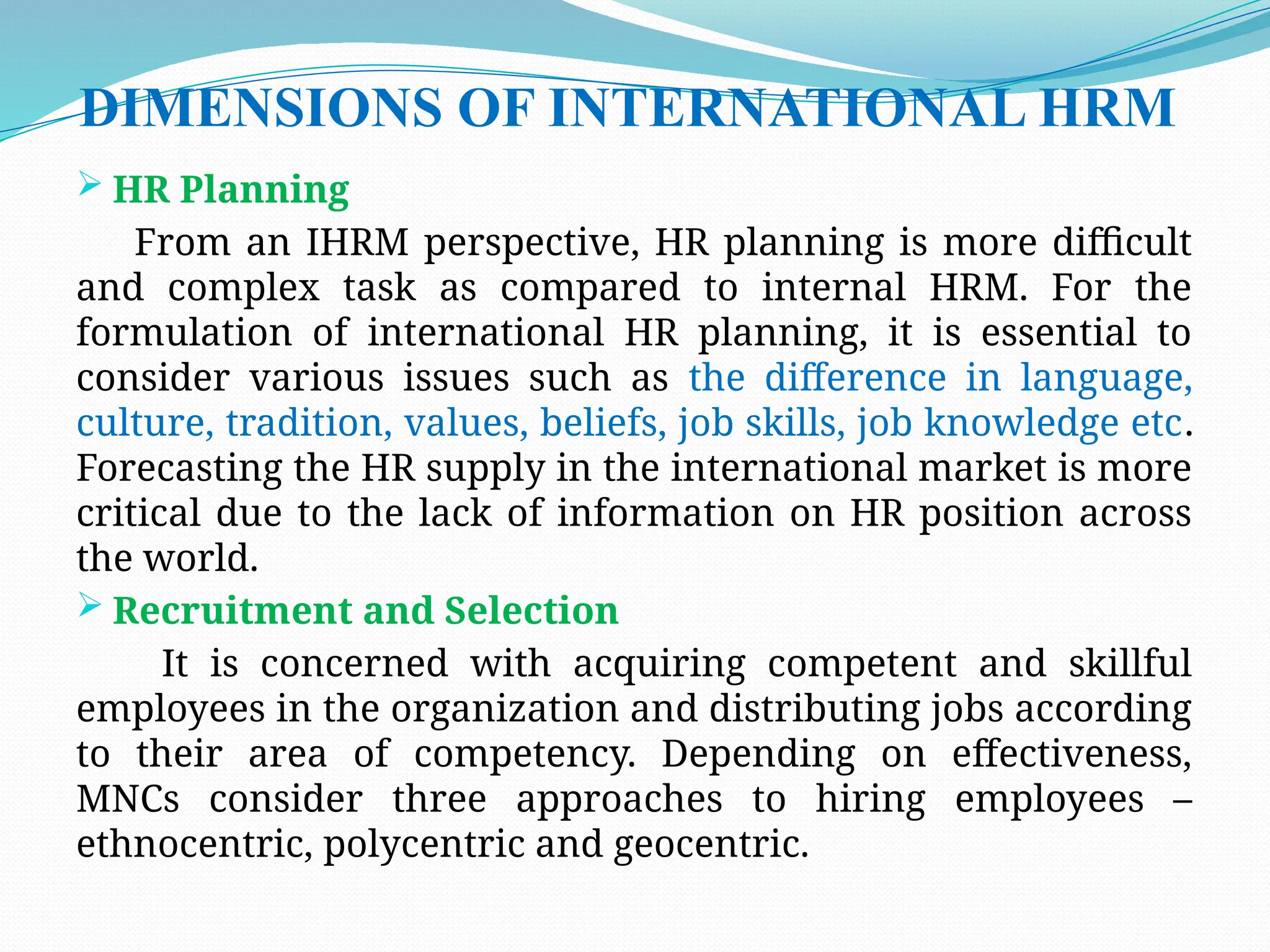
 HR Planning
From an IHRM perspective, HR planning is more difficult
and complex task as compared to internal HRM. For the
formulation of international HR planning, it is essential to
consider various issues such as the difference in language,
culture, tradition, values, beliefs, job skills, job knowledge etc.
Forecasting the HR supply in the international market is more
critical due to the lack of information on HR position across
the world.
 Recruitment and Selection
It is concerned with acquiring competent and skillful
employees in the organization and distributing jobs according
to their area of competency. Depending on effectiveness,
MNCs consider three approaches to hiring employees –
ethnocentric, polycentric and geocentric.
DIMENSIONS OF INTERNATIONAL HRM
 Recruitment and Selection
 In an ethnocentric approach, all major management position are held
by the parent company nationals and subordinate level positions are
only given to the people of host country.
 In a polycentric approach, all the business activities of foreign
subsidiaries are managed by the employees of host country nationals
and corporate office by the employees of parent country nationals.
 The geocentric approach emphasizes on the assignment of key jobs to
the best people throughout the organization regardless of any
nationality.
 Training and Development
Training and development are necessary for accomplishing
assigned job effectively. The main reason for expatriate failure is the
inability of managers and employees to adjust to the foreign
environment. Therefore, overseas employees need culture training,
language training, and practical training that seem to reduce the
probability of failure.
DIMENSIONS OF INTERNATIONAL HRM
 Compensation of HR
Compensation involves the financial incentives that the
employee have given for their time and effort devoted to the
organization. The compensation system developed should be
equitable and sufficient to attract and retain competent and
potential employees. The employee should feel equitable and
justice about the compensation system provided by the
organization.
 Performance Appraisal
Performance appraisal is used to evaluate the performance
of managers and subordinates by considering some criteria
based on the nature of the job assigned. A performance
evaluation system should be developed by considering the
organizational requirement and also by considering the
cultural values of manager and subordinates of the countries.
CHALLENGES OF HRM
1. Globalization
2. Outsourcing HR activities
3. Balancing work life and family life
4. Managing Workforce Diversity
5. Change in employee expectation
6. Partnership relationship with unions
CHALLENGES OF HRM
1. Globalization
Globalization ensures free flow of ideas, goods
and services all over the world. It brings the
concept of keen competition among the
entrepreneurs of the world. It caused great
concern for the maximization of productivity
through proper utilization of resources.
Therefore, there is growing attention in HRM
because of the close relationship between human
expertise and productivity. It is necessary to
develop new human resource rules and
regulation to adapt to the changing environment
of the globe.
CHALLENGES OF HRM
2. Outsourcing HR activities
Outsourcing is the process by which
organizations transfer routine work to another
organization that specializes in that work and
can perform it more effectively. Due to
outsourcing the importance and need for HR
departments are in danger. Theoretically, if
outsourcing is carried to the logical end, a firm
can do without an HR department.
Therefore, there is a big challenge in front of HR
managers to justify that their department is not
less important than any other department in the
organization.
CHALLENGES OF HRM
3. Balancing work life and family life
Work life balance has become a hot issue to the both
HR managers and employees. This issue become
more serious when both husband and wife are
employed. To reduce the level of stress, anxiety and
depression(among employees), HR managers need to
introduce work-life balance programs.
4. Managing Workforce Diversity
Diversified workforce is the reality of today. If such
diversified workforce is managed properly,
organization will be highly benefited . But if they are
not managed properly, they create serious problem.
So managing such diversified workforce is one of the
major challenges of HR managers.
CHALLENGES OF HRM
5. Change in employee expectation
What motivated employees yesterday do not
motivate today. Employee’s expectation are
changing everyday. It is also a major challenge for
HR managers to satisfy employees and retain them.
6. Partnership relationship with unions
It is in unfair practice from employer’s side to
dominate either the formation or the
administration of labor unions. If managed
properly unionization offers several benefit to the
organization. HR managers have to play a vital role
to convert employers and employees from
opponents role to friendship role.
ASSIGNMENT
1. “Human resource is the most valuable
resources that allows competitive advantages
for the company.” Elaborate the statement in
the context of the rising interest of HRM.
2. What are the major challenges faced by human
resource management in today’s managerial
world.
3. “Strategic human resource management
(SHRM)integrates human resource activities
within firm’s overall strategic planning and
implementation.” Explain why SHRM is
important to the organization.
An Overview of HRMS for the master level

An Overview of HRMS for the master level

  • 1.
  • 2.
    CONCEPT OF HRM People are the most important resources of every organization. No organization can exists and grow without them.  People become HR when they combine energy and physical strength with knowledge, skills, attitudes and potential for growth.  Human Resource Management is proper and systematic arrangement and handling human resource, their competencies and energies in organization.  HRM involves all the activities such as acquisition, development, utilization and maintenance, necessary for manpower management for a long period.
  • 3.
    CONCEPT OF HRM Accto Robbins: HRM is a process consisting of acquisition, development, motivation, and maintenance of human resource to achieve organizational goals Acc to Gibson: HRM is the process of accomplishing organizational objectives by acquiring, retaining, developing and properly using the human resources in an organization.
  • 4.
    CHARACTERISTICS OF HRM Managing People at Work  Concerned with developing the employees  Continuous Function  Strategy focused  Tools for human benefit  Integration of mutual interest  System oriented
  • 5.
    DEVELOPMENT OF HRMCONCEPT Stage I : Industrial Revolution Era (Pre Scientific Management Era before 1900) Stage II : Scientific Management Era (Early 1900s) Stage III: The Personal Management Era (Early 20th Century) Stage IV: Human Relation Movement Era (1920-1930) Stage V : HRM Era (Late 20th Century) Stage VI: Strategic HRM Era (21st Century)
  • 6.
    DEVELOPMENT OF HRMCONCEPT Stage I: Industrial Revolution Era(Pre Scientific Management Era, before 1900)  In this stage, people work alone or in such small groups that their work relationship were easily handled.  They had to work for long hours under very poor conditions of health and hygiene  Their incentives were not in accordance with their workload.  Two leading Contributor of that time are  Robert Own, who was the first contributors to emphasize human needs of employees.  Andrew Ure, who recognized the HUMAN FACTOR and provided workers with hot tea, medical treatment and sickness payments.
  • 7.
    DEVELOPMENT OF HRMCONCEPT Stage II: Scientific Management Era (Early 1900s)  F.W. Taylor popularized the concept of scientific management through his book Principles of Scientific Management in 1911.  His principles consist of development and use of the best way of doing work, scientific selection and placement of workers, proper division of work, harmonious relation among workers etc.  The changes he brought to the management paved the way to HRM.  The main contribution of Taylor to management was it led to the professionalization of management and human engineering.
  • 8.
    DEVELOPMENT OF HRMCONCEPT Stage III: The Personal Management Era (Early 20th Century)  The personal management era mainly concentrated on keeping employee records and ensuring compliance with the stated policies.  It emphasized to increase productivity through wage increases and training, and enforcement of standard.  It focused on dealing with trade unions and trying to solve industrial disputes through collective bargaining and other industrial relations approaches.
  • 9.
    DEVELOPMENT OF HRMCONCEPT Stage IV: Human Relation Movement Era (1920-1930)  In 1920s and 1930s Elton Mayo and his associates conducted a study in the area of human behavior at work.  Mayo and his associates concluded that HR managers beside economic rewards should also focus on feelings, emotions, and sentiments of employees.  It was recognized that treating employees with respect would improve employee satisfaction and help in achieving higher productivity.
  • 10.
    DEVELOPMENT OF HRMCONCEPT Stage V: HRM Era (Late 20th Century)  This era evolved during the late 20th century with the introduction of new theories such as Maslow’s Need Hierarchy Theory, Two Factor Theory etc.  In this era, employees of an organization were considered valuable resources. Greater attention was given towards social responsibility and social well- being.  More emphasis was given to the relationship between employers and employees. Employees ideas and initiatives were encouraged.
  • 11.
    DEVELOPMENT OF HRMCONCEPT Stage VI: Strategic HRM Era (21st Century)  In SHRM, the importance of human resource is considered for long-range strategic planning of the organization.  It supports individual goal and objectives with corporate goals and objectives.  It emphasizes to act as a facilitator and promotes a participative approach rather than enforce rules in dictatorial terms.
  • 12.
    HRM ENVIRONMENT  HRMenvironment involve all components of the surroundings of business organization, which affects its operations and determine effectiveness.  A profitable business organization of today may not be in same position in the future if HR managers are unable to adapt business operations according to the changing environment.  Management needs to estimate and forecast environmental influence in order to survive in a competitive environment.
  • 13.
    COMPONENTS OF HRMENVIRONMENT HRM ENVIRONMENT INTERNAL ENVIRONMENT EXTERNAL ENVIRONMENT  Organizational Goal and Strategy  Organizational Structure  Organizational Culture  Organizational Resources  Physical Location  Political Legal environment  Economic Environment  Socio Cultural Environment
  • 14.
    ETHICS IN HRM Ethics is a set of moral principles and rules guiding an individual’s behavior. It is the basis of determining right or wrong in a given situation.  Ethics govern the members of profession, business or society so that the interest of people involved in these organization are protected.  Managerial Ethics is the standard of social norms and values , truth and justice that is accepted by the managers in the decision-making process.
  • 15.
    SIGNIFICANCE OF ETHICALCONSIDERATION  Promotes goodwill and image  Helps maintain better relation with stakeholders  Less interference from government  Promotes fair competition  Promotes social responsibility  Improve working environment  Helps to increase the profitability
  • 16.
    ETHICAL ISSUES OFHRM  Competitive Intelligence  Performance Appraisal  Executive Compensation  Safety and Health  Employee discrimination  Information distortion
  • 17.
    ETHICAL ISSUES OFHRM  Competitive Intelligence It focuses on getting information about core competitors, their strategies, activities and the effect of such activities. These information can be obtained from various sources such as advertisements, promotional materials, reports etc. However, competitive intelligence is not organizational spying.  Performance Appraisal Assessment of an employee’s performance is based on observation and judgment. It is essential not only for providing feedback to employees for their performance but also for introduction of their efficiency development plans. It is considered as an emerging ethical issue in HRM.
  • 18.
    ETHICAL ISSUES OFHRM  Executive Compensation The amount of base salary and incentives paid to the CEO of the organization is an emerging issue of HRM.  Safety and Health Maintaining a safe working environment and taking necessary measuring for protecting the health of employees is an emerging ethical issues of HRM.  Employee discrimination Employee discrimination on the basis of race, gender, or religion is an ethical issue that HR managers facing in day to day work.  Information distortion In some cases, managers need to maintain secrecy about internal matters for organizational benefits. In such a situation, HR managers may face problems relating to escaping the truth, distorting facts or lying to others.
  • 19.
    FACTORS AFFECTING ETHICSOF HRM  Action of Top Managers  Standard of HR Managers  Organizational Culture  Internal Environment  Social Factors
  • 20.
    FACTORS AFFECTING ETHICSOF HRM  Action of Top Managers They are the highest level in hierarchy and source of ethical standards. If top level managers consider code of conduct and morality in the course of the day to activities, it is also followed by all the subordinates.  Standard of HR Managers HR managers are the source of ethical standards. They formulate the rules, regulations, working procedures and system for accomplishing goals.  Organizational Culture It is a system of shared belief held by the organization’s members. It provides an impact on the ethical consideration of all the members of the organization.
  • 21.
    FACTORS AFFECTING ETHICSOF HRM  Internal Environment The internal environmental factors involves rules, policies, procedures and practices implemented by the managers and subordinates in regular activities. If the internal system is not properly considered, it is become difficult to maintain the standard of performance and ethical value.  Social Factors A organization establishes, exists and grows in a society. Every society involves some norms, values, customs, tradition and laws. All HR managers need to consider social value while doing business. It is taken as unethical behavior if social norms and standard are not taken into consideration.
  • 22.
    STRATEGIC HRM (SHRM) Strategic HRM is a combination of Strategic management and Human Resource management  Strategic management is the process of identifying and executing the organization’s mission by matching its capabilities with the demands of its environment.  Human Resource Management is proper and systematic arrangement and handling human resource, their competencies and energies in organization.  SHRM is a concept that integrates human resource activities within firm’s overall strategic planning and implementation.
  • 23.
    STRATEGIC HRM (SHRM) Strategic HRM defines the organization’s intention and plans on how its business goals should be achieved through people.  It emphasizes on three propositions  Human Capital is the major source of competitive advantage.  It is people who implement the strategic plan  A systematic approach should be adopted by defining where the organization wants to go. According to Miles and Snow, “ Strategic Human Resource Management is a human resource system that is tailored to the demands of the business strategy.”
  • 24.
    ROLE OF HRMFUNCTION IN STRATEGY FORMULATION  Formulation of Strategic Objectives  Environmental Analysis  Supply Competitive HR  Opinion Survey of Employees  Customer Expectation  New Rules and Regulations  Effective utilization of Resources  Provides Competitive Advantage
  • 25.
    ROLE OF HRMFUNCTION IN STRATEGY FORMULATION  Formulation of Strategic Objectives The strategic objective focuses on long term activities and performance of the organization. It needs detailed information about how a strategic plan can be implemented in practice. HR planning is part of strategic planning so it supports the management for the formulation of the strategic objective.  Environmental Analysis Environmental analysis is one of the important significant part of strategy formulation. It facilitates the management to formulate a strategic plan by considering the strategic objectives of the organization. HRM plays an important role in environmental analysis by providing necessary information about the changing environment.
  • 26.
    ROLE OF HRMFUNCTION IN STRATEGY FORMULATION  Supply Competitive HR HRM is an important source of supplying intelligent and competitive manpower to various departments of the organization. They provide support to the management for collecting reliable information necessary for strategy formulation. Competent employees also provide suggestions for handling difficulties that may arise in the course of implementation of strategies.  Opinion Survey of Employees HR involve both in the formulation and implementation of strategic plans. Therefore all the employees must be positive towards new plan and strategies. HRM system facilitates the collection of opinions views and attitudes of employees towards new plans and strategies. It supports the management for taking necessary measures if it is required.
  • 27.
    ROLE OF HRMFUNCTION IN STRATEGY FORMULATION  Customer Expectation The expectation and needs of the customers would be changes on the basis of the changing environment of the society. HRM facilitates extracting information about customer’s complaints about product and services of the organization. Such information provide support for the formulation of future strategies.  New Rules and Regulations HRM system involves the study of new rules and regulations enacted by the government related to business activities. At the time of formulation of new strategies, it is essential to consider changing rules and regulation of the government. Therefore, HRM provides great support to the top management for the formulation of strategies by providing legal information.
  • 28.
    ROLE OF HRMFUNCTION IN STRATEGY FORMULATION  Effective utilization of Resources The main focus of strategy formulation is the effective utilization of organizational resources consisting manpower, money, material and machines. HRM plays in important role in the proper utilization of organizational resources through the proper use of human resources.  Provides Competitive Advantage HRM provides support to maintain internal strength of the organization through the proper division of work, delegation of authority, empowering employees etc. It helps to maintain the quality and quantity of products which facilitates competitive advantage of the organization.
  • 29.
    DIMENSIONS OF INTERNATIONALHRM  HR Planning  Recruitment and Selection  Training and Development  Compensation of HR  Performance Appraisal
  • 30.
    DIMENSIONS OF INTERNATIONALHRM  HR Planning From an IHRM perspective, HR planning is more difficult and complex task as compared to internal HRM. For the formulation of international HR planning, it is essential to consider various issues such as the difference in language, culture, tradition, values, beliefs, job skills, job knowledge etc. Forecasting the HR supply in the international market is more critical due to the lack of information on HR position across the world.  Recruitment and Selection It is concerned with acquiring competent and skillful employees in the organization and distributing jobs according to their area of competency. Depending on effectiveness, MNCs consider three approaches to hiring employees – ethnocentric, polycentric and geocentric.
  • 31.
    DIMENSIONS OF INTERNATIONALHRM  Recruitment and Selection  In an ethnocentric approach, all major management position are held by the parent company nationals and subordinate level positions are only given to the people of host country.  In a polycentric approach, all the business activities of foreign subsidiaries are managed by the employees of host country nationals and corporate office by the employees of parent country nationals.  The geocentric approach emphasizes on the assignment of key jobs to the best people throughout the organization regardless of any nationality.  Training and Development Training and development are necessary for accomplishing assigned job effectively. The main reason for expatriate failure is the inability of managers and employees to adjust to the foreign environment. Therefore, overseas employees need culture training, language training, and practical training that seem to reduce the probability of failure.
  • 32.
    DIMENSIONS OF INTERNATIONALHRM  Compensation of HR Compensation involves the financial incentives that the employee have given for their time and effort devoted to the organization. The compensation system developed should be equitable and sufficient to attract and retain competent and potential employees. The employee should feel equitable and justice about the compensation system provided by the organization.  Performance Appraisal Performance appraisal is used to evaluate the performance of managers and subordinates by considering some criteria based on the nature of the job assigned. A performance evaluation system should be developed by considering the organizational requirement and also by considering the cultural values of manager and subordinates of the countries.
  • 33.
    CHALLENGES OF HRM 1.Globalization 2. Outsourcing HR activities 3. Balancing work life and family life 4. Managing Workforce Diversity 5. Change in employee expectation 6. Partnership relationship with unions
  • 34.
    CHALLENGES OF HRM 1.Globalization Globalization ensures free flow of ideas, goods and services all over the world. It brings the concept of keen competition among the entrepreneurs of the world. It caused great concern for the maximization of productivity through proper utilization of resources. Therefore, there is growing attention in HRM because of the close relationship between human expertise and productivity. It is necessary to develop new human resource rules and regulation to adapt to the changing environment of the globe.
  • 35.
    CHALLENGES OF HRM 2.Outsourcing HR activities Outsourcing is the process by which organizations transfer routine work to another organization that specializes in that work and can perform it more effectively. Due to outsourcing the importance and need for HR departments are in danger. Theoretically, if outsourcing is carried to the logical end, a firm can do without an HR department. Therefore, there is a big challenge in front of HR managers to justify that their department is not less important than any other department in the organization.
  • 36.
    CHALLENGES OF HRM 3.Balancing work life and family life Work life balance has become a hot issue to the both HR managers and employees. This issue become more serious when both husband and wife are employed. To reduce the level of stress, anxiety and depression(among employees), HR managers need to introduce work-life balance programs. 4. Managing Workforce Diversity Diversified workforce is the reality of today. If such diversified workforce is managed properly, organization will be highly benefited . But if they are not managed properly, they create serious problem. So managing such diversified workforce is one of the major challenges of HR managers.
  • 37.
    CHALLENGES OF HRM 5.Change in employee expectation What motivated employees yesterday do not motivate today. Employee’s expectation are changing everyday. It is also a major challenge for HR managers to satisfy employees and retain them. 6. Partnership relationship with unions It is in unfair practice from employer’s side to dominate either the formation or the administration of labor unions. If managed properly unionization offers several benefit to the organization. HR managers have to play a vital role to convert employers and employees from opponents role to friendship role.
  • 38.
    ASSIGNMENT 1. “Human resourceis the most valuable resources that allows competitive advantages for the company.” Elaborate the statement in the context of the rising interest of HRM. 2. What are the major challenges faced by human resource management in today’s managerial world. 3. “Strategic human resource management (SHRM)integrates human resource activities within firm’s overall strategic planning and implementation.” Explain why SHRM is important to the organization.
Editor's Notes