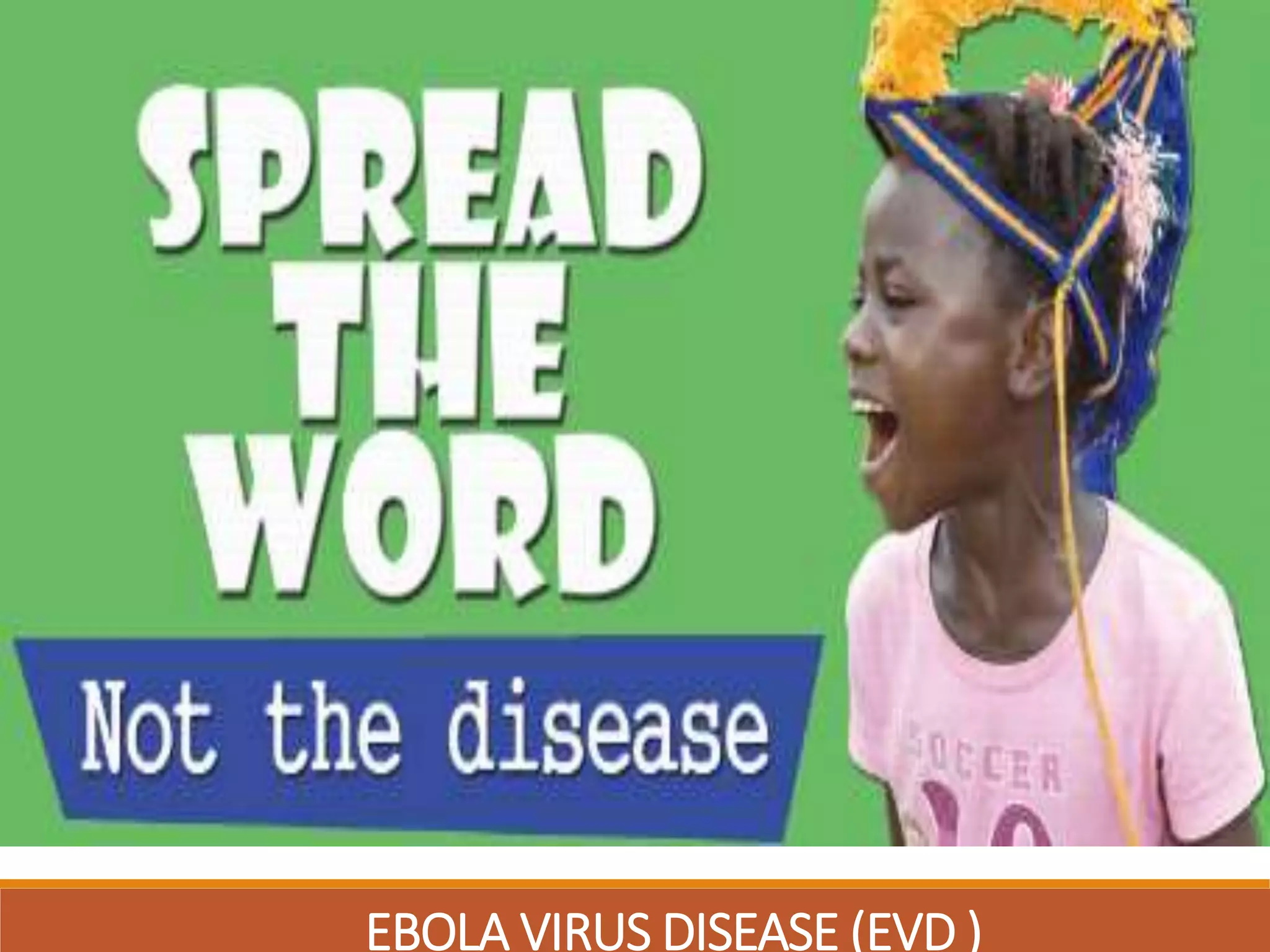
EBOLA VIRUS DISEASE (EVD )
12 AUGUST
2014
Outline
Definition of terms
Brief history
Causative organism/Reservoir of
infection
Mode of transmission
Signs and symptoms
Current update
Prevention and Control
Meaning of Acronyms
EVD - Ebola Virus Disease
EVHF - Ebola Viral Hemorrhagic Fever
VHF - Viral Hemorrhagic Fever
CFR – Rate (%) of death in those with a disease
PPE - Personal Protective Equipment
LGA- Local Government Authority
Definition of Terms
Incubation period – interval between entrance of an
infectious agent into the body and manifestation of signs
and symptoms of disease.
Reservoir of infection – organism in which an infectious
agent lives, multiplies and acts as source of infection.
Zoonotic infection – infection primarily of animals which is
transmissible to man.
Brief History
Ebola Virus Disease (EVD) also known as Ebola Viral
Haemorrhagic Fever (EVHF) first appeared in 1976 in two (2)
simultaneous outbreaks:
- in a village near Ebola River in Northern part of Zaire
(now emocratic Republic of Congo - DRC) from which the
disease derived its name.
- in a remote area of Sudan.
Other Viral Haemorrhagic Fevers (VHFs)
Other VHFs in the same group as EVD are:
- Yellow fever
- Lassa fever
- Dengue fever
- Marburg viral disease
Yellow fever and Dengue fever are transmitted by
mosquito.
Lassa fever is transmitted by a rat.
Causative Organism & Reservoir of Infection
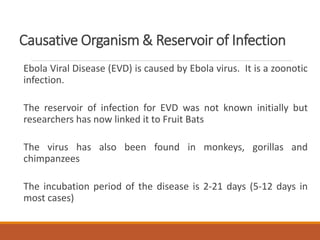
Ebola Viral Disease (EVD) is caused by Ebola virus. It is a zoonotic
infection.
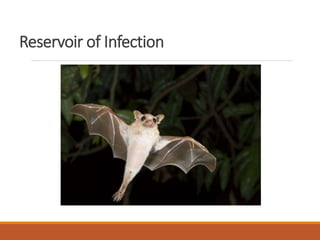
The reservoir of infection for EVD was not known initially but
researchers has now linked it to Fruit Bats
The virus has also been found in monkeys, gorillas and
chimpanzees
The incubation period of the disease is 2-21 days (5-12 days in
most cases)
Reservoir of Infection
Mode of Transmission
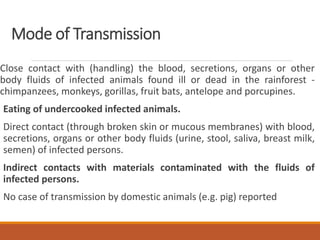
Close contact with (handling) the blood, secretions, organs or other
body fluids of infected animals found ill or dead in the rainforest -
chimpanzees, monkeys, gorillas, fruit bats, antelope and porcupines.
Eating of undercooked infected animals.
Direct contact (through broken skin or mucous membranes) with blood,
secretions, organs or other body fluids (urine, stool, saliva, breast milk,
semen) of infected persons.
Indirect contacts with materials contaminated with the fluids of
infected persons.
No case of transmission by domestic animals (e.g. pig) reported
Mode of Transmission
Direct contact with the body of deceased person
during burial ceremonies or autopsy.
Persons who have recovered from EVD can still
transmit the virus through sex for up to 7 weeks
after recovery.
Persons at most Risk
People in direct contact with infected persons –
family members, home caregivers, healthcare
workers.
Mourners who have direct contact with the
infected dead bodies.
Morticians – autopsy on infected corpse.
Hunters who have contact with dead animals in
the forest.
Signs and Symptoms
Early symptoms, which may be observed as early as 2 days from
exposure (average = 5-8 days) are similar to that of common
diseases (malaria, typhoid):
- Acute fever
- Generalized body pain and weakness, even joint pains
- Tiredness
- Sore throat
- Nausea
- Headache
- Difficulty in swallowing
Signs and Symptoms
Later symptoms may manifest as bleeding from different orifices or openings
in the body:
- Nose bleeding
- Vomiting of blood
- Bleeding into the eyes
- Stooling of blood
- Bleeding into the skin
- Bleeding from the ear
- In pregnant women, abortion (miscarriage) and heavy vaginal bleeding are
common.
Signs and Symptoms
Damage to the vital organs in the body especially the liver and the
kidney are possible complications of the disease.
Most cases may present in the health facilities when the late
symptoms of the disease are experienced – increased case fatality.
Hence, health workers need to have high index of suspicion to avoid
infection / development of the disease.
Death usually occurs during the second week - usually due to massive
blood loss.
Diagnosis
Ebola virus infections can be diagnosed in a
laboratory.
Current Update on EVD Outbreak W/Africa
Outbreak of 2014 is most challenging witnessed in Africa,
crossing Guinea, Liberia, Senegal, Sierra Leone and very recently
Nigeria.
The head doctor treating patients with Ebola in Sierra Leone,
virologist Sheik Umar Khan, has himself contracted the virus and
died.
An American doctor and health worker were recently evacuated
to USA from Liberia and are reported to be responding to
treatment (new drug).
Prevention– Personal & Environment Hygiene
The risk of infection can be reduced by observing high standard of
personal and environmental hygiene:
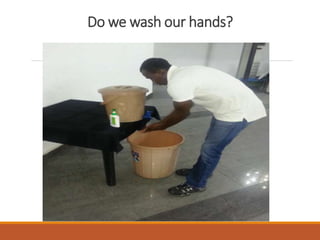
- Regular hand washing with soap and water, (sanitizer if soap and
water not available)
- Always wash your fruits and your vegetables before cooking.
- Avoid close contact with people who are sick or with
suspicious signs and places of outbreak.
- Do not touch patients, their secretions and body fluids
(blood, vomit, stool, urine, mucus secretion)
- Ensure that objects used by the sick are decontaminated and
properly disposed.
Do we wash our hands?
Prevention Personal & Environment Hygiene
-DO NOT wash, touch or kiss dead bodies – keep away.
-DO NOT wash hands in the same bucket as other who have
touched a dead body.
-Watch out for the warning signs which mimic malaria
symptoms.
-Isolation of patients with high index of suspicion.
-Health workers should observe universal safety precautions
when attending to all patients by use of PPE.
-Traditional burial rituals especially those requiring
touching, embalming of bodies are discouraged.
Prevention of EVD
- Avoid eating bush meat for now, especially bat &
monkey/baboon/ape & antelope.
- Continuous public health education and awareness on the disease
using multimedia including social media platforms (twitter, WhatsApp,)
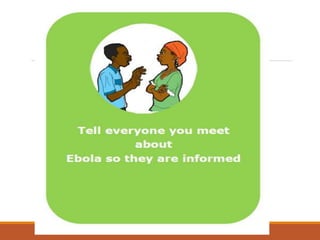
- Help spread the campaign
- Reporting and taking any suspected case to the nearest health facility
- Health facilities should immediately inform the
LGA health authorities and then Ministry of Health
- Ill persons to keep away from others so they don’t get sick
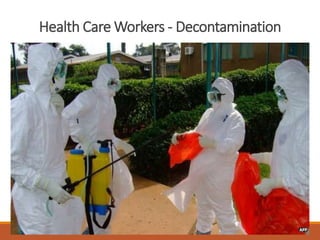
Health Care Workers - Decontamination
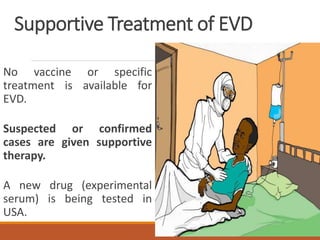
Supportive Treatment of EVD
No vaccine or specific
treatment is available for
EVD.
Suspected or confirmed
cases are given supportive
therapy.
A new drug (experimental
serum) is being tested in
USA.
Ebola Virus Disease 12 August 2014

Ebola Virus Disease 12 August 2014

  • 1.
    EBOLA VIRUS DISEASE(EVD ) 12 AUGUST 2014
  • 2.
    Outline Definition of terms Briefhistory Causative organism/Reservoir of infection Mode of transmission Signs and symptoms Current update Prevention and Control
  • 3.
    Meaning of Acronyms EVD- Ebola Virus Disease EVHF - Ebola Viral Hemorrhagic Fever VHF - Viral Hemorrhagic Fever CFR – Rate (%) of death in those with a disease PPE - Personal Protective Equipment LGA- Local Government Authority
  • 4.
    Definition of Terms Incubationperiod – interval between entrance of an infectious agent into the body and manifestation of signs and symptoms of disease. Reservoir of infection – organism in which an infectious agent lives, multiplies and acts as source of infection. Zoonotic infection – infection primarily of animals which is transmissible to man.
  • 5.
    Brief History Ebola VirusDisease (EVD) also known as Ebola Viral Haemorrhagic Fever (EVHF) first appeared in 1976 in two (2) simultaneous outbreaks: - in a village near Ebola River in Northern part of Zaire (now emocratic Republic of Congo - DRC) from which the disease derived its name. - in a remote area of Sudan.
  • 6.
    Other Viral HaemorrhagicFevers (VHFs) Other VHFs in the same group as EVD are: - Yellow fever - Lassa fever - Dengue fever - Marburg viral disease Yellow fever and Dengue fever are transmitted by mosquito. Lassa fever is transmitted by a rat.
  • 7.
    Causative Organism &Reservoir of Infection Ebola Viral Disease (EVD) is caused by Ebola virus. It is a zoonotic infection. The reservoir of infection for EVD was not known initially but researchers has now linked it to Fruit Bats The virus has also been found in monkeys, gorillas and chimpanzees The incubation period of the disease is 2-21 days (5-12 days in most cases)
  • 8.
  • 9.
    Mode of Transmission Closecontact with (handling) the blood, secretions, organs or other body fluids of infected animals found ill or dead in the rainforest - chimpanzees, monkeys, gorillas, fruit bats, antelope and porcupines. Eating of undercooked infected animals. Direct contact (through broken skin or mucous membranes) with blood, secretions, organs or other body fluids (urine, stool, saliva, breast milk, semen) of infected persons. Indirect contacts with materials contaminated with the fluids of infected persons. No case of transmission by domestic animals (e.g. pig) reported
  • 10.
    Mode of Transmission Directcontact with the body of deceased person during burial ceremonies or autopsy. Persons who have recovered from EVD can still transmit the virus through sex for up to 7 weeks after recovery.
  • 11.
    Persons at mostRisk People in direct contact with infected persons – family members, home caregivers, healthcare workers. Mourners who have direct contact with the infected dead bodies. Morticians – autopsy on infected corpse. Hunters who have contact with dead animals in the forest.
  • 12.
    Signs and Symptoms Earlysymptoms, which may be observed as early as 2 days from exposure (average = 5-8 days) are similar to that of common diseases (malaria, typhoid): - Acute fever - Generalized body pain and weakness, even joint pains - Tiredness - Sore throat - Nausea - Headache - Difficulty in swallowing
  • 13.
    Signs and Symptoms Latersymptoms may manifest as bleeding from different orifices or openings in the body: - Nose bleeding - Vomiting of blood - Bleeding into the eyes - Stooling of blood - Bleeding into the skin - Bleeding from the ear - In pregnant women, abortion (miscarriage) and heavy vaginal bleeding are common.
  • 14.
    Signs and Symptoms Damageto the vital organs in the body especially the liver and the kidney are possible complications of the disease. Most cases may present in the health facilities when the late symptoms of the disease are experienced – increased case fatality. Hence, health workers need to have high index of suspicion to avoid infection / development of the disease. Death usually occurs during the second week - usually due to massive blood loss.
  • 15.
    Diagnosis Ebola virus infectionscan be diagnosed in a laboratory.
  • 16.
    Current Update onEVD Outbreak W/Africa Outbreak of 2014 is most challenging witnessed in Africa, crossing Guinea, Liberia, Senegal, Sierra Leone and very recently Nigeria. The head doctor treating patients with Ebola in Sierra Leone, virologist Sheik Umar Khan, has himself contracted the virus and died. An American doctor and health worker were recently evacuated to USA from Liberia and are reported to be responding to treatment (new drug).
  • 17.
    Prevention– Personal &Environment Hygiene The risk of infection can be reduced by observing high standard of personal and environmental hygiene: - Regular hand washing with soap and water, (sanitizer if soap and water not available) - Always wash your fruits and your vegetables before cooking. - Avoid close contact with people who are sick or with suspicious signs and places of outbreak. - Do not touch patients, their secretions and body fluids (blood, vomit, stool, urine, mucus secretion) - Ensure that objects used by the sick are decontaminated and properly disposed.
  • 18.
    Do we washour hands?
  • 19.
    Prevention Personal &Environment Hygiene -DO NOT wash, touch or kiss dead bodies – keep away. -DO NOT wash hands in the same bucket as other who have touched a dead body. -Watch out for the warning signs which mimic malaria symptoms. -Isolation of patients with high index of suspicion. -Health workers should observe universal safety precautions when attending to all patients by use of PPE. -Traditional burial rituals especially those requiring touching, embalming of bodies are discouraged.
  • 20.
    Prevention of EVD -Avoid eating bush meat for now, especially bat & monkey/baboon/ape & antelope. - Continuous public health education and awareness on the disease using multimedia including social media platforms (twitter, WhatsApp,) - Help spread the campaign - Reporting and taking any suspected case to the nearest health facility - Health facilities should immediately inform the LGA health authorities and then Ministry of Health - Ill persons to keep away from others so they don’t get sick
  • 21.
    Health Care Workers- Decontamination
  • 22.
    Supportive Treatment ofEVD No vaccine or specific treatment is available for EVD. Suspected or confirmed cases are given supportive therapy. A new drug (experimental serum) is being tested in USA.