Health Systems in Transition
Republic of Korea Health
System Review
2
Authors:
Soonman Kwon
Tae-kin Lee
Chang-yup Kim
Editors:
Soonman Kwon
Health Systems in Transition: Republic of Korea
Health System Review
Suggested citation: Kwon S, Lee Tj, Kim Cy. Republic of Korea Health System Review. Vol.5 No.4. Manila: World Health
Organization, Regional Office for the Western Pacific, 2015.
 Republic of Korea: Socio-demographic profile
 Overview of health system
 Service delivery network
 Governance and administration
 Financing
 Major reforms
 Infrastructure
 Human resources
 Main findings
 Progress made
 Remaining challenges
 Future prospects
3
Presentation outline:
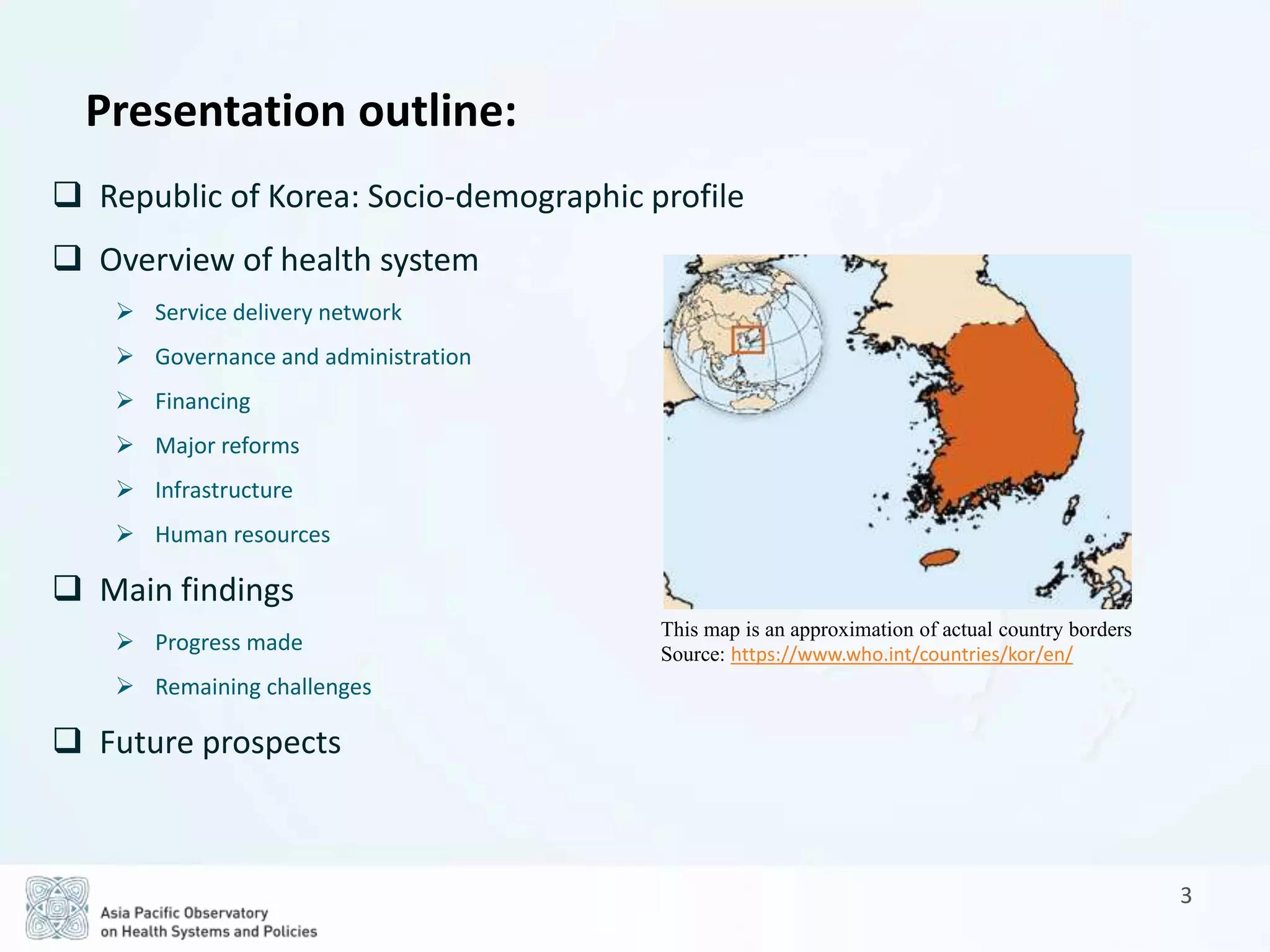
This map is an approximation of actual country borders
Source: https://www.who.int/countries/kor/en/
4
Socio-demographic profile
Area 97,265 sq. km
Population • 49.8 Million (2011)
• 83% Urban population
• 1.24 TFR (2011)
Life expectancy at
birth m/f
77.7/84.5 (2011)
GDP per capita: USD 29,786 (PPP, 2011)
HDI 22
Expenditure on
health % GDP
7.4 (2011)
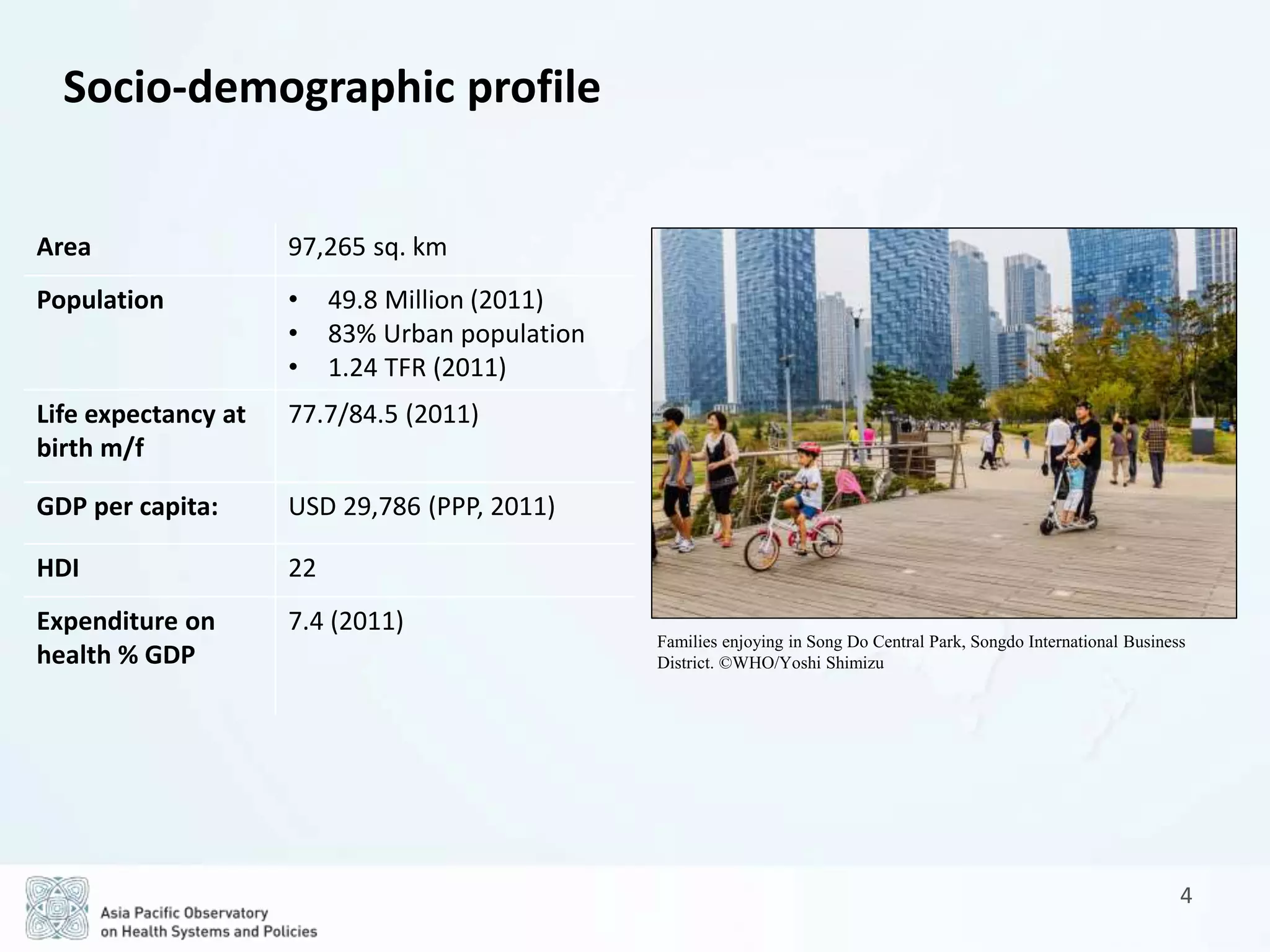
Families enjoying in Song Do Central Park, Songdo International Business
District. ©WHO/Yoshi Shimizu
5
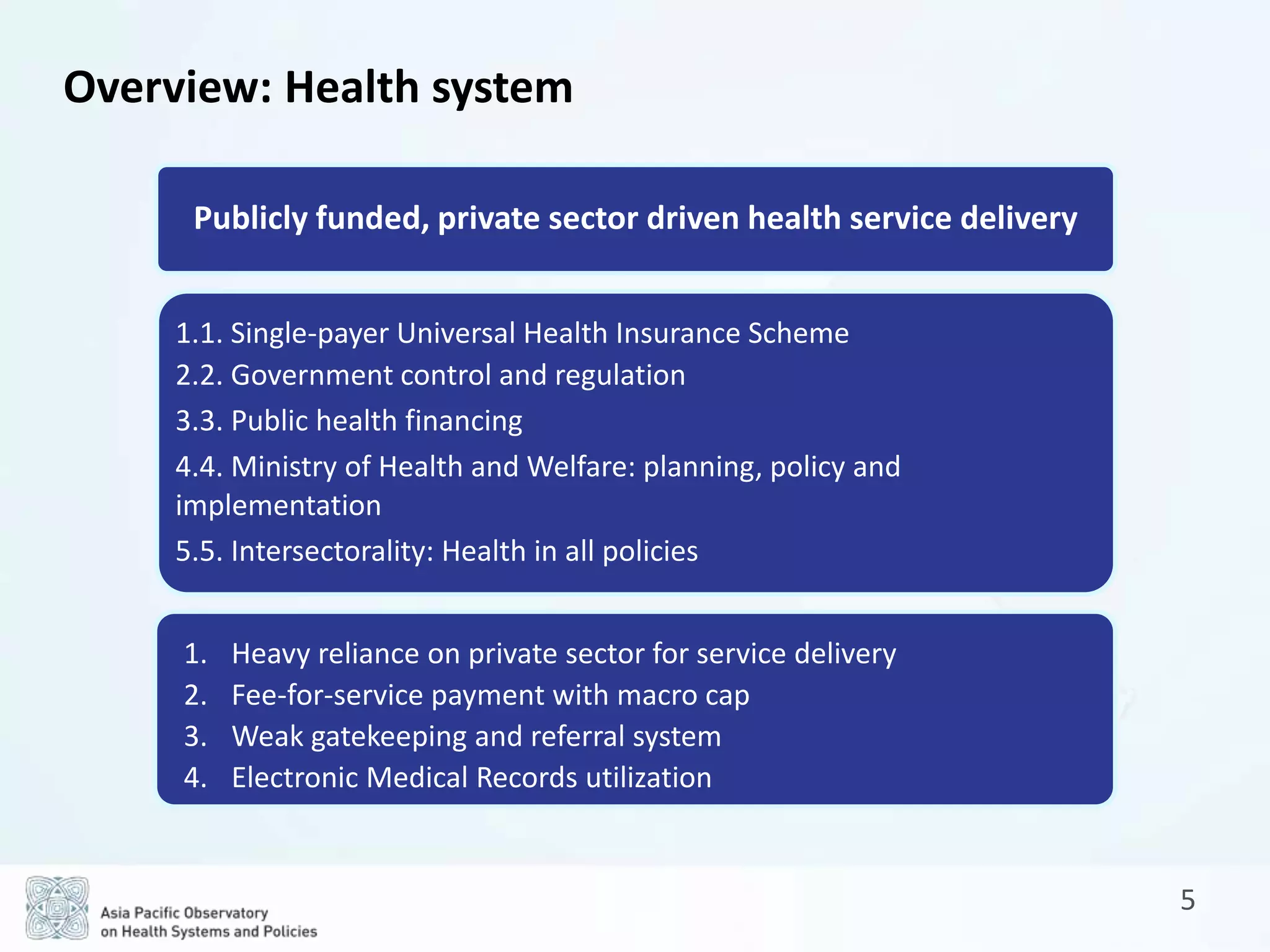
Publicly funded, private sector driven health service delivery
1.1. Single-payer Universal Health Insurance Scheme
2.2. Government control and regulation
3.3. Public health financing
4.4. Ministry of Health and Welfare: planning, policy and
implementation
5.5. Intersectorality: Health in all policies
Overview: Health system
1. Heavy reliance on private sector for service delivery
2. Fee-for-service payment with macro cap
3. Weak gatekeeping and referral system
4. Electronic Medical Records utilization
Overview: Service delivery
6
• Private sector dominated health-care delivery system
• Patient pathways: weak gatekeeping
• Inpatient care: Most inpatient care provided by hospitals.
‘Big 5’ hospitals receive 1/3 of receipts (NHI payments)
• Some clinics have inpatient beds while all hospitals have
outpatient care
• Length of stay (inpatient) higher than OECD nations
• Outpatient care: Primary and secondary health care levels
not well differentiated
• Outpatient visits are almost double the OECD average
Private sector
delivery
Weak gatekeeping
Low differentiation
between levels of
care
7
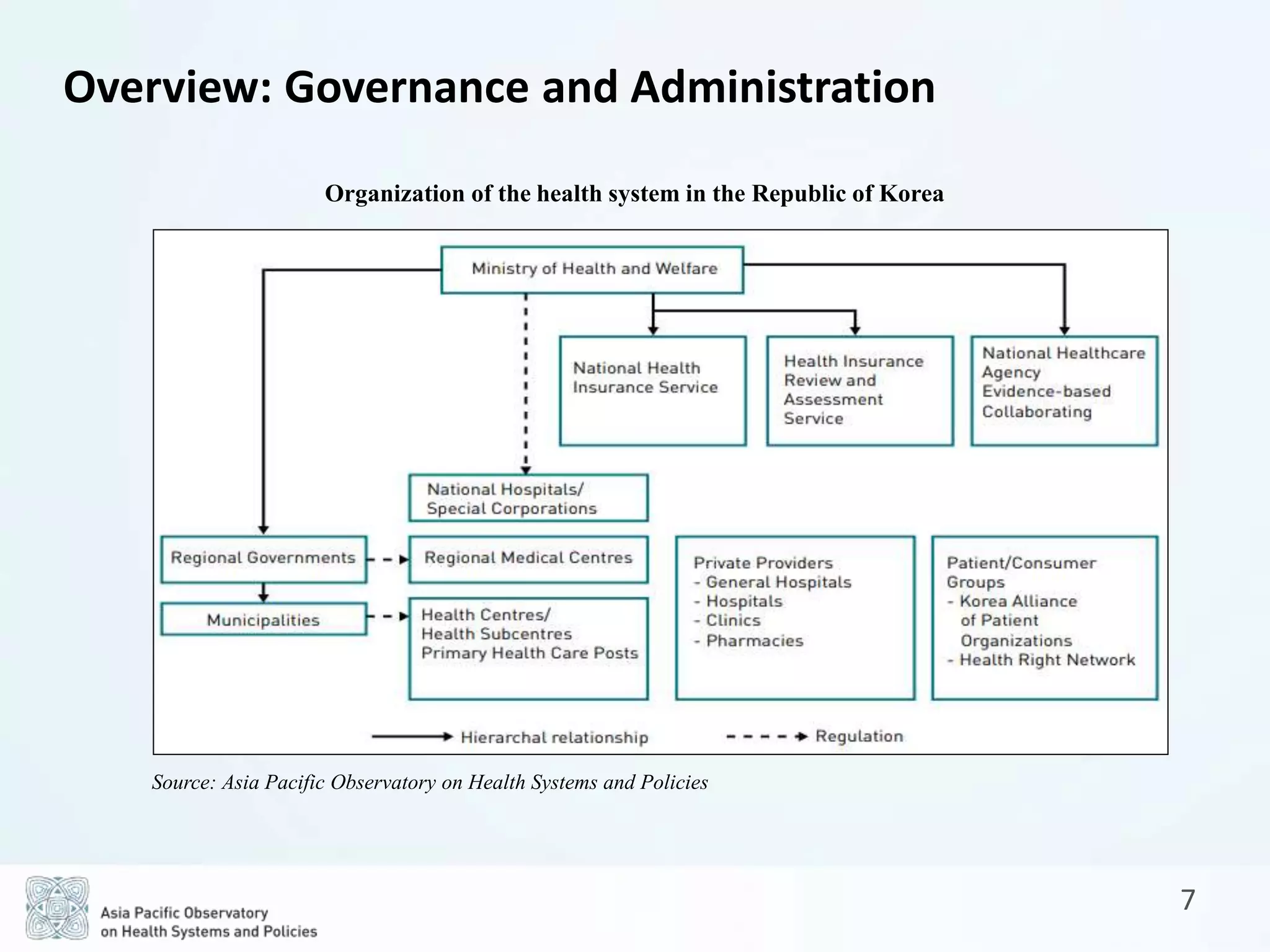
Overview: Governance and Administration
Organization of the health system in the Republic of Korea
Source: Asia Pacific Observatory on Health Systems and Policies
8
Overview: Health Financing
Source: MOHW, 2013a
Financial Flows
• THE doubled from 3.7% in 1995 to
7.4% 2012
• Coverage:
• 97% National Health Insurance
• 3% Tax-funded Medical Aid
Program (targeting low-income
citizens)
9
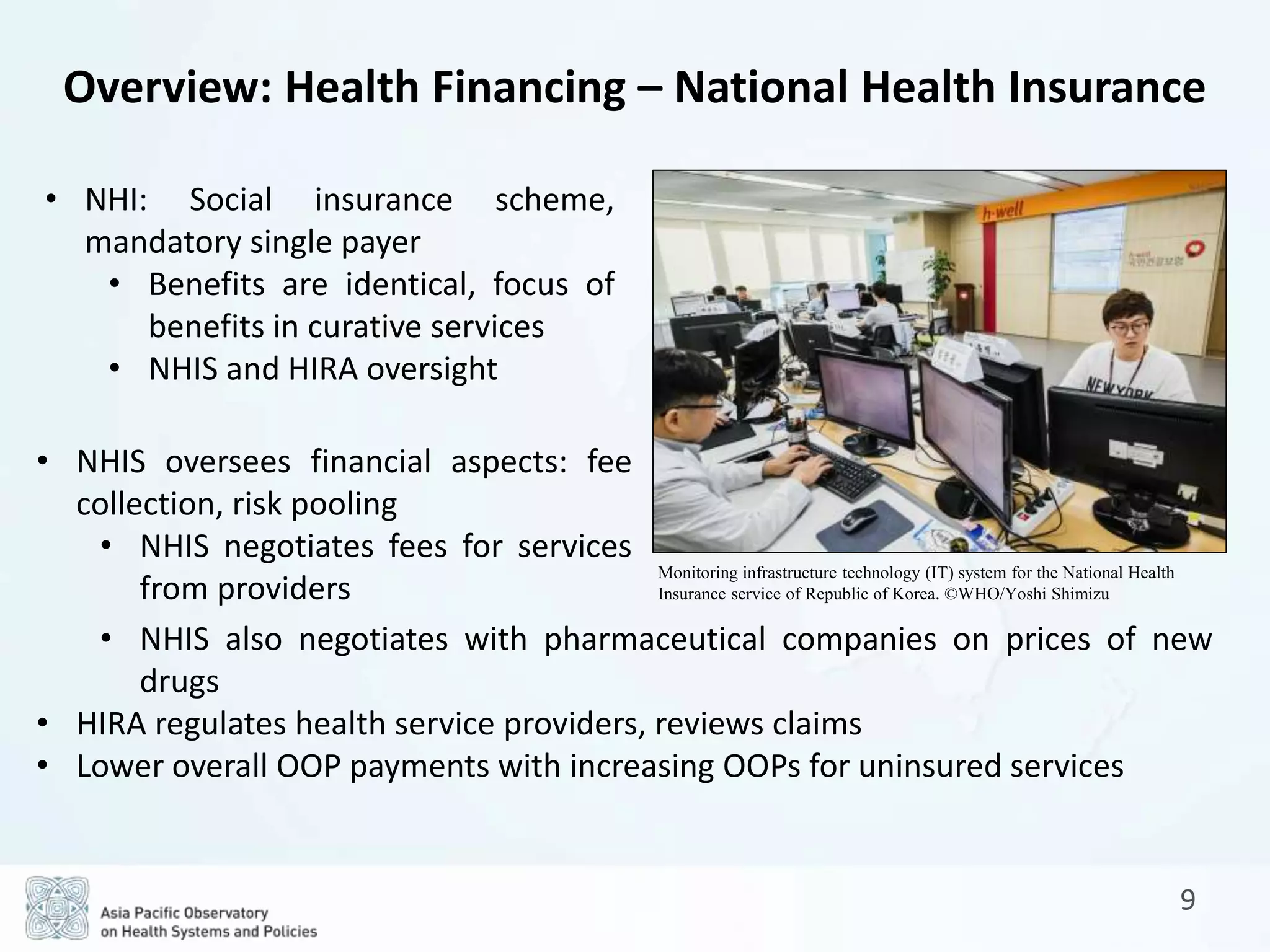
Overview: Health Financing – National Health Insurance
• NHI: Social insurance scheme,
mandatory single payer
• Benefits are identical, focus of
benefits in curative services
• NHIS and HIRA oversight
• NHIS oversees financial aspects: fee
collection, risk pooling
• NHIS negotiates fees for services
from providers
• NHIS also negotiates with pharmaceutical companies on prices of new
drugs
• HIRA regulates health service providers, reviews claims
• Lower overall OOP payments with increasing OOPs for uninsured services
Monitoring infrastructure technology (IT) system for the National Health
Insurance service of Republic of Korea. ©WHO/Yoshi Shimizu
10
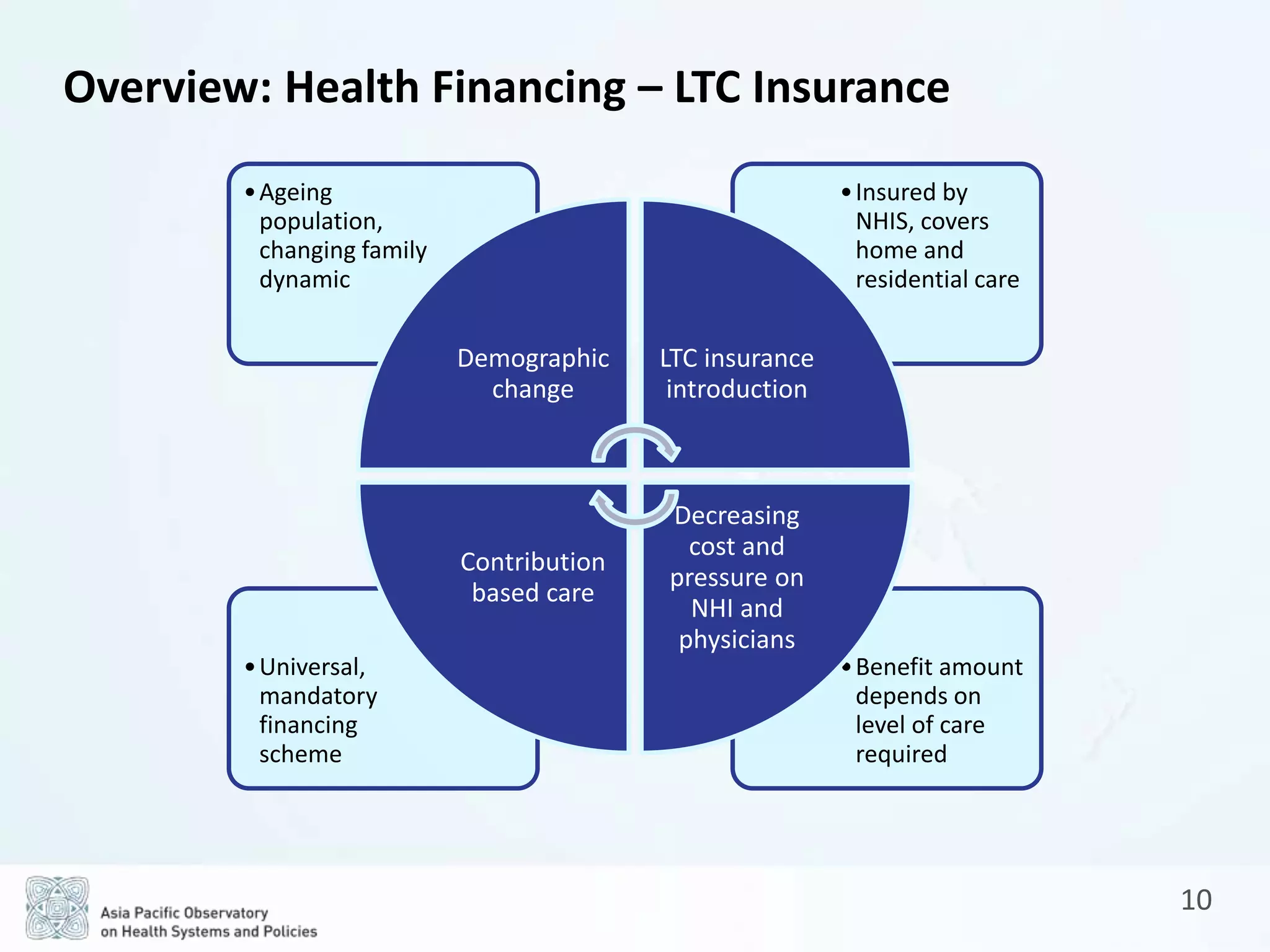
Overview: Health Financing – LTC Insurance
•Benefit amount
depends on
level of care
required
•Universal,
mandatory
financing
scheme
•Insured by
NHIS, covers
home and
residential care
•Ageing
population,
changing family
dynamic
Demographic
change
LTC insurance
introduction
Decreasing
cost and
pressure on
NHI and
physicians
Contribution
based care
Overview: Major reforms
11
Timeline:
• 1977 – Social health insurance introduced
• 1989 – Universal health coverage achieved
• 2000 – Single payer health insurance scheme
• 2000 – Separation of medicine prescribing and dispensing
• 2000s – Macro-cap on OOP payments introduced
• 2006 – Pharmaceutical cost containment
• 2008 – Long-term care introduced for the elderly
Self generating electricity bike in Haenggu Lake Park.
©WHO/Yoshi Shimizu
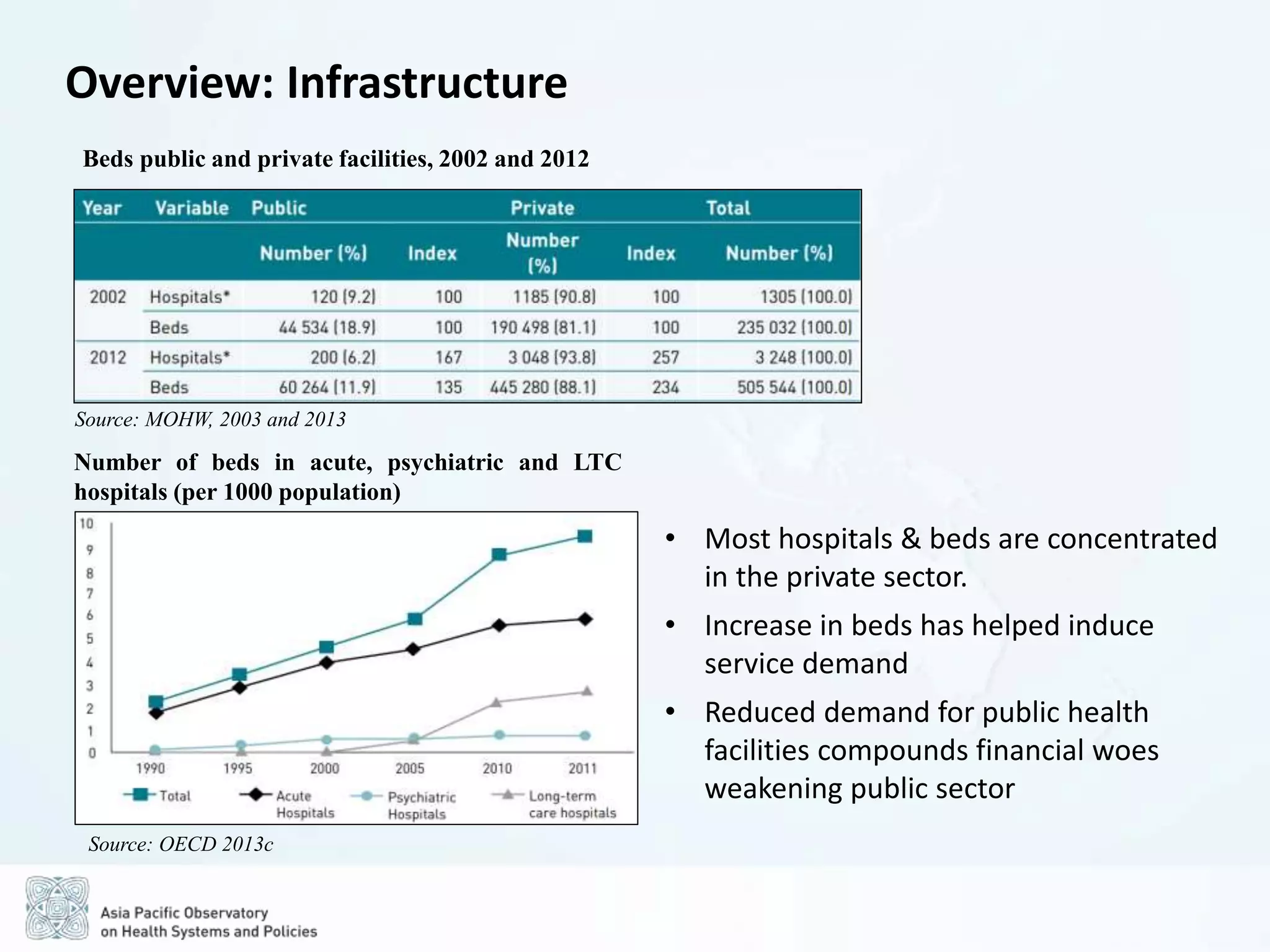
Overview: Infrastructure
Beds public and private facilities, 2002 and 2012
Source: MOHW, 2003 and 2013
Number of beds in acute, psychiatric and LTC
hospitals (per 1000 population)
• Most hospitals & beds are concentrated
in the private sector.
• Increase in beds has helped induce
service demand
• Reduced demand for public health
facilities compounds financial woes
weakening public sector
Source: OECD 2013c
Overview: Human resources for Health
Distribution of health workforce in primary care and hospitals, 2012
Source: MOHW, 2013c
• Doctor and nurse numbers < OECD average
• Low nurse employment due to cost cutting in hospitals
• Nursing aides have substituted nurses in primary care
• Lower levels of doctors and nurses in non-metropolitan areas exacerbates health needs
14
Achievements and progress made: Health status
High life expectancy compared to regional
neighbours
Communicable diseases have declined significantly
National Cancer screening program
Clear improvement in child mortality
Have
requested
for an image
15
Informs evidence-based policy
EMR and cost reimbursement
Outreach services
• Electronic data for evidence-based policy
• NHIS and HIRA have analysis and feedback measures to ensure
needs are met
• Rapid private sector adoption, slow public health facility adoption
• All public health centres and most private providers have adopted
health information systems including EMR
• essential due to weak gatekeeping
• U-health-care telehealth pilot project: for remote patients, elderly
and chronic disease
Achievements & progress: Health Information Systems
Achievements and progress made: Quality of care
 Information asymmetry: HIRA regulations
ensures greater understanding and choice on
health provider, pharmaceuticals
 Facilitation of medical disputes: Decreases
asymmetry of information, empowers
patients
 Freedom of choice to choose health service
provider
 Public participation: Direct citizen input into
health system decision making
16
Information
Care
Outcome
17
Achievements & progress: Medical equipment
23.5 19.6
37.1
129.3
0
20
40
60
80
100
120
140
Per 1 million population Utilization (per 1000 population)
MRI units CT scanners
Source: OECD, 2013c
• Basic medical equipment,
including MRI and CT
scanners easily accessible
• MRI and CT prevalence well
above OECD average
• Easy access to technology
facilitated due to lack of
regulation and oversight
MRI and CT scanner prevalence and utilization
18
Remaining challenges: Mortality and morbidity
Ten major causes of death by gender, 2012
Source: KOSIS, 2013
• High NCD mortality rate
• Steady increase in rate of high-risk drinking, obesity, hypertension, diabetes
• Decline in physical activity
• Consequences: Higher expected burden of NCDs on the health system in future
19
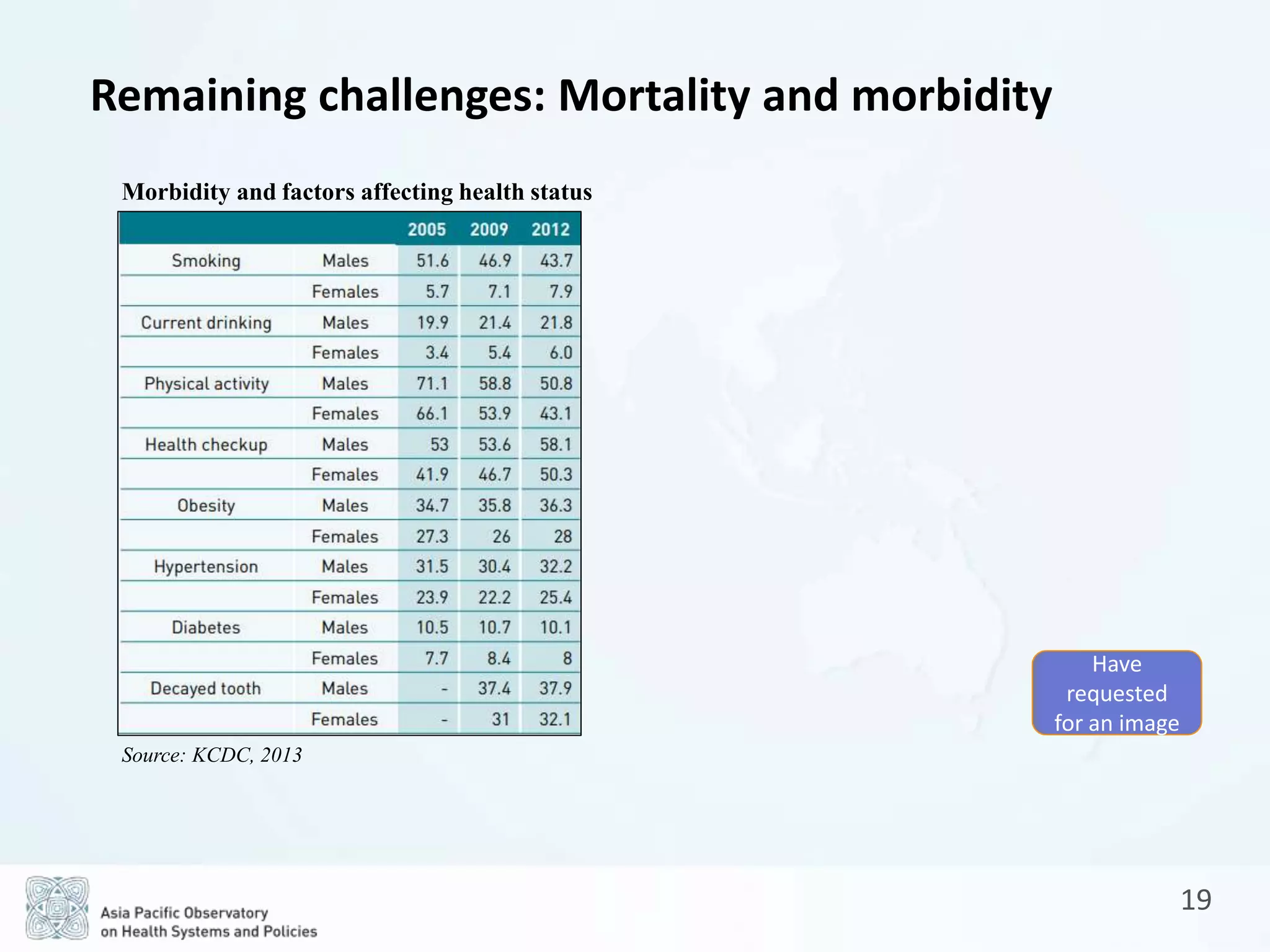
Remaining challenges: Mortality and morbidity
Morbidity and factors affecting health status
Source: KCDC, 2013
Have
requested
for an image
20
Remaining challenges: Technology
Rising OOP
Collaborative
Review
Committee
Private sector
driven
demand
Minimal
regulation
• Private sector able to make high-tech
purchases freely
• Purchases made for unregulated tech
to enable independent cost setting
• A multi-stakeholder review committee
in place to measure cost-effectiveness
of new tech
• Yet, OOP payments are rising for
uninsured services, mostly for new
technologies
NHIS and HIRA regulated indirectly by MOHW
Appointment of NHIS and HIRA leadership, health insurance policy and
implementation run by MOHW
Government reversal in face of criticism in implementing and
enforcing health service accreditation program
9.3% participation rate
Little to no restriction on capital investment
Lack of alignment on not-for-profits facilitates capacity to enter for-
profit business ventures
Non-financial regulation over voluntary health insurance not in place
Indirectly precludes higher risk consumers from accessing benefits
21
Remaining challenges: Regulation
22
Remaining challenges: Heavy reliance on private sector
NHI-designated
and regulated
Collaboration to
address health
needs possible
Demand
inducement
Profits over
public health
Urban-rural
disparity
Positive
Negative
• Private sector dominates the
health service delivery landscape
• Tends to operate outside of
existing regulations to reap profits
of new high-tech care services and
medicines
• Decrease in demand in public
mirrors a rise in demand for
private health care
23
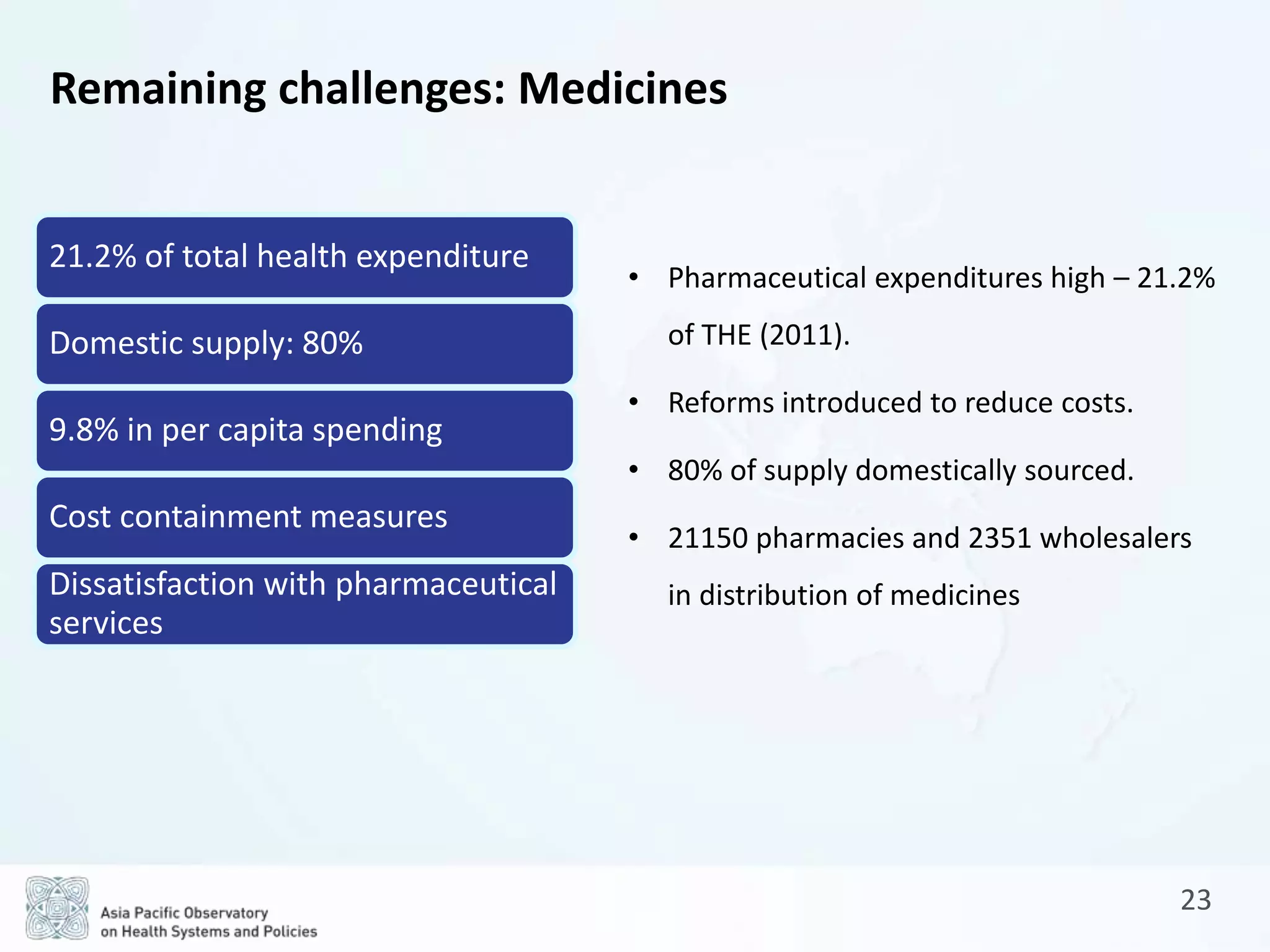
Remaining challenges: Medicines
• Pharmaceutical expenditures high – 21.2%
of THE (2011).
• Reforms introduced to reduce costs.
• 80% of supply domestically sourced.
• 21150 pharmacies and 2351 wholesalers
in distribution of medicines
21.2% of total health expenditure
Domestic supply: 80%
9.8% in per capita spending
Cost containment measures
Dissatisfaction with pharmaceutical
services
Remaining challenges: OOP payments
24
User charges for health services
Source: NHIS, 2014
 OOP payments threaten NHI
sustainability contributing to 35% of THE
 Proportion of households with high OOP
payments increased after the year 2000
 Can be exploited for unregulated
practices and medicines increasing OOPs
 Protective mechanisms introduced to
decrease rates of impoverishment
 User dissatisfaction survey: high costs
and economic vulnerability are main
concerns with health system
25
Future prospects: Republic of Korea
Government leadership: managing stakeholder interests to
ensure reform
Reduce health inequities
Greater coordination: Social Health Insurance and LTC
insurance
Further cost containment of pharmaceuticals
Extension of prospective case-based payment
26
Based on the Health Systems in Transition
Republic of Korea Health Systems Review, 2015
http://www.searo.who.int/entity/asia_pacific_observatory/publications/hits/hit_korea/en/
Access full publication at:
THANK YOU

APO Korea Health System Review (Health in Transition)

  • 1.
    Health Systems inTransition Republic of Korea Health System Review
  • 2.
    2 Authors: Soonman Kwon Tae-kin Lee Chang-yupKim Editors: Soonman Kwon Health Systems in Transition: Republic of Korea Health System Review Suggested citation: Kwon S, Lee Tj, Kim Cy. Republic of Korea Health System Review. Vol.5 No.4. Manila: World Health Organization, Regional Office for the Western Pacific, 2015.
  • 3.
     Republic ofKorea: Socio-demographic profile  Overview of health system  Service delivery network  Governance and administration  Financing  Major reforms  Infrastructure  Human resources  Main findings  Progress made  Remaining challenges  Future prospects 3 Presentation outline: This map is an approximation of actual country borders Source: https://www.who.int/countries/kor/en/
  • 4.
    4 Socio-demographic profile Area 97,265sq. km Population • 49.8 Million (2011) • 83% Urban population • 1.24 TFR (2011) Life expectancy at birth m/f 77.7/84.5 (2011) GDP per capita: USD 29,786 (PPP, 2011) HDI 22 Expenditure on health % GDP 7.4 (2011) Families enjoying in Song Do Central Park, Songdo International Business District. ©WHO/Yoshi Shimizu
  • 5.
    5 Publicly funded, privatesector driven health service delivery 1.1. Single-payer Universal Health Insurance Scheme 2.2. Government control and regulation 3.3. Public health financing 4.4. Ministry of Health and Welfare: planning, policy and implementation 5.5. Intersectorality: Health in all policies Overview: Health system 1. Heavy reliance on private sector for service delivery 2. Fee-for-service payment with macro cap 3. Weak gatekeeping and referral system 4. Electronic Medical Records utilization
  • 6.
    Overview: Service delivery 6 •Private sector dominated health-care delivery system • Patient pathways: weak gatekeeping • Inpatient care: Most inpatient care provided by hospitals. ‘Big 5’ hospitals receive 1/3 of receipts (NHI payments) • Some clinics have inpatient beds while all hospitals have outpatient care • Length of stay (inpatient) higher than OECD nations • Outpatient care: Primary and secondary health care levels not well differentiated • Outpatient visits are almost double the OECD average Private sector delivery Weak gatekeeping Low differentiation between levels of care
  • 7.
    7 Overview: Governance andAdministration Organization of the health system in the Republic of Korea Source: Asia Pacific Observatory on Health Systems and Policies
  • 8.
    8 Overview: Health Financing Source:MOHW, 2013a Financial Flows • THE doubled from 3.7% in 1995 to 7.4% 2012 • Coverage: • 97% National Health Insurance • 3% Tax-funded Medical Aid Program (targeting low-income citizens)
  • 9.
    9 Overview: Health Financing– National Health Insurance • NHI: Social insurance scheme, mandatory single payer • Benefits are identical, focus of benefits in curative services • NHIS and HIRA oversight • NHIS oversees financial aspects: fee collection, risk pooling • NHIS negotiates fees for services from providers • NHIS also negotiates with pharmaceutical companies on prices of new drugs • HIRA regulates health service providers, reviews claims • Lower overall OOP payments with increasing OOPs for uninsured services Monitoring infrastructure technology (IT) system for the National Health Insurance service of Republic of Korea. ©WHO/Yoshi Shimizu
  • 10.
    10 Overview: Health Financing– LTC Insurance •Benefit amount depends on level of care required •Universal, mandatory financing scheme •Insured by NHIS, covers home and residential care •Ageing population, changing family dynamic Demographic change LTC insurance introduction Decreasing cost and pressure on NHI and physicians Contribution based care
  • 11.
    Overview: Major reforms 11 Timeline: •1977 – Social health insurance introduced • 1989 – Universal health coverage achieved • 2000 – Single payer health insurance scheme • 2000 – Separation of medicine prescribing and dispensing • 2000s – Macro-cap on OOP payments introduced • 2006 – Pharmaceutical cost containment • 2008 – Long-term care introduced for the elderly Self generating electricity bike in Haenggu Lake Park. ©WHO/Yoshi Shimizu
  • 12.
    Overview: Infrastructure Beds publicand private facilities, 2002 and 2012 Source: MOHW, 2003 and 2013 Number of beds in acute, psychiatric and LTC hospitals (per 1000 population) • Most hospitals & beds are concentrated in the private sector. • Increase in beds has helped induce service demand • Reduced demand for public health facilities compounds financial woes weakening public sector Source: OECD 2013c
  • 13.
    Overview: Human resourcesfor Health Distribution of health workforce in primary care and hospitals, 2012 Source: MOHW, 2013c • Doctor and nurse numbers < OECD average • Low nurse employment due to cost cutting in hospitals • Nursing aides have substituted nurses in primary care • Lower levels of doctors and nurses in non-metropolitan areas exacerbates health needs
  • 14.
    14 Achievements and progressmade: Health status High life expectancy compared to regional neighbours Communicable diseases have declined significantly National Cancer screening program Clear improvement in child mortality Have requested for an image
  • 15.
    15 Informs evidence-based policy EMRand cost reimbursement Outreach services • Electronic data for evidence-based policy • NHIS and HIRA have analysis and feedback measures to ensure needs are met • Rapid private sector adoption, slow public health facility adoption • All public health centres and most private providers have adopted health information systems including EMR • essential due to weak gatekeeping • U-health-care telehealth pilot project: for remote patients, elderly and chronic disease Achievements & progress: Health Information Systems
  • 16.
    Achievements and progressmade: Quality of care  Information asymmetry: HIRA regulations ensures greater understanding and choice on health provider, pharmaceuticals  Facilitation of medical disputes: Decreases asymmetry of information, empowers patients  Freedom of choice to choose health service provider  Public participation: Direct citizen input into health system decision making 16 Information Care Outcome
  • 17.
    17 Achievements & progress:Medical equipment 23.5 19.6 37.1 129.3 0 20 40 60 80 100 120 140 Per 1 million population Utilization (per 1000 population) MRI units CT scanners Source: OECD, 2013c • Basic medical equipment, including MRI and CT scanners easily accessible • MRI and CT prevalence well above OECD average • Easy access to technology facilitated due to lack of regulation and oversight MRI and CT scanner prevalence and utilization
  • 18.
    18 Remaining challenges: Mortalityand morbidity Ten major causes of death by gender, 2012 Source: KOSIS, 2013 • High NCD mortality rate • Steady increase in rate of high-risk drinking, obesity, hypertension, diabetes • Decline in physical activity • Consequences: Higher expected burden of NCDs on the health system in future
  • 19.
    19 Remaining challenges: Mortalityand morbidity Morbidity and factors affecting health status Source: KCDC, 2013 Have requested for an image
  • 20.
    20 Remaining challenges: Technology RisingOOP Collaborative Review Committee Private sector driven demand Minimal regulation • Private sector able to make high-tech purchases freely • Purchases made for unregulated tech to enable independent cost setting • A multi-stakeholder review committee in place to measure cost-effectiveness of new tech • Yet, OOP payments are rising for uninsured services, mostly for new technologies
  • 21.
    NHIS and HIRAregulated indirectly by MOHW Appointment of NHIS and HIRA leadership, health insurance policy and implementation run by MOHW Government reversal in face of criticism in implementing and enforcing health service accreditation program 9.3% participation rate Little to no restriction on capital investment Lack of alignment on not-for-profits facilitates capacity to enter for- profit business ventures Non-financial regulation over voluntary health insurance not in place Indirectly precludes higher risk consumers from accessing benefits 21 Remaining challenges: Regulation
  • 22.
    22 Remaining challenges: Heavyreliance on private sector NHI-designated and regulated Collaboration to address health needs possible Demand inducement Profits over public health Urban-rural disparity Positive Negative • Private sector dominates the health service delivery landscape • Tends to operate outside of existing regulations to reap profits of new high-tech care services and medicines • Decrease in demand in public mirrors a rise in demand for private health care
  • 23.
    23 Remaining challenges: Medicines •Pharmaceutical expenditures high – 21.2% of THE (2011). • Reforms introduced to reduce costs. • 80% of supply domestically sourced. • 21150 pharmacies and 2351 wholesalers in distribution of medicines 21.2% of total health expenditure Domestic supply: 80% 9.8% in per capita spending Cost containment measures Dissatisfaction with pharmaceutical services
  • 24.
    Remaining challenges: OOPpayments 24 User charges for health services Source: NHIS, 2014  OOP payments threaten NHI sustainability contributing to 35% of THE  Proportion of households with high OOP payments increased after the year 2000  Can be exploited for unregulated practices and medicines increasing OOPs  Protective mechanisms introduced to decrease rates of impoverishment  User dissatisfaction survey: high costs and economic vulnerability are main concerns with health system
  • 25.
    25 Future prospects: Republicof Korea Government leadership: managing stakeholder interests to ensure reform Reduce health inequities Greater coordination: Social Health Insurance and LTC insurance Further cost containment of pharmaceuticals Extension of prospective case-based payment
  • 26.
    26 Based on theHealth Systems in Transition Republic of Korea Health Systems Review, 2015
  • 27.