



trends that are reshaping
Information
Technology (IT)
It’s a well-known fact that
information technology is changing.
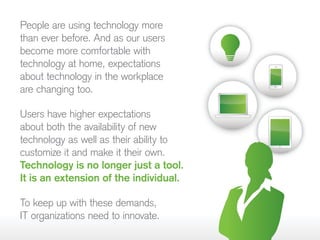
People are using technology more
than ever before. And as our users
become more comfortable with
technology at home, expectations
about technology in the workplace
are changing too.
Users have higher expectations
about both the availability of new
technology as well as their ability to
customize it and make it their own.
Technology is no longer just a tool.
It is an extension of the individual.
To keep up with these demands,
IT organizations need to innovate.
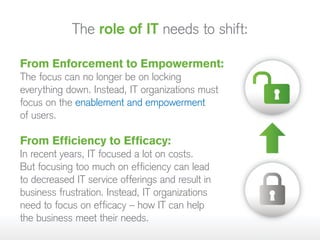
The role of IT needs to shift:
From Enforcement to Empowerment:
The focus can no longer be on locking
everything down. Instead, IT organizations must
focus on the enablement and empowerment
of users.
From Efficiency to Efficacy:
In recent years, IT focused a lot on costs.
But focusing too much on efficiency can lead
to decreased IT service offerings and result in
business frustration. Instead, IT organizations
need to focus on efficacy – how IT can help
the business meet their needs.
And to make a difficult situation even worse,
IT needs to respond to these changes
at the very same time that IT budgets
are declining and there are significant
fundamental technological changes underway.
But amidst all this change,
one thing remains the same:
BI and analytics continue to be a priority
for the business. In fact, the desire to use data
in every day decision making is extending
beyond traditional data driven roles such as
finance and marketing. More and more users
are recognizing that they, too, can benefit
from data driven decision making.
So how does IT ensure that they are
empowering their users with the tools
they need to naturally explore data, ask the
next question, and uncover the insight they
need to make informed decisions?
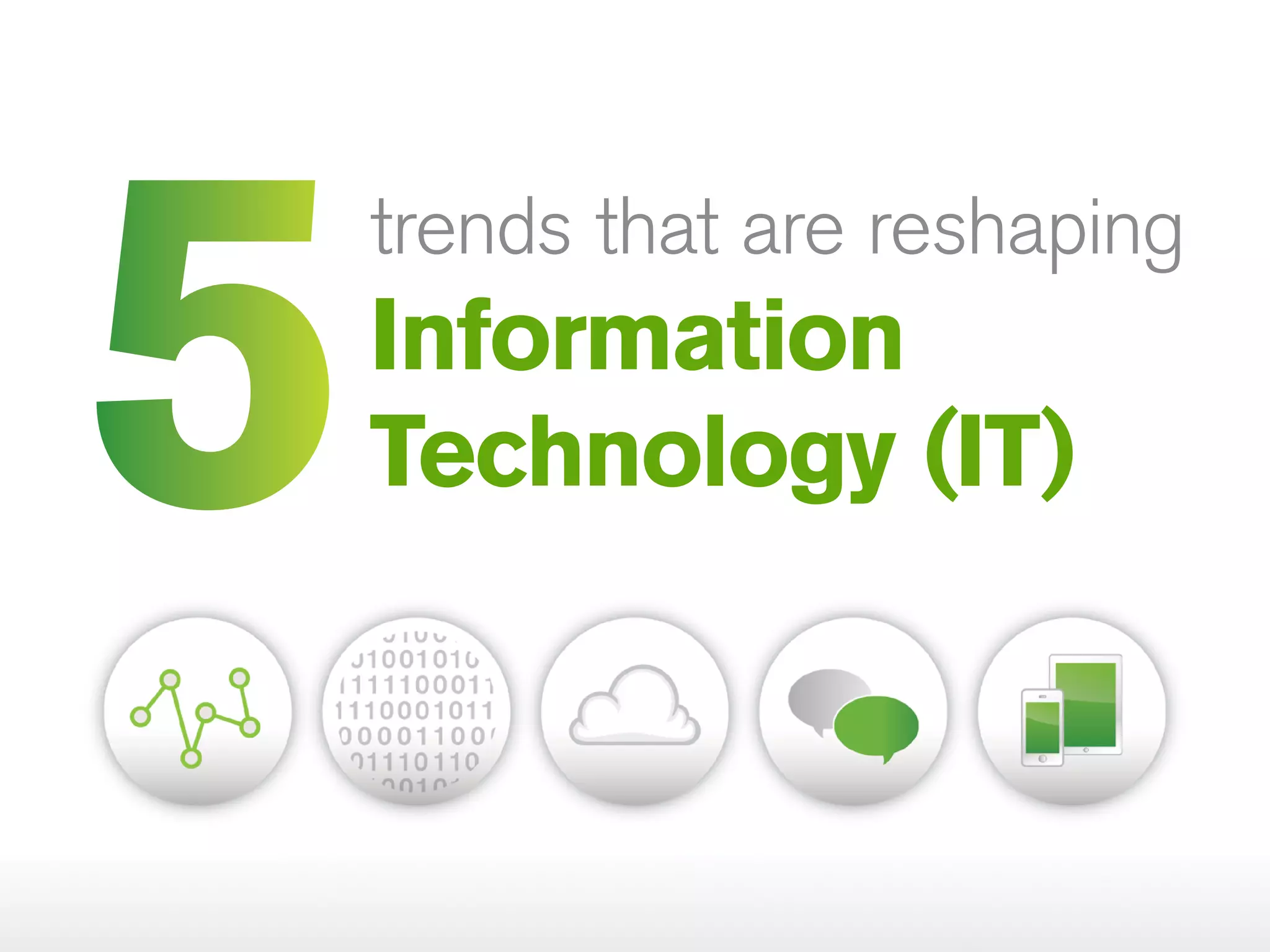
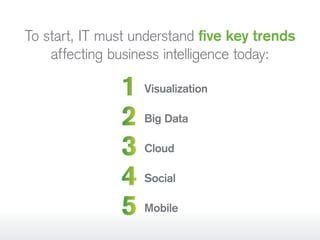
1 Visualization
2 Big Data
3 Cloud
4 Social
5 Mobile
To start, IT must understand five key trends
affecting business intelligence today:
Visualization
1
Data visualizations are a powerful tool
because they take advantage of innate human
capabilities to explore and process complex
information. Used the right way, data visualizations
offer the ability to intelligently summarize
information and convey new meaning in data.
But adding visualizations to
existing BI isn’t enough. How the
business uses visualizations is just as
important. Many visualizations look
good, but lack meaning. Or worse,
they mislead the user to an incorrect
conclusion. To derive deep insights,
users need to be able to interact and
explore their visualizations to better
understand their data.
Big Data
2
Big data is not interesting because it is BIG.
The toolsets to manage and process large
amounts of data are maturing rapidly.
What is interesting is that we are at a time in
history when we can know almost anything
on any topic. So, the question about big data
becomes one of innovation. What are we
going to do with this wealth of information?
In today’s digital world,
understanding the data means
understanding the business.
So, in order to answer that question
of what to do, organizations need
more users looking at their business
data, both big and small; asking more
questions; and deriving more insight.
This is critical because the real power
of data doesn’t come from the data
alone. It comes from the combination
of data with human expertise and
intuition. It is the power of informed
intuition that drives real innovation.
Cloud
3
Cloud can refer to a lot different things:
PaaS, IaaS, SaaS, etc. But at the core, what
cloud really means is that components of the
IT infrastructure – from the data center to
the software itself – can be managed and
supported by someone else.
There are a number of reasons why companies
choose to pursue cloud offerings:
Low cost of entry:
You can get started with a project with minimal
up-front investment.
Flexibility and agility:
You can contract and expand your service as you need it.
Value differentiation:
You can focus your energy on the services that are true
differentiators rather than keep-the-lights-on activities.
1
2
3
When it comes to business intelligence, cloud
requires some special considerations:
Security & Compliance:
It is critical to ensure that any cloud implementation
protects your organization’s most valuable technology
asset – your data.
Cost:
The cost of storing and processing data is only a part of
the story. You need to keep in mind the cost in terms of
time, money, and performance for moving data between
data center locations.
1
2
Social
4
Social doesn’t mean chatting. And it is much
more than just sharing the latest news on
Facebook and Twitter. Social is about how
technology can support collaboration
even as work groups become more
geographically dispersed.
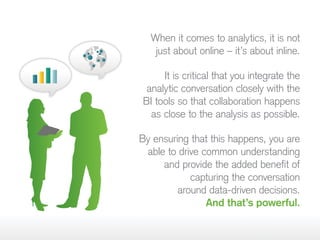
When it comes to analytics, it is not
just about online – it’s about inline.
It is critical that you integrate the
analytic conversation closely with the
BI tools so that collaboration happens
as close to the analysis as possible.
By ensuring that this happens, you are
able to drive common understanding
and provide the added benefit of
capturing the conversation
around data-driven decisions.
And that’s powerful.
Mobile
5
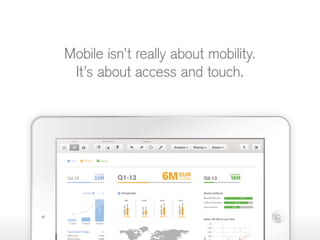
Mobile isn’t really about mobility.
It’s about access and touch.
These days, many people carry some kind
of connected device on them at all times,
and given mobile usage growth trends,
that is unlikely to change. This means that
you can answer any question, anytime,
anywhere. And the touch experience
encourages immersion and exploration.
When we use touch, we explore
and learn. When we use a keyboard,
we create and input.
With mobile, we provide a new, immersive
way to explore data anytime, anywhere.
And that engages users and promotes
stronger BI adoption.
So how do you balance trends in the
BI industry with increasing pressure to give
every user access to the data they need,
when they need it?
The answer is
self-service visual data discovery.
Self-service visual data discovery is nimble,
straightforward, mobile, and for everyone.
• It provides less of a burden on short-staffed IT
departments by delivering an ecosystem for data
discovery rather than specific, overly-defined
business reports.
• It gives business users an easy-to-use tool that
helps them explore their data in a natural way.
• And it creates a stronger partnership
between the business and IT.
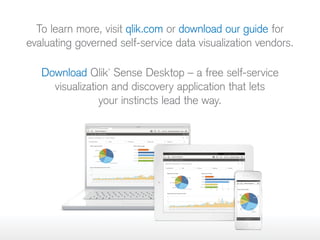
To learn more, visit qlik.com or download our guide for
evaluating governed self-service data visualization vendors.
Download Qlik
®
Sense Desktop – a free self-service
visualization and discovery application that lets
your instincts lead the way.
qlik.com
© 2015 QlikTech International AB. All rights reserved. Qlik®
, QlikView®
, Qlik®
Sense, QlikTech®
, and the QlikTech logos are trademarks of QlikTech International AB which have been
registered in multiple countries. Other marks and logos mentioned herein are trademarks or registered trademarks of their respective owners.

5 trends that are reshaping Information Technology

  • 1.
    trends that arereshaping Information Technology (IT)
  • 2.
    It’s a well-knownfact that information technology is changing.
  • 3.
    People are usingtechnology more than ever before. And as our users become more comfortable with technology at home, expectations about technology in the workplace are changing too. Users have higher expectations about both the availability of new technology as well as their ability to customize it and make it their own. Technology is no longer just a tool. It is an extension of the individual. To keep up with these demands, IT organizations need to innovate.
  • 4.
    The role ofIT needs to shift: From Enforcement to Empowerment: The focus can no longer be on locking everything down. Instead, IT organizations must focus on the enablement and empowerment of users. From Efficiency to Efficacy: In recent years, IT focused a lot on costs. But focusing too much on efficiency can lead to decreased IT service offerings and result in business frustration. Instead, IT organizations need to focus on efficacy – how IT can help the business meet their needs.
  • 5.
    And to makea difficult situation even worse, IT needs to respond to these changes at the very same time that IT budgets are declining and there are significant fundamental technological changes underway.
  • 6.
    But amidst allthis change, one thing remains the same: BI and analytics continue to be a priority for the business. In fact, the desire to use data in every day decision making is extending beyond traditional data driven roles such as finance and marketing. More and more users are recognizing that they, too, can benefit from data driven decision making.
  • 7.
    So how doesIT ensure that they are empowering their users with the tools they need to naturally explore data, ask the next question, and uncover the insight they need to make informed decisions?
  • 8.
    1 Visualization 2 BigData 3 Cloud 4 Social 5 Mobile To start, IT must understand five key trends affecting business intelligence today:
  • 9.
  • 10.
    Data visualizations area powerful tool because they take advantage of innate human capabilities to explore and process complex information. Used the right way, data visualizations offer the ability to intelligently summarize information and convey new meaning in data.
  • 11.
    But adding visualizationsto existing BI isn’t enough. How the business uses visualizations is just as important. Many visualizations look good, but lack meaning. Or worse, they mislead the user to an incorrect conclusion. To derive deep insights, users need to be able to interact and explore their visualizations to better understand their data.
  • 12.
  • 13.
    Big data isnot interesting because it is BIG. The toolsets to manage and process large amounts of data are maturing rapidly. What is interesting is that we are at a time in history when we can know almost anything on any topic. So, the question about big data becomes one of innovation. What are we going to do with this wealth of information?
  • 14.
    In today’s digitalworld, understanding the data means understanding the business. So, in order to answer that question of what to do, organizations need more users looking at their business data, both big and small; asking more questions; and deriving more insight. This is critical because the real power of data doesn’t come from the data alone. It comes from the combination of data with human expertise and intuition. It is the power of informed intuition that drives real innovation.
  • 15.
  • 16.
    Cloud can referto a lot different things: PaaS, IaaS, SaaS, etc. But at the core, what cloud really means is that components of the IT infrastructure – from the data center to the software itself – can be managed and supported by someone else.
  • 17.
    There are anumber of reasons why companies choose to pursue cloud offerings: Low cost of entry: You can get started with a project with minimal up-front investment. Flexibility and agility: You can contract and expand your service as you need it. Value differentiation: You can focus your energy on the services that are true differentiators rather than keep-the-lights-on activities. 1 2 3
  • 18.
    When it comesto business intelligence, cloud requires some special considerations: Security & Compliance: It is critical to ensure that any cloud implementation protects your organization’s most valuable technology asset – your data. Cost: The cost of storing and processing data is only a part of the story. You need to keep in mind the cost in terms of time, money, and performance for moving data between data center locations. 1 2
  • 19.
  • 20.
    Social doesn’t meanchatting. And it is much more than just sharing the latest news on Facebook and Twitter. Social is about how technology can support collaboration even as work groups become more geographically dispersed.
  • 21.
    When it comesto analytics, it is not just about online – it’s about inline. It is critical that you integrate the analytic conversation closely with the BI tools so that collaboration happens as close to the analysis as possible. By ensuring that this happens, you are able to drive common understanding and provide the added benefit of capturing the conversation around data-driven decisions. And that’s powerful.
  • 22.
  • 23.
    Mobile isn’t reallyabout mobility. It’s about access and touch.
  • 24.
    These days, manypeople carry some kind of connected device on them at all times, and given mobile usage growth trends, that is unlikely to change. This means that you can answer any question, anytime, anywhere. And the touch experience encourages immersion and exploration. When we use touch, we explore and learn. When we use a keyboard, we create and input.
  • 25.
    With mobile, weprovide a new, immersive way to explore data anytime, anywhere. And that engages users and promotes stronger BI adoption.
  • 26.
    So how doyou balance trends in the BI industry with increasing pressure to give every user access to the data they need, when they need it? The answer is self-service visual data discovery.
  • 27.
    Self-service visual datadiscovery is nimble, straightforward, mobile, and for everyone. • It provides less of a burden on short-staffed IT departments by delivering an ecosystem for data discovery rather than specific, overly-defined business reports. • It gives business users an easy-to-use tool that helps them explore their data in a natural way. • And it creates a stronger partnership between the business and IT.
  • 28.
    To learn more,visit qlik.com or download our guide for evaluating governed self-service data visualization vendors. Download Qlik ® Sense Desktop – a free self-service visualization and discovery application that lets your instincts lead the way.
  • 29.
    qlik.com © 2015 QlikTechInternational AB. All rights reserved. Qlik® , QlikView® , Qlik® Sense, QlikTech® , and the QlikTech logos are trademarks of QlikTech International AB which have been registered in multiple countries. Other marks and logos mentioned herein are trademarks or registered trademarks of their respective owners.