10
 10
                        It’s Going to be a BIG (Business
  TOP                   Intelligence Growth) Year
                        What a year 2012 was for business intelligence! The staid old
                        world of databases is developing faster and faster, with startups
                        addressing new data problems and established companies
                        innovating on their platforms. Web-based analytics tools are
                        connecting to web-based data. And everything’s mobile.


                        With all the attention organizations are placing on innovating
BUSINESS INTELLIGENCE   around data, the rate of change will only increase. So what
TRENDS FOR 2013         should you expect to see?
Proliferation of data stores.


                                                         1
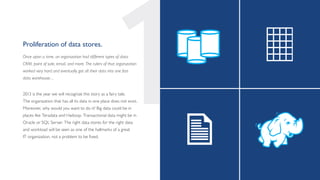
Once upon a time, an organization had different types of data:
CRM, point of sale, email, and more. The rulers of that organization
worked very hard and eventually got all their data into one fast
data warehouse…


2013 is the year we will recognize this story as a fairy tale.
The organization that has all its data in one place does not exist.
Moreover, why would you want to do it? Big data could be in
places like Teradata and Hadoop. Transactional data might be in
Oracle or SQL Server. The right data stores for the right data
and workload will be seen as one of the hallmarks of a great
IT organization, not a problem to be fixed.
2
Hadoop is real.
Back in 2008 and 2009 Hadoop was a science project. By 2010
and 2011 some forward-thinking organizations started doing
proof-of-concepts with Hadoop. In 2012, we saw the emergence
of many production-scale Hadoop implementations, as well as a
crop of companies trying to address pain points in working with
Hadoop. In 2013, Hadoop will finally break into the mainstream
for working with large or unstructured data. It is also becoming
more “right-time” for a faster analytics experience.
3
Self-reliance is the new self-service.
Self-service BI is the idea that any business user can analyze the
data they need to make a better decision. Self-reliance is the
coming of age of that concept: it means business users have
access to the right data, that the data is in a place and format
that they can use, and that they have the solutions that enable
self-service analytics. When all this happens, people become
self-reliant with their business questions and IT can focus on
providing the secure data and solutions to get them there.
The value of text and other
unstructured data is (finally!) recognized.
One of the subplots of the rise of Hadoop has been the rise
of unstructured data. Emails, documents, web analytics and
customer feedback have existed for years, but most organizations
struggled enough to understand their structured data that
unstructured data was left alone. In 2011 and 2012 we saw
more techniques emerge to help people deal with unstructured
data, not least of which is a place to put it (Hadoop). With the
explosion of social data like Twitter and Facebook posts, text
analysis becomes even more important. Expect to see a lot of
it in 2013.
5
Cloud BI grows up.
Cloud business intelligence as your primary BI? No way! Not
in 2012, at least. There are cloud BI services, but with important
limitations that have made it difficult to use the cloud as your
primary analytics solution. In 2013 we expect to see the
maturation of cloud BI, so that people can collaborate with
data in the cloud, just like they collaborate on their Salesforce
CRM or help desk data.
6
Visual analytics wins Best Picture.
For years visual analytics has been the Best Documentary of
business intelligence: impressive, but for the intellectuals and
not the mass audience. But people are finally beginning to
realize that visual analytics helps anyone explore, understand
and communicate with data. It’s the star of business analytics,
not a handy tool for scientists.
Forecasting and predictive analytics
become common.


                                        7
Much like visual analytics, forecasting used to be seen as the
domain of the scientist. But everyone wants to know the future.
Forecasting tools are maturing to help businesses identify
emerging trends and make better plans. We expect forecasting
and predictive analyses to become much more common as
people use them to get more value from their data.
8
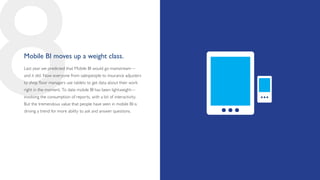
Mobile BI moves up a weight class.
Last year we predicted that Mobile BI would go mainstream—
and it did. Now everyone from salespeople to insurance adjusters
to shop floor managers use tablets to get data about their work
right in the moment. To date mobile BI has been lightweight—
involving the consumption of reports, with a bit of interactivity.
But the tremendous value that people have seen in mobile BI is
driving a trend for more ability to ask and answer questions.
Collaboration is not a feature,
it’s a reality.
Business intelligence solutions have often talked up their
collaboration features. In 2013, that’ll no longer be good enough.
Collaboration must be at the root of any business intelligence
implementation, because what is business intelligence but a
shared experience of asking and answering questions about a
business? In 2013, business will look for ways to involve people
all around their organization in working together to understand
and solve problems.
10
Pervasive analytics are finally…pervasive.
As an industry, we’ve talked for years about terms like “pervasive
BI” or “BI for the masses”. There’s a whole market for data that
is outside of the market for “business intelligence.” When we
talk more about data, and less about software categories like
BI, we get to the crux of maximizing business value—and fast,
easy-to-use visual analytics is the key that opens the door to
organization-wide analytics adoption and collaboration.
So there you have it, the
future in 10 points.
These are the trends we see in talking with customers about
what they’re doing today and where are investing for the
future. The good news is that investment is most often being
driven by a desire to take good initiatives farther, not a sense
of frustration with failed initiatives. Perhaps the new technology
and investment of the last few years is finally starting to pay
off. No matter what, you can expect lots of change in business
intelligence in 2013.


                                                                       www.tableausoftware.com/desktop

                                                                     Tableau Software helps people see and understand data.
                                                                     Used by more than 10,000 organizations worldwide,
                                                                     Tableau delivers fast analytics, visualization and rapid-fire
                                                                     business intelligence.

Business Intelligence Trends (based on 2012 experience)

  • 1.
    10 10 It’s Going to be a BIG (Business TOP Intelligence Growth) Year What a year 2012 was for business intelligence! The staid old world of databases is developing faster and faster, with startups addressing new data problems and established companies innovating on their platforms. Web-based analytics tools are connecting to web-based data. And everything’s mobile. With all the attention organizations are placing on innovating BUSINESS INTELLIGENCE around data, the rate of change will only increase. So what TRENDS FOR 2013 should you expect to see?
  • 2.
    Proliferation of datastores. 1 Once upon a time, an organization had different types of data: CRM, point of sale, email, and more. The rulers of that organization worked very hard and eventually got all their data into one fast data warehouse… 2013 is the year we will recognize this story as a fairy tale. The organization that has all its data in one place does not exist. Moreover, why would you want to do it? Big data could be in places like Teradata and Hadoop. Transactional data might be in Oracle or SQL Server. The right data stores for the right data and workload will be seen as one of the hallmarks of a great IT organization, not a problem to be fixed.
  • 3.
    2 Hadoop is real. Backin 2008 and 2009 Hadoop was a science project. By 2010 and 2011 some forward-thinking organizations started doing proof-of-concepts with Hadoop. In 2012, we saw the emergence of many production-scale Hadoop implementations, as well as a crop of companies trying to address pain points in working with Hadoop. In 2013, Hadoop will finally break into the mainstream for working with large or unstructured data. It is also becoming more “right-time” for a faster analytics experience.
  • 4.
    3 Self-reliance is thenew self-service. Self-service BI is the idea that any business user can analyze the data they need to make a better decision. Self-reliance is the coming of age of that concept: it means business users have access to the right data, that the data is in a place and format that they can use, and that they have the solutions that enable self-service analytics. When all this happens, people become self-reliant with their business questions and IT can focus on providing the secure data and solutions to get them there.
  • 5.
    The value oftext and other unstructured data is (finally!) recognized. One of the subplots of the rise of Hadoop has been the rise of unstructured data. Emails, documents, web analytics and customer feedback have existed for years, but most organizations struggled enough to understand their structured data that unstructured data was left alone. In 2011 and 2012 we saw more techniques emerge to help people deal with unstructured data, not least of which is a place to put it (Hadoop). With the explosion of social data like Twitter and Facebook posts, text analysis becomes even more important. Expect to see a lot of it in 2013.
  • 6.
    5 Cloud BI growsup. Cloud business intelligence as your primary BI? No way! Not in 2012, at least. There are cloud BI services, but with important limitations that have made it difficult to use the cloud as your primary analytics solution. In 2013 we expect to see the maturation of cloud BI, so that people can collaborate with data in the cloud, just like they collaborate on their Salesforce CRM or help desk data.
  • 7.
    6 Visual analytics winsBest Picture. For years visual analytics has been the Best Documentary of business intelligence: impressive, but for the intellectuals and not the mass audience. But people are finally beginning to realize that visual analytics helps anyone explore, understand and communicate with data. It’s the star of business analytics, not a handy tool for scientists.
  • 8.
    Forecasting and predictiveanalytics become common. 7 Much like visual analytics, forecasting used to be seen as the domain of the scientist. But everyone wants to know the future. Forecasting tools are maturing to help businesses identify emerging trends and make better plans. We expect forecasting and predictive analyses to become much more common as people use them to get more value from their data.
  • 9.
    8 Mobile BI movesup a weight class. Last year we predicted that Mobile BI would go mainstream— and it did. Now everyone from salespeople to insurance adjusters to shop floor managers use tablets to get data about their work right in the moment. To date mobile BI has been lightweight— involving the consumption of reports, with a bit of interactivity. But the tremendous value that people have seen in mobile BI is driving a trend for more ability to ask and answer questions.
  • 10.
    Collaboration is nota feature, it’s a reality. Business intelligence solutions have often talked up their collaboration features. In 2013, that’ll no longer be good enough. Collaboration must be at the root of any business intelligence implementation, because what is business intelligence but a shared experience of asking and answering questions about a business? In 2013, business will look for ways to involve people all around their organization in working together to understand and solve problems.
  • 11.
    10 Pervasive analytics arefinally…pervasive. As an industry, we’ve talked for years about terms like “pervasive BI” or “BI for the masses”. There’s a whole market for data that is outside of the market for “business intelligence.” When we talk more about data, and less about software categories like BI, we get to the crux of maximizing business value—and fast, easy-to-use visual analytics is the key that opens the door to organization-wide analytics adoption and collaboration.
  • 12.
    So there youhave it, the future in 10 points. These are the trends we see in talking with customers about what they’re doing today and where are investing for the future. The good news is that investment is most often being driven by a desire to take good initiatives farther, not a sense of frustration with failed initiatives. Perhaps the new technology and investment of the last few years is finally starting to pay off. No matter what, you can expect lots of change in business intelligence in 2013. www.tableausoftware.com/desktop Tableau Software helps people see and understand data. Used by more than 10,000 organizations worldwide, Tableau delivers fast analytics, visualization and rapid-fire business intelligence.