Building stronger bridges between
users and IT
Teamwork starts with listening. Listening
leads to understanding. Understanding
fosters alignment and informed activity.
What sounds so simple and so funda-
mental isn’t always the norm. Often
overwhelmed with new service requests,
systems administration, infrastructure
optimization, and problem resolution, IT
organizations sometimes overlook the
users they serve.
“End users are our customers,” says Faith
McCreary, user research team lead for
Intel IT. “It’s critical that we listen to them
important. And then we must turn their
feedback into action and improvement.”
Intel IT started building stronger bridges
between its user community and its IT
strategy with the creation of a central
user experience function in 2005. Recent
years have brought a variety of peo-
ple-centric innovations to Intel IT including
an annual Voice of the User (VoU) survey
that helps assess employee
preferences and satisfaction and a
Partnership Excellence (PE) interview that
facilitates discussion and collaboration
between Intel’s senior business and IT
leaders.
“Our task,” says Mac Agan, director in the
and commit to act.”
“The ultimate value and the
greatest insights are found when
we align and correlate this data
with other business intelligence,
projects, and investments.”
Ed Goldman, Intel IT CTO
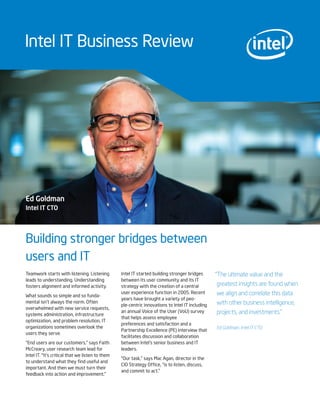
Ed Goldman
Intel IT CTO
Intel IT Business Review
The VoU survey has a standard set of
questions—covering everything from user
satisfaction and support to computing
systems and services to training and
communications—that helps establish
baselines and measure progress. New
questions are included every year to
attain additional feedback and new
insights.
“The VoU is our connection to the user
community,” says Julie Rovegno, marketing
communications manager of IT products
and services for Intel IT. “It’s much more
than a satisfaction survey. Employee VoU
feedback helps us understand what drives
satisfaction; what is most valuable to our
employees; what’s being used and what’s
not; and it uncovers opportunities for
improving employee productivity.”
The intersection of satisfaction and
importance
The intersection of two key vectors helps
identify areas of needed improvement:
satisfaction and importance. Low
satisfaction in a certain category is more
acceptable, for example, when users deem
that category less important. But when
users express dissatisfaction in an area
they feel is important to their job or their
productivity, Intel IT can justify and
prioritize change.
VoU and PE feedback are also used to
measure the progress, satisfaction, and
impact of recent investments. Intel IT, for
example, invested heavily in mobility to
able to compare 2012 VoU feedback with
2013 results to demonstrate these
investments yielded an average increase of
10 percent in satisfaction year-over-year.
VoU also allowed Intel IT to gauge the
different user groups and shape 2014
strategy to focus on those groups with the
lowest satisfaction.
“We’re taking the pulse of 100,000
employees,” says Agan. “We can identify
opportunities for improvement.
We can measure how well our investments
are working, and we can also see what
happens when we don’t invest in certain
areas. We can’t invest everywhere, so the
VoU and PE feedback help us prioritize and
justify at a very granular level.”
This granularity is what sets Intel IT’s user
research apart from others, says Ed
Goldman, CTO of Intel IT.
“We’ve transitioned from tactical to
strategic over the years,” Goldman explains.
“We’re diving deeper and getting a much
richer picture of the work we do on behalf
of our customers. And we use it to guide
where our IT organization is going and how
to get there.”
Shaping IT Strategy
research were about establishing macro
baselines, 2014 and beyond will be focused
shape Intel IT’s Strategy. This includes
research about emerging technologies and
interfaces, such as gesture and touch, to
gauge demand and perceived value. VoU
and PE feedback is also being used to learn
from new Intel employees to administrative
assistants to software developers.
Building stronger bridges between users and IT
2
“Our task is to listen, discuss, and
commit to act.”
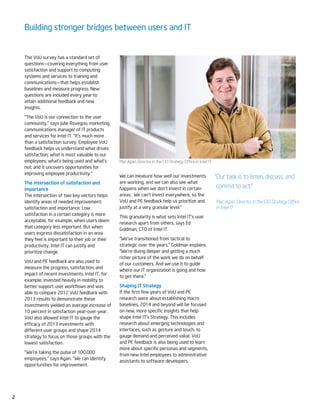
Mac Agan, Director in the CIO Strategy Office
in Intel IT
Mac Agan, Director in the CIO Strategy Office in Intel IT
Building stronger bridges between users and IT
THE INFORMATION PROVIDED IN THIS PAPER IS INTENDED TO BE GENERAL IN NATURE AND IS NOT SPECIFIC GUIDANCE. RECOMMENDATIONS
(INCLUDING POTENTIAL COST SAVINGS) ARE BASED UPON INTEL’S EXPERIENCE AND ARE ESTIMATES ONLY. INTEL DOES NOT GUARANTEE OR
WARRANT OTHERS WILL OBTAIN SIMILAR RESULTS.
Intel, and the Intel logo are trademarks of Intel Corporation in the U.S. and other countries.
*Other names and brands may be claimed as the property of others.
Copyright © 2014 Intel Corporation. All rights reserved.
3
InTEl IT buSInESS rEvIEw app
Check out the Intel IT Business Review,
a new mobile app (for smart phones)
and digital magazine (for tablets). Down-
load this app and you’ll receive a regular
cadence of articles from Intel IT thought
leaders sharing their insights on IT
strategy, best practices and examples
of the ways IT is committed to deliver
business value to Intel. The app delivers
rich multimedia content from an
extensive portfolio of IT@Intel
whitepapers, videos, radio shows,
podcasts, as well as the Intel IT Annual
Report. Join in the conversations and
connect with other IT professionals via
social sharing and help Intel IT keep the
conversation going throughout the year.
Download the app:
“There is so much data, we can slice and
dice it in many ways,” says McCreary. “We
roles, geographies, teams, or tenure. We
can learn more about the importance and
things like our change management and
implementation processes.”
“The ultimate value and the greatest
insights are found when we align and
correlate this data with other business
intelligence, projects, and investments,”
adds Goldman.
These efforts are ongoing. For Intel IT,
taking the pulse of its user community,
identifying opportunities for improvement,
driving more purposeful, informed action
and investments, and measuring progress
is a never-ending journey.
But it all starts with listening.

Intel it business_review_building_stronger_bridges_between_users_it

  • 1.
    Building stronger bridgesbetween users and IT Teamwork starts with listening. Listening leads to understanding. Understanding fosters alignment and informed activity. What sounds so simple and so funda- mental isn’t always the norm. Often overwhelmed with new service requests, systems administration, infrastructure optimization, and problem resolution, IT organizations sometimes overlook the users they serve. “End users are our customers,” says Faith McCreary, user research team lead for Intel IT. “It’s critical that we listen to them important. And then we must turn their feedback into action and improvement.” Intel IT started building stronger bridges between its user community and its IT strategy with the creation of a central user experience function in 2005. Recent years have brought a variety of peo- ple-centric innovations to Intel IT including an annual Voice of the User (VoU) survey that helps assess employee preferences and satisfaction and a Partnership Excellence (PE) interview that facilitates discussion and collaboration between Intel’s senior business and IT leaders. “Our task,” says Mac Agan, director in the and commit to act.” “The ultimate value and the greatest insights are found when we align and correlate this data with other business intelligence, projects, and investments.” Ed Goldman, Intel IT CTO Ed Goldman Intel IT CTO Intel IT Business Review
  • 2.
    The VoU surveyhas a standard set of questions—covering everything from user satisfaction and support to computing systems and services to training and communications—that helps establish baselines and measure progress. New questions are included every year to attain additional feedback and new insights. “The VoU is our connection to the user community,” says Julie Rovegno, marketing communications manager of IT products and services for Intel IT. “It’s much more than a satisfaction survey. Employee VoU feedback helps us understand what drives satisfaction; what is most valuable to our employees; what’s being used and what’s not; and it uncovers opportunities for improving employee productivity.” The intersection of satisfaction and importance The intersection of two key vectors helps identify areas of needed improvement: satisfaction and importance. Low satisfaction in a certain category is more acceptable, for example, when users deem that category less important. But when users express dissatisfaction in an area they feel is important to their job or their productivity, Intel IT can justify and prioritize change. VoU and PE feedback are also used to measure the progress, satisfaction, and impact of recent investments. Intel IT, for example, invested heavily in mobility to able to compare 2012 VoU feedback with 2013 results to demonstrate these investments yielded an average increase of 10 percent in satisfaction year-over-year. VoU also allowed Intel IT to gauge the different user groups and shape 2014 strategy to focus on those groups with the lowest satisfaction. “We’re taking the pulse of 100,000 employees,” says Agan. “We can identify opportunities for improvement. We can measure how well our investments are working, and we can also see what happens when we don’t invest in certain areas. We can’t invest everywhere, so the VoU and PE feedback help us prioritize and justify at a very granular level.” This granularity is what sets Intel IT’s user research apart from others, says Ed Goldman, CTO of Intel IT. “We’ve transitioned from tactical to strategic over the years,” Goldman explains. “We’re diving deeper and getting a much richer picture of the work we do on behalf of our customers. And we use it to guide where our IT organization is going and how to get there.” Shaping IT Strategy research were about establishing macro baselines, 2014 and beyond will be focused shape Intel IT’s Strategy. This includes research about emerging technologies and interfaces, such as gesture and touch, to gauge demand and perceived value. VoU and PE feedback is also being used to learn from new Intel employees to administrative assistants to software developers. Building stronger bridges between users and IT 2 “Our task is to listen, discuss, and commit to act.” Mac Agan, Director in the CIO Strategy Office in Intel IT Mac Agan, Director in the CIO Strategy Office in Intel IT
  • 3.
    Building stronger bridgesbetween users and IT THE INFORMATION PROVIDED IN THIS PAPER IS INTENDED TO BE GENERAL IN NATURE AND IS NOT SPECIFIC GUIDANCE. RECOMMENDATIONS (INCLUDING POTENTIAL COST SAVINGS) ARE BASED UPON INTEL’S EXPERIENCE AND ARE ESTIMATES ONLY. INTEL DOES NOT GUARANTEE OR WARRANT OTHERS WILL OBTAIN SIMILAR RESULTS. Intel, and the Intel logo are trademarks of Intel Corporation in the U.S. and other countries. *Other names and brands may be claimed as the property of others. Copyright © 2014 Intel Corporation. All rights reserved. 3 InTEl IT buSInESS rEvIEw app Check out the Intel IT Business Review, a new mobile app (for smart phones) and digital magazine (for tablets). Down- load this app and you’ll receive a regular cadence of articles from Intel IT thought leaders sharing their insights on IT strategy, best practices and examples of the ways IT is committed to deliver business value to Intel. The app delivers rich multimedia content from an extensive portfolio of IT@Intel whitepapers, videos, radio shows, podcasts, as well as the Intel IT Annual Report. Join in the conversations and connect with other IT professionals via social sharing and help Intel IT keep the conversation going throughout the year. Download the app: “There is so much data, we can slice and dice it in many ways,” says McCreary. “We roles, geographies, teams, or tenure. We can learn more about the importance and things like our change management and implementation processes.” “The ultimate value and the greatest insights are found when we align and correlate this data with other business intelligence, projects, and investments,” adds Goldman. These efforts are ongoing. For Intel IT, taking the pulse of its user community, identifying opportunities for improvement, driving more purposeful, informed action and investments, and measuring progress is a never-ending journey. But it all starts with listening.