





Easy ORM-ness with Objectify-AppengineMeetu MaltiarInphina Technologies
Overall Presentation GoalGoogle Datastore BasicsOptions available for managing persistenceObjectify-AppengineDemo of an application using Objectify
Enough About MeSenior Software Engineer at InphinaTechnologies that interest me:     Cloud Computing     Scala     Hadoop
Datastore BasicsEntitiesOperationsKeysTransactions
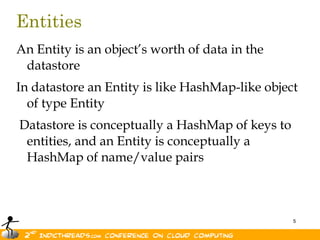
EntitiesAn Entity is an object’s worth of data in the datastoreIn datastore an Entity is like HashMap-like object of type Entity Datastore is conceptually a HashMap of keys to entities, and an Entity is conceptually a HashMap of name/value pairs
OperationsGet() an entity as a whole from datastorePut() an entity as whole in datastoreDelete() an entity from datastoreQuery() for entities matching criteria you define
KeysIn the datastore, entities are identified by the id (or name) and a kind, which corresponds to the type of Object you are storing. So, to get Employee #111 from datastore, we need to call something like get_from_datastore (“Employee”, 111)
Keys ContinuedThere is actually a third parameter required to identify an entity and it is called parentParent places the child in the same entity group as the parentParent (which can be null for the un-parented, root entity) is also required to uniquely identify an Entity.
Keys ContinuedSo, to get Employee #111 from datastore we need to call something equivalent to:get_from_datastore (“Employee”, 111, null)or,get_from_datastore (“Employee”, 111, the_parent). Instead of passing three parameters datastore wraps it in a single Object called Key.
TransactionsData gets stored in gigantic form of thousands of machinesIn order to perform an atomic transaction datastore requires that entities lie on same servers.To give us more control over where our data is stored, the datastore has a concept of an entity groupTo give us more control over where our data is stored, the datastore has a concept of an entity group
Transactions ContinuedWithin a Transaction we can access data from a single entity groupChoose entity groups carefullyWhy not have everything in a single entity group?Google restricts number of requests per second per entity group
Executing TransactionsWhen we execute get(), put(), delete() or query() in transactionWe must operate it on single entity groupAll operations will either fail or succeed completelyIf another process modifies the data before commit datastore operation will fail
Tools
Persistence OptionsJPA/JDOGoogle DatastorePersistence Frameworks on GAE  Objectify-Appengine  Twig  Simple Datastore  Slim3
Google Datastore ChallengesSupports just four operationsIt persists GAE-Specific entity classes rather than POJO’sDatastore Keys are untyped
JPA/JDO ChallengesExtra CruftFetch Groups   Detaching   Owned/UnownedrelationshipsLeaky AbstractionKeys   Entity Groups   Indexes
Developers Dilemma
ObjectifyIt lets you persist, retrieve, delete and query typed objectsAll native datastore features are supportedIt provides type safe key and query classes
Objectify Design ConsiderationsMinimally impacts cold start time. It is light weightNo external dependencies apart from GAE SDK
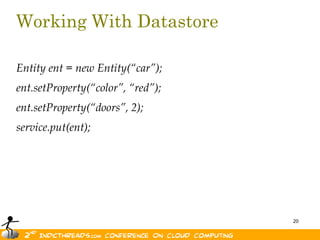
Working With DatastoreEntity ent = new Entity(“car”);ent.setProperty(“color”, “red”);ent.setProperty(“doors”, 2);service.put(ent);
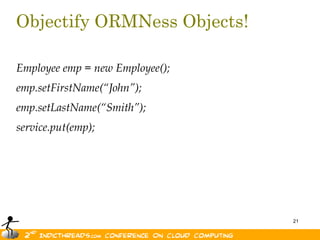
Objectify ORMNess Objects!Employee emp = new Employee();emp.setFirstName(“John”);emp.setLastName(“Smith”);service.put(emp);
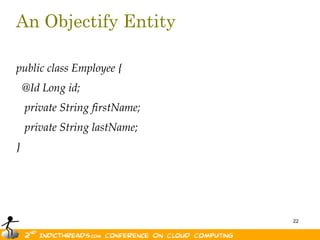
An Objectify Entitypublic class Employee {  @Id Long id;   private String firstName;   private String lastName;}
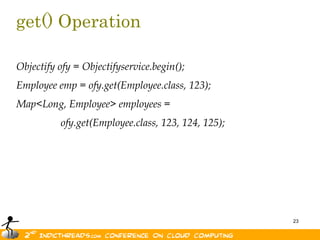
get() OperationObjectify ofy = Objectifyservice.begin();Employee emp = ofy.get(Employee.class, 123);Map<Long, Employee> employees = ofy.get(Employee.class, 123, 124, 125);
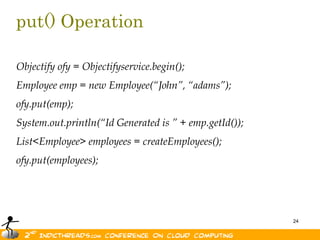
put() OperationObjectify ofy = Objectifyservice.begin();Employee emp = new Employee(“John”, “adams”);ofy.put(emp);System.out.println(“Id Generated is ” + emp.getId());List<Employee> employees = createEmployees();ofy.put(employees);
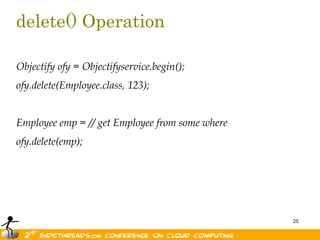
delete() OperationObjectify ofy = Objectifyservice.begin();ofy.delete(Employee.class, 123);Employee emp = // get Employee from some whereofy.delete(emp);
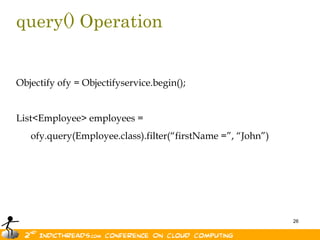
query() OperationObjectify ofy = Objectifyservice.begin();List<Employee> employees =       ofy.query(Employee.class).filter(“firstName =”, “John”)
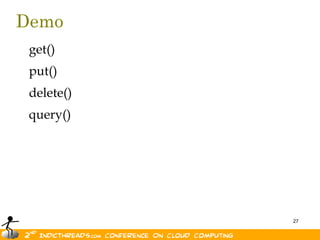
Demo    get()    put()    delete()    query()
Objectify Best PracticesUse a DAO to register entitiesAutomatic Scanningnot advised adds to initialization time    will require dependency jars apart from GAE    will require changes in web.xmlGAE spins down the instance when not in use. When it comes up the request is slow because of added initialization time. This is called cold start.
Objectify Best Practices …Use Batch Gets Instead of QueriesUse Indexes sparinglyBy default every field of object will be indexed. It comes with heavy computational price.Use @Unindexed  on entity level and @Indexed at fields required for queryAvoid @ParentIn JPA “owned” entity relationship provides referential integrity checking and cascading deletes and saves. Not so here.
Happy Developer
ConclusionJDO/JPA learning curve is steep due to App Engine’s non-relational nature and unique concepts such as entity groups, owned and un-owned relationships.Google Datastore is low level. It makes no pretense of being relational but also does not allow working with objects. It just stores the objects of type com.google.appengine.api.datastore.EntityObjectify is light weight and it preserves the simplicity and transparency of low level API and does all work converting to and from POJOS to Entity Objects.
mmaltiar@inphina.comwww.inphina.comhttp://thoughts.inphina.com
ReferencesObjectify-Appengine http://code.google.com/p/objectify-appengine/Google IO 2011 Session on highly productive gwt rapid development with app-engine objectify-requestfactory and gwt-platformTwitter mining with Objectify-Appengine http://www.ibm.com/developerworks/java/library/j-javadev2-14/?ca=drs-

Easy ORMness with Objectify-Appengine

  • 1.
    Easy ORM-ness withObjectify-AppengineMeetu MaltiarInphina Technologies
  • 2.
    Overall Presentation GoalGoogleDatastore BasicsOptions available for managing persistenceObjectify-AppengineDemo of an application using Objectify
  • 3.
    Enough About MeSeniorSoftware Engineer at InphinaTechnologies that interest me: Cloud Computing Scala Hadoop
  • 4.
  • 5.
    EntitiesAn Entity isan object’s worth of data in the datastoreIn datastore an Entity is like HashMap-like object of type Entity Datastore is conceptually a HashMap of keys to entities, and an Entity is conceptually a HashMap of name/value pairs
  • 6.
    OperationsGet() an entityas a whole from datastorePut() an entity as whole in datastoreDelete() an entity from datastoreQuery() for entities matching criteria you define
  • 7.
    KeysIn the datastore,entities are identified by the id (or name) and a kind, which corresponds to the type of Object you are storing. So, to get Employee #111 from datastore, we need to call something like get_from_datastore (“Employee”, 111)
  • 8.
    Keys ContinuedThere isactually a third parameter required to identify an entity and it is called parentParent places the child in the same entity group as the parentParent (which can be null for the un-parented, root entity) is also required to uniquely identify an Entity.
  • 9.
    Keys ContinuedSo, toget Employee #111 from datastore we need to call something equivalent to:get_from_datastore (“Employee”, 111, null)or,get_from_datastore (“Employee”, 111, the_parent). Instead of passing three parameters datastore wraps it in a single Object called Key.
  • 10.
    TransactionsData gets storedin gigantic form of thousands of machinesIn order to perform an atomic transaction datastore requires that entities lie on same servers.To give us more control over where our data is stored, the datastore has a concept of an entity groupTo give us more control over where our data is stored, the datastore has a concept of an entity group
  • 11.
    Transactions ContinuedWithin aTransaction we can access data from a single entity groupChoose entity groups carefullyWhy not have everything in a single entity group?Google restricts number of requests per second per entity group
  • 12.
    Executing TransactionsWhen weexecute get(), put(), delete() or query() in transactionWe must operate it on single entity groupAll operations will either fail or succeed completelyIf another process modifies the data before commit datastore operation will fail
  • 13.
  • 14.
    Persistence OptionsJPA/JDOGoogle DatastorePersistenceFrameworks on GAE Objectify-Appengine Twig Simple Datastore Slim3
  • 15.
    Google Datastore ChallengesSupportsjust four operationsIt persists GAE-Specific entity classes rather than POJO’sDatastore Keys are untyped
  • 16.
    JPA/JDO ChallengesExtra CruftFetchGroups Detaching Owned/UnownedrelationshipsLeaky AbstractionKeys Entity Groups Indexes
  • 17.
  • 18.
    ObjectifyIt lets youpersist, retrieve, delete and query typed objectsAll native datastore features are supportedIt provides type safe key and query classes
  • 19.
    Objectify Design ConsiderationsMinimallyimpacts cold start time. It is light weightNo external dependencies apart from GAE SDK
  • 20.
    Working With DatastoreEntityent = new Entity(“car”);ent.setProperty(“color”, “red”);ent.setProperty(“doors”, 2);service.put(ent);
  • 21.
    Objectify ORMNess Objects!Employeeemp = new Employee();emp.setFirstName(“John”);emp.setLastName(“Smith”);service.put(emp);
  • 22.
    An Objectify Entitypublicclass Employee { @Id Long id; private String firstName; private String lastName;}
  • 23.
    get() OperationObjectify ofy= Objectifyservice.begin();Employee emp = ofy.get(Employee.class, 123);Map<Long, Employee> employees = ofy.get(Employee.class, 123, 124, 125);
  • 24.
    put() OperationObjectify ofy= Objectifyservice.begin();Employee emp = new Employee(“John”, “adams”);ofy.put(emp);System.out.println(“Id Generated is ” + emp.getId());List<Employee> employees = createEmployees();ofy.put(employees);
  • 25.
    delete() OperationObjectify ofy= Objectifyservice.begin();ofy.delete(Employee.class, 123);Employee emp = // get Employee from some whereofy.delete(emp);
  • 26.
    query() OperationObjectify ofy= Objectifyservice.begin();List<Employee> employees = ofy.query(Employee.class).filter(“firstName =”, “John”)
  • 27.
    Demo get() put() delete() query()
  • 28.
    Objectify Best PracticesUsea DAO to register entitiesAutomatic Scanningnot advised adds to initialization time will require dependency jars apart from GAE will require changes in web.xmlGAE spins down the instance when not in use. When it comes up the request is slow because of added initialization time. This is called cold start.
  • 29.
    Objectify Best Practices…Use Batch Gets Instead of QueriesUse Indexes sparinglyBy default every field of object will be indexed. It comes with heavy computational price.Use @Unindexed on entity level and @Indexed at fields required for queryAvoid @ParentIn JPA “owned” entity relationship provides referential integrity checking and cascading deletes and saves. Not so here.
  • 30.
  • 31.
    ConclusionJDO/JPA learning curveis steep due to App Engine’s non-relational nature and unique concepts such as entity groups, owned and un-owned relationships.Google Datastore is low level. It makes no pretense of being relational but also does not allow working with objects. It just stores the objects of type com.google.appengine.api.datastore.EntityObjectify is light weight and it preserves the simplicity and transparency of low level API and does all work converting to and from POJOS to Entity Objects.
  • 32.
  • 33.
    ReferencesObjectify-Appengine http://code.google.com/p/objectify-appengine/Google IO2011 Session on highly productive gwt rapid development with app-engine objectify-requestfactory and gwt-platformTwitter mining with Objectify-Appengine http://www.ibm.com/developerworks/java/library/j-javadev2-14/?ca=drs-