The 90-Day Startup on Google AppEngine David Chandler [email_address] http://TurboManage.com
Who is this guy? Wrote first book on running a Web site (1995) Written Web apps in perl, ksh, C with lex/yacc, ColdFusion, JSF, GWT Most recently, Web architect with Intuit on Internet banking products Patent on non-recursive SQL trees Working in a startup last 6 mos
AppEngine for Java What is it? Getting started Where does it fit? Designing for AppEngine An architecture that works Unsolved problems Resources
What is AppEngine? Business: Google’s cloud computing platform competing with Azure and AWS Technical: giant Web farm in front of world’s largest HashMap Java developer: easiest and most scalable Java hosting environment Startup developer: FREE to get started Enterprise developer:  tools that make you drool, but Security will never allow it
Let’s do it Sign up for AppEngine beta Download Google plugin for Eclipse Create new Google Web application Deploy it
What didn’t we do? Install Tomcat Configure Tomcat Start Tomcat Stop Tomcat Install a database Configure a database Find a DBA to run scripts to populate a database…
What didn’t we do? But what would we do differently to SCALE our Web tier? our data tier? our asynchronous service tier? For example, Azure: provision more SQL or IIS instances in admin console AWS: same, using Rightscale or similar AppEngine: see checklist…
 
Tradeoffs You have to build the AppEngine way BigTable is not a relational database Can’t start your own threads JRE whitelist Don’t forget quotas
Working with the Datastore Hierarchical, not relational Entity may have child entities Entity + children = entity group Transactions only work within entity group But deeply nested entity graph limits perf Datastore can only write 5-10 updates / sec per entity group (instance, not class, thankfully) To update many entities in one request, they must be root entities
Datastore APIs Native get(Key key), put(Entity e), etc. But…entities are not POJOs, so you need... JDO or JPA JDO supported first, seems to be Google’s favorite JPA well-supported now, Google is committed Objectify ( http://code.google.com/p/objectify-appengine ) Twig, SimpleDS, others
Datastore limitations Some RDBMS features can be implemented in JDO / JPA drivers Lazy fetching (be careful) Cascading deletes Relationship modeling with Collections Others can’t Datastore doesn’t enforce FK relationships Query restrictions
Query restrictions No OR clauses (requires separate trips to the Datastore) IN supported, but makes separate trips Inequality filters (<, >, !=) on one prop only Joins barely supported As of Feb 12, can do 2-way == joins with JDO or JPA only
What IS supported? Fast, scalable index retrieval Remember, it’s a HashMap Define multi-property indexes in datastore-indexes.xml JDO + JPA auto-create them for you Merge-join AND clause on multiple properties AppEngine uses efficient zig-zag algorithm to satisfy AND conditions without multi-prop idx
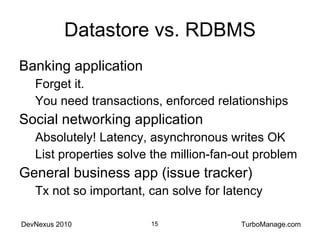
Datastore vs. RDBMS Banking application Forget it. You need transactions, enforced relationships Social networking application Absolutely! Latency, asynchronous writes OK List properties solve the million-fan-out problem General business app (issue tracker) Tx not so important, can solve for latency
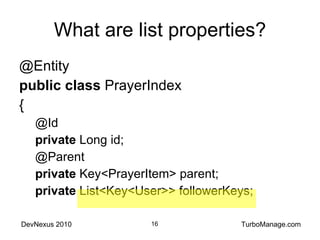
What are list properties? @Entity public   class  PrayerIndex { @Id private  Long id; @Parent private  Key<PrayerItem> parent; private  List<Key<User>> followerKeys;
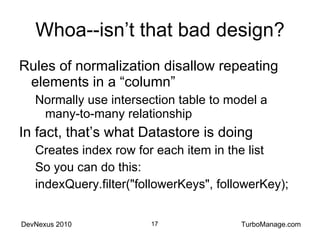
Whoa--isn’t that bad design? Rules of normalization disallow repeating elements in a “column” Normally use intersection table to model a many-to-many relationship In fact, that’s what Datastore is doing Creates index row for each item in the list So you can do this: indexQuery.filter(&quot;followerKeys&quot;, followerKey);
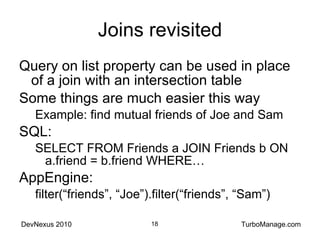
Joins revisited Query on list property can be used in place of a join with an intersection table Some things are much easier this way Example: find mutual friends of Joe and Sam SQL:  SELECT FROM Friends a JOIN Friends b ON a.friend = b.friend WHERE… AppEngine:  filter(“friends”, “Joe”).filter(“friends”, “Sam”)
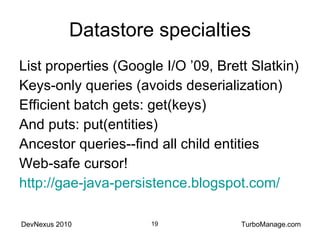
Datastore specialties List properties (Google I/O ’09, Brett Slatkin) Keys-only queries (avoids deserialization) Efficient batch gets: get(keys) And puts: put(entities) Ancestor queries--find all child entities Web-safe cursor! http://gae-java-persistence.blogspot.com/
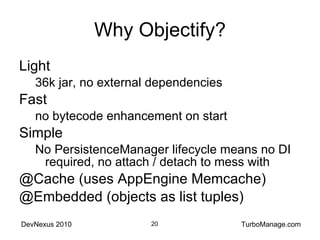
Why Objectify? Light 36k jar, no external dependencies Fast no bytecode enhancement on start Simple No PersistenceManager lifecycle means no DI required, no attach / detach to mess with @Cache (uses AppEngine Memcache) @Embedded (objects as list tuples)
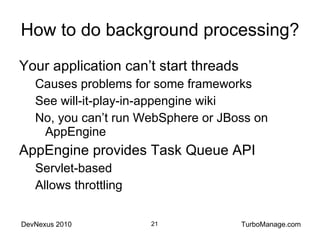
How to do background processing? Your application can’t start threads Causes problems for some frameworks See will-it-play-in-appengine wiki No, you can’t run WebSphere or JBoss on AppEngine AppEngine provides Task Queue API Servlet-based Allows throttling
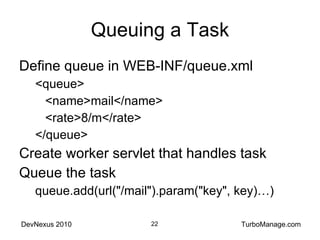
Queuing a Task Define queue in WEB-INF/queue.xml <queue> <name>mail</name> <rate>8/m</rate> </queue> Create worker servlet that handles task Queue the task queue.add(url(&quot;/mail&quot;).param(&quot;key&quot;, key)…)
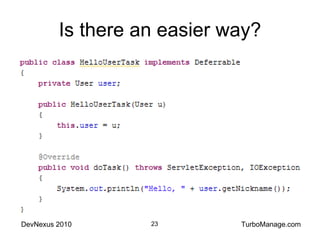
Is there an easier way?
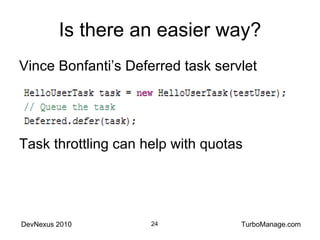
Is there an easier way? Vince Bonfanti’s Deferred task servlet Task throttling can help with quotas
An architecture that works Objectify Guice Gwt-dispatch (GWT-RPC) QueuingBatchingCachingDispatchAsync
Guice Google’s dependency injection framework Small, light, almost plain English See ServerModule DispatchServletModule DispatchTestModule ROAUserServiceImpl Used by gwt-dispatch, useful for unit tests
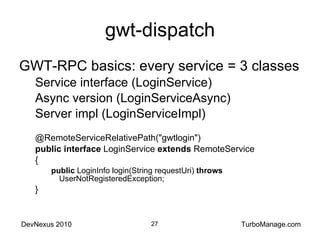
gwt-dispatch GWT-RPC basics: every service = 3 classes Service interface (LoginService) Async version (LoginServiceAsync) Server impl (LoginServiceImpl) @RemoteServiceRelativePath(&quot;gwtlogin&quot;) public   interface  LoginService  extends  RemoteService { public  LoginInfo login(String requestUri)  throws  UserNotRegisteredException; }
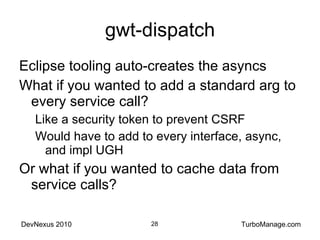
gwt-dispatch Eclipse tooling auto-creates the asyncs What if you wanted to add a standard arg to every service call? Like a security token to prevent CSRF Would have to add to every interface, async, and impl UGH Or what if you wanted to cache data from service calls?
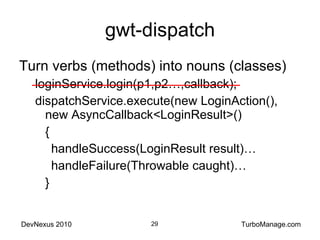
gwt-dispatch Turn verbs (methods) into nouns (classes) loginService.login(p1,p2…,callback); dispatchService.execute(new LoginAction(), new AsyncCallback<LoginResult>() { handleSuccess(LoginResult result)… handleFailure(Throwable caught)… }
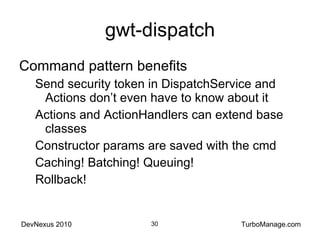
gwt-dispatch Command pattern benefits Send security token in DispatchService and Actions don’t even have to know about it Actions and ActionHandlers can extend base classes Constructor params are saved with the cmd Caching! Batching! Queuing! Rollback!
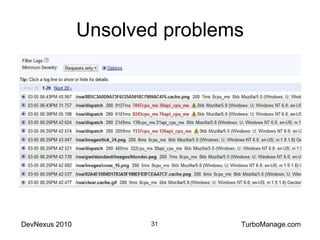
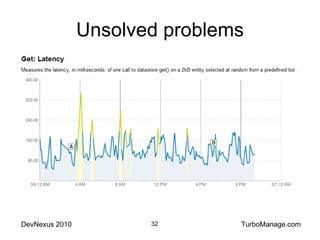
Unsolved problems Cold start Datastore latency
Unsolved problems
One more thing AppEngine for Java < 1 yr old gwt-presenter, gwt-dispatch < 5 mos Many Datastore features < 2 mos Objectify barely 1 mo Bleeding edge : (t problem  – t solution posted )   == 0 How close can you tolerate?
How long did it really take? Deploy sample app 90s Ooh & aah at admin console 90m Wait for frameworks I needed 90d Learn how to use them 30d Write application code 60d Upgrade them constantly 90h
Resources AppEngine docs (a little thin, but good) Forums http://groups.google.com/group/google-appengine-java  (Google engineers monitor) http://groups.google.com/group/google-appengine-downtime-notify http://gae-java-persistence.blogspot.com / http://turbomanage.wordpress.com  (Objectify, gwt-dispatch, gwt-presenter example code) Upcoming Google I/O conf

The 90-Day Startup with Google AppEngine for Java

  • 1.
    The 90-Day Startupon Google AppEngine David Chandler [email_address] http://TurboManage.com
  • 2.
    Who is thisguy? Wrote first book on running a Web site (1995) Written Web apps in perl, ksh, C with lex/yacc, ColdFusion, JSF, GWT Most recently, Web architect with Intuit on Internet banking products Patent on non-recursive SQL trees Working in a startup last 6 mos
  • 3.
    AppEngine for JavaWhat is it? Getting started Where does it fit? Designing for AppEngine An architecture that works Unsolved problems Resources
  • 4.
    What is AppEngine?Business: Google’s cloud computing platform competing with Azure and AWS Technical: giant Web farm in front of world’s largest HashMap Java developer: easiest and most scalable Java hosting environment Startup developer: FREE to get started Enterprise developer: tools that make you drool, but Security will never allow it
  • 5.
    Let’s do itSign up for AppEngine beta Download Google plugin for Eclipse Create new Google Web application Deploy it
  • 6.
    What didn’t wedo? Install Tomcat Configure Tomcat Start Tomcat Stop Tomcat Install a database Configure a database Find a DBA to run scripts to populate a database…
  • 7.
    What didn’t wedo? But what would we do differently to SCALE our Web tier? our data tier? our asynchronous service tier? For example, Azure: provision more SQL or IIS instances in admin console AWS: same, using Rightscale or similar AppEngine: see checklist…
  • 8.
  • 9.
    Tradeoffs You haveto build the AppEngine way BigTable is not a relational database Can’t start your own threads JRE whitelist Don’t forget quotas
  • 10.
    Working with theDatastore Hierarchical, not relational Entity may have child entities Entity + children = entity group Transactions only work within entity group But deeply nested entity graph limits perf Datastore can only write 5-10 updates / sec per entity group (instance, not class, thankfully) To update many entities in one request, they must be root entities
  • 11.
    Datastore APIs Nativeget(Key key), put(Entity e), etc. But…entities are not POJOs, so you need... JDO or JPA JDO supported first, seems to be Google’s favorite JPA well-supported now, Google is committed Objectify ( http://code.google.com/p/objectify-appengine ) Twig, SimpleDS, others
  • 12.
    Datastore limitations SomeRDBMS features can be implemented in JDO / JPA drivers Lazy fetching (be careful) Cascading deletes Relationship modeling with Collections Others can’t Datastore doesn’t enforce FK relationships Query restrictions
  • 13.
    Query restrictions NoOR clauses (requires separate trips to the Datastore) IN supported, but makes separate trips Inequality filters (<, >, !=) on one prop only Joins barely supported As of Feb 12, can do 2-way == joins with JDO or JPA only
  • 14.
    What IS supported?Fast, scalable index retrieval Remember, it’s a HashMap Define multi-property indexes in datastore-indexes.xml JDO + JPA auto-create them for you Merge-join AND clause on multiple properties AppEngine uses efficient zig-zag algorithm to satisfy AND conditions without multi-prop idx
  • 15.
    Datastore vs. RDBMSBanking application Forget it. You need transactions, enforced relationships Social networking application Absolutely! Latency, asynchronous writes OK List properties solve the million-fan-out problem General business app (issue tracker) Tx not so important, can solve for latency
  • 16.
    What are listproperties? @Entity public class PrayerIndex { @Id private Long id; @Parent private Key<PrayerItem> parent; private List<Key<User>> followerKeys;
  • 17.
    Whoa--isn’t that baddesign? Rules of normalization disallow repeating elements in a “column” Normally use intersection table to model a many-to-many relationship In fact, that’s what Datastore is doing Creates index row for each item in the list So you can do this: indexQuery.filter(&quot;followerKeys&quot;, followerKey);
  • 18.
    Joins revisited Queryon list property can be used in place of a join with an intersection table Some things are much easier this way Example: find mutual friends of Joe and Sam SQL: SELECT FROM Friends a JOIN Friends b ON a.friend = b.friend WHERE… AppEngine: filter(“friends”, “Joe”).filter(“friends”, “Sam”)
  • 19.
    Datastore specialties Listproperties (Google I/O ’09, Brett Slatkin) Keys-only queries (avoids deserialization) Efficient batch gets: get(keys) And puts: put(entities) Ancestor queries--find all child entities Web-safe cursor! http://gae-java-persistence.blogspot.com/
  • 20.
    Why Objectify? Light36k jar, no external dependencies Fast no bytecode enhancement on start Simple No PersistenceManager lifecycle means no DI required, no attach / detach to mess with @Cache (uses AppEngine Memcache) @Embedded (objects as list tuples)
  • 21.
    How to dobackground processing? Your application can’t start threads Causes problems for some frameworks See will-it-play-in-appengine wiki No, you can’t run WebSphere or JBoss on AppEngine AppEngine provides Task Queue API Servlet-based Allows throttling
  • 22.
    Queuing a TaskDefine queue in WEB-INF/queue.xml <queue> <name>mail</name> <rate>8/m</rate> </queue> Create worker servlet that handles task Queue the task queue.add(url(&quot;/mail&quot;).param(&quot;key&quot;, key)…)
  • 23.
    Is there aneasier way?
  • 24.
    Is there aneasier way? Vince Bonfanti’s Deferred task servlet Task throttling can help with quotas
  • 25.
    An architecture thatworks Objectify Guice Gwt-dispatch (GWT-RPC) QueuingBatchingCachingDispatchAsync
  • 26.
    Guice Google’s dependencyinjection framework Small, light, almost plain English See ServerModule DispatchServletModule DispatchTestModule ROAUserServiceImpl Used by gwt-dispatch, useful for unit tests
  • 27.
    gwt-dispatch GWT-RPC basics:every service = 3 classes Service interface (LoginService) Async version (LoginServiceAsync) Server impl (LoginServiceImpl) @RemoteServiceRelativePath(&quot;gwtlogin&quot;) public interface LoginService extends RemoteService { public LoginInfo login(String requestUri) throws UserNotRegisteredException; }
  • 28.
    gwt-dispatch Eclipse toolingauto-creates the asyncs What if you wanted to add a standard arg to every service call? Like a security token to prevent CSRF Would have to add to every interface, async, and impl UGH Or what if you wanted to cache data from service calls?
  • 29.
    gwt-dispatch Turn verbs(methods) into nouns (classes) loginService.login(p1,p2…,callback); dispatchService.execute(new LoginAction(), new AsyncCallback<LoginResult>() { handleSuccess(LoginResult result)… handleFailure(Throwable caught)… }
  • 30.
    gwt-dispatch Command patternbenefits Send security token in DispatchService and Actions don’t even have to know about it Actions and ActionHandlers can extend base classes Constructor params are saved with the cmd Caching! Batching! Queuing! Rollback!
  • 31.
    Unsolved problems Coldstart Datastore latency
  • 32.
  • 33.
    One more thingAppEngine for Java < 1 yr old gwt-presenter, gwt-dispatch < 5 mos Many Datastore features < 2 mos Objectify barely 1 mo Bleeding edge : (t problem – t solution posted ) == 0 How close can you tolerate?
  • 34.
    How long didit really take? Deploy sample app 90s Ooh & aah at admin console 90m Wait for frameworks I needed 90d Learn how to use them 30d Write application code 60d Upgrade them constantly 90h
  • 35.
    Resources AppEngine docs(a little thin, but good) Forums http://groups.google.com/group/google-appengine-java (Google engineers monitor) http://groups.google.com/group/google-appengine-downtime-notify http://gae-java-persistence.blogspot.com / http://turbomanage.wordpress.com (Objectify, gwt-dispatch, gwt-presenter example code) Upcoming Google I/O conf

Editor's Notes

  • #6 While waiting for deploy, show web.xml, appengine-web.xml, servlet Go to appspot versions, check it out What did we do? Show logs Tweak security constraint and redeploy using command line While waiting, go back to system status Hit it again, login now required Show logs with username
  • #8 Sure, you say, it’s a toy
  • #10 Having said that…
  • #21 Examples ObjectifyDAO PrayerIndexDao
  • #24 Show SimpleTaskTest
  • #27 ServerModule DispatchServletModule DispatchTestModule ROAUserServiceImpl Speaking of unit tests, show BaseTest
  • #28 Backup why GWT-RPC Lets you send POJOs, handler serialization / deserialization Show RoaMvp also
  • #31 Demo cache hits Daily ROA, Home, Daily ROA Look at AddPrayerPresenter, search for refreshPrayerLists