Beacon House
School System
SBGR

Geography
VIII
Supervised
By: Ms.
Maleeha

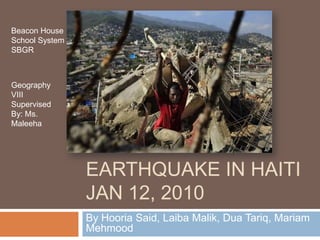
EARTHQUAKE IN HAITI
JAN 12, 2010
By Hooria Said, Laiba Malik, Dua Tariq, Mariam
Mehmood
Introduction









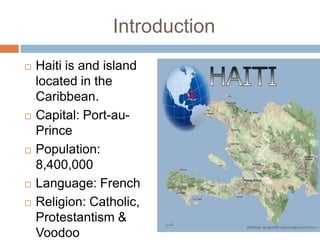
Haiti is and island
located in the
Caribbean.
Capital: Port-auPrince
Population:
8,400,000
Language: French
Religion: Catholic,
Protestantism &
Voodoo
Haiti , January 2010


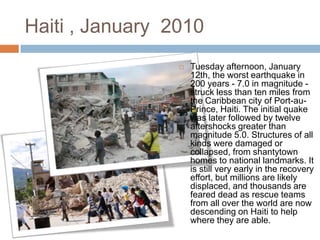
Tuesday afternoon, January
12th, the worst earthquake in
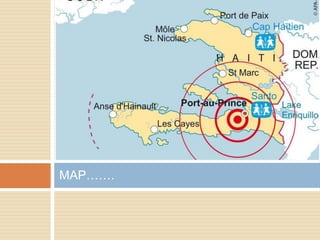
200 years - 7.0 in magnitude struck less than ten miles from
the Caribbean city of Port-auPrince, Haiti. The initial quake
was later followed by twelve
aftershocks greater than
magnitude 5.0. Structures of all
kinds were damaged or
collapsed, from shantytown
homes to national landmarks. It
is still very early in the recovery
effort, but millions are likely
displaced, and thousands are
feared dead as rescue teams
from all over the world are now
descending on Haiti to help
where they are able.
MAP…….
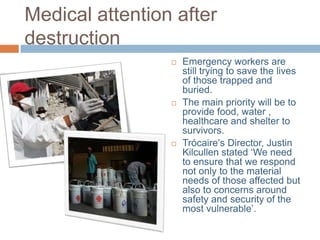
Medical attention after
destruction






Emergency workers are
still trying to save the lives
of those trapped and
buried.
The main priority will be to
provide food, water ,
healthcare and shelter to
survivors.
Trócaire’s Director, Justin
Kilcullen stated ‘We need
to ensure that we respond
not only to the material
needs of those affected but
also to concerns around
safety and security of the
most vulnerable’.
Haiti: Context
•

•

•

•

•

Haiti is the poorest country in
the America.
Annual income per person is
$560.
It is ranked 146th out of the
177 countries in the world on
United Nations Human
Development Index.
78% of people were already
living on less than $2 per day
before the disaster.
Haiti is also one of the most
disaster prone countries in
the world due to its high
latitude tropics, mountainous
terrain and severely degraded
environment.

•

Nearly every year brings extreme
climate shocks. In particular flash foods
as recent as September 2008; four
consecutive storms and hurricanes
which killed 800 people and another
800,000 also affected.
•
•

Take Action
Check out www.trocaire.org for
background information on Haiti
before the earthquake occurred.
Hold a classroom debate on the
following topic:
‘It is more important to reduce poverty
around the world than to raise money
for disaster relief’.

Earthquake

  • 1.
    Beacon House School System SBGR Geography VIII Supervised By:Ms. Maleeha EARTHQUAKE IN HAITI JAN 12, 2010 By Hooria Said, Laiba Malik, Dua Tariq, Mariam Mehmood
  • 2.
    Introduction      Haiti is andisland located in the Caribbean. Capital: Port-auPrince Population: 8,400,000 Language: French Religion: Catholic, Protestantism & Voodoo
  • 3.
    Haiti , January2010  Tuesday afternoon, January 12th, the worst earthquake in 200 years - 7.0 in magnitude struck less than ten miles from the Caribbean city of Port-auPrince, Haiti. The initial quake was later followed by twelve aftershocks greater than magnitude 5.0. Structures of all kinds were damaged or collapsed, from shantytown homes to national landmarks. It is still very early in the recovery effort, but millions are likely displaced, and thousands are feared dead as rescue teams from all over the world are now descending on Haiti to help where they are able.
  • 4.
  • 5.
    Medical attention after destruction    Emergencyworkers are still trying to save the lives of those trapped and buried. The main priority will be to provide food, water , healthcare and shelter to survivors. Trócaire’s Director, Justin Kilcullen stated ‘We need to ensure that we respond not only to the material needs of those affected but also to concerns around safety and security of the most vulnerable’.
  • 6.
    Haiti: Context • • • • • Haiti isthe poorest country in the America. Annual income per person is $560. It is ranked 146th out of the 177 countries in the world on United Nations Human Development Index. 78% of people were already living on less than $2 per day before the disaster. Haiti is also one of the most disaster prone countries in the world due to its high latitude tropics, mountainous terrain and severely degraded environment. • Nearly every year brings extreme climate shocks. In particular flash foods as recent as September 2008; four consecutive storms and hurricanes which killed 800 people and another 800,000 also affected. • • Take Action Check out www.trocaire.org for background information on Haiti before the earthquake occurred. Hold a classroom debate on the following topic: ‘It is more important to reduce poverty around the world than to raise money for disaster relief’.